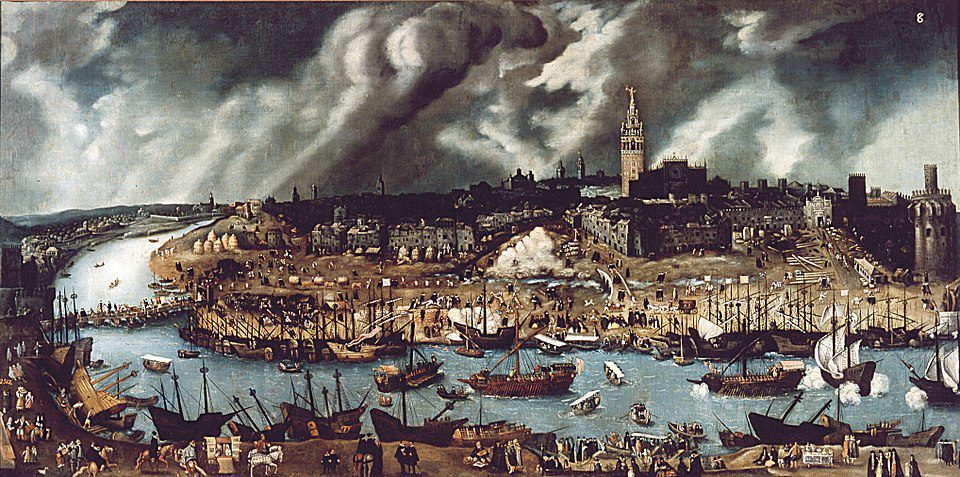
Somewhere between myth and archaeology, the shadowy civilization of Tartessos shaped the first artistic pulse of what would one day become Seville. Ancient writers such as Herodotus and Strabo spoke of Tartessos as a wealthy riverine kingdom near the Guadalquivir—rich in silver, gold, and tin, and legendary for its contact with Eastern Mediterranean traders. Whether this kingdom was a centralized state or a looser cultural sphere remains debated, but what is indisputable is that the Tartessian legacy left behind a distinctive visual vocabulary shaped by metallurgical abundance and ritual complexity.
In the 8th to 6th centuries BC, artifacts now attributed to Tartessos began surfacing throughout the lower Guadalquivir valley. Hoards such as the Carambolo Treasure—a shimmering collection of gold diadems, chest plates, and bracelets—evoke both regal authority and religious spectacle. The ornate repousse technique used in many of these items suggests Eastern Mediterranean influence, likely introduced via Phoenician trade routes. Yet the motifs remain regionally distinct: a preference for abstracted animal forms, symmetrical curves, and a balance between functional and ceremonial purpose.
The art of Tartessos was deeply bound to metallurgy and landscape. This was a culture that saw power and beauty in the manipulation of the earth’s deep materials: copper, silver, and especially gold. In the absence of monumental architecture, the artistic language was carried through the portability of luxury—burial offerings, warrior regalia, and votive items. Few urban ruins survive, but the tactile richness of their artifacts suggests a people for whom artistry was inseparable from the sacred and the elite.
Phoenician Foundations and Artistic Trade
By the 9th century BC, Phoenician settlers from Tyre and Sidon had begun to establish trading colonies along the southern coast of the Iberian Peninsula. Their arrival transformed the artistic and commercial life of pre-Roman Seville. Known to the Phoenicians as Spal, the settlement that would later become Hispalis functioned as both entrepôt and cultural junction, where Mediterranean tastes encountered local traditions.
Phoenician art brought with it a visual vocabulary of sinuous lines, figurative iconography, and an emphasis on maritime symbols. Amphorae and terracotta figurines found in the region show clear signs of Levantine style—goddesses with stylized faces, anchors etched with religious symbolism, and painted vessels bearing motifs of fish, ships, and the sacred tree. These motifs were not simply aesthetic; they conveyed a cosmology of trade, fertility, and divine navigation.
Three striking artistic exchanges emerged from this encounter:
- The fusion of Egyptian-influenced scarabs with Iberian burial goods, suggesting spiritual hybridization.
- The adaptation of Phoenician alphabetic scripts into local graffiti and markers, reflecting the visual role of text in early civic life.
- The emergence of hybrid deities—part Phoenician, part Iberian—embodied in votive figures placed near riverbanks and springs.
Spal was not yet Seville, but its artistic DNA was already forming. The encounter between Tartessian metallurgy and Phoenician craft seeded a regional visual culture both sophisticated and syncretic—open to foreign currents but grounded in the material specificity of the Guadalquivir basin.
Myths, Metals, and Maritime Aesthetics
What remains most compelling about Seville’s proto-history is not its ruins—few remain—but the poetic convergence of myth and artifact. This was a landscape animated by the river and the sea, where mythologies of water guided both religious belief and artistic production. The Guadalquivir, then called the Bætis, was not only a commercial artery but a sacred mirror in which gods and ancestors were imagined to dwell.
Ancient myths placed Hercules at the founding of Seville, a detail that persisted long into the Renaissance and even Baroque civic iconography. According to one tradition, Hercules founded the city after completing his tenth labor, the stealing of Geryon’s cattle—a tale that metaphorically links Seville to ideas of conquest, strength, and divine appointment. These narratives, embellished over centuries, helped frame early artistic forms with epic resonance.
Artisans of the pre-Roman period crafted imagery that emphasized the fluidity of forms—fish transforming into deities, waves stylized into abstract swirls, the human body coiled with marine motifs. This aesthetic, shaped by both vision and navigation, persisted in the design of jewelry, ceramics, and religious paraphernalia well into the Roman period.
It is perhaps telling that Seville’s earliest known art is not monumental but intimate. From finely wrought brooches to river-deposited offerings, the emphasis was on what could be touched, worn, or gifted. This intimacy of form foretold a city whose later grandeur would never fully sever itself from the tactile, from the handmade, from the art that circulates rather than towers.
Seville began not in marble but in metal, not in empire but in trade. Its artistic history starts with a shimmer—the glint of gold, the curve of a brooch, the echo of a Phoenician hull—and with that shimmer came a sensibility that would echo across centuries.
Roman Hispalis: Marble, Mosaics, and Imperial Spectacle
Public Art and Private Power in Italica
A short ride northwest from Seville, the ruins of Italica reveal the ambitions of an empire made visible in stone. Founded in 206 BC by Scipio Africanus after the Battle of Ilipa, Italica was not merely a garrison town but a projection of Roman identity onto Iberian soil. As one of the first Roman settlements outside Italy, its role was both practical and symbolic: to reward loyal Iberians, assert Roman permanence, and craft an architectural theatre for Romanitas in the West.
What remains today—fragments of villas, amphitheaters, and bath complexes—speaks to a civic order where aesthetics reinforced hierarchy. Mosaic floors formed the silent ground beneath elite conversations. Colonnaded courtyards balanced domestic comfort with performative status. Public spaces, such as the Traianeum—a temple built in honor of Emperor Trajan—fused piety with imperial propaganda.
Roman urban art in Italica served two masters: the gods and the gaze. Streets were aligned for maximum visibility, with statues placed at axial points, creating a rhythm of revelation and concealment. Domus mosaics reflected not only wealth but worldview. In the so-called House of the Birds, thirty-three different avian species are rendered with astonishing delicacy. These were not merely decorative motifs but symbols of knowledge, leisure, and dominion over nature.
Elite patrons competed to sponsor structures, vying for prestige through architecture. The process reinforced the Roman belief that public virtue was expressed through visible, durable contributions. And yet, in these expressions of grandeur, traces of local flavor persisted. Native Iberian motifs, like abstract spirals or vegetal tendrils, occasionally crept into Roman compositions—quiet reminders that Italica was not built on a blank slate.
Gods in Color: Roman Religious Iconography
Roman Seville, or Hispalis, was not a temple city, but it was rich with devotional art. Though fewer free-standing temples survive than in Italica, what we do have—altars, reliefs, statuary fragments—shows how religion and visual culture were intertwined. Gods were not distant abstractions but vividly embodied forces, brought to life in pigment, proportion, and presence.
Much of the religious art in Roman Hispalis was polychrome—an aspect modern viewers often forget. Statues of Jupiter, Minerva, or Isis were painted in lifelike hues, their garments dyed in deep reds and blues, their lips and eyes carefully tinted to animate expression. Temples were not white marble hushed in solemnity, but loud with color, shadow, and scent.
Three key forms of religious art thrived in Roman Seville:
- Votive Statuettes: Often bronze or terracotta, these miniatures of deities were deposited in sacred spaces or household shrines. They reveal a deeply personal dimension of faith.
- Funerary Stelae: Inscribed slabs, sometimes illustrated with tools, animals, or symbolic gestures, that blended portraiture with epitaph. They offer a glimpse into how ordinary people wished to be remembered.
- Wall Frescoes in Lararia: Domestic shrines inside homes often featured painted panels of household gods (Lares and Penates) with scenes of offering and feasting, reminding inhabitants of divine oversight.
While Roman religion was famously inclusive—absorbing deities from Egypt, Asia Minor, and Gaul—local variations developed. The cult of Isis, for example, became popular among women and freed slaves in Hispalis. Artistic representations of Isis, often adorned with lunar symbols and crowned with horns, introduced new stylistic elements that would echo faintly in later Marian iconography.
Architectural Imprints Beneath the Cathedral
Beneath Seville’s Gothic cathedral lies a buried palimpsest of its Roman past. Excavations under the Patio de los Naranjos and surrounding streets have unearthed foundations of warehouses, streets, and sewage systems dating back to Roman Hispalis. These fragments tell of a dense commercial city rather than a grand ceremonial one—a place of wool-dyers, fishmongers, wine traders, and potters.
The riverfront, in particular, was key to Roman Seville’s artistic and economic life. Artisans clustered along the Guadalquivir, producing amphorae, tiles, and bronze works for both local use and export. Workshops etched their makers’ marks into clay, and these signatures—rudimentary but individual—give texture to an otherwise anonymous class of creators.
There is compelling evidence that Roman Hispalis was defined by utility over magnificence. Unlike Italica, it did not boast an oversized amphitheater or imperial forum. But its infrastructure—its roads, aqueducts, sewers, and tiled courtyards—was a quietly artful expression of Roman engineering as civic beauty. The act of paving, plumbing, and patterning the urban surface was itself a form of artistry.
In some instances, Roman columns were cannibalized centuries later into Visigothic and even Islamic structures. One can still find them embedded in crypts or church walls, silent stelae of an earlier era repurposed by newer faiths. Seville did not erase its past—it built upon it, quite literally. The Roman grid beneath the cathedral’s cloisters reminds visitors that every new monument is a response, not a beginning.
Roman Seville may lack the bombast of Rome or the utopian planning of Pompeii, but its art and architecture reveal a quieter mastery: the beauty of integration. The city served as a hinge between Iberian tradition and Mediterranean innovation, crafting a visual culture not of imitation, but of adaptation. Its legacy is still visible—if one knows to look below the surface.
Visigothic and Early Christian Transitions
Symbolism in Stone and Relic Art
The fall of the Roman Empire did not end Seville’s artistic life—it transformed it. Between the 5th and 7th centuries AD, as the Western Empire fractured and the Visigoths established their rule in Hispania, Seville became both a political and theological center. With the old imperial structures eroding, the new aesthetic language of the Visigoths emerged: leaner, more symbolic, and deeply infused with Christian theology.
The Visigothic kingdom, based in Toledo but reaching strongly into southern Spain, left few grand architectural works in Seville itself. What survives is more fragmentary but no less telling. Friezes, capitals, and liturgical furnishings bear the stylistic imprint of the period: low-relief carving, abstracted vegetal patterns, and Christian symbols compressed into dense visual fields. The cross, the vine, the peacock, and the fish began to appear with increased frequency, not as decoration but as encoded theological messages.
Relic culture began to shape the city’s relationship with sacred art. As martyrdom narratives and miracle stories grew in prestige, objects associated with saints—bones, garments, or instruments of death—became spiritual talismans. These relics were often housed in ornate reliquaries: small-scale sculptures in gold, ivory, or wood, designed not for aesthetic delight but for reverence and proximity to the divine. Though few original pieces survive in Seville, contemporary accounts and analogues from Mérida and Toledo suggest a rich material devotion centered around such forms.
The art of this era was not about grandeur but about presence. Even in the smallest artifacts—an engraved ring, a portable altar—there was an intensity of meaning. The shift from public monumentalism to private devotionalism reshaped how art was conceived and encountered: no longer imperial or civic, but intimate, mystical, and salvific.
From Basilica to Mosque: Adaptations in Sacred Space
One of the most important architectural transitions in Seville’s history began during this period. As Christianity became entrenched in the post-Roman West, former Roman temples and civic buildings were often adapted into churches. Basilicas—once used for legal and commercial affairs—became places of Christian worship. Their form, with a long nave, side aisles, and an apse, suited the performative needs of liturgy.
Seville was home to several such churches, many now vanished or absorbed into later structures. Most notable was the original cathedral dedicated to Saint Vincent, thought to have stood near or on the current site of the city’s later Gothic cathedral. Though its fabric has not survived, the church’s importance is attested in early medieval sources and in the memory of Saint Isidore of Seville, who likely taught and worshipped within its walls.
These Christian buildings were transitional by nature—formed from the bones of the old world but facing toward the next. Capitals reused from Roman columns sat beneath new arches; pagan marble found a second life beneath the feet of bishops. This act of architectural palimpsest was not accidental. It was a theological statement: Christianity did not abolish the Roman world, but absorbed and reoriented it.
The most dramatic spatial transformation would come later, during the Islamic conquest, when the Visigothic churches were repurposed as mosques or dismantled for their materials. Yet even before that, the structures themselves carried within them a DNA of conversion—a silent story of how sacred space could change hands, meanings, and forms, while still commanding reverence.
Manuscripts, Metalwork, and the Fractured West
Amid the instability of post-Roman Europe, Seville became a beacon of intellectual and artistic production, largely thanks to one man: Isidore of Seville. Archbishop from 599 until his death in 636, Isidore was not only a theological writer but a compiler of knowledge. His Etymologiae was a sprawling encyclopedia of classical learning, Biblical exegesis, and contemporary science—one of the most copied books of the early medieval period.
Manuscript illumination in Visigothic Seville followed a visual language distinct from both classical and later medieval styles. It favored heavy outlines, stylized human figures, and vivid color blocks. Surviving codices from nearby monasteries, such as the Codex Vigilanus, suggest what Seville’s scriptoriums might have produced: densely symbolic compositions filled with diagrams, letter forms, and cosmological charts. Margins became arenas for artistic play, even as text remained the primary focus.
Three unusual artistic forms thrived during this period:
- Bejeweled liturgical objects, such as processional crosses and altar frontals, embedded with garnet, glass, and enamel, demonstrating a fusion of Iberian metalwork and Christian ritual.
- Ivory diptychs, used as portable writing tablets and ceremonial gifts, featuring saints, angels, or vegetal scrollwork in tight relief.
- Inscribed votive crowns, like those found at Guarrazar, offering a vision of regal and ecclesial splendor suspended in churches to honor Christ or the Virgin.
Seville’s artistic production, while modest in volume compared to later periods, offered remarkable coherence. It was a city negotiating its place in a disintegrating empire and a forming Christendom. Art became less about the eye and more about the soul—about encoding the mysteries of faith in portable, legible, and sacred forms.
As the city prepared to enter centuries of Islamic rule, its Christian artisans had already laid down a template for transformation: an art that lived in adaptation, in reuse, in the belief that the sacred was not fixed in form but found in meaning.
Al-Andalus and the Aesthetic of Harmony
Geometry and the Garden: Almohad Design Principles
When Seville fell under Muslim rule in AD 712, its artistic language entered a new phase—not an erasure, but a recalibration. For over five centuries, the city was part of Al-Andalus, the Muslim-ruled region of the Iberian Peninsula. Under the Almohad dynasty in the 12th century, Seville emerged as a political capital and architectural jewel, where abstraction, proportion, and spatial elegance became the cornerstones of visual culture.
Almohad aesthetics favored geometry over figuration. Religious doctrine discouraged the depiction of living beings in sacred spaces, redirecting creative energy into the manipulation of form, texture, and spatial rhythm. In place of statues or paintings, mosques and palaces were adorned with intricate patterns of interlaced arches, muqarnas (stalactite vaulting), and sebka latticework. Every surface invited close looking.
The Almohads treated space as a theological proposition: to walk through a building was to be enveloped in an abstract grammar of divine unity. The Great Mosque of Seville—of which only the minaret (the Giralda) and the Patio de los Naranjos survive—was one of the largest in the Islamic West. It embodied the Almohad idea of proportion as beauty. Its prayer hall contained rows of horseshoe arches repeating into the horizon, evoking a forest of rhythm. Light filtered softly through windows set high in the qibla wall, touching carved stucco with a whisper more than a shine.
Almohad gardens were not merely decorative but deeply conceptual. The quadripartite chahar bagh layout, dividing space into four symbolic rivers of paradise, brought irrigation, fragrance, and philosophical order into urban courtyards. Water—channeled into still pools and flowing rills—acted as both visual mirror and acoustic instrument. In these spaces, sound, light, and geometry operated together as a single aesthetic organism.
Calligraphy and Abstraction as High Art
In the absence of figural representation, Islamic Seville turned to the written word as its most exalted visual form. Calligraphy became not only a means of communication but a form of worship. Qur’anic inscriptions, poetic verses, and aphoristic fragments were inscribed into stucco, carved into wood, painted onto tiles, and woven into textiles. The aesthetic of letters replaced the image.
Scripts such as kufic and later maghrebi evolved into complex, ribbon-like patterns that often doubled as ornament. On the minaret of the Giralda, Kufic inscriptions once encircled the tower just below its decorative cornices—marking the structure not just as a civic landmark, but a spiritual exclamation. Inside palaces and mosques, the same words—“There is no victor but God,” “In the name of the Merciful”—were repeated in looping arabesques that offered both meaning and visual rhythm.
The preference for abstraction extended into surface decoration. Zellij tilework, carved stucco panels, and wooden ceilings created interplays of texture and illusion. Artists operated less as “creators” in the Western sense than as craftsmen dissolving their ego into pattern. This was art as submission, not to an audience, but to a divine order.
Three artistic techniques flourished in this period:
- Carved plasterwork, with vegetal motifs (arabesques), epigraphic bands, and lace-like textures layered across palace walls and mihrabs.
- Polychrome tiles, arranged in mathematically perfect mosaics of stars, polygons, and knots, their designs often derived from algebraic principles.
- Inlaid wood ceilings, known as alfarje, combining cedar, pine, and cypress into geometric vaults with interlocking beams and painted detail.
This abstraction was not sterile. It throbbed with rhythm, pulse, and symbolic precision. In Almohad Seville, beauty was not an act of portrayal, but of alignment—between earth and heaven, material and divine, structure and breath.
The Giralda: Power, Precision, and the Vertical Gaze
The most enduring legacy of Almohad Seville is the Giralda, begun in 1184 as the minaret of the city’s great mosque. At over 100 meters high, it was among the tallest towers in the Islamic world at the time of its construction. Its design was both practical and poetic. Inside, a gently sloped ramp spirals upward—a feature that allowed the muezzin to ascend on horseback to call the faithful to prayer. Outside, its walls are a textbook of Almohad design: narrow arched windows, brick latticework, and subtle calligraphic friezes.
The tower did not exist in isolation. It was part of an architectural complex that included the mosque, the sahn (courtyard), and the fountain used for ablutions. The verticality of the Giralda contrasted with the horizontal expanse of the prayer hall, suggesting a deliberate duality: earthbound repetition below, celestial aspiration above. Its function was spiritual, civic, and visual—dominating the city skyline, orienting prayer, and anchoring time through the call to prayer.
When the mosque was replaced by a cathedral after the Reconquista, the Giralda was retained and crowned with a Renaissance belfry, topped in the 16th century by the Giraldillo, a colossal bronze weather vane representing Faith. Yet the Islamic foundation remained intact. Unlike other conquered structures, the tower was not destroyed but incorporated. Its endurance became a symbol of continuity disguised as transformation.
The Giralda stands as an argument in stone: that great art often comes not from purity, but from layering. Though born in an era of exclusivist Almohad reform, it absorbed and adapted older Andalusi models. Its latticed façades echo earlier minarets in Marrakesh and Rabat. Its structural logic belongs to the practical genius of engineers who knew how to shape mass without brute force.
Seville under Islamic rule did not seek to dazzle with volume or iconography. It created a visual culture of restraint, balance, and ambient richness. In its mosques, palaces, gardens, and manuscripts, the city learned to speak in pattern, to praise through repetition, and to honor space as a moral and spiritual medium.
The Christian Reconquest and the Gothic Imprint
The Cathedral as Manifesto
When Ferdinand III of Castile entered Seville in 1248, the city had been under Islamic rule for over five centuries. The Christian Reconquest was not merely a political event—it was an aesthetic rupture. Almost immediately, efforts began to assert the new order not only through governance, but through visual dominance. At the epicenter of this transformation stood the former Great Mosque, whose bones would soon support the largest Gothic cathedral in the world. This was not restoration, but declaration.
The construction of the Catedral de Santa María de la Sede, begun in 1401 and continuing for over a century, was more than an ecclesiastical project—it was an ideological monument. Local legend holds that the canons declared: “Let us build a church so beautiful and so grand that those who see it finished will take us for mad.” The scale itself was the first act of artistic ambition: vaults soaring 42 meters high, a nave wider than Notre-Dame in Paris, and over 80 side chapels embedded within its perimeter.
Yet the Cathedral’s Gothic identity was not imported wholesale. It absorbed earlier elements with calculated ingenuity. The Patio de los Naranjos, once the courtyard of ablutions, was preserved as an entrance cloister. The Giralda was retained and Christianized. These gestures—half practical, half political—produced an architecture of tension and layering, where Gothic pointed arches coexisted with horseshoe relics of the mosque.
The Gothic language deployed here was full-throated: ribbed vaults, flying buttresses, rose windows with kaleidoscopic tracery. Sculptural programs above the portals depicted Judgment, Apostles, martyrs, and saints—all finely carved with intense narrative vigor. Inside, light filtered through stained glass commissioned from Northern Europe, casting chromatic veils across stone piers and wooden choir stalls. The entire interior was orchestrated not for contemplation but for awe.
Seville’s cathedral was not a copy of French models; it was a reinterpretation. Its ambition, ornamentation, and hybrid forms reflected the city’s unique status as a post-Islamic Christian capital. It was both a house of worship and a stage of supremacy.
Flemish Influences in Mudéjar Contexts
While Gothic architecture claimed the monumental center, a parallel visual language persisted in the domestic and civic arts of Seville: Mudéjar. This term refers to the Islamic-influenced aesthetic practiced by Muslim and Morisco artisans under Christian rule. In 14th and 15th century Seville, Mudéjar was not marginal—it was foundational.
Flemish painters and sculptors were welcomed to the city by royal and episcopal patrons, bringing with them the techniques of oil painting, naturalistic detail, and a devotion to texture. Their influence appears in altar panels depicting biblical scenes with northern landscapes, in retablos thick with gilded foliage, and in devotional paintings that emphasize the individual face of Christ or Mary with unprecedented intimacy.
But the settings into which this northern realism was placed were often Mudéjar in structure: palaces with artesonado ceilings, coffered with interlocking stars; rooms framed by horseshoe arches and tiled dados. The Alcázar of Seville is the most enduring testament to this synthesis. Rebuilt in part by Pedro I in the 14th century using Muslim artisans from Granada and Toledo, it fuses Christian iconography with Nasrid craftsmanship. Arabic inscriptions praising Christian kings share walls with heraldic shields, while ceramic tiles reflect Islamic geometry under Christian commission.
This hybrid style flourished not out of tolerance, but necessity. Christian Seville depended on the artisanal infrastructure inherited from Al-Andalus. The best builders, woodworkers, plasterers, and tilers were Muslim or of Muslim descent. They brought not only skill but a centuries-old visual tradition, one that was subtly reoriented toward Christian ends without losing its formal logic.
Three visual contradictions define this moment:
- The Virgin Mary painted by a Flemish hand, seated in a palace framed by Mudéjar arches.
- Saints rendered in oil above altars tiled with geometric zellij patterns.
- Heraldic crests flanked by Kufic inscriptions that once praised Allah but were now seen as exotic decoration.
Rather than erasing the Islamic past, Christian Seville layered over it, repurposed it, and in many cases celebrated its beauty—though often without acknowledging its origins. This was an art of negotiation, born in a city still processing conquest.
Altarpieces, Retablos, and Sculptural Flourish
The Seville Cathedral’s most overwhelming artistic feature is not its vaults or its stained glass, but its retablo mayor—the massive main altarpiece, designed by Flemish craftsman Pieter Dancart and completed over decades by local sculptors. Carved in the late Gothic style and finished in brilliant gold, it towers nearly 30 meters high and contains over 40 relief scenes from the life of Christ and the saints. It is one of the largest wooden altarpieces in the Christian world.
The retablo was not simply decoration. It was pedagogy. In a city where most people were illiterate, it served as a visual catechism: every fold of drapery, every facial expression, every narrative moment was carefully calibrated to teach, to move, and to impress. Sculptors employed polychromy and gilding with theatrical precision, rendering wounds that glistened, eyes that wept, and halos that blazed.
Beyond the cathedral, this sculptural exuberance took root in parish churches across the city. Artisans like Jorge Fernández and Juan Martínez Montañés would carry this tradition into the Baroque, but its seeds were sown in the Gothic period, when woodcarving and polychromy became central to devotional experience. Life-sized crucifixes, sorrowful Virgins, and saintly martyrs appeared not on distant walls but within reach of the faithful—sometimes dressed in fabric and adorned with real hair and jewels.
These were not passive icons; they were liturgical actors. Carried in processions, wept over during Holy Week, illuminated by candlelight in chapels and sacristies, they turned churches into stages of emotional encounter.
The Gothic and Mudéjar periods in Seville did not merely coexist—they interwove. The result was a visual culture both sumptuous and subtle, triumphant and indebted. In asserting its Christian future, the city preserved and transformed the visual legacy of its Islamic past. Out of conquest came creation. Out of layering, a new vocabulary of faith and form.
Renaissance Flourishing in a Global Port
Seville as the Eye of the Empire
By the early 16th century, Seville was no longer simply a provincial capital—it was the principal maritime gateway to the Americas, and arguably the most vital city in Spain’s expanding empire. The 1503 establishment of the Casa de la Contratación (House of Trade) in Seville centralized all transatlantic commerce through the city, filling its streets with gold, spices, codices, maps, and stories. That mercantile status transformed its artistic culture: patronage expanded, new styles arrived, and Seville began to conceive of itself as a global city.
The Renaissance reached Seville not as a slow diffusion from Italy, but as a sudden infusion—through trade, books, and the mobility of artists. Wealth from the New World funded commissions for churches, civic buildings, and private homes. A new artistic vocabulary took shape, fusing classical forms with local material traditions. This was not the solemn humanism of Florence or the serene clarity of Raphael, but something warmer, denser, and laced with the textures of empire.
Architecture led the way. The Ayuntamiento (City Hall), begun in the early 1500s, blended Plateresque ornamentation—so-called because of its silversmith-like delicacy—with classical balance. Its façades are bristling with grotesques, floral curls, and candelabra motifs drawn from Roman models. Inside, wood ceilings (still Mudéjar in spirit) hovered over Renaissance layouts, while altarpieces embraced new proportions and iconography.
Sculpture and painting soon followed. Seville’s churches became experimental chambers for the visual culture of grace. Saints appeared with idealized anatomy. The Virgin’s garments moved with weight and rhythm. Figures began to stand not against gold-leaf backgrounds but in real space, often with colonnades, gardens, or landscape views framing their holy presence.
Three early effects of Seville’s new Renaissance identity:
- The sudden increase in imported pigments and materials—from lapis lazuli for blue drapery to Brazilian woods for choir stalls.
- The emergence of Italian-trained or Italian-influenced artists establishing workshops in Seville, such as Pietro Torrigiano and Luis de Vargas.
- The transformation of funerary art from medieval sarcophagi to lifelike effigies in repose, often carved in alabaster with Latin inscriptions.
This Renaissance was as much civic as religious. With imperial revenue flowing through its port, Seville saw itself reflected not only in its altars but in its plazas, libraries, and palaces. The city was no longer a borderland—it was a mirror of empire.
Humanism in Paint: Luis de Vargas and Early Masters
The earliest painters to reflect the full aesthetic weight of the Renaissance in Seville came of age in the first half of the 16th century. Luis de Vargas, perhaps the most significant among them, studied in Italy—most likely Florence or Rome—before returning to Seville around 1550. His paintings bear the mark of that training: anatomical fluency, perspectival depth, and a soft but structured light that reveals the body as both sacred and ideal.
His Purísima Concepción, still housed in the Seville Cathedral, is notable for its compositional clarity. The Virgin stands alone, enveloped in an almond-shaped mandorla of angels, her body rendered with Renaissance grace and her face softened by sfumato. Yet the work avoids slavish imitation of Italian prototypes. Its color palette, dominated by warm ochres and silvery blues, remains distinctively Andalusian.
Vargas’s contemporaries, such as Pedro de Campaña and Francisco Pacheco, developed a Renaissance idiom tailored to local devotion. Campaña’s Descent from the Cross—also in the Cathedral—is monumental, drawing influence from northern European artists like Rogier van der Weyden. It is crowded, theatrical, and emotionally intense, filled with writhing bodies and gold-fringed robes. Meanwhile, Pacheco, though less skilled as a painter, was instrumental in codifying artistic practice through his treatise Arte de la pintura, which would influence his student Diego Velázquez.
Renaissance humanism, when filtered through the lens of Sevillian religiosity, produced images that felt both universal and immediate. Artists gave the sacred body a weight in the world. Saints and martyrs bled in real time, their agony humanized, their beatitude bathed in late-afternoon Andalusian light.
This was not a dry academicism. It was affective, devotional, and firmly rooted in the city’s spiritual rhythm. Art was not only a vehicle of learning but a tool of persuasion—imbuing Catholic theology with visual empathy.
Palatial Patronage and the Domestic Renaissance
Beyond churches and altarpieces, the Renaissance in Seville transformed how its elite lived. The palaces of noble and mercantile families—such as the Casa de Pilatos and the Palacio de las Dueñas—became centers of architectural hybridization. These were not purely Italianate villas nor Islamic qasrs, but something uniquely Sevillian: spaces where Mudéjar tilework framed Renaissance courtyards, where classical busts sat atop carved wooden lintels, where Arabic inscriptions shared space with Latin epigrams.
The Casa de Pilatos, begun in the late 15th century by the Enríquez de Ribera family, is often considered the prototype of this synthesis. Named for its imagined resemblance to Pontius Pilate’s house, it fused Andalusi spatial planning with Italianate ornament. Marble statues of Roman emperors lined tiled patios. The coffered ceilings above the main stairwell were carved in pine and cedar, painted in crimson, lapis, and gold.
In these palaces, art functioned as both pleasure and pedagogy:
- Galleries featured mythological frescoes inspired by Ovid, read as allegories for civic virtue.
- Gardens were geometrically ordered yet sensuous, filled with oranges, jasmine, and fountains whispering classical allusions.
- Libraries expanded to include not only devotional manuscripts but classical texts, maps, and anatomical treatises.
This fusion of luxury, intellect, and piety marked Seville’s Renaissance not as a phase but as a worldview. The domestic realm was treated with the same aesthetic seriousness as the ecclesiastical. The body, the house, and the city were each considered worthy of ideal proportion and ornamentation.
By the close of the 16th century, Seville’s Renaissance had matured into something fully its own. It had digested the lessons of Italy and Flanders, adapted them to the rhythms of a city ruled by devotion and commerce, and produced a visual culture as complex and luminous as the empire it served.
The Golden Century of Painting: Zurbarán, Murillo, and Velázquez
Realism, Mysticism, and the Cloistered World
In the 17th century, Seville became a crucible for the most emotionally charged religious painting in Europe. The city’s Golden Age was not driven by royal courts or intellectual academies, but by a unique confluence of factors: a devout populace, a wealthy ecclesiastical infrastructure, and a local artistic tradition already adept at fusing realism with reverence. At the heart of this world stood its convents and monasteries—cloistered spaces where faith and image were fused in silence and routine.
Francisco de Zurbarán, the first of Seville’s Golden Age triumvirate, emerged from this context. Born in 1598 in Extremadura, he established his workshop in Seville by the 1620s and quickly earned a reputation as the “painter of monks.” His commissions were largely for religious orders—the Mercedarians, the Dominicans, and the Carthusians—who sought images that would reflect their vows of poverty, obedience, and contemplation.
Zurbarán’s style was marked by restraint and authority. His figures often appear in isolation, frontally posed, illuminated by a single divine light source against a deep, velvety darkness. A St. Francis in Meditation sits cross-legged in a brown habit, hands clasped, skull in lap, rendered with such tactile accuracy that one can almost feel the fabric’s rough weave. Yet these are not simply studies in texture; they are metaphysical portraits—moments where stillness becomes spiritual inquiry.
His series of Virgin Martyrs presents young female saints as elegant, introspective figures, dressed in 17th-century Spanish fashion, each holding the emblem of her martyrdom. These images are startlingly modern in their psychological clarity. The saints are neither in agony nor ecstasy—they simply are, bearing the solemn grace of those who know their death is meaningful.
Zurbarán’s art was not theatrical. It did not seek to overwhelm the viewer but to draw them inward. This inwardness made his paintings particularly resonant within the walls of cloisters, where daily life unfolded in ritual, silence, and repetition. His palette—bone whites, ash greys, earth browns—echoed the stone corridors and candlelit cells of his audience.
Genre, Light, and the Rise of Emotional Intimacy
If Zurbarán painted for the cloister, Bartolomé Esteban Murillo painted for the street. His art captured the devotional temperature of Seville’s broader population—its orphans, vendors, nuns, and beggars—without sacrificing theological complexity. Born in 1617 and trained in the city’s painterly traditions, Murillo developed a style that would dominate religious and genre painting in Seville for over three decades.
Murillo’s early work reflected the influence of Caravaggio and Ribera—strong contrasts, physical naturalism, dramatic light. But by the 1650s, his palette began to soften. He introduced a luminosity that gave his figures a pearlescent gentleness. His Immaculate Conceptions, of which he painted more than two dozen versions, became icons of Counter-Reformation piety: the Virgin, hovering in a crescent moon, surrounded by cherubs, glowing with innocence and maternal calm.
Yet Murillo was not confined to celestial themes. He pioneered a form of genre painting in Seville that captured the city’s poor with warmth and dignity. His Young Beggar shows a barefoot boy examining his lice; another painting depicts street children playing dice with the glint of mischief in their eyes. These works were not moralizing—they were affectionate, nuanced, and psychologically alert.
Murillo’s ability to blend sacred and secular, divine and domestic, made him immensely popular. His paintings were commissioned for altars, hospitals, orphanages, and brotherhoods. He painted with grace, but also with an intuitive understanding of human emotion. A Holy Family by Murillo does not simply depict doctrine; it radiates familial tenderness. A Christ Child is not a symbol but a child—restless, tender, alert.
Murillo’s success also shaped Seville’s artistic infrastructure. His workshop trained numerous pupils, and his reputation extended across Spain and into the New World. He bridged the cloister and the city, showing that religious painting need not be severe to be profound.
Velázquez Before Madrid: Formative Tensions
Diego Velázquez, the most internationally renowned of Seville’s painters, left the city early in his career, but its artistic DNA never left him. Born in 1599 and trained by Francisco Pacheco—Murillo’s future father-in-law—Velázquez absorbed both the strictures of Counter-Reformation decorum and the city’s deepening interest in realism and genre.
His early works, produced in Seville before his departure to Madrid in 1623, demonstrate his preoccupation with the ordinary. In paintings like Old Woman Cooking Eggs or The Water Seller of Seville, Velázquez elevates everyday figures to subjects of intense formal scrutiny. The folds of a headscarf, the reflection in a glass jug, the play of light on a wooden table—these details are rendered with precision and humility. This was painting not of symbols, but of presences.
Velázquez’s religious works from this period—such as his Immaculate Conception or Adoration of the Magi—reveal a painter still navigating the demands of Catholic iconography. He fulfilled the Church’s expectations, but with an observational realism that stripped away sentimentalism. Mary is a teenage girl, the Magi are weathered and tired, and Christ’s divinity is all the more arresting for its quietness.
What makes Velázquez’s Sevillian period so remarkable is its economy. There is nothing extraneous. Every gesture matters. His chiaroscuro is subtler than Caravaggio’s, his figures less dramatic, but his commitment to the dignity of the visible world is absolute. He does not moralize or embellish—he observes, and in observing, reveals.
This attention to reality was deeply rooted in Seville’s painterly culture, shaped by decades of devotional art that respected material presence as a theological condition. Velázquez’s later court paintings, with their illusionistic mastery and psychological insight, grew from this foundation: a belief that painting, at its best, shows us not how the world ought to be, but how it is—and by doing so, dignifies it.
Together, Zurbarán, Murillo, and Velázquez defined the artistic personality of Golden Age Seville. They shared little in technique, but much in temperament: a respect for the visible, a reverence for the human, and a sense that painting was not just craft, but conscience. Their legacy still haunts the walls of Seville’s churches, museums, and processions—not as echoes of a lost era, but as enduring arguments for the power of art to render the sacred in the everyday.
Baroque Theatrics and the Civic Imagination
Plaza, Procession, and Public Art
In the 17th century, Seville embraced spectacle. While its painters pursued psychological depth and quiet transcendence, its public spaces and sculptors moved toward the theatrical. The city, increasingly shaped by its religious brotherhoods (cofradías), Holy Week rituals, and civic ceremonies, became a living stage. The Baroque era in Seville was not confined to canvases or church interiors—it animated plazas, processions, and architecture with a choreography of devotion and power.
Seville’s Holy Week (Semana Santa) emerged as a uniquely Baroque institution. Centered around elaborate processional floats (pasos) carrying life-sized sculptures of Christ, the Virgin, and various saints, these events became the preeminent stage for sculptural drama. The floats moved slowly through the city’s narrow streets, illuminated by candlelight and accompanied by choirs, incense, and sobbing spectators. They blurred the line between art and ritual, between civic performance and spiritual catharsis.
This demand for visceral religious imagery led to the creation of some of Spain’s most affecting sculptures. These works were not made to be viewed passively—they were designed to be encountered, moved, and wept before. Art became participatory. A sorrowing Virgin was not merely a statue; she was a surrogate mother, a symbol of collective grief, and a mirror for human anguish.
Seville’s plazas also changed. Public fountains, civic facades, and staircases acquired ornate forms. The Plaza del Salvador, anchored by the Church of El Salvador, became a site of both piety and pageantry. Sculptures were increasingly integrated into architecture, not as decoration, but as actors—niches housing saints who seemed to step forward from the wall, gestures frozen in mid-sermon or benediction.
Three distinctive developments marked the civic Baroque of Seville:
- The proliferation of retablos callejeros—outdoor altarpieces installed in niches on building exteriors, often illuminated at night to sanctify entire neighborhoods.
- The adaptation of ephemeral architecture for feast days—arches, stages, and columns erected temporarily for celebrations, constructed from wood and stucco, painted with allegories of virtue and monarchy.
- The integration of sound and movement—bells, drums, liturgical chants—into civic experience, making Seville’s Baroque not only visual but multisensory.
The city’s aesthetic was theatrical because life itself had become a stage for performance: of faith, loyalty, and mortality. Art no longer waited in chapels—it processed through the streets, demanding attention and offering consolation.
Pedro Roldán and the Sculptural Workshop
If any single artist embodied the civic and religious ambitions of Baroque Seville, it was Pedro Roldán (1624–1699). Sculptor, workshop master, and patriarch of a family of artists, Roldán transformed the medium of wood into something both elastic and monumental. His figures could tremble with agony or sigh in ecstasy. They were constructed not only for altars, but for movement—for procession, for proximity, for tears.
Trained in Granada but active primarily in Seville, Roldán fused Castilian realism with Andalusian sensuality. His studio operated like a small factory, producing large quantities of devotional sculpture for churches across the region. It was also a school. His daughter, Luisa Roldán—known as La Roldana—would become Spain’s first officially appointed female court sculptor, eventually working in Madrid but trained in her father’s demanding workshop.
Roldán’s figures are marked by expressive hands, deeply carved drapery, and faces calibrated for emotional impact. His Christ Tied to the Column, for example, shows the body taut with tension, the flesh bruised and bloodied, the expression resigned but luminous. It is not realism for its own sake; it is realism as empathy.
His process was collaborative. Different assistants specialized in carving, polychromy, hair application, and gilding. The final works, though often associated with Roldán’s name, were collective acts of devotion and craft—fusing theology with labor. They were not passive idols but kinetic forms: dressed in fabric, adorned with silver crowns or crystal tears, and animated by candlelight during processions.
Roldán also understood theatricality beyond sculpture. His works often echoed the structure of Baroque drama, with heightened gestures, narrative sequencing, and emotional climax. A Descent from the Cross becomes a tableau vivant; a Pietà becomes a maternal embrace frozen at its most unbearable moment.
In the hands of the Roldáns, sculpture achieved a new vocabulary. It was not merely illustrative—it was affective. Seville’s sculptors did not simply depict Christ’s suffering; they invited the viewer to suffer with him, to feel the lash, the silence, the final breath.
Relics and Ruptures in Counter-Reformation Aesthetics
The Baroque in Seville cannot be disentangled from the Catholic Church’s post-Tridentine agenda. Following the Council of Trent (1545–1563), art was explicitly tasked with reaffirming doctrine, resisting Protestant iconoclasm, and drawing the faithful back to the emotional and sacramental life of the Church. In Seville, this translated into a visual culture of clarity, intensity, and above all, presence.
Relics—already venerated in the medieval period—gained renewed prominence. Churches competed for bones, garments, and fragments of the True Cross. These sacred remnants were often housed in elaborately crafted reliquaries, themselves works of art. Goldsmiths like Juan Laureano de Pina created miniature temples of silver and crystal, framing a fingernail or thorn as if it were a jewel.
Seville’s Cathedral expanded its treasury to house these new vessels, creating chapels not only for the display of relics but for their ritual use. During feast days, relics were processed through the streets, elevated on platforms, incensed, and sung over. They became part of the city’s dramatic calendar, turning objects into events.
Baroque aesthetics in Seville also mirrored social rupture. The 1649 plague, which killed nearly half the city’s population, intensified the themes of suffering, martyrdom, and penitence in art. Skeletons appeared in murals, timepieces bore inscriptions like Memento Mori, and altarpieces grew darker in tone and subject. Death was not hidden; it was acknowledged, framed, and, in a strange way, glorified.
Three paradoxes define this era of sacred art:
- Art made to affirm doctrine, yet filled with doubt, agony, and longing.
- Sculptures designed to portray transcendence, yet rooted in raw corporeality.
- Public rituals meant to comfort, yet built around suffering and sacrifice.
Baroque Seville transformed theology into theater. Its art did not seek to explain suffering, but to give it shape. In doing so, it offered the faithful not certainty, but companionship—a sense that even in agony, one was never alone.
Decline and Provincialism in the Bourbon Era
Academies, Imitation, and Imperial Hangover
By the early 18th century, the creative momentum that had defined Seville’s Golden Age was faltering. The causes were not merely aesthetic but structural. Spain’s imperial focus had shifted decisively to Madrid. The port of Cádiz replaced Seville as the principal Atlantic hub. Trade declined, wealth dried up, and with it the patronage networks that had sustained the city’s vibrant artistic life. What remained was a proud legacy, a fading glow, and an increasing reliance on repetition.
The ascension of the Bourbon dynasty in 1700 brought a centralized, French-influenced cultural policy to Spain. In Seville, the founding of the Real Academia de Bellas Artes de Santa Isabel de Hungría in 1660 (just before the dynasty’s rise) marked a turning point that would define the city’s art for the next century. Though intended to elevate standards and transmit classical principles, the academy often became a mechanism for codifying taste and limiting innovation.
In its early years, the academy trained artists in drawing, anatomy, and classical proportions. Students copied antique casts, studied geometrical perspective, and worked from live models. But for all its aspirations, the institution lacked the economic scaffolding to foster true experimentation. Commissions remained tied to the Church, increasingly conservative and risk-averse. Artists were encouraged to emulate the past—Zurbarán, Murillo, even Velázquez—but rarely to move beyond them.
This produced an art of homage rather than invention. Painters like Domingo Martínez and Pedro Tortolero rendered religious scenes in competent but formulaic styles. Their work filled altars, sacristies, and municipal buildings, often indistinguishable from their predecessors, save for a tendency toward sweetness, polish, and sentimental overstatement.
Three features marked this provincial Bourbon aesthetic:
- The near-total dominance of late Murillesque style—soft faces, pastel palettes, and floating cherubs indistinguishable from each other.
- A shift in devotional focus from drama and martyrdom to more decorative, emotionally diluted themes like the Immaculate Conception or Infant Christ with Angels.
- A decline in sculptural innovation, with processional figures often produced by lesser workshops imitating Roldán-era designs.
The city’s once-urgent relationship with visual expression dulled into decorum. Without a thriving port, Seville’s exposure to new currents in European art—Rococo, Neoclassicism, Romanticism—was filtered through academic protocol and ecclesiastical caution.
The Vanishing Artist-Guilds
One of the less visible yet crucial transformations of this era was the dissolution of Seville’s traditional artisan structures. Throughout the Golden Age, art had been produced not only in academies or ateliers, but in guilds—complex systems of transmission, patronage, and mutual support rooted in medieval corporatism. These guilds regulated training, ensured quality, and often wielded real political clout within the city’s civic and religious life.
By the mid-18th century, these institutions were collapsing. The guild of painters (gremio de pintores), once an influential entity with its own chapel and statutes, had lost most of its authority to the academy. Apprenticeships declined. The workshop model gave way to individual practice, often within the narrow career prospects of church patronage or private instruction.
The demise of the sculptors’ guild followed a similar trajectory. The once-thriving world of collaborative, processional sculpture was reduced to a handful of workshops eking out replicas of earlier masterpieces. New figures lacked the psychological intensity of earlier works. Polychromy turned garish. Drapery became stylized rather than expressive. The old power of form to move the soul was diminished by routine.
In parallel, the guilds of embroiderers, silversmiths, and woodworkers suffered under Bourbon reforms that centralized economic oversight in Madrid. Taxes, regulation, and shifting trade patterns weakened local autonomy. The intimate connection between artisan and altar, between city street and sacred object, began to erode.
Seville’s art had long been nourished by its corporate structure of labor, faith, and pride. Its unmaking left behind not just a loss of skill, but a loss of identity. Artists became professionals, employees, or dependents—not guildsmen, not civic contributors, not voices in a larger chorus of making.
Ruins as Romantic Motif
By the end of the 18th century and into the early 19th, Seville began to appear more often in travelogues than in commissions. Foreign visitors, especially from Britain and France, arrived in search of the “exotic South”—a city of crumbling palaces, Moorish shadows, and faded glories. These travelers did not come to see new art, but to witness ruins.
Ruins became the dominant aesthetic. Artists like David Roberts and John Frederick Lewis depicted the Giralda, the Alcázar, and abandoned convents as picturesque relics of a bygone age. Their watercolors and engravings emphasized overgrown courtyards, cracked arches, and the interplay of sun and decay. Seville’s art was no longer a living culture—it was a museum without walls.
Local artists began to adopt this posture, too. Romanticism entered Seville not through avant-garde revolt but through nostalgia. Painters such as Manuel Barrón y Carrillo created moody landscapes dotted with monastic remains and medieval towers. Interiors glowed with candlelight, emphasizing chiaroscuro not as drama but as memory.
This romanticization masked a deeper reality: many of the city’s artistic treasures were vanishing. The Ecclesiastical Confiscations of Mendizábal (1835–1837), part of a liberal effort to diminish Church wealth, led to the seizure and sale of monastic properties. Altarpieces were dismantled. Libraries were looted. Thousands of paintings and sculptures disappeared into private collections or were destroyed outright.
Three moments capture the pathos of Seville’s Romantic decline:
- The closure of the Convent of San Clemente, whose cloisters had once housed an entire cycle of Zurbarán paintings.
- The dismantling of smaller chapels where once-renowned sculptural groups had stood, now sold off in parts or left to decay.
- The increasing use of artistic imagery as civic branding rather than spiritual expression, with postcards replacing pilgrimage.
In the Bourbon period, Seville ceased to be an innovator and became an image of itself. Its art, once a dialogue with the sacred and the social, became self-referential. Even beauty began to feel like memory. The city that had sculpted saints, painted miracles, and paraded its grief through the streets now seemed to echo rather than speak.
The Nineteenth Century: Costumbrismo and Nostalgia
Carmen, Cigars, and Spanish Exoticism
By the 19th century, Seville had become less a cultural engine and more a stage onto which the world projected its fantasies. European Romanticism had cast Spain—especially Andalusia—as the “other” within Europe: passionate, sun-drenched, pre-modern. Seville, with its blend of Islamic architecture, Catholic ritual, and lingering decay, played its part to perfection. Artists, composers, and tourists flocked to the city, not for innovation, but for what they believed to be authenticity.
Few works embody this myth-making as forcefully as Georges Bizet’s 1875 opera Carmen. Based loosely on Prosper Mérimée’s novella, the opera unfolds in a stylized Seville of soldiers, smugglers, gypsies, and factory girls. The real tobacco factory—the Real Fábrica de Tabacos, an immense Baroque building completed in the 18th century—was transformed in the popular imagination into a site of exotic passion and fatalism. The story bore little resemblance to the city’s social reality, but the image stuck.
Painters too indulged in this constructed vision. Costumbrismo, the genre of everyday life scenes rendered with anecdotal charm and regional specificity, dominated Sevillian art through most of the century. Local artists such as José Domínguez Bécquer (uncle of poet Gustavo Adolfo Bécquer) and Manuel Cabral Aguado Bejarano depicted tavern interiors, flamenco dancers, street vendors, and bullfighters in careful detail. Their works were richly colored, technically competent, and emotionally conservative—intended more to affirm cliché than interrogate experience.
Three motifs dominated Sevillian costumbrismo:
- The flirtatious maja, a young woman in traditional dress, often positioned near balconies or fountains with coquettish glances.
- The torero, idealized as virile and stoic, usually shown mid-preparation rather than mid-action.
- The religious festival, particularly Semana Santa or the Feria de Abril, with its color, crowd, and ornate costumes rendered almost as ethnographic display.
What had once been religious spectacle became cultural performance. The depth of Baroque emotionalism was replaced by decorative surface. Religious imagery lingered, but in a diluted form—icons became sentimental, processions picturesque.
The international appetite for “Spanishness” further flattened Seville’s complexity. Travel writers, illustrators, and photographers packaged the city as timeless, ignoring its modernization struggles, its economic stagnation, and its internal divisions. Seville’s image, forged by outsiders and reinforced by local painters eager for patronage, became a marketable fiction.
José Villegas Cordero and Academic Realism
One figure who attempted to mediate between costumbrismo and academic ambition was José Villegas Cordero (1844–1921). Trained in Seville and later in Rome, Villegas gained acclaim for his polished historical scenes, Orientalist fantasies, and decorative compositions, many of which combined Sevillian motifs with grander European tastes.
Villegas’s paintings were technically masterful. His Death of the Master (1884), depicting a medieval Castilian noble in his final moments, drew critical praise for its emotional control and compositional balance. Yet his real success came from a genre that blended costumbrista subjects with academic finish—bullfighters, card players, musicians—rendered with a sheen that appealed to foreign collectors and official institutions alike.
In 1898, Villegas was appointed director of the Prado Museum in Madrid, where he oversaw the conservation and cataloguing of Spain’s greatest masterpieces. But even from this central perch, his ties to Seville remained strong. His later works often returned to Andalusian subjects, albeit in a soft-focus, retrospective style that seemed to mourn rather than celebrate.
Villegas marked a transition: he was a Sevillian artist with international polish, capable of adapting local color for cosmopolitan tastes. But in doing so, he also distanced his art from the intensity that had characterized Seville’s earlier epochs. The result was elegance without urgency—art as decor rather than revelation.
Even within Seville, the academic model—based on clarity, finish, and historical theme—struggled to maintain its position. As modernism began to stir in Paris and Vienna, Seville’s artistic scene remained insulated. The academy still reigned, and innovation was often treated as disobedience.
Villegas’s legacy, while respected, encapsulated a paradox: excellence without rupture. His art affirmed what Seville had become—a city of memory and display, technically gifted but inward-facing.
Architecture in an Age of Imitation
Nineteenth-century Seville did not produce an architectural revolution. Instead, it constructed a cityscape of deliberate quotation—styles borrowed, recombined, and often idealized. Neoclassical, Neo-Gothic, and Neo-Mudéjar all appeared, not as forward-looking solutions, but as gestures of identity. Architecture became a form of heritage management—building not for the future, but to stabilize the past.
One of the most emblematic examples is the expansion of the Archivo de Indias, the vast Renaissance building originally designed by Juan de Herrera in the 1580s to house the Consulado de Mercaderes. In the 19th century, it was repurposed as the central archive of Spain’s colonial administration. Its use as a site of bureaucratic memory reflected Seville’s new role—not as an actor in empire, but as its chronicler.
Elsewhere, churches were restored or remodeled in a style that blurred original intent with 19th-century taste. Gothic vaults were reconstructed with iron reinforcements, Baroque façades cleaned or reimagined, Mudéjar features reinterpreted through a romantic lens. The Neo-Mudéjar style, which would explode in popularity at the turn of the century, began to appear in civic buildings and train stations—characterized by horseshoe arches, polychrome brickwork, and ornate tilework consciously referencing Andalusi models.
Three notable patterns in architectural imitation:
- The reinterpretation of Islamic motifs as regional identity markers, severed from their religious origins.
- The replication of Renaissance forms, not as humanist aspirations, but as symbols of imperial nostalgia.
- The rise of public monuments celebrating historical figures—often generals, saints, or explorers—as civic art for a modernizing but anxious city.
In this environment, art and architecture became tools of civic reassurance. As Spain lost its last American colonies in 1898, Seville clung more tightly to its historic grandeur. The result was an urban aesthetic of melancholy repetition—a city building itself in its own image, even as the world around it changed irrevocably.
Twentieth-Century Turbulence and Modern Experimentation
Surrealism, Struggle, and Civil War Shadows
Seville entered the twentieth century with a cultural inheritance both immense and immobilizing. The city had mastered the art of remembering; it had yet to learn how to invent again. But invention did come—fitfully, and often through fracture. Political upheaval, social unrest, and aesthetic experimentation collided in the early decades of the century, pulling Sevillian art into a turbulent modernity.
The avant-garde did not find immediate fertile ground in Seville. Madrid and Barcelona led in Cubism, Futurism, and abstraction, while Seville’s cultural elite remained anchored in historicism and academic taste. Yet beneath the surface, artists began to push. José García Ramos and Gonzalo Bilbao, both trained in academic realism, showed flickers of stylistic freedom. Their paintings of market scenes, washerwomen, and gardens—still grounded in costumbrismo—began to favor atmospheric color over linear detail, intimacy over narrative.
It was not until the 1920s and ’30s that modernism made a deliberate mark. Sevilla-born artist Alfonso Grosso Sánchez blended Symbolist suggestion with figurative elegance. Others, like Santiago Martínez Martín, dabbled in Fauvism and Expressionism, though always tempered by regional sensibilities. Modernity, when it arrived in Seville, wore a local costume.
The Spanish Civil War (1936–1939) proved catastrophic not only for the nation’s political order, but for its artistic ecosystem. In Seville—held early by Nationalist forces—Republican-sympathizing artists were persecuted or silenced. Studios closed, exhibitions stopped, and experimental voices vanished. Public art during and after the war turned toward Catholic conservatism, military commemoration, and Francoist iconography.
Three effects of the war on Sevillian art:
- The stifling of left-leaning collectives, especially those exploring abstraction, political satire, or avant-garde theatre.
- The reinforcement of religious iconography, often simplified and monumentalized for propaganda and spiritual comfort.
- The marginalization of women artists, whose access to training, exhibition, and patronage was severely curtailed during the Franco regime.
Despite the repression, fragments of modernism survived. A number of artists developed underground or coded vocabularies, borrowing from Surrealism and Symbolism to express psychological unease. Antonio Gómez Gil’s dreamlike landscapes and Daniel Vázquez Díaz’s Cubist-inflected portraits, though not centered in Seville, influenced younger painters determined to work within constraints without surrendering to them.
The true legacy of early twentieth-century art in Seville was not stylistic cohesion, but courage—resisting erasure, searching for form within fracture.
Revival and Resistance in Sevillian Arts
The post-war decades in Seville oscillated between reaction and renewal. On one hand, the Franco regime co-opted regional traditions for nationalist ends, emphasizing flamenco, bullfighting, and Catholic iconography as pillars of “authentic” Spanish culture. On the other, artists and intellectuals gradually began to reassert autonomy, crafting new visual languages rooted in experience rather than ideology.
In the 1950s and ’60s, abstract painting gained traction among a small but influential circle. Carmen Laffón, born in 1934, emerged as a key figure in this movement. Trained in Madrid and Paris, Laffón brought a meditative, tactile sensibility to still life and landscape painting. Her palette—soft, diffused, grounded in observation—revived intimacy as a modern virtue. Though her work rarely addressed politics directly, it resisted spectacle and sentimentality in favor of quiet presence.
Another important voice was Luis Gordillo, born in 1934 in Seville but trained in Paris, where he absorbed Abstract Expressionism, Pop Art, and Conceptualism. His works—often fragmented, colorful, and psychologically charged—stood in stark contrast to Andalusian traditionalism. Gordillo’s aesthetic, filled with organic forms and subtle narrative disruptions, represented a mental map of post-war Spain: fractured, vibrant, unresolved.
The 1970s, shaped by the death of Franco and the slow emergence of democratic freedoms, allowed for more explicit experimentation. Artist collectives formed; independent galleries opened; the university expanded its role as a cultural incubator. Yet Seville remained ambivalent toward radical change. Traditional arts—Semana Santa sculpture, Marian imagery, tile-making—continued to dominate public commissions.
Three forces defined this transitional era:
- The persistence of sacred art, still produced by master workshops for religious festivals, often in conscious continuity with Baroque models.
- The institutional support for “safe” modernism, particularly landscape, abstraction, and still life, as markers of international relevance without domestic disruption.
- The emergence of hybrid practices, where artists combined historical forms (like retablos or procession floats) with contemporary materials and critical content.
In these decades, the question of what it meant to be a Sevillian artist remained fraught. To look forward risked alienation; to look back invited kitsch. Navigating that divide required tact, irony, and sometimes subversion.
Neo-Mudéjar, Pavilions, and the Ibero-American Exposition
Perhaps the most visually dramatic intervention in twentieth-century Seville was architectural, not painterly. The 1929 Ibero-American Exposition transformed the city’s physical and symbolic landscape. Planned during the Primo de Rivera dictatorship and opened under King Alfonso XIII, the exposition was part celebration of Spain’s imperial past, part attempt to position Seville as a cosmopolitan cultural capital.
The centerpiece was the Plaza de España, designed by Aníbal González. The vast semi-circular building, with its soaring towers, colonnaded walkways, and tiled alcoves representing each Spanish province, fused Art Deco with Neo-Mudéjar—an invented style drawing loosely from Islamic, Gothic, and Renaissance models. The plaza was built not only to impress, but to perform: a choreography of materials (brick, tile, wrought iron) that turned historical reference into spectacle.
Other pavilions, built by participating countries like Mexico, Peru, and Argentina, added to the visual cacophony. Some evoked colonial mission architecture; others leaned into Art Nouveau. The entire complex was both a tribute and a contradiction: celebrating empire in an age of crumbling colonialism, aesthetic harmony in a city of growing economic disparity.
The exposition left a complex legacy:
- It modernized infrastructure, introducing new parks, avenues, and civic buildings that remain central to Seville’s urban fabric.
- It institutionalized Neo-Mudéjar as a regional aesthetic, cementing a style that was more invention than inheritance.
- It offered artists and artisans employment, but channeled their creativity into decorative and propagandistic ends.
In the decades that followed, the exposition’s buildings became part of Seville’s identity—postcards, films, weddings, and memories. Yet their visual language remained anchored in a paradox: a modern city nostalgic for an imagined past.
Twentieth-century Seville never quite produced an avant-garde in the traditional sense. But it generated something more subtle: a culture of resilience, adaptation, and ambivalent beauty. It neither rejected its heritage nor surrendered to it. Instead, it found ways—sometimes hidden, sometimes luminous—to keep asking what it meant to see, to believe, and to belong.
Contemporary Seville: Art in a Living City
Biennials, Collectives, and Reimagined Spaces
The art of contemporary Seville unfolds in a city layered with memory. For every gallery opening or public installation, there stands a cathedral, a Mudéjar palace, or a Baroque altarpiece nearby—visible reminders of a past that exerts pressure even as it inspires. The artists working in Seville today inhabit this dual space: one eye on history, the other on the unfinished present.
One of the most important developments in recent decades has been the rise of independent artist collectives and alternative spaces. While the Facultad de Bellas Artes at the University of Seville continues to train emerging painters and sculptors, much of the city’s energy now pulses through informal networks. The former industrial district of San Luis and the working-class neighborhood of Triana have become hotspots for studios, small galleries, and art festivals.
A turning point came with the establishment of the Biacs—the Bienal Internacional de Arte Contemporáneo de Sevilla—in 2004. Though short-lived, it brought global attention to Seville’s potential as a contemporary art node. Housed in unconventional venues, including defunct monasteries and industrial spaces along the Guadalquivir, the Bienal introduced Seville to artists like Olafur Eliasson, Bill Viola, and Marina Abramović. Just as importantly, it provided a platform for Andalusian artists to exhibit alongside international peers.
Three recurring strategies now define contemporary art production in Seville:
- Reclamation of abandoned sites: artists converting old factories, churches, and market halls into temporary art spaces, reasserting creative agency in a city shaped by real estate speculation and tourism.
- Fusion of traditional media with new technologies: ceramicists incorporating digital mapping; printmakers using algorithmic patterning; flamenco dancers working with video artists to deconstruct gesture.
- Themes of memory and fragmentation: installations that invoke the silences of the Civil War, the displacements of modernization, or the erasure of working-class neighborhoods in the face of gentrification.
The visual culture emerging from these contexts is not loud, but attentive. It resists both tourist-friendly nostalgia and internationalist homogeneity. In place of grand gestures, it offers intimacy, disruption, and slow-burning critique.
Street Art, Flamenco Futurism, and Digital Interventions
Beyond the white cubes of galleries, Seville’s streets have become canvases in their own right. Street art—once dismissed as vandalism—now serves as a form of visual democracy, especially in areas overlooked by official culture. Walls in Macarena and Polígono Sur bear works that blend graffiti, political commentary, and Andalusian symbolism: saints with robotic halos, bulls dissolving into pixels, verses of Lorca spray-painted in luminous orange.
The city’s flamenco tradition, long considered untouchable, has also undergone radical reinterpretation. Artists like Israel Galván and Rocío Molina have deconstructed its visual codes—costume, gesture, masculinity—and reconstructed them as performance art. Collaborating with filmmakers, fashion designers, and composers, they have transformed flamenco from folkloric token into a kinetic form of critical inquiry.
One particularly emblematic example is La Curva, a performance by Molina that toured internationally, in which the dancer moves between electric guitar feedback and silence, dressed not in ruffled skirts but minimalist black. The performance’s staging, lighting, and bodily syntax function as moving sculpture—a contemporary art piece in motion.
Digital art is also slowly gaining ground. While Seville lacks the technological infrastructure of cities like Barcelona or Berlin, it boasts a growing number of media artists experimenting with AR (augmented reality), projection mapping, and immersive sound. The annual Zemos98 festival, though modest in scale, champions this intersection of art, technology, and activism. Projects emerging from the festival often use public space as both stage and subject, addressing themes of migration, surveillance, and collective memory.
Contemporary art in Seville does not ignore its past—it samples, critiques, and rewrites it. The result is a layered aesthetic, where a neon Virgin might hover over a video installation, or a QR code leads to a poem about lost artisans of the Giralda. It is an art of palimpsest, but without sentimentality.
Preservation vs. Progress in the Urban Canvas
If Seville’s contemporary artists wrestle with their past, the city itself struggles more visibly. The question of how to modernize without erasing has become a political, aesthetic, and ethical crisis. Nowhere is this tension more evident than in architecture and urban planning.
The 2011 completion of Metropol Parasol—popularly known as “Las Setas” (the Mushrooms)—marked the most ambitious architectural intervention in Seville since the Plaza de España. Designed by Jürgen Mayer, the undulating wooden structure spans over 150 meters in the Plaza de la Encarnación, shading a market, archaeological museum, and elevated walkway. While celebrated for its innovation, the project was fiercely debated. Critics saw it as an intrusion on Seville’s historic skyline; supporters saw a city finally daring to innovate.
This divide has grown sharper as tourism reshapes the city. Airbnb-driven gentrification has pushed long-time residents out of central neighborhoods, turning parts of the historic core into a picturesque shell. Art has responded: performances staged in vacant lots, exhibitions inside abandoned casas palacio, murals painted over evicted storefronts. The city’s artistic community acts not just as critic, but as witness.
Three interlocking tensions define Seville’s present:
- Tourism vs. authenticity: how to welcome without hollowing out.
- Preservation vs. experimentation: how to safeguard without stagnating.
- Tradition vs. contemporaneity: how to honor without mythologizing.
Yet amid these tensions, there is momentum. Seville remains a city of deep aesthetic literacy, where even casual passersby know the difference between a Murillo and a Martínez Montañés. The question is no longer whether art belongs here—it always has—but how it should behave now.
The artists of Seville today live with ghosts—not to exorcise them, but to walk beside them. They paint, sculpt, film, and dance with full knowledge of the weight they carry. In this burden lies a certain freedom. For when a city knows its own myths, it can begin to imagine new ones.