The fairy tale known as Rumpelstiltskin was first published by Jacob Grimm (1785–1863) and Wilhelm Grimm (1786–1859) in 1812. Appearing in the inaugural edition of their Children’s and Household Tales, the story was part of their effort to preserve Germanic folklore. While their version has become the most recognized, the tale has roots in older oral traditions across Europe, with comparable stories found in Scotland, Scandinavia, and Eastern Europe. It reflects a long-standing fascination with magical transformation and the power of names.
Jacob and Wilhelm Grimm were linguists and folklorists who collected stories not to entertain children but to preserve German cultural heritage. The tale of Rumpelstiltskin was numbered 55 in their catalog and underwent revisions in subsequent editions of the Grimms’ fairy tale collections, especially in 1819 and 1857. The version most people know today was shaped over decades to be more morally instructive and slightly less violent than earlier iterations. However, its essential elements—spinning straw into gold, a deceptive bargain, and the test of naming—remained intact.
The Brothers Grimm and Their Legacy
In the story, a boastful miller claims his daughter can spin straw into gold, catching the attention of a greedy king. Locked in a tower, she faces death unless she performs the impossible task. Enter Rumpelstiltskin, a strange little man who performs the feat in exchange for her necklace, then her ring, and finally, the promise of her first-born child. When the child is born, he returns to collect, but she can save the child if she guesses his name.
The themes at play here—greed, desperation, deception, and the mystical power of language—are ancient and universal. Rumpelstiltskin’s demand for anonymity and the challenge of naming him represent deeper questions about identity, secrecy, and control. For artists across centuries, these elements offer a rich tapestry of symbols to explore, from the spinning wheel as a tool of feminine labor to the gold as a metaphor for transformation, ambition, or deceit.
Rumpelstiltskin in 19th-Century Illustration
The 19th century brought a golden age of illustration, and fairy tales were prime material for visual interpretation. As books became more affordable, publishers began commissioning illustrators to breathe life into classic stories. Rumpelstiltskin, with its eerie tone and supernatural subject, appealed to artists exploring the strange and fantastical. The tale’s contrasts—light and dark, innocence and cunning, beauty and grotesquerie—offered fertile ground for visual drama.
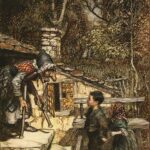
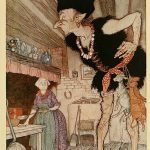
Arthur Rackham (1867–1939) was among the most influential illustrators of the time. Known for his work on fairy tales and myths, he illustrated the Brothers Grimm’s stories in a 1909 edition that included Rumpelstiltskin. Rackham’s technique combined precise ink linework with muted watercolors, creating moody, atmospheric scenes filled with twisted trees, gnarled figures, and uncanny expressions. His Rumpelstiltskin was not cartoonish but uncanny—his features part-human, part-animal.
Arthur Rackham and the Visual Fairy Tale
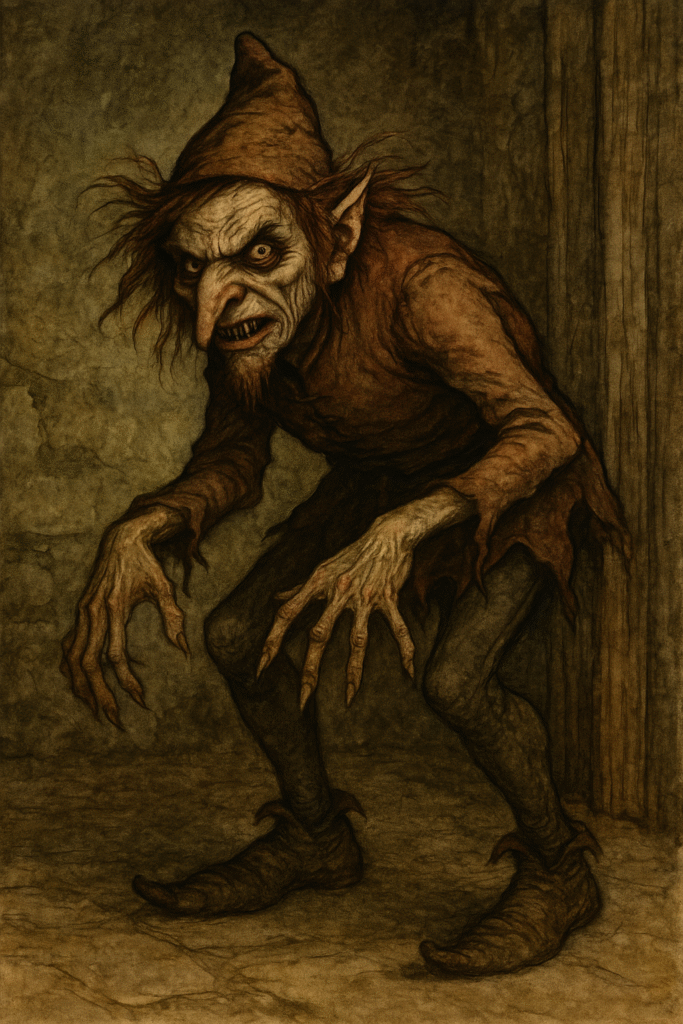
Rackham’s rendition of the character captures his ambiguous morality. He’s neither a pure villain nor a hero, but something in between—a mischievous, morally complex outsider. This visual ambiguity reflects the tale’s own tension: is Rumpelstiltskin wrong to claim the child, or is the girl wrong to promise what she does not intend to give? Through his imagery, Rackham invites readers to consider both sides, presenting a layered moral universe.
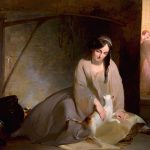
The illustrations also elevate the miller’s daughter from a passive damsel to a figure of desperate intelligence. Her expressions are fearful but determined. Rackham emphasized her isolation in vast, shadowy rooms, often dwarfed by looming straw piles or ominous architectural features. These settings convey emotional truth, making the story resonate beyond the words on the page.
20th-Century Adaptations in Fine Art
As art evolved in the 20th century, fairy tales like Rumpelstiltskin took on new forms and meanings. The rise of modernism and symbolism opened doors for deeper, often psychological interpretations of traditional narratives. Artists began reimagining fairy tales not just as children’s stories, but as archetypal explorations of the human condition. The story’s themes of power, secrecy, and transformation were ripe for exploration in this new artistic climate.
Prominent among these re-interpreters was Paula Rego (1935–2022), a Portuguese-British painter known for her psychologically intense, often disturbing works based on folk tales and literature. While Rego did not focus exclusively on Rumpelstiltskin, her oeuvre included multiple fairy-tale themes that echo its dynamics: female subjugation, the complexities of deals with male figures, and maternal fear. Similarly, Surrealist painter Leonora Carrington (1917–2011) engaged with myth and fairy tale through dreamlike, symbolic imagery.
Symbolism, Modernism, and Moral Ambiguity
During the 1930s to 1960s, fairy tales were increasingly read through a Freudian lens, which influenced both literary critics and artists. Rumpelstiltskin became a case study in repressed desires, castration anxiety, and identity formation. The spinning wheel itself was sometimes interpreted as a symbol of female sexuality or labor under patriarchal constraints. Artists drew on these themes to critique or illuminate broader cultural dynamics.
Feminist artists of the later 20th century also turned to Rumpelstiltskin as a lens to explore power and voice. In particular, the moment the girl speaks the name becomes a symbolic act of reclaiming agency. The idea that knowledge—especially secret knowledge—can liberate women resonated strongly. This reinterpretation positioned Rumpelstiltskin not just as a trickster but as a force that challenges complacency and compels growth.
Rumpelstiltskin in Contemporary Art and Mixed Media
In the 21st century, artists working in installation, textile, and performance art have embraced fairy tales as cultural artifacts to be deconstructed and reassembled. Rumpelstiltskin, with its layers of secrecy, transformation, and negotiation, remains a compelling subject. Contemporary creators often blur boundaries between narrative and experience, inviting audiences into immersive retellings or symbolic reconstructions of classic stories.
One notable example is Kiki Smith, an American artist born in 1954, known for her multidisciplinary work that often references fairy tales. Smith has not directly illustrated Rumpelstiltskin in a major series, but her recurring themes of female embodiment, transformation, and myth connect deeply with the tale’s motifs. Her use of textiles and thread in sculptural work echoes the spinning theme, while her exploration of vulnerability and resilience mirrors the story’s emotional arc.
Installations, Textiles, and New Storytelling Forms
Other artists have created installations using spinning wheels, straw, and gold to explore labor, materiality, and storytelling. Some use actual looms and thread in gallery settings to invite participatory experiences, where viewers contribute to the act of “spinning.” This symbolic participation evokes the girl’s own labor and the manipulative circumstances she faces.
Contemporary interpretations also examine economic systems and human value through the tale. The idea of turning straw into gold can be seen as a metaphor for capitalist transformation of labor into profit. By placing the story within modern frameworks, artists highlight enduring concerns: who profits from labor, who pays the price, and how value is defined. Rumpelstiltskin thus becomes not only a character but a metaphor for transactional society.
The Story’s Role in Children’s Book Art
Children’s book illustrators have long found inspiration in the tale of Rumpelstiltskin, not just for its visual drama, but also for its emotional complexity. The challenge of presenting morally ambiguous content to young readers has led to inventive approaches. Artists walk a delicate line: preserving the darkness of the tale while making it suitable for developing minds. The results are often visually stunning and psychologically nuanced.
Paul O. Zelinsky, born in 1953, created a celebrated version of Rumpelstiltskin in 1986 that won a Caldecott Honor. His illustrations were rendered in the style of early Renaissance painting, bringing gravitas and historical texture to the story. Zelinsky’s meticulous detail and expressive character design brought a timeless quality to the book, which has remained a staple in school libraries and art curricula.
Visual Literacy and Psychological Symbolism
Maurice Sendak (1928–2012), though better known for Where the Wild Things Are, also illustrated fairy tales in ways that emphasized psychological tension. While he did not illustrate Rumpelstiltskin directly, his approach influenced how later artists handled similar material. His belief that children could handle complex emotions opened the door to darker, richer fairy-tale illustrations.
Educators and therapists often use illustrated versions of Rumpelstiltskin in bibliotherapy and visual literacy programs. The tale teaches lessons about promises, consequences, and the importance of speaking up. Modern editions frequently depict the girl not as helpless, but as clever and resourceful, reflecting changing views on female agency in storytelling. The visual medium helps reinforce these themes through body language, color, and composition.
Rumpelstiltskin in Popular Culture and Digital Art
In recent decades, Rumpelstiltskin has found new life in popular culture, particularly in digital and televised formats. The TV series Once Upon a Time, which aired from 2011 to 2018, featured Rumpelstiltskin as a central character, played by Robert Carlyle. Here, he is a morally complex figure with tragic origins and immense magical power, far removed from the simple trickster of the original tale. This reimagining brought the character to a new generation.
Fan art platforms like DeviantArt and ArtStation have thousands of Rumpelstiltskin-themed works. Artists around the world reinterpret the character through various lenses—gothic, comedic, romantic, or horror. Digital art has opened space for voices outside the traditional publishing world, including self-taught and independent artists. Their contributions often push boundaries, blending influences from anime, video games, and historical aesthetics.
From Disney to DeviantArt
While Disney has not produced a feature-length adaptation of Rumpelstiltskin, elements of the story appear in various productions and merchandise. His archetype—an untrustworthy but charismatic dealmaker—can be seen in characters like Hades in Hercules or Rumplestiltskin in the Shrek franchise. These portrayals keep the character alive in public imagination, even as they diverge significantly from the source material.
Some critics raise concerns about the transformation of traditional tales in digital culture. As stories are adapted into memes, fan fiction, and remixes, they often lose their historical roots and moral weight. However, others argue that reinterpretation is part of the folk tradition itself. Rumpelstiltskin’s journey from oral story to screen and digital canvas demonstrates the resilience and adaptability of myth in an age of rapid change.
Lasting Influence and Interpretative Freedom
Rumpelstiltskin remains a source of fascination because it resists easy categorization. The tale is neither fully a morality play nor purely a fantasy. It is both personal and archetypal, psychological and social. Its strange tone, moral ambiguity, and dramatic visuals continue to inspire artists seeking to explore complex themes through accessible symbols.
Modern artists and audiences alike are drawn to the idea of naming as empowerment. The moment the girl speaks Rumpelstiltskin’s name is more than a plot twist—it’s a revelation of truth and an act of resistance. In a world where speech and silence carry weight, the story reflects timeless human struggles: to know, to speak, and to be heard. It is not the man’s defeat that matters most, but the woman’s transformation.
The Power of Reinvention in Artistic Practice
The tale’s simplicity masks its interpretive richness. Each generation finds new angles—economic, psychological, spiritual, or political. Artists continue to use Rumpelstiltskin to challenge viewers, explore identity, and highlight injustice. From medieval woodcuts to modern installations, his presence endures.
Ultimately, Rumpelstiltskin’s influence on art reveals the enduring power of myth. Stories that ask hard questions and depict personal trials invite endless reinterpretation. In the hands of skilled artists, these tales become mirrors of our fears and hopes. Whether he is drawn with a gnarled grin or a golden thread, Rumpelstiltskin continues to spin his magic across the canvas of culture.
Key Takeaways
- Rumpelstiltskin first appeared in the Grimms’ fairy tale collection in 1812.
- Arthur Rackham’s 1909 illustrations defined the tale’s eerie visual tone.
- 20th-century fine artists reimagined the tale through symbolism and feminism.
- Contemporary artists use Rumpelstiltskin to explore identity and transformation.
- Digital and pop culture adaptations keep the tale relevant for modern audiences.
FAQs
- What is the origin of the Rumpelstiltskin story?
It was first published by the Brothers Grimm in 1812, though it draws on older folk traditions. - Who are notable artists influenced by Rumpelstiltskin?
Arthur Rackham, Paula Rego, Kiki Smith, and Paul O. Zelinsky have all engaged with the tale. - Why is the act of naming important in the story?
Naming symbolizes power, identity, and control, themes central to the story’s climax. - How is Rumpelstiltskin depicted in modern art?
He is shown in varied ways, from grotesque trickster to misunderstood outsider. - Is Rumpelstiltskin still relevant in contemporary art?
Yes, his story continues to inspire reinterpretations across media and cultures.