The art history of Porto is not a chronology of visual spectacles or avant-garde provocations. It is instead a slow and tenacious unfolding of form, faith, and material anchored in the city’s elemental foundations—granite, Atlantic fog, and the unyielding rhythms of commerce and devotion. Porto’s aesthetic identity is forged less in bursts of innovation than in the persistent echo of stone façades, the blue glint of azulejos beneath shifting skies, and the austere grandeur of ecclesiastical silhouettes. The city resists flamboyance; it favors resonance.
Located on the northern bank of the Douro River, Porto has always been a city of edges—geographical, cultural, and historical. Its topography, defined by steep slopes and rugged escarpments, has determined much of its urban morphology and, by extension, its visual character. The relationship between land and architecture here is not merely picturesque; it is structural. Unlike Lisbon, whose urban imagery often reflects the bright ornamentalism of southern baroque or the airy melancholy of Fado aesthetics, Porto’s built environment speaks in the dense, dark tones of granite. This material, local and immovable, has shaped the city’s churches, walls, bridges, and private dwellings for over a millennium. It is both literal and symbolic—the substance of the city’s defensive posture and the surface upon which artistic tradition was inscribed.
Porto’s art history cannot be separated from its history as a mercantile and religious center. The city emerged as a key node in medieval trade networks, both inland and maritime, and its fortunes were tied as much to the movement of spices, textiles, and wine as to the edicts of bishops and kings. Patronage, then, was never only ecclesiastical or royal; it was bourgeois, civic, and later, republican. From the Romanesque cruciform of the Sé to the imperial blue of São Bento station, the city’s monuments reflect both spiritual hierarchies and commercial pragmatism. Art in Porto often carries the double burden of functionality and aspiration—it must work, and it must last.
There is, throughout Porto’s history, a pattern of restraint followed by eruption. The city’s Romanesque and Gothic churches are often simple in external form but unexpectedly rich within. The baroque period, particularly the 18th century, saw an unleashing of interior splendor, gilded talha dourada curling in dramatic cascades over altar pieces and ceilings. But this ornamental intensity was always contained within solid stone enclosures, a theatrical soul housed in a granite body. The same duality continues into the modern age. Álvaro Siza Vieira’s architecture, for instance, with its luminous minimalism and quiet radicalism, emerges not in opposition to tradition but as a distilled continuation of it. In Siza, as in the anonymous masons of the Romanesque era, form is not display—it is judgment.
Any account of Porto’s art must also attend to its peripheral position in relation to national power. The city has often stood in quiet, and sometimes explicit, opposition to Lisbon’s central authority. This oppositional spirit has given rise to a visual culture that is simultaneously local and defiant. It can be seen in the stubborn preservation of medieval forms in a baroque age; in the monochromatic intensity of azulejo panels, which often function as popular didactic narratives rather than purely decorative motifs; and in the civic pride that surrounds institutions like the Serralves Museum, which seeks to situate Porto not merely as a provincial city with a past, but as a critical node in the European contemporary art network.
Yet Porto remains immune to certain aesthetic trends that have swept more cosmopolitan capitals. Its resistance to the ephemeral, the fashionable, and the iconoclastic is not a sign of backwardness, but of a different temporality. Porto’s art is slow, cumulative, and often anonymous. Many of its greatest works were not made for galleries, but for altars, façades, processions, and rituals. They exist not to be seen in passing, but to be inhabited—through repetition, memory, and physical proximity. In this sense, the city itself becomes a kind of sacred object: both sculpture and reliquary.
The river Douro is not merely a geographical feature but a metaphorical axis for Porto’s artistic psyche. Like the river, the city’s art flows slowly, winding through epochs, eroding and shaping, carrying with it traces of Roman legions, crusading knights, Jesuit educators, English merchants, and modernist architects. Its currents are never still, but they are seldom hurried. Each epoch in Porto’s art builds on the foundations of its predecessor without entirely displacing it. This palimpsestic quality—a layering rather than a succession—creates a city in which time is visibly sedimented into space.
In what follows, we will examine Porto’s art historical trajectory through these layers: from its Roman and Suebi substrata to its medieval sanctuaries, from baroque effusion to modernist geometry. Along the way, we will observe how a peripheral city cultivated an aesthetic not of dominance, but of endurance—a mirror not only of the Atlantic it faces, but of the centuries it contains.
Origins in Stone: Roman and Suebi Foundations
Porto’s genesis as an artistic and architectural entity begins not in splendor but in structure. Before it was Porto, it was Portus Cale—a Romanized settlement occupying the northern banks of the Douro, marked not by imperial pretension but by its strategic location along trade and military routes. Unlike southern cities such as Emerita Augusta (modern Mérida), whose Roman past remains visibly monumental, Porto’s classical foundations are subtler, sedimented beneath centuries of rebuilding, fire, ecclesiastical expansion, and industrial transformation. Yet the Roman imprint is not absent. It is embedded in the city’s spatial logic, in the persistence of certain street alignments, in the substructures uncovered beneath medieval layers, and in the very etymology that gave rise to the name “Portugal.”
The Roman Portus Cale likely emerged in the 1st century BC as a modest trading post integrated into the broader network of civitates governed from Bracara Augusta (modern Braga). Archaeological excavations in and around the modern city have yielded remnants of paved roads, necropoleis, amphora fragments, and domestic foundations—fragments rather than complete testimonies, yet enough to confirm continuous occupation. The art of this early Porto was not sculptural or pictorial in the grand Roman sense, but infrastructural. Roads, aqueducts, and stoneware—these were the mediums through which form met function, and which would, in centuries to come, be reinterpreted as the groundwork of sacred and civic constructions.
What is most notable in this period is not the presence of an established artistic school but the enduring principle of adaptation. Roman engineering techniques—opus caementicium, mortared stone, tile roofing—would inform subsequent architectural developments, particularly in the medieval period, when the revival of classical forms was less ideological than pragmatic. The Roman sense of urban organization, with its attention to defensibility, proximity to water, and orthogonal layouts adapted to topography, laid the substrate for Porto’s eventual medieval compactness. It is this skeletal logic that permitted the city’s vertical rise along the Douro’s cliffs in later centuries, a natural fortification upon which towers and churches would be erected.
The Suebi, who arrived in the early 5th century AD following the general collapse of Roman imperial authority in the Iberian Peninsula, brought with them not a refined visual culture but a different conception of space, sanctity, and authority. Based in Gallaecia, with their capital at Bracara Augusta, the Suebi were among the first Germanic tribes to establish a kingdom within Roman boundaries. Their presence in the Porto region was likely less destructive than adaptive, and although they left few directly attributable artworks or monuments, their religious transformation—initially Arian Christian, later Catholic—ushered in a new era of ecclesiastical presence and architectural form.
It is difficult to separate Suebi influence from early Christian forms more generally, particularly because the visual culture of post-Roman Iberia was shaped by overlapping populations and theological disputes. What is clear is that the late antique period in Porto witnessed the emergence of small chapels, baptisteries, and tombs which, though visually austere, represent a crucial transformation in the function of space. Where Roman civic art had emphasized public spectacle—amphitheaters, baths, forums—early Christian and Suebi religious spaces were inward-looking, sacred, and symbolically charged. The art of this period, to the extent it can be reconstructed, was focused on stone carving, modest frescoes, and liturgical objects—chalices, reliquaries, altar slabs—many of which survive only in fragments or through textual inference.
A paradigmatic example of this transitional aesthetic is the reuse of Roman materials in early medieval construction. Columns, capitals, and dressed stones were repurposed in ecclesiastical buildings, not out of antiquarian reverence but out of necessity and continuity. This spoliation was not an act of aesthetic degradation but of cultural reconfiguration. The Roman became Christian not through obliteration but through absorption. This process—of palimpsest, of layered meaning and matter—would become a leitmotif in Porto’s artistic development.
One of the few concrete artifacts from this early period is the series of funerary stelae and altar fragments housed in Porto’s Museu Arqueológico, located in the cloisters of the Church of São Francisco. These pieces, many from the 5th to 7th centuries, reveal a hybrid language of Latin inscriptions, rudimentary Christian iconography, and local sculptural forms. They are modest in ambition but potent in implication: markers of a society in transition, rooted in the stoneworking traditions of the Roman past but pivoting toward a Christian symbolic future. Their imagery—a cross, a palm, a chi-rho—speaks to continuity under conditions of transformation.
The Christianization of the region, formalized by ecclesiastical hierarchies and the gradual re-establishment of diocesan control, brought with it a renewed emphasis on symbolic space. The cathedral, as a concept if not yet a full structure, began to emerge as the focal point of both civic and religious identity. By the time of the Moorish invasions in the 8th century, Porto’s artistic and architectural forms had solidified into a recognizably Christian idiom—however simple, however provisional.
When the city was reconquered and reorganized under the aegis of the County of Portucale in the 9th and 10th centuries, this Roman-Suebi substratum would become the basis for renewed building campaigns, particularly monastic. The return to stone construction—massive, weighty, geometrically disciplined—would be a hallmark of Porto’s Romanesque future. But that future rested firmly on the quiet, fragmented artistry of its classical and early medieval past.
In sum, Porto’s earliest art was not an art of spectacle or grandeur, but of continuity, adaptation, and sacred purpose. It was made by engineers, masons, monks, and magistrates—by those for whom form was a function of necessity, but also of transcendence. The city’s later visual richness—the theatricality of Baroque interiors, the polychrome exuberance of azulejos, the stark poetry of Siza’s geometries—was built upon this foundation of stone, silence, and sanctity.
Medieval Devotion and the Romanesque Imprint
By the dawn of the 12th century, Porto had been drawn into the expanding gravitational field of Christian Iberia’s Reconquista, both spiritually and politically. The city, granted to Bishop Hugo by the King of León in 1096, became a vital ecclesiastical stronghold and a node of resettlement and religious consolidation. The foundation of the Diocese of Porto, formally linked to the broader Archdiocese of Braga, established the city not merely as a strategic port on the Douro but as a theological and architectural laboratory—an urban organism in which the visual culture of the Romanesque would take on its distinctive, granite-carved form.
Romanesque art in Porto must be understood less as a style imported wholesale from Cluniac or Lombard models than as a localized response to spiritual necessity and material condition. Porto’s Romanesque was thick-walled, defensible, sober in ornamentation yet conceptually rich, a visual language at once liturgical and civic. The building of the Sé—Porto’s cathedral—epitomizes this duality. Construction began in the early 12th century, possibly under the auspices of Bishop Hugo himself, and unfolded over several generations, incorporating styles and elements from Romanesque to Gothic and beyond. Yet its core remains an imposing Romanesque mass, with twin towers, rounded apses, and a stark silhouette perched dominantly over the Ribeira.
The Sé is not simply a building; it is a theological statement in stone. The rhythm of its nave, articulated by heavy piers and barrel vaulting, evokes the procession of the faithful toward the altar, toward transcendence. Its defensive appearance—crenellations, narrow windows, compact form—was not merely symbolic. In a region vulnerable to military conflict and internal disorder, the cathedral served a protective as well as spiritual function. This duality—church as fortress, bishop as territorial authority—defined much of Porto’s Romanesque era.
The Romanesque impulse extended beyond the cathedral. Numerous smaller churches and monastic complexes emerged in and around the city during the 12th and 13th centuries, each contributing to a dense network of ecclesiastical presence and architectural experimentation. Among the most notable is the Church of Cedofeita, dedicated to Saint Martin, which predates the Sé and contains elements from an earlier pre-Romanesque structure, likely dating to the Suebi or Visigothic era. Its later Romanesque reconstruction showcases the restrained, locally adapted style that typified Porto: low proportions, modest ornamentation, and structural solidity. The absence of expansive sculptural programs, such as those found in the pilgrimage churches of Santiago or Toulouse, reflects both the economic limitations and the aesthetic tendencies of the region.
The monasteries, particularly the Benedictine and Cistercian foundations in the surrounding Douro valley, played a critical role in shaping Porto’s Romanesque character. These institutions, many endowed by noble families seeking spiritual insurance and political influence, functioned as centers of manuscript production, stone carving, and liturgical innovation. They also provided a reservoir of skilled labor—masons, sculptors, glaziers—whose work traveled along monastic networks. Though documentation is sparse, evidence suggests that Porto’s Romanesque churches were often the work of itinerant workshops, blending Galician, Asturian, and even Aquitanian elements with local materials and techniques.
Crucial, too, was the role of pilgrimage. While Porto never rivaled Santiago de Compostela in sanctity, it lay along subsidiary routes of the Camino de Santiago and thus absorbed some of the visual and theological currents associated with pilgrimage culture. The need to accommodate pilgrims, to assert orthodoxy, and to offer visual didacticism within sacred space led to a refinement of Romanesque iconography, particularly in capitals, tympana, and liturgical furnishings. Though relatively few of these survive in situ, fragments and reconstructions—many preserved in the Museu Nacional Soares dos Reis—reveal a symbolic vocabulary of beasts, saints, and geometric interlace rendered with a disciplined, almost abstract vigor.
Beyond the ecclesiastical, Romanesque architecture in Porto extended into civic life. The nascent municipal authority, granted charters and privileges by successive monarchs, began constructing walls, gates, and towers during this period. Though often remodeled or absorbed into later structures, traces of these Romanesque fortifications survive in the city’s medieval core. The layout of the streets around the Sé, the placement of markets and squares, and the orientation of the old Jewish quarter all reflect a medieval logic of enclosure, hierarchy, and controlled access—an urban theology as much as an urban plan.
What emerges from this period is a city not of splendor but of conviction. The Romanesque imprint in Porto is not decorative but structural; it forms the deep grammar of the city’s visual and spiritual lexicon. Its repetition of rounded arches, thick stone vaults, and axial plans asserts not innovation but permanence. In an age of uncertainty—religious conflict, political fragmentation, and economic fluctuation—the Romanesque offered a stable form through which sacred meaning could be inscribed and social order projected.
This is not to say Porto’s medieval art was without beauty or imagination. On the contrary, the very limitations of material and resources seem to have inspired a kind of disciplined ingenuity. Capitals carved with biblical scenes, corbels shaped as grimacing faces or beasts, and the occasional polychrome fresco—these were not flourishes but focal points, directing the faithful toward contemplation, toward the mystery enclosed within the stone. The absence of exuberance was not an aesthetic failing but an ethical stance: truth, in this theology, was austere.
By the late 13th century, the Romanesque paradigm in Porto began to wane, giving way to the verticality and lightness of the Gothic. But the Romanesque never truly disappeared. It remained embedded in the city’s foundational monuments, in the anonymous chapels that dotted its hills, in the very memory of stone. The Gothic would add complexity and height, but it would never efface the fundamental grammar laid down in the 12th century.
In Porto, the Romanesque is not merely a historical style. It is a foundational ethos: a way of building, seeing, and believing that continues to reverberate in the city’s art, long after the last rounded arch was raised.
Gothic Ascension: Porto in the Age of Stone and Faith
The Gothic in Porto did not burst forth as revolution. It arrived, as much of Porto’s art does, by accretion—layering itself upon the Romanesque substratum, extending upward from the thick foundations of the 12th century with a slow but deliberate reach toward transcendence. Where the Romanesque had spoken in the language of enclosure and weight, the Gothic introduced the dialect of verticality, fenestration, and liturgical rhythm. But in Porto, this transition was tempered by material constraint and regional character. The city’s granite yielded only reluctantly to the soaring ambitions of pointed arches and flying buttresses. As a result, Porto’s Gothic art and architecture acquired a character all its own—sober, muscular, often stark, but no less expressive of the spiritual and political aspirations of its age.
The preeminent expression of Gothic architecture in Porto is the Church of São Francisco. Originally established as a modest Franciscan convent in the 13th century, it evolved into a monumental complex by the 14th and 15th centuries, incorporating elements that reflect the full maturation of Gothic sensibility. The structure’s plan—a Latin cross with a long nave, side chapels, and a polygonal apse—conforms to established Gothic models, yet its execution is distinctly localized. The stone is massive and unyielding; the walls, though pierced by lancet windows, remain thick and shadowed. There is little of the filigree lightness found in northern French cathedrals, none of the flamboyant tracery of later Castilian examples. Instead, the Gothic in Porto retains a Romanesque gravity, its innovations moderated by the pragmatic exigencies of construction and climate.
Yet São Francisco’s interior would later become a locus of Baroque excess—its gilded woodwork engulfing the Gothic bones in a riot of curling foliage and saints. But in its original form, the church reflected the Franciscan ethos: plainness, asceticism, a focus on preaching and the Eucharist. The Gothic, in this early Franciscan iteration, was not a vehicle for aristocratic display but for spiritual clarity. The vaults lifted the gaze, not for awe, but for understanding.
Elsewhere in Porto, the Gothic style made its mark not through cathedrals but through civic and funerary architecture. The rise of municipal autonomy, marked by the granting of charters and the development of a merchant elite, found architectural expression in the construction of the Gothic cloister at the Sé and in the development of ancillary chapels, guild churches, and confraternity spaces. These were not grand in scale, but they were rich in implication. The cloister of the Sé, begun in the late 14th century, offers pointed arches, ribbed vaults, and a new choreography of space. Unlike the fortress-like nave, the cloister invites circulation, contemplation, and the gentle play of light—qualities essential to the Gothic spirit.
Porto’s relative prosperity in the late medieval period was driven in large part by maritime trade, particularly in wine, textiles, and salted cod. This economic expansion enabled the development of guilds and confraternities, many of which commissioned chapels, artworks, and public rituals that drew upon Gothic visual culture. The integration of sculpture into portal programs—angels, apostles, Christ in Majesty—offered both decoration and instruction. In a city with relatively low literacy rates, these carved figures functioned as the catechism in stone.
Among the most refined Gothic funerary monuments in Porto is the tomb of João Gordo, knight of the Order of Saint John of Jerusalem and chancellor to King Dinis, located within São Francisco. His tomb, carved in the late 13th century, is a rare surviving example of Gothic figural sculpture in situ. The effigy of the knight lies recumbent, sword at side, flanked by heraldic emblems and angelic figures. The monument is modest in scale but rich in Gothic sentiment: the valorization of the individual soul, the assertion of noble identity within the sacred enclosure, the tension between death’s inevitability and the promise of resurrection. Porto, in this mode, partakes in the broader European funerary culture of the Gothic age, though its expressions are less monumental than intimate.
Gothic also transformed the urban fabric in subtler ways. The reorientation of streets toward churches, the emergence of processional routes, the installation of crosses and wayside chapels—these were all part of a growing sacralization of the cityscape. Religious orders such as the Dominicans and Carmelites expanded their presence, each contributing to the iconographic and architectural tapestry of Porto. Though few of their original Gothic structures survive intact, archival records and foundation charters testify to their ambitions and spatial claims.
It is also during the late Gothic period that we see the first emergence of imported artistic forms from the Burgundian and Flemish worlds, mediated through trade and dynastic alliance. Illuminated manuscripts, altar paintings, and devotional objects made their way into Porto’s ecclesiastical treasuries, introducing new pictorial techniques and devotional modes. Though the city lacked the courtly infrastructure of Lisbon or the academic ateliers of Coimbra, its proximity to the Atlantic meant it remained receptive to artistic currents from beyond the Iberian Peninsula. The Gothic, then, was not simply a style imposed from above; it was a visual language that circulated through ships, reliquaries, pilgrims, and textiles.
What distinguished Porto’s Gothic from that of more flamboyant European centers was its fidelity to stone—not merely as a material, but as a metaphysical principle. The city’s granite resisted both the ornate excesses of late Gothic decoration and the technical virtuosity of tracery and stained glass. In its place, Porto’s Gothic buildings offered a theology of solidity: arches that soared modestly, vaults that bore weight visibly, spaces that emphasized the vertical without forgetting the ground. It is a Gothic of gravity, not levitation.
By the end of the 15th century, as the Age of Discoveries dawned and Renaissance forms began to appear in Portuguese courtly and ecclesiastical commissions, Porto remained fundamentally medieval in appearance and ethos. The Gothic continued to inform its devotional life, its processions, its funerary culture. And when new styles eventually arrived, they did so not by effacing the Gothic, but by wrapping around it—transforming cloisters with azulejos, overlaying chapels with gilded wood, but leaving the essential structure intact.
The Gothic in Porto was never a flamboyant proclamation. It was a quiet ascension: a slow turning of the eye upward, a measured response to spiritual hunger and urban evolution. It did not seek to rival the cathedrals of Chartres or Burgos. It sought instead to give shape to faith within the constraints of stone, climate, and conscience—and in doing so, it left a legacy as indelible as the granite from which it was hewn.
The Baroque Surge: Opulence in the North
Baroque art in Porto did not descend like a thunderclap upon the city’s medieval silhouette—it surged gradually, like the swelling of a tide, curling inward into the ribs of Gothic churches, gilding their shadows, and breaking finally upon the city’s façades with theatrical confidence. From the late 17th century into the 18th, the Baroque transformed Porto from a somber ecclesiastical bastion into a city of gilded interiors, exuberant façades, and orchestrated religious spectacle. If Romanesque had emphasized mass and the Gothic aspired to light, the Baroque in Porto demanded awe—and achieved it through movement, contrast, and radiance.
The Baroque era in Porto coincided with a period of economic growth and religious consolidation. The twin engines of this transformation were the mercantile economy—particularly the international wine trade—and the militant spirituality of the Counter-Reformation, spearheaded by the Society of Jesus. The former provided capital; the latter, a program. Together they produced a visual culture oriented toward persuasion, display, and affective immersion. Baroque art was never meant to be quietly contemplated. It was meant to overwhelm.
The most singular figure in this transformation was the Italian-born architect and painter Nicolau Nasoni, who arrived in Porto in the 1720s and left an indelible mark on its urban and ecclesiastical landscape. Nasoni’s genius lay in his ability to transpose the rhetorical flourishes of Italian Baroque into the idiom of Portuguese granite, creating a hybrid style that was both monumental and sensuous. His masterpiece, the Clérigos Church and Tower, stands as the most iconic Baroque structure in Porto. The church itself, though compact, is a virtuoso exercise in dynamic form—its elliptical nave and undulating walls drawing the eye forward in a visual crescendo. But it is the tower, completed in 1763, that dominates the city’s skyline, rising over 75 meters in height and visible from nearly every quadrant of the city. It is less a bell tower than a vertical exclamation point: Porto’s Baroque signature inscribed in stone.
Yet Nasoni’s influence was not confined to Clérigos. He contributed to the remodeling of the Sé, designed staircases, altars, and façades across Porto, and helped codify a regional Baroque idiom rooted in movement and ornamental intensity. His use of concave and convex forms, broken pediments, volutes, and theatrical lighting effects brought an operatic drama to Porto’s previously austere religious architecture. Even in stone, Nasoni managed to suggest the movement of drapery, the flicker of candlelight, the ascent of the soul.
This theatricality extended most fully into the interior spaces of Porto’s Baroque churches, where the art of talha dourada—gilded wood carving—reached a kind of ecstatic culmination. The Church of São Francisco, whose Gothic structure had long stood in relative simplicity, became by the 18th century a cathedral of gold. Every surface—columns, altars, pulpits, walls—was enveloped in intricately carved and lavishly gilded wood. Angels, vines, cherubs, clouds, and flames coiled around one another in a visual fugue, a heavenly cacophony rendered in gold leaf. It is no exaggeration to say that São Francisco represents one of the most intense examples of interior Baroque decoration in Europe. For some, it inspires reverence; for others, unease. But it never leaves one indifferent.
This gilded excess had theological roots. The Baroque was the visual arm of the Counter-Reformation, a style born of the Council of Trent’s insistence on the emotional and didactic power of sacred art. In a period when Protestant iconoclasm had stripped churches of imagery across northern Europe, the Catholic world responded with sensual plenitude. Porto’s Baroque interiors were sermons in wood and gold, designed to move the faithful toward ecstasy, repentance, or awe. They were not simply decorative—they were programmatic, every element subordinated to a spiritual goal.
The Jesuits played a critical role in this transformation. Their church of São Lourenço, known as the Grilos Church, stands as another key site of Porto’s Baroque identity. Built between 1577 and 1622 and remodeled in the 18th century, it features a restrained façade but a richly ornamented interior, marked by the same gilded vocabulary seen in São Francisco. The Jesuits understood that art was not a luxury but a weapon in the battle for souls. Their influence extended to schools, colleges, and missions, and their pedagogy of spectacle—drama, painting, sculpture—saturated the visual culture of Porto in this era.
Baroque sculpture, too, flourished in Porto, though it remained largely subordinate to architectural frameworks. Artists such as Manuel dos Santos Porto and António Teixeira Lopes the Elder created expressive wooden figures for altars and processions, ranging from crucifixions and Pietàs to images of saints and martyrs rendered with visceral emotion. These works, often polychromed and anatomically vivid, were not meant to be admired as objects of art, but to elicit compassion, horror, or fervor. In Holy Week processions, such sculptures were carried through the streets, transformed from inert matter into the beating heart of communal devotion.
The Baroque also left its mark on civil and infrastructural projects. The construction of the Ribeira’s arcades and quays, the development of new fountains and public staircases, and the remodeling of the Episcopal Palace all bear traces of Baroque formal logic: axiality, symmetry, grandeur, and the play of light upon surface. Even the tilework of this period—though best treated separately—took on Baroque themes and compositions, with blue-and-white azulejos depicting battle scenes, hagiographies, and biblical episodes in swirling, dynamic layouts.
By the end of the 18th century, the Baroque in Porto began to fade, overtaken by neoclassicism, liberal politics, and changing liturgical sensibilities. But its legacy endures in the city’s most defining images: the glint of gold behind a wrought-iron grille, the silhouette of Clérigos Tower against a smoky sky, the rhythmic ascent of granite stairs into a chapel enflamed with ornament. The Baroque did not merely embellish Porto—it reoriented it, turned it inward and upward, taught it to see in curves and gilded shadows.
In Porto, the Baroque is not a relic of decorative indulgence. It is a vision of heaven staged upon the earth—dense, vertiginous, and luminous, carved into the very soul of the city.
The Azulejo as Surface and Soul
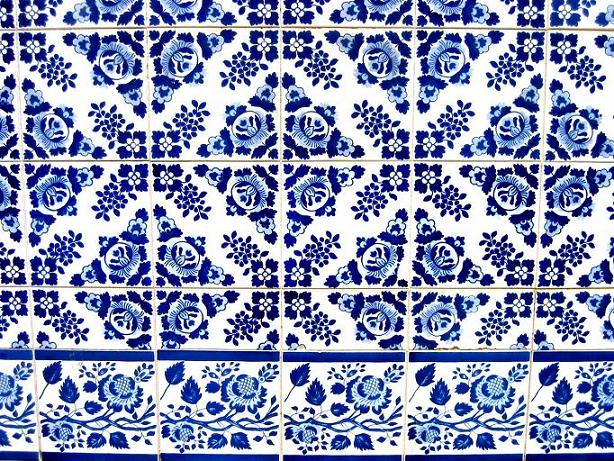
In Porto, the tile is more than ornament. It is syntax. The city’s surfaces—church façades, train stations, stairwells, fountains—speak in the language of azulejo: a porcelain poetry of light, repetition, and iconography. Nowhere in Portugal is the tile more deeply woven into the urban fabric than in Porto, where the glazed ceramic panel does not simply decorate space—it transforms it. It narrates history, defines interiority, and grants movement to stone. If the Baroque was Porto’s sacred theatricality, the azulejo became its secular and sacred skin.
The azulejo, derived etymologically from the Arabic al-zulayj—“polished stone”—was first introduced to the Iberian Peninsula through Islamic artistic traditions, particularly in southern Spain during the Almohad and Nasrid periods. Yet what in Seville or Granada was a geometric and vegetal abstraction became in Portugal, and most especially in Porto, a figural, narrative, and monumental form. This transformation occurred over centuries, culminating in the 17th and 18th centuries, when the azulejo achieved a uniquely Portuguese synthesis of painting, architecture, and devotion. In Porto, this synthesis was not merely aesthetic—it was ontological. The city began to see itself through its tiles.
The shift from polychrome to monochrome—particularly the dominance of cobalt blue and white—defined the mature azulejo style. This palette, inspired by Chinese porcelain and disseminated through Dutch and Flemish ceramic traditions, lent itself to both legibility and spiritual clarity. It allowed for detailed figuration while harmonizing with the cool gray of Porto’s granite architecture. Beginning in the late 17th century, entire walls were covered in narrative panels, often depicting biblical scenes, saintly legends, historical battles, or allegories of virtue and vice. These were not mosaics but unified pictorial fields, painted by hand on tin-glazed tiles and fired in kilns before being assembled like massive jigsaw frescoes.
The churches of Porto are an encyclopedic catalogue of this ceramic art. The Church of Saint Ildefonso, completed in the 18th century, bears one of the city’s most iconic azulejo façades. Designed by Jorge Colaço in the early 20th century but executed in an 18th-century style, it features over 11,000 tiles arranged in dynamic narrative compositions. These depict the life of Saint Ildefonso and various gospel scenes, their figures rendered with dramatic chiaroscuro and serpentine movement. The façade functions not merely as decoration but as proclamation: theology in blue and white, visible even to those who never cross the threshold.
Equally emblematic is the Capela das Almas (Chapel of Souls) on Rua de Santa Catarina. Though completed relatively late (early 20th century), its azulejo panels by Eduardo Leite are designed in the spirit of 18th-century narrative grandeur. Covering the entire exterior, the tiles recount the lives of Saint Francis of Assisi and Saint Catherine, depicted with theatrical flair, elongated gesture, and architectural depth. The chapel, though modest in size, achieves a monumental presence through its pictorial skin—becoming, in effect, a cinematic surface embedded within the street.
But it is in the interiors of churches and cloisters where the azulejo achieves its most intimate intensity. The cloister of the Sé is lined with early 18th-century azulejo panels illustrating the Song of Songs and other biblical texts. These tiles are not mere background. They envelop the space, creating a visual rhythm that accompanies the contemplative gait of the walker. In this way, the azulejo functions like illuminated manuscript marginalia expanded into architectural scale—devotional, decorative, and didactic.
Porto’s civil architecture also embraced the azulejo with particular fervor. The São Bento railway station, completed in 1916, contains what is perhaps the most famous secular tile ensemble in Portugal. The vestibule, designed by Jorge Colaço, features monumental panels depicting scenes from Portuguese history: the Battle of Valdevez, the Conquest of Ceuta, rural life, and royal ceremonies. Unlike church panels, which tend toward iconography and spiritual allegory, these scenes celebrate national myth and civic identity. Yet the mode remains religious in intensity—processional, didactic, hieratic. The station, a transit hub, becomes a chapel of memory.
What distinguishes Porto’s use of azulejo from that of other Portuguese cities is its totality. Here, the tile is not confined to elite commissions or ornamental niches. It covers the modest façades of row houses, climbs stairwells, wraps around fountains, and appears, unceremoniously, in the vestibules of apartment buildings. This democratization of surface—this insistence that every wall may speak—is part of the tile’s enduring cultural power. The azulejo is both elite and popular, both ecclesiastical and domestic, both ancient and modern. It is the city’s epidermis.
Technically, the production of azulejo in Porto was concentrated in workshops that flourished from the late 17th through the 19th centuries. These included both independent artisans and larger manufactories, often linked to religious orders or civic patronage. The tiles were typically painted with mineral oxides on a tin-glazed earthenware surface, then fired at high temperatures. The durability of this process explains the remarkable survival of many tile panels, despite centuries of weathering and urban transformation.
Stylistically, Porto’s azulejos often display a fusion of baroque drama and neoclassical order. While Lisbon’s azulejos, especially after the 1755 earthquake, leaned toward Rococo and Enlightenment themes, Porto retained a more pious, often medieval sensibility. Its azulejo panels, even when secular, often borrow compositional strategies from altarpieces and illuminated manuscripts: central figuration, symmetrical flanking elements, scrolling borders, and text-bearing cartouches.
Yet for all their grandeur, azulejos in Porto remain curiously intimate. They are absorbed not as spectacle, but as presence. They do not leap out; they seep in. Walking through the streets of Bonfim, Foz, or the Ribeira, one encounters tile not as exception but as rule—constant, reflective, quietly speaking of continuity and care. In this sense, the azulejo does not merely cover Porto. It defines it. It is both its surface and its soul.
In the following century, as modernism questioned ornament and functionalism stripped buildings of their skin, the azulejo remained—a sign of cultural memory, aesthetic endurance, and urban identity. And even today, as tourists photograph its patterns and developers replicate its motifs, the azulejo continues to anchor Porto to its past, not nostalgically, but architecturally, sensually, and spiritually.
Liberalism and Bourgeois Patronage: 19th Century Shifts
The 19th century transformed Porto not with a single act of revolution, but through the slow recalibration of its artistic and civic priorities. It was a century of transitions—between empires and nations, monarchies and republics, sanctity and secularity. The city emerged from the Baroque age gilded and theologically ornate, only to find itself remade in the image of liberal modernity: a place of academies, industrialists, newspapers, and civic ambition. In this newly rationalized and increasingly bourgeois environment, art in Porto began to shed its medieval and ecclesiastical moorings, evolving into an instrument of public identity, private display, and national myth-making.
The roots of this transformation lay in the ideological convulsions that swept Portugal in the wake of the Napoleonic invasions and the Liberal Wars. Porto, often referred to as the “Cidade Invicta” for its resistance to absolutism, was a stronghold of liberal thought and constitutional agitation. The city endured a prolonged siege (1832–1833) during the struggle between liberal and absolutist factions—a siege that physically and psychologically restructured its urban and artistic landscape. The aftermath brought not only political liberalization but also the emergence of a new patron class: the merchant-industrialist bourgeoisie. This class, steeped in Enlightenment ideals and economic pragmatism, demanded a new visual language—one that would reflect their aspirations, rationalism, and public virtue.
One of the clearest manifestations of this shift was the rise of civic architecture and monumental public works. No longer content with ecclesiastical patronage alone, Porto’s liberal elites commissioned buildings that symbolized the modern city: town halls, markets, schools, theatres, and hospitals. These were not merely functional spaces—they were architectural declarations of order, progress, and moral hygiene. The Palácio da Bolsa (Stock Exchange Palace), begun in 1842 and completed over several decades, exemplifies this transformation. Designed in a neoclassical style with Romantic flourishes, the building served both economic and symbolic functions. Its monumental façade, rational proportions, and opulent interiors—particularly the celebrated Arab Room, a later 19th-century Orientalist fantasy—spoke to the cosmopolitan ambitions of Porto’s bourgeoisie. Here, trade became theatre, commerce a civic ritual, gilded not with faith but with credit.
Art education was another axis of change. The Academia de Belas Artes do Porto, founded in 1836, institutionalized artistic production and criticism, drawing on both classical models and contemporary European currents. It provided formal instruction in drawing, painting, sculpture, and architecture, shaping generations of artists and architects in the image of academicism and humanist refinement. The Academy was not simply a school; it was a mechanism for standardizing taste, elevating technique, and embedding art within the liberal state’s cultural apparatus. Artists such as António Soares dos Reis, Teixeira Lopes (father and son), and Henrique Pousão emerged from this milieu, creating works that oscillated between classical restraint and nascent Romanticism.
Soares dos Reis, arguably Porto’s most emblematic 19th-century sculptor, encapsulated this dialectic. His oeuvre—marked by formal rigor, psychological nuance, and national sentiment—culminated in the now-iconic marble sculpture O Desterrado (The Exiled), completed in 1872. The figure, seated and wrapped in a cloak, exudes melancholy and introspection, his face turned downward in silent exile. The sculpture became a symbol of Portuguese Romantic nationalism: rooted in classical form, yet imbued with the emotional tenor of historical displacement. It was not a commission of the Church or the Crown, but a product of an artist trained in liberal academies, shaped by the pain of political dislocation and the influence of European models—particularly the French and Italian.
Painting, too, began to shift from ecclesiastical commissions to secular subjects and bourgeois patrons. Portraiture flourished, capturing the likenesses of merchants, doctors, lawyers, and intellectuals who now constituted the new cultural elite. These works were often displayed in private salons and civic institutions rather than altars, their function less devotional than social: affirmations of status, taste, and lineage. Genre painting and landscape also gained prominence, reflecting the Romantic preoccupation with national identity, rural life, and individual sentiment. The Douro valley, long a source of economic wealth, now became a subject of aesthetic contemplation—a pictorial terrain of nostalgia and rootedness.
Photography, introduced in the mid-19th century, added a new dimension to Porto’s visual culture. Studios proliferated, offering portraits to the middle class and documentation of civic events, buildings, and ceremonies. While photography was often dismissed by academic artists as mechanical or unartistic, it nevertheless reshaped the public’s relationship to image and memory. The camera democratized representation, capturing not only the powerful but also the mundane: street vendors, soldiers, workers, and processions. It was, in effect, the first modern mass medium of Porto’s urban life.
Exhibitions, salons, and international fairs became increasingly important as venues for artistic dissemination and recognition. Porto’s participation in these events—whether as host or contributor—linked it to a broader European network of cultural exchange. The city was no longer an isolated provincial capital; it had become part of a transnational system of aesthetic circulation. Art criticism, too, gained traction in the press, with newspapers and journals publishing reviews, manifestos, and debates. The figure of the artist evolved accordingly: no longer solely a craftsman or servant of the Church, but a public intellectual, a participant in national discourse.
Yet beneath this liberal optimism lurked a set of contradictions. The bourgeois patronage that elevated art to new public and private heights also constrained it within the norms of decorum, nationalism, and commercial appeal. The academies, for all their formal discipline, often stifled experimentation, relegating innovation to the margins. Religious art, though diminished, did not disappear—it continued in traditional forms, especially in rural areas and among conservative patrons. And while public monuments proliferated—statues of kings, generals, and poets in granite and bronze—many of them remained formulaic, their iconography frozen in neoclassical idealism rather than responding to the social tensions of industrial capitalism.
In the last decades of the 19th century, Porto’s art began to grapple more directly with modernity. Industrialization had altered the city’s geography and demography, creating a working class, new suburbs, and new forms of poverty and alienation. Some artists, inspired by Realism and Naturalism, turned their gaze toward these realities. Others clung to idealized visions of Portugal’s past, evoking medieval themes and patriotic allegories. The tension between these poles—between documentation and myth, progress and nostalgia—would set the stage for the aesthetic debates of the 20th century.
In sum, the 19th century in Porto marked a profound reorientation of artistic production and meaning. Art became professionalized, secularized, and instrumentalized in service of the liberal order. It was no longer simply a manifestation of divine mystery; it became a language of civic identity, bourgeois ambition, and historical narrative. The sacred gold of the Baroque gave way to the polished marble of academic sculpture, the chiaroscuro of Romantic canvas, the hard gaze of the photographic lens. The city did not reject its past—it recontextualized it, setting its medieval and baroque inheritance within the frame of liberal modernity.
Modernism, Conflict, and the Estado Novo
The 20th century arrived in Porto with the promise of reinvention. Yet, as in so many of the city’s historical transformations, modernism did not take hold through rupture but through negotiation—a slow dismantling of academic conventions and monumental formalism, intertwined with political upheaval, social fragmentation, and the authoritarian consolidation of the Estado Novo. Porto’s modernism, like its granite substratum, was layered rather than fluid: stratified by generational tension, ideological friction, and aesthetic ambivalence.
At the dawn of the century, the dominant artistic vocabulary in Porto remained tied to late Romantic and Naturalist idioms. Painters such as Aurélia de Souza and her brother António Carneiro captured the twilight of the 19th century with introspective portraits and symbolist landscapes, bridging the psychological depth of Romanticism with the emerging interest in interiority and abstraction. Aurélia’s Autorretrato (1900), depicting herself in masculine attire and direct gaze, stands as one of the most assertive acts of subjectivity in Portuguese painting. Its flat pictorial plane and psychological ambiguity place it on the cusp of modernist inquiry, even as it remains grounded in painterly tradition.
Porto’s position within the national art world was increasingly defined by its friction with Lisbon. Where Lisbon cultivated salon culture, imperial iconography, and courtly neoclassicism, Porto’s artists often looked abroad—to Paris, Berlin, and later, to Brazil and the Americas—for formal and ideological models. The influence of post-impressionism, expressionism, and cubism began to filter into the city’s ateliers, yet these were absorbed with caution. The Art Nouveau movement, which flourished briefly in the first decades of the century, made its mark particularly in architecture and design. Buildings such as the Majestic Café (1921), with its sinuous lines and ornamental detail, signaled a brief period of stylistic cosmopolitanism before the consolidation of a more austere visual order.
Political events, however, soon overwhelmed aesthetic experimentation. The republican revolution of 1910, the trauma of World War I, and the social instability of the 1920s rendered the cultural field increasingly volatile. In this interregnum, Porto became a city of tension: between the democratic promise of the republic and the reactionary forces that would culminate in the Estado Novo under António de Oliveira Salazar. The 1930s inaugurated not only a political dictatorship, but also a cultural doctrine—one that would prove deeply ambivalent toward modernism.
The Estado Novo’s cultural policy was driven by an ideal of “order, authority, and nation,” codified through the Secretariado da Propaganda Nacional (SPN, later SNI), which functioned as the regime’s artistic and ideological arm. While Salazar’s government opposed avant-garde radicalism and international abstraction, it was not anti-art per se. Rather, it co-opted art in service of nationalist pedagogy and moral discipline. In this context, Porto’s artists faced a dilemma: whether to engage with the regime’s cultural machinery or to retreat into forms of internal exile.
One of the most paradoxical figures of the period is José de Almada Negreiros, a modernist who often collaborated with official institutions while maintaining an idiosyncratic aesthetic. Though more associated with Lisbon, his work circulated nationally and influenced a generation of younger artists. His geometric abstractions and stylized figuration found a curious echo in Porto’s own ambivalent modernism: one tempered by material austerity, formal discipline, and metaphysical resonance.
In contrast to the lyrical abstraction favored in the capital, Porto’s modernism took shape most decisively in architecture, particularly through the Porto School. This movement, though emerging in mid-century, had its conceptual roots in the interwar period, where functionalism and vernacular tradition were already being synthesized. Fernando Távora, a pivotal figure, articulated a theory of architecture grounded in site-specificity, social engagement, and formal clarity. His approach rejected both historicist pastiche and doctrinaire modernism, advocating instead for an architecture of continuity—modern, yes, but deeply rooted in local conditions and traditions.
This ethos would find its most celebrated expression in the work of Álvaro Siza Vieira, who began practicing in the 1950s and came to embody the Porto School’s philosophical and aesthetic ideals. Siza’s architecture—most famously the Boa Nova Tea House (1963) and later the Serralves Museum (1999)—exemplifies a modernism of restraint and empathy. His use of white planes, natural light, and topographical integration reflects not a break from tradition but a distillation of it. Siza’s buildings are not monuments; they are choreographies of space, evocations of silence and tactility.
Yet while architecture flourished, the visual arts in Porto during the Estado Novo often found themselves constrained. The regime’s sponsorship of public art and exhibitions came with implicit boundaries: aesthetic conformity, ideological neutrality, and avoidance of political critique. Artists who deviated from these norms found limited outlets for expression. Nevertheless, a number of independent initiatives and alternative spaces emerged, particularly in the 1960s, as younger artists pushed against the regime’s cultural orthodoxy.
Among them were figures like Ângelo de Sousa and Jorge Pinheiro, whose work explored minimalism, geometric abstraction, and conceptualism. Their affiliation with the School of Fine Arts in Porto fostered a microclimate of resistance—one that quietly questioned the visual and political status quo. The Bienal de Cerveira, founded in 1978 (shortly after the fall of the dictatorship), would later serve as a retrospective stage for many of these under-recognized artists, bringing them into a broader national and international dialogue.
Importantly, modernism in Porto during the Estado Novo was not simply a formal matter—it was an ethical and civic question. To create art under dictatorship required a negotiation of visibility and silence, assertion and withdrawal. Many of the most potent works of the period are notable not for what they proclaim but for what they withhold: the spareness of form, the inwardness of gaze, the refusal of spectacle. In a regime that sought to colonize aesthetics, the refusal of expression became its own form of resistance.
By the early 1970s, the cracks in the regime began to widen, culminating in the Carnation Revolution of 1974. The dictatorship’s end opened the floodgates to decades of repressed experimentation, political commentary, and international collaboration. But the modernism that had endured under censorship—modest, rigorous, often melancholic—remained a vital part of Porto’s artistic DNA. It had survived not through provocation but through endurance, through the cultivation of form as a space of quiet dignity in an age of rhetorical violence.
Thus, Porto’s journey through modernism was not triumphant, nor iconoclastic. It was, characteristically, architectural in spirit: built slowly, from stone and intention, in resistance to erasure and in fidelity to place. The city did not embrace modernism to erase its past, but to transmute it—into new geometries, new silences, new vocabularies of care.
The Escola do Porto: Architecture as Art and Ideology
No institution has shaped the visual and spatial culture of modern Porto more profoundly than the Escola do Porto—the so-called Porto School of Architecture. It is not a school in the conventional sense of a unified style or aesthetic program, but rather a lineage of architects, educators, and thinkers who, across the 20th century and into the 21st, redefined architecture as a deeply ethical, civic, and artistic endeavor. The Porto School emerged not in the shadow of Lisbon’s political centrality, but in conscious distinction from it: intellectually rigorous, regionally grounded, and fundamentally humanist.
The intellectual foundations of the Porto School were laid in the mid-20th century, during a period when Portugal remained politically isolated under the Estado Novo dictatorship. At a time when much of Europe was embracing either the mechanized functionalism of international modernism or the eclectic spectacle of postwar reconstruction, the Porto School turned inward—toward local materials, vernacular forms, and the continuity of tradition. Its goal was not to reject modernity but to anchor it in place, to strip it of universalist abstraction and infuse it with context, climate, and community.
The central figure in this movement was Fernando Távora (1923–2005), who, more than anyone, provided the intellectual scaffolding for the Porto School. Educated at the Escola Superior de Belas Artes do Porto, Távora absorbed both the rationalist clarity of European modernism and the spatial humility of Portuguese vernacular architecture. His 1947 essay O Problema da Casa Portuguesa argued not for nostalgic revivalism but for a synthesis—an architecture that respected historical continuity while embracing modern techniques and needs. His designs, including the Santa Maria da Feira Market (1953–59) and the renovation of Guimarães’ historic center, exemplified this ethos: disciplined in form, modest in scale, but conceptually radical in their embrace of the social function of architecture.
Távora was not merely a practitioner—he was a teacher, mentor, and theorist. His influence extended through generations of students at the Porto School, most notably Álvaro Siza Vieira, whose work would come to define the international profile of the movement. Siza’s early works, such as the Boa Nova Tea House (1963) and the Piscinas de Marés in Leça da Palmeira (1966), announced a new architectural language: restrained, site-sensitive, geometrically rigorous, and emotionally resonant. These buildings do not impose themselves on the landscape; they emerge from it. They are less constructions than conversations with topography, light, and material.
Siza’s work, though deeply rooted in Porto’s ethos, transcended national boundaries. After the fall of the Estado Novo, he became a central figure in European architectural culture, winning the Pritzker Prize in 1992. His designs—whether the Serralves Museum (1999) or the Iberê Camargo Foundation in Brazil—retain a precise, almost musical sense of proportion, coupled with a resistance to spectacle. They are not iconic in the contemporary sense of self-referential starchitecture; they are spatial essays, articulating the moral and civic responsibility of architecture.
The Escola do Porto, however, is not reducible to Siza or Távora alone. It is a broad and evolving network of architects and pedagogues committed to the idea of architecture as a cultural discipline. Figures such as Eduardo Souto de Moura, a student of Siza and winner of the Pritzker Prize in 2011, continued this legacy with a more tectonic and minimalist sensibility. Souto de Moura’s designs—such as the Braga Stadium (2003), carved into a former quarry—demonstrate a profound understanding of landscape, weight, and material. His work, like that of his predecessors, refuses ornament for its own sake, pursuing instead a clarity that verges on the metaphysical.
What binds these architects is not style, but attitude: a respect for context, an economy of means, a commitment to education, and a rejection of architecture as mere image. The Escola do Porto emerged as a counterpoint to the excesses of late modernism and postmodernism—its practitioners declined both the dogmatism of the Bauhaus and the theatricality of deconstructivism. Instead, they cultivated a modernism of care: careful with space, with history, with users.
Education played a crucial role in this continuity. The Porto School of Architecture (FAUP), reorganized in the 1970s and housed in a building designed by Siza himself, became a crucible for architectural pedagogy. It fostered not only technical skill but critical inquiry, emphasizing drawing, site analysis, and theoretical reflection. Its graduates have gone on to shape urban environments across Portugal and beyond, carrying with them a sensibility forged in the fog, stone, and restraint of Porto.
The ideological dimension of the Porto School is perhaps its most enduring contribution. Under the dictatorship, architecture in Portugal was often forced into ideological conformity—monumentalism, moralism, rural nostalgia. The Porto School quietly resisted this, not through overt political opposition but through the cultivation of an architecture that could not be co-opted: an architecture of ambiguity, nuance, and depth. After the revolution, this resistance evolved into a broader civic commitment. Architecture was not simply shelter, nor expression, nor capital—it was a means of shaping society.
This ideology found expression in urban renewal projects, public housing, and cultural institutions. The SAAL process (Serviço de Apoio Ambulatório Local), initiated after 1974, brought architects into direct collaboration with communities, designing housing with and for working-class residents. Though not exclusive to Porto, the SAAL ethos echoed the Porto School’s belief in participatory, grounded design. It was architecture not from above, but from within.
Even as globalization has transformed the architectural profession into a market of spectacles and signatures, the Escola do Porto has maintained a degree of independence. Its influence persists in the continuing emphasis on drawing and critical thought at FAUP, in the discreet presence of Porto-trained architects across Lusophone countries, and in the quiet gravitas of buildings that refuse to shout. Porto itself remains the proving ground for this ethos: a city where architecture is not a billboard, but a companion to life.
To walk through Porto today is to encounter the legacy of this movement not in monuments, but in moments: the calibrated turn of a staircase, the meeting of plane and light in a modest civic building, the alignment of window and horizon in a quiet museum. The Escola do Porto is not a movement that seeks attention; it is a discipline that seeks meaning.
From Salons to Studios: The Contemporary Art Scene
By the final decades of the 20th century, Porto’s artistic terrain had undergone a profound reorientation. What had once been a city of ecclesiastical commissions and academic salons was increasingly defined by a dynamic ecosystem of independent studios, galleries, experimental spaces, and cultural institutions. The contemporary art scene in Porto, while often overshadowed internationally by Lisbon’s more aggressively branded avant-garde, developed a quieter but no less compelling character: intellectually serious, materially inquisitive, and structurally diffuse. The transition from salon to studio marked not simply a spatial shift but a redefinition of artistic agency, audience, and ambition.
The democratizing forces of the Carnation Revolution in 1974 reverberated throughout Portuguese cultural life, dismantling the Estado Novo’s authoritarian apparatus and liberating forms of expression that had long been subject to implicit or explicit censorship. In Porto, this political rupture catalyzed a rethinking of art’s function and its sites of production. The state no longer held a monopoly on cultural meaning; nor did the Church. Artists began to conceive of their practice not as service to a patron or a nation, but as a critical engagement with form, space, and society.
One of the earliest and most important consequences of this shift was the multiplication of artistic venues. The older institutions—such as the Sociedade Nacional de Belas Artes or the Museu Nacional Soares dos Reis—retained their authority but were joined, and at times challenged, by a wave of new galleries, artist-run spaces, and hybrid cultural centers. The 1980s and 1990s witnessed the growth of galleries like Galeria Quadrado Azul and Galeria Fernando Santos, which provided platforms for emerging and mid-career artists whose work diverged from academic painting or state-sanctioned themes. These spaces offered more than walls—they offered autonomy, curatorial experimentation, and dialogue with international movements.
The founding of the Museu de Arte Contemporânea de Serralves in 1999 marked a watershed in Porto’s cultural self-definition. Housed in a building designed by Álvaro Siza Vieira, Serralves quickly became one of the most important institutions for contemporary art in the Iberian Peninsula. Its programming—marked by retrospectives, commissions, and international collaborations—placed Porto decisively on the global cultural map. Yet Serralves, for all its prestige, did not define the scene; it mirrored and amplified a vitality that was already underway in the city’s studios and independent circuits.
Contemporary artists in Porto, many of them trained at the city’s Escola Superior de Belas Artes (now the Faculdade de Belas Artes da Universidade do Porto, FBAUP), came of age in an environment where conceptualism, performance, and interdisciplinary practice were not radical departures but normative options. The pedagogical legacy of the Escola do Porto in architecture—a commitment to rigorous formal inquiry and critical autonomy—found resonance in the visual arts. Artists such as Alberto Carneiro, known for his ecological and sculptural interventions, and later Pedro Cabrita Reis, whose work explores the metaphysics of construction, exemplify this lineage of materially engaged, philosophically inflected practice.
The studio became, in this new order, the crucible of experimentation. No longer bound by the expectations of academy or Church, Porto’s contemporary artists carved out spaces in converted warehouses, upper-floor apartments, and defunct industrial sites. These studios were not isolated cells but nodal points in an evolving network: of workshops, residencies, and informal critiques. Collaboration became a mode of survival and creation. Groups like Oficina Arara emerged, producing prints, posters, zines, and performative events that blended graphic design, underground music, and visual art into a participatory aesthetic.
Concurrently, curatorial practice underwent its own transformation. A new generation of curators, often trained abroad and fluent in the vocabularies of institutional critique and post-medium practice, brought theoretical rigor to the presentation of contemporary art. Exhibitions were increasingly conceived not as static arrays but as arguments, performances, or spatial inquiries. The traditional salon model—based on individual virtuosity and connoisseurial framing—gave way to thematic constellations and discursive frameworks. Porto’s exhibitions became occasions for dialogue rather than display.
The medium itself expanded. Video, installation, sound art, and digital experimentation found fertile ground in a city whose infrastructure was porous and relatively affordable. Artists such as João Onofre explored the intersections of endurance and absurdity through durational performance captured on film. Others, like Ana Jotta, played with the boundaries of authorship and the everyday, producing works that elude categorization while destabilizing assumptions about medium and meaning. The city’s proximity to the Atlantic and its long tradition of maritime and industrial labor also surfaced in aesthetic themes—abandonment, memory, material decay—often refracted through a post-industrial lens.
Porto’s contemporary scene, for all its internationalization, remained marked by a certain insularity. This was not a provincial weakness but a kind of intellectual self-sufficiency. The city’s artists were less preoccupied with trends than with their own formal problems, their own material vocabularies. In contrast to Lisbon’s often overt politicization or performative internationalism, Porto’s art world cultivated a tone of critical inwardness—rigorous, slow-burning, and resistant to spectacle.
That said, the last two decades have seen an undeniable broadening of Porto’s contemporary art field. International residencies, Erasmus exchanges, and EU cultural funding brought new bodies, perspectives, and networks into the city. Artists from other parts of Europe and Latin America began to settle in Porto, attracted by its relative affordability, its educational infrastructure, and its atmospheric intensity. Biennials and art fairs, while never dominant, became periodic occasions for visibility. Yet even as the city globalized, its artistic rhythm remained durational rather than event-based. Porto does not absorb trends—it metabolizes them.
This metabolism is visible in the current generation of artists and spaces, many of whom navigate the ambiguities of the post-studio condition: where production, exhibition, and critique often occur in overlapping zones. Venues such as Maus Hábitos, RAMPA, and Kubikgallery blend nightlife, performance, installation, and curating into hybrid formats that resist easy categorization. These are not merely galleries; they are infrastructures of attention and presence.
If one seeks a unifying quality in Porto’s contemporary art scene, it is not medium or ideology but sensibility. A commitment to material thoughtfulness, formal restraint, and critical autonomy pervades the best work coming from the city’s artists and institutions. This sensibility, deeply embedded in Porto’s architectural and urban DNA, sustains a culture of seriousness without solemnity, experimentation without frivolity.
The journey from salons to studios in Porto is not a simple arc of progress or liberation. It is a reconfiguration of the conditions under which art is made, seen, and understood. The contemporary artist in Porto is neither court painter nor icon maker, neither bohemian exile nor market darling. They are, more often, interlocutors: in dialogue with space, with history, with community, and with the intransigent granite of the city itself.
Urban Palimpsests: Graffiti, Memory, and Gentrification
Porto today is a city suspended between preservation and transformation. It walks a precarious line between the gravitas of its historical architecture and the volatile dynamism of its present cultural and economic flux. Nowhere is this more visible than in the city’s street-level visual culture—on façades worn by centuries, staircases etched by footsteps, and walls marked by both official restoration and unsanctioned intervention. The visual language of the city has become a palimpsest: a layering of histories, erased and rewritten, in which graffiti, murals, and other forms of urban inscription compete and converse with the monumental narratives of stone and tile.
The rise of street art in Porto over the past two decades has not merely introduced a new genre into the city’s artistic lexicon. It has complicated it—challenging heritage discourse, contesting ownership of visual space, and revealing the fractures between aesthetic value and economic change. What began as a marginal or illicit practice—graffiti tags, political slogans, stencil art—has grown into a heterogeneous field encompassing everything from large-scale murals to ephemeral sticker art, spatial interventions, and curated street festivals. These inscriptions have no singular style or message. They are, instead, fragments of an ongoing urban argument.
In the context of Porto, where the built environment is saturated with layers of religious, aristocratic, and civic symbolism, the intervention of the street artist takes on a different valence than it might in a modernist grid or planned suburb. Here, to paint on a wall is not merely to assert one’s presence—it is to insert oneself into a centuries-old visual order. The Gothic arches, baroque pediments, and azulejo panels form a backdrop of historical authority. Against this, graffiti may appear as rupture or commentary, but never as neutrality. The street artist must negotiate with the city’s memory, even as they contest it.
One of the most visible consequences of this negotiation has been the proliferation of muralism in formerly neglected or working-class neighborhoods. Artists such as Hazul, Mr. Dheo, and ±MaisMenos± have become known for their stylized iconographies—abstract, calligraphic, or semiotic—applied to the crumbling façades of the inner city. Hazul’s sinuous, geometric forms draw on sacred and architectural motifs, echoing both Islamic tilework and Byzantine iconography. Mr. Dheo, by contrast, works in a more hyperrealist mode, blending portraiture with graffiti lettering in compositions that evoke both the virtuosity of academic drawing and the urgency of street culture. ±MaisMenos±, the conceptual project of Miguel Januário, introduces a more polemical dimension, producing stark black-and-white slogans that critique consumerism, bureaucracy, and urban commodification. His interventions are less aesthetic than philosophical—a visual language of subtraction and negation.
What unites these artists, despite their stylistic differences, is their sensitivity to site. Their works do not simply adorn walls; they react to them. A mural on a derelict tenement may mourn its decay, reanimate its surface, or interrogate its future. A stencil on a government building may signal resistance or irony. A wheatpaste poster on a newly refurbished hotel may mark a transient protest against gentrification. In all these cases, the surface is not blank—it is already inscribed, both materially and symbolically.
Gentrification, indeed, forms the unspoken backdrop to much of Porto’s contemporary street art. Since the early 2010s, the city has experienced an influx of capital, tourism, and speculative real estate investment. Formerly marginal neighborhoods such as Bonfim and Miragaia have become desirable, their rents rising precipitously, their vernacular architecture repurposed into boutique hotels and short-term rentals. In this context, the visual culture of the street becomes both witness and battleground. Murals are commissioned as beautification projects, sometimes with municipal support, while unauthorized graffiti is increasingly subject to removal. Yet the line between appropriation and resistance is not always clear. Street art may romanticize ruin or accelerate its erasure, depending on the gaze and the funding.
Municipal authorities have responded ambivalently to these developments. On one hand, they promote initiatives like Street Art Porto, which maps and celebrates urban murals as part of the city’s cultural capital. On the other, they continue to prosecute or erase unauthorized graffiti, particularly in tourist-heavy areas. The result is a selective curating of visual dissent: aestheticized when decorous, criminalized when disruptive. This paradox mirrors broader tensions within the cultural economy of the post-tourist city, where authenticity is both fetishized and commodified.
Beyond the politics of surface, Porto’s urban inscriptions also function as a form of public memory. Graffiti tags and murals often mark sites of historical trauma, erasure, or resistance. In the narrow alleys near São Bento or the crumbling structures of Campanhã, one finds inscriptions mourning lost homes, denouncing police violence, or invoking revolutionary slogans. These markings are rarely preserved. Their transience is part of their power: they assert a claim on the city that refuses institutional mediation. They are visual ghosts—present, then gone—yet lingering in the city’s subconscious.
At times, street interventions move toward a more integrated artistic language. Installations using found objects, plants, light projections, or QR codes transform Porto’s streets into arenas of aesthetic experiment. These are not merely images but environments—spaces that provoke attention, disorientation, or participation. They challenge the boundary between gallery and city, artist and citizen. In this way, they echo earlier avant-garde traditions, from Situationist dérives to Fluxus actions, but they do so in a city where history is never neutral.
This entanglement of memory and inscription is particularly evident in Porto’s relationship to decay. The city’s many abandoned buildings, often romanticized by photographers and filmmakers, have become both canvas and symbol. For artists, these spaces offer freedom and texture; for residents, they mark dispossession. As new capital flows into the city, the aesthetic of ruin has become a marketing tool—an ironic twist in which the signs of abandonment are preserved as ambience, even as the communities they housed are displaced.
Thus, street art in Porto is not merely decoration. It is an index of the city’s struggles over identity, memory, and future. It reflects a visual democracy that is always contested: between artist and state, between resident and tourist, between surface and depth. The palimpsest is never complete. It is scraped, rewritten, sprayed over, gentrified, and reclaimed.
To read the walls of Porto is to read its conscience. One sees not only the legacy of saints and architects, but the shadows of eviction, the flash of rebellion, the longing for permanence in a city that remains in flux. The stone remembers. The paint protests. And together, they form a portrait not of harmony, but of conflict rendered visible—layered, fleeting, and urgently alive.
Conclusion: The Persistent Image of Porto
Porto’s artistic identity is not reducible to a single movement, period, or material. It is, rather, a continuum—an enduring negotiation between weight and light, enclosure and revelation, permanence and impermanence. To chart the history of art in Porto is to follow a city in dialogue with its own density: of stone, of ritual, of memory. This dialogue takes place not through grand ruptures or spectacular reinventions, but through layering—architectural, spiritual, and aesthetic. The city’s visual culture is palimpsestic not by accident but by design. It remembers as it transforms.
From the Roman foundations of Portus Cale to the granite solemnity of the Romanesque, Porto’s early art was forged in the crucible of faith and stone. Its religious architecture was not ornamental excess but theological embodiment: masses of carved granite arranged in hieratic lines, spaces configured for processional drama and metaphysical weight. Even when the Gothic introduced elevation and light, it did so within the city’s material grammar—granite that would not soar, but stand. In the Baroque, Porto found a paradoxical release: gilded interiors erupting from restrained exteriors, a visual theology of ecstasy encased in civic sobriety. Here, the sacred reached fever pitch, but always within the contours of discipline.
The azulejo, in its luminescent blue and white, translated narrative into surface, becoming Porto’s most expressive visual language. Unlike fresco or mosaic, it existed at once as ornament and document—a medium through which the sacred and the civic, the monumental and the domestic, could speak. Its reflective surface absorbed the weather, the street, the viewer—becoming, in a city so often drenched in cloud and mist, a kind of secular stained glass.
With the arrival of liberalism and industrial modernity, Porto’s art extended beyond the cloister. Civic architecture and academic painting sought to capture the dignity of the bourgeois public sphere. The new artistic patron was not the bishop, but the banker, the merchant, the industrialist—men who demanded portraits, sculpture, and exhibitions, who built palaces of exchange and museums of marble. Yet the character of the city did not drift into flamboyance. It retained a sensibility of restraint, of grounded vision. Even in the flourishes of Romanticism or the mythologies of national history, Porto’s art remained local in its soul, rooted in place even as it gestured toward the European stage.
In the 20th century, under dictatorship, Porto’s visual culture developed a quiet, cerebral form of resistance. Architecture became the most potent language of this resistance—not through polemic, but through integrity. The Escola do Porto articulated a model of artistic responsibility that was neither nostalgic nor utopian. It built with care, with attention, with a certain moral austerity. In an age of ideological violence and aesthetic spectacle, Porto’s architects turned their gaze to proportion, texture, light. Their work did not shout. It endured.
The post-revolutionary decades brought both liberation and uncertainty. The fragmentation of artistic authority—once held by Church, State, or Academy—opened the field to a proliferation of practices, mediums, and audiences. The contemporary art scene in Porto, defined by its independence, modesty, and critical rigor, extended the city’s aesthetic legacy into new registers: conceptual, performative, transient. Yet it did so without abandoning Porto’s traditional virtues—craft, seriousness, and site-specificity. Even the most ephemeral installation or conceptual project in Porto bears the weight of this inheritance.
Now, in an age of globalization, gentrification, and mass tourism, Porto finds itself transformed yet again. Its once-abandoned buildings gleam with new façades; its streets are curated as experiences. Artists compete not only for cultural relevance but for physical space. The city has become image-conscious, commodified even in its decay. And yet, even now, beneath the gloss and reinvention, the essential character of Porto persists.
It persists in the grain of the granite, in the echo of footfalls through cloisters and alleys, in the gold leaf catching candlelight on a winter morning. It persists in the white-walled calm of a Siza museum, in a student’s pencil scratching floor plans in a FAUP studio, in the quiet resistance of a stencil in Campanhã. Porto’s image does not fade with time. It accumulates—like sediment, like patina.
The art history of Porto is not only a record of what has been made; it is a record of what has been endured, and what continues. It is a history of solemnity, not spectacle—of architecture as ethos, of surface as memory, of beauty as fidelity to place. In a world increasingly dislocated, Porto offers a model of aesthetic continuity: a city that never severed the thread of tradition, but wove it, patiently, into the fabric of the present.
In the final analysis, Porto’s artistic legacy may not reside in its most famous monuments or institutions, but in its atmosphere: the way form, space, and light conspire to shape thought and feeling. This is the city’s persistent image—not a style, but a sensibility. An image carved in stone, traced in tile, suspended in mist—and still, somehow, unfinished.