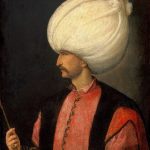
Ottoman miniature painting emerged in the 15th century, rooted in a rich blend of artistic traditions. The earliest examples appeared under Sultan Mehmed II, who reigned from 1451 to 1481. Known for his deep interest in art and culture, Mehmed invited painters and scholars from Persia and Italy to his court. This laid the groundwork for a visual language that would evolve into a distinctly Ottoman form of miniature painting.
Byzantine and Persian influences shaped the style of early Ottoman miniatures. Persian art contributed fine line work, elaborate detailing, and vivid storytelling. Byzantine influence added a focus on symbolism, flattened perspective, and rich use of gold and color. Together, these elements formed a hybrid style that reflected both Islamic traditions and the imperial ambitions of the Ottomans.
Persian and Byzantine Roots in the Early Ottoman Style
Persian-style manuscript illustration brought with it a preference for decorative geometry and storytelling through image. Ottomans adapted these elements, but favored realism in architectural details and depictions of real events. This emphasis on documentation marked a key difference from Persian miniatures, which often illustrated poetry and allegory. The Ottomans preferred battle scenes, ceremonies, and portraits of sultans.
By the late 1400s, the artistic influence of Central Asia also filtered into the Ottoman aesthetic through Timurid connections. Artists and calligraphers migrated from Herat and Samarkand, bringing new techniques in ink, paper, and composition. Ottoman painters adopted these methods and began to develop their own schools of miniature production. The imperial court quickly became the heart of this evolution.
Ottoman miniatures were not merely decorative; they were also historical records. As early as the 1490s, manuscripts illustrated specific military campaigns and court events. The shift toward realism continued through the 16th century. These works not only pleased the sultans but also served to preserve and project imperial power.
The Role of the Nakkashane (Imperial Workshops)
Miniature painting in the Ottoman Empire was institutionalized through the establishment of imperial workshops known as nakkashanes. These ateliers were located primarily within the Topkapi Palace and were supervised by court-appointed officials. The nakkashanes functioned as complex creative hubs where artists, calligraphers, and bookbinders collaborated on imperial manuscripts. This organizational model ensured high-quality artistic production and strict oversight of content and style.
Sultans played an active role in overseeing the workshops, commissioning works to celebrate military victories, religious devotion, and court ceremonies. Artists were salaried members of the palace staff and often worked on multiple projects at once. The collaborative nature of production meant that no single artist typically signed their name, reflecting the collective identity of the imperial enterprise. However, senior painters known as başnakkaş (chief painters) often left stylistic marks identifiable by scholars.
Organization and Hierarchy of the Miniature Painters
The hierarchy within the nakkashane was formal and strict. At the top stood the chief painter, who managed projects and approved final compositions. Beneath him were master miniaturists, illuminators responsible for decorative motifs, and junior assistants or apprentices. Each artist specialized in a specific aspect, whether faces, garments, landscapes, or calligraphic borders.
Apprentices underwent years of training under senior artists, learning everything from pigment grinding to manuscript layout. Promotions within the workshop were based on skill and loyalty to the court. Though most remained anonymous, some artists gained reputations for exceptional work and were later recognized by name. Over time, the workshop system became central to preserving stylistic consistency across imperial commissions.
Manuscript production was a labor-intensive process, often taking months or even years to complete. The process began with text layout, followed by image planning, drawing, coloring, and gold illumination. Final works were reviewed by court officials before being placed in the palace library or gifted to dignitaries. The nakkashane ensured that Ottoman visual culture remained both refined and regulated.
This system allowed for continuity and innovation within boundaries set by imperial patronage. It helped the Ottoman miniature develop a recognizable visual identity, distinct from the Persian and Arabic traditions. The nakkashanes were essential to the cultural prestige of the empire and remained active for over two centuries.
Court Patronage and the Golden Age under Suleiman the Magnificent
The reign of Sultan Suleiman I, from 1520 to 1566, marked the golden age of Ottoman miniature painting. Under his patronage, the imperial workshops reached unprecedented levels of productivity and refinement. Suleiman was a patron of the arts who commissioned grand manuscripts to glorify his reign. These included histories, scientific treatises, and religious texts, all richly illustrated.
One of the most celebrated works from this era is the “Süleymanname,” completed in 1558. This illustrated biography depicted the sultan’s achievements in battle and governance. Dozens of miniatures within the manuscript show Suleiman on campaign, receiving foreign ambassadors, and reviewing his troops. The work reflects the balance between stylized grandeur and historical specificity that defined the period.
Key Commissions and Artistic Flourishing in the 16th Century
A key figure of this period was Matrakçı Nasuh, born around 1480 and active until his death in 1564. Trained as a soldier, historian, and mathematician, Nasuh became a master of miniature painting. His most famous works depict cities and roads along imperial campaigns in astonishing topographical detail. His 1537 illustrations of the route to Baghdad offer a rare visual document of 16th-century urban life.
Another major work of the period was the “Hünername,” or “Book of Talents,” begun during the reign of Suleiman and completed under his successor. It recorded the deeds of earlier sultans and included hundreds of miniatures. The project’s scale demonstrates the immense resources the court devoted to manuscript illustration. Each image reinforced imperial legitimacy through art.
Artists of this period focused not only on grand scenes but also on intimate court moments. Coronations, weddings, banquets, and even natural disasters were meticulously recorded. By illustrating these events, artists helped immortalize the grandeur and order of the Ottoman world. Manuscripts became tools of statecraft as well as artistic expression.
This golden era established the visual grammar of Ottoman miniatures that endured for centuries. While later artists refined and adapted it, the core stylistic features—detailed rendering, flat composition, and narrative sequence—emerged fully under Suleiman’s rule. The 16th century remains the pinnacle of miniature painting in Ottoman history.
Themes and Techniques in Ottoman Miniature Art
Ottoman miniature painting centered on narrative and documentation rather than personal expression or abstract concepts. Major themes included military campaigns, royal ceremonies, religious processions, and urban architecture. Artists illustrated not only events but also the symbolic structures of empire, such as the palace, mosque, and army. These themes aligned with the needs of a ruling elite keen on documenting and promoting imperial order.
Scientific texts and literary works were also common subjects. Illustrated treatises on medicine, astrology, and botany were produced for the palace library. Many images show physicians treating patients, astronomers charting the stars, or court scholars engaging in debate. Religious works, especially hagiographies and commentaries, were also illustrated, though figural depiction was carefully managed to avoid controversy.
Narrative, Portraiture, and Architectural Detailing
One defining feature of Ottoman miniatures was the lack of depth and realistic perspective. Space was flattened, and figures appeared side-by-side in profile or three-quarter view. This approach emphasized clarity and storytelling over naturalism. Faces were often similar and non-individualized, in keeping with Islamic artistic conventions discouraging portraiture.
Color and material also played important roles. Artists used gouache, gold leaf, and burnished paper to achieve luminous effects. Bold reds, blues, and greens defined figures and settings, while gold highlighted architectural forms. Outlines were carefully drawn in ink, with each element meticulously filled in by hand. The result was a vibrant, controlled image that captured complex events.
Architectural features were depicted with great care, particularly domes, towers, and minarets. Artists included city walls, markets, and interior spaces with surprising detail. These images offer historians valuable insights into urban life and design in the Ottoman period. Cities like Istanbul, Cairo, and Baghdad were repeatedly rendered in ceremonial and cartographic context.
While lacking realism by modern standards, Ottoman miniatures excelled in their ability to convey information visually. The style prioritized legibility and symbolism, linking the manuscript to the broader goals of state documentation and cultural preservation. The technique was both functional and beautiful.
Famous Artists and Manuscripts of the Ottoman Tradition
Several artists rose to prominence within the miniature tradition despite the collaborative nature of manuscript production. Among the earliest and most important was Matrakçı Nasuh, who combined artistic and scientific skills to create detailed cityscapes and campaign routes. Born in Bosnia around 1480, he joined the imperial court and served in both military and artistic roles. His maps and illustrations set new standards for clarity and documentary value.
Nakkaş Osman, active during the reign of Murad III (1574–1595), became one of the most prolific and influential miniature painters of the late 16th century. His name appears in several colophons, rare in Ottoman practice, suggesting high status and recognition. Osman specialized in historical scenes and was known for his attention to facial expression and crowd composition. His style defined the look of later courtly works.
Names that Shaped the Ottoman Miniature Legacy
Another standout figure was Levni, born around 1680 and active until his death in 1732. He brought a more relaxed, expressive style to miniature painting, influenced by European prints and baroque aesthetics. Levni’s most famous work, the “Surname-i Vehbi,” illustrates a grand royal circumcision festival held in 1720. The manuscript is lively and humorous, with dancing figures and theatrical gestures.
Important manuscripts of the tradition include the “Hünername,” the “Süleymanname,” and the “Zubdat al-Tawarikh,” a royal chronicle of Ottoman history. These works combined text and image to promote imperial narratives. The “Surname-i Vehbi” stands apart for its depiction of daily life and cultural festivities. It reflects a shift toward genre scenes and lighter subject matter in the 18th century.
Though most artists remain anonymous, stylistic analysis and historical documentation have revealed patterns of authorship. The Topkapi Palace archives preserve hundreds of illustrated manuscripts, allowing modern scholars to trace individual hands and workshop styles. These works represent some of the finest examples of Islamic book art.
Ottoman miniature painters served the court but also created a lasting cultural legacy. Their work documents an empire’s vision of itself—its battles, ceremonies, cities, and ideals. The painters may not have signed their names, but their skill ensured their place in art history.
The Decline and Transformation of the Miniature Tradition
By the late 17th and early 18th centuries, Ottoman miniature painting began to lose its prominence within the court. The changing tastes of the elite, influenced by increasing contact with European artistic styles, led to a preference for realism, shading, and perspective. Western oil painting techniques were introduced through diplomatic gifts and imported books. As a result, the formal structure of miniatures began to feel dated compared to the new visual possibilities offered by European painting.
The decline of the miniature was also tied to the rise of print technology. As printing presses spread across the empire in the 18th century, the demand for hand-painted manuscripts declined sharply. Mass-produced books, though less decorative, were cheaper and more widely accessible. Illustrated works gave way to engravings and printed illustrations that favored linear drawing over rich color and gold. Miniature artists were increasingly pushed to the margins or forced to adapt to new roles.
Westernization, Printing Press, and Changing Aesthetics
Levni, active until 1732, represented both the peak and the transition of the miniature tradition. His style, with its lighter touch and animated figures, showed an openness to Western influence. Levni’s “Surname-i Vehbi” of 1720 captured the lavish court festival for Sultan Ahmed III’s son with humor and vitality. Yet this artistic high point was also a final flourish before the tradition gave way to modern forms.
As the empire modernized in the 19th century, miniature painting became an increasingly obsolete court art. Artists began receiving formal training in Western-style academies such as the Mekteb-i Sanayi-i Nefise, founded in 1883. Ottoman painting shifted toward oil portraits, landscapes, and scenes of daily life rendered in realistic style. The visual language of empire was transforming rapidly.
Despite the decline, some miniaturists continued working into the early 1800s, producing decorative and religious manuscripts. However, these works were often viewed as nostalgic or backward-looking by an elite focused on modernization. Ottoman miniature art faded from elite culture and was largely forgotten by the end of the 19th century.
The miniature tradition did not disappear entirely—it lived on in folk arts, religious calligraphy, and popular ephemera. Its techniques influenced poster art, tile design, and other decorative media. Though the court workshops closed, the legacy of the miniaturists remained embedded in the culture.
Legacy and Revival in Contemporary Art and Museums
Today, Ottoman miniature painting is celebrated as a cornerstone of Turkey’s visual heritage. Museums, libraries, and universities preserve and study these works for their artistic and historical value. Institutions like the Topkapi Palace Museum and the Istanbul University Library house extensive collections of illustrated manuscripts. Many are displayed in exhibitions to educate the public and promote national pride in Ottoman culture.
Contemporary Turkish artists have also drawn inspiration from the miniature tradition. Some mimic the flat composition and decorative style, while others reinterpret it through modern themes. Artists such as Nusret Çolpan and contemporary miniaturist Hasan Kale have created new works that pay homage to the old forms. This revival reflects a renewed interest in traditional arts amid broader discussions of cultural identity.
Ottoman Miniatures in Modern Turkish Culture
Art schools and workshops in Istanbul and beyond now offer courses in miniature painting. Students learn traditional techniques including ink preparation, gold application, and brushwork. These institutions are helping to pass down a discipline that once defined the empire’s visual imagination. Though adapted for the present, the core methods and aesthetics remain faithful to historical practice.
Miniature art is also featured in modern media, from children’s books to graphic novels. Artists have begun incorporating Ottoman visual styles into digital illustration and animation. These new formats bring the miniature tradition to wider and younger audiences, helping it remain relevant in the 21st century.
Public interest in Ottoman art has surged in recent years, aided by popular television series and cultural tourism. The visual grandeur of the empire continues to captivate modern viewers. Exhibitions of Ottoman miniatures have toured internationally, drawing attention to a once-overlooked chapter in world art history.
Though the imperial court that once sponsored miniatures is long gone, the art form it nurtured has found new life. As both a historical document and a visual treasure, the Ottoman miniature continues to tell stories—this time to new audiences, in new ways.
Key Takeaways
- Ottoman miniature painting began in the 15th century and peaked during the reign of Suleiman the Magnificent.
- Key influences included Persian, Byzantine, and Central Asian artistic traditions.
- Artists like Matrakçı Nasuh, Nakkaş Osman, and Levni helped define the visual style.
- The nakkashane workshop system ensured quality, collaboration, and court oversight.
- The tradition declined in the 18th and 19th centuries but is now experiencing a revival.
Frequently Asked Questions
- What was the main purpose of Ottoman miniature painting?
To illustrate manuscripts and document historical events, often for royal and official use. - Who were some famous Ottoman miniature painters?
Matrakçı Nasuh, Nakkaş Osman, and Levni are the most well-known names. - Why did the miniature tradition decline?
European influence, the rise of the printing press, and changing artistic tastes led to its decline. - Where can I see original Ottoman miniatures today?
Topkapi Palace Museum and Istanbul University Library hold major collections. - Are Ottoman miniatures still created today?
Yes, modern artists and students continue the tradition using both old and new techniques.