In 1753, a small group of German-speaking Moravian settlers arrived in the wooded interior of what would become North Carolina’s Piedmont region. They named the land “Wachovia” and began building a settlement that was at once spiritual, social, and architectural. This community—first Bethabara, then Salem—was not organized around conquest, profit, or secular freedom, but around a religious imperative that fused daily labor with devotional life. They cleared trees, molded bricks, raised walls, and crafted tools and furnishings with a theological seriousness that gave shape to the region’s earliest enduring works of art.
This was not “fine art” in the academic sense. These settlers produced few oil paintings, no monumental sculpture, and had little use for decoration for its own sake. Their legacy survives not in portraits of aristocrats or battle scenes, but in the form of robust brick houses, half-timbered workshops, elegantly proportioned furniture, and utilitarian pottery—all constructed with an inward discipline and communal ethic. The Moravians believed that craftsmanship was not only compatible with religious humility—it was an expression of it. Every joint fitted properly, every pot thrown well, and every dovetail hidden from sight affirmed the idea that beauty and usefulness were inseparable in a well-ordered life.
Brick by Brick: The Masonry of Melchior Rasp
Among the most skilled and influential early builders in Salem was Melchior Rasp, an Austrian-born stonemason who had worked on imperial projects in Europe before joining the Moravian cause. He arrived in Wachovia in the mid-1760s and quickly became indispensable to the community’s architectural rise. Rasp’s expertise is visible in buildings such as the Single Brothers’ House (1769) and the Salem Tavern, whose brickwork and structural discipline reflect not only European craftsmanship but a pragmatic adaptation to frontier conditions.
These structures remain intact today, preserved in the Old Salem Historic District, and they speak directly to Rasp’s formal rigor. Unlike the rough log cabins that dotted the frontier elsewhere, Moravian buildings in Salem exhibited symmetrical facades, neatly coursed bricks, and rational interior layouts. Rasp brought with him the traditions of German masonry and timber-framing, but he also adapted them to local materials—clay-rich soil for bricks, native oak and pine for beams, and handmade lime for mortar. His buildings are not merely relics; they are documents of transatlantic skill transferred into the heart of early American wilderness.
Shops, Cellars, and the Quiet Beauty of Order
By the 1770s, Salem had grown into a network of interlocking workshops, trade buildings, homes, and religious structures. The Joiner’s Shop, the Potter’s Workshop, and the Tavern Kitchen were not just places of labor—they were carefully constructed environments that reflected an economy of form and a theology of modesty. Doors were crafted with recessed panels, floorboards were hand-planed and pegged, and windows were proportioned to let in a moderate, rational light.
One striking example is the Joiner’s Shop, which housed carpenters trained in the making of furniture, cabinetry, and architectural interiors. These joiners—men such as Johann Gottlob Krause—produced pieces that merged practical necessity with subtle stylistic grace. Beds, tables, and cupboards bore restrained ornament: a beveled edge here, a carefully turned leg there. No element was overdone, and none was purely decorative. Even their stains and finishes spoke of patience and material respect, often derived from locally sourced ingredients: walnut hulls, iron oxide, and hand-rendered wax.
Within this workshop world, artisans were not anonymous laborers but respected members of the congregation. Their days were guided by the clock and the chapel bell. They lived in communal houses and shared in religious music, prayer, and meals. The whole structure of life elevated the act of making into something closer to devotion. In this, the Moravian settlement prefigured the later ideal of the workshop school or Bauhaus studio—but without any ideology of revolution, only one of obedience and harmony.
Clay in the Hand: Early Pottery and Everyday Art
Of all the media practiced in early Salem, pottery was perhaps the most directly expressive. It offered a tactile bridge between European formality and local necessity. Functional wares—jugs, crocks, storage jars, pitchers—were thrown on the wheel and finished with slips and glazes in hues of brown, green, and gray. These pieces, often unsigned, bear a quiet, classical restraint. Their elegance lies in proportion, weight, and surface texture, not flourish or display.
The Moravian potter Johann Gottfried Aust, active in the late 18th century, is one of the few whose work can be definitively attributed. His surviving pieces show a fine sensitivity to balance and use, often featuring sgraffito decoration with incised floral or geometric designs. While these marks suggest a European folk tradition, they are executed with control and consistency, never descending into whimsy or excess. Aust’s kiln also became a teaching site for future potters, helping to establish what would later evolve into the Seagrove pottery tradition, a through-line that links early religious settlement to 20th-century artistic revival.
The Domestic Interior as Artistic Composition
Perhaps the most complete expression of Moravian aesthetics is not found in any one object but in the total composition of a domestic interior. Stepping into a preserved house in Old Salem today, one encounters a world shaped by proportionality, modesty, and craft. The bed is built-in, the chest of drawers hand-planed, the walls whitewashed. Even the fireplace mantels and corner cupboards show evidence of thoughtful design—simple chamfers, minimal cornices, and honest joinery. The result is a visual and spatial coherence that holds aesthetic value even in silence.
There is no separation between fine and decorative art in such a space. The art lies in the arrangement of labor, the use of material, and the belief that a well-made object contributes to spiritual and communal order. In that sense, these interiors are not merely historic—they are philosophical.
The Legacy of Early Craftsmanship
By the early 1800s, as Salem grew in population and economic complexity, its artistic culture remained grounded in these early principles. While styles would shift and external influences grow stronger over time, the foundation laid by the Moravian settlers continued to shape North Carolina’s understanding of what good art should be: honest, purposeful, and grounded in material reality. Their legacy is not one of innovation for innovation’s sake, but of a quiet mastery that speaks still through wood, clay, and the geometries of a brick wall.
There are few clearer statements of belief than a structure still standing after 250 years, built by hand, measured by faith.
Chapter 2: The Quiet Craftsmanship of the Piedmont
A Furniture Language Carved in Walnut and Poplar
By the early 1800s, the tide of settlement in North Carolina had pushed westward from the coastal plain and Moravian towns into the Piedmont. This interior upland was not shaped by formal town planning or religious collectivism, but by scattered farms, kinship settlements, and a slow-building domestic economy. With no central authority guiding aesthetics, the artistry that emerged here developed out of necessity, material availability, and the quiet pride of independent craftsmanship. It was in these fields and forests—around towns like Salisbury, Lexington, and Hillsborough—that North Carolina’s most distinctive early furniture forms took root.
These were not imported pieces from Philadelphia or Charleston. They were local, often rough-hewn, built by hand with tools sharpened in the back of a barn. Yet within their practical outlines—chests of drawers, blanket boxes, tall-case clocks—emerged a refined design intelligence. Cabinetmakers used native walnut, cherry, and yellow pine. They carved modest ogee bracket feet. They assembled dovetail joints without glue. And when ambition struck, they added paint: ochres, indigos, and black iron oxide, stenciled or brushed in rhythmic, often geometric patterns.
This was a regional language of craftsmanship, spoken fluently but without ostentation. A chest made by Jesse Needham in Guilford County around 1810 says more about the character of the Piedmont than any surviving document from that time. The proportions are strong and slightly squat, the feet low and clipped, the surface free of frill but not of grace. It is an object of daily use—but also of inheritance, survival, and place.
The Hands Behind the Wood
The cabinetmakers of the Piedmont were often farmers first. Winter months, when fields lay fallow, offered time for joinery. Sometimes a skilled craftsman would take commissions for neighbors—a wedding chest, a cupboard, a bedframe—and gradually earn a local reputation. These men worked in lean shops with foot-powered lathes, bow saws, and hand planes. They worked with what they had and designed with what they knew: a blend of Old World inheritance and the pressures of New World life.
The German-speaking settlers who dominated Rowan and Davidson counties brought strong woodworking traditions. Their joinery was direct, their ornament restrained but purposeful. The Scots-Irish and English settlers, more dispersed but equally determined, often favored simpler lines and painted finishes. In either case, the guiding principle was durability—physical, but also familial. These were objects made not to impress, but to last.
A blanket chest with compass-rose decoration, made in the late 18th century near Alamance County, reflects this ethos perfectly. Its decorative pattern—a simple red and black star inside a squared frame—was applied not by stencil but freehand, with a steady brush and local pigments. It was never meant for a salon, but for the corner of a bedroom, where it held quilts and heirlooms. And yet its presence endures as strongly as any parlor portrait.
The Michael Braun House and the Stone Ideal
Not all Piedmont craftsmanship was in furniture. The Michael Braun House, built in 1766 in Rowan County, stands as one of the oldest surviving stone dwellings in North Carolina. Constructed by German immigrants, its thick walls and steep gabled roof reflect a building tradition born in the Rhineland and adapted to the Carolina piedmont. It took over a year to quarry, shape, and assemble the stone. The house still stands today, as solid as a tomb but never inert.
Inside, the wooden floors, plastered walls, and iron hardware speak to the same craft continuum as the local furniture trade. This was not high design—it was high purpose. Stone gave protection from heat and storm; wood gave shape to daily life; lime plaster sealed the human world from the elements. Every element had a reason, and that reason was always practical.
The house also shows how individual builders—most of them nameless to us now—brought patterns of making into a new, wild landscape and adjusted them with humility. There is no grand hall or dramatic staircase. There is instead a low-ceilinged central hearth, worn flagstones, and hand-hewn lintels that still bear the marks of the adze. It is, like the furniture of the Piedmont, deeply physical and utterly unpretentious.
Paint, Pattern, and the Decorative Impulse
While many surviving Piedmont pieces emphasize structure over ornament, some cabinetmakers ventured into the decorative. Using mineral-based paints, they applied stylized motifs to case furniture—crosses, fylfots, vines, and chevrons—often adapted from Germanic folk traditions. These painted pieces were especially common in Davidson, Randolph, and Alamance counties between 1790 and 1840.
One striking example—a tall corner cupboard painted in red and black with stylized floral forms—was likely created by a semi-itinerant craftsman who worked up and down the Uwharrie region. It is not precise, nor is it entirely symmetrical. But it is deeply intentional, and it reveals a sense of rhythm and tone not unlike that of a regional ballad or fiddle tune: familiar, slightly improvised, and unmistakably local.
Three key features distinguish these painted works:
- They used locally available woods such as yellow pine or tulip poplar, which took paint easily and were often covered entirely.
- Their decoration followed structural lines, emphasizing panel divisions, drawer borders, and corners rather than hiding them.
- The color palette was narrow but bold, favoring earthy reds, deep blacks, and warm browns—all derived from regional minerals or trade pigments.
Though rarer than their unpainted cousins, these pieces signal the latent aesthetic impulse running through Piedmont craftsmanship—not mere utility, but the desire to make the useful beautiful.
Stoneware and Clay Vessels of the Interior
Parallel to woodcraft, Piedmont settlers also produced vast quantities of functional pottery—stoneware jugs, lidded jars, and storage crocks—thrown on wheels and fired in wood-burning kilns. These potteries, operating from the late 18th century through the mid-19th, formed another quiet artistic tradition rooted in endurance.
Most Piedmont stoneware was salt-glazed or alkaline-glazed, depending on the clay body and firing technique. Decorations, if any, were sparse: a finger-swiped line of cobalt, a scribed floral loop, a stamped maker’s mark. The forms were dictated by use—how much cider or buttermilk it held, how tightly it sealed, how well it balanced on a shelf or wagon.
Many of these potters were also farmers. Their craft was seasonal, repetitive, and learned through direct apprenticeship. And yet the best pieces—like those attributed to potters such as William Dennis or Peter Bell—exhibit an understated elegance: walls of even thickness, lips that pour cleanly, lids that sit with satisfying finality.
The Craft Tradition as a Cultural Logic
What unites these disparate works—furniture, pottery, buildings—is not a shared school or ideology, but a shared sensibility. Piedmont art in this period was not “art” in the modern sense. It was a system of making that answered immediate needs but did so with thought, repetition, and refinement. It produced objects that stood upright, held weight, locked tight, and endured.
And in their endurance, they reveal a kind of unsung aesthetic knowledge. There is no manifesto, no artist’s statement. There is only the object, well made, still serving.
In a culture increasingly obsessed with novelty, these early works remind us that art also lives in repetition, in habit, in the grain of walnut, and the curve of a turned leg.
Chapter 3: Portraits, Parlors, and the Itinerant Eye
The Face as Claim to Posterity
In the first half of the 19th century, North Carolina remained largely rural, agrarian, and culturally peripheral compared to cities like Boston, Philadelphia, or Charleston. Yet even in this loosely connected network of farms, market towns, and emerging municipalities, there existed a growing hunger for permanence—something beyond the fields, something to last longer than a season’s crop. One response was portraiture. To sit for one’s likeness was to assert one’s place in the world. A painting, even modestly executed, declared that a name and a face mattered enough to be remembered.
These were not grand society portraits hung in marble halls. Most were modest oil-on-canvas works commissioned by merchants, landowners, physicians, and their families—individuals who had achieved a degree of stability but who remained outside the sphere of cultural elites. And the artists who painted them were rarely household names. They were itinerants, semi-trained or self-taught, working from town to town with a portable easel and a kit of pigments. The portrait tradition in North Carolina did not emerge from art academies. It came through the back door, canvas rolled under one arm, hoping for a commission.
Jacob Marling in Raleigh: The Lone Professional
The English-born painter Jacob Marling, active in Raleigh after 1810, stands out as a rare early example of a professional portraitist settling in North Carolina’s capital. Marling’s surviving works, such as Portrait of a Boy (held by the North Carolina Museum of Art), show a delicate but formal composition: a youth seated against a darkened backdrop, gaze direct, attire carefully detailed. There is a clear effort to emulate the conventions of Anglo-American portraiture—the pose stiff but composed, the lighting modeled, the skin smooth, the hands carefully considered.
Marling’s work is not revolutionary, but it is competent, and it testifies to a desire among Raleigh’s residents to engage with broader cultural norms. At a time when the city had few painters and no dedicated art institutions, Marling’s studio served as a bridge between provincial need and metropolitan aspiration. It also reflected the emergence of a stable class in North Carolina that could afford art—not in abundance, but with purpose. The goal was not style for style’s sake, but remembrance: a family face over the mantel, a visual record passed through generations.
William Joseph Williams and the Coastal Commissions
Further east, in the port city of New Bern, painter William Joseph Williams found more fertile ground. A veteran of the broader American portrait scene, Williams arrived in North Carolina around 1804 and remained active for nearly two decades. Unlike Marling, whose work remained locally known, Williams had painted distinguished national figures, including George Washington. His arrival in New Bern brought a touch of cultural prestige, and his portraits from this period reflect both technical skill and cosmopolitan ease.
Williams’ subjects in New Bern included merchants, lawyers, and regional leaders—men whose wealth was often built on trade, real estate, or law. His style was refined but unfussy: strong delineation of facial features, careful attention to garments, and a plain yet dignified compositional structure. These works underscore how portraiture in early North Carolina was not only about individual likeness but also about social self-definition. To be painted by someone like Williams was to claim connection to a larger American narrative—one that reached beyond the Neuse River.
The Itinerant Painter: A Road-Borne Profession
For much of the Piedmont and western parts of the state, portraiture came not from residents like Marling or Williams, but from artists who passed through. These itinerant painters operated without studios, setting up temporary workspaces in inns, boarding houses, or clients’ homes. They offered likenesses for a fixed fee, often advertising in local newspapers. Some had rudimentary training, others none at all. The quality varied, but the demand was steady.
A miniature portrait painter like George Ladd, who worked across several Southern states including North Carolina, provides a model for this class of artist. His sitters were often middle-class customers seeking affordable but flattering images—something to mark a marriage, commemorate a death, or celebrate upward mobility. Many of these works remain unsigned, their makers known only through local lore or stylistic clues.
These itinerants offered more than just portraits. They carried a kind of cultural knowledge—trends in clothing, poses, and props—that clients in more remote areas might not have otherwise encountered. In this way, they functioned as both artists and messengers, bringing a traveling theater of self-representation to a population eager to participate.
Parlors as Picture Galleries
Once painted, portraits were not tucked away but prominently displayed—in parlors, front halls, and sometimes above fireplaces. In wealthier homes, several generations of portraits might be hung together in carefully staged groupings, combining grandparents, parents, and children into a painted lineage. These compositions, however informal, were deeply intentional. They mapped identity, respectability, and continuity.
The physical settings of these displays matter. Many North Carolina homes of the period had modest rooms with plain plaster walls and handmade furnishings. Within these restrained interiors, a portrait stood out as a visual centerpiece. It was, in effect, a claim: this family was stable, respectable, and enduring. The image didn’t merely reflect the subject—it elevated them.
- A child’s portrait might mark survival through early illness or loss.
- A woman’s portrait might fix her youth and beauty just before marriage or motherhood altered her role.
- A patriarch’s likeness might solidify legal and economic standing in a town where documentation was sparse.
The portrait thus became more than a likeness. It was a surrogate presence, a kind of moral anchor within the home.
The Challenge of Likeness
In a region with no established art schools, no grand salons, and few engravings or examples to study from, early North Carolina painters often struggled with anatomy, perspective, and light. Faces could appear stiff, hands poorly rendered, and bodies slightly out of scale. But within these limitations lies something honest. These portraits often capture something essential—a child’s solemnity, a matriarch’s reserve, a farmer’s pride.
There is no mannered flattery in many of these works. Instead, they offer a kind of visual candor shaped as much by the sitter’s expectations as the artist’s technique. In some cases, the lack of polish becomes a strength: it forces the viewer to focus on the character, not the finish.
One anonymous mid-19th-century portrait from Alamance County shows a man in plain black coat, face slightly turned, eyes alert. The background is a dark ochre wash; the light falls awkwardly across his brow. Yet the painting holds. It speaks with a quiet authority, rooted in place and purpose.
Memory on Canvas
By the 1850s, photography would begin to supplant painted portraiture in many parts of North Carolina. Daguerreotypes and later cartes de visite offered faster, cheaper, and more accurate likenesses. But the painted portrait held on—especially among families who valued tradition or who could afford both.
What survives in museum collections today, such as those at the North Carolina Museum of Art, is a record not only of faces but of a whole era’s self-image. These portraits are not merely decorative. They are archival, testimonial, and deeply local. They remind us that the desire to be remembered is not reserved for the powerful. In small towns and rural homes, across parlors and across decades, North Carolinians used art to say: “We were here.”
And across the centuries, they still are.
Chapter 4: Landscape Before Landscape
Before the Hudson River School, the Hills Had a Quiet Majesty
In the cultural hierarchy of early American painting, landscape was late to take root. History, portraiture, and genre scenes dominated artistic priorities well into the 19th century, especially in rural regions like North Carolina. And yet, long before names like Thomas Cole or Frederic Church became synonymous with American views of wilderness, there existed a subtler, more utilitarian form of landscape image-making—one that quietly documented the terrain of daily life. In North Carolina, these early depictions of land were not born of aesthetic philosophy but of proximity, necessity, and curiosity. They came from surveyors, travelers, amateur artists, and local observers who turned their eyes toward the wooded hills, winding rivers, and open fields—not to idealize them, but to record them.
Landscape painting, in the formal academic sense, would not flourish in North Carolina until decades after it did in the Northeast. But fragments of that vision—early and often anonymous—survive in oil sketches, prints, topographical vignettes, and the occasional fully rendered painting. Together, they form a proto-landscape tradition: one rooted in geography rather than grand theory, in observation rather than idealism.
A Small Canvas, a Big Silence
In the holdings of the North Carolina Museum of Art, there exists a small oil-on-copper painting from the late 18th or early 19th century titled simply Landscape. The artist is unknown. The scene is quiet, almost stark: a modest house set against a rolling field, edged with low trees and a narrow sky. There is no drama, no allegory, no heroic mountain bathed in divine light. And yet the work compels. Its silence feels lived in. The painter—whether local or visiting—did not seek to elevate the land but to inhabit it.
Works like this suggest that North Carolina’s earliest landscape images were not imitative of European pastoral models but reflective of a distinctly local engagement with space. The land was not backdrop. It was subject. Not yet aestheticized, it was nonetheless studied, walked, and internalized. These early landscapes carry the texture of memory, the spacing of settlement, the shape of survival.
Surveyors, Soldiers, and the Topographical Eye
Before artists arrived with romantic ideals, the land was being drawn, mapped, and sketched by men with other purposes. Military engineers, surveyors, and naturalists traveled through the Piedmont and Appalachians in the 18th and early 19th centuries, leaving behind topographical drawings, field maps, and botanical illustrations. These were not “art” in the formal sense—but they often functioned visually in the same way.
The drawing of a bend in the Yadkin River, the contouring of a foothill ridge, or the shading of forest cover on a military map reveals a level of observational attention remarkably close to that of later landscape painters. For these early recorders, the land was measured and marked—but it was also watched. The angle of a slope, the direction of drainage, the shape of a tree line—these became compositional elements long before artists turned them into metaphors.
Three practical forces shaped this visual prehistory of landscape:
- Land grants and settlement claims required visual surveys and hand-drawn maps to establish boundaries and ownership.
- Military expeditions needed terrain drawings for navigation and strategic planning, particularly in the wooded mountain areas.
- Naturalists and geologists increasingly recorded terrain features alongside specimens, contributing to both science and the early pictorial understanding of land.
Out of these functional images emerged a sense of regional place—a vocabulary of hills, rivers, and ridgelines that prefigured artistic landscape without yet being claimed by it.
The Mountains as Distant Stage
For most early North Carolinians, the Blue Ridge and Great Smoky Mountains were more myth than subject. Distant, vast, and logistically challenging, the western highlands were often referenced but rarely depicted. It was not until the early 1800s that artists began traveling into the region with the express purpose of rendering its visual character.
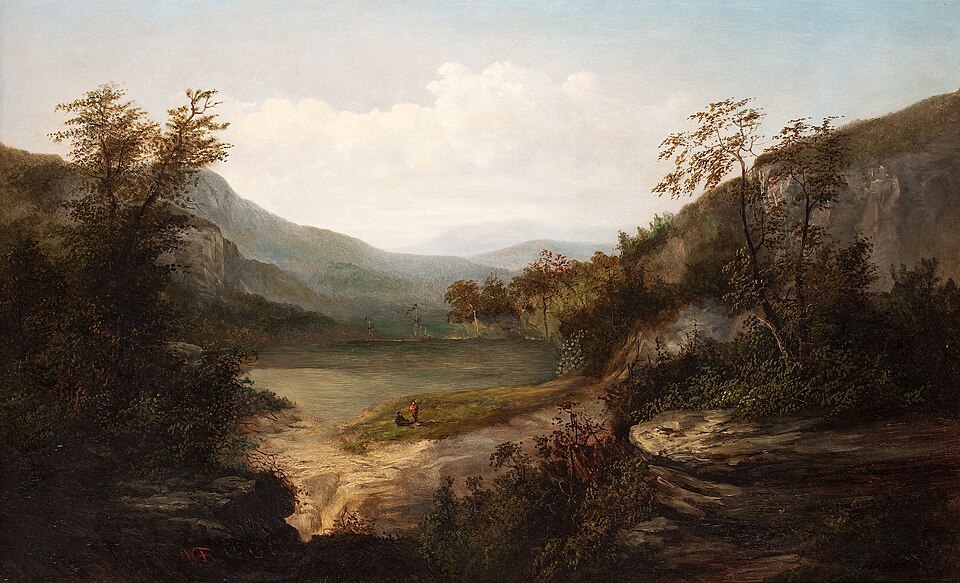
A few works from the 1820s and 1830s—likely by itinerant or visiting artists—depict Appalachian foothills and rural river valleys in what is now western North Carolina. These are modest works: oil on panel or paper, often unsigned, sometimes derivative of broader Eastern seaboard painting trends. Yet they mark a turning point. The land was no longer just terrain to be crossed. It was something to be looked at, and looked at with intent.
Even these early views, however, resist the dramatic verticality that would later define Hudson River School panoramas. North Carolina’s landscapes—more intimate, humid, and dense—did not lend themselves to theatrical compositions. Instead, they invited detail. A low ridge rising through morning fog. A fence line breaking the edge of a cornfield. A cabin nestled into the base of a hollow. The artists, whether trained or not, responded to what the land offered: closeness, texture, and enclosure.
Hudson River Reverberations
When the Hudson River School emerged in the 1820s and gained momentum through the mid-19th century, it sent visual shockwaves through American painting. Cole, Durand, Bierstadt, and others brought a new intensity to the idea of landscape as moral terrain—a place of sublime encounter and national destiny. While these artists focused primarily on the Northeast, their influence spread. By the 1840s and 1850s, their approach to landscape painting reached artists across the country, including those working—or traveling through—North Carolina.
And yet, North Carolina painters did not simply imitate the Hudson River style. The geography they confronted demanded a different scale, a different light. The mountains here were worn and wooded, not jagged or snow-capped. The coast was marshy and intimate, not cragged and storm-blown. And the culture was one of restraint, not theatricality. The result was a landscape approach more muted, more textural, and often more topographically honest.
By the time Hudson River aesthetics arrived in the region, North Carolina already had its own visual memory of land—one shaped by function, closeness, and endurance.
The Land Remembered More Than Imagined
These early North Carolina landscapes rarely strive to evoke transcendence. There is little allegory, little abstraction. Instead, they function as visual recollections—personal, regional, and grounded. They serve as records of habit: the way a field slopes toward a creek, the bend in a fence line, the dimming light across pinewoods at dusk.
They also reflect a deep local knowledge. Unlike later tourist-painter images of the American West, these landscapes were made by people who lived among the places they depicted. There is no spectacle, no sense of discovery. There is, instead, a kind of visual neighborliness—a seeing that comes from walking the same path every day.
- A field cleared by hand, now shown in full summer grass.
- A ridgeline viewed from the porch, winter light settling across bare trees.
- A garden plot tucked behind a log barn, sketched from memory.
Such images remind us that landscape does not require grandeur to be meaningful. In North Carolina, it began not with manifestoes or manifest destiny, but with familiarity—with people who knew the land well enough not to romanticize it.
A Foundation Without a Movement
North Carolina’s earliest landscapes did not form a “school.” There was no unified philosophy or formal instruction. But there was, undeniably, a way of seeing the land that took hold in these early decades: attentive, restrained, durable. The artists—known and unknown—left behind more than painted surfaces. They left an attitude, a posture toward the land that shaped what came after.
In that posture lies the root of something lasting. It is the beginning of a regional visual memory—not loud, not ideological, but insistent. The land was not background. It was where one stood. And for those early painters, that was reason enough to begin.
Chapter 5: Civil War and the Aesthetics of Disruption
A Shattered Continuity
The Civil War disrupted every institution in North Carolina—its farms, cities, schools, churches, and homes. It also disrupted the quiet, handmade visual traditions that had taken shape in the decades prior. The long-standing regional crafts of joinery, pottery, and portraiture did not vanish, but they were strained and fragmented. The work of the artisan slowed or ceased; studios closed; raw materials became scarce. Painters took up arms or fled towns. Families once commissioning portraits or furniture turned to survival. In short, the war fractured not only the economy but the continuity of artistic labor.
But destruction does not always erase memory—it can imprint it. And in the case of North Carolina, the Civil War left a strange, uneven visual record: fragments, impressions, images born of constraint rather than intention. There are no great canvases of battle scenes or panoramic murals of victory. What survives is quieter, more observational—lithographs, photographs, field drawings, and, later, emotionally charged landscapes. These remnants form a disjointed but real visual history of the war’s effect on the region’s art.
A Prison Camp on Paper: Botticher’s Salisbury Image
One of the few images created during the war in North Carolina comes from Otto Botticher, a German-American soldier and artist who was imprisoned at Salisbury Confederate Prison in 1862. His watercolor sketch, later adapted into a lithograph, depicts Union prisoners playing baseball in the prison yard. Though the scene appears oddly tranquil, it is, in fact, charged with tension. The high walls, watchful guards, and barred windows encase the men in a world of uncertainty. Yet Botticher chooses not to dramatize confinement. He shows human endurance—soldiers reclaiming a moment of normalcy within the chaos of war.
The image is significant not only for its content but for its medium. As a lithograph, it could be reproduced and distributed, reaching a broader audience than any oil painting. It reflects how visual communication during the war shifted: from singular, commissioned works toward reproducible images meant for circulation, documentation, or propaganda. In this sense, Botticher’s view of Salisbury represents a pivot—art as witness, not embellishment.
The Rise of the Camera and the Fall of Illusion
While painters had once dominated the field of visual memory, the 1860s marked the ascendancy of photography. Even in war-torn North Carolina, photography studios existed before the war and resumed work shortly after. Cartes-de-visite and tintypes captured soldiers, widows, generals, and ruins. The camera documented not glory but loss: damaged buildings, empty streets, ragged uniforms. These images were not idealized—they were often stark, even brutal.
Photographers in North Carolina such as Samuel M. Siewers in Salem or E. & H.T. Anthony & Co., whose works circulated nationally, offered the public something new: memory that could be mechanically fixed. Unlike a portrait, which interpreted, the photograph insisted. It gave war a face, a landscape, a body.
Three major consequences followed:
- The democratization of image-making: No longer confined to the wealthy or artistically inclined, families of modest means could now afford to be photographed—especially in uniform.
- The documentation of physical damage: Post-war photographs of Raleigh, Wilmington, and Fayetteville show crumbling buildings and emptied town squares—not scenes of victory, but absence.
- The rise of visual mourning: Portraits of the dead, often retouched or displayed with black borders, turned photography into a private ritual of grief.
Painters had once served this role, but the camera overtook them. The war ended not only lives, but an era in which art could pretend to be separate from history.
Post-War Reverberations: Tonalism and Emotional Landscape
The war also changed how the land was seen. Where once the Piedmont and mountain regions had been painted as workmanlike spaces of settlement, post-war artists began to see the land in more emotional terms. The best-known example is Elliott Daingerfield, born in 1859 in Harpers Ferry but raised in North Carolina. Though too young to have fought, Daingerfield grew up in a landscape marked by memory and ruin.
His mature works, produced in the late 19th and early 20th centuries, show a deep Romantic sensibility. “Evening Glow”, “Landscape with Mist”, and other paintings dissolve detail into atmosphere. There are no battlefields, but the mood carries an echo of loss. Daingerfield’s soft tonal gradients and hazy light reflect not nostalgia but reverence—a desire to see the land not as property, but as something sacred and altered.
While his style owes more to European Tonalism and Symbolist influences than to local tradition, his sensibility is deeply Southern. He paints memory without narrative, mood without event. This is, perhaps, the most lasting aesthetic inheritance of the Civil War in North Carolina: a shift from literal representation to a kind of emotional evocation. The war taught artists that not everything can be shown directly.
Regional Absences and the Problem of Representation
Compared to Northern states, or even to Virginia, North Carolina produced few grand-scale Civil War paintings. There were no commissions for mural cycles, no nationally prominent battlefield canvases. This absence is telling. Much of the war’s artistic record in North Carolina is composed of fragments:
- A hand-colored photograph of a young man in Confederate gray, now gone.
- A letterpress broadside with a woodcut image of a burning depot.
- A mourning brooch with a miniature portrait of the deceased.
- A painted-over canvas, where war-time shortages forced artists to reuse materials.
These fragments reflect the material realities of the war—scarcity, disruption, improvisation. But they also suggest a deeper reluctance. For many in the South, including North Carolina, the war could not be easily aestheticized. The cost was too high, the meaning too complex. Artists responded with quietness, indirection, or silence.
Even decades later, when painting revived in the state, direct representations of war remained rare. Instead, the themes of endurance, loss, and reverence filtered through other subjects: misty landscapes, still interiors, solitary figures. The visual response to the war was not monumental—it was diffused, scattered, personal.
Art After Crisis
The Civil War did not destroy North Carolina’s artistic spirit. But it scattered it. In place of linear development, there came rupture. In place of civic commissions, private grief. In place of confident likenesses, uncertain memories.
And yet, out of this emerged something else: a way of seeing shaped by fragility. The war taught artists to look harder, not at glory, but at what survives it. A crooked fence, a worn face, a field with nothing left to mark its past—these became subjects worthy of depiction.
The aesthetic of disruption did not announce itself loudly in North Carolina. It entered the visual tradition through omission, through tone, through the things not said. And in that silence, art found a new depth.
Chapter 6: Academic Traditions and Institutional Foundations
A Museum by Law, a Culture by Conviction
In 1947, the North Carolina General Assembly passed legislation that would create something without precedent in the United States: a state-funded art museum. The North Carolina Museum of Art (NCMA), which opened its doors in Raleigh in 1956, was not built on a private endowment or philanthropic bequest. It was the direct product of legislative action—a formal public commitment to the visual arts as a cultural necessity. This decision, remarkable in its time, marked the transition of North Carolina’s art world from one of individual makers and private patrons to one of public institutions and academic frameworks. It was the moment when the state declared, with clarity, that art belonged not only in homes and churches, but in schools, museums, and the broader civic realm.
But the museum did not appear overnight. Its origins trace back to 1924 with the founding of the North Carolina Art Society, a volunteer-led organization dedicated to promoting art appreciation and eventually acquiring works for a future public collection. These early efforts—largely grassroots and often underfunded—reflected a slow-growing recognition that the state’s art history would need institutional support if it hoped to survive and expand. The NCMA would eventually house not only European Old Masters and American modernists, but also a growing collection of Southern and North Carolinian art. Its founding marked a moment of consolidation: the merging of civic ambition with academic infrastructure.
The Penland Alternative: Craft as Curriculum
While the NCMA looked outward—toward European art history and national collecting standards—another kind of art institution was growing quietly in the western mountains. The Penland School of Craft, founded in the late 1920s and formally established in 1929, offered an entirely different model: one rooted in the hand, the region, and the revival of craft traditions. Nestled in Mitchell County, Penland rejected the gallery system and embraced the studio, the forge, the loom. It taught pottery, weaving, bookbinding, metalwork, and glassblowing—not as nostalgic hobbies, but as living disciplines.
Penland’s ethos was not anti-academic, but extra-academic. It provided an education based on mastery through repetition, experimentation, and shared labor. Artists learned not from lectures but from tools. The school’s model, influenced by Appalachian heritage and Arts and Crafts ideals, proved remarkably durable. Decades later, Penland-trained craftspeople would exhibit nationally, run studios, and teach at universities. But their training often remained grounded in Penland’s belief: that learning happens through doing, and that art is not confined to canvas and frame.
The contrast with NCMA is instructive. Where the museum sought to collect and exhibit, Penland sought to make and preserve. Together, they formed a kind of institutional double helix: one formal and outward-facing, the other tactile and rooted. Both expanded the state’s cultural infrastructure in complementary ways.
The Rise of University Art Museums
In the mid-20th century, North Carolina’s universities began to embrace the visual arts not only as academic subjects but as vital parts of campus and civic life. The Ackland Art Museum, established at the University of North Carolina at Chapel Hill in 1958, offered a clear example. Funded by a bequest from William Hayes Ackland, the museum focused from the outset on education, accessibility, and the integration of art into the undergraduate experience. Unlike private university collections restricted to donors or graduate scholars, Ackland opened its doors to the public and rapidly built a serious collection of European, Asian, and American art.
This institutional model—university museum as public-cultural engine—became increasingly common. Colleges across the state established galleries, collections, and exhibition programs tied to academic departments. Art history and studio programs grew in tandem. Students studied both theory and technique, often exhibiting their work on campus or assisting in curatorial efforts. These university institutions did not rival NCMA in size, but they often offered more flexibility, showcasing experimental or regional work and providing a pipeline for emerging artists.
Three key developments defined this academic growth:
- Curricular integration: Art history and studio art became standard components of liberal arts education, especially at flagship institutions like UNC and Duke.
- Regional focus: Many university galleries prioritized works by North Carolinian artists, helping build a scholarly and collector base for local talent.
- Public programming: Lectures, exhibitions, and student shows created dialogue between town and gown, merging campus resources with community engagement.
Through these mechanisms, the university museum became not just a repository, but a classroom—and often a launchpad.
Winston-Salem and the State Conservatory Model
The founding of the University of North Carolina School of the Arts (UNCSA) in Winston-Salem in 1963 further institutionalized art education, this time with a conservatory model. Unlike traditional universities, UNCSA focused exclusively on training artists—dancers, musicians, actors, filmmakers, and visual artists—from the high school level through graduate study. Its establishment reflected a growing confidence in North Carolina’s ability to train, not just import, talent.
Visual arts at UNCSA benefited from the intensity and discipline of the conservatory model. Students worked in dedicated studios under working artists; critique and revision were central. The school’s proximity to the Southeastern Center for Contemporary Art (SECCA) and Reynolda House Museum of American Art created a fertile environment for exhibitions, internships, and dialogue.
UNCSA also marked a shift in regional ambition. No longer content to follow national trends from afar, North Carolina’s art institutions began to shape their own. Graduates from UNCSA and other programs stayed in the state, opened galleries, founded collectives, and taught in public schools. The conservatory model proved that high-level art education could thrive in the South, if given structure and support.
Art for the State, Art from the State
The combination of public museums, university programs, and independent schools like Penland created a robust network of institutions. For the first time, North Carolina could support a full art ecosystem: makers, scholars, curators, collectors, and students. Art was no longer something imported from Europe or New York. It could be made here, studied here, shown here, and preserved here.
But these institutions did more than professionalize art. They normalized it. They made it part of daily life—something children encountered on field trips, something students studied in lecture halls, something citizens saw in libraries and public buildings. Art was no longer elite or exotic. It became part of the state’s vocabulary.
This democratization came not from ideology, but from infrastructure. A child who saw a painting at NCMA might study drawing at a local college, visit an exhibition at Ackland, and train at Penland or UNCSA. Each institution reinforced the others. And together, they anchored art in North Carolina not as ornament, but as cultural necessity.
Foundations That Still Hold
By the end of the 20th century, North Carolina had built a solid base for the visual arts—state-funded museums, university collections, craft schools, and public conservatories. These institutions varied in mission and method, but together they ensured that art could be taught, shown, debated, and lived. They provided continuity after a century marked by war, migration, and technological change.
They also left a challenge: to maintain flexibility without losing rigor, to support regional artists without becoming insular, and to remain public-facing in a time of increasing specialization. These are questions that persist. But the institutions endure.
Their greatest success may not be the preservation of masterpieces or the training of virtuosos, but the establishment of a culture in which art is expected—not as luxury, but as part of the structure of a civilized life.
Chapter 7: Seagrove and the Ceramic Renaissance
Clay, Kinship, and the Shape of Endurance
In a quiet radius of pine-covered hills near the geographic center of North Carolina, generations of hands have shaped earth into vessels. The town of Seagrove and its surrounding communities—Whynot, Jugtown, Robbins—form a region where pottery was never a revival or rediscovery. It was survival. Clay here was not romanticized. It was dug, stomped, thrown, fired, and sold. Jugs were for molasses, churns for butter, jars for pickled beans. And when the need for such things faded, the potters did not. They adapted. They turned from utility to beauty, from the plain to the expressive. In doing so, they created something rare in American art history: an unbroken regional tradition that moved from necessity to aesthetic without losing its roots.
The Ground Itself
The story begins with the land. Central North Carolina sits atop a clay belt formed by ancient geological activity. The soil, rich in kaolin and iron oxides, produces a range of workable clays—red earthenware, salt-glaze stoneware, and alkaline clay bodies suitable for high firing. Long before any European or American settler touched it, this land had already supported centuries of Indigenous pottery, crafted by hand and fired in open pits. The early European potters who came—mostly English and German-descended settlers—did not invent pottery in Seagrove. They joined a lineage.
By the late 18th century, permanent pottery settlements were well established. Family shops sprang up, and surnames like Owen, Cole, and Auman became fixtures. These early potters worked in small, often multi-generational operations. They dug their own clay, cut their own wood for kilns, and sold wares from wagons or roadside shops. The forms were dictated by use: gallon jugs, sugar jars, storage crocks. Glazes—when used—were minimal: ash, salt, and occasionally a brown iron slip. There were no galleries. Only need, labor, and repetition.
Jugtown and the Revivalists
The pivotal shift came not from within Seagrove, but from outside eyes looking in. In the 1910s, Jacques and Juliana Busbee, artists from Raleigh trained in New York, visited the region and recognized the artistry embedded in these utilitarian wares. Alarmed by the growing disappearance of traditional potters due to industrialization and mass-produced containers, the Busbees sought to preserve and promote the Seagrove tradition by adapting it to a changing market.
They founded Jugtown Pottery in 1917. At first, the idea was simple: help local potters continue their work by connecting them with urban and national buyers who valued “folk” and “handmade” goods. But Jugtown became more than a retail experiment. Under Juliana Busbee’s management and later under the stewardship of potters like Ben Owen, Jugtown developed a refined visual vocabulary—combining traditional forms with stylized glazes (like Chinese blue, tobacco-spit brown, and orange matte) and decorative touches that elevated the work from rural necessity to studio craft.
The Busbees’ efforts positioned Seagrove at the heart of a growing national interest in regionalism and folk art. What had been dismissed as backward craftsmanship was rebranded as cultural heritage. Museums began to collect it. Tourists began to travel for it. And the potters, for the most part, kept throwing.
Original Owens Pottery: The Line Unbroken
While Jugtown helped shape a public-facing aesthetic for Seagrove, other workshops preserved its core function: continuity through work. One such example is Original Owens Pottery, established in 1895 and still in operation today. Unlike Jugtown, which positioned itself as a kind of artistic conservancy, Owens Pottery remained fiercely local. Their jars, pitchers, and animal figures are formed in much the same way they were a century ago, using wood-fired kilns and family-taught techniques.
This workshop stands as a direct link to the past—not frozen, but alive. Tools are handed down, glazes mixed from memory. When a kiln is fired, it is not to perform history. It is to make pots. There are no apprentices here in the formal sense, no gallery managers or press releases. There is only the rhythm of clay, fire, and sale.
The contrast with Jugtown is instructive, but not oppositional. Both models preserved the tradition. One made it visible to the outside world; the other made it last inside the family. Together, they ensured Seagrove would never become a museum town. It would remain a working town.
Auman Hands and Public Memory
In the mid-20th century, as highways expanded and tourism brought outsiders deeper into rural North Carolina, another set of potters played a critical role in documenting and preserving Seagrove’s legacy: Dorothy and Walter Auman. Their shop, simply called “Seagrove Pottery,” became both a production studio and an informal cultural archive. The Aumans collected not only pots but stories, recipes, kiln bricks, glaze samples, and tools. Their work culminated in a substantial contribution to the founding of the North Carolina Pottery Center, which opened in 1998.
The Center serves as both museum and archive. It documents Native American pottery traditions, colonial ware, 19th-century utilitarian forms, and the 20th-century studio movement. It is one of the few institutions in the United States focused specifically on the pottery of a single state—and it is located not in a university or major city, but in Seagrove itself. This is no accident. The Center reflects an ethos in which place is not background—it is source.
Form, Function, and the Modern Potter
Today, the Seagrove region hosts over 100 active potters. Some are descendants of original families. Others are newcomers trained at universities or craft schools like Penland. Many operate hybrid studios: half production, half gallery. The work ranges from traditional jugs to abstract sculptural forms, high-fire porcelain to low-fired raku.
Yet across the diversity of form and glaze, a few constants remain:
- Clay is still sourced locally: many potters continue to dig or process their own materials from the same Piedmont earth their predecessors used.
- Wood-firing and salt-glazing continue: not as demonstrations, but as serious techniques with visual and tactile consequences.
- Function is never far from form: even the most decorative vessels usually retain some reference to utility—whether in lip, handle, or proportion.
This blend of continuity and evolution defines the Seagrove Renaissance. It is not nostalgic. It is alive.
A Center of Gravity
Seagrove is, by population, a small town. But in the world of American ceramics, it is a center of gravity. Its importance lies not only in the number of potters it supports, but in the depth of its memory. Here, art is not a rejection of the past, but its continuation. The skills are older than any museum wall. The forms are as old as water. And the fire—whether in a groundhog kiln or a gas-fired raku chamber—is still the final judge.
The ceramic renaissance in Seagrove did not emerge from a crisis or a trend. It emerged from clay itself—dug, wedged, thrown, and fired by people who never saw art as separate from life. That is why it endures.
Chapter 8: Black Mountain College and the Experimental Frontier
A Radical Campus in the Carolina Hills
In the summer of 1933, as the economic wreckage of the Great Depression deepened across the United States and authoritarian movements swelled in Europe, a group of educators and artists opened an experimental college in the Appalachian foothills of North Carolina. They called it Black Mountain College. Located in a repurposed boys’ summer camp near Asheville, the school was tiny, rural, and obscure. Yet over the next two decades, it would become one of the most influential art institutions in American history. Painters, poets, potters, dancers, designers, and composers passed through its classrooms and studios, not to learn conventional technique or theory, but to live the problem of art as an existential, social, and material practice.
Black Mountain was not a college with an art department. It was an art-driven college, rooted in the belief that creativity, self-governance, and community labor were inseparable. It had no grades, no tenure, and no rigid divisions between disciplines. Students farmed and cooked alongside faculty. Critique happened in the dining hall as often as in the studio. What mattered was process, experimentation, and a fierce commitment to experience over credential. That such a place emerged in North Carolina—a state then better known for tobacco fields than Bauhaus philosophy—is among the most surprising and consequential episodes in the state’s cultural history.
Josef Albers and the Color of Discipline
Black Mountain College’s artistic foundation was laid with the arrival of Josef Albers in 1933. A German-born painter and former instructor at the Bauhaus in Weimar and Dessau, Albers had fled the collapse of the school under National Socialist pressure. At Black Mountain, he and his wife, Anni Albers—a renowned textile artist in her own right—brought with them a pedagogy of rigor, reduction, and material sensitivity.
Josef Albers’s teaching was not based on expressive self-discovery. It was rooted in structure, repetition, and disciplined seeing. His color theory classes became legendary: students were asked to repaint the same square in 20 hues, to compare the emotional weight of a pale ochre beside a cadmium red. Form mattered. Contrast mattered. Assumptions were to be tested, not indulged. His methods, minimalist in form but maximalist in implication, laid the groundwork for what would become modernist visual thinking in America.
Anni Albers, meanwhile, transformed weaving into a conceptual practice. Her textile courses emphasized not only historical technique but innovation—exploring industrial materials, new fiber blends, and the expressive capacity of the grid. Her work, like her husband’s, collapsed the boundaries between craft and art, structure and poetry. She understood the loom as both an ancient technology and a modern medium. Together, the Alberses offered a curriculum unlike anything else in the United States: formally strict, materially inventive, and unrepentantly modern.
A Laboratory of Modernism
Under the Alberses’ influence, Black Mountain became a living laboratory of modern art. But the school’s identity was never confined to their vision. Over time, it expanded in eccentric, sometimes chaotic directions. In the summers, visiting artists brought bursts of energy: Willem de Kooning, John Cage, Merce Cunningham, and Buckminster Fuller all taught or performed at the college. Each left traces—both aesthetic and pedagogical—that shaped the ethos of the place.
In 1948, Robert Rauschenberg enrolled. At the time, he was a young Navy veteran with only vague formal training. At Black Mountain, he encountered not only painting but performance, theater, textiles, music, and philosophy. He studied under Josef Albers but bristled against his dogma. Still, the foundational experience of material discipline and intellectual range stayed with him. Rauschenberg would later say that Black Mountain gave him the confidence to work “in the gap between art and life”—a phrase that would become central to postwar American art.
The school did not produce a unified style or school of painting. Rather, it cultivated a way of thinking: interdisciplinary, collaborative, fearless. Students were encouraged to explore across mediums, to fail productively, to test ideas in real time. The emphasis was not on mastery but on movement. A student might spend the morning constructing a geodesic dome, the afternoon working on a monoprint, and the evening attending a Cage concert performed with a prepared piano and tin cans. This fusion of the practical and the conceptual placed Black Mountain far ahead of its time.
A Culture of Making and Living
Daily life at Black Mountain was as experimental as the curriculum. The community was small—usually fewer than 100 people on campus. Faculty and students shared chores: cooking, building, repairing. There was no janitorial staff, no hierarchy of prestige. Decisions were made collectively. The community governed itself, and in doing so became part of its own aesthetic practice.
This approach had both strengths and costs. Financial instability was constant. The lack of administrative infrastructure created recurring crises. But for those who lived through it, the intensity was formative. Black Mountain was not a college one simply attended. It was a system one entered, worked, broke, and remade.
This fusion of art and life had profound consequences. It foreshadowed later movements in performance art, installation, conceptualism, and process-based practice. It also helped redefine the role of the artist: not as specialist or solitary genius, but as social participant, builder, teacher, and thinker. These ideas—common in today’s art schools—were radical in 1940s North Carolina.
From Obscurity to Reverence
In 1957, Black Mountain College closed its doors. Financial collapse and internal conflict had finally undone it. For a time, the school faded from public consciousness. Its alumni dispersed—some into obscurity, others into art history.
But by the 1970s, its influence began to reemerge. Retrospectives, oral histories, and scholarly reassessments revealed just how deeply BMC had shaped modern and postmodern art in America. Institutions such as the Blowing Rock Art and History Museum, the Black Mountain College Museum + Arts Center, and periodic exhibitions at the North Carolina Museum of Art and elsewhere have since worked to preserve and celebrate the college’s legacy.
The school’s most enduring impact may be that it made North Carolina, briefly but vividly, the center of an international avant-garde. This was not simply a matter of geography. It was a matter of structure. Black Mountain allowed something to happen that most institutions are designed to prevent: an open-ended experiment, ungoverned by market, unaffected by prestige, and rooted in the belief that art must be lived to be learned.
The Frontier That Remains
Black Mountain College no longer exists. But its echoes remain—especially in the state that hosted it. Artists trained in its shadow continued to work in North Carolina. New schools, collectives, and residencies have taken cues from its model, blending media, breaking categories, and fusing thought with craft.
In a state often known for tradition, Black Mountain offered a vision of radical continuity—not between past and future, but between people and ideas, between making and meaning. It was, and remains, one of the most extraordinary art experiments ever attempted on American soil.
And it began in a place where few would have thought to look.
Chapter 9: Realism Reaffirmed
Holding the Line
As the American art world moved rapidly through abstract expressionism, pop, minimalism, and conceptual experimentation in the postwar decades, North Carolina quietly maintained a different course. In its studios, rural homes, and small academic departments, a commitment to realism—to careful observation, representational accuracy, and material fidelity—never fully waned. It evolved, certainly, adapting to new techniques and sensibilities. But it never broke with its foundations. In a period when much of the national conversation had abandoned the visible world for the conceptual or theoretical, North Carolina artists continued to find meaning in what could be seen, touched, and remembered.
Realism in North Carolina was never simply retrograde. It was not an aesthetic conservatism. It was a language—rooted in place, reinforced by practice, and deeply tied to a sense of local truth. From mid-century painters steeped in Depression-era memory to the Blue Ridge Realists who formed in 1968 and continued into the present, these artists used realism not as resistance to modernity, but as an anchor within it.
Blue Ridge Realists: A Regional Vocation
In the late 1960s, a group of painters working in and around western North Carolina began exhibiting together under the informal label of the Blue Ridge Realists. They had no manifesto, no declared school. But they shared an approach: a quiet, technically disciplined realism rooted in observation of the natural and domestic world. Their subject matter was often modest—mountain fields, farm tools, kitchen counters, old tobacco barns, muddy roads after rain. But their treatment was precise, luminous, and reverent.
These painters were not attempting to revive academic realism in its 19th-century form. Nor were they engaged in nostalgic kitsch. Their works often bore traces of photographic influence—sharp edges, clean light, quiet stillness—combined with an intuitive sensitivity to atmosphere. They aimed not to illustrate, but to reveal. In doing so, they formed one of the longest-running regional realist clusters in the country.
What united them was not technique alone, but a kind of devotional eye. Realism, for the Blue Ridge painters, was not just a method. It was a way of attending to things.
- A rusted hinge rendered in tight oil layers.
- A winter branch caught against a pale sky.
- A ceramic pitcher set in early light.
Each painting held the residue of time, place, and close looking. Their realism was not theatrical. It was attentive.
Continuities Through Crisis
The roots of North Carolina’s 20th-century realism stretch back to the early and mid-1900s, particularly among artists shaped by the Great Depression and its aftermath. While urban art centers moved into abstraction after World War II, many regional artists continued to focus on local subjects and figurative clarity. Supported at times by WPA commissions, university residencies, or state fairs, these painters documented labor, land, and rural life—often with restraint and formal dignity.
Some of these early modern realists were trained in academic traditions, others self-taught. Their work did not reject modernism entirely but filtered it through regional concern. Their colors were muted. Their forms remained grounded in human experience. A barn’s angle, a worker’s posture, the bend of trees in wind—all spoke of place and permanence.
This sensibility persisted even as academic art departments began to favor theory and experimentation. In many smaller colleges across the state, realism remained part of the curriculum. Students learned life drawing, cast study, landscape painting—not as dogma, but as foundation. And for many, it became more than foundation. It became practice.
James H. Cromartie: A Modern Fidelity
Born in North Carolina in 1944, James H. Cromartie offers a singular case of modern realism shaped by traditional technique and historical sensibility. Often associated with a style he termed “Hard-Edge Realism,” Cromartie’s paintings combine meticulous surface control with sharp-edged precision, resulting in images that appear almost hyperreal yet emotionally subdued.
His subjects include historic architecture, seascapes, and American landmarks, rendered with such clarity that the images often read as digital—though they are entirely painted by hand. Cromartie’s realism is not photographic. It is idealized. He aims to present the image as it ought to be seen, distilled of clutter, bathed in ideal light.
Though his career took him far from his home state—his work has hung in presidential collections and national institutions—Cromartie’s North Carolina roots remain integral. His method echoes the material clarity and discipline seen in the Blue Ridge tradition, even as his polish and formality align more with classical realism than with rural documentary. He shows that North Carolina realism, even at its most refined, does not abandon its soil.
Realism as Regional Memory
Why did realism endure in North Carolina when other regions embraced abstraction so fully? The reasons are partly cultural. The South has long carried a narrative weight—a burden of memory, place, and personal inheritance that often resists the impersonal or ironic. In North Carolina specifically, the landscapes, objects, and interiors that filled realist paintings were not just scenes—they were stories.
Realist painting allowed for a kind of visual continuity. A grandfather’s barn, a grandmother’s quilt, a family homeplace rendered in quiet oil tones—these were not just aesthetic subjects. They were anchors. And in a state marked by accelerating change—industrial growth, urbanization, shifting demographics—realism offered a visual form that could hold memory without sentimentality.
This does not mean that realist painters in North Carolina rejected modernity. Many embraced modern materials, compositions, and even minimalist influences. But they used realism to slow time down. To see a jar on a shelf as more than a jar. To paint a window not as a formal problem, but as a light remembered.
Realism and the Present
Today, realism in North Carolina continues. It thrives in studios, galleries, and teaching ateliers. It is not an act of resistance, but of persistence. Young painters in Asheville, Durham, Boone, and Winston-Salem still work from life. They depict the world they live in—not out of nostalgia, but out of necessity. Their realism is not academic, nor is it ironic. It is direct. Often quiet. Sometimes severe. But always rooted in the belief that what is seen still matters.
Three qualities define this living tradition:
- Material exactness: a faith in surface, texture, edge, and light.
- Emotional restraint: an avoidance of theatricality in favor of tonal subtlety.
- Spatial honesty: an attention to how things sit in space, with weight and volume.
In an age saturated with digital imagery, North Carolina’s realist painters remind us of the power of slowness, attention, and the hand that observes.
A Tradition Without a Movement
Realism in North Carolina has never been a movement. It has no central manifesto, no New York critics, no stylistic coherence. It has endured quietly, in homes and hills, in regional museums and studio corners. But its impact is real. It offers a counterpoint to the noise of conceptualism, a stillness amid acceleration.
And it reminds us that art, at its core, is not always invention. Sometimes, it is observation. Patience. And care.
Chapter 10: Chapel Hill and the Academy
Where Scholarship Meets Practice
By the mid-20th century, as North Carolina’s art world expanded beyond craft and private patronage, Chapel Hill emerged as a vital intellectual and institutional center. Unlike the self-contained experiment of Black Mountain College or the inherited traditions of Seagrove, Chapel Hill’s contribution to the state’s artistic life came through academic infrastructure—a deliberate, sustained integration of scholarship, practice, and public engagement. Here, art was not just taught or displayed. It was studied, preserved, contextualized, and interrogated.
The University of North Carolina at Chapel Hill (UNC) played a central role in this transformation. Through its Art and Art History Department, founded in the early 20th century and steadily expanded over the decades, it established a formal space where artists, historians, critics, and curators could be trained in tandem. The Ackland Art Museum, opened in 1958, solidified this shift. As a university-affiliated museum, it combined the resources of a major research institution with a commitment to public accessibility. The result was a model in which the academy did not merely support art—it actively shaped how art functioned in public life.
The Founding of Ackland: A Gift, A Statement
The Ackland Art Museum was born from a bequest by William Hayes Ackland, a lawyer and collector who had envisioned a museum in the South devoted to both scholarship and public benefit. Though his estate initially intended the museum for Duke University, legal disputes redirected it to UNC. When Ackland opened in 1958, it became one of the first university museums in the South to combine a teaching mission with a growing public collection.
From the beginning, Ackland refused to be provincial. It acquired European paintings, Asian ceramics, American modernism, photography, and contemporary installations—creating a cosmopolitan collection rooted in a university town. But it also collected with pedagogical clarity. Works were chosen not only for aesthetic value, but for their ability to serve in the classroom, in exhibitions, and in the shaping of visual literacy.
The building itself—modest, modern, functional—signaled a shift from grand institutional posturing to intellectual utility. Students didn’t just tour the galleries. They used them. Professors taught directly from paintings and objects. Over time, this practice of object-based learning became core to the museum’s identity, reinforcing the belief that art belonged not only to collectors or critics, but to anyone willing to look seriously.
Art and the Curriculum
At the heart of Chapel Hill’s artistic infrastructure was its Art and Art History Department. Structured to include both studio practice and historical scholarship, the department offered a dual approach rare in American universities at the time. Students were not asked to choose between making and thinking. They were expected to do both.
Courses ranged from traditional life drawing and sculpture to rigorous seminars in medieval iconography, Renaissance patronage, and 20th-century theory. Faculty included both practicing artists and historians trained at major research institutions. The result was a department in which craft and critique informed one another.
This cross-pollination extended outward. Art students collaborated with writers, musicians, and designers. Art historians worked with archaeologists, architects, and anthropologists. The academic setting encouraged interdisciplinary thinking, a legacy not entirely unlike the ethos of Black Mountain College—but embedded within a much larger and more stable institution.
The Museum as Classroom, the Campus as Gallery
What made the Chapel Hill model distinctive was its seamless integration of museum and classroom. At Ackland, exhibitions were often curated with direct input from students or designed to support particular courses. The “Class Notes” program invited faculty from all departments to build lectures around specific artworks. This meant that a history class might examine a 17th-century Dutch still life not for its brushwork, but for its depiction of trade goods. A biology seminar might analyze the anatomical precision of a Renaissance drawing. Art in this context was not marginal. It was central to intellectual inquiry.
The museum’s design and curation style encouraged return visits, close study, and direct engagement. Works were labeled clearly, not didactically. Rotating exhibitions were paired with scholarly symposia. Acquisitions reflected both aesthetic and educational value. And students—undergraduate and graduate—were given access not just to the galleries, but to storage rooms, archives, and curatorial processes.
This created a generation of students for whom art was not mysterious or elite. It was present, discussable, learnable.
The Broader Campus Aesthetic
Chapel Hill’s academic influence extended beyond the walls of the art department. The campus itself cultivated a visual and environmental sensibility. The North Carolina Botanical Garden, established in 1951 and expanded over subsequent decades, offered an alternative kind of aesthetic education: one rooted in landscape, native species, and ecological design. Sculpture gardens, site-specific works, and architectural details across campus reinforced the idea that art was not confined to galleries—it lived in pathways, courtyards, and common spaces.
This commitment to designed environments echoed older Southern traditions of horticulture and spatial ornament, while aligning with modern ideas about public art and civic design. The result was a campus where intellectual life and visual life were inextricably linked.
Scholarship, Preservation, and the Public
Beyond teaching, Chapel Hill became a site for serious art historical scholarship and preservation. Graduate students conducted original research on works in the Ackland collection. Faculty published in major journals. Collaborative projects with institutions like the North Carolina Museum of Art and the Mint Museum enabled shared exhibitions and research.
Funding from the university supported student curatorships, conservation efforts, and digital cataloging. Academic conferences hosted in Chapel Hill drew national attention. And alumni of the program went on to careers in museums, libraries, universities, and cultural foundations across the country. The model worked—not by chasing trends, but by sustaining rigor.
At the same time, Chapel Hill remained committed to public access. The museum was always free. Lectures were open. Community programming engaged local schools and visitors. The academy, in this context, did not retreat into specialization. It reached outward.
A Distinctive Model
What Chapel Hill achieved was neither provincial nor utopian. It was a sustainable fusion of scholarship, art-making, and public service, grounded in the resources of a major research university. Unlike the singular vision of Black Mountain or the generational craft of Seagrove, Chapel Hill’s contribution to North Carolina’s art history was institutional and systemic.
Its greatest success may lie in its balance: between making and studying, between teaching and exhibiting, between local relevance and global perspective. It showed that art could thrive in a public university setting—not as adornment, but as discipline.
And in doing so, it helped ensure that North Carolina’s visual culture would not be a series of isolated moments, but a continuous and evolving tradition, anchored in the academy.
Chapter 11: Private Patrons, Public Legacies
From Possession to Preservation
Every public collection begins, at some point, in a private room. Before museums and endowments, before gallery walls and guided tours, there are the choices of individuals: to buy, to keep, to give. In North Carolina, the emergence of a statewide art infrastructure did not begin with a government initiative or an academic committee. It began with citizens—wealthy, committed, often anonymous—who chose to transform private holdings into public legacies. Over time, these acts of donation, bequest, and institutional support helped define the artistic identity of the state itself.
North Carolina’s history of art patronage is not one of opulence or spectacle. Unlike the Gilded Age collectors of New York or Boston, its donors were more often civic-minded professionals, regional philanthropists, or families with quiet ambitions to see art flourish close to home. Their impact, however, was no less profound. Through a steady accumulation of gifts, foundations, and state partnerships, these patrons enabled the creation of one of the South’s most respected public art institutions—the North Carolina Museum of Art (NCMA)—as well as a constellation of smaller museums, regional collections, and university galleries.
The State Art Society and Robert F. Phifer
The first formal effort to establish a public art collection in North Carolina came in 1924, with the founding of the State Art Society. This organization, composed of educators, artists, and civic leaders, envisioned a permanent, publicly accessible collection of works that could enrich cultural life across the state. But it remained, at first, an idea without walls—a project without property.
That changed in 1928, when Robert F. Phifer, a philanthropist from Concord, made a pivotal gift: a collection of seventy-five paintings, mainly European and American works, which became the Society’s foundational holdings. Phifer, like many early Southern collectors, acquired art not for fashion but for education. His intent was not to build a private museum, but to seed a public one.
This initial act of giving demonstrated the power of private initiative to shape public culture. Phifer’s collection—modest by international standards—gave the State Art Society tangible momentum. It was now possible to imagine a real, state-supported institution, one that could house, conserve, and exhibit art for the benefit of all North Carolinians.
Kress and the Old Masters
The next decisive shift came two decades later, through the intervention of one of America’s most significant philanthropic foundations. Between 1947 and 1952, the Samuel H. Kress Foundation donated a series of Old Master paintings to the emerging state collection, provided that the state would commit funding to house and preserve them. Kress, a five-and-dime retail magnate, had spent years assembling a vast European collection, with the specific goal of distributing works to regional museums and educational institutions.
His gift to North Carolina—part of a larger national program—transformed what had been a small civic collection into one of genuine international breadth. Suddenly, the people of Raleigh, Durham, and Greensboro could stand before Renaissance altarpieces and Baroque portraits without traveling to New York or Europe. More than a gesture of largesse, the Kress gift was a challenge: it required the state to match his vision with its own resources.
North Carolina responded. In 1947, the General Assembly appropriated $1 million—the first such state funding for an art collection in U.S. history—to create a permanent home for the paintings. By 1956, the North Carolina Museum of Art opened its doors. It was the first major art museum in the country formed through a direct partnership between private philanthropy and state government.
The Rise of Institutional Legacy
From the beginning, the NCMA was shaped by a hybrid identity. It was a public institution—accountable to taxpayers, governed by state oversight—but also fueled by private gifts. Collectors continued to donate works. Foundations sponsored acquisitions. Local families provided endowments and funding for special exhibitions. The museum grew not only in size but in mission: expanding its holdings to include American modernism, African art, contemporary photography, and ancient sculpture.
What emerged was a living model of public-private collaboration. Art was no longer the possession of a few families or locked in distant urban centers. It became a shared inheritance, curated by professionals but funded, in large part, by the generosity of those who believed that beauty, history, and imagination belonged to everyone.
This model extended well beyond the walls of the NCMA. Across the state, regional museums and university galleries followed similar patterns. In Wilmington, the Cameron Art Museum was formed from a mix of private funding and public support. In Charlotte, the Mint Museum benefited from long-term donations of decorative arts and fashion. In Boone, Greensboro, and Asheville, private gifts to local institutions helped build permanent collections that now serve students, researchers, and the general public.
Modern Patronage: The Goodnight Legacy
In the late 20th and early 21st century, a new generation of North Carolina patrons emerged—less rooted in inherited wealth, more tied to technology, entrepreneurship, and global business. Among them, Ann and Jim Goodnight, founders of the software company SAS, became some of the state’s most influential art benefactors.
Ann Goodnight, in particular, developed a reputation for collecting with purpose. Her acquisitions—many of them modern and contemporary works—were not hoarded or hidden. She made clear her intention to donate substantial portions to public institutions, particularly the NCMA. Her collection became not just a personal archive but a future asset for the state.
The Goodnights’ support also extended to education, infrastructure, and institutional expansion. Their funding helped enable new exhibition spaces, conservation labs, and digital access initiatives. Unlike 19th-century patrons, who often sought personal recognition or architectural monuments, this new wave of North Carolina collectors focused on sustainable legacy: ensuring that art remained accessible, properly preserved, and educationally integrated.
A Broadening Network
Not all patronage in North Carolina has flowed through its capital. Smaller towns and regional centers—often overlooked in national discourse—have benefited from bequests, collection gifts, and civic generosity. In Asheville, retired collectors have endowed regional collections. In Durham and Winston-Salem, private donations have built archives of folk art, photography, and outsider traditions. These gifts do not often make headlines, but they have built a decentralized cultural network, allowing art history to take root across the state rather than concentrating in a single city.
This regional distribution matters. It ensures that young artists and students in smaller towns have access to original works. It allows for local identity and memory to be reflected in collection priorities. And it honors the idea—once visionary, now foundational—that art is a public good.
Art as Civic Resource
North Carolina’s public art landscape is neither accidental nor inevitable. It is the product of deliberate choices: by individuals who could have kept their collections private, by legislators willing to fund cultural institutions, by museum professionals who balanced scholarship with accessibility. It reflects a belief that art does not belong only in textbooks or private salons, but in the civic fabric of everyday life.
Today, when a high school student visits the NCMA and sees a 14th-century crucifixion panel or a 1960s minimalist sculpture, they stand not just before a work of art—but in the path of a long line of gifts. From Phifer to Kress to Goodnight, each act of patronage opened a door that remains open still.
Chapter 12: Contemporary Currents and Continuities
Art in a Present Tense
Contemporary art in North Carolina does not exist in opposition to its past. It emerges from it, deepens it, complicates it. The state’s current artistic climate is not a rupture but a braided continuity—one that ties the formal rigors of academic realism, the tactile intensity of craft, and the experimental energy of Black Mountain College to a pluralistic and decentralized art scene. Across its cities and towns, from Raleigh’s museum district to Asheville’s studios and Durham’s galleries, artists now work in a present tense that acknowledges the long weight of regional tradition while stepping outward into national and international dialogues.
Unlike earlier periods where a few institutions defined the trajectory of the arts in North Carolina, today’s landscape is multipolar and dynamic. There is no single dominant style, no central authority. Instead, contemporary art in the state is defined by fluidity: between media, between tradition and innovation, between local memory and global influence.
The Expanding Museum
Nowhere is this continuity more visible than at the North Carolina Museum of Art (NCMA) in Raleigh. Long regarded as the state’s central repository of historic works, the museum has, over the past two decades, made significant investments in contemporary acquisitions and exhibitions. These are not gestures of novelty but of intent: a deliberate commitment to placing contemporary artists—North Carolinian, American, and international—within the same institutional space as Old Masters and 19th-century landscapes.
The Museum Park, a 164-acre outdoor gallery adjacent to the main building, exemplifies this shift. Here, site-specific sculptures and land installations interact with natural terrain, blending art, landscape, and public engagement. Works by contemporary artists such as Daniel Johnston and Ledelle Moe are not just displayed—they’re embedded. The landscape becomes a canvas, and walking becomes a mode of aesthetic attention.
Inside the museum, the contemporary collection continues to grow. Large-scale photographs, mixed-media sculptures, and abstract paintings by emerging and mid-career artists hang beside more established figures. The curatorial approach favors dialogue across time rather than chronological isolation. A visitor may encounter a 17th-century Dutch still life near a contemporary piece using similar compositional logic but rendered in plastic and steel. These juxtapositions reflect an evolving belief: that art, regardless of era, speaks to what is seen, made, and remembered.
New Spaces, New Rhythms
In downtown Raleigh, the Contemporary Art Museum of Raleigh (CAM Raleigh) represents a different institutional model. Housed in a renovated industrial building and unaffiliated with a permanent collection, CAM operates as a rotating platform for contemporary artists. Its exhibitions are frequently site-specific, often interdisciplinary, and sometimes provocative. Freed from the demands of preservation and canon, CAM focuses on immediacy—on what artists are doing now.
This approach complements the slower, legacy-bound rhythm of institutions like NCMA. CAM responds quickly, experimenting with curatorial formats and embracing risk. Its exhibitions include digital work, large-scale installation, performance, and emerging media. The museum also emphasizes community interaction, with programs designed to draw in younger audiences, local creatives, and neighborhood collaborators. In a city experiencing rapid growth, CAM helps ensure that contemporary art remains part of urban life, not just institutional programming.
Charlotte, too, has entered the contemporary dialogue with the Bechtler Museum of Modern Art, opened in 2010. With a collection rooted in 20th-century European and American modernism, the Bechtler bridges the historical with the present. Its sleek architecture and carefully curated shows position it as a regional counterpart to larger modern museums—yet it retains a Southern sensibility: intimate, precise, and attuned to material presence.
Local Ecosystems and Independent Energy
Beyond major cities and institutions, a vast ecosystem of galleries, co-ops, studios, and independent spaces flourishes. In Asheville, known for its long-standing craft tradition, the contemporary scene thrives at the intersection of artisan technique and conceptual innovation. Galleries like Momentum and Blue Spiral 1 present regional artists alongside national names, while studio spaces in the River Arts District host sculptors, painters, weavers, printmakers, and hybrid practitioners.
Durham, historically more industrial and literary than painterly, has cultivated its own art scene through mid-size galleries like 5 Points Gallery, artist-run spaces, and pop-up exhibitions. The city’s cultural identity—intellectual, improvisational, open-ended—has attracted a new generation of artists working in video, performance, assemblage, and socially-engaged practice.
Other towns—Boone, Greensboro, Wilmington—sustain active creative networks. These are not “peripheries” to the state’s cultural core. They are part of a distributed creative model, one in which contemporary art happens everywhere, not just in capitals or on campuses.
This spread reflects a larger national trend—the erosion of coastal dominance in art markets and discourse—but in North Carolina, it takes on particular resonance. The state has always prized place-based integrity. Even now, amid digital globalization and conceptual abstraction, its artists often maintain a tactile relationship to material and memory.
Materials, Methods, Media
What do North Carolina’s contemporary artists make? The range defies easy taxonomy. There are painters, of course—both abstract and realist—but also installation artists, digital practitioners, printmakers, sculptors, ceramicists, and interdisciplinary experimenters. Media blend freely. Artists trained in ceramics build large-scale installation environments. Painters incorporate video. Printmakers stitch textile into woodcuts.
Three recurring tendencies shape much of the work:
- Material specificity: a continued emphasis on texture, weight, surface, and craft—even in non-traditional media.
- Spatial dialogue: many artists create works that engage space architecturally, environmentally, or socially—not simply as backdrop, but as integral form.
- Memory and revision: works often incorporate themes of place, history, and transformation—sometimes through archival materials, sometimes through metaphor.
This is not a state obsessed with the avant-garde. Nor is it trapped in nostalgia. It occupies a middle zone—responsive, deliberate, and rooted.
Continuities and Conclusions
Looking across this history, from 18th-century landscapes to 21st-century installations, the shape of North Carolina’s art becomes clear not as a linear story, but as a field of continuities. Certain themes persist: the value of observation, the integrity of craft, the bond between artist and community, the use of material to record or reimagine place.
The state’s art history contains bold experiments and quiet perseverances. It includes academic realism, rural pottery, modernist abstraction, public sculpture, and private collecting. It unfolds across institutions, towns, forests, and factories. And today, it continues—not through any one style or school, but through a shared commitment to making art that matters where it’s made.
Contemporary North Carolina is not defined by a movement or market. It is defined by practice: individual, regional, collaborative, ongoing. And in that practice—slow or sudden, humble or ambitious—the state’s past lives on.