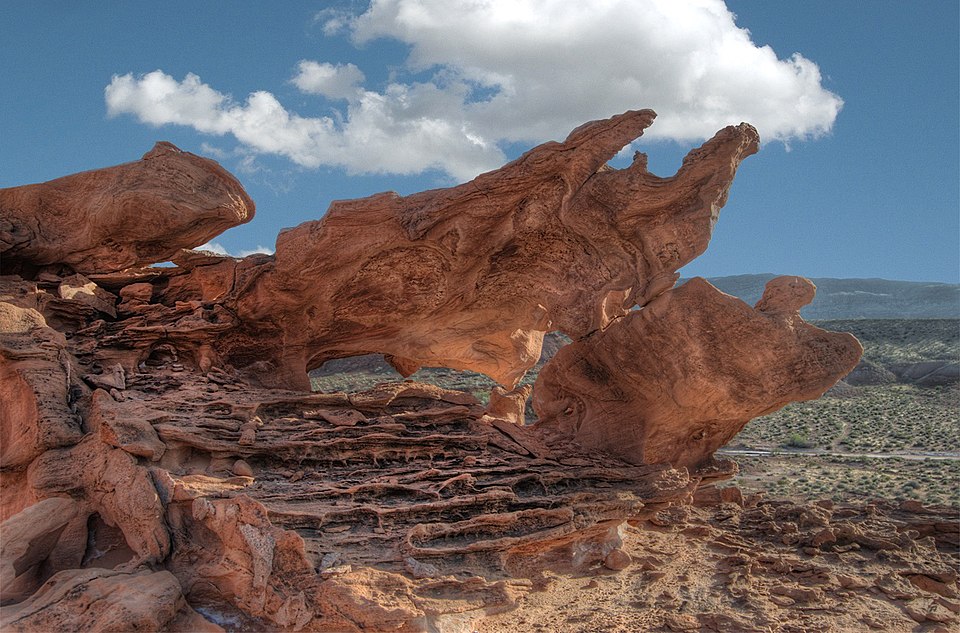
The first art of Nevada is carved, pecked, and painted into stone, scattered across dry valleys, volcanic outcrops, and desert canyons. Long before prospectors arrived with their sketchbooks and cameras, the landscape itself served as a vast gallery, etched with spirals, hunting scenes, and abstract symbols whose meanings remain partly elusive. These works, created by the ancestors of Nevada’s Native peoples—the Northern Paiute, Washoe, and Western Shoshone among them—form one of the most enduring cultural records in the region. Their survival across millennia is due less to deliberate preservation than to the arid climate, which has left these fragile marks remarkably intact. To walk among Nevada’s petroglyphs is to step into an ongoing dialogue between land, survival, and imagination.
Symbols in Stone
Archaeologists date many of Nevada’s petroglyphs to at least 10,000 years ago, placing them among the oldest rock art in North America. Sites such as Grimes Point near Fallon, the carvings along the Winnemucca Lake shore, and the Mount Irish Archaeological District preserve thousands of images. Spirals, zigzags, concentric circles, and gridded patterns appear alongside figures of bighorn sheep and deer. The stark repetition of certain forms suggests patterns of ritual significance. Other motifs appear connected to practical life—maps of hunting routes, indicators of water sources, or marks of territorial identity.
The act of creating these images required deliberate effort. Hard stones were used to chip, peck, or grind into the volcanic rock surfaces, leaving lighter marks that stand out against the darker patina. In some places, red ochre pigment was applied in pictographs, though paint is far more vulnerable to weathering than carved designs. What results is a corpus of imagery that is at once utilitarian and aesthetic, blending communication with visual rhythm.
Storytelling Across Generations
For the Native peoples of Nevada, rock imagery was not static ornament. It was part of a living landscape of stories, ceremonies, and survival practices. Northern Paiute elders have described certain petroglyphs as “story places,” locations where oral histories and myths were tied to the land. A bighorn sheep etched into stone may evoke not only the importance of the hunt but also the animal’s spiritual significance as a figure of strength and agility. Concentric circles may symbolize water, an image of extraordinary resonance in a region where springs determine patterns of habitation.
The desert itself became a kind of narrative medium. At certain times of year, sunlight would strike carvings in specific ways, turning them into dynamic markers of solstices or seasonal cycles. The images were not isolated but part of a broader experience—songs, stories, and ritual activity that animated the desert environment. Just as painted pottery shards carry the fingerprints of long-vanished makers, Nevada’s rock art bears the marks of lives deeply entwined with the land.
An unusual and revealing detail is that some sites show layers of carving spanning centuries. A figure may be overwritten, a new symbol added beside the old, suggesting both continuity and change. In this sense, the rock surfaces became a kind of visual palimpsest—not in the academic cliché but in the literal sense of one generation inscribing itself alongside another. The endurance of these markings reveals a form of timekeeping far different from written records, one rooted in repetition, accumulation, and the endurance of stone.
Continuity and Renewal
Although the meanings of many symbols remain debated, Nevada’s Native artists today continue to draw inspiration from these ancient sources. Washoe and Paiute painters, weavers, and sculptors sometimes reference petroglyph forms in contemporary works, creating a visual bridge across thousands of years. The desert’s carved imagery has also inspired public art installations, educational programs, and museum exhibitions that seek to place Nevada’s earliest art into dialogue with modern creativity.
Yet the survival of rock art is not guaranteed. Vandals and casual visitors have damaged panels by carving initials or spray-painting over ancient lines. The growth of tourism has brought both opportunities for education and risks of irreversible harm. Nevada’s Bureau of Land Management has increased protective measures, fencing off certain areas while opening others with guided tours. These interventions highlight the tension between accessibility and preservation: how to share the art without erasing it in the process.
In recent decades, the rediscovery of massive petroglyphs at Winnemucca Lake—some of which may be the oldest known in North America—has sharpened awareness of Nevada’s role in deep cultural history. Carved into limestone boulders near long-vanished shorelines, these spirals and geometric forms suggest human presence in the Great Basin when the region looked drastically different, lush with lakes and wetlands. They remind us that Nevada’s deserts are not barren voids but landscapes layered with human memory.
A Living Landscape
To approach Nevada’s earliest art as mere archaeology risks stripping it of its living dimension. For many Native communities, the carvings remain spiritually potent. They are not “artifacts” to be admired from a distance but reminders of continuity, identity, and belonging. When Northern Paiute or Shoshone artists incorporate spiral motifs into paintings or beadwork, they are not simply quoting the past; they are extending its life into the present.
The paradox of this art is that it is both fragile and enduring. A single careless touch can erode pigment, yet the petroglyphs have survived ten millennia of wind and sun. Their endurance places them among the most remarkable cultural achievements of North America. Unlike the great painted caves of Europe, Nevada’s rock art does not retreat into the hidden. It stands in the open, etched against the blazing sky, enduring as long as stone and shadow persist.
The foundation of Nevada’s art history is thus not a gallery, museum, or studio, but the land itself—an immense stage upon which images, stories, and rituals were carved and painted long before the word “Nevada” was ever spoken. These first works set a precedent that echoes through the centuries: that in the desert, art is not a luxury but a way of orienting oneself in a vast, demanding, and often beautiful world.
Prospectors and Painters: Mining Camps and Early Settler Art
When gold and silver were discovered in Nevada during the mid-19th century, the desert filled not only with miners but with storytellers, image-makers, and improvising artists. The Comstock Lode of the 1850s and 1860s transformed the state from a sparsely settled frontier into one of the most feverish mining regions in the world. Amid the roar of stamp mills and the chaos of boomtowns like Virginia City, visual culture flourished in unexpected forms. Art here was rarely born of leisure—it was woven into the scramble of prospecting, the documenting of claims, and the desire to make distant investors and families see what words could not fully capture.
Sketches in the Dust
In the earliest mining camps, before permanent structures were raised, prospectors often drew crude but vivid sketches to accompany letters sent eastward. These images depicted makeshift shacks, towering mine shafts, or the improbable mountains where veins of silver were said to run. Few of these early drawings survive, but those that do reveal a world in which art functioned less as aesthetic pursuit than as proof of experience. A miner’s rough pencil sketch might serve as a visual boast: evidence that he had truly reached the frontier and dug into the desert earth.
At the same time, newspapers in Virginia City and Gold Hill printed woodcut illustrations to convey scenes of bustling streets, stagecoaches, and saloons. These images circulated widely, shaping how Nevada was imagined by people who would never set foot in the territory. The act of representing the frontier—whether through amateur sketches or printed engravings—was inseparable from the economic frenzy that defined it. To picture Nevada was, in a sense, to invest in it.
The Eye of the Photographer
Photography arrived quickly in Nevada’s mining towns. Traveling daguerreotypists and later wet-plate photographers set up studios along main streets, offering miners the chance to send likenesses to families far away. Tintypes of grizzled prospectors in patched clothing became treasured keepsakes, balancing hardship with pride. Yet photographers were not limited to portraits. They also documented the industrial machinery of mining: hoisting engines, stamp mills, and rail connections.
Among the most striking images are panoramic views of Virginia City, with its tangle of streets and wooden facades clinging precariously to steep hillsides. These photographs, often carefully composed, softened the grit and danger of the camps, lending them the aura of bustling but orderly settlements. Investors studying such images might see not chaos but opportunity. Photography in Nevada thus oscillated between documentary truth and carefully staged persuasion.
Not all was sober or utilitarian. Some photographers delighted in novelty, arranging miners with shovels and pickaxes into theatrical poses or photographing saloon interiors with their raucous patrons frozen mid-toast. In these staged images, art and life blurred, creating a performative portrait of frontier existence.
The First Art Communities
Out of this raw environment, more sustained artistic communities began to take shape. Virginia City, enriched by Comstock wealth, supported theaters, concert halls, and even small galleries by the 1870s. Amateur painters and itinerant artists found a ready audience among mine owners eager to display culture as a mark of refinement. Watercolors of the Sierra Nevada, oil portraits of successful businessmen, and lithographs of panoramic mining scenes adorned offices and parlors.
One revealing detail is how often these works balanced the brutality of mining with a sense of grandeur. Where the reality was dust, danger, and economic volatility, paintings offered blue skies, vigorous machinery, and orderly progress. In this, Nevada’s earliest settler art was not simply reflective; it was aspirational, shaping how residents wished to see themselves.
Equally important were the artistic crosscurrents that flowed through Nevada because of its transient population. Prospectors came from California, New England, Ireland, China, and beyond, bringing with them traditions of illustration, decorative arts, and craft. Carved wooden signs, hand-painted shopfronts, and decorative metalwork lent the mining towns a surprising visual richness. Even in remote camps, one might find a painted backdrop for a dance hall, a hand-tooled saddle decorated with floral motifs, or a miner’s cabin adorned with sketches clipped from eastern magazines.
A Rough Aesthetic
If Nevada’s first art carried an aesthetic, it was one of improvisation and resilience. Materials were scarce, and artists adapted. Pigments might be mixed from local soils, canvases improvised from flour sacks, and frames constructed out of scrap lumber. This rough aesthetic carried a certain charm, rooted not in polish but in the immediacy of frontier life.
In one sense, the art of Nevada’s mining camps was temporary, as fragile as the camps themselves. Yet it laid the foundation for a tradition of visual expression tied to resource extraction, rapid growth, and stark contrasts between hardship and display. The same tension would resurface in later periods: in the neon glamour of Las Vegas casinos, in the monumental sculptures of Burning Man, in the grand but impermanent visions the desert seems always to inspire.
The miners’ sketches, photographers’ lenses, and makeshift galleries of the 19th century thus represent more than quaint relics. They were the first attempts to give visual form to Nevada as a place of imagination and enterprise. From the dust of the camps arose an artistic culture—imperfect, provisional, yet unmistakably alive—that set the stage for everything that followed.
A Harsh Beauty: Landscape Painting in the Great Basin
To paint Nevada’s land is to confront a paradox: it is at once overwhelming in scale and deceptively bare. Where forests or coastlines offer layers of detail, the Great Basin spreads in vast distances, its horizons unbroken, its colors shifting subtly with light. The first painters who attempted to capture Nevada often found themselves challenged not only by the technical difficulties of the desert’s palette but by the question of how to render beauty in what many outsiders dismissed as desolation. And yet, from the mid-19th century onward, a tradition of landscape painting grew here, charting the changing ways in which artists—and their audiences—understood the desert.
Painters on the Edge of Empire
The earliest recorded landscape views of Nevada came not from residents but from itinerant artists traveling with survey expeditions. Painters like Albert Bierstadt, who passed through the Sierra Nevada, and Thomas Moran, who sketched the western deserts, were associated with the larger Hudson River School and Rocky Mountain School of painting. Their works, though often made with the East Coast market in mind, conveyed an awe at the scale and strangeness of the West. Mountains loomed in golden light, clouds billowed with theatrical grandeur, and even barren valleys were transformed into dramatic compositions.
In these canvases, Nevada appeared not as an inhospitable wasteland but as a sublime frontier—daunting, but also spiritually charged. For investors, settlers, and railroad companies, such images served as persuasive advertisements: the land was not only valuable but magnificent. Yet there was an unavoidable tension. Moran’s sketches of the Humboldt River or the Truckee Meadows, stripped of embellishment, reveal stark emptiness, dry brush, and muted tones—far from the romanticized oils that later circulated in eastern salons. The difficulty of depicting Nevada lay in this very contrast between firsthand austerity and the demand for grandeur.
The Language of Desert Color
Color was the central problem. The Great Basin is a land of grays, tans, muted greens, and pale blues, punctuated by short bursts of wildflower bloom or the white glare of alkali flats. Painters trained on the rich greens of New England or the golden fields of Europe found themselves confronted with hues that seemed at first lifeless. Some exaggerated, painting purple mountains and fiery sunsets to satisfy aesthetic expectations. Others experimented with more subtle tonalities, attempting to convey the way Nevada’s light flattens space yet also intensifies shadow.
One striking detail is how often artists remarked on the sky. Without tall forests or buildings to break the horizon, Nevada’s sky dominates the eye, shifting from searing midday blue to the blood-red of desert twilight. For painters, the sky became a subject in itself. Works by early Nevada-based artists, such as the lesser-known miners’ painters who set up studios in Virginia City, often devote more canvas to cloud and light than to landforms.
This focus on atmosphere aligned Nevada with broader developments in American landscape painting. As Impressionism spread in the late 19th and early 20th centuries, artists found in Nevada an ideal subject for experiments with light and fleeting effects. The desert’s apparent emptiness became an advantage, stripping away distractions and forcing attention onto subtler shifts of tone and color.
Local Eyes, Local Hands
As Nevada developed its own artistic communities in the late 19th and early 20th centuries, painters born or settled in the region began to create work that differed from the traveling artists’ spectacles. These local artists painted not to sell romantic visions to distant audiences but to express familiarity with the land itself. Their canvases feature the sagebrush plains, the slow rise of distant ranges, and the patterns of seasonal light with a restrained intimacy.
Unlike the grandiose Hudson River School canvases, these works often embraced modest scale and subdued composition. A small painting of a dry creek bed, a pastel sketch of a ranch tucked against a foothill, or a watercolor of a sun-bleached fence—such works spoke to lived experience rather than spectacle. In doing so, they opened a different aesthetic register: beauty found not in awe but in endurance, not in drama but in rhythm.
This shift also reflected Nevada’s growing sense of itself as a place with its own cultural identity. Just as mining-era art had attempted to assert refinement amid roughness, landscape painting in Nevada became a way to assert belonging. To paint the desert was to claim it as home.
The Lasting Challenge
Even today, Nevada’s landscape poses difficulties to painters. Where photographers may exploit stark minimalism, painters must wrestle with composition in a land where the horizon often swallows all. Yet this very challenge has inspired innovation. Some contemporary painters have embraced abstraction, reducing sagebrush plains to bands of muted color, while others have focused on microscopic detail—the twist of a Joshua tree branch, the texture of volcanic rock.
The history of Nevada’s landscape painting reveals a continual negotiation between what outsiders expected and what locals saw. For early survey artists, the desert was sublime emptiness. For later residents, it was familiar terrain. For contemporary painters, it is both—a place that resists cliché, demanding new strategies of representation.
In every case, Nevada’s harsh beauty has proven too compelling to ignore. Whether in romantic exaggeration, subtle tonality, or abstract distillation, painters have returned again and again to the challenge of capturing a land that seems both endless and elusive. The Great Basin may appear bare, but for those who have attempted to paint it, it offers inexhaustible complexity.
Silver Screens and Sagebrush: Nevada in Popular Imagination
From the earliest days of Hollywood, Nevada was cast as a backdrop for stories larger than life. Its deserts, mountain passes, and small towns offered settings at once iconic and ambiguous, perfect for the projection of myth. The silver screen, the tourist postcard, and the illustrated brochure together forged a powerful visual image of Nevada that often bore little resemblance to lived reality. Through film and print, the state became at once a symbol of rugged independence, a playground of romance and divorce, and a theater of outlaw spectacle.
Nevada on Film
The Western film genre, rising in the early 20th century, found in Nevada an almost ready-made stage. Its wide valleys and rocky outcrops embodied the frontier ideal, a land of endless horizons where law and lawlessness collided. Silent films such as The Virginian (shot partly in Nevada settings) introduced audiences to landscapes that would become shorthand for rugged authenticity. As the Western matured into a dominant genre by the 1930s and 1940s, Nevada’s imagery circulated even more widely, with cattle drives, mining towns, and desert standoffs etched into the collective imagination.
Yet the cinematic Nevada was often more invention than documentation. Sets in California often doubled for the Nevada desert, and directors used Nevada’s name as a narrative shorthand for toughness or isolation rather than as a literal location. Still, the myth stuck. Nevada became a place Americans thought they knew through cinema, even if they had never crossed its borders.
Later films layered new dimensions onto this imagery. By mid-century, Las Vegas emerged on screen as a gleaming, dangerous paradise, a place where neon lights masked both glamour and corruption. In movies ranging from Viva Las Vegas to Casino, Nevada’s cultural role expanded beyond the frontier to embody a new kind of spectacle: artificial, excessive, but unforgettable. The state’s cinematic identity thus stretched from sagebrush to neon, from dusty cattle trails to dazzling showrooms.
Selling the West
Alongside film, tourism campaigns and printed imagery cemented Nevada’s reputation. The state’s boosters produced brochures, posters, and illustrated maps that leaned heavily on Western iconography. Cowboys on horseback, Native dancers, snowcapped peaks, and desert sunsets appeared on postcards sold in railway stations and hotel lobbies.
These images were less about accuracy than attraction. A postcard might place a rider against a background that bore little relation to actual Nevada topography; what mattered was the evocation of “the West.” For eastern tourists or European audiences, Nevada became interchangeable with the larger mythology of western America: a place where freedom was vast, the landscape unforgiving, and adventure close at hand.
There was also the practical lure of Nevada’s unique laws. By the 1930s, Reno had established itself as the “divorce capital of the world,” and brochures played up this role with a mix of humor and allure. Sketches of glamorous women stepping off trains, caricatures of judges wielding pens like sabers, and stylized ranch resorts where would-be divorcées passed their residency requirements all circulated as visual advertising. In this period, Nevada’s image as a place of reinvention and escape grew side by side with its frontier mystique.
Between Caricature and Reality
The gap between Nevada’s popular imagery and its lived experience was often wide. Ranching families, mining communities, and small-town residents found themselves caricatured as stock figures in stories aimed at outsiders. A postcard of a smiling cowboy might mask the brutal economic cycles of ranch life; a neon-bathed casino scene might ignore the surrounding poverty of working-class neighborhoods.
Yet these images had a strange power. Even when exaggerated, they shaped how both outsiders and residents saw the state. Many Nevadans embraced the mythology, seeing in it a form of identity, however stylized. The cowboy became a symbol not only of Hollywood fantasy but of ranching heritage; the neon skyline of Las Vegas became both a marketing device and a genuine civic emblem.
The persistence of these dualities—between sagebrush and silver screen, caricature and authenticity—continues to define Nevada’s cultural presence. The state exists in the American imagination as both a real place and an invented one, a desert of grit and a stage of spectacle. The visual art of postcards, posters, and films did more than represent Nevada: it created the Nevada the world came to expect.
Modernism in the Desert: Architecture and Design of Reno and Las Vegas
If Nevada’s early image was bound to sagebrush and silver screens, the mid-20th century gave rise to another visual identity altogether: a desert modernism defined by sleek lines, neon glow, and an unlikely mix of restraint and extravagance. Reno and Las Vegas, though very different cities, both became stages for architectural experimentation. Reno cultivated a quieter, residential modernism in tune with western landscapes, while Las Vegas turned its casinos and hotels into showcases of bold design. Together they formed an architectural dialogue that made Nevada an unexpected laboratory for modern design.
Streamlined Beginnings
The 1930s and 1940s saw Nevada embracing streamlined architecture, influenced by the broader American fascination with speed, progress, and aerodynamic form. In Reno, civic buildings adopted stripped-down classical lines softened by modern curves. Schools and post offices bore the clean geometry of the WPA era, emphasizing efficiency without sacrificing presence.
Las Vegas, by contrast, was beginning to invent its own architectural vocabulary. Early casinos like the El Rancho Vegas and the Last Frontier evoked a blend of rustic Western motifs and streamlined forms. Low horizontal profiles, broad canopies, and large illuminated signage combined nostalgia for the frontier with the optimism of the machine age. Even in these early decades, Las Vegas signaled that architecture here would be inseparable from entertainment.
Casinos as Laboratories
By the 1950s and 1960s, Las Vegas became one of the most daring arenas of American modernism—not in austere museums or minimalist houses, but in casinos designed to dazzle. The Sands, the Stardust, and the Desert Inn pioneered the integration of neon signage, expansive glass walls, and dramatic interiors. Architects and designers were given unusual freedom, since casino owners prized novelty and spectacle above convention.
The results were remarkable. The Stardust’s façade stretched for hundreds of feet, covered in neon stars that pulsed and cascaded across the night. The Sands combined modernist simplicity with theatrical showrooms, creating a seamless flow between architecture and performance. Casinos experimented with moving light, themed interiors, and modular design long before these ideas entered mainstream architectural discourse. What in other cities might have been dismissed as kitsch was in Las Vegas a serious exploration of how buildings could engage audiences emotionally and visually.
This innovation did not go unnoticed. Architects like Robert Venturi and Denise Scott Brown studied Las Vegas closely in the 1960s, producing the influential book Learning from Las Vegas (1972). They argued that the city’s architecture, far from trivial, anticipated postmodern ideas about symbolism, communication, and popular culture. In their eyes, Las Vegas was a place where architecture spoke directly, loudly, and unashamedly—a lesson many in the architectural establishment had ignored.
Reno’s Quiet Modernism
While Las Vegas lit up the desert with flamboyant casinos, Reno developed a quieter modernist tradition. Residential neighborhoods in the mid-20th century showcase houses influenced by California modernism: flat roofs, large windows, and integration with surrounding landscapes. Architects adapted to the high desert climate with shaded patios, breezeways, and materials that softened the harsh sun.
Public buildings in Reno also carried modernist clarity without spectacle. The Washoe County Library, for example, embraced openness and light, making civic architecture a part of community identity. Unlike Las Vegas, Reno did not aim to dazzle tourists but to express stability and civic pride through design. Its modernism was lived rather than performed.
Yet Reno’s design experiments were not without flair. Hotels along Virginia Street, catering to gamblers and honeymooners, combined modernist glass façades with bold signage. The famous Reno Arch, first erected in 1926 and redesigned several times since, became a local answer to Las Vegas neon—less overwhelming, but equally emblematic of the city’s evolving self-image.
The Legacy of Desert Modernism
Taken together, Reno and Las Vegas represent two sides of Nevada’s modernist story. Reno shows how modernism could be domesticated, integrated into daily life, and adapted to local landscapes. Las Vegas demonstrates how modernism could be amplified into spectacle, testing the boundaries of architecture as communication. Both cities challenged the idea that the desert was hostile to design. Instead, they revealed how aridity, openness, and light could become creative catalysts.
The legacy of this period continues. Preservation efforts in Reno protect mid-century neighborhoods, while Las Vegas celebrates its neon heritage through museums and restorations. Architects today still look to Nevada as a site of experimentation, where the rules are less fixed and the possibilities more open.
In the stark desert, modernism found unlikely soil. Out of sand and neon, glass and steel, Nevada forged an architectural identity that was at once playful, serious, experimental, and enduring—a reminder that even in places dismissed as peripheral, art and design often find their boldest expression.
Neon Dreams: The Visual Language of Las Vegas
Few cities in the world have been defined so completely by light as Las Vegas. For most of the 20th century, neon was not mere decoration here; it was the city’s true architecture, wrapping casinos, motels, and diners in glowing skins of color. The skyline of Las Vegas became less about buildings themselves than about signs—towers of tubing bent into stars, martini glasses, cowboys, and endless permutations of the word “casino.” This visual language of neon was both functional and fantastical: it drew in gamblers, but it also gave the desert a surreal nightly glow that transformed the city into a theater of light.
Signage as Sculpture
What makes Las Vegas unique is the way signage became sculptural. In most cities, a sign was a nameplate; in Las Vegas, it was the building. The Stardust’s sign, erected in 1958, stretched nearly 300 feet long, covered in thousands of bulbs and starbursts. The Silver Slipper built an enormous revolving shoe, while the Sahara’s camels marched endlessly across its façade. These were not mere advertisements but kinetic artworks, animated by electricity and imagination.
The scale mattered. Signs were designed to be seen from passing cars on the Strip, each one competing for attention with its neighbors. Designers pushed for brighter colors, bolder shapes, and larger letters, until the Strip became a canyon of light. To walk it at night was to enter a visual storm, where the boundaries between architecture, advertisement, and art dissolved.
The Craft of the Signmakers
Behind the spectacle stood skilled artisans. Companies like the Young Electric Sign Company (YESCO) pioneered techniques for bending glass tubing, filling it with neon or argon gas, and wiring it to flicker in choreographed patterns. These craftsmen treated neon not as a novelty but as a material with its own expressive possibilities.
One of the most influential designers was Betty Willis, who created the iconic “Welcome to Fabulous Las Vegas” sign in 1959. Her design distilled the city’s essence into a single emblem: playful, bold, and unmistakable. Unlike many casino signs, it was not attached to a building but stood alone on the highway, greeting travelers as if they were entering a glowing fantasy. Willis and her peers elevated neon from advertising to a distinct art form, one whose style defined an entire era.
Neon’s influence spread beyond the casinos. Motels, diners, wedding chapels, and liquor stores adopted the style, each erecting its own glowing beacon. Even the most modest establishments participated, turning the city into a democratic gallery of light where high and low, glamorous and ordinary, coexisted in luminous competition.
Preservation and Memory
By the late 20th century, neon began to decline. New casinos favored massive LED screens and architectural spectacle over handcrafted tubing. Many classic signs were dismantled, scrapped, or left to decay in the desert sun. But nostalgia, and recognition of their artistry, sparked preservation efforts.
The Neon Museum, established in the 1990s, became the central institution for saving these luminous relics. Its “Boneyard,” where old signs are displayed against the night sky, has turned into one of Las Vegas’s most beloved attractions. Visitors wander among the Stardust’s starbursts, the Moulin Rouge’s elegant script, and the once-revolving Silver Slipper, encountering neon not as commerce but as history and art.
The preservation movement reframed neon as cultural heritage. What had once been dismissed as kitsch became understood as design innovation, reflecting the optimism, bravado, and humor of mid-century Las Vegas. For many, the glow of neon is inseparable from the memory of the city itself—its promise of escape, its defiance of desert darkness, its belief in the power of spectacle.
A Living Language
Though LED now dominates the Strip, neon remains a vital symbol. Contemporary artists in Nevada and beyond use salvaged tubing in installations, referencing the city’s luminous past. Neon workshops continue to operate, training new generations in the craft. And for locals, the “Welcome” sign still glows as brightly as ever, its starburst a reminder that Las Vegas was built not only on gambling but on light.
Neon in Las Vegas was never just about brightness. It was about atmosphere, mood, and identity. It gave the desert city its character, its sense of fantasy, and its global recognition. In its blaze and flicker, one can trace the story of a city that invented itself through illumination, turning darkness into art night after night.
Ephemeral Monuments: Burning Man and the Nevada Desert
In late summer, a flat expanse of Nevada’s Black Rock Desert becomes one of the largest temporary art spaces in the world. Tens of thousands of people gather to build a city from nothing, populate it with monumental sculptures, temples, and kinetic machines, and then watch much of it vanish in fire. Burning Man, which began as a small gathering on a San Francisco beach in 1986 and relocated to Nevada in 1990, has transformed into a global phenomenon. At its heart lies a vision of art that is immersive, communal, and fleeting—an echo of Nevada’s longer tradition of impermanence in art, from mining camps to neon that flickers and dies.
Building a Temporary City
The Black Rock Desert is one of the harshest environments in North America: flat, alkaline, sun-baked, and subject to sudden dust storms. Yet this blank canvas has proven ideal for an event that seeks to push the limits of creativity. Each year, participants—many of them artists, engineers, and builders—construct Black Rock City, a temporary settlement complete with streets, camps, and towering artworks.
The most famous of these structures is the wooden effigy known as “the Man,” burned at the festival’s climax. But alongside it rise vast sculptures, interactive installations, and temples built from wood, metal, and even salvaged materials. Some artworks stand hundreds of feet tall, dwarfing anything else on the playa. At night, lighting and fire effects transform them into glowing landmarks.
What distinguishes Burning Man from conventional exhibitions is scale and impermanence. The city exists for little more than a week, then is dismantled, burned, or removed entirely, leaving the desert floor bare. This cycle of creation and erasure lends the event both intensity and poignancy. To experience the art is to accept its transience.
Ritual, Fire, and Community
At its core, Burning Man is a fusion of ritual and art. The burning of the central effigy, witnessed by tens of thousands, is both spectacle and ceremony. Other burns take place throughout the week: temples filled with personal messages are set ablaze, installations go up in flames, and fire-based performances light the night. Fire here is not destruction alone but transformation—art consumed to make space for renewal.
Community is equally central. Unlike museums, where audiences passively view works, Burning Man encourages interaction. Sculptures are often designed to be climbed, entered, or manipulated. Art cars—motorized vehicles transformed into rolling sculptures—roam the playa, turning the entire city into a moving gallery. Participation blurs the line between artist and spectator, making creativity a shared endeavor.
The harsh desert environment reinforces this sense of unity. Dust storms can engulf the city in whiteout conditions, forcing strangers to help one another. The absence of commercial advertising and the reliance on barter and gift exchange create an atmosphere distinct from daily life. Out of these conditions, art is not just displayed but lived.
From Fringe to Influence
What began as an obscure countercultural gathering has grown into an event with global reach. Burning Man now draws artists and participants from around the world, and its influence extends far beyond Nevada. Sculptures first conceived on the playa have later been installed in urban plazas, museums, and festivals worldwide. The event has also inspired smaller regional “burns” across Europe, Australia, and South America, spreading its model of ephemeral community art.
Yet its Nevada location remains central. The Black Rock Desert’s vastness allows for scale impossible elsewhere, and the extreme environment gives the event a distinctive character. Unlike urban art festivals, Burning Man could not be mistaken for anything but itself. Its impermanence, its spectacle of fire, and its communion with the desert all tie it uniquely to Nevada’s artistic history.
Critics sometimes dismiss the event as indulgent or chaotic, but even skeptics acknowledge its role in fostering large-scale, experimental art. For many artists, the playa offers a freedom unavailable in galleries or institutions: the chance to build something enormous, temporary, and participatory, without the constraints of commerce or permanence.
Art That Vanishes
Burning Man’s art is defined by its disappearance. Unlike the petroglyphs of ancient Nevada or the neon preserved in museums, much of it leaves no trace. What remains is memory, photography, and influence carried into future projects. This ephemerality links Burning Man to a broader theme in Nevada’s art history: the tension between endurance and impermanence, between works carved into stone and those consumed in flame.
In the end, Burning Man is less about a single effigy or sculpture than about a recurring act of collective creation. Each year, the desert becomes a vast workshop of imagination, then returns to silence. Nevada’s harsh landscape, which has challenged artists for centuries, here becomes the very condition that makes the art possible. In the Black Rock Desert, art is not only made—it is burned, scattered, and reborn.
Building a Home for Art: Nevada’s Museums and Universities
For much of Nevada’s early history, art was scattered and improvised: petroglyphs in canyons, sketches in mining camps, neon along the Strip, installations on the desert floor. Institutions dedicated to preserving, studying, and exhibiting art came later, gradually anchoring the state’s cultural life. Today, Nevada’s museums and universities provide not only repositories for collections but also platforms for dialogue about the desert’s unique role in artistic imagination.
The University as Seedbed
The University of Nevada, Reno, founded in the late 19th century, became the state’s first academic anchor for the arts. What began with small collections and traveling exhibitions grew over decades into a hub of teaching, research, and display. Faculty brought in visiting artists, organized exhibitions, and encouraged students to engage with both regional and international traditions.
The campus gradually acquired a collection that reflected Nevada’s diverse artistic story: landscapes of the Great Basin, works by Native artists, and pieces connected to the mining boom. The presence of a university art department mattered deeply in a state where distance and isolation often limited cultural exchange. It provided a place where young artists could train without leaving Nevada and where residents could encounter art from far beyond their borders.
In Reno, the university’s influence spilled into the surrounding city, supporting galleries, festivals, and collaborations with civic organizations. It helped foster a sense that art was not only an import but a local resource, woven into the rhythms of daily life.
The Nevada Museum of Art
The Nevada Museum of Art, also in Reno, has become the state’s leading institution for visual culture. Founded in the 1930s and steadily expanded, it has pursued a distinctive mission: exploring the relationship between art, environment, and place. Its collections include works by regional painters, international artists, and contemporary creators who engage with issues of landscape, ecology, and design.
One of its most innovative projects is the Center for Art + Environment, established to collect archives and support research on how artists respond to natural and built environments. This initiative reflects both Nevada’s geography and its cultural trajectory: in a state defined by deserts, mountains, and rapid urban growth, the dialogue between art and environment is unavoidable.
The museum’s exhibitions often highlight this interplay. Shows might juxtapose 19th-century landscape paintings with contemporary land art, or explore how photography has shaped perceptions of the Great Basin. By doing so, the museum positions Nevada not as a cultural outpost but as a participant in global conversations about how humans see and shape their surroundings.
Public Art and Civic Identity
Beyond universities and museums, Nevada has invested in public art as a way to enrich its cities and towns. Reno, in particular, has cultivated a reputation as a city of murals and outdoor sculpture. Events like the Reno Sculpture Fest and the installation of Burning Man pieces downtown bring large-scale works into public space, creating continuity between the desert festival and urban life.
Las Vegas, meanwhile, has commissioned public artworks for parks, civic buildings, and even freeway interchanges. The city’s contemporary art scene, though often overshadowed by its casinos, has found new platforms in these civic projects. Murals, installations, and sculptures offer residents and visitors alternative images of the city, ones that move beyond neon spectacle to embrace creativity in everyday settings.
These public art initiatives underscore a crucial point: Nevada’s artistic identity is not confined to museums or galleries. It extends into streets, campuses, and civic spaces, making art part of the lived environment. In this way, the state’s institutions—academic, museum, and municipal—act less as isolated repositories than as active partners in shaping cultural identity.
Anchoring the Ephemeral
Nevada’s art history is often defined by impermanence: rock art slowly weathering, mining-town sketches lost to time, neon signs dismantled, Burning Man sculptures consumed by fire. Museums and universities offer a counterbalance, providing continuity and preservation. They safeguard fragile works, document transient creations, and connect Nevada to broader currents of art history.
At the same time, they embrace the state’s unique conditions. The Nevada Museum of Art’s focus on environment, the university’s integration with regional traditions, and the proliferation of public art all demonstrate an understanding that Nevada’s artistic strength lies not in imitating other regions but in interpreting its own.
In anchoring art, these institutions do not tame it. Rather, they ensure that Nevada’s creativity—whether carved into stone, lit in neon, or burned on the playa—remains part of an ongoing cultural conversation. They root the fleeting in history, giving Nevada’s art both a past and a future.
Independent Creators: Folk, Vernacular, and Visionary Artists
Beyond universities, museums, and casino spectacle, Nevada has long been a fertile ground for artists working outside institutional frameworks. In small towns, along highways, and deep in desert valleys, individuals have fashioned their own worlds of imagery and form, often without formal training or recognition. These folk and visionary creators remind us that Nevada’s art history is not only about professional painters, architects, or festival designers, but also about solitary builders, eccentric dreamers, and communities passing down traditions in humble yet enduring ways.
Roadside Marvels
Driving Nevada’s long highways, one occasionally encounters unexpected bursts of creativity: a sculpture garden in front of a ranch, a hand-painted billboard far from any town, or a collection of found-object assemblages on the edge of the desert. These works, often the product of years of patient labor, blur the line between art and environment.
One of the best-known examples is the International Car Forest of the Last Church near Goldfield. Here, dozens of cars, trucks, and buses are buried nose-first in the earth or stacked atop one another, their surfaces painted with murals and graffiti. The site is both playful and monumental, transforming discarded vehicles into a desert cathedral of improvisation. Like much Nevada folk art, it combines humor, resourcefulness, and spectacle, echoing the larger state tradition of turning scarcity into invention.
Elsewhere, roadside attractions have long incorporated artful flourishes. Giant cowboys, dinosaur sculptures, and handmade neon signs once dotted the highways, each designed to draw the eye of passing motorists. Some survive, weathered but still expressive, as remnants of a time when highway travel was as much about surprise as destination.
Mystical Desert Creations
Nevada’s wide open spaces have also inspired visionary and mystical projects by individuals seeking to give form to spiritual or personal quests. Isolated desert sites have been marked by cairns, altars, or elaborate stone arrangements created not for commerce but for meaning.
One such figure was Clarence Schmidt, an eccentric builder who, though more famously associated with New York, influenced desert tinkerers who created labyrinthine dwellings from scrap and natural materials. In Nevada, comparable projects have taken shape: solitary builders stacking bottles into walls, carving images into sandstone, or arranging found metal into totemic forms. These environments, though often fragile and eventually reclaimed by weather, offer glimpses into the private visions of their makers.
What links these creations is an embrace of the desert’s solitude. The same vastness that intimidates many becomes, for visionary artists, a canvas without limits. Their works do not seek validation from institutions; they exist because someone felt compelled to make them.
Craft and Continuity
Not all Nevada folk art is eccentric or monumental. Much of it lies in crafts passed through families and communities: quilt-making, saddle tooling, beadwork, and basketry. The state’s ranching heritage has supported a strong tradition of leatherwork, from intricately stamped saddles to decorative belts. Native basketry, particularly among Washoe artisans, remains a vital form of cultural continuity, producing pieces that combine utility with remarkable precision and beauty.
These crafts are sometimes dismissed as “decorative arts,” yet they embody the same creativity and discipline as painting or sculpture. They also reveal a different rhythm of artistic life: one rooted in repetition, skill, and transmission rather than spectacle. In Nevada, where communities are often small and isolated, such crafts become markers of identity and continuity, sustaining artistry across generations.
Between Margins and Mainstream
The work of Nevada’s independent creators complicates simple boundaries between “high art” and “folk art.” The International Car Forest attracts tourists and photographers, finding its way into galleries and publications. Washoe baskets appear in museum collections alongside oil paintings. Roadside neon, once dismissed as commercial signage, is now celebrated in the Neon Museum.
This blurring of categories reflects something fundamental about Nevada’s artistic landscape: it resists hierarchy. Whether an architect designing a casino or a rancher welding scrap metal into a giant horse, both are responding to the same desert, the same conditions of isolation, ingenuity, and spectacle.
These folk and visionary works remind us that Nevada’s art history is not confined to institutions or movements. It thrives wherever imagination meets desert space—on highways, in backyards, in solitary workshops under the sun. In their variety and stubborn individuality, these creators embody a truth at the heart of Nevada’s culture: that art here is as much about persistence as perfection, as much about vision as recognition.
Photography and the Nevada Image
If painting struggled to capture Nevada’s muted palette and vast distances, photography found in the state both a challenge and a revelation. From the earliest daguerreotypes of mining towns to contemporary landscape experiments, Nevada has been a proving ground for photographers testing the limits of their medium. Its extremes—dazzling light, stark shadow, weathered ruins, neon nights—demand precision and creativity. In the process, photography has become one of the most important ways Nevada has been seen, remembered, and imagined.
Early Documentary Eyes
The first generation of Nevada photography emerged in the mining boom of the mid-19th century. Photographers set up studios in Virginia City and Gold Hill, producing portraits of miners, businessmen, and entertainers. These images, often formal and stiff, served as mementos and status symbols. But photographers also turned their lenses outward, capturing panoramic views of towns carved into hillsides, railroads threading through valleys, and mining operations with their towering hoists and stamp mills.
Carleton Watkins, known for his sweeping western landscapes, passed through Nevada, as did Timothy O’Sullivan, whose 1860s survey photographs of the Great Basin remain among the most striking early images of the region. O’Sullivan’s work, commissioned for geological exploration, emphasized stark geological forms and austere horizons. His images are almost unsettling in their emptiness, stripped of romantic embellishment, portraying Nevada as a land of desolation and grandeur in equal measure.
These early photographers left a legacy that was both scientific and aesthetic. Their images served practical purposes—documenting resources, settlements, and topography—while also shaping perceptions of Nevada as a land defined by extremes.
Modernist Experiments
In the early 20th century, Nevada attracted photographers with more explicitly artistic goals. Edward Weston, traveling the West in the 1930s, made a series of stark desert negatives that reduced landforms to pure shape and texture. His photographs of sand dunes and eroded rock emphasized abstraction, finding sculptural form in what others saw as emptiness.
Later, photographers such as Ansel Adams turned their attention to the Sierra Nevada and Nevada’s eastern ranges, producing images that combined clarity of detail with a sense of spiritual sublimity. Adams’s famous Zone System was tested against Nevada’s high-contrast light, demanding precision to capture both blinding alkali flats and deep shadowed canyons. His work, though often associated with California, cannot be separated from the Great Basin’s influence.
These modernist experiments positioned Nevada as more than a backdrop. Its light, colorless expanses, and severe geometry became subjects in themselves, shaping the evolution of photographic technique and aesthetics.
The Neon Night
If the desert offered photographers abstraction, Las Vegas provided spectacle. Beginning in the mid-20th century, photographers flocked to the Strip to capture the city’s neon glow. Nighttime exposures revealed casinos transformed into glowing canvases of color and light.
Commercial photographers promoted the city’s glamour, producing postcard views of neon canyons that circulated worldwide. At the same time, documentary photographers captured more ambivalent scenes: gamblers hunched over tables, workers behind the glow, the contrast between dazzling signage and the surrounding desert darkness. The neon night became a photographic genre of its own, balancing allure and critique.
One of the most compelling aspects of Las Vegas photography is its ability to compress time. A long exposure might render neon signs as streaks of color, transforming the city into pure light and movement. These images echoed the kinetic energy of the casinos themselves, making photography not merely a record but a reinterpretation of spectacle.
Contemporary Reimaginings
Today, Nevada continues to attract photographers seeking new ways to see its land and culture. Some focus on abandoned mining towns, capturing decaying facades and rusted machinery as symbols of impermanence. Others document Burning Man, where ephemeral sculptures and dust storms create conditions ideal for experimental photography. Still others turn their lenses to environmental change, photographing shrinking lakes, scarred landscapes of open-pit mines, or the fragile habitats of desert wildlife.
Nevada has also become a site for conceptual photography. Artists use its vast empty spaces to stage interventions—placing objects, staging performances, or experimenting with scale. The Black Rock Desert, in particular, functions as a blank photographic backdrop, allowing works to float against a horizon that seems infinite.
Through these diverse practices, Nevada remains central to the photographic imagination. Its extremes—of light, landscape, and spectacle—continue to challenge and inspire. More than any other medium, photography has shaped how the world pictures Nevada, from the first silver plates of miners’ camps to the luminous digital images of neon, dust, and sky.
The Performance of Place: Entertainment and Stagecraft
If mining towns and neon signs gave Nevada its early visual identity, the state’s reputation as a stage—both literal and metaphorical—was cemented by its entertainment culture. Nowhere else in America did performance, costume, and design so fully merge with civic identity. Las Vegas in particular became a theater not confined to auditoriums but spread across entire buildings, streets, and even the bodies of its performers. The city was more than a venue: it was the performance itself.
Showgirl Aesthetics
The Las Vegas showgirl remains one of the most enduring visual icons of Nevada. Emerging in the 1950s and 1960s, when productions like the Lido de Paris and Folies Bergère brought Parisian revue style to the desert, the showgirl was both dancer and living sculpture. Elaborate headdresses, sequined costumes, and dramatic feathered backpieces transformed the human figure into a moving artwork.
These productions were not simply about dance technique but about spectacle. Sets sparkled with mirrored surfaces, stages revolved or elevated, and lighting bathed performers in shifting color. For audiences, the showgirl embodied Las Vegas’s promise: glamour made visible, fantasy given form.
Artists and designers behind these productions—costumers, set builders, lighting specialists—were rarely household names, but their work shaped Nevada’s cultural image as decisively as any painter or architect. The visual vocabulary of the showgirl influenced advertising, graphic design, and even casino architecture, embedding performance into the very fabric of the city.
The Casino as Stage
Casinos themselves were designed as theaters, where the line between audience and performer blurred. From the 1950s onward, the interiors of major resorts were crafted not only to house gambling but to orchestrate an experience. Lighting guided visitors through rooms, soundscapes created mood, and architectural details evoked exotic or fantastical settings.
Themed casinos like Caesars Palace or the Venetian transformed the Strip into a kind of immersive stage design on an urban scale. Columns, fountains, canals, and replicas of Roman or Venetian landmarks provided backdrops in which visitors became both players and spectators. In this way, Nevada pioneered forms of immersive design later imitated worldwide in theme parks, malls, and entertainment districts.
Even outside the spectacle of themed resorts, performance infused casino life. Lounge acts, magicians, comedians, and musical residencies turned the Strip into a cultural circuit where design and entertainment fed one another. Every surface—carpet, ceiling, costume, sign—was part of the show.
Cirque and the Immersive Era
By the late 20th century, a new kind of performance further reshaped Nevada’s stagecraft. Cirque du Soleil, beginning with Mystère in 1993, introduced a fusion of acrobatics, dance, theater, and elaborate design. Unlike traditional revues, Cirque productions enveloped audiences in surreal worlds: aquatic stages, floating platforms, or cavernous theaters filled with shifting light and sound.
These shows elevated Las Vegas entertainment into high-concept art, merging avant-garde performance with popular spectacle. They also extended Nevada’s influence on global stagecraft, as productions developed in Las Vegas later toured internationally or inspired imitators abroad.
The city’s entertainment landscape became a laboratory where set design, costume, and lighting were pushed to extremes. In doing so, Nevada blurred the distinction between art and commerce, creating experiences that were simultaneously mass entertainment and cutting-edge design.
A State of Performance
The history of Nevada’s entertainment culture underscores a central theme: the state itself has functioned as a stage. From the neon cowboy signs waving on Fremont Street to the feathers of a showgirl, from casino interiors to Cirque’s immersive worlds, performance has been a visual and spatial language as much as an art form.
In Nevada, art does not hide in quiet galleries. It struts, glows, dazzles, and beckons. It makes architecture into scenery, turns costumes into sculpture, and transforms audiences into participants. The desert state, often caricatured as barren, thus reveals itself as one of the most theatrically inventive places on earth—a land where place and performance are inseparable.
Contemporary Horizons: Nevada Artists Today
Nevada’s current art scene is a dialogue between past and present, permanence and impermanence, local traditions and global networks. The state’s artists today work in media ranging from painting and sculpture to digital installations and land art, and their themes often reflect Nevada’s distinctive geography and history. While institutions provide support, much of the most striking work emerges from artists who engage directly with the land, with community traditions, and with questions of how Nevada fits into broader artistic conversations.
Engaging Land and Climate
For contemporary painters and sculptors, Nevada’s desert remains a powerful subject. Some artists respond to environmental concerns, creating works that highlight shrinking water sources, drought, and the scars of mining. Sculptors have incorporated reclaimed wood, rusted metal, or desert stone into installations that speak to resilience and fragility. Painters experiment with palettes that capture not only the muted sagebrush and alkali flats but also the searing neon glow of urban nights.
This environmental engagement is not framed as activism alone but as aesthetic exploration. The desert’s extremes—its silence, its sudden storms, its stark geometry—continue to challenge and inspire new visual languages. For many Nevada artists, the land is not backdrop but co-creator, shaping both the materials they use and the themes they pursue.
Native Artists and Cultural Continuity
Nevada’s Native communities remain central to its artistic present. Basketry among Washoe artisans continues to flourish, with traditional techniques passed down while new motifs are introduced. Beadwork, painting, and sculpture explore both continuity with ancient practices and dialogue with contemporary forms. Some artists directly reference petroglyph patterns in modern media, creating links across thousands of years of desert imagery.
These works resist easy categorization as either “traditional” or “contemporary.” A Washoe basket may be woven with techniques identical to those of the 19th century, yet its pattern might incorporate modern abstractions. A Shoshone painter may depict sacred landscapes while also experimenting with digital layering. The vitality of Nevada’s Native art lies precisely in this refusal to be confined, affirming cultural identity while participating in wider artistic currents.
Nevada in Global Networks
Though geographically isolated, Nevada is increasingly connected to international art circuits. The influence of Burning Man has brought artists from across the globe to the Black Rock Desert, while Nevada-based creators travel abroad to exhibit large-scale installations first tested on the playa. Reno and Las Vegas both host biennials, festivals, and exchange programs that connect local artists with peers from Europe, Asia, and Latin America.
Las Vegas, once thought of only as a city of entertainment, now supports galleries that show contemporary painting, photography, and installation art. Reno’s Nevada Museum of Art draws international attention for its focus on environment and place, situating Nevada within global conversations about climate and culture. Even smaller towns host arts festivals, often blending local craft traditions with visiting performers and creators.
This global integration has not erased Nevada’s specificity. On the contrary, it has highlighted the state’s distinctiveness: its desert as laboratory, its history of spectacle, its enduring blend of fragility and boldness. Nevada artists today move fluidly between local and international contexts, carrying with them the unmistakable imprint of the Great Basin and the neon Strip.
Looking Forward
Nevada’s contemporary art is diverse, restless, and often experimental. It thrives on the state’s contradictions—between desert silence and casino noise, between permanence and fire, between craft passed through families and installations meant to last only a week. What unites it is a refusal to separate art from place. Whether woven, welded, painted, projected, or burned, Nevada’s art today insists on engaging with its landscape and history.
In this insistence lies its strength. The artists of Nevada are not merely echoing national trends but shaping new approaches, grounded in their unique environment yet resonant worldwide. The desert that once seemed empty continues to generate abundance—not of water or vegetation, but of imagination.
Conclusion: Nevada as Stage, Studio, and Experiment
Nevada’s art history defies simple narratives. It begins with carvings and paintings on stone, among the oldest in North America, and extends through mining-camp sketches, grand desert landscapes, neon cathedrals of light, ephemeral temples of fire, and contemporary works that bridge local craft with global networks. Few places combine such extremes of permanence and impermanence. In Nevada, art is not only made—it is lived, staged, displayed, consumed, dismantled, and reborn.
Between Permanence and Flame
The contrast between petroglyphs etched thousands of years ago and Burning Man sculptures consumed in fire could not be sharper, yet both speak to a central truth: art in Nevada often arises from confrontation with impermanence. Rock imagery survives only because of the desert’s dryness, while neon flickers out when power fails, and playa installations are built with destruction in mind. This pattern reveals a culture in which beauty is not guaranteed to endure, but is no less meaningful for its fragility.
The Desert as Catalyst
The Great Basin’s stark conditions have shaped every stage of Nevada’s art. Its muted colors challenged painters to find new palettes. Its vast horizons demanded new photographic strategies. Its empty flats provided a stage for experiments in scale, ritual, and community. Even the neon of Las Vegas is best understood as a response to desert darkness, an insistence on creating light where none exists. The desert has not merely been background; it has been the primary collaborator, shaping the state’s aesthetic at every turn.
Nevada’s Continuing Role
Today, Nevada’s artists continue to wrestle with questions of identity, spectacle, and survival. Museums safeguard fragile works, universities train new generations, and public art spreads creativity into civic spaces. Folk artists weld and weave on their own terms, while contemporary painters and sculptors draw inspiration from climate, land, and history. The state is both a site of preservation and a laboratory of invention.
In this, Nevada offers a model of how art thrives at the edge: not in spite of isolation or harshness, but because of it. Its art has always emerged from tension—between wilderness and settlement, showmanship and sincerity, memory and reinvention. To study Nevada’s art history is to see how a desert can become a stage, how neon can become heritage, and how fire can become creation.
Nevada remains, in every sense, an experiment: a place where artists test what it means to make, display, and remember. From the carved stones of Grimes Point to the glowing signs of Fremont Street and the fiery effigies of Black Rock, its art continues to challenge assumptions about what lasts, what vanishes, and what it means to create in the desert.