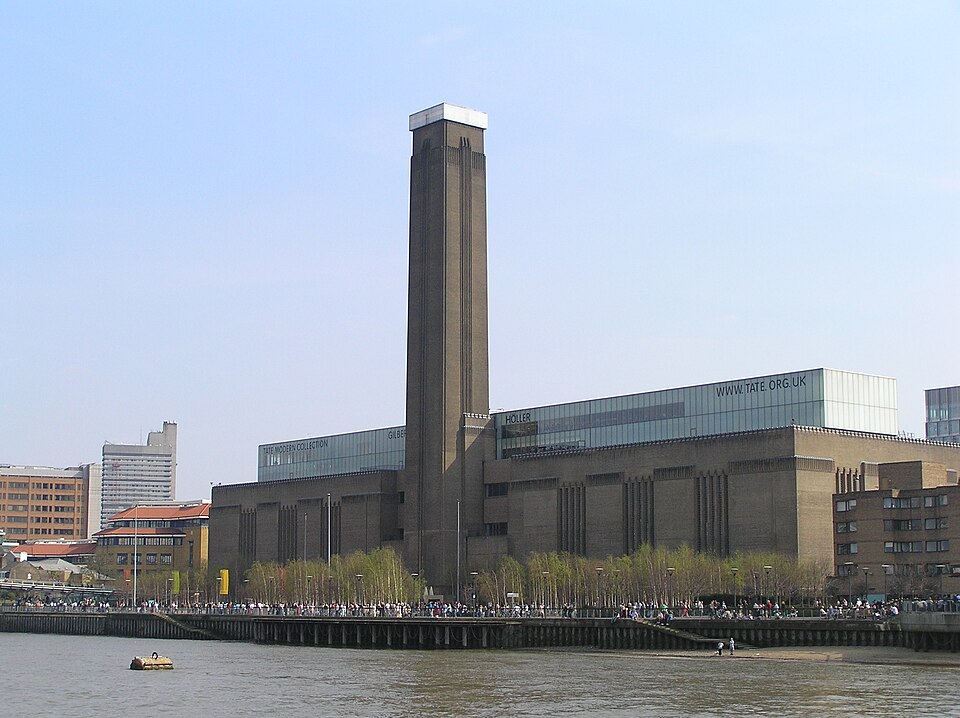
Walking toward Tate Modern for the first time can feel like approaching a cathedral—though one built for machines rather than for worship. Its immense brick exterior and tall central chimney, rising from the south bank of the Thames like a rust-red monolith, signal something different from the glass-and-steel modernity of nearby London landmarks. There’s a hum of seriousness even before you enter. This isn’t a museum that sidles up to you politely. It looms. It waits. And then it swallows you whole.
A Former Power Station Still Charging the Atmosphere
The building was once Bankside Power Station, a mid-century behemoth designed by Sir Giles Gilbert Scott, who also gave London the red telephone box and Battersea Power Station. Completed in stages between the late 1940s and early 1960s, Bankside burned oil to produce electricity until it was decommissioned in 1981. After two decades of abandonment, it was reborn as Tate Modern in 2000.
The architects chosen for the transformation, Herzog & de Meuron, chose not to erase the building’s industrial past. Instead, they preserved it—respectfully, even reverently. They left the brickwork intact, exposed the cavernous volume of the main turbine chamber, and let the architecture retain its original severity. The result is a building that feels honest about its history. It doesn’t pretend to have been made for art. But it has become a place where art feels possible on an almost geological scale.
The Entrance as a Threshold Experience
The museum’s main entrance delivers you directly into the Turbine Hall, the former generator room, now a five-story canyon of raw space. The floor slopes gently downward, and you descend—not symbolically, but actually—into a void large enough to absorb crowds without clutter, and artworks without boundaries.
This isn’t merely dramatic design. It’s functional dramaturgy. The Turbine Hall is the museum’s first artwork. Its emptiness holds tension. Its walls frame nothing and everything. And the way visitors move through it—slowly, aimlessly, often quietly—resembles a kind of secular ritual.
Over the years, this space has hosted some of Tate Modern’s most ambitious and public commissions. It’s where Louise Bourgeois installed her towering steel spider Maman in 2000, where Olafur Eliasson built a setting sun for The Weather Project in 2003, and where Doris Salcedo cracked open the floor itself in 2007. These works weren’t just viewed—they were inhabited. The Turbine Hall turned spectators into participants and physical scale into conceptual force.
A Building That Shapes the Visit from the Start
What this means for the visitor is simple but profound: your experience begins before you even reach the galleries. The building isn’t a neutral container. It’s part of the museum’s identity—and part of the art’s effect. It sets a tone of expansiveness and seriousness, which can heighten attention or overwhelm, depending on how you enter.
Give yourself a moment. Don’t rush through. Stand still at the top of the ramp. Let your eyes travel the full length of the hall. Notice the echoes. Observe the way people become small here—not insignificant, but absorbed. This is not a place designed to entertain you. It’s a place that expects something of you.
The Turbine Hall doesn’t make you feel clever or relaxed. It doesn’t try to impress with polish or precision. It’s elemental. And that makes it the perfect threshold for what Tate Modern is: a museum that asks you to look harder, linger longer, and sometimes let discomfort do its work.
Chapter 2: What Not to Miss — Essential Works
A museum as vast and varied as Tate Modern cannot be conquered in a single visit. Nor should it be. But for those who want a sense of orientation—some handholds in the avalanche of modern and contemporary art—it helps to know which works stand as anchors. Some are iconic. Some are surprisingly quiet. All are worth seeing not because they are famous, but because they deepen the museum’s character and reward close attention.
The Icons That Shape the Museum’s Identity
Begin with the works that have, by now, become synonymous with Tate Modern itself. Few visitors will fail to find their way to Andy Warhol’s Marilyn Diptych (1962), a glowing, ghostly monument to image repetition and the machinery of fame. Its left half pulses with silkscreened pinks and oranges, while the right drains slowly to black-and-white—a visual funeral for the media-saturated self. Seen in person, the surface is blotchy, imperfect, even intimate in its coarseness. Warhol’s cool detachment is more fragile than it first appears.
Not far from Warhol, Roy Lichtenstein’s Whaam! (1963) delivers a punch of its own. This two-panel painting borrows the language of comic books—bold outlines, primary colours, Ben-Day dots—but on a monumental scale. A jet fighter explodes across the canvas, its onomatopoeic “WHAAM!” erupting like a sonic boom. It’s easy to dismiss as pop candy. But stand in front of it long enough and something else begins to emerge: an unease about violence, masculinity, and mass culture’s ability to flatten tragedy into style.
Both works are strategically placed: they greet, arrest, and absorb. They are spectacles, yes—but they also establish the museum’s curatorial rhythm, which swings between excess and introspection.
Into the Abstract: Pollock, Rothko, and the Emotional Field
Jackson Pollock’s Yellow Islands (1952) occupies a different register. It doesn’t shout. It spills. The painting is a dense accumulation of looping skeins and calligraphic energy, rendered in enamel and oil on canvas. Unlike the more chaotic drip works Pollock is known for, this one has a surprising clarity—a pair of yellow masses floating like continents amid a storm of gestural marks. The physicality of the paint, the way it hangs in webs and whorls, reminds you that abstraction was once a risk, not a guarantee of prestige.
A few rooms away, if they are on display, the Seagram Murals by Mark Rothko bring a nearly monastic stillness. These nine large paintings, deep reds and blacks, were originally commissioned for the Four Seasons restaurant in New York but were never delivered. Rothko withdrew from the project after visiting the site, deciding that his work would become decoration for the wealthy—a fate he could not bear. The murals now live in a low-lit room where they hum with sombre gravity. They do not yield to casual looking. They require time. Sit for ten minutes, then twenty. Let the red seep in.
These works reshape the visitor’s tempo. After the bright jolts of Pop, abstraction introduces a different kind of intensity: emotional, atmospheric, unresolved.
The Modern Masters and a Museum’s Roots
Picasso’s Les Trois Danseuses (1925) remains one of Tate Modern’s most structurally vital paintings, linking it to the upheavals of early 20th-century art. Here, three dancers—contorted, mask-like, half-anatomical—form a jagged frieze of desire, violence, and metamorphosis. Painted during a moment of personal turmoil and creative transition, the work is a bridge between Cubism and something darker, stranger: Surrealism before it had a name.
This painting reminds the visitor that the Tate’s modern collection isn’t only concerned with the contemporary. It holds deep roots in the movements that shaped the modernist rupture—Futurism, Dada, Cubism, Constructivism. These aren’t always the loudest rooms, but they are foundational.
- Among smaller works from this period, look for:
- A modest but evocative early Mondrian,
- A small but searing oil study by Giacometti,
- And rare pieces by British Vorticists—less familiar, but fiercely original.
The Afterlife of the Turbine Hall
Even if the Turbine Hall is empty on your visit, it resonates with the memory of what has filled it. Olafur Eliasson’s The Weather Project (2003–2004) is perhaps the most widely remembered commission: an enormous artificial sun glowed through mist and mirrors, flooding the space with a golden, unreal warmth. Visitors lay on the floor, watching their reflections drift across the mirrored ceiling. It was at once sublime and strange—a collective dream about light, scale, and suspended time.
Other works have been more jarring. Doris Salcedo’s Shibboleth (2007) was a crack in the floor—a literal rupture visitors could walk along, step into, even fall inside. Its violence was quiet, unadvertised, and easy to overlook if you didn’t notice your foot sinking slightly into concrete. The hall has also been filled with slides, fog, raw earth, and mechanised sculptures. Even when bare, it feels haunted by the scale of what has come before.
Choosing with Intention, Not Exhaustion
The temptation is to try to “see it all.” But Tate Modern is designed to resist that impulse. Its thematic layout deliberately breaks chronology. Instead of marching from Impressionism to Pop to Postmodernism, it clusters works by idea: States of Flux, Media Networks, In the Studio, and so on. This can be confusing at first, but it’s also freeing. You’re not responsible for covering history. You’re invited to explore relationships.
So rather than pushing through every room, choose a few to linger in. Let a single artwork hold your attention for longer than feels natural. Take notes—not with your phone, but with your mind. Ask: what’s happening here, and why is it affecting me?
There is no correct route through Tate Modern. But there are wrong ways to experience it—mostly involving speed, fatigue, and obligation. The best approach is slow, selective, and responsive. Follow what arrests you. Skip what doesn’t. And if a room feels empty, give it a second look.
Chapter 3: How the Museum Is Organized — and Why That Matters
Tate Modern refuses to be a museum you simply walk through. Unlike traditional galleries that unfold chronologically—from Impressionism to Cubism to Conceptualism—it has rejected the timeline altogether. Instead, its permanent collection is arranged around themes: groupings of works that speak to each other by idea, not by date. For the visitor, this matters more than you might expect. It affects not just how you move through the building, but how you think, what you notice, and whether you leave dazed or curious.
Thematic, Not Historical: A Conscious Break from Tradition
When Tate Modern opened in 2000, the decision to abandon chronological order was more than a curatorial gimmick—it was a statement of institutional identity. This was not to be a reverent walk through the “greatest hits” of modern art history. It would be a living, reconfigurable space in which works from different periods, places, and philosophies could encounter each other in unexpected ways.
One room might pair a 1930s painting with a contemporary video piece. Another might juxtapose a postwar sculpture with a minimalist installation made fifty years later. The logic is conceptual: works are grouped under banners like “Artist and Society,” “In the Studio,” “Performer and Participant,” or “Living Cities.” Each theme invites a different kind of looking—less about where a work fits in the story of art, more about what it reveals when placed alongside something seemingly unrelated.
This approach frustrates some, liberates others, and confounds many. But its purpose is clear: to challenge the assumption that art unfolds in a neat, linear sequence, and to open up the possibility of dialogue across distance, genre, and time.
The Layout: Two Buildings, Many Paths
Physically, the museum is split between two main wings: the Boiler House and the Blavatnik Building. The Boiler House occupies the original structure of the Bankside Power Station, while the Blavatnik Building—opened in 2016—rises from the southwest corner as a twisting, angular extension. Together, they house not just the permanent collection, but also temporary exhibitions, performance spaces, film screenings, and reading rooms.
The internal layout can be disorienting. Floors are not uniform. Galleries vary wildly in size and mood. Some rooms are airy and flooded with light; others are intimate, hushed, or bunker-like. There is no official “starting point,” though many visitors begin in the Turbine Hall and ascend via escalators to the collection displays above.
This non-linear structure echoes the museum’s curatorial philosophy. You are not led—you wander. And in wandering, you construct your own version of the museum. The architecture offers no master narrative. You assemble it as you go.
What This Means for You as a Visitor
There’s a subtle pressure in traditional museums to see everything. To begin at the beginning and finish at the end. Tate Modern resists this. It isn’t built to be “completed.” Instead, it encourages you to browse like a reader flipping through a book, stopping where the material arrests you and skipping what doesn’t.
That freedom can be exhilarating—but also overwhelming. Visitors often find themselves wandering in and out of rooms without knowing what they’re meant to be looking for. One room might contain a dozen masterpieces; another might feel sparse or puzzling. Labels are informative but not didactic. You’re not told what to think. The museum expects you to work.
There’s also no clear sense of progression. You won’t end up in the “contemporary” wing after passing through the “modern” rooms. The old categories are intentionally scrambled. A mid-century American canvas might sit beside a recent work from Lagos or Seoul. A sculpture in steel might echo a fragile textile. The goal is not to compare by chronology or geography, but to think across boundaries.
Strategy: Don’t Rush, Don’t Drown
So how do you approach a museum like this without getting lost or exhausted?
Start small. Pick one or two themes. Spend time in them. Don’t worry if you don’t “get” everything. Move slowly, double back. Let the logic of the rooms reveal itself. And above all, give yourself permission to leave. You won’t see everything—and you’re not meant to.
Many of the best moments at Tate Modern aren’t planned. They happen in corners, in silence, in the time between rooms. A sudden color field that stops you. A tiny video screen in a darkened alcove. A sound piece that lingers longer than expected. You aren’t following a path—you’re collecting impressions.
Unlike museums that funnel you through a defined experience, Tate Modern invites you to build your own. It doesn’t tell you what to see. It asks what you notice.
Chapter 4: The Boiler House and the Blavatnik Building — Two Wings, One Museum
When you walk into Tate Modern, you’re actually entering a museum made of at least two very different buildings — the old power‑station wing, and a newer extension. Each has its own character and its own logic. Knowing the difference can help you plan your visit more intelligently.
From Power Station to Gallery: The Boiler House
The north wing of the site — the older part — was originally the Boiler House of the former Bankside Power Station. When the station closed in 1981, the hulking brick structure stood silent for years, until, in the 1990s, architects Herzog & de Meuron were commissioned to transform it into Tate Modern. Their design left much of the original architecture intact: high ceilings, robust brick walls, and the sense of industrial scale.
The main galleries displaying the permanent international modern and contemporary art collection occupy this Boiler House space. Galleries are spread across several floors (commonly floors 2, 3 and 4 in the building’s internal numbering scheme). Because of the original structure’s shape and size, the rooms vary: some are broad, grand halls; others more modest. This variety allows for a flexible curatorial layout, mixing large canvases, sculpture, installations, and more intimate works.
For many first‑time visitors, the Boiler House offers the classic “museum” experience: you enter, climb escalators or stairs, then wander through familiar‑feeling galleries populated by paintings, objects, and installations. The solidity of the building — brick, concrete, steel bones — gives the art a grounded frame.
The New Wing: The Blavatnik Building (formerly Switch House)
In 2016 Tate Modern opened a major extension: the structure known as the Blavatnik Building (formerly the “Switch House”). This tower‑like addition rises above, and expands beyond, what was the power station’s southern part. The extension increased the museum’s display and public‑space capacity by roughly sixty percent — a dramatic expansion born of the gallery’s unexpected popularity.
Inside the Blavatnik Building you’ll find more than just extra wall space. The new wing repurposed the old fuel‑oil tanks of the power station for underground performance, film, and installation spaces. Above those, the tower contains several floors of gallery space, alongside restaurants, shops, rooftop terraces, and public‑space amenities. The building’s brick façade echoes the old power station’s exterior — but its geometry, verticality, and internal layout clearly mark it as different.
This contrast between old and new — between Boiler House and Blavatnik Building — is more than architectural. It shapes how art is exhibited and experienced: intimate works can sit beside vast installations; a crowded gallery can open into an airy tower room; older paintings can converse with contemporary experiments.
A Visitor’s Route: How to Use Both Wings in One Visit
Here’s a simple strategy to get the most out of both wings if you have a single visit:
- Enter through the main entrance and take in the grandeur of the central space (the former turbine chamber) — a symbolic and spatial introduction to what’s inside.
- Head into the Boiler House first: climb to the main gallery floors and see a selection of the permanent collection. This gives you a sense of the “core” Tate Modern — its backbone of painting, sculpture, and mixed‑media art.
- After that, move toward the southern extension. Descend into the tank‑spaces if they’re open, or ride up to the tower levels for newer galleries, contemporary installations, or a rooftop view.
- Use the contrast — old vs new — to pace your visit. The solidity of the Boiler House followed by the expansiveness and flexibility of the Blavatnik Building creates a rhythm: contemplation, then confrontation or surprise.
- Allow for breaks. The extension houses cafés, shops, and terraces — ideal places to rest, reflect, or plan your next move.
Why This Architectural Duality Matters
As a visitor, recognizing that Tate Modern is actually two (or more) connected buildings helps you read the museum more clearly. The older wing reminds you of history: of industrial ambition, architectural re‑use, and the transformation of everyday structures into art spaces. The newer wing reminds you of the present: expansion, the growing scale of contemporary art, and the museum’s ambition to keep evolving.
The contrast also mirrors the collection’s own range. Modernism and contemporary art share the same home; traditional canvases and experimental forms coexist. That overlap — of history, style, architecture, and purpose — embodies what Tate Modern does best: hold tensions, invite unexpected juxtapositions, and challenge you to roam not only chronologically or stylistically, but spatially too.
When you leave the building — maybe through the southern exit near the extension, perhaps up to a terrace and back out into the city — you do so as someone who has crossed a threshold, invited into a space that is as much architecture as gallery.
Chapter 4: The Boiler House and the Blavatnik Building — Two Wings, One Museum
Tate Modern is not a single structure, but a conversation between two buildings. Most visitors enter unaware of this, stepping into the former Bankside Power Station and assuming the museum’s vastness is contained within that industrial shell. But the experience of Tate Modern is shaped—structurally and psychologically—by its split personality: the old and the new, the horizontal and the vertical, the Boiler House and the Blavatnik Building.
Knowing how these two halves function can radically change how you experience the museum. They do not just hold different types of work. They ask different kinds of questions.
The Boiler House: A Museum Inside an Industrial Ghost
The north wing of the museum—the original power station—was where steam turbines once roared and thick machinery filled the interior. When the building was adapted by architects Herzog & de Meuron in the late 1990s, they left much of the core architecture untouched. The result is a set of galleries that feel grounded, rectilinear, substantial. The walls are heavy. The ceilings are high. The rooms breathe, but they don’t drift.
This part of the museum houses much of the permanent collection: the paintings, sculptures, and classic installations from the 20th century. Here is where you’ll find Warhol’s ghostly Marilyn Diptych, Lichtenstein’s explosive Whaam!, and the cooler zones of postwar abstraction. Many visitors spend the bulk of their time in this wing without even realizing there is more. That’s not a flaw—it’s a testament to how well the building holds attention.
Even the route itself plays into this stability. You enter the Turbine Hall, then move upwards via escalator or ramp into galleries that unfold one after another. It has a certain rhythm: progression without prescription, openness without chaos. It’s in this wing that Tate Modern feels most like a traditional museum. And for many, that is comforting.
But it’s also only half the story.
The Blavatnik Building: Tate’s Vertical Imagination
Walk south through the Turbine Hall and you may find yourself ascending into another kind of space. The Blavatnik Building—added in 2016—rises like a twisting, fortress-like tower, all sharp angles and pleated brickwork. It looks like it grew out of the original building but decided to mutate halfway up. Inside, the experience changes.
This is not a neutral extension of the museum. It is its own architectural event. The lower levels, built into the old oil tanks of the power station, house raw, subterranean spaces used for performances, sound installations, and film. They’re dim, resonant, unfinished. The air is cooler. Footsteps echo differently.
Above them, the new galleries stretch vertically. Unlike the horizontal logic of the Boiler House, the Blavatnik Building feels like an ascent. Each level reveals different types of work: immersive installations, contemporary global art, architectural experiments, and sometimes works too awkward or fragile for traditional spaces. The lighting is more varied. The walls curve. The rooms open and close in ways that sometimes disorient, sometimes seduce.
At the very top, a viewing terrace offers one of the finest free panoramas in London. From here you can look across the river to St Paul’s Cathedral, out to the towers of the City, or west toward the Shard. It’s not merely a photo opportunity. It’s part of the museum’s structure: a release point after layers of looking. Art inside, then city beyond.
Planning Your Path Between the Two
It’s easy to miss the architectural logic if you’re not paying attention. The museum’s physical layout isn’t linear—it’s spatially complex, with long ramps, hidden staircases, and looping routes between rooms and buildings. You can move from one wing to the other without noticing the transition.
To get the most out of both wings, plan for contrast:
- Begin in the Boiler House if it’s your first visit. It’s more intuitive. It grounds you in the major movements of 20th-century art. It gives you a baseline.
- Move into the Blavatnik Building once you’ve established that grounding. Let the newer wing pull you into less familiar territory—new media, non-Western voices, contemporary interventions that challenge the idea of what a museum is supposed to hold.
- Use the verticality. The Blavatnik Building isn’t just another set of rooms—it’s a different rhythm. Descend into the tanks for darkness and intensity. Ascend to the rooftop for air and release.
- Take breaks deliberately. The newer wing offers more seating areas, cafés, and viewing points. Use them. A successful Tate Modern visit is as much about managing pace and sensory input as it is about seeing everything.
Why the Split Matters More Than You Think
The two wings are not opposites, but complements. The old building reminds you that the museum has roots—in time, in industry, in art history. The new building reminds you that those roots are not the end of the story. Contemporary art, and the contemporary museum, are expanding in scale, in geography, and in ambition.
By housing these dualities within a single institution, Tate Modern allows for a rare experience: movement not just through galleries, but between architectural metaphors. The past as weight; the present as climb. The grounded; the aerial. The remembered; the speculative.
When you step back outside—whether through the northern slope to the riverfront, or the southern path that winds through the new façade—you carry that dual movement with you. You’ve moved through two buildings, but also through two ways of thinking about art, space, and time.
Chapter 5: The Viewing Level and the City Beyond
After hours spent inside Tate Modern—amid concrete walls, curated lighting, and the tightly choreographed experience of art—it’s easy to forget where you are. Then you step out onto the 10th-floor viewing terrace, and the city returns all at once. Light, air, movement, skyline. This is not an afterthought. It’s part of the museum’s rhythm.
Above the Galleries: A Shift in Perspective
The viewing level is housed at the top of the Blavatnik Building, the twisting tower that forms Tate Modern’s more recent extension. You can reach it via lift or stairs from the upper gallery floors. Emerging onto the terrace, you find yourself suddenly open to the sky—no longer a viewer of art, but a viewer of the city.
To the north, across the Thames, stands St Paul’s Cathedral, its dome calm and symmetrical against the sprawl. Eastward lies the jagged silhouette of the financial district—glass towers, cranes, metallic glint. South and west, the view stretches across rooftops and narrow streets, cranes and spires, balconies and chimneys. The Millennium Bridge cuts a graceful arc across the river below, carrying pedestrians like a quiet procession.
It’s a view that many Londoners forget exists. It’s also free, which makes it one of the rare places in the capital where the sublime costs nothing.
Why the View Is More Than a View
It would be easy to treat the viewing level as a kind of reward for museum fatigue—a place to catch your breath and check your messages. But in the context of Tate Modern, it serves a deeper function.
The terrace reframes what you’ve just seen. Inside, you’ve moved through decades of painting, sculpture, installation, video, and sound. You’ve encountered art that addresses war, identity, abstraction, capitalism, climate, memory. And then—out here—you see the city those ideas live in.
You realize how little separates the museum from the world outside. The galleries were never meant to be a fortress. They are a porous space, both reflecting and absorbing the pressures of urban life. From the terrace, London no longer seems like a background. It becomes the foreground—the medium into which all that art must eventually return.
Best Times to Visit, and What to Expect
The terrace is open during museum hours and can be reached via a dedicated lift in the Blavatnik Building. It’s accessible and unassuming, with no ticket required and no pretension attached.
If possible, go early in the day or late in the afternoon. Mornings tend to be calm, and the golden hour brings a particular magic as the city’s surfaces catch light and shadow. On overcast days, the view becomes more introspective: a grey tapestry of rooftops and stone. Even in rain, the spectacle doesn’t vanish—it just shifts mood.
The terrace is also a natural break point. After galleries that demand focus and emotional energy, this space gives you room to reset. Visitors often fall silent here, not from reverence but from something quieter: the relief of reentering the world slowly.
From Looking at Art to Looking at the World
What makes this terrace unusual among museum spaces is its refusal to close the loop. You don’t end your visit with a gift shop or an exit corridor. You end it with a horizon. You see where you are, and what surrounds the museum—the architecture, the crowds, the patterns of movement across bridges and along the river.
And in doing so, you’re reminded that the concerns of the art inside—power, politics, intimacy, memory, imagination—are not confined to the gallery walls. They’re out here too, in the visible body of the city.
For many visitors, this final elevation becomes the moment they remember most vividly. Not because it’s dramatic, but because it feels earned. After immersion, perspective. After detail, distance. You step back from the frames and installations and see something larger, uncurated, unscripted. The art lingers—but the world reasserts itself.
Chapter 6: Hidden Rooms, Quiet Spaces, and Unlikely Favorites
In a museum as vast and visited as Tate Modern, it’s easy to mistake movement for attention. The flow of people tends to follow the gravitational pull of the well-known: a Rothko room, a towering sculpture, a name you recognize from a textbook or a tote bag. But for those who deviate—who pause at unmarked doors, descend to the basement, or wander into a half-lit gallery that seems like an afterthought—the museum reveals something else: its capacity for quiet, for discovery, and for art that resists summary.
Beneath the Surface: The Tanks and the Power of Descent
The best place to begin looking for Tate’s quieter side is below it. Deep under the newer Blavatnik wing lies a series of curved, bunker-like spaces originally built to store fuel oil. Now known simply as the Tanks, these subterranean chambers retain their original industrial character. The architecture hasn’t been softened. The walls curve without concession. The floor is bare. Light is minimal. The spaces are stubborn.
They are also perfect for work that requires a different kind of attention. Here, time-based media—film, performance, sound installation—unfolds without the distractions of daylight or wall text. There’s no pressure to move quickly. Visitors slow down not because they’re told to, but because the space demands it.
In one gallery, a single-channel video might run silently, its images looping across a projected surface. In another, a large speaker might pulse with low frequencies that rattle the air. You are not only looking—you are inhabiting. And that shift in posture changes everything.
The Smallest Rooms Often Hold the Most
Back above ground, amid the better-known galleries, there are certain rooms that many visitors miss—either because they’re tucked away or because they house work that doesn’t shout. These are often the spaces where the museum’s curators take quiet risks. A modest series of works on paper. A sculpture barely the size of a fist. A single photograph hung without commentary.
These works do not declare themselves. They are easy to overlook. But they stay with you—precisely because they don’t resolve into a quick impression. One visitor might stop before a small drawing whose lines look unfinished, uncertain. Another might find an empty chair in a dim gallery where ambient noise and time itself seem to be part of the installation.
There is a humility in these encounters. The museum stops being a machine for delivering significance and becomes something closer to a studio or a journal. The art doesn’t ask to be understood all at once. It asks you to stay.
The Relief of Silence in a Museum Built for Scale
Tate Modern is a building of grand gestures. The Turbine Hall, the high-ceilinged white boxes, the tower—all speak of scale, ambition, and public spectacle. Yet within that framework, silence has its own language.
In the Blavatnik Building, a visitor who strays from the escalators and elevators may find a gallery half the size of the others, dimly lit, with one object placed alone. A single textile, suspended like a banner. A room of cyanotypes. A short film that repeats every three minutes. What these spaces offer is not so much a contrast to the grand narrative, but a pause in it. A space in which looking is no longer collective, but solitary.
These moments are not passive. The silence sharpens your perception. The artwork doesn’t compete—it breathes.
Overlooked Artists and Peripheral Rooms
There’s a particular joy in encountering a name you don’t know and realizing that the work before you carries the same emotional weight as the most celebrated pieces in the museum. Tate Modern has made strides in presenting a global collection—one not only weighted toward Europe and North America, but increasingly attentive to artists working in Latin America, Asia, Africa, and the Middle East.
Often, these works are displayed outside the high-traffic galleries. You’ll find them in transition zones, small rooms without benches, or tucked between better-known displays. And yet they are frequently the works that stop people in their tracks.
A collage made from political ephemera. A performance documented only through a fragment of video and a pair of worn shoes. A work that uses dust or light or language as its medium. These are not spectacle—they are residue. And they ask the viewer to meet them halfway.
What they offer in return is not clarity, but depth. They don’t explain themselves. They suggest.
How to Find What Isn’t Pointed Out
There is no map to the quietest places in Tate Modern. And that’s the point. What’s hidden is not hidden deliberately—it’s hidden by habit. The crowds walk one path. The museum encourages another. But the best way to see what’s often missed is to refuse both.
- Take a staircase instead of the escalator.
- Enter a gallery from the “wrong” end.
- Backtrack. Sit. Wait.
- Listen for silence—where there are fewer footsteps, fewer phones, less chatter.
Treat the museum not as a route, but as a landscape. Let accident do the work of curation. You’ll find what you didn’t know you were looking for.
The Rooms That Remember You Were There
There’s a kind of art that leaves a mark as soon as you see it—a vivid image, a shock, a phrase. And then there’s another kind, more difficult to describe. It lingers not in memory but in mood. You don’t remember the title, or even the medium. You just remember the space. How long you stood there. What it felt like to leave.
These are the rooms Tate Modern doesn’t advertise. The ones no guidebook lists. They change over time. They might be gone next week. But they are what give the museum its depth. They are why people return.
Not for the big pieces. But for the ones they almost missed.
Chapter 7: Time‑Based Media and the Moving Image
Stepping into a gallery devoted to moving images at Tate Modern is like trading a book for a film: the canvas becomes time, the frame opens, and the meaning shifts from “what is” to “what becomes.” In a museum many know for paintings and sculptures, these works offer a different kind of encounter — one defined by duration, sound, context, and the porous boundaries between art and life.
Spaces Built for Motion: The Tanks and Dedicated Media Rooms
Deep beneath the main galleries lies one of the museum’s most distinctive zones: a set of concrete, cylindrical rooms once used as fuel‑oil storage by the former power station. Today, these chambers — collectively known as “the Tanks” — form a permanent venue for work in film, video, performance, and installation. Because these underground halls retain their industrial architecture, they offer artists a space unbound by traditional gallery expectations: low ceilings, raw surfaces, darkness, and an enveloping sense of isolation or immersion.
In such a setting, time‑based work isn’t competing with natural light or polished white walls. Instead, the medium unfolds in controlled—or even unsettling—environments. A silent video loop on a bare wall. A sound installation pulsing through concrete. A fragment of performance documented but still alive in memory. When the museum turns lights low, dims the surround, and invites silence, you don’t just view art — you inhabit it.
Because of this design, long after the predictable movements of galleries and corridors fade, Tate Modern keeps a corner reserved for art that resists clarity, comfort or closure. For a visitor willing to descend, sit, and wait, these are often the most rewarding encounters.
Artists Who Think in Frames, Not Stillness
Some of the art shown in these media‑based galleries emphasizes narrative: moving‑image works that unfold like short films, presenting a story, a montage, or a reflection in time. Others treat film or video as material — loops, textures, destabilized perspective, soundscapes — where intensity or meaning arises from movement itself, not from linear narrative.
In this context, the medium becomes part of the message. The grain of film, the flicker of projection, the ambient noise, the hush of a near-empty room — all contribute to the work. The effect is rarely instantaneous. It may take minutes, sometimes the duration of the full piece, for patterns to emerge. Once they do, the experience can linger: in memory, mood, or a sensation of displacement.
These works challenge the visitor differently than a painting. You cannot glance — you must stay. You cannot skim — you must listen, wait, be aware. And when you emerge again into the light, the rest of the museum feels different. Slower. Quieter. Full of possibility.
A Rhythm for the Viewer: How to Watch (or Listen)
Visiting time‑based media at Tate Modern calls for a different approach than you might use in most galleries. Here are a few ways to get the most out of it:
- Allow yourself to enter without expectations. Sit if you need to. The work may not play out like a dramatic climax — sometimes its power comes from gradual accumulation.
- Check schedules: sometimes films or screenings rotate. If you approach at the tail end, you may miss the start — and with it, the meaning.
- Embrace discomfort or ambiguity. Not all works resolve neatly. Some leave open questions. That’s part of what they’re asking of you.
- Give time for your senses to adjust. The Tanks may feel cold, damp, or disorienting at first. Let your eyes, ears, and body recalibrate before dismissing what you see.
When treated with patience, the experience can be transformative: an image dissolving into sound, a thought unspooling slowly, a silence that echoes longer than a painting’s presence.
Why Moving‑Image Works Matter in a Museum of Monumentality
Tate Modern is often associated with scale: towering installations, massive canvases, loud assertions. But the inclusion and central placement of moving‑image works — especially in the Tanks — suggests another ambition. The museum acknowledges that modern and contemporary art can’t always be pinned down in a frame. Some works must breathe, evolve, shift. Some demand time.
By giving film, video and performance a permanent, dedicated home, Tate Modern expands what art can be: ephemeral, temporal, vulnerable, emerging. It becomes less about the object to own and more about the moment to experience. The gallery stops being a vault. It becomes a stage, a screening room, a space for time itself.
In a building born of industry and conversion — once pulsing with mechanical rotations, now echoing with footsteps, conversation, and silence — time‑based media feels especially fitting. The concrete walls, once contained oil, now contain memory, light, sound, motion.
For a visitor who wants more than spectacle, more than canonical names, these works are a chance to meet art in process: unfinished, unpredictable, alive.
Leaving Changed — or at Least Slowed Down
When you exit the Tanks or a media gallery and re‑enter the main flow of the museum, you may find everything seems different. The paintings look quieter. The rooms feel larger. The high ceilings of the former power station hum with possibility instead of history.
That shift isn’t a glitch. It’s the point. Tate Modern doesn’t just show art. Sometimes, it reminds you that art—and time—are inseparable.
So if you go, go slow. Sit. Stay. Let moving images draw out shadows of memory and space. And when you leave, carry with you a sense of duration — a reminder that what you just saw doesn’t end on the wall. It travels with you.
Chapter 8: Tate Modern After Dark (and Before the Crowds)
Museums have rhythms just like cities do. At Tate Modern, the difference between walking in at 10:00 AM and walking out at 9:30 PM isn’t just a matter of hours—it’s a difference of atmosphere, attention, and memory. There’s a version of the museum that crackles with noise and motion, crowded with school groups and camera shutters. But there’s another version too, available only to those who arrive early or linger late. That version is slower, quieter, stranger—and in many ways, more powerful.
The First Visitors of the Day
Arriving just as the museum opens, especially on a weekday, gives you a rare kind of freedom. For a short window—usually no more than twenty or thirty minutes—the galleries feel like they belong to you. The hum of crowds hasn’t arrived. The floors are still being polished. Security staff greet you with calm rather than fatigue.
The art looks different in the morning. Light filtering through the windows in certain galleries hits paintings and sculptures at an angle you won’t see later in the day. Dust hangs visibly in the beams. You begin not with urgency, but with space.
This is the ideal time to see works that normally draw clusters of people. A well-known Warhol, a Rothko room, a popular installation—without others jostling beside you, these pieces breathe. You can walk around them slowly. You can sit. You can linger without becoming a bottleneck.
Early morning also lets you build your own path through the museum. Without the gravitational pull of foot traffic, you’re more likely to wander, to follow your own interest rather than the movements of others. That difference can be subtle, but it matters: your experience becomes personal, not collective.
The Long Fade of Evening Light
Then there’s the other side of the day: late visits, when the museum stays open into the evening. As the sky outside shifts from blue to amber to dark, the building itself begins to change character. Artificial light takes over. The temperature drops slightly. The volume lowers. By seven or eight in the evening, the galleries thin out. By nine, entire wings might feel nearly deserted.
This is not the museum closing—it’s the museum entering a different state. The Turbine Hall, usually echoing with conversation and footsteps, becomes cavernous and still. The elevators seem slower. Conversations turn from loud declarations to whispers. It feels, at times, like you’ve stayed after hours—even though you haven’t.
And that mood seeps into how you see the work. A quiet film loop in the Tanks might feel more immersive. A sculpture under spotlights in an otherwise darkened room feels more theatrical, more alive. The city visible through the museum’s windows has also dimmed, and so the internal space takes over.
Late visits also give you permission to move slowly. No one’s behind you. No group is heading toward you. You begin to notice things: textures in a painting’s surface, a strange detail in the corner of a video frame, the ambient sound that’s been playing for an hour without recognition.
Light, Sound, and the Shifting Architecture of the Museum
Tate Modern was designed with light in mind. Natural light enters through the high windows in the Boiler House, while the newer Blavatnik Building alternates between exposed spaces and completely controlled environments. As the light outside changes, so does the museum’s internal balance.
During midday, galleries are often at their brightest—sunlight bouncing off white walls, large windows turning rooms into glowing boxes. This can be exhilarating, but also exhausting. The noise of the crowd amplifies. Attention fragments. Visual overwhelm sets in.
By contrast, mornings and evenings dim the whole structure. Light becomes directional rather than diffuse. The museum’s architecture sharpens—its edges more pronounced, its rooms more atmospheric. Shadows creep along staircases. Escalators hum like instruments. What was a public space begins to feel semi-private.
It’s worth returning at different times just to experience this architectural mood shift. The same gallery can feel like a laboratory at noon, and a chapel at dusk.
Planning Your Visit Around Time, Not Just Art
Most people approach a museum with a checklist: what works they want to see, how long they plan to stay, where they’ll have lunch. Few think of time of day as part of the experience. But at Tate Modern, it matters.
- If you crave stillness, come early. Be among the first through the door. Don’t rush. Start with the quieter rooms—those without crowds—and build up to the larger works.
- If you want drama, come late. Let the darkness outside reframe the space. Let the museum feel like a refuge from the noise and glare of the city.
- If you’re overwhelmed, pause. Leave and return later in the day. Tate Modern rewards repeated, staggered visits more than one long, exhaustive pass.
Even your emotional state can align differently depending on the hour. What feels overstimulating at 3:00 PM might feel profound at 8:30.
Why Museums Are Not the Same All Day
The art doesn’t move. But everything else does: the people, the air, the light, the way you feel after coffee or before dinner. Tate Modern is not a static experience. It’s temporal. It shifts.
Recognizing this isn’t just about strategy—it’s about respect. For the works, for the space, for your own mind. Art changes depending on how you arrive to it. And some works, especially those that rely on atmosphere, sound, and space, reveal themselves only when the conditions are right.
By treating time of day as one of the materials of your visit—not a constraint, but a tool—you enter into a richer, more responsive relationship with the museum. You become part of its rhythm, rather than a body moving through it.
And when you finally leave, whether into the blue light of morning or the orange shadows of London after dark, the experience doesn’t feel like it ended. It feels like something suspended, ready to be picked up again—at a different hour, with different light, and new attention.
Chapter 9: The Art of Eating in the Museum
Art museums can be exhausting—not because they demand physical exertion, but because they ask for a kind of sustained attention that few other spaces require. After an hour or two of looking, walking, and thinking, even the most engaged visitor begins to fade. At Tate Modern, the museum itself seems to understand this. It offers moments to pause, to eat, and to recalibrate—not just to refuel, but to reenter the experience with clarity.
Where and how you eat during your visit is more than convenience. It’s part of the arc of your day.
A Museum That Understands Its Scale
Tate Modern is vast. The two wings, multiple floors, vertical transitions, and deep gallery rotations make for a sprawling experience. It’s not a place you “get through” in one go. The museum’s size and ambition create the need for intervals. And so the question becomes not just where to eat, but when.
Some visitors rush to the top-floor restaurant after a few hours, while others descend mid-way into one of the cafés to pause before continuing. The building offers multiple layers of hospitality, each with its own atmosphere.
The top of the Blavatnik Building houses the museum’s most elevated dining experience—literally and figuratively. With large windows overlooking the Thames and London’s skyline, this restaurant serves not just food, but perspective. It’s a space for reflection, for shifting gear. After the compressed silence of the galleries, the openness of the view can feel like a necessary exhale.
Casual Breaks: The Ground-Level and Mid-Level Cafés
For visitors who prefer something more informal, the museum offers other spaces designed for shorter pauses. The ground floor houses a café accessible without a ticket—useful for those beginning or ending their visit. It serves pastries, light meals, and coffee, and is often animated with the energy of visitors regrouping or reentering the museum from the riverside.
Mid-level cafés, embedded deeper in the museum’s interior, offer respite without full departure. These are the spaces where families with children regroup, solo visitors journal quietly, and couples decompress after an intense gallery. They’re less about dining and more about stopping—resetting your visual and mental pace.
You’ll notice how different the art feels after even fifteen minutes of rest. What was once overwhelming becomes interesting again. What felt obscure starts to open. Attention returns, and with it, the desire to keep going.
Eating as Part of the Museum’s Architecture
In Tate Modern, food is not siloed away. The cafés and restaurants are woven into the flow of movement. They offer not just sustenance, but transitions. They shift your body from one tempo to another.
One of the most overlooked functions of these spaces is the way they allow you to extend a work’s presence. After encountering a powerful installation or a room of emotionally charged paintings, moving directly into the next gallery can flatten the impact. But sitting down, even briefly, allows the experience to settle. The brain catches up. You carry the work with you longer.
A café becomes not just a break, but a buffer. It lets meaning linger.
Outside the Museum: Nearby Options and the City’s Edges
For some, the best way to rest in the middle of a museum visit is to leave entirely—step outside, walk a few hundred meters along the Thames, and find food elsewhere. Tate Modern is surrounded by restaurants, bakeries, food trucks, and pubs. The South Bank is a mix of corporate offices, cultural institutions, and tourist routes, and that blend is reflected in the food offerings.
Whether it’s a sandwich by the river or a meal in a shaded courtyard, leaving the museum can also be a way to restore autonomy. The shift in context reorients you. When you return, you feel less like a visitor passing through a system, and more like someone actively constructing a day.
There’s no wrong time to do this. You can leave after your first hour. Or wait until the late afternoon. The key is not to treat the museum as a marathon to be conquered, but as a sequence of moments—some of which are better experienced after a plate of food and a change of light.
Eating as a Form of Thinking
There’s a tendency to treat museum cafés as neutral spaces—functional, forgettable, peripheral. But in a place like Tate Modern, where the experience can be conceptually and emotionally rich, eating serves a quiet intellectual role. It punctuates the visit.
The best museum meals are not rushed. They give you space to reflect. You replay what you’ve seen, talk it out, or sit in silence as your mind processes color, movement, confusion, beauty, exhaustion. A good table becomes a thinking device.
And for those traveling alone, these moments are especially meaningful. You are neither in nor out of the museum. You’re between things. And in that in-between, you notice more—not only about the art, but about how you’ve responded to it.
At its best, food in a museum is not a detour. It’s part of the art’s afterlife.
Chapter 10: For Families, First-Timers, and the Curious but Unsure
Not everyone walks into Tate Modern knowing what they’re looking at—or for. And that’s fine. In fact, it’s expected. Modern and contemporary art can often feel more opaque than enlightening, more confrontational than beautiful, and more concerned with the idea than the object. But Tate Modern, despite its scale and reputation, is not designed only for the initiated. Its spaces, its staff, and even its artworks make room for curiosity, uncertainty, and exploration without expertise.
No One Knows Everything in a Museum Like This
Start with this: even people who work in museums sometimes walk into a gallery and feel baffled. The artist might be unfamiliar. The materials might be unconventional. The wall text might help—or leave you with more questions than answers. That confusion is not a failure of the visitor. It’s part of the dynamic between art and attention.
Tate Modern does not require prior knowledge. The museum doesn’t assume you’ve read catalogues, studied theory, or seen the full history of modernism unfold. What it does ask is presence. A willingness to look. And sometimes, a willingness to be uncomfortable.
Many of the museum’s most powerful works can’t be understood at a glance. Some aren’t even made to be understood—they’re made to provoke a feeling, to disturb a pattern, or to draw you into a strange internal rhythm. The key is not to interpret immediately, but to stay in the room long enough to let something shift.
That’s the difference between visiting and encountering. And anyone can do it.
For Families and Children: Not a Playground, But Still Playful
There’s a common anxiety among parents: is this the kind of museum where children are really welcome? The short answer is yes—but with realism. Tate Modern isn’t interactive in the way that science museums or children’s museums are. The art is rarely touchable. The spaces are often quiet. The architecture can feel imposing.
But children don’t need things to be simplified to engage with them. In fact, the scale and oddness of the museum often captivates younger visitors more than adults. The Turbine Hall, for instance, with its enormous emptiness and architectural drama, is one of the most child-friendly museum spaces imaginable. It invites walking, lying down, looking up, and a kind of free movement that galleries rarely allow.
Inside the galleries, some works lend themselves naturally to childlike curiosity—bright colours, surprising materials, moving parts. Others may pass them by. That’s fine. It’s not a curriculum. It’s a journey.
The museum also provides practical help: lifts and ramps are everywhere, most galleries are accessible with prams, and staff are usually understanding. For families who want a softer pace, the quieter areas—like the Tanks, side galleries, or café spaces—offer a good place to retreat and reset.
For Those Who Feel Unsure Where to Begin
One of the best places to start, especially for those who feel a bit out of place, is the “Start Display” gallery. This area is often used to showcase iconic works from the collection—pieces that give a clear sense of the museum’s tone and range. You won’t necessarily “get” everything there, but you’ll begin to see the shape of the museum’s logic: bold, wide-ranging, idea-driven, and deliberately non-linear.
And if you find yourself in a room that leaves you cold or confused, the answer is simple: walk on. No guilt. Not every room is for every visitor. The museum is not asking for completion, only engagement.
Often, the most meaningful experiences happen by accident. You turn a corner and find a room empty but for a strange sculpture that seems alive. You sit before a video installation for a moment and find yourself still there twenty minutes later. These are the gifts the museum offers freely, but quietly.
How the Museum Helps Without Hovering
Tate Modern’s staff tend to strike a balance between availability and distance. They don’t follow or monitor you, but if you ask, they’re usually glad to talk. Many are artists or students themselves. A simple question—“Do you know who made this?” or “What’s going on in this room?”—can open a door. And unlike audio guides that overwhelm with information, a short exchange with a real person often leads to something more memorable.
There are also booklets, leaflets, and information panels placed strategically for those who want more context. But none of them are required. Some visitors engage deeply with every text. Others skip them all. Both approaches are valid.
The museum is built to hold multiple types of visits: fast, slow, deliberate, aimless. There’s no one correct pace.
Why It’s Okay Not to Understand
A modern art museum is not a puzzle with a single solution. It’s more like a city—a collection of impressions, contrasts, tensions, ideas, provocations. Some of it is made to be clear. Some of it isn’t. And part of the experience is noticing how you respond.
You might feel admiration, resistance, joy, sadness, or nothing at all. Those are all valid reactions. The purpose isn’t to arrive at a correct reading, but to be awake inside the encounter.
That’s why Tate Modern, though full of complexity, remains open to everyone. It doesn’t ask you to pretend. It invites you to notice.
Chapter 11: Bookshops, Editions, and the Exit Ritual
Leaving a museum is rarely abrupt. It’s a transition—an easing back into ordinary time. At Tate Modern, that transition often begins not with the door, but with the shop. Few institutions have mastered the art of the museum store quite like Tate. And at its best, the shop becomes more than a place to buy—it becomes a final gallery, a coda, and an emotional threshold between the intensity of art and the dispersal of the street.
The Shop as a Threshold
At the end of many visitor routes, especially those emerging from the Boiler House galleries, the bookshop appears not just conveniently, but strategically. You don’t fall into it—you pass through it. The architecture guides you toward it as part of your exit. Even if you don’t intend to buy anything, you find yourself slowing down, scanning the tables, grazing the covers.
It’s not just commerce. It’s transition. After hours spent in sensory absorption—paintings, videos, sculptures, rooms of light and sound—the shop feels familiar. Books. Objects. Print. Scale returns to something graspable. The infinite becomes edited.
This moment is as much psychological as spatial. You begin to reflect, to choose, to summarize. What did you love? What lingers? What was confusing? And as you stand with a book in your hand or a postcard in your pocket, you’re often doing what the museum hoped for all along: thinking about what you just saw.
The Objects You Can Carry
Tate’s retail strategy is layered. It doesn’t just sell the obvious—a few Monet posters, some fridge magnets, an umbrella with a quote. It also offers depth: exhibition catalogues, critical monographs, rare art books, zines, journals, limited editions. The materials echo the museum’s values. There are children’s books on sculpture, biographies of overlooked artists, manifestos from avant-garde movements. The store isn’t just decoration—it reflects the institution’s curatorial intelligence.
What visitors choose to buy—or not—becomes a kind of emotional imprint of the visit. A student might leave with a slim book of poems that echoes something seen in the Tanks. A parent might carry out a brightly coloured hardcover about abstract shapes to read with their child. A solo traveller might pocket a single postcard that captures a mood they can’t describe.
These objects function not as souvenirs in the kitsch sense, but as totems of experience. They don’t just say “I went.” They say: “I paused. I looked. I cared enough to bring something home.”
Editions, Prints, and Art Beyond the Museum Walls
For those drawn to art more seriously—or more intimately—the shop also offers prints and artist editions. These are not reproductions in the glossy-poster sense, but carefully curated, signed, or numbered works that offer a different kind of ownership. They are, in a quiet way, an extension of the collection into the private world.
Even for those who don’t purchase them, their presence in the shop reaffirms the museum’s ethos: that art is not only for institutions, but for homes, for hands, for lives. That it can move out of the gallery and into the ordinary.
Standing in the shop beside these prints, visitors often look longer than they did in front of paintings. There is no rush, no label, no guard. The work is there to be held, even if only by the eyes. And in that moment, something about the museum’s purpose comes into sharper focus.
The Ritual of the Exit
Every museum has its own pattern of departure. Some release you suddenly, from gallery to pavement with barely a pause. Others draw it out. Tate Modern falls into the latter category. Between the escalators, the cafes, the bookshops, and the terrace, it gives you multiple chances to leave—and to hesitate.
That hesitation matters. It allows the experience to settle, to be transformed from a sequence of rooms into a memory. The shop, then, is not simply where visitors stop last. It’s where they decide how to carry the experience forward.
Will you buy a book and read more? Will you send a postcard to someone? Will you bring back a gift for a child who didn’t come with you? These decisions are small, but they shape the afterlife of your visit.
Leaving Tate Modern with something in hand—however modest—is an act of closure. You step into the street not empty-handed, not as a passive observer, but as someone who chose, who responded, who found something worth carrying into the wider world.
Chapter 12: Temporary Exhibitions and How to Navigate Them
Tate Modern is not a fixed landscape. Even its permanent collection moves. But it’s the temporary exhibitions—rotating, often ticketed, time-sensitive shows—that most dramatically reshape the museum’s energy. These exhibitions are not supplements to the main experience; at times, they become the main event. For some visitors, they are the reason for coming. For others, they are a pleasant surprise. Either way, they require a different kind of attention.
Not All Exhibitions Are Created Equal
The term “temporary exhibition” might sound generic, but what it describes varies widely. At Tate Modern, it can mean a career-spanning retrospective for a major figure in 20th-century art. It can also mean a sharply curated thematic show that brings together multiple artists around a single idea. Or a new commission—ambitious, large-scale, and ephemeral—that occupies an entire wing for a season.
Some exhibitions are blockbusters, advertised on banners across the city. Others slip in quietly, tucked into smaller galleries and left to be discovered. The size of the show, its marketing, or even its ticket price is not always an indicator of its depth or quality. Some of the most affecting experiences come from modest shows with minimal fanfare.
For the visitor, the key is to approach each exhibition on its own terms. Don’t assume it must explain everything. Don’t assume it’s essential. Ask: does the subject interest me? Am I curious enough to give this part of my day?
To Book or Not to Book
Many of Tate Modern’s temporary exhibitions require a timed entry ticket. While tickets can often be purchased on the day, some shows—especially retrospectives of well-known artists—do sell out in advance. Booking ahead secures a slot, but spontaneity has its advantages too. On quieter days, a walk-in ticket may be available, allowing you to decide in the moment whether to enter.
There’s also a deeper consideration: are you prepared, mentally and physically, to give the exhibition the time it deserves? Some shows are dense with material—photographs, text-heavy panels, multiple rooms. They require sustained attention. Others are spacious, with fewer works and more atmosphere. If you’re already tired from the permanent collection, rushing through a major show just to “tick it off” may dull both experiences.
Sometimes it’s better to come back another day—or start with the exhibition and leave the rest of the museum for later. The order in which you visit matters more than most people realize.
Thematic vs. Retrospective: What Type of Exhibition Are You Entering?
There are two main kinds of temporary exhibition, and understanding the difference can shape how you engage with them.
A retrospective typically focuses on a single artist, offering a deep dive into their evolution, style, and significance. It invites a kind of longitudinal attention—you’re asked to trace development, notice changes, understand context. These exhibitions often contain early sketches, letters, models, or unfinished works. They humanize the artist. They slow you down.
A thematic show, by contrast, is often more experimental. It brings together diverse artists to examine an idea—identity, protest, the body, technology. Here, the connections are conceptual rather than chronological. You may not know all the names, and that’s part of the point. The experience becomes more about intuition, comparison, and surprise.
Both kinds of shows have their own logic. Both reward focus. But each asks different things of the viewer. Be flexible. Let the show guide you.
How Temporary Exhibitions Affect the Museum’s Mood
When a major temporary exhibition is running, it alters the museum’s entire dynamic. The café is busier. The corridors hum with conversation. The shop stocks themed items. You can feel the gravitational pull of the show even before you’ve entered.
But there’s a subtler shift too. These exhibitions often echo across the permanent collection. A show about a mid-century sculptor might prompt you to revisit the abstract works in the Boiler House with fresh eyes. A contemporary installation on surveillance might sharpen your reading of a minimal video piece two floors down. Tate Modern’s curators often embrace these cross-references, sometimes deliberately placing related works in adjacent rooms.
If you’re alert to these patterns, the temporary and the permanent can form a dialogue rather than a dichotomy.
When to Skip—and Why That’s Sometimes the Right Call
Not every exhibition is for every visitor. It’s entirely legitimate to look at a description, or even enter a first room, and decide not to continue. Fatigue, indifference, or simply the sense that the show’s tone isn’t right for you—these are valid reasons to turn away.
Art isn’t medicine. You don’t have to take every dose offered.
There’s also wisdom in recognizing when you’re too saturated to take in more. Even an excellent exhibition can be dulled by overload. In these cases, your time may be better spent in an empty stairwell, a quiet café, or walking slowly along the river.
The museum doesn’t need to be conquered. It needs to be experienced. And knowing when to pause or withdraw is part of that.
Why They Matter, Even If They’re Temporary
Despite their impermanence, these exhibitions often leave the strongest imprint. Maybe it’s because they’re time-bound. Maybe it’s because they reshape familiar architecture into something new. Maybe it’s because they change the conversation. Whatever the reason, visitors often remember the temporary shows more vividly than the works they expect to see.
A single room in a temporary exhibition—sparse, focused, unforgettable—can stay with you for years. A sound piece, barely audible, embedded in a dark corner, can alter how you hear silence. A film, glimpsed from the hallway, can redraw how you think about narrative.
These are the museum’s shifting heartbeats. They keep the building alive. And they remind the visitor that art is not just a collection. It is a process, a pulse, a constant turning toward the next moment.
Chapter 13: A Short History of the Tate Modern
It’s easy to forget, standing in the Turbine Hall or looking out from the tenth floor of the Blavatnik Building, that this institution—now one of the most visited modern art museums in the world—did not exist at the end of the twentieth century. Tate Modern is young. And its emergence was not inevitable. It required a confluence of vision, architecture, politics, risk, and cultural timing. The building that now defines contemporary art in Britain was once a hulking shell—disused, unloved, and nearly forgotten.
From Power to Silence: Bankside Before the Art
The story begins not with artists, but with engineers. The building that houses Tate Modern was originally Bankside Power Station, designed by Sir Giles Gilbert Scott. Construction began in the late 1940s and continued in phases through the early 1960s. With its austere brick façade, central chimney, and symmetrical form, it was both monumental and functional. Across the river, Scott’s earlier St Paul’s Cathedral stood in contrast—sacred dome to the north, industrial stack to the south.
Bankside supplied electricity to a large portion of central London, but by the 1980s, the building had become obsolete. It was decommissioned and closed in 1981. For nearly two decades, it sat dormant: a post-industrial relic in a city still trying to define its future.
No one quite knew what to do with it. Demolition was considered. So was commercial redevelopment. But the idea that it could become a home for art—serious, international, ambitious art—took time to gain traction.
The Serota Vision and a Museum Reimagined
The turning point came under the leadership of Sir Nicholas Serota, who became Director of the Tate in 1988. At the time, the Tate Gallery (now Tate Britain) housed a growing collection of modern and contemporary works, but lacked the space and focus to exhibit them properly. Serota envisioned a separate institution: a dedicated home for twentieth and twenty-first century art.
The decision to situate it on the South Bank—then underdeveloped, under-visited, and lacking cultural landmarks—was bold. Choosing the Bankside building was even bolder. The structure was vast, forbidding, and inflexible. But it was also dramatic. And it offered something no purpose-built museum could: atmosphere.
In 1995, the architects Herzog & de Meuron were chosen to lead the conversion. Their proposal was defined not by transformation, but restraint. They kept the building’s core elements—the brick exterior, the towering chimney, the vast turbine chamber—and adapted them. The result was not a neutral white box, but a building with memory.
Construction proceeded at remarkable speed. In 2000, Tate Modern opened to the public.
The Opening and the Shock of the New
The response was immediate and immense. Crowds flooded in—far more than expected. Critics, architects, artists, and the public all engaged with it. Some celebrated the ambition. Others worried that scale and spectacle were overshadowing intimacy. But no one ignored it.
From its opening days, Tate Modern set itself apart not just by what it showed, but how it showed it. The initial decision to organize the permanent collection thematically—not chronologically—challenged conventions. The Turbine Hall commissions, which began with Louise Bourgeois’s giant spider and three-storey towers, established a tradition of monumental site-specific installations. These gestures redefined what the public could expect from a museum visit.
Tate Modern wasn’t just a gallery. It was a space of encounter—intellectual, architectural, and bodily.
Expansion, Complexity, and the Twenty-First Century
In the years following its opening, the museum continued to evolve. The collections grew. The audience changed. More international artists were acquired. More contemporary voices were introduced. And the original building began to feel full.
In 2016, the museum expanded. The new wing—originally called the Switch House, later renamed the Blavatnik Building—added substantial gallery space, new learning areas, performance zones, and a rooftop terrace. It also created a new circulation system, allowing visitors to move vertically and horizontally across the entire complex.
This expansion wasn’t just logistical. It marked a shift in tone. The museum began to present itself not only as a house for artworks, but as a civic space—a place for dialogue, education, and social engagement. The architecture supported this shift. The new building was less fortress-like than the old. It opened outward. It invited light. It blurred the lines between inside and outside, museum and city.
What the Museum Became
Today, Tate Modern is many things at once. It is a symbol of contemporary London, a case study in adaptive reuse, a pilgrimage site for international art audiences, and a platform for challenging, experimental, and global work. It is also a space that still retains the echo of its origins—industrial, raw, unpolished.
Its history is a history of transformation. Not just of a building, but of an idea: that a city’s past can hold its future, that a museum can be both grand and accessible, and that art can be made strange again by placing it inside a former generator of electricity.
That strangeness is its strength. It means the museum remains alive. Not frozen in its success, but open to whatever comes next.
Chapter 14: Tate Modern in the Cultural Imagination
Some museums are collections. Some are destinations. And some, over time, become something larger: shorthand for cultural aspiration, a symbol in the skyline, a reference point in debates about value, space, and public life. Tate Modern has entered that third category. It is no longer only a museum. It is a character—sometimes heroic, sometimes contentious—in the story London tells about itself.
To visit Tate Modern is not only to see art. It is, increasingly, to participate in a ritual that millions of others have performed. It is to move through a building whose silhouette appears in films, whose exhibitions provoke headlines, whose very architecture is loaded with meaning before you’ve stepped through the doors.
The Museum as Monument and Symbol
Tate Modern’s exterior has become as recognisable as its contents. The brick tower rising beside the Thames, the long horizontal mass of the original power station, the twisting geometry of the newer wing—all of it signals something: seriousness, ambition, modernity repurposed.
Seen from across the river, the building looks almost Roman—monumental, symmetrical, stoic. Walk across the Millennium Bridge and the approach feels ceremonial. The building does not welcome you gently. It absorbs you. This theatricality is no accident. It frames your visit before it begins.
And in doing so, it places the museum not just in the city’s geography, but in its mental architecture. Tate Modern stands for something—what exactly depends on who you ask. For some, it represents artistic openness. For others, a certain institutional coolness. For many, it marks the moment when contemporary art moved out of elite corners and into the city’s bloodstream.
Art, Tourism, and the Performance of Participation
For locals, Tate Modern can be a place of routine. A quiet weekday morning visit, a café stop, a school trip. But for many others, it is a destination—a place to be seen, to post, to perform one’s proximity to culture. The museum knows this, and in many ways embraces it.
Photography is permitted in most galleries. The building itself is filled with sightlines and backdrops. People pose beneath installations, or against brick walls, or in the glow of a projection. This is not trivial. It is part of how contemporary museums function: not as places of stillness, but of presence. Visitors don’t just consume—they circulate.
And that circulation reinforces the museum’s place in the wider imagination. Tate Modern becomes not only where the art is, but where people gather around the idea of art. It is where you go to be reminded—or to remind others—that you’re interested in what art might mean.
Controversy, Critique, and Cultural Tension
No museum this prominent escapes criticism. Some of it is architectural: the Blavatnik Building’s terrace, for example, raised concerns from nearby residents about privacy, prompting debates about urban design and public access. Other critiques are ideological: about which artists get shown, how diverse the programming really is, what political positions are implicit in the curatorial choices.
There is also the ever-present question of sponsorship. As with many large institutions, Tate Modern has at times drawn scrutiny over its funding sources, partnerships, and the politics that accompany cultural philanthropy. These tensions place the museum not only in the realm of art, but of public accountability.
And yet, these critiques confirm rather than diminish the museum’s significance. A museum that provokes no questions is a museum that has ceased to matter. Tate Modern remains a site of friction—between commerce and culture, activism and institution, art and audience.
A Cinematic and Literary Presence
Tate Modern has also entered the landscape of fiction. It appears in films as a sign of London’s cultural ambition, in novels as a setting for introspection or revelation, and in television as the backdrop for characters trying to understand themselves through—or in opposition to—art. Its geography becomes metaphor. Its rooms become psychological terrain.
This symbolic layering is a sign of cultural saturation. The museum now exists in the imagination of people who have never visited it. It is an idea as much as a place.
And that idea is complex. It is not simply “the modern art museum.” It is the museum in a former power station. It is a place of confrontation and awe, of emptiness and spectacle, of noise and silence. A place where art feels large—sometimes too large—and where the visitor is asked not only to look, but to interpret, to question, to participate.
What Remains After You Leave
The cultural imagination is not just shaped by media, reputation, or architectural drama. It is shaped by memory. And in the case of Tate Modern, memory takes many forms.
For some, it is the first encounter with a vast, empty space that made them feel small and thrilled at once. For others, it’s a single artwork that stirred something unresolved. For many, it’s the simple experience of walking across the river and into something that feels both monumental and intimate.
That lasting impression—emotional, architectural, intellectual—is what makes the museum more than a building. It becomes part of how people think about art, about cities, about what it means to look seriously at the world.
Not everyone will remember what they saw. But they will remember how the space made them feel. And that, more than anything, is what embeds a museum in the cultural imagination: not just the art it holds, but the mood it creates, and the idea of possibility it leaves behind.