First Impressions Beneath the Pyramid
The first confrontation with the Louvre is less about art than about arrival: the vast square of the Cour Napoléon, the glass Pyramid rising with strange gravity from the stone. It is both an entry point and a riddle. Designed by I. M. Pei and unveiled in 1989, the Pyramid was once reviled as a modernist invasion. Today, it’s so familiar that its sharp lines barely register as controversial. But even for the returning visitor, stepping beneath its angular shell into the subterranean concourse provokes a moment of spatial uncertainty. One emerges from sunlight into a whirl of polished stone, multilingual signage, security queues, and the flicker of light off tour group lanyards. It is the Louvre’s first lesson: beauty here is structured, but not simplified.
The Pyramid was a solution to an old problem. By the 1980s, the Louvre had grown unwieldy. Expanded piecemeal across centuries, its courtyards and wings—originally built for kings, not crowds—choked under the weight of millions. Pei’s design pushed entry underground, funneling visitors centrally before distributing them across the museum’s three great wings: Denon, Sully, and Richelieu. This solved the problem of entrance but created a new challenge: how to make sense of a space intentionally vast, discontinuous, and designed for awe, not logic.
Echoes of a Fortress and Palace
The Louvre wasn’t built to be a museum. It began as a fortress in the late 12th century under Philip Augustus, designed to defend Paris from attack along the Seine. That medieval stronghold, buried and almost forgotten, was rediscovered during the Pyramid’s construction. Its foundations are now visible in the museum’s basement, a dark curve of thick stone looming out of antiquity. Visitors can walk beside it, often in silence, far from the Mona Lisa crowds, brushing past the original bones of the building before ascending into its more gilded incarnations.
After the fortress came the palace. In the 16th century, under Francis I and later Louis XIV, the Louvre was transformed into a royal residence. Architects added classical façades and sweeping halls, and artists were summoned to decorate ceilings with allegorical frescoes. But the Louvre never fully settled into its palace role—too large, too disjointed, too overshadowed by Versailles. When Louis XIV abandoned it, he left behind a semi-furnished shell, rich in art but awkward as home. That disuse, paradoxically, made it ready for reinvention. When the Revolution came, the building was vacant enough to become something new.
The transformation from palace to public museum began in 1793, in the heat of the French Revolution. Former royal collections were nationalized and installed in the now-empty halls. Paintings, sculptures, and antiquities were seized or donated, catalogued or simply crated and stacked. The Louvre became a museum not by slow evolution, but by political rupture. It was the people’s treasure house—though, as history shows, “the people” often meant administrators, artists, and military looters far more than ordinary citizens.
Orienting in a Palace Meant to Confuse
Even with a map, the Louvre does not easily reveal itself. Its layout is not intuitive, and that is not accidental. It retains the logic of a palace: ceremonial axes, hidden staircases, uneven floor levels, and sudden shifts in scale. Grand galleries give way to intimate salons; hallways terminate in minor alcoves or loop into courtyards. The museum can feel not so much navigated as endured.
Three wings anchor the museum today, each one named for a figure in French history. The Denon Wing is the most visited and loudest: home to the Mona Lisa, the Winged Victory of Samothrace, and the Italian masters. Sully, the central and oldest section, contains Egyptian antiquities, the medieval foundations, and French painting. Richelieu, often the quietest, houses sculpture, Mesopotamian artifacts, and the Louvre’s spectacular collection of Dutch and Northern European painting.
There’s no single right path through these wings. Visitors often zigzag based on impulse or exhaustion: one room may enthrall, the next disorient. This unpredictability is part of the experience. The Louvre resists being “done.” It must be surrendered to, not conquered.
That surrender, however, can be shaped by a kind of practiced drift. Stand beneath the Pyramid and watch. Families cluster around the map kiosks, arguing in three languages. Tour groups surge toward Denon. Solitary visitors hover near signs, hoping to divine a strategy. The real Louvre begins once you move past this triage zone—past the crush of the concourse, through a staircase or elevator, into a wing’s silence or clamor. That’s when the museum opens itself to you: not as a site of order, but as a beautifully staged confusion.
Why the Louvre Matters (and Always Has)
From Royal Cabinet to Revolutionary Trove
The Louvre’s significance is not simply a matter of size, fame, or the masterpieces it shelters. Its weight in world culture comes from a stranger, deeper story—how a royal palace became the prototype for the modern art museum, and how that transformation has shaped what “art” means, and for whom.
Before it became a public museum, the Louvre was a collection site for the tastes of monarchs. Francis I, who reigned from 1515 to 1547, began assembling a courtly cabinet of paintings, sculptures, and classical objects. His eye was famously drawn to the Italian Renaissance, and his personal friendship with Leonardo da Vinci sealed a legacy that continues today: Leonardo died in France under Francis’s patronage, and several of his works—including the Mona Lisa—entered the royal collection. Later monarchs added their own layers: Louis XIV emphasized decorative arts and French painting; Louis XV and XVI expanded antiquities. But the logic remained the same—art was private majesty, not public education.
Then came 1789. The Revolution dismantled the monarchy’s monopoly on culture. In August 1793, the Louvre officially opened as the Muséum central des arts de la République. Access was free (at least in theory), and its mission was both instructional and ideological: to make France’s artistic legacy visible to its citizens and to redefine the relationship between people and property. The museum was not merely a place to look—it was a site of transformation, in which viewers could be remade as citizens.
Yet even in its revolutionary birth, the Louvre was not an innocent container. Its early growth relied on conquest. Napoleon’s armies swept through Europe and the Middle East, pillaging palaces, churches, and ruins. The Louvre became a showcase of imperial spoils, referred to grandly as the Musée Napoléon. When the emperor fell, many objects were returned—most famously the Horses of Saint Mark, seized from Venice. But much remained, and the museum’s fame grew with its audacity.
The Louvre’s Role in Defining ‘Art’
More than most institutions, the Louvre shaped what modern societies came to mean by the term “art.” It wasn’t the first public museum, but it was the first truly encyclopedic one—the first to place Assyrian lamassu beside Roman statues, French allegories beside Dutch portraits, all under a single national roof. It imposed categories, hierarchies, and a certain rhythm of looking: walls hung high with frames, long corridors sequenced by school and century, guidebooks prescribing the canon.
This taxonomy of culture filtered outward. Museums across Europe modeled themselves on the Louvre’s structure. Collecting priorities shifted to match its aesthetic logic. Art education increasingly involved pilgrimage to its halls. Artists visited to copy the old masters; students arrived to be instructed in taste. Even the Louvre’s layout suggested a story—of progress, refinement, and universal heritage—that was anything but neutral.
By creating that narrative and embedding it in architecture, the Louvre didn’t merely display art. It conferred status, dictated norms, and quietly flattened the distinctions between culture, empire, and knowledge. Its early curators treated Greek statuary, Egyptian funerary objects, and Mesopotamian tablets not as sacred or ethnographic, but as evidence of a grand civilizational ladder, with France somewhere near the top.
This had real consequences. Entire genres—African sculpture, Islamic manuscripts, Asian ceramics—were marginalized or excluded, considered “craft” or “curiosity” rather than capital-A Art. That imbalance is being reexamined today, but the Louvre still bears its traces. Some departments remain far more developed than others. The museum’s own architecture reflects this hierarchy, with more remote or dimly lit rooms housing the non-European collections, often receiving far less foot traffic and funding.
Global Magnetism, Local Symbol
Today, the Louvre serves multiple masters. It is the most visited museum in the world, hosting over seven million visitors annually. But it is also a Parisian landmark, a French state institution, and a symbolic mirror for global culture. These roles do not always sit easily together.
For tourists, the Louvre is a bucket-list item—a cathedral of culture whose fame often outpaces its comprehension. People come to see the Mona Lisa, snap photos of the Venus de Milo, and perhaps stumble upon a Vermeer or a Rembrandt along the way. For Parisians, it is both loved and resented: a public treasure smothered by tourism, both accessible and opaque. Entry is free for French and EU citizens under 26, a policy meant to encourage familiarity, yet many locals avoid the crowds altogether.
For the French state, the Louvre functions as a soft-power megaphone. Its exhibitions travel internationally; its branding has expanded into Abu Dhabi through a controversial licensing deal. The Louvre is not just a museum—it is a projection of French cultural identity, one that walks the line between universalism and nationalism, prestige and propaganda.
And then there’s the art itself. Despite its complexity, the Louvre still overwhelms. Stand before Géricault’s Raft of the Medusa—a chaotic mass of drowning bodies and desperate limbs, painted with fury and compassion—and the museum’s broader story flickers into focus. It is not merely a warehouse of objects, but a furnace of human striving: ambition, grief, beauty, ideology, and fear, all framed and reframed by power.
In the end, the Louvre matters because it has always been more than a museum. It is a battleground of meanings, a stage for competing claims of beauty and belonging. It reflects the world not as it is, but as someone once hoped, or believed, or insisted it should be.
When to Go, How to Book, and What to Avoid
Beating the Crowds Without Losing Your Mind
The Louvre is many things—a palace, a museum, a monument—but it is also a logistical challenge. It hosts over 7 million visitors each year, with a daily rhythm that moves like a tide: predictable in shape, difficult to resist. Timing your visit is not a matter of convenience; it is a matter of survival.
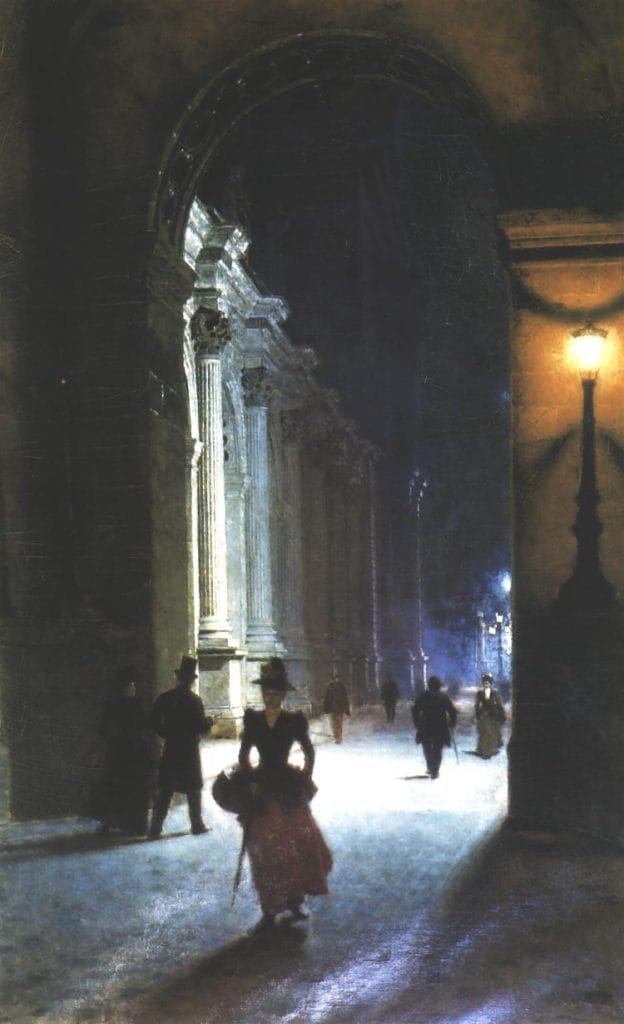
The worst time to enter the Louvre is midday in peak season. By noon, the museum has become a hive of congestion. The Denon Wing, home to the Mona Lisa, will be impassable. Elevators will be overloaded. Security guards will be rotating their shifts, and the air in the Grande Galerie will carry the warmth of thousands. Avoid it. The best visits begin early or late, with weekday mornings (especially Wednesday or Friday) offering the quietest paths. On those two days, the museum remains open until 9:45 p.m., and the evening hours can be sublime. Light changes the mood of the galleries, and the noise drops to a murmur. You might even find yourself alone in front of a 17th-century altarpiece or tucked beside an Assyrian gate with only a guard for company.
Pre-booking your ticket is no longer optional. As of recent years, time-slot reservations are required for all visitors, including those entitled to free admission. The online system is efficient, and choosing a morning or evening slot gives you a head start on the more aimless hordes. Once inside, resist the temptation to follow them. The Louvre is not a mall or an airport terminal. It rewards detour and drift.
There are, however, three guaranteed crowd surges that can derail even the best-planned day:
- Group tours from cruise ships, which flood the museum in the early morning and aim straight for the Mona Lisa.
- School groups, who arrive mid-morning and cluster in loud semi-circles around French painting.
- Art pilgrims who move in coordinated packs, often with headphones or guides, forming mini-blockades in front of single works.
To dodge these, start in the Richelieu or Sully wings and approach Denon from the far end, if at all.
Choosing Between Daylight, Twilight, and Night
A museum’s lighting is not just practical—it shapes your memory. The Louvre’s natural light, which filters into certain galleries through glass ceilings or high windows, offers a changing canvas. In the morning, the Dutch paintings in Richelieu glow with cool precision; by late afternoon, the Egyptian galleries shimmer with warmth. If you are drawn to sculpture, daylight makes the Cour Marly and Cour Puget come alive—their massive marbles, placed in restored courtyards, bask in a sun filtered through contemporary glass roofs.
Twilight adds mystery. As the sun dips, the Denon Wing softens, and the Grand Galerie’s vaulted ceiling becomes a kind of dusk-lit tunnel. The crowd thins. This is when dramatic works—Delacroix, Géricault, Caravaggio—start to feel theatrical again, as if the dimming light belongs to their own stagecraft. A late-night visit might not give you solitude, but it will give you slowness.
Night visits (on Wednesdays and Fridays) are ideal for a different reason: the Louvre gets quieter, and your attention becomes sharper. The absence of noise reshapes the space. Details emerge. A painted foot becomes visible in a corner. A forgotten still life holds you longer than expected. You begin, if you’re lucky, to see not just art, but looking itself.
What to Skip (and What to Fight For)
No one sees the Louvre in a single day. That cliché is repeated often, but rarely acted on. The temptation to “see everything” lingers like a curse. It leads to fatigue, and fatigue leads to carelessness. What’s worse, it turns a visit into a checklist, rather than a conversation.
There is no shame in skipping the Mona Lisa. Her image is so over-reproduced that the real painting can feel anticlimactic. Worse, the viewing conditions are miserable: she hangs behind glass, at a distance, in a jostling crowd that moves like a wave pool. If you must see her, go early or late, and stay longer than the rest. Wait until the selfie-sticks move on. Let the quiet settle. Sometimes the painting will speak again.
Other skips might include the overly photographed Venus de Milo—beautiful, yes, but poorly lit and rarely unmobbed—or the Napoleon III Apartments, whose plush opulence tends to numb rather than intrigue. These are not bad collections, but they are poor environments for seeing.
By contrast, there are things worth fighting for:
- The Mesopotamian Galleries, especially Room 227, with its colossal winged bulls from Khorsabad.
- The 17th-century Dutch rooms, hidden in the Richelieu Wing, where Vermeer’s Lacemaker sits in serenity.
- The Galerie d’Apollon, with its dazzling ceiling and display of royal French crowns, now often missed.
What these spaces offer is more than content—they offer conditions. They allow looking. That’s the most precious resource in a museum like the Louvre: not access, but attention. And attention, like light, is finite.
Every visitor must make choices. Some arrive prepared with lists; others follow intuition or exhaustion. Both approaches can yield something unforgettable. But the real key is to leave with questions, not just images. What surprised you? What left you unmoved? What will haunt you later, when the crowds have faded and the light has changed?
The Three Wings: Denon, Sully, Richelieu
What’s Where, and Why It Matters
To enter the Louvre is to choose a direction, often without knowing what you’re choosing. The museum is divided into three main wings—Denon to the south, Sully in the center, Richelieu to the north—each corresponding to a different arm of the old royal palace, each with its own layout, sensibility, and gravitational pull. Understanding their personalities is not just a navigational tool; it’s a way to tune your visit, to match the mood of the space to the mood of your mind.
Denon is the most famous, the most crowded, and the most narratively charged. This is where the Mona Lisa resides, where Delacroix’s Liberty Leading the People unfurls its tricolor defiance, and where the Grand Galerie stretches in a continuous line of Renaissance might. Denon offers drama. It is the Louvre’s cinematic wing: high ceilings, historical epics, and well-known faces. You go here for masterpieces, yes—but also for spectacle.
Sully is quieter. It forms the oldest part of the Louvre, built over the medieval keep, and spirals through a more introspective geography. Its strengths are antiquities, especially Egyptian and Near Eastern; French painting; and the architectural traces of the palace’s past. Sully feels like a museum within a museum—less overwhelming, more intimate. It is the best place to lose time without noticing.
Richelieu, by contrast, is the Louvre’s reserved genius. Largely skipped by first-time visitors, it houses the Louvre’s sculpture courts, Mesopotamian art, and the entire Dutch and Northern European collection, including Rembrandt, Vermeer, and Van Eyck. It also includes the period rooms of the Napoleon III Apartments—anachronistic, extravagant, but revealing. Richelieu is the wing where patience is rewarded and beauty sneaks up on you from behind.
Each wing has multiple levels, often with partial floors and unexpected half-staircases. There are mezzanines and basements, courtyards open to the sky, and halls that run hundreds of meters before changing theme entirely. The official maps help, but only to a point. The real way to know a wing is to walk it, backtrack, pause, and—when in doubt—look up.
Wing Personalities: Loud, Quiet, and Scholarly
Denon is the extrovert. It pulses with movement and expectation. Visitors who enter under the Pyramid tend to turn left and ascend the sweeping staircase toward the Winged Victory of Samothrace, who stands atop a ship’s prow, headless and windblown, as if caught mid-resurrection. This first encounter sets the tone: Denon is built on spectacle, and it doesn’t apologize for it. The route through its Italian and Spanish painting galleries feels choreographed. You are swept from Giotto to Caravaggio, then deposited before Leonardo’s Mona Lisa, a single painting on a wall that has become a global pilgrimage site. Cameras click, people elbow, and the painting itself is nearly impossible to engage with in silence. Yet the surrounding rooms reward those who linger—Raphael’s Saint Michael, Titian’s sensual portraits, El Greco’s volcanic intensity.
In contrast, Sully speaks in a lower register. Begin in the basement, where the medieval moat encircles the original fortress tower. These foundation stones feel far removed from the crowds above—dark, massive, cool. Climb upward, and you pass through the Louvre’s Egyptian galleries, still laid out in a 19th-century archaeological logic: sarcophagi, hieroglyphs, mummified cats. The rooms are dimly lit, the glass cases deep. Higher still, French painting begins to dominate, and one can trace a visual evolution from the lush religious canvases of the 17th century to the neoclassical clarity of David and the revolutionary fever of Delacroix.
Richelieu is the introvert: sharp, structured, full of detail. It’s where curators seem to have had the most freedom. The sculpture courts—Cour Puget and Cour Marly—are among the Louvre’s most elegant spaces, bathed in natural light under soaring glass ceilings. Statues are arranged like living beings: lounging, twisting, poised mid-myth. Nearby, the Assyrian wing stuns with its massive scale—human-headed bulls, wall reliefs of lion hunts. Upstairs, the Dutch and Flemish rooms offer a complete change of pace: small paintings, quiet lighting, a sense of domestic intimacy. Vermeer’s Lacemaker is no larger than a sheet of paper. Rembrandt’s self-portraits stare back across the centuries, weary and lucid.
Planning Cross-Wing Movement Without Collapse
Moving between wings is not always easy. The Louvre’s architecture is not linear, and the distances are real. A walk from the base of Denon to the upper floors of Richelieu can take 15 minutes or more, including stairs, escalators, and moments of disorientation. Elevators exist but are not always easy to find or quick to arrive. For visitors with limited mobility, or limited time, it is often best to treat each wing as a distinct visit.
One strategy is to treat the museum as three smaller museums, each with its own logic and rhythm:
- A Denon visit might focus on Italian painting, major sculptures, and the Grand Galerie. Two to three hours is realistic.
- A Sully visit can concentrate on Egyptian antiquities, the medieval foundations, and key French works. It suits slower pacing.
- A Richelieu visit is best for those already acquainted with the museum or seeking deeper calm—ideal for second or third visits.
Cafés and rest areas are located unevenly. Denon has the most options; Richelieu the fewest. Bathrooms are scattered and sometimes hidden. Re-entering the museum after a break is possible with a same-day ticket, but the security lines can deter this.
The Louvre was not built for comfort. It was built for power, and then adapted—imperfectly—for public use. But once you understand its logic, its quirks become part of the experience. You learn to move diagonally through courtyards, to spot the red room numbers beside the doors, to follow the spiral staircases where escalators stall. And you learn, above all, to rest. The best visits are not marathons. They are careful, looping returns.
The wings are not just architectural units. They shape how we look. They invite different moods, different speeds. To know the Louvre is not to memorize its map, but to recognize its temperaments—and to let your own fall into rhythm with them.
The Icons and Their Mobs
The Mona Lisa and Its Arena
The experience of seeing the Mona Lisa at the Louvre is unlike seeing any other painting in the world—and not always in a good way. It is not a contemplative moment. It is an event, carefully choreographed and strangely hollow. The painting itself is modest: 30 inches by 20, a quiet face with a half-smile set against a muted landscape. But the scene around it is anything but modest. Tourists surge forward, phones held aloft, flashes bouncing off protective glass, voices echoing in half a dozen languages. It is not a viewing; it is a contest for proof.
The room that houses the painting, Salle des États, is cavernous. Built to display monumental French painting, it now centers on a single Italian portrait dwarfed by its surroundings. Directly opposite hangs Paolo Veronese’s Wedding at Cana, a 22-foot-wide canvas bustling with Renaissance figures—musicians, guests, servants—each rendered with dazzling precision. It is one of the finest works in the Louvre and perhaps the most ignored. Visitors have their backs to it, focused entirely on the small, glassed-in rectangle across the room.
This imbalance is not accidental. The Mona Lisa’s celebrity was cultivated deliberately—first through Napoleon, who hung her in his bedroom; later by Romantic writers; and most dramatically after her 1911 theft, when the painting vanished for over two years before being recovered in Italy. Her absence made her famous. Since then, her fame has grown exponentially, inflated by mass media and digital culture until she became a symbol of art itself, detached from context. Most of her viewers don’t want to study her; they want to witness the act of witnessing.
Yet for those who stay longer than the crowd, the painting can still work. Her gaze, slightly off-center, her delicate hands, her almost-sneer—these can surface in the brief seconds between camera flashes. But it takes effort, and courage, to ignore the pressure to move on. To see her properly is to reject the performance of seeing her.
Venus de Milo, Winged Victory, and the Dance of Cameras
Two other works vie with the Mona Lisa for icon status: the Venus de Milo and the Winged Victory of Samothrace. Neither is easy to see alone, and both have been so widely reproduced that the real encounter feels uncanny, as if the statues were posing in imitation of themselves.
The Venus de Milo stands at the end of a long corridor in the Sully Wing. Armless and serene, she faces forward with composure, her draped hips tilted in a curve that manages to feel both accidental and theatrical. Carved around 130 BC, she was discovered on the Greek island of Melos in 1820 and quickly absorbed into France’s myth of classical heritage. Her missing arms have only amplified her mystique. But unlike the Mona Lisa, the Venus rewards close inspection. Her surface carries subtle asymmetries, her gaze does not quite meet ours, and the rhythm of her pose suggests movement caught mid-thought. The room is rarely empty, but it is possible—briefly—to stand near her without obstruction. The crowd here flows rather than crushes.
The Winged Victory of Samothrace, by contrast, stages its own reveal. Perched atop a stone ship on the Daru staircase, this second-century BC sculpture of Nike greets visitors ascending from the Pyramid concourse. Wind seems to drive her robes backward. Her head is lost, her arms gone, but her stride is unstoppable. She is the Louvre’s most cinematic object, and the curators have leaned into that drama. She sits not in a gallery, but on a stairway landing flooded with natural light. Visitors climb to her in waves, and pause—some reverent, others exhausted. Photos are inevitable. But they rarely capture the sculpture’s most haunting quality: its silence. The absence of a face makes her unreadable. She does not return our gaze. She doesn’t need to.
What’s striking about both statues is how their fame has not entirely flattened them. Unlike the Mona Lisa, they retain an aura of physical presence. You feel their weight, their scale, their volume in space. Even with a crowd, they exist in three dimensions, and that protects them. They still surprise.
Can the Canon Still Surprise You?
The Louvre’s “greatest hits” are a trap and a gift. On one hand, they compress the museum into a handful of names: da Vinci, Michelangelo, Géricault, Delacroix, David, Rembrandt. On the other, they offer access points. For many visitors, these works are a first encounter with visual history. They have names already known, stories already half-remembered from textbooks or film. That familiarity can dull the experience—but it can also intensify it, if approached with patience.
Take Jacques-Louis David’s The Coronation of Napoleon, a sprawling 20-by-32-foot canvas that dominates a room in the Denon Wing. At first glance, it’s pure propaganda: Napoleon crowning himself, surrounded by frozen courtiers, everything polished to imperial gloss. But look closer. The brushwork is meticulous, yes—but the staging is cold, the symbolism overdetermined. David includes himself in the composition, half-shadowed, a painter recording power from within. The painting becomes a document not of majesty, but of calculation.
Or consider Théodore Géricault’s Raft of the Medusa. Based on a real shipwreck in 1816, it shows 147 men left adrift on a raft; only 15 survived. Géricault’s canvas is enormous, dark, almost theatrical. Bodies sprawl across the foreground—naked, contorted, grasping at a barely visible ship on the horizon. It is both history painting and accusation. The French government’s incompetence led to the disaster, and Géricault made sure that fact could not be forgotten. The painting seethes.
These canonical works survive fame because they carry contradiction. They are not merely beautiful; they are difficult, charged, layered. Their presence in the Louvre is not a triumph of consensus but a record of unresolved meanings. They continue to speak, if we let them.
French Painting: The Louvre’s National Epic
David, Delacroix, and the Shape of Modern France
In the Louvre, French painting isn’t just a category—it’s a national narrative. Its galleries trace the rise of a visual language shaped by monarchy, rebellion, Enlightenment, and empire. The rooms themselves feel like a progression of moods: from ornate religiosity to neoclassical restraint, revolutionary fervor, romantic spectacle, and finally the uneasy precision of modernity. Each shift reflects not just an evolution in style, but a profound change in what painting was meant to do, and for whom.
No painter embodies the neoclassical turn more than Jacques-Louis David. His Oath of the Horatii (1784), hanging in the Denon Wing, depicts three Roman brothers swearing allegiance to their father before battle—muscular, symmetrical, and infused with stoic resolve. Painted just before the French Revolution, it became a call to civic virtue. David’s classical rigor and political edge made him the Revolution’s unofficial visual chronicler. He later served as Napoleon’s court painter, producing The Coronation of Napoleon (1807), which—despite its grandeur—suggests more manipulation than majesty.
David’s legacy was aesthetic and ideological. His students and successors carried forward his sense of painting as historical theater. But Romanticism soon challenged that logic, and Eugène Delacroix detonated the shift.
Delacroix’s Liberty Leading the People (1830) is one of the Louvre’s most famous works—and one of its most misunderstood. It depicts a chaotic barricade scene during the July Revolution, with a bare-breasted allegorical figure of Liberty striding over the bodies of the dead, tricolor in hand. The painting is not a snapshot of a specific event, but a synthesis of myth and bloodshed. Liberty’s body is real—fleshy, dirty, grounded—but her gaze is beyond the frame. She is both woman and idea.
Delacroix’s technique breaks with David’s clarity. His brushwork is urgent, his palette murky with smoke and sweat. Where David offered structure, Delacroix offers feeling. And where David’s heroes act with discipline, Delacroix’s characters erupt with desperation. Together, these two artists bookend a crucial shift in French self-imagining: from the heroic rationalism of the Republic to the raw, volatile energies of post-revolutionary France.
Women on Canvas and Their Discontents
Despite its wealth of painting, the Louvre is still overwhelmingly a museum of male artists painting female subjects. The women in these works are often muses, goddesses, martyrs, temptresses, or saints—projected figures rather than persons. The 18th-century French Rococo tradition, for example, offers pastel visions of noblewomen at leisure: Fragonard’s The Swing, Boucher’s Diana Resting. These are paintings of erotic charm and cultivated frivolity. Their women float in silks and gardens, suspended between flirtation and fantasy.
But not all is lightness. Take Georges de La Tour’s Magdalene with the Smoking Flame—a stark, candlelit portrait of Mary Magdalene seated in contemplation, her hand resting on a skull. Her beauty is muted, her pose reflective, her surroundings minimal. The candle illuminates her face and darkens the world around her. The painting does not seduce; it stares. It’s one of the Louvre’s quieter masterpieces, and a rare instance of interiority granted to a female subject.
The women behind the canvas—the female artists—are less visible. Elisabeth Vigée Le Brun, a court favorite of Marie Antoinette, is represented, but modestly. Her self-portraits offer a counterpoint to the gallery of female sitters around her. She smiles slightly, brush in hand, dressed with elegance but asserting her authorship. Her presence raises a larger absence: the scarcity of women in the Louvre’s painting collections. This is not just a problem of curation, but of history—the result of centuries in which women were barred from academies, commissions, and public life.
Yet viewers can still read between the lines. Consider Ingres’s portraits—his Grande Odalisque, elongated and impossible, or his more restrained depictions of aristocratic women. These images are as much about fantasy and control as they are about beauty. The male gaze in the Louvre is not subtle, but it is instructive. It teaches us what kinds of stories were once told—and which were excluded.
From Rococo Swag to Revolution’s Brush
The transition from the 18th-century Rococo to 19th-century Neoclassicism is one of the Louvre’s most vivid narrative arcs. Rococo painting, epitomized by Watteau, Boucher, and Fragonard, celebrates aristocratic ease. In The Embarkation for Cythera by Watteau, couples drift through a dreamscape of trees and statues, boarding a boat toward a mythical island of love. The figures are ephemeral, their colors powdered, their world exquisitely artificial.
But that world collapsed. The French Revolution didn’t just overturn politics—it redefined taste. The Rococo became associated with decadence, and Neoclassicism emerged as a reaction: sober, rational, moral. Painting had to serve the Republic, not pleasure. David’s Death of Marat (not in the Louvre, but central to its narrative) shows the murdered revolutionary slumped in his bath, bloodied quill still in hand. This was painting as martyrdom, not ornament.
The Louvre’s arrangement encourages this shift. Walk from a Fragonard to a David, and you move from boudoir to tribunal. The brush changes, the palette cools, the space tightens. The Revolution created not just a new society, but a new viewer—one who was supposed to be morally improved by the canvas before them.
Yet the pendulum swung again. By the mid-19th century, history painting began to collapse under its own weight. Realism emerged. Romanticism mutated. Courbet—whose large canvases are housed elsewhere—mocked the pretensions of academic painting. By the time the Impressionists arrived (many of whom are in the Musée d’Orsay), the French tradition had already fractured.
What remains in the Louvre is a prelude and a peak: the classical inheritance and its revolutionary break. French painting in the Louvre is not modern, and it does not pretend to be. Instead, it offers something rarer: a long corridor through which a nation once walked, brush in hand, trying to picture itself.
Italian Masterworks: Leonardo and His Legacy
Giotto to Caravaggio: Predecessors and Rebels
The Louvre’s collection of Italian painting is vast, spanning from the 13th century to the 18th, and yet its reputation is disproportionately anchored to one man: Leonardo da Vinci. That’s understandable—his works are rare, fragile, and freighted with myth. But to approach the Italian rooms only as a pilgrimage to Leonardo is to miss a richer, more volatile story. The Louvre holds a progression of Italian art that begins in spiritual allegory and ends in psychological drama, with stops at nearly every ideological crossroad in between.
It starts quietly, with panel paintings by Giotto and Cimabue, the Florentine forerunners of the Renaissance. These early works retain a stiff verticality, a hieratic stillness borrowed from Byzantine traditions. Gold backgrounds glow like sacred thresholds; figures float more than stand. But already there are ruptures: Giotto’s Saint Francis Receiving the Stigmata introduces a landscape, a gesture, a flicker of realism. It’s the beginning of a seismic shift in how art could reflect not just belief, but perception.
From there, the Renaissance blooms. Masaccio, Fra Angelico, and Botticelli usher in proportion, perspective, anatomy. In the Louvre, their presence is more limited than in Florence or the Uffizi, but the Italian rooms still provide a sweeping view. Mantegna’s sculptural sharpness, Bellini’s luminous tenderness, and Andrea del Sarto’s balance of serenity and tension all appear. The paintings stretch out along long corridors and high walls, and visitors often move through them too quickly, unaware that they are passing centuries of transformation.
Then Caravaggio arrives like a thunderclap. His chiaroscuro—violent contrasts of light and dark—rips through the harmonious balances of his predecessors. In The Fortune Teller and Death of the Virgin, he rejects idealism. His saints have dirt under their fingernails; his Madonnas look like street women; his apostles are racked with fatigue. The Louvre owns fewer of his works than Rome or Vienna, but the ones it does display are decisive. They announce a new attitude: not just realism, but confrontation.
Caravaggio’s influence radiated through Europe, and particularly shaped the Baroque. His drama, his psychology, his refusal to flatter—these set the stage for a more complex vision of humanity. The Italian collection at the Louvre, by tracing this arc, becomes less a celebration of harmony and more a record of artistic defiance.
Leonardo’s Strange Stillness
Leonardo da Vinci occupies an almost sacred position in the Louvre, and not only because of the Mona Lisa. The museum holds five of his paintings—the largest number in any one place—and numerous drawings. This is partly due to Francis I’s acquisitive generosity, and partly due to the Louvre’s curatorial strategy: to build a shrine within the larger narrative of Italian art.
What strikes most visitors about Leonardo’s work is not its beauty, which is considerable, but its stillness. The figures seem to be pausing between breaths. In La Belle Ferronnière, the sitter looks to the side with unreadable intention; in Saint John the Baptist, a curl of the finger gestures upward, while the eyes smile slightly, provocatively, refusing explanation. Leonardo’s subjects seem to know something we do not—and will not tell.
His use of sfumato, the smoky blending of tones and contours, produces a softening effect that defies easy outlines. Light does not fall on his subjects so much as emanate from within them. The result is a mood of ambiguity—emotional, narrative, even moral. Where other Renaissance artists aimed for clarity, Leonardo leaned into mystery.
This stillness is magnetic, but it can also be frustrating. Viewers come to these paintings expecting revelation. What they find instead is resistance. The Mona Lisa is not a story, but a stare. It gives nothing away. And this is precisely what has kept her—and Leonardo himself—so endlessly studied and reproduced. He leaves room.
It is worth lingering on his unfinished works. In The Virgin and Child with Saint Anne, the figures twist in a triangle, and the composition pulses with unsteady equilibrium. The contours are faint, the painting unresolved. But the gestures feel alive: Mary reaching toward the infant Christ, who wrestles with a lamb, while Saint Anne watches. It is a theological moment rendered as human interaction. The incompletion invites not dismissal, but curiosity.
Leonardo’s genius was not technical perfection. It was his ability to make thought visible—to render ambiguity as form. That is why, even amid the Louvre’s loudest rooms, his works create a hush.
Titian, Veronese, and Venetian Dazzle
If Florence shaped the form of the Renaissance, Venice shaped its color. The Venetian school, well represented in the Louvre, offers a sensuous, atmospheric counterpoint to the more linear traditions of central Italy. Here, the eye swims in deep reds, watery blues, and golden light. The subjects may be classical or biblical, but their textures are flesh and silk, marble and haze.
Titian is the giant of this school, and his portraits dominate one section of the Denon Wing. His Man with a Glove gazes outward in velvet and lace, exuding a kind of quiet power. His religious scenes, like The Entombment, balance emotional gravity with painterly richness. Titian’s brushwork is freer than his Florentine contemporaries. He lets paint behave like paint—smearing, layering, glowing.
Next comes Veronese, the grand decorator of myth and banquet. His Wedding at Cana, opposite the Mona Lisa, is one of the most complex and theatrical canvases in the museum. Painted for a Venetian monastery in 1563, it stages the biblical miracle as a Venetian feast, complete with musicians, servants, dwarfs, and extravagant architecture. It’s not pious—it’s luxurious. Every figure is adorned, every dish gleams. The painting was cut in half to be moved, and even now it barely fits the wall. Most viewers barely glance at it, turned toward da Vinci’s more famous face. But those who look will find a painting that performs abundance—visually, socially, even acoustically. You can almost hear it.
Tintoretto, more turbulent and spiritual, appears as well—though less prominently. His swirling compositions and elongated figures carry Venetian colorism into the Mannerist future. Together, these Venetian painters offer a sensual dimension to Renaissance art that complements the intellectual intensity of Florence and Rome.
Venetian painting in the Louvre is often skipped, overshadowed by the Mona Lisa or by the scale of the museum itself. But it offers something rare: color as philosophy, sensuality as structure. These are paintings to be seen slowly, and with appetite.
Egyptian Antiquities and the Louvre’s Colonial Eye
Obelisks, Sarcophagi, and Sphinxes on the Seine
The Louvre’s Department of Egyptian Antiquities stretches across dozens of rooms, making it one of the largest and most comprehensive collections of its kind outside Cairo. Entering these galleries is like descending into another logic of time: pharaonic dynasties, immovable stone, a culture obsessed with death and permanence. The rooms are cool and dim, arranged in a near-linear chronology from the earliest dynastic periods (around 3000 BC) through the Greco-Roman era.
But the display is more than archaeological. It is theatrical. Massive sphinxes flank corridors. A corridor of sarcophagi looms like a procession of coffins. Painted stelae, alabaster canopic jars, mummified cats and falcons sit behind glass with a kind of cold eloquence. Each object tells a story of kingship, ritual, or afterlife, and yet they are now removed from their original religious or funerary context—recast instead as museum exhibits.
The centerpiece is the Great Sphinx of Tanis: a 26-ton granite colossus, installed in 1826, one of the oldest sculptures in the Louvre. Its paws are worn, its nose broken, but its presence is undeniable. It rests not in the sun-drenched deserts of Egypt but in a vaulted stone chamber in Paris, beneath a 19th-century ceiling. The spatial dislocation is profound. These objects were built to last forever, but not here.
The fascination with Egypt was part of a broader 19th-century obsession—what scholars have called Egyptomania. Following Napoleon’s 1798 campaign in Egypt, which brought artists, scientists, and looters along with soldiers, Europe became consumed with pharaonic aesthetics. Obelisks were erected in city squares, sphinxes appeared on furniture and opera sets, and the symbols of ancient Egypt were folded into the visual language of empire and authority.
The Louvre became a key repository of that fascination. Many of its Egyptian holdings arrived during the early 19th century via collectors, diplomats, and archaeologists operating under colonial auspices. These were not simply acquisitions—they were trophies of intellectual and imperial conquest.
Champollion’s Conquests in Script
No name is more closely linked to the Louvre’s Egyptian collection than Jean-François Champollion, the French philologist who deciphered the Rosetta Stone and thus cracked the code of Egyptian hieroglyphics. His achievement in 1822 marked a turning point—not just in the study of Egypt, but in the West’s imagined access to ancient civilizations.
Champollion did not work in isolation. He relied on previous attempts, including those by English rivals, and on comparative linguistic study. But his genius was real, and the Louvre celebrated it. In 1826, under his guidance, Charles X established a dedicated Egyptian department—the first of its kind in the world. Champollion personally selected many of the artifacts, including sculptures, papyri, and ritual objects, some from royal expeditions, others from private collectors or dealers.
The pride of this scholarly accomplishment is visible in the museum’s early 19th-century displays, many of which remain largely intact. Stone fragments are labeled with inscriptions; mummies are presented not as human remains, but as specimens of civilization. There is reverence, yes, but also a sense of possession. Hieroglyphs, once sacred, became texts to be mastered. Objects, once worshipped, became specimens to be classified.
And behind the scholarship was strategy. Decoding Egypt gave France a cultural foothold in the region—a claim not only to knowledge but to authority. Champollion’s success was used to justify further expeditions, digs, and acquisitions. His portrait hangs in the Louvre today as both a symbol of genius and a reminder of how closely knowledge and empire once walked hand in hand.
Where Wonder Collides with Possession
There is a particular silence that hangs over the Egyptian galleries—not just from the muffled footfalls on stone floors, but from the unsettled questions these objects raise. Who do they belong to? Why are they here? And how should we look at them now?
These questions are not new. As early as the 19th century, critics questioned the ethics of removing sacred or funerary items from their original contexts. But the debate has intensified in recent decades, as calls for restitution and repatriation have gained momentum. The Louvre has responded cautiously. Unlike the British Museum, it has not been at the center of major legal battles, but it has also made few voluntary returns. Its Egyptian collection remains intact, and proudly so.
This is partly due to the structure of French law, which places national collections under a regime of inalienability: once acquired, they are not to be dispersed. But it also reflects a broader reluctance to revisit the premises of empire. France’s colonial legacy in North Africa—especially in Algeria and Egypt—is long, complicated, and often avoided in public discourse. The Louvre’s Egyptian wing stands as a paradox: it offers wonder, but also erasure.
And yet the artifacts themselves resist simplification. A painted tomb stele from the Middle Kingdom (ca. 2000 BC) depicts a seated couple sharing a meal, flanked by hieroglyphs naming their titles and family. The colors are still vivid, the poses formal but intimate. One senses a desire to be remembered—not just as types, but as people. That this stele now rests thousands of miles from the grave it once guarded complicates the beauty it still radiates.
There are three particular objects in the Egyptian collection that encapsulate this strange duality of marvel and dislocation:
- A mummified ibis, sacred to Thoth, whose bandaged body rests beside a bronze figurine of the god himself—votive offering and divine symbol fused.
- A papyrus of the Book of the Dead, its spells written in black ink with red rubrics, the handwriting clear even after three millennia.
- A wooden statue of a scribe, seated with legs crossed, gaze alert, brush in hand, as if ready to begin recording your presence.
These are objects meant to last beyond mortality. They speak of a world that believed in continuity between this life and the next. But their journey—from tomb to crate, from Nile to Seine—has placed them in a different afterlife, one governed by curators and glass cases.
The Louvre’s Egyptian department offers no easy resolution. It dazzles and it unsettles. It reminds the visitor that every museum is also a story about displacement—that the act of looking often depends on the silence of what has been taken.
The Obscure, the Quiet, the Missable (and Unmissable)
Hidden Altarpieces and Empty Corridors
To visit the Louvre only for its stars—the Mona Lisa, the Winged Victory, the Raft of the Medusa—is to overlook its strangest and most moving pleasures. For every room besieged by flashbulbs, there is another that sits in near silence, harboring a painting or object that few visitors notice. These quieter works do not announce themselves. They wait.
One such space is the early Netherlandish gallery in the Richelieu Wing. Often bypassed on the way to the Rembrandts, this suite of rooms houses works by Rogier van der Weyden, Hans Memling, and the enigmatic Master of Flémalle. These paintings—tiny, intricate, devotional—are radically different from the monumental canvases of French or Italian art. Their surfaces are dense with detail: fingernails rendered like opals, fabric woven with obsessive care, reflected windows in a single tear. The Diptych of Jean Carondelet by Jan Gossaert, for instance, captures a sitter so intimately, so fully immersed in prayer, that one feels almost invasive.
A few rooms away, you might find a jewel-toned 14th-century altarpiece by Paolo Veneziano, glowing in the half-light like a relic from a vanished ritual. Its saints stand stiffly, halos interlocking, eyes fixed beyond the frame. These are not paintings designed for a gallery. They were made for chapels, for incense, for whispered invocation. Their presence in the Louvre is a quiet contradiction.
Wander farther, and you may stumble into the Department of Islamic Art, accessible via an unobtrusive elevator or staircase. This relatively recent addition (opened in 2012) occupies a glass-roofed courtyard under a curving canopy. Here, fragments of mosques, Persian tiles, Syrian ceramics, and Mamluk metalwork glimmer in careful displays. There are no blockbuster names. But the artistry—calligraphy carved into ivory, kufic inscriptions traced in gold—is astonishing. The gallery invites slowness. Most visitors, conditioned by the more famous works nearby, pass through without adjusting their gaze. But to stop here is to remember how much of the world’s visual intelligence lies outside the European canon.
Sculpture Courts Without Crowds
There are few better places in the Louvre to pause and recover your attention than the two sculpture courts in the Richelieu Wing: the Cour Puget and the Cour Marly. These long, open spaces are covered by vaulted glass ceilings that pour soft daylight onto the stone floors. Unlike the dim, compartmentalized painting galleries, the sculpture courts feel almost outdoors—expansive, breathable, calm.
The Cour Puget features 17th- and 18th-century French sculpture, including mythological subjects by artists such as Pierre Puget and Nicolas Coustou. The figures here are full of motion: Hercules grapples with monsters, fauns wrestle and laugh, and muscled gods arch in theatrical poses. Their white marble surfaces, untouched by paint, catch light like skin in cold water. There are benches here, and quiet.
The Cour Marly, by contrast, presents sculptures from the gardens of the Château de Marly, Louis XIV’s private retreat. These were meant to be seen in the open air, and in the Louvre they retain a strange sense of exile. Horses rear, nymphs recline, Tritons blow their conch-shell horns. A pair of colossal horses by Guillaume Coustou—the Chevaux de Marly—anchor the space. They were once fountains; now they stand still, waterless, their tension undiminished.
These sculpture courts are rarely full, even on crowded days. Part of that is logistics—many visitors never make it to Richelieu. But it’s also because sculpture demands a different kind of looking. You must walk around it. It slows you down. And in slowing down, you notice the seams: a chisel mark, a toe that never quite curves, a cloak that defies gravity. In these moments, the Louvre’s vastness narrows to a single, shared space between you and the object.
Maps, Medals, Clocks, and Cabinets
Tucked into corners and along forgotten corridors, the Louvre also holds collections that defy its reputation as a gallery of high art. Decorative arts, coins and medals, scientific instruments, and royal furnishings are scattered across the museum, often marked on maps but poorly signposted. These objects are no less significant—but they require a different eye.
In the Sully Wing, the Galerie d’Apollon dazzles with jewels and crown regalia, including the 140-carat Regent Diamond and the coronation sword of Charlemagne. The room itself is a baroque hallucination: golden cornices, allegorical ceiling frescoes, walls that glitter even when bare. The display here is unapologetically sumptuous—objects not only of value, but of spectacle. They are emblems of monarchy, of theft, of craft, of time.
Elsewhere, in quieter rooms, there are cabinets filled with Renaissance scientific instruments—astrolabes, compasses, orreries. These were not made for beauty, yet many are beautiful. They speak of a world where the visual and the mathematical were inseparable. A small celestial globe might tell us as much about the 16th century’s sense of the cosmos as any painting.
One of the Louvre’s most overlooked departments is the collection of medals and coins. Housed in a subdued set of rooms, this archive of metal and history includes Greek tetradrachms, Roman aurei, medieval seals, and Napoleonic medallions. Each is tiny. Each was meant to circulate. Their presence here, in glass cases under artificial light, suggests a different kind of fame—less heroic, more granular.
Among these fragments of time are also the cabinets themselves: carved, inlaid, sometimes more intricate than the objects they contain. These are not merely storage. They are evidence of a world in which objects were made to be touched, held, and passed from hand to hand.
The Louvre’s quieter holdings don’t shout. They wait for you to find them. And when you do, they reward you not with recognition, but with curiosity.
How the Louvre Was Made: Architecture as Story
Medieval Foundations Underfoot
The Louvre did not begin as a museum, nor even as a palace. Its first incarnation was as a fortress, commissioned around 1190 by King Philip Augustus to protect Paris from invasion along the Seine. That medieval Louvre—circular, compact, utilitarian—was long buried beneath later constructions and was only rediscovered during the ambitious renovations of the 1980s, when digging for the Grand Louvre project unearthed its foundations. Today, the original keep is visible in the Sully Wing’s basement: massive stone walls, arrow slits, a dry moat that once ran with water and soldiers.
Walking these foundations offers a disorienting shift in time. The Louvre becomes not a container of history, but an artifact itself. These stones witnessed a Paris without boulevards, before Notre-Dame’s completion, before the Renaissance. There is little light here, no great paintings, few tourists. Just rock, weight, and the echo of a forgotten geometry. The presence of this medieval structure is more than architectural trivia—it anchors the museum’s grand narrative in defense, not display.
The transition from fortress to royal palace began in the 16th century under Francis I. Inspired by his travels to Italy and hungry for a Renaissance identity for France, he began replacing the medieval fortress with a more gracious residence. Successive monarchs expanded and refined the project: Pierre Lescot’s elegant wing, built in the 1540s, introduced a new French classicism; Henri IV connected the Louvre to the Tuileries Palace with the Grande Galerie; Louis XIII and Louis XIV extended and embellished the complex further.
Yet the Louvre never became a primary royal residence. Versailles eclipsed it in the 1680s, and for a time the Louvre fell into semi-abandonment, occupied sporadically by artists, academicians, and bureaucrats. This neglect, ironically, preserved its openness—making it the perfect vessel for Revolutionary reinvention.
The Classical Shell, Rebuilt and Reimagined
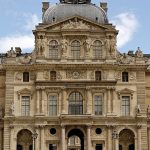
The Louvre as we recognize it today—long, uniform, imposing—is the product of centuries of additions, demolitions, and redesigns. The façades are textbook examples of French classicism: symmetrical, restrained, punctuated by colonnades and pediments. Yet each wing bears the imprint of its time.
The Cour Carrée (Square Courtyard) is the museum’s oldest part and its architectural palimpsest. Its east façade, designed by Claude Perrault in the 1660s, is considered a landmark of early French classicism: a sequence of Corinthian columns stretched across a plinth, modeled after ancient Roman temples but rendered in the precise, mathematical order that Enlightenment thinkers adored. The clarity and gravity of this façade would become a template for state buildings across Europe.
To walk the Louvre’s outer walls is to see a timeline of taste and power: medieval towers smoothed into Renaissance arcades; Baroque embellishments giving way to Napoleonic grandeur; 19th-century mansard roofs layered onto 17th-century walls. The building is not cohesive. It’s continuous. A living document of French self-imagining.
The 19th century brought some of the most aggressive transformations. Under Napoleon III and architect Hector Lefuel, the museum was finally consolidated into a near-complete quadrilateral by connecting the north wing to the Tuileries Palace. This was the moment when the Louvre became not just a palace with paintings, but an empire of art. Courtyards were enclosed, staircases grandified, ceilings frescoed. The Louvre ceased to be a set of buildings and became an architectural ideology: one meant to house, and to embody, national greatness.
But this ideology was ruptured—literally—in 1871, when the Tuileries Palace was burned by Communards during the final days of the Paris Commune. The ruins stood for a decade before being demolished, leaving the Louvre’s western arm open-ended, a wound that has never fully healed. The museum, incomplete by design, ended not with a climax, but with a collapse.
The Pyramid: Scar or Genius?
No addition to the Louvre has caused more controversy—or ultimately more transformation—than I. M. Pei’s glass pyramid. Commissioned by President François Mitterrand and completed in 1989, it was meant to solve a practical problem: the museum could no longer handle the scale of its own success. Its entrances were fragmented, its circulation clogged. Pei’s proposal—to create a centralized underground entrance beneath the Cour Napoléon, topped by a modernist pyramid—was met with outrage. It was called a scar, a stunt, a violation of French heritage.
But over time, the pyramid has become not just accepted, but iconic. Its geometric clarity stands in deliberate contrast to the ornate façades around it. In sunlight, it reflects the palace; at night, it glows from within. Its function is as elegant as its form: it draws visitors underground, then disperses them evenly across the museum’s three wings. What was once a maze is now a choreographed flow.
Pei’s pyramid is not merely a piece of design. It is a statement—that a museum of the past must also speak to the present. Its symbolism is flexible: for some, it evokes Egyptian antiquity; for others, Enlightenment geometry; for others still, the sharp edge of global modernity cutting into old stone. Whatever its reading, it forces the viewer to confront contradiction: old and new, horizontal and vertical, imperial and democratic.
Inside the Pyramid, the entrance hall is light and stone, movement and queue. It is not beautiful in the traditional sense. But it is functional. The architecture here is not meant to awe, but to manage: security lines, ticket kiosks, signs in four languages. This, too, is the Louvre.
What Pei’s intervention did—more than anything—was make the building visible again. It reminded the public that the museum is not just about paintings, but about the frames they sit in. The Louvre is not neutral. It is an edifice of authority, designed to teach, to impress, and sometimes to overwhelm. Its architecture enacts that mission as surely as its collections.
And yet the building holds paradoxes. It began as a fortress and became a beacon. It was a royal palace turned into a revolutionary shrine. Its stones carry the fingerprints of dozens of rulers, architects, curators, and citizens—each trying to define, through bricks and arches, what France should be.
Restoration, Conservation, and Controversy
How the Art Stays (and Doesn’t Stay) Alive
A museum as vast as the Louvre is not only a showcase of cultural heritage but a complex organism of preservation. Every painting, sculpture, textile, or manuscript within its walls is subject to time: cracking varnish, fading pigments, structural fatigue, and environmental stress. Behind the scenes—often beneath public floors or in adjacent buildings—a quiet army of conservators, scientists, and curators work continuously to slow that decay. The Louvre is not just a collection of objects. It is a site of constant triage.
Conservation at the Louvre combines traditional techniques with cutting-edge technologies. In its laboratories, experts examine paintings with X-ray fluorescence, infrared reflectography, and ultraviolet scanning. These tools allow scholars to look beneath the visible surface, identifying earlier sketches, hidden details, or later overpainting. They track the chemical breakdown of pigments, the warping of wooden panels, and the microscopic stress fractures in marble or bronze.
But not all interventions are scientific. Sometimes, keeping a work alive requires artistic judgment. Should a sculpture’s missing limb be reconstructed? Should a discolored sky be retouched? Should a frame be replaced, or conserved in its damaged state? These are decisions that affect how future generations will see the work—and how much of the original remains.
In some cases, conservation is preventive. The Mona Lisa, for instance, is housed in a climate-controlled glass case, its temperature and humidity constantly monitored, its position unaltered for years. The case itself becomes a kind of coffin—a necessary precaution, but one that changes the painting’s aura. She no longer hangs on a wall; she floats in a box.
Elsewhere, tapestries are rotated out of view to avoid light damage, works on paper are shown only in limited time blocks, and delicate artifacts are removed from permanent display altogether. In this way, the museum balances public access with long-term responsibility. Seeing something today may mean not seeing it again for years—or ever.
Cleaning a Da Vinci, or Overwriting Him?
Few processes in a museum provoke more public scrutiny than the restoration of a major artwork. Every brushstroke risks becoming an argument. Nowhere was this more visible than in the Louvre’s high-profile cleaning of Leonardo da Vinci’s The Virgin and Child with Saint Anne, completed in 2011 after a two-year effort.
The restoration aimed to remove layers of yellowed varnish that had dulled the painting’s vibrancy. But debate erupted among art historians, curators, and even members of the Louvre’s own advisory committees. Critics accused the museum of going too far—of stripping away not just varnish, but subtle shadows and transitions that were integral to Leonardo’s sfumato technique. The resulting image, they argued, was cleaner but less ambiguous, brighter but less profound.
Defenders of the restoration claimed the opposite: that the process revealed details long obscured, including the contours of figures, the intensity of the landscape, and the psychological interplay between Mary, the Christ Child, and Saint Anne. The Louvre’s official position was that the painting had regained its original depth.
But the controversy revealed a deeper anxiety. Restoration is not simply about repair. It’s about authorship. Once touched, a painting is no longer wholly the artist’s—it becomes a collaboration between the past and the present, between intent and interpretation. Every act of cleaning is also an act of rewriting.
This debate extends beyond Leonardo. When Géricault’s Raft of the Medusa was restored in 2018, conservators faced a similar dilemma: how to preserve the painting’s original intensity without flattening its surface with new varnish. In sculpture, questions of patina, fracture, and reintegration are even more charged. Should a Roman bust with a missing nose be repaired? Should a Hellenistic torso be left incomplete? Each decision is both aesthetic and ethical.
In this sense, restoration is one of the Louvre’s most creative acts. It is not passive caretaking, but an interpretive force—deciding not just what survives, but how it will be seen.
Ethics of Repair in the Age of Image
The modern museum operates in a world saturated with reproductions. The Louvre’s collections exist not only in Paris but across the internet, in coffee-table books, in VR reconstructions, and AI-generated facsimiles. This ubiquity adds urgency to the question of how—and whether—originals should be altered. If a painting has a million digital doubles, what weight does the physical intervention carry?
For some, the argument leans toward conservation minimalism: do as little as possible. Let the object age. Let the cracks show. Allow the aura of history to remain unglossed. For others, restoration is an act of responsibility—returning a work to its legibility, to its capacity to communicate.
But ethics also enter when the source of damage is not time, but acquisition. Many objects in the Louvre, particularly from Egypt, Mesopotamia, and the Eastern Mediterranean, arrived under conditions shaped by colonial extraction, uneven power, or outright theft. Conservation, in such cases, cannot be separated from provenance. The question is not only how to preserve the object, but whether—and where—it belongs.
This has led to rising pressure on museums to be transparent about the histories of their collections. The Louvre has begun to acknowledge problematic acquisitions in some cases, but often obliquely. Labels may note the country of origin, but rarely the method of removal. Recent debates over restitution of African and Near Eastern artifacts, while more publicly focused on British institutions, have begun to gather momentum in France as well.
Then there’s the role of the public. In 2019, the Louvre moved the Mona Lisa temporarily to another gallery during renovation works. The chaos that ensued—mass confusion, overcrowding, and logistical failures—was a reminder that viewers often see iconic works not just as objects, but as destinations. Any change to them, even in context, can feel like a violation.
The Louvre, then, stands at a difficult crossroads. It must care for its works, but also account for how that care shapes meaning. It must protect without erasing. It must adapt without distorting. And it must decide—daily—whether the act of looking backward should also include looking inward.
In the end, conservation is not about freezing time. It is about listening: to materials, to methods, to history, and to the quiet ways in which art insists on remaining alive.
Leaving the Louvre (and Coming Back)
Exit Through the Gift Shop, or Not
Leaving the Louvre is not as simple as retracing your steps. After hours of visual saturation—columns, canvases, torsos, gods—the transition back to the outside world can feel abrupt, even disorienting. The air changes. The light hardens. The clamor of the city returns. Many visitors pass through the main shop beneath the Pyramid, where reproductions, catalogs, and souvenir tokens offer a final act of consumption: the familiar tableau of postcards, magnets, and tote bags bearing the Mona Lisa’s endlessly reproduced face.
The shop’s offerings are polished, global, and self-aware. There are minimalist notebooks printed with the Winged Victory, silk scarves patterned after Rococo ceilings, high-end perfumes branded in collaboration with the museum. Some of these are well designed, others exploitative. All trade in the Louvre’s mythos—the idea that to take home a fragment of its aura is to extend your visit indefinitely.
But for many, the more authentic exit comes elsewhere. From the Richelieu Wing, one can step out into the Place du Carrousel and face the Arc de Triomphe du Carrousel, a smaller cousin to the larger arch at the top of the Champs-Élysées. This view—the Pyramid behind you, the Tuileries before you—feels like a palimpsest of France’s imperial identity: the garden of the ancien régime, the architecture of revolution, and the symbols of military conquest layered like transparent slides.
The Louvre does not release its visitors easily. Its final impression is not a painting, but a perspective: space opening outward, time compressed in stone.
The Museum You Missed in Your Head
No one sees everything. That is not a failure, but a design. The Louvre’s very structure ensures incompletion. Its halls repeat, its maps dissemble, its signage hints and withholds. You will exit with questions, with unvisited rooms and half-remembered names, with the faint regret of something just missed on the floor above or behind the wrong door. This is not an accident. It’s the Louvre’s most subtle lesson: art is not a checklist. It is an encounter.
And like all encounters, it leaves a residue. You might find, hours later, that a detail returns without invitation—a blue robe, the curve of a column, a funerary mask’s empty eyes. These are not memories so much as echoes. They arrive in the quiet after overload, when the noise has dropped and your mind starts to make sense of what it held.
Sometimes the thing you remember most clearly is something you did not see at all. You heard about it. You meant to find it. You never did. It becomes a phantom work, imagined more vividly than if you’d stood in front of it. The Louvre allows this kind of myth-making. It depends on it.
There is also the museum within the museum: the way your perception changed. You may have entered with assumptions about what art should be—familiar names, grand canvases, linear history. And then, somewhere on a quiet stairwell or in a gallery with no crowd, you encountered something small, strange, unfamiliar. That moment will shape how you look at art everywhere else. That moment was the Louvre.
Why the Louvre Can’t Be ‘Done’
The phrase “I’ve done the Louvre” gets tossed around by travelers with weary bravado. But the museum resists completion. It is too large, too layered, too full of minor revelations. To “do” the Louvre is to misunderstand it. It is not a mountain to be summited, nor a route to be completed. It is a city, with neighborhoods you visit and revisit, sometimes forgetting why you came until you are already inside.
In that sense, the best Louvre visit is always unfinished. You leave wanting more—not from exhaustion, but from appetite. You begin to understand why Parisians return not once, but often: to see just one room, or one work, or to stand briefly in a certain light that only strikes a certain gallery in a certain hour of the day.
There is a freedom in that return. It means you are no longer a tourist, but a participant. The Louvre, for all its grandeur and bureaucracy, belongs to anyone who chooses to walk its halls with attention. Its most powerful gift is not what it displays, but what it demands: time, curiosity, and the willingness to be surprised.
The best way to leave the Louvre is not with answers, or with photos. It is with the sense that something changed—not just in how you see art, but in how you move through history, through architecture, through crowds. You become attuned to the fact that beauty, power, violence, and silence can occupy the same frame. That everything shown has also been hidden. That every object is a survivor.
And that, like the Louvre itself, you are not finished.