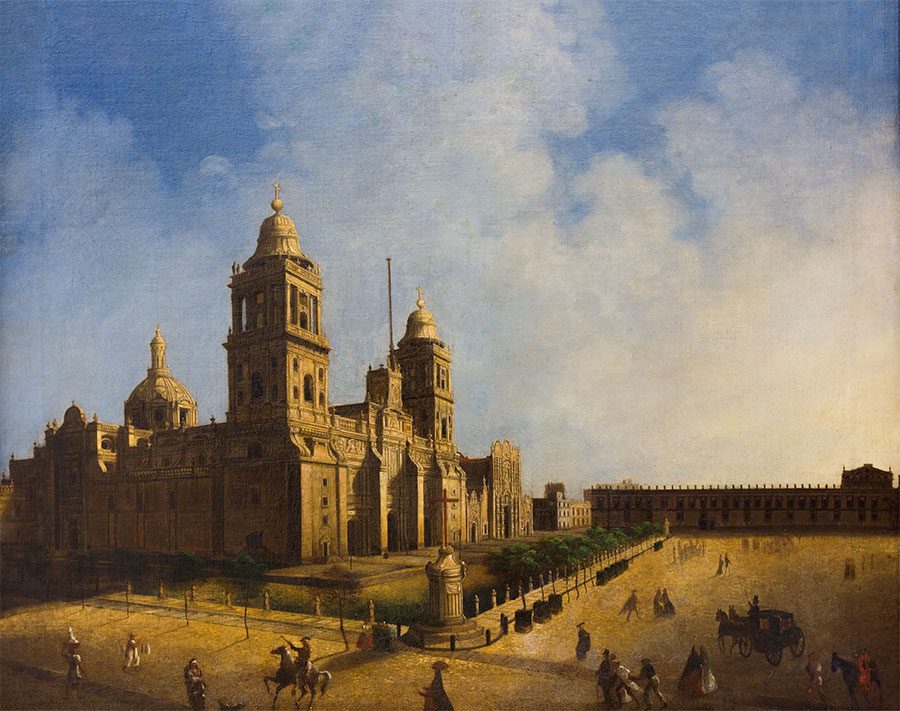
Long before it became the sprawling metropolis of more than twenty million people that we know today, Mexico City was already a center of artistic activity. Built on the ruins of the Aztec capital of Tenochtitlán, and later transformed by centuries of Spanish colonial rule, the city stands as one of the most continuously active sites of artistic production in the Western Hemisphere. Its layered history is visible on almost every street: an 18th-century Baroque church beside a modernist tower; a pre-Hispanic sculpture housed in a neoclassical museum; murals from the 1920s inside buildings from the colonial era.
What makes Mexico City unique as an artistic capital is its ability to absorb and reframe diverse influences—from indigenous traditions and Spanish Catholicism to French academicism and international modernism—without ever losing its distinctive character. Rather than being a passive recipient of foreign styles, the city has continually reinterpreted and reinvented those styles to produce art that speaks to local conditions, social changes, and historical memory.
Unlike cities whose art history is mostly tied to a single era or style—Florence with the Renaissance, Paris with Impressionism—Mexico City is characterized by its layered simultaneity. The city never truly sheds its earlier artistic identities; it accumulates them. Aztec stone carving, colonial religious painting, academic portraiture, and conceptual installations all coexist within the same urban space, forming a palimpsest of cultural memory.
Geography played no small role in the city’s emergence as a creative powerhouse. The Valley of Mexico, ringed by volcanoes and rich in natural resources, was home to advanced civilizations for centuries before the Spanish conquest. Tenochtitlán, the Mexica capital, was not only a political and religious center but also a major hub for artisans, goldsmiths, and stoneworkers. When Hernán Cortés razed the city in the 1520s, he didn’t erase this cultural infrastructure so much as overlay it with a new European vision—setting off a centuries-long tension between imported styles and local expression.
Colonial authorities quickly established Mexico City as the capital of New Spain, and with that came institutions dedicated to artistic instruction, religious image-making, and architectural grandeur. By the 18th century, the city housed the first major art academy in the Americas: the Royal Academy of San Carlos, founded in 1781. This gave Mexico City a formal structure for artistic training, based on European norms, but over time it became a space where local artists could develop their own voices.
The city’s importance only grew in the 19th and 20th centuries. As the political capital of an independent Mexico, it became the center of debates over national identity—debates often carried out through visual culture. Artists were commissioned to paint history, sculpt heroes, and define what it meant to be Mexican. This peaked in the early 20th century with the Mexican Muralist movement, which turned the city’s public buildings into ideological canvases. Diego Rivera’s epic frescos in the National Palace and Secretariat of Education are not only iconic artworks; they’re declarations about who belongs in the nation’s story and how that story should be told.
Yet art in Mexico City has never been confined to elite spaces. Folk artists, street muralists, ceramicists, and weavers have long contributed to the city’s visual life. The popular and the academic have interacted in complex ways, particularly in the late 20th century, when artists began to question traditional hierarchies. Today, the city’s galleries and museums exhibit both conceptual video art and indigenous textiles, making room for a broader and more inclusive definition of art without politicizing every gesture.
In recent decades, Mexico City has emerged as a global player in the contemporary art world. It hosts international fairs like Zona MACO, is home to influential galleries like Kurimanzutto, and attracts curators and collectors from across the world. But while it participates in global networks, the city remains firmly grounded in its own artistic heritage. Artists like Gabriel Orozco, Damián Ortega, and Teresa Margolles draw on Mexico’s social realities, architectural forms, and layered histories—even as they exhibit in places like New York, Berlin, and Tokyo.
To walk through Mexico City is to move through centuries of artistic vision. The cathedral stones whisper of colonial splendor; subway stations display pre-Hispanic motifs; cafes hang modernist prints beside handwoven textiles. This is not a museum frozen in time. It’s a living city where art is not an ornament but an essential part of its identity.
Art in the Mexica (Aztec) Capital of Tenochtitlán
Long before the Spanish arrived in the Valley of Mexico, the Mexica people—often referred to as the Aztecs—had built one of the most remarkable cities of the pre-Columbian world: Tenochtitlán. Founded in 1325 on a series of islands in Lake Texcoco, the city was a marvel of engineering and aesthetics. By the time Hernán Cortés set foot on its causeways in 1519, Tenochtitlán was larger than any European city of the time, with a population estimated at 200,000 and a dense layout of temples, markets, canals, and palaces. Art was not a side pursuit in this society—it was inseparable from religion, politics, and daily life.
The Mexica had a sophisticated understanding of materials and symbolism. Their art was not merely decorative; it was designed to convey power, cosmology, and sacred meaning. From stone sculpture and featherwork to codices and ceramics, every object served a function—either ceremonial, communicative, or utilitarian. And yet, within those functional boundaries, there was great beauty and technical refinement.
Stone sculpture was central to Mexica artistic achievement. The Templo Mayor, the massive ceremonial center of Tenochtitlán, was surrounded by carved monuments to gods, warriors, and mythical creatures. Among the most famous of these is the Coyolxauhqui Stone, a massive circular relief discovered in 1978, depicting the dismembered body of the moon goddess Coyolxauhqui. Executed in volcanic rock, it is both a mythological narrative and a powerful artistic composition, with curving lines and a sense of dynamic movement that rivals the best relief sculpture of any ancient culture.
Deities were frequently represented in full-figure sculptures. Huitzilopochtli, the god of war and the sun, and Tlaloc, the rain god, were common subjects. These works were not just religious icons—they were tools of statecraft. Their sheer scale and expression projected the divine authority of the Mexica rulers. This was an empire where gods and government were intertwined, and the visual language reinforced that relationship.
One of the most refined art forms of the Mexica world was featherwork. The Mexica valued feathers, particularly from exotic birds like the quetzal, above gold. These feathers were used to create mosaics and garments for nobles and priests. Feather shields, headdresses, and ceremonial fans were not only technically intricate but also vibrant with color and symbolic meaning. While most examples were lost or destroyed during the conquest, surviving pieces—such as the so-called “Montezuma’s headdress” in Vienna—demonstrate a mastery of color coordination, material manipulation, and spatial rhythm.
Codices—hand-painted books made from deerskin, bark paper, or agave—represent another major area of Mexica artistic and intellectual life. These were not narrative texts in the Western sense, but visual manuscripts that recorded dynastic histories, tribute payments, cosmological beliefs, and calendrical systems. The art of the codex was a complex fusion of image and symbol, demanding interpretive literacy. While many were destroyed during the Spanish conquest, a number were preserved and now offer scholars key insights into Mexica worldviews.
In daily life, art also appeared in more humble forms: ceramics, textiles, and body adornment. Mexica pottery included both utilitarian wares and elaborately decorated vessels. Geometric patterns, deity faces, and stylized animals adorned cups, bowls, and incense burners. Artisans often worked within strict formal conventions, yet individual style and innovation were not absent. Similar finesse appeared in jewelry and lapidary arts—jade, turquoise, obsidian, and gold were carved into nose rings, ear spools, and pectorals. While gold was admired, it was not as sacred to the Mexica as it was to the Spanish. For the Mexica, materials held meaning, and turquoise or obsidian might carry deeper cosmological weight than mere luster.
The production of these artworks was highly organized. Artisans were often trained in calmecac (schools for nobles) or telpochcalli (schools for commoners), depending on their social status and specialization. Guilds or hereditary workshops ensured skill transmission. Some artists specialized in stone carving, others in feather mosaics or manuscript painting. These were not amateurs but professionals in a thriving cultural economy.
Tenochtitlán itself was a work of art. Its layout reflected cosmological principles. The city was divided into four quarters, echoing the four cardinal directions, with the Templo Mayor at the center—marking the axis mundi, or cosmic center. Public art and architecture reinforced this sacred geometry. Even the markets were filled with colorful textiles, painted gourds, and sculpted goods, revealing the Mexica’s integrated vision of commerce and aesthetics.
What the Spanish encountered was not a primitive world, but a civilization that used art as a language of power, faith, and identity. This made the conquest not only a military defeat but a cultural collision. Much of Mexica art was destroyed, buried, or recontextualized under colonial rule. Temples were demolished to make way for cathedrals; sacred sculptures were removed or reinterpreted through a Christian lens. And yet, remnants survived—in museum collections, in the foundations of modern buildings, and in the stylistic echoes that would influence centuries of Mexican art to come.
Today, the legacy of Mexica artistry is preserved and studied in institutions like the Templo Mayor Museum and the National Museum of Anthropology in Mexico City. But it also persists in less formal ways: in the motifs of contemporary muralists, in artisan markets, and even in street art. The aesthetics of Tenochtitlán remain a vital part of Mexico City’s identity—a reminder that before it was a colonial capital, it was already a center of vision and craftsmanship.
Colonial Foundations: Spanish Conquest and Catholic Iconography
The fall of Tenochtitlán in 1521 marked not only the collapse of the Mexica Empire but also the beginning of a profound transformation in the artistic life of the Valley of Mexico. In place of the temples and codices of the pre-Hispanic world, a new visual culture arose—one built to serve the spiritual and political aims of New Spain, the Spanish colony established atop the ruins of the Aztec capital. This period, stretching from the early 16th century through the 17th, was defined by artistic hybridity. European forms dominated, but indigenous hands crafted them; Catholic imagery proliferated, yet pre-Columbian influences remained just beneath the surface.
From the outset, art was central to the colonial project. Hernán Cortés and the Franciscan friars who accompanied him quickly understood the persuasive power of images. Evangelization was a priority, and religious art became one of its most potent tools. Churches rose where pyramids once stood. Frescoes replaced murals. Statues of saints took the place of gods. And at the center of this cultural realignment stood the Virgin Mary.
One of the earliest and most powerful icons of colonial art was Our Lady of Guadalupe. While the version known today—a dark-skinned Virgin appearing to the indigenous convert Juan Diego on the hill of Tepeyac—would not be formally canonized until the 18th century, the seeds of this image were planted early. It offered a symbol of convergence: Christian in message, indigenous in audience, and Mexican in identity. The Virgin of Guadalupe became not just a religious figure but a central theme in New Spanish art, appearing in paintings, sculptures, and altarpieces throughout Mexico City and beyond.
The Church, as both commissioner and censor, dictated much of the artistic production in this period. The goal was didactic: to teach Christian doctrine to a population unfamiliar with it. Consequently, much of the early colonial art in Mexico City was highly illustrative. Painters adopted a European visual vocabulary—Renaissance perspective, humanist anatomy, chiaroscuro techniques—brought by Spanish artists or transmitted through prints from Seville and Antwerp. But these styles were often localized. Indigenous artists, trained in newly established workshops and schools, adapted what they learned to native materials and instincts.
A key institution in this transition was the San José de los Naturales, an arts workshop founded by Franciscans around 1527 specifically for indigenous students. Here, native artisans were taught to paint, carve, and build according to European standards. Yet their work bore unmistakable signs of their heritage: stylized figures, flattened space, and geometric detailing persisted. A notable example is the so-called “tequitqui” style—a term used by art historians to describe works that fuse Spanish religious themes with pre-Hispanic visual forms. In church façades, baptismal fonts, and retablos from the mid-16th century, one can still detect symbols of maize, serpents, and native flora, subtly embedded within Christian iconography.
Stone carving remained a dominant medium. While monumental sculpture in the Aztec tradition was largely suppressed, indigenous sculptors turned their attention to new subjects: crucifixes, saints, angels. The results were often striking in their intensity. One fascinating example is the “Cristo de Caña,” lightweight figures of Christ made from corn pith and glue, a technique rooted in pre-Hispanic crafting methods. These sculptures were not only easier to transport but carried deep symbolic resonance—maize being the sacred crop of Mesoamerica.
Architecturally, the early colonial period witnessed a rapid construction boom. Mexico City became dotted with monasteries, convents, and cathedrals. The most ambitious of these was the Metropolitan Cathedral, begun in 1573 and built atop the sacred precinct of the Templo Mayor. It would take centuries to complete, incorporating Renaissance, Baroque, and Neoclassical elements as styles evolved. Yet from the start, its massive bulk and ornate chapels signaled the arrival of a new religious and cultural order.
Murals returned as well, though in a different register. No longer the mythic narratives of Mexica temples, these were didactic frescoes inside cloisters and churches. Painted by indigenous artists under European direction, they often depicted scenes from the life of Christ, the Passion, or missionary work. Yet within these biblical tableaux, eagle warriors and tropical landscapes sometimes appeared—echoes of an earlier world not entirely erased.
Manuscript painting also persisted. Though the Spanish authorities destroyed many pre-Hispanic codices, new ones were created to serve colonial needs. The Codex Mendoza, for example, commissioned around 1541, records the tributes paid to the Mexica emperors but includes Spanish annotations and framing. Such documents are vital windows into the cultural negotiation of the time: the visual language is Mexica, but the function is colonial.
Importantly, this era also established the foundations for artistic institutions in Mexico City. By the late 17th century, guilds of painters, sculptors, and architects had formed, many of them dominated by criollos (Mexicans of Spanish descent). These guilds regulated training, pricing, and professional standards. They also began to marginalize indigenous artists from the highest ranks of production, even as native labor continued to power the city’s workshops.
Despite these inequities, the first century of colonial rule produced an extraordinary flowering of visual culture in Mexico City. Art served the Church and Crown, but it also bore the fingerprints of the conquered. In stone and paint, Mexico’s dual heritage was taking shape—not as a peaceful synthesis, but as a layered, sometimes uneasy, coexistence. These foundations would give rise to the uniquely rich and complex art history that continues to define the city.
Baroque Splendor: Churches, Altarpieces, and Murals
By the mid-17th century, the outlines of colonial Mexico City were firmly drawn. The Spanish Crown, the Catholic Church, and the emerging criollo elite had created a new urban society over the foundations of the old Mexica world. Yet the art and architecture that defined this era were not rigid replications of European models—they were exuberant, ornate, and, in many ways, uniquely Mexican. Nowhere is this clearer than in the Baroque period, which transformed Mexico City into one of the most visually dazzling capitals of the Spanish Empire.
Baroque art and architecture first developed in Italy during the 17th century, driven by the Catholic Church’s desire to inspire awe and reinforce religious devotion during the Counter-Reformation. Characterized by dramatic movement, emotional intensity, elaborate ornamentation, and dynamic contrasts of light and shadow, Baroque style soon spread across Europe and its colonies. In Mexico City, the Baroque found especially fertile ground. It merged with local materials, indigenous craftsmanship, and religious fervor to produce what some art historians now call the Mexican Churrigueresque—a style more florid and intense than its Spanish counterpart.
The most visible legacy of this period lies in the architecture of Mexico City’s colonial churches. These buildings were not merely places of worship; they were theatrical environments meant to dazzle the eye and elevate the soul. Walking into a Baroque church in 18th-century Mexico City meant entering a world of gold, carved wood, painted angels, and bursting clouds of stucco. Retablos—elaborate altar screens rising from floor to ceiling—became the focal points of religious interiors. Crafted from gilded wood, these structures were packed with sculptures, columns, niches, and spiraling decorative elements. The interplay of light and shadow, gilded surfaces, and sacred imagery was designed to make the divine feel immediate and overwhelming.
One of the most celebrated examples of Baroque architecture in the city is the Church of La Profesa, officially the Temple of San Felipe Neri. Begun in the late 16th century and reworked throughout the 17th and 18th centuries, it features a richly decorated interior that epitomizes the theatricality of Mexican Baroque design. Another landmark is the Church of Santa Prisca in nearby Taxco—while outside Mexico City, its construction by a Mexico City-based patron and its influence on urban builders made it part of the broader cultural milieu.
Sculpture during this period became more lifelike, often bordering on the hyperreal. Religious figures were carved in wood and then painted with such detail that they seemed almost animate—complete with glass eyes, real hair, and tear-shaped pearls to simulate weeping. These estofados (gilded and painted wooden statues) were often used in processions and devotional displays. The most skillful of these pieces came from workshops in Mexico City, where Spanish-trained sculptors collaborated with local artisans.
Painting, too, reached new heights. The 18th century saw the rise of prominent Mexican-born artists, many trained in the Academy of San Carlos or informal workshops, who developed sophisticated approaches to composition, perspective, and color. Among the most notable was Miguel Cabrera, whose works blend European academic style with a sensitivity to local religious devotion. His series of the Virgin of Guadalupe, painted repeatedly for churches and private patrons, helped to canonize the image as a national religious symbol.
Another significant genre in Baroque painting was the casta painting, a uniquely colonial form of portraiture that illustrated the various racial mixtures in New Spain. These works, though controversial today, were not intended primarily as scientific or anthropological records; rather, they were expressions of social order and hierarchy, often produced for elite patrons. Mexico City was the center of this practice, and its artists developed increasingly elaborate formats, depicting families in staged domestic settings with accompanying inscriptions describing their racial categories.
Murals, while less dominant than in the pre-Hispanic or later revolutionary periods, remained an important form of ecclesiastical decoration. Cloisters and sacristies were painted with religious scenes, historical narratives, and allegorical imagery. These murals often served didactic purposes—illustrating the lives of saints, scenes from scripture, or the triumph of the Church over paganism. Many of these works were created collaboratively by teams of artists, some of whom were indigenous or mestizo, continuing the hybrid tradition established in the early colonial era.
Materials played a critical role in shaping the aesthetic of the Baroque in Mexico City. Local volcanic stone—tezontle, a porous red basalt—was used for façades and structural elements. Its rough texture and rich color gave buildings a distinct regional character. Combined with cantera, a light gray stone, and gilded interior finishes, the contrast added to the visual complexity. The availability of fine woods, pigments, and gold from local mines allowed Mexican artisans to take Baroque exuberance to new extremes.
What distinguished the Mexican Baroque from its European roots wasn’t just decoration—it was a sense of spiritual intensity deeply rooted in the physical environment. Earthquakes, volcanic eruptions, and floods were common occurrences in central Mexico, and these natural phenomena made the fragility of life a visible part of the urban experience. Religious art in this context took on an almost apocalyptic urgency. Angels trumpet from the clouds, martyrs suffer in exquisite detail, and saints intercede in ecstatic poses—all of it meant to remind viewers of the transience of the material world and the promise of salvation.
By the end of the 18th century, however, tastes began to shift. Enlightenment values, neoclassical restraint, and the changing priorities of the Bourbon monarchy began to temper the excesses of the Baroque. Still, its legacy endured. To this day, some of Mexico City’s most beloved landmarks—the Metropolitan Cathedral, San Francisco el Grande, Santa Teresa la Antigua—bear the stylistic fingerprints of this golden age.
More than any other period, the Baroque shaped the emotional and spiritual contours of colonial Mexico City. It left behind a cityscape rich in symbolism and spectacle, a place where faith and art fused into one overwhelming, often sublime, experience.
The Academy and Enlightenment: Neoclassicism in the 18th Century
By the mid-18th century, the cultural tides in Mexico City began to shift. The swirling dynamism of the Baroque style—so dominant in the churches, altars, and paintings of the preceding century—started to fall out of favor. In its place came a new aesthetic aligned with order, symmetry, and rational beauty: Neoclassicism. This was not merely a matter of taste but a reflection of broader intellectual and political currents. As Enlightenment ideas took hold across Europe and its colonies, art in Mexico City became part of a larger effort to promote civic virtue, classical education, and modern governance. At the heart of this transformation was a single institution: the Academy of San Carlos.
Founded in 1781 under the patronage of King Charles III of Spain, the Academy of San Carlos was the first formal art academy in the Americas. It was modeled on the great academies of Europe—the Royal Academy of San Fernando in Madrid and the French Academy in Paris—and its mission was clear: to professionalize the arts, elevate the status of artists, and replace guild-based, religiously oriented training with a secular, classical curriculum. Its establishment marked a deliberate break from the workshop model of the colonial period and a step toward the modern system of art education.
The academy was initially housed in the Royal Mint building (Casa de Moneda) in Mexico City’s historic center. Under the leadership of Spanish artist Jerónimo Antonio Gil, it offered instruction in drawing, painting, sculpture, and architecture. Students learned by copying plaster casts of Greco-Roman statuary, studying anatomy, and mastering principles of perspective and proportion. Artistic excellence was measured not by religious devotion or decorative excess, but by adherence to classical ideals and technical precision.
The academy’s early curriculum was deeply tied to Enlightenment values. The goal was to form artists who could contribute to society—not just decorate it. Painters were encouraged to move beyond devotional subjects and engage with history, mythology, and moral allegory. Portraiture, too, gained prominence, as the emerging criollo elite sought to assert their cultural sophistication and civic identity. These new patrons favored restrained compositions and rational beauty over the emotional intensity of the Baroque.
One of the Academy’s early success stories was Manuel Tolsá, a Valencian-born sculptor and architect who came to New Spain in the 1790s to teach at the institution. Tolsá quickly became a leading figure in the city’s artistic transformation. His best-known work is the Equestrian Statue of Charles IV, commonly called El Caballito. Completed in 1803 and originally installed in the Plaza Mayor (now Zócalo), the statue exemplifies the Neoclassical ideal: harmony of form, idealized anatomy, and civic grandeur. Though a colonial monument to a Spanish monarch, it soon became a beloved urban landmark in its own right.
Tolsá also played a key role in finishing the Metropolitan Cathedral, adding its Neoclassical façade and bell towers, which now define the building’s profile. His work symbolically and literally capped a long era of Baroque dominance, signaling Mexico City’s entry into a new artistic age.
While Neoclassicism was European in origin, it was not simply imposed from above. Mexican artists trained at the academy began to take ownership of the style and adapt it to local themes. Painters like Rafael Ximeno y Planes and José Joaquín Fabregat produced elegant portraits, allegories, and engravings that reflected both Enlightenment humanism and a growing sense of local pride. They created images not only of kings and saints but also of scientists, educators, and civic heroes—marking a subtle but meaningful shift in subject matter.
This was also a time when printmaking flourished. The academy taught engraving as a central discipline, seeing it as a vehicle for the wide dissemination of ideas. Illustrated books, scientific treatises, and public announcements all became more visually sophisticated. Art was now a tool not only for devotion but for education and civic engagement.
Despite these advances, the academy was not without tensions. Its preference for classical ideals sometimes clashed with popular tastes, which still leaned toward the emotional warmth and religious themes of the Baroque. And while the academy professed a meritocratic ethos, its leadership remained largely Spanish, and access to its resources was uneven. Indigenous and mestizo artists were often excluded from its highest ranks, even as their work continued to sustain the broader visual culture of the city.
Nevertheless, the Academy of San Carlos laid the foundation for a more modern, secular, and intellectual approach to art in Mexico. It helped shift the center of artistic life from the church to the public square—from altar to academy—and nurtured a generation of artists who would go on to play major roles in shaping the visual identity of independent Mexico.
As the 18th century gave way to the 19th, and as political unrest began to stir throughout the Spanish Empire, the academy would become a site of both artistic innovation and ideological contest. The seeds of Mexican nationalism, planted in paint and stone during the Neoclassical era, would soon bloom in the wake of independence.
Art and Nationhood: Post-Independence Identity (1821–1870)
The year 1821 marked a profound turning point in the history of Mexico City. With the end of Spanish colonial rule, the capital of New Spain became the capital of a new, sovereign nation. But while political independence came swiftly, the question of national identity—what it meant to be “Mexican”—was far more complex and took decades to define. Art played a central role in this cultural project. In the decades following independence, artists, architects, and patrons in Mexico City turned their attention to the task of crafting a visual language that could express a unified national character—one that blended pre-Hispanic heritage, colonial legacy, and modern aspirations.
In the early years of the republic, the visual arts served both ideological and commemorative functions. Portraiture became one of the dominant genres, as the new elite—politicians, military leaders, and intellectuals—sought to enshrine their place in history. Gone were the images of Spanish kings and Catholic martyrs. In their place appeared generals like Agustín de Iturbide, the short-lived emperor of Mexico, and Guadalupe Victoria, the first president of the republic. These portraits were painted in the formal style inherited from the Academy of San Carlos: balanced compositions, neoclassical settings, and symbols of virtue, order, and leadership.
One of the central tensions in post-independence art was how to deal with Mexico’s dual heritage. On one hand, there was growing interest in celebrating the country’s indigenous past, especially the achievements of the Mexica and Maya civilizations. On the other, there remained a strong pull toward European ideals and aesthetics, particularly among the elite classes. Artists walked a fine line, incorporating pre-Hispanic motifs while continuing to work within academic conventions.
This fusion is visible in history painting, a genre that gained significant traction during the 19th century. Painters began to depict episodes from Mexico’s ancient and colonial past, recasting them as part of a national narrative. Scenes of conquest, resistance, and heroism were dramatized on canvas—turning figures like Cuauhtémoc, the last Aztec emperor, into symbols of resilience and patriotism. These works were often displayed in government buildings, schools, and public exhibitions, where they helped to shape a collective memory.
The Academy of San Carlos, still the dominant institution in artistic training, adapted to the new political climate. Though founded under Spanish rule, it became a site for fostering patriotic themes and Mexican talent. The academy hosted competitions on national subjects and began to admit a broader range of students, though the highest ranks still reflected the social hierarchies of the day. Its emphasis on drawing from classical models remained, but there was increasing space for local adaptation.
The idea of art as a national expression extended beyond the canvas. Public sculpture became a powerful medium for civic pride. Monuments were erected to commemorate independence and honor key figures of the revolution. One of the earliest and most iconic examples is the Altar a la Patria, erected in Chapultepec to honor the Niños Héroes, young cadets who died defending Mexico City from U.S. forces in 1847. Though completed later, this site reflects the emergence of public commemoration as a central theme in 19th-century art.
Architecture, too, participated in the construction of national identity. While Neoclassicism remained dominant in official buildings, there was a gradual incorporation of motifs inspired by indigenous architecture—particularly in decorative elements and allegorical frescoes. Government buildings, schools, and cultural institutions began to feature imagery of pyramids, feathered serpents, and native flora, often reinterpreted through a European lens.
The mid-19th century was also marked by political instability—republics rose and fell, foreign interventions occurred, and the empire of Maximilian I briefly took hold (1864–1867). Despite the turbulence, or perhaps because of it, art continued to serve as a means of anchoring national ideals. The Second Mexican Empire, under Maximilian and his consort Carlota, introduced a refined European court aesthetic to the capital. Artists like Édouard Pingret, a French painter who spent time in Mexico City, captured this moment with portraits of aristocrats and civic leaders, often with a more romantic and cosmopolitan tone.
At the same time, popular forms of art—lithographs, allegorical engravings, and calendars—gained wide circulation thanks to improvements in printing technology. These works, produced by both elite and popular artists, depicted national heroes, patriotic symbols, and religious themes, reaching an audience far beyond the gallery or academy. They helped create a visual vernacular of nationalism that could resonate with both urban elites and rural communities.
By 1870, Mexico City had firmly established itself as the artistic center of the nation. Its painters, sculptors, and architects were shaping not just what Mexico looked like, but how it imagined itself. The struggle to define Mexican identity—caught between the ancient and the modern, the indigenous and the European—remained unresolved. But through the visual arts, this ongoing negotiation took on tangible, enduring form.
Porfirian Modernity: Art, Architecture, and European Influence
From 1876 to 1911, Mexico was ruled—almost uninterruptedly—by Porfirio Díaz, a military hero turned authoritarian president who ushered in an era of political stability, economic development, and aggressive modernization. Often referred to as the Porfiriato, this period had a profound impact on Mexico City’s artistic and architectural identity. Art was no longer just a means of national expression—it became a tool of statecraft, urban beautification, and international alignment. Under Díaz, Mexico City was reshaped in both form and image to reflect a vision of modernity rooted in European elegance, especially that of Paris.
Díaz and his technocratic inner circle saw the arts as essential to legitimizing the regime and positioning Mexico as a civilized, orderly, and progressive nation on the world stage. To that end, massive investments were made in public works, monuments, museums, and academic institutions. The artistic style that dominated the period was Academicism, rooted in classical traditions, but filtered through French sensibilities and executed with technical precision. It was grand, controlled, and explicitly cosmopolitan.
Architecture was the most visible expression of this ideology. Mexico City was reimagined as a Latin American Paris. Wide boulevards, formal plazas, and Beaux-Arts buildings replaced or restructured colonial neighborhoods. Avenida Juárez, for example, was developed as a European-style promenade, while Paseo de la Reforma, inspired by the Champs-Élysées, became the city’s grand artery—lined with statues of national heroes and shaded by imported trees. At the center of this vision stood the Monumento a la Independencia, or El Ángel, inaugurated in 1910 for the centennial of Mexican independence. This golden-winged figure atop a towering column epitomized the Porfirian aesthetic: elegant, allegorical, and assertively monumental.
The government also supported the expansion and elevation of formal art institutions. The Academy of San Carlos, long the core of Mexico’s art training, was restructured to align more closely with European academies. Its curriculum emphasized historical painting, classical sculpture, and technical draftsmanship. Mexican artists were sent abroad—especially to France—for training, and many returned with an academic, salon-style approach to subject matter and execution. The goal was to elevate Mexican art to international standards, even if that meant downplaying native themes in favor of Greco-Roman mythology, aristocratic portraiture, and neoclassical composition.
Among the notable artists of this era was José María Velasco, whose panoramic landscapes of the Valley of Mexico became icons of national identity. Although trained in the academic tradition, Velasco brought a uniquely Mexican vision to the genre of landscape. His paintings—such as El Valle de México desde el cerro de Santa Isabel (1875)—depict the region’s sweeping geography with scientific detail and poetic atmosphere. These works were celebrated both at home and abroad, and Velasco earned medals at World’s Fairs in Europe. Through him, Mexican nature became a source of national pride, even as the urban core of the country was being remade in a European image.
Portraiture remained a prominent genre during the Porfiriato, but with a more refined, even theatrical sensibility. Political leaders, wealthy industrialists, and socialites commissioned large-format paintings to be displayed in private salons and official buildings. Artists like Felipe Santiago Gutiérrez captured the elite in rich fabrics and sumptuous interiors, mirroring the elegance of their European counterparts. These portraits were less about individual character than about displaying status, taste, and alignment with the Porfirian vision of order and progress.
At the same time, a new class of urban artisans and decorative artists flourished under the patronage of public works. The interiors of government buildings, opera houses, and train stations were filled with stained glass, wrought iron, and decorative painting—all produced by skilled local workers trained in European techniques. The Palacio de Bellas Artes, begun in 1904, stands as a crowning achievement of this synthesis. Though completed later due to the Revolution, its Art Nouveau and Neoclassical exterior, coupled with indigenous motifs on the interior, captures the paradox of Porfirian aesthetics: a deep admiration for European modernity coexisting with a performative nod to Mexican identity.
Photography also came into its own during this era. Studios flourished in the capital, offering formal portraits to middle- and upper-class clients. Photographers like Guillermo Kahlo (father of Frida Kahlo) documented not only people but also the transformation of Mexico City’s built environment. These images were used in promotional materials, government reports, and international exhibitions to portray a modern, orderly metropolis in line with European capitals.
Despite the regime’s emphasis on order and decorum, not all artistic production served elite interests. Printmakers and caricaturists, especially those working in broadsheets and popular newspapers, offered satirical counterpoints. José Guadalupe Posada, now recognized as a foundational figure in Mexican art, created thousands of engravings that mocked politicians, warned of moral decline, and depicted skeletons—calaveras—in scenes of everyday life. While often humorous, Posada’s work hinted at the social discontent brewing beneath the surface of Porfirian society.
By the early 20th century, this discontent would explode into the Mexican Revolution. The very visual language that Díaz had championed—ornate, European, elite—would be violently rejected by the new generation of artists who emerged in its wake. But even in its fall, the Porfirian era left a powerful mark. It defined the contours of modern Mexico City: its boulevards, its public monuments, its institutional framework for art education. It set the stage, visually and institutionally, for the ideological battles to come.
Revolution and Muralism: Public Art in a Changing Nation
The Mexican Revolution, which erupted in 1910 and raged for over a decade, marked one of the most profound social and political upheavals in the country’s history. By its end, Mexico had a new constitution, a new political elite, and, perhaps most dramatically, a new vision of itself. Nowhere was this vision more powerfully expressed than in the arts. The Revolution not only upended the old social order—it inspired a sweeping artistic movement that would make Mexico City an international center for public art: the Mexican Muralist movement.
The mural movement emerged not simply as a stylistic shift but as a deliberate response to the perceived elitism and European mimicry of the Porfirian era. For the new revolutionary government, art needed to be public, didactic, and accessible. It had to reflect the struggles of the Mexican people, celebrate their indigenous and mestizo heritage, and educate a largely illiterate population about history, justice, and national unity. Walls—massive, immovable, and accessible—became the new canvases of the republic.
At the heart of this transformation were three towering figures: Diego Rivera, José Clemente Orozco, and David Alfaro Siqueiros. Though different in temperament and technique, they shared a belief that art should serve the people and that Mexico’s long and complex history could be told visually in a way that words often failed to convey.
Diego Rivera, arguably the most famous of the three, had spent time in Europe, absorbing Cubism and the fresco techniques of the Italian Renaissance. When he returned to Mexico in the early 1920s, he began a series of monumental murals that fused Renaissance grandeur with Mexican themes. Commissioned by the new Secretariat of Public Education, Rivera painted vast, narrative cycles across its courtyards—images of workers, peasants, indigenous rituals, and revolutionary struggles. He followed this with an even more ambitious series at the National Palace, where he depicted the entire sweep of Mexican history, from Aztec civilization to the Revolution, with a clarity and dramatic force that turned the building into a national visual archive.
Rivera’s murals were not abstract or symbolic. They were clear, accessible, and overflowing with figures and stories. His use of vibrant colors, sweeping lines, and architectural integration made his work both educational and emotionally compelling. He presented the working classes not as passive victims but as active agents in shaping the nation’s destiny. His murals effectively redefined who belonged in Mexico’s history—elevating farmers, laborers, and indigenous communities to central roles.
José Clemente Orozco, by contrast, brought a more tragic and philosophical tone to the movement. His work, seen in murals at the National Preparatory School and later in Guadalajara, emphasized the destructive forces of war, the dangers of fanaticism, and the complexity of historical memory. Where Rivera’s murals could feel utopian, Orozco’s were often somber and critical. His depictions of faceless masses and disfigured prophets conveyed a deep ambivalence about revolution and progress. In Mexico City, his murals pushed viewers to confront not just what history includes, but what it costs.
David Alfaro Siqueiros, the most overtly militant of the trio, experimented with dynamic compositions, dramatic foreshortening, and modern materials. He believed that murals should not only reflect revolutionary themes but also revolutionize form. His work often bursts from the walls, enveloping the viewer and breaking traditional spatial boundaries. At the Polyforum Cultural Siqueiros (completed later in his career), he created a monumental, multi-surface mural titled The March of Humanity—a dizzying, panoramic vision of social struggle and future emancipation. Though not in the early muralist core, it represents the culmination of his ideas about total art environments.
Beyond these three, a host of other artists contributed to the mural renaissance. Jean Charlot, Fermin Revueltas, Ramón Alva de la Canal, and many others painted murals in schools, theaters, and government offices throughout Mexico City. Women also played a role, though often marginalized by the movement’s patriarchal structures. Aurora Reyes, considered the first female Mexican muralist, painted powerful works focusing on women’s rights and social justice.
The government played a central role in funding and shaping this movement. Under the guidance of José Vasconcelos, Minister of Education in the early 1920s, art was folded into the broader project of nation-building. Vasconcelos believed that a shared cultural narrative could unify Mexico’s fragmented society and heal the wounds of war. Muralism, with its visual accessibility and public format, was the ideal tool. Artists were not left to work independently; their commissions were state-sponsored, and often aligned with ideological goals.
But even as muralism became a national emblem, it was not without tensions. The same state that promoted revolutionary art also set limits on its content. Rivera famously clashed with authorities over his inclusion of communist symbols, leading to cancellations and revisions. His later mural for Rockefeller Center in New York was destroyed for including a portrait of Lenin. In Mexico City, too, artists often had to balance ideological conviction with political pragmatism.
Nevertheless, the impact of the muralist movement on Mexico City was transformative. The city itself became a gallery. Public buildings, once austere, now pulsed with color and drama. Art moved from the confines of museums and elite salons to streets, schools, and civic centers. The Mexican people, long depicted as subjects of history, now became its protagonists.
The legacy of this period endures. Visitors to Mexico City today can trace the country’s revolutionary past not only through archives and books but on the walls of its most important buildings. The Palacio de Bellas Artes, Secretariat of Education, National Palace, and dozens of other sites preserve this uniquely Mexican fusion of politics, pedagogy, and art.
Beyond the Murals: Mid-Century Modernism and Abstraction
By the 1950s, the monumental legacy of the Mexican muralists still loomed large over the art world of Mexico City. Their work had dominated the walls of public institutions, their messages had helped shape national consciousness, and their reputations had extended far beyond the country’s borders. But for a younger generation of artists, this very dominance posed a challenge. As Mexico entered a period of industrialization and international engagement, artists began to question whether the figurative, state-sponsored, ideologically rigid art of the previous decades could still reflect their realities. In response, many turned toward modernism, abstraction, and individual expression, signaling a major stylistic and philosophical break from their predecessors.
This movement away from muralism didn’t happen overnight, nor was it uniform. It developed gradually, through a network of artists, architects, and intellectuals who were increasingly influenced by international art movements—particularly those emerging from the United States and Europe after World War II. New materials, forms, and philosophies entered the Mexican scene: geometric abstraction, expressionism, constructivism, and kinetic art all found homes in Mexico City.
One of the key figures of this transitional moment was Rufino Tamayo. Though older than many of the artists leading the break, Tamayo had always kept a critical distance from the muralists. Born in Oaxaca but trained in Mexico City, he drew on both pre-Hispanic iconography and European modernism, particularly the work of Picasso and Braque. His paintings, marked by textured surfaces and vibrant color, often fused human figures with mythic and cosmic themes. Tamayo rejected overt political messaging in favor of a universal, humanist approach. “I’m not interested in painting the history of Mexico,” he once said. “I’m interested in painting man’s universal destiny.” His work opened the door for a more introspective and formally experimental type of Mexican art.
By the late 1950s, a group of younger artists formalized their dissatisfaction with muralism into a movement. Known collectively as La Ruptura (“The Break”), these artists—including José Luis Cuevas, Manuel Felguérez, Lilia Carrillo, and Vicente Rojo—rejected both the style and ideology of the muralist generation. They saw muralism as overly didactic, state-controlled, and out of step with contemporary art movements abroad. In its place, they advocated for individualism, critical inquiry, and stylistic plurality.
José Luis Cuevas became one of the most outspoken voices of La Ruptura. In a 1956 manifesto titled La cortina de nopal (“The Prickly Pear Curtain”), he argued that Mexican art had become provincial and backward-looking. He championed existentialism, psychological depth, and the grotesque. Cuevas’s drawings and prints often depict distorted human figures in claustrophobic, nightmarish settings—haunting allegories of alienation and repression.
Other artists, like Manuel Felguérez, explored geometric abstraction and constructivism. He used industrial materials such as scrap metal, aluminum, and wood, integrating art with architecture and urban space. Felguérez saw modernist abstraction not as an import but as a tool for creating a contemporary visual language that resonated with Mexico’s own modernization.
A key architectural partner in this broader modernist turn was Mathias Goeritz, a German-born artist and theorist who settled in Mexico and played a crucial role in redefining the relationship between art and space. He collaborated with architects like Luis Barragán on projects such as the Torres de Satélite, a series of monumental abstract sculptures erected in 1957 in the growing suburb of Ciudad Satélite. These vibrant, geometric towers rejected narrative and embraced scale, color, and form as ends in themselves—a clear departure from muralism’s figurative storytelling.
Goeritz also advanced his “emotional architecture” theory, which argued that built environments should stimulate spiritual and emotional responses rather than simply fulfill utilitarian or propagandistic purposes. This idea found fertile ground in Mexico City’s rapidly expanding urban landscape, as planners and artists alike sought to reflect the country’s new identity as a modern industrial nation.
The institutional landscape evolved as well. The Academy of San Carlos, once the bastion of academic and nationalist art, was increasingly challenged by newer venues. The Museo de Arte Moderno (founded in 1964) and the Museo Tamayo (founded in 1981, but conceptualized earlier) became centers for showcasing contemporary and international works. Commercial galleries, artist-run spaces, and critical publications created a more dynamic and decentralized art scene, less tethered to state sponsorship and official ideology.
Despite the growing popularity of abstraction, some artists maintained a strong engagement with figuration and social commentary—but in radically new ways. Painters like Francisco Toledo blended folk traditions, animal symbolism, and personal mythology with avant-garde techniques. His work was not overtly political, but deeply rooted in indigenous culture and the natural world. Similarly, Felipe Ehrenberg and Helen Escobedo explored conceptual and installation art, using ephemeral materials and public interventions to question the boundaries of what art could be.
By the 1970s, Mexico City had become a fertile ground for experimentation. While the muralists had once defined the nation’s artistic identity with sweeping narratives and monumental scale, the new generation offered fragmentation, multiplicity, and critical detachment. The city’s art scene no longer spoke with a single voice—it echoed with many.
Still, the muralist legacy was never entirely abandoned. Some artists revisited it with irony or deconstruction. Others, including Rivera’s own daughter Guadalupe Rivera Marín, continued to support its preservation and reinterpretation. The walls of Mexico City remained vital surfaces for expression, but now they carried not just heroic histories but also abstractions, contradictions, and provocations.
Contemporary Movements: The Rise of Conceptual and Installation Art
By the 1980s, Mexico City’s art world had reached a new phase of evolution. The hegemony of muralism was long past, and even the modernist certainties of abstraction and formalism had begun to dissolve. In their place arose a multifaceted and experimental landscape marked by conceptual art, installation, performance, and multimedia practices. This period was less about the triumph of a single style than the coexistence of many—and the reassertion of the city as a global cultural hub that could no longer be understood only through national categories or canonical figures.
Mexico City’s transformation into a platform for contemporary art emerged in tandem with broader global currents: the rise of neoliberal economies, post-Cold War political realignments, and the digital revolution. But it also reflected internal shifts—economic crises, the 1985 earthquake, increasing urbanization, and the erosion of official state ideologies. Artists responded not with a return to overt political propaganda but with skepticism, irony, and experimentation.
One of the most important developments of this era was the rise of installation art, where the boundaries between object, viewer, and environment dissolved. Gabriel Orozco, who emerged in the late 1980s and gained international fame in the 1990s, exemplifies this shift. His work—ranging from a human skull covered in graphite to a Citroën car sliced lengthwise—defied categorization. Orozco rejected studio-based production in favor of site-specific, often ephemeral pieces that blurred the lines between art and life. His interventions in public spaces and everyday objects offered a subtle critique of consumer culture, identity, and modernity.
Orozco’s success opened the door for a generation of Mexican artists who worked across disciplines and media. Damián Ortega, originally a political cartoonist, developed sculptural installations that deconstructed tools, vehicles, and architectural elements. His Cosmic Thing (2002)—a disassembled Volkswagen Beetle suspended in space—became an emblem of Mexican conceptual art. It referenced not only Mexico’s industrial history but also its entanglement with global capitalism, all rendered with minimalist elegance.
Another pivotal figure was Teresa Margolles, whose work confronted the viewer with the physical and emotional aftermath of violence. Trained as a forensic technician, Margolles created stark installations using materials directly related to death: bloodstained cloths, water used to wash corpses, walls infused with the dust of cremated remains. While often focused on femicide and narco-violence, her art never resorted to spectacle. Instead, it demanded quiet contemplation, forcing viewers to reckon with the consequences of systemic injustice and erasure.
In parallel, Francis Alÿs, a Belgian-born artist living in Mexico City, brought a poetic, performative approach to urban exploration. His works often involved small acts—a man pushing a block of ice through city streets (Paradox of Praxis, 1997), or a line of people passing a bucket of water in vain toward a smoking volcano. These seemingly absurd gestures spoke volumes about labor, futility, hope, and civic life.
The city’s gallery scene also underwent a renaissance. Kurimanzutto, founded in 1999 by Mónica Manzutto and José Kuri, became a central platform for contemporary Mexican artists. Unlike traditional galleries, Kurimanzutto initially operated nomadically, using warehouses, markets, and parking lots for exhibitions. This rejection of formality mirrored the broader ethos of the scene: adaptable, irreverent, and globally connected. Today, Kurimanzutto is internationally recognized and has launched or sustained the careers of artists like Orozco, Ortega, Carlos Amorales, and Minerva Cuevas.
Museums adapted as well. The Museo Universitario Arte Contemporáneo (MUAC), inaugurated in 2008 on the campus of UNAM, provided a dedicated space for contemporary works by both Mexican and international artists. With a focus on critical engagement, interdisciplinary practices, and public programming, MUAC became a counterpoint to the older, more canonical institutions in the city. Meanwhile, independent and artist-run spaces like Casa del Lago, Ex Teresa Arte Actual, and Laboratorio Arte Alameda provided experimental platforms for emerging voices.
This period also saw a resurgence of interest in performance art, video, and new media. Artists used the moving image not merely as documentation but as primary artistic material. Melquiades Herrera, Ximena Cuevas, and Pedro Reyes produced works that blended political commentary, humor, and social critique, often with strong theatrical or participatory elements.
Crucially, contemporary art in Mexico City moved beyond the constraints of national narratives. While earlier generations were preoccupied with defining “Mexicanidad” (Mexicanness), contemporary artists increasingly addressed transnational themes: migration, environmental crisis, gender identity, and the commodification of culture. They engaged with global discourses without abandoning local specificity—making Mexico City not just a center of Mexican art, but a node in the broader international art world.
Yet even amid this global integration, the city’s public spaces remained active sites of artistic expression. Graffiti, street art, and spontaneous installations blurred the lines between sanctioned and unsanctioned art. Artists like Saner and Sego turned the walls of working-class neighborhoods into vibrant canvases, drawing from indigenous iconography, mythology, and urban folklore. These practices brought art directly to the people without institutional mediation, echoing some of the aims of the muralist generation but reimagined through a postmodern lens.
By the 2010s, Mexico City had fully embraced its role as a contemporary art capital. Events like Zona MACO, Material Art Fair, and Salón Acme brought international collectors, curators, and critics to the city, helping Mexican artists gain visibility while also fostering dialogue across borders. Importantly, these platforms retained an experimental edge, resisting the overly commercial feel of some global art fairs.
What emerged in these decades was not a single movement, but a cultural ecology: artists, curators, institutions, and informal networks working in tandem—sometimes cooperatively, sometimes in friction—to redefine what art could be in a sprawling, complex, and often contradictory metropolis.
Institutions and Markets: Museums, Collectors, and Global Positioning
The transformation of Mexico City into a global art capital did not happen by accident. It was built on a foundation of institutional investment, private patronage, and market infrastructure that, over the last fifty years, has supported the production, preservation, and promotion of art on an unprecedented scale. While the city’s artistic vibrancy has always depended on creative vision, it is equally the result of networks of funding, exhibition spaces, educational structures, and savvy international engagement.
Museums have played a pivotal role in this evolution. Some of the most significant institutions date back to earlier eras—the Museo Nacional de Arte (MUNAL), housed in a neoclassical building from the Porfirian period, and the Museo de Arte Moderno, established in the 1960s, continue to serve as vital repositories of Mexican art from the 19th and 20th centuries. These institutions maintain historical continuity while periodically hosting contemporary exhibitions that bridge past and present.
But it was the emergence of more flexible, contemporary-focused museums that signaled Mexico City’s full embrace of the global art conversation. The Museo Universitario Arte Contemporáneo (MUAC), affiliated with UNAM, has become a leader in experimental programming, with a mandate to support both established and emerging voices in critical contemporary practice. Its exhibitions often center on sociopolitical issues—migration, state violence, climate change—reflecting the global orientation of Mexico’s newest generation of artists.
Meanwhile, the Museo Jumex, opened in 2013 and funded by Eugenio López Alonso, heir to the Jumex fruit juice fortune, brought private collecting into public visibility. The museum’s stark white limestone building, designed by British architect David Chipperfield, sits across from the Museo Soumaya, another privately funded institution backed by Carlos Slim, the billionaire telecommunications magnate. Together, these neighboring museums in the upscale neighborhood of Polanco offer radically different curatorial visions: Jumex as a space for international contemporary art with a rotating calendar of avant-garde exhibitions, and Soumaya as a more encyclopedic and populist venue, housing Slim’s vast personal collection—including European masters like Rodin, Dalí, and El Greco.
The growing visibility and legitimacy of private collectors in public cultural life has been one of the defining features of Mexico City’s art ecosystem. Figures like López Alonso, Slim, and others such as Patricia Martín, Ramiro Martínez, and Axel Stein have shaped not only what is shown but how art is circulated and valued. Their roles as patrons, funders, and board members influence acquisitions, exhibitions, and the global positioning of Mexican artists.
Commercial galleries, too, have evolved from small domestic venues to internationally recognized players. Kurimanzutto, perhaps the best known, was among the first to develop a truly international strategy—taking its artists to art fairs in Basel, New York, and Hong Kong while maintaining a robust program in Mexico City. Other galleries like Proyectos Monclova, Galería OMR, and Labor have followed suit, cultivating rosters that include both Mexican and foreign artists, and acting as conduits between local scenes and global circuits.
These commercial entities are not merely sales platforms; they act as producers, curators, and tastemakers. They support new commissions, organize publications, and help their artists navigate the complex terrain of the global art market. Their work has been especially vital in a country where public funding for the arts can be inconsistent or politically vulnerable.
International art fairs have further integrated Mexico City into the global calendar. Zona MACO, founded in 2002, quickly grew into the largest art fair in Latin America, attracting galleries from Europe, the U.S., and Asia. Held annually in February, it draws collectors, curators, and critics from around the world. Though sometimes critiqued for its commercialization, Zona MACO also offers an important platform for emerging talent and provides critical exposure for younger Mexican galleries.
In response to MACO’s market-centric model, alternative fairs like Material Art Fair and Salón Acme emerged, focusing on independent projects, risk-taking curators, and artist-run spaces. These events offer more affordable, informal venues that resist the polish of the international art market, showcasing work that is often more experimental or politically pointed. Their growth reflects a broader ecosystem that values not just sales, but innovation and conversation.
Educational institutions have kept pace with these developments. The Academy of San Carlos remains active, though its influence has waned. Meanwhile, new programs—like those at Centro de la Imagen, SOMA, and Escuela de Artes Plásticas y Audiovisuales at UNAM—offer training in contemporary media, curatorial practice, and critical theory. These programs foster a generation of artists who are as versed in institutional critique and social practice as they are in traditional studio disciplines.
At the same time, Mexico City remains deeply tied to its neighborhoods and informal networks. Artist collectives, pop-up galleries, and street-level workshops thrive in boroughs like Roma, Condesa, San Rafael, and Doctores. Some of the most innovative work of the last two decades has come not from institutions or market galleries, but from independent collectives and grassroots spaces such as Casa Maauad, Biquini Wax EPS, and La Curtiduría.
While international attention has brought prestige and investment, it has also sparked concerns about gentrification, cultural commodification, and the loss of local autonomy. The influx of foreign collectors and digital nomads has changed the socioeconomic dynamics of many art-centric neighborhoods. Rents have soared, traditional spaces have closed, and some artists have been priced out of the very districts they helped energize. In this way, the global rise of Mexico City as an art capital has mirrored the broader dilemmas facing cities from Berlin to Brooklyn: how to balance economic vitality with cultural authenticity and equitable access.
Still, Mexico City’s art institutions and markets continue to thrive by adapting. Rather than clinging to nationalist frameworks or mimicking foreign models, they are developing uniquely hybrid forms that reflect the city’s past while engaging the present. Whether in the glass pavilions of Polanco, the lofts of Roma Norte, or the concrete basements of artist-run spaces, Mexico City’s art world is powered by a dynamic interplay of legacy, ambition, and reinvention.
Cultural Legacy and Urban Identity: Art in the Everyday
In Mexico City, art is not confined to galleries, museums, or the homes of collectors—it spills into the streets, markets, metro stations, and neighborhoods. The city’s visual culture is not something that exists only in curated spaces; it’s stitched into the urban fabric. This everyday presence of art—historic, vernacular, spontaneous, and institutional—is part of what gives Mexico City its distinctive identity. Here, the boundaries between “high” art and “popular” expression dissolve, and the act of walking through the city becomes a journey through layered cultural memory.
Nowhere is this more evident than in the public spaces that host permanent artworks. Since the 20th century, government-sponsored sculpture and urban monuments have defined much of Mexico City’s visual geography. The Avenida Paseo de la Reforma, with its line of bronze heroes, exemplifies this tradition. Statues of Benito Juárez, Cuauhtémoc, and Christopher Columbus (until its recent removal) mark symbolic points along the boulevard, mapping a version of national history into physical space.
But these official narratives are constantly contested and complemented by other forms of urban art. One of the most visible is murals—not only the monumental state-commissioned works of Rivera or Siqueiros, but the many smaller-scale paintings in markets, schools, metro stations, and community centers. For instance, the Metro system, used by millions daily, is a subterranean gallery: stations like Insurgentes, Pino Suárez, and Bellas Artes feature tile mosaics, bas-reliefs, and replicas of pre-Hispanic sculptures. In this sense, public transportation is also public pedagogy—infused with visual history and civic pride.
Graffiti and street art have become central to the city’s urban identity. In areas like Doctores, Centro Histórico, and La Merced, walls speak in layers: political slogans, stenciled icons, colorful abstractions, and intricate murals referencing Aztec mythology, social issues, or local heroes. Artists like Saner, Sego, and Spaik have elevated street art to an expressive form that both honors tradition and critiques present conditions. Their use of indigenous symbols and psychedelic aesthetics creates a kind of visual folklore, addressing contemporary concerns—violence, migration, identity—without the heavy-handed moralism of earlier public art.
Even in more commercialized spaces, art finds a foothold. Mexico City’s tianguis (open-air markets) are filled with hand-painted signs, religious images, and decorative crafts that blur the line between utility and expression. The ubiquitous ex-voto paintings, which depict miraculous events in a naive but heartfelt style, offer insight into the personal and communal beliefs that continue to animate the city. These small devotional works, whether in private homes or clustered in churches like the Basílica de Guadalupe, express gratitude and tell stories of survival, love, and fate—connecting aesthetic practice with spiritual life.
Architecture also carries the weight of the city’s artistic legacy. Walking through neighborhoods like Roma, San Rafael, or Santa María la Ribera, one encounters Porfirian mansions with ironwork balconies, Art Deco apartment buildings with mosaic facades, Brutalist public housing complexes, and minimalist glass towers. Each reflects a different era, aesthetic, and ideology. The city’s refusal to fully modernize or homogenize gives it a uniquely textured appearance—an urban collage where art is embedded in the very bones of the place.
Artistic interventions in urban space also come from festivals, protests, and ephemeral events. Day of the Dead altars, papier-mâché alebrijes paraded through Reforma, and performance art in public plazas reveal how traditions evolve in real time. These events are not staged for tourists; they are civic rituals that reaffirm cultural belonging and allow space for innovation. The Zócalo, Mexico City’s historic main square, often serves as both a stage and a canvas for these hybrid spectacles.
Meanwhile, art education and community workshops bring creativity into the fabric of neighborhoods. Organizations like Taller Arte del Nuevo Amanecer (TANA) and Taller 75 Grados offer printmaking and graphic arts to local residents, creating bridges between professional artists and everyday citizens. This democratization of artistic practice continues a legacy begun in the post-revolutionary era but adapted for today’s decentralized, media-saturated world.
Yet, the city’s urban art ecosystem is not without challenges. Rapid gentrification, especially in once-working-class districts now favored by real estate developers and international newcomers, threatens to displace artists and erode local cultures. The commercialization of art districts like Roma-Condesa has led to debates over who gets to produce, view, and profit from creative labor. In response, collectives and neighborhood councils have pushed for more inclusive cultural planning, fighting to retain space for grassroots expression and cultural memory.
Amid this complexity, Mexico City’s identity as an “art city” is not imposed from above—it is enacted daily by its residents. From subway murals to sidewalk shrines, from open-air workshops to internet-based collectives, the city pulses with a democratic, sometimes chaotic, artistic energy. It is not a place where art merely decorates life; here, art is life—reflected in the city’s rhythms, rituals, and resistance.
Conclusion: A Living Tradition in Motion
To speak of the history of art in Mexico City is to trace a continuum that resists neat categorization. It is a history not of linear progression, but of layers, ruptures, and returns. From the ceremonial sculpture of Tenochtitlán to the experimental installations of the 21st century, art in Mexico City has continuously reshaped itself in response to conquest, ideology, modernization, and global conversation. But even as styles and materials change, certain qualities endure: a deep engagement with history, a drive to integrate art with public life, and a belief that visual culture matters—not as ornament, but as structure.
What distinguishes Mexico City in the global history of art is not simply the quality of its individual artists, though they are numerous and world-class. It is the persistence of art as a civic language—one that speaks across centuries, social divisions, and political regimes. Here, art has always been more than personal expression. It has been a means to narrate identity, contest power, mark territory, and imagine futures. Its function has ranged from religious devotion and state propaganda to philosophical inquiry and neighborhood storytelling.
The city’s artistic tradition is not frozen in museums. It is alive in the streets and subway stations, in classrooms and protests, in workshops and collector’s salons. It is etched into buildings and woven into festivals. Even when styles change—when muralism gives way to abstraction, or when academicism is challenged by conceptual practice—there remains a throughline: the belief that visual culture can shape the way people see themselves and their place in the world.
Mexico City’s current status as a global art capital is the product of both internal continuity and external recognition. Its galleries now show in Basel and Venice. Its artists win international prizes and exhibit in MoMA and Tate. Yet this success has not erased local urgency or specificity. On the contrary, what resonates globally is often what is most grounded: the use of indigenous motifs in digital formats, the reinterpretation of colonial forms through feminist performance, the defiant beauty of a street mural in a gentrifying barrio.
But with recognition comes responsibility. As the city navigates the pressures of market forces, tourism, and urban transformation, questions arise: Who gets to make art? Who is it for? How can a city preserve its heritage while fostering innovation? These are not rhetorical questions—they are the daily concerns of curators, teachers, muralists, street artists, and cultural policymakers.
The answers will not be singular. Mexico City thrives because it does not demand consensus. It accommodates contradiction: Baroque churches beside Brutalist towers, sacred icons next to satirical graffiti, ancient pyramids underfoot as you ride the Metro. It is a city of aesthetic dissonance—and that is its genius.
Ultimately, Mexico City’s art history is not a closed book but a living archive. Every generation adds its own pages. Some chapters are grand and state-sponsored; others are scribbled in the margins, hidden in alleyways, or etched into subway tiles. But all of them matter.
In this way, the art of Mexico City continues to do what it has always done: bear witness, provoke thought, and offer beauty—not in isolation, but in dialogue with the pulse of the city itself.