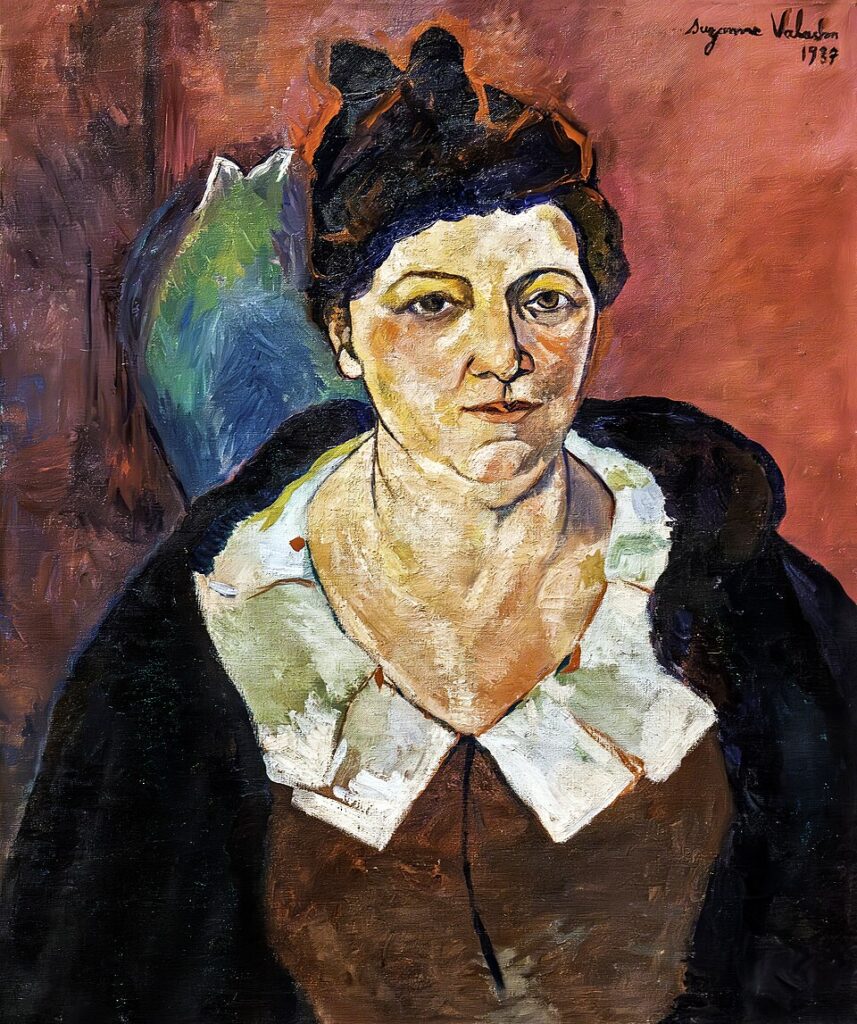
Maurice Utrillo was born on December 26, 1883, in Montmartre, Paris, a neighborhood already steeped in artistic legend. His mother, the gifted painter Suzanne Valadon, was a former circus acrobat turned celebrated artist, while his father is believed to have been the Spanish art critic and writer Miguel Utrillo. From a young age, Maurice’s life was colored by both artistic brilliance and personal instability. He struggled in school and found himself drawn more to painting than to traditional studies, a tendency that would shape his entire life.
Lucie Valore, by contrast, entered the world in 1896, also in France, but far from the whirlwind of Montmartre. Her upbringing was marked by a gentler rhythm, though she, too, was touched by the creative spirit. While she never achieved the fame of her future husband, she painted with a quiet intensity and also wrote poetry. This quieter trajectory gave her a grounding that would later balance Utrillo’s volatility.
Parallel Paths in Art and Adversity
By the early 1900s, Utrillo was already creating the cityscapes that would become his signature. His earliest paintings, often of Montmartre streets and Parisian architecture, displayed a sensitivity to light and mood that set him apart. Yet his personal life was marred by alcoholism, which began in his teenage years, and by recurrent bouts of mental illness. These struggles led to repeated stays in psychiatric clinics, including one in 1904, where painting was prescribed as therapy.
Lucie’s early adulthood was less dramatic but still driven by artistic ambition. She attended local art gatherings, exhibited in smaller salons, and circulated in literary groups. Though her name never carried the same market value as Utrillo’s, she developed her own quiet mastery of line and color. By the early 1920s, their lives were running on separate tracks — his chaotic and public, hers restrained and private — yet both were deeply tied to the world of French art.
Montmartre: The Setting for an Unlikely Romance
In the early 20th century, Montmartre was more than just a Paris neighborhood — it was the beating heart of the city’s bohemian life. Artists, poets, musicians, and dreamers crowded its cafés, cabarets, and studios. It was here that Utrillo not only lived but thrived artistically, even as the temptations of alcohol and nocturnal excess gnawed at his health. The cobblestone streets, the steep staircases, and the glinting lights of Paris from the hilltop would become recurring motifs in his paintings.
By the 1920s, Montmartre was experiencing a renewed wave of artistic energy after the devastation of World War I. New talents were emerging alongside established masters, and the area was alive with exhibitions and spontaneous collaborations. For Utrillo, the district offered endless inspiration, but it also offered danger — the same cafés where art was discussed deep into the night also served the strong wine he could not resist. Lucie, though not living permanently in Montmartre, visited often to attend literary gatherings.
A Neighborhood of Art, Vice, and Bohemian Energy
This was the Paris of the Moulin Rouge, Le Chat Noir, and smoky basement jazz clubs. Painters like Amedeo Modigliani and Pablo Picasso had already passed through, leaving behind a trail of stories and portraits. Montmartre could be intoxicating in more ways than one, and for someone with Utrillo’s vulnerabilities, it was a double-edged sword. Still, it was here that his reputation as one of France’s most authentic interpreters of urban life took root.
For Lucie, Montmartre was not a home but a stage she occasionally stepped onto. She came for the salons and the poetry readings, for the art exhibits and the café debates. The place impressed itself upon her — its mixture of beauty and decay, glamour and grime — but she remained cautious about its excesses. Little did she know that this neighborhood, in all its chaos, would one day provide the setting for a life-changing meeting.
When Utrillo Met Lucie
It was in the mid-1920s, when Utrillo was already a well-known name in French painting, that he met Lucie Valore. He was in his early forties, she in her late twenties. The introduction likely came through mutual acquaintances in the art world, people who saw in Lucie someone both sympathetic and strong enough to withstand the demands of his personality. Utrillo was at that time oscillating between periods of creative intensity and spells of near-total collapse.
The exact moment of their first meeting has not been precisely recorded, but accounts suggest that they encountered each other at an exhibition or small gathering of artists. Lucie, already familiar with Utrillo’s work, was struck not just by his reputation but by his reserved, even shy demeanor when sober. He, in turn, found in her a calm steadiness that contrasted with the turbulence of his own existence.
An Encounter That Changed Two Lives
From the outset, their interactions were marked by a mutual curiosity. Lucie admired his ability to capture the soul of a Paris street with nothing more than muted tones and deliberate brushwork. Utrillo, though often distrustful of strangers, seemed to open up in her presence, speaking about his mother, his art, and his health struggles. Their early conversations hinted at a shared understanding of what it meant to live for art while enduring personal challenges.
Though neither could have predicted it, this meeting set in motion a relationship that would evolve from acquaintance to partnership. It was not love at first sight in the romanticized sense, but it was a connection that deepened with each meeting. The slow pace of their early acquaintance allowed trust to take root — a rare and necessary foundation for what was to come.
Courtship and Companionship
As the months passed, Utrillo and Lucie began spending more time together. They took walks through quieter corners of Paris, away from the noise of Montmartre, and visited exhibitions both large and small. Lucie listened patiently as Utrillo spoke of his latest paintings and the struggles that lay behind them. She, in turn, shared her own work, modest though it was compared to his in terms of fame, and found that he respected her creativity.
Their companionship became a kind of refuge for both. For Utrillo, it was a rare source of stability; for Lucie, it was an opportunity to stand beside someone whose work she admired and whose vulnerabilities she accepted. Friends began to notice the changes — he seemed calmer, more inclined to stay home and paint rather than drift through the cafés.
From Artist Friends to Lifelong Partners
The progression from friendship to romance was gradual but unmistakable. Shared meals turned into shared plans, and before long, the two were speaking of a future together. Lucie’s influence was clear: she encouraged healthier routines, discouraged excessive drinking, and even persuaded him to leave Montmartre for extended periods to paint in quieter towns.
In return, Utrillo began painting with renewed vigor. The subjects broadened beyond Montmartre to include rural landscapes and sunlit village squares. While his inner battles did not vanish, the presence of Lucie provided a steadying hand. By the early 1930s, their bond was strong enough that marriage became not only a possibility but an inevitability.
Marriage in 1935: A Turning Point
On May 27, 1935, Maurice Utrillo and Lucie Valore were married. The ceremony was small and attended mainly by close friends, fellow artists, and a few family members. Suzanne Valadon, now in her seventies, witnessed the event with evident pride, knowing her son had found someone who could care for him. Though society’s gossip columns occasionally speculated about the union, it was largely seen as a stabilizing step for the often-troubled painter.
The wedding marked a symbolic turning point in Utrillo’s life. With Lucie as his wife, he moved further from the dangerous currents of Montmartre’s nightlife. They set up home in a quieter district, with Lucie managing much of the household and shielding him from social obligations that could prove stressful. For a man who had spent decades in a state of artistic and personal instability, this was a profound change.
A New Chapter for Utrillo and Valore
Marriage also had an impact on Utrillo’s art. In the years immediately following 1935, his paintings reflected a greater sense of peace, even when depicting urban scenes. Village squares, country churches, and sunlit courtyards appeared more frequently, and critics noted a subtle softening of his palette. While Lucie never sought to take credit for these shifts, those close to the couple could see her influence in the calmer mood of his work.
Their relationship was not without challenges. Utrillo’s health remained fragile, and periods of depression still occurred. Yet Lucie approached these difficulties with patience, tending to him when needed and ensuring that his work continued to find its way to galleries and buyers. Together, they built a rhythm that balanced creativity with care.
Life Together: Love, Challenges, and Creativity
In the years after their marriage, the couple divided their time between Paris and quieter provincial towns. They lived for a while in Le Vésinet, a peaceful suburb that allowed Utrillo to work without the constant lure of city distractions. Lucie oversaw household affairs and organized exhibitions, often acting as an intermediary between Utrillo and art dealers. These years were marked by a mixture of steady work and ongoing health concerns.
The daily routine was simple but deliberate. Mornings were for painting; afternoons might include short walks or reading together. Lucie’s paintings, though less commercially recognized, continued to develop, and she occasionally exhibited her work alongside local artists. Evenings were quiet, a stark contrast to Utrillo’s earlier life in Montmartre’s cabarets.
Living with Genius and Vulnerability
Of course, life with a man like Utrillo meant facing storms as well as calm. His bouts of illness could be sudden and severe, requiring Lucie to suspend her own activities to care for him. Yet these moments also deepened their bond, as they had learned to navigate the crises together.
Creativity remained a constant thread. Even during difficult periods, Utrillo rarely stopped painting altogether, and Lucie encouraged him to keep working. In the quieter seasons of their marriage, they found joy in the simple fact of being together, surrounded by canvases, paints, and the shared love of their craft.
The Final Years and Enduring Legacy
By the early 1950s, Utrillo’s health was in steady decline. Decades of alcoholism and mental strain had taken their toll, though his determination to paint persisted. The couple spent these years in Dax, in the south of France, hoping the climate would be beneficial. Lucie remained by his side, managing his affairs and ensuring he was never without the materials he needed to work.
Utrillo died on November 5, 1955, at the age of 71. His passing was widely mourned in France, and tributes poured in from fellow artists, critics, and admirers. For Lucie, the loss was both personal and public — she had been his partner in life and the guardian of his career. In the months that followed, she dedicated herself to preserving and promoting his artistic legacy.
After the Farewell
Lucie continued to live quietly after his death, occasionally appearing at exhibitions of his work. She maintained close contact with galleries and collectors, ensuring that Utrillo’s paintings remained visible to the public. Her own artistic career, though overshadowed by his, did not fade entirely, and she left behind a small but thoughtful body of work.
In the decades since, the story of Maurice Utrillo and Lucie Valore has been remembered as one of love, patience, and mutual respect. While his paintings are the more tangible legacy, their partnership offers an equally compelling reminder: that behind the canvases and the fame was a human connection strong enough to endure life’s most difficult challenges.
Key Takeaways
- Maurice Utrillo was born in 1883 in Montmartre, Paris, to artist Suzanne Valadon.
- Lucie Valore, born in 1896, was a painter and poet who met Utrillo in the mid-1920s.
- They married in 1935, with Lucie playing a stabilizing role in Utrillo’s life.
- Their marriage balanced creativity with the challenges of his poor health.
- Lucie preserved and promoted Utrillo’s artistic legacy after his death in 1955.
FAQs
- When was Maurice Utrillo born?
He was born on December 26, 1883, in Montmartre, Paris. - When did Utrillo and Lucie Valore marry?
They married on May 27, 1935. - What was Lucie Valore’s profession?
She was a painter and poet with a modest but respected career. - When did Maurice Utrillo die?
He died on November 5, 1955, in Dax, France. - Did Lucie Valore continue to promote his work after his death?
Yes, she remained active in preserving and showcasing his art.