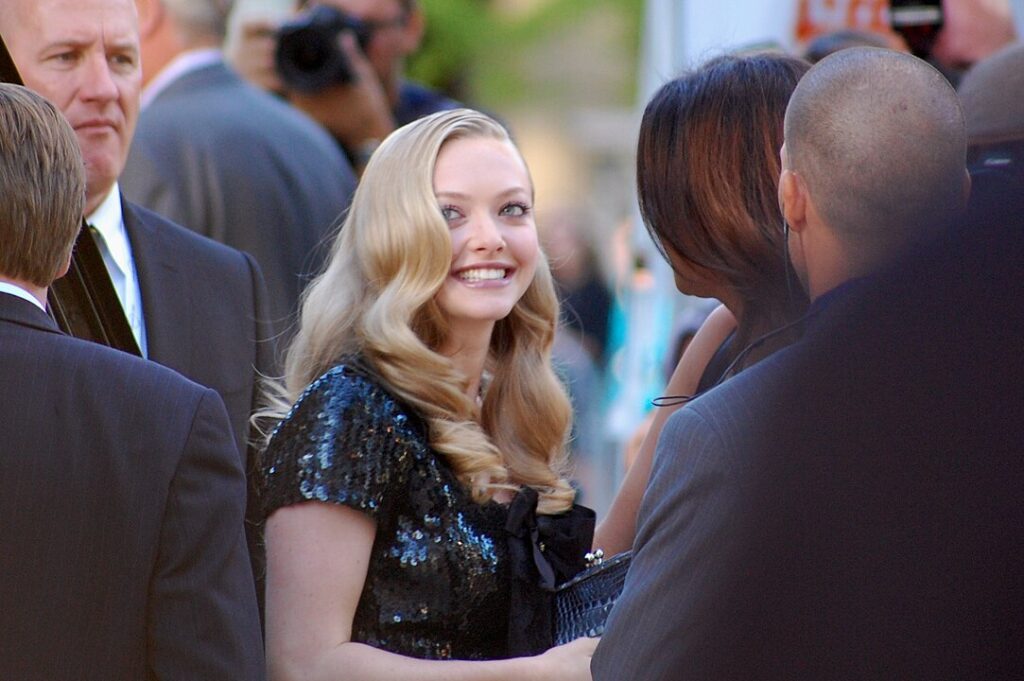
Amanda Seyfried’s beauty resides in the rare fusion of natural softness and balanced symmetry—a visual presence that feels both approachable and ethereal. She came to prominence in the early 2000s, but unlike many of her contemporaries, her look has remained quietly iconic. She became, visually speaking, a modern romantic figure—wide-eyed, delicate, and luminous.
While her fame spans film, television, and musical performance, she is featured here for her consistent visual appeal. Seyfried’s face, with its fine-tuned softness and light-reactive features, is frequently used by photographers and directors seeking atmosphere: innocence without fragility, sensuality without severity.
Artistic Overview
From an artistic perspective, Seyfried’s beauty reflects balance and luminosity. She appears to possess the kind of facial harmony often described in classical and Romantic portraiture: even thirds, central alignment, and a consistent tone. Her beauty is not sculptural in the dramatic sense, but painterly—best captured in soft light, favoring gradual transitions over hard edges.
She carries a mix of symmetry and expressive exaggeration. Her eyes are notably large in relation to her facial proportions, but this is tempered by a narrow nose and gently sloped cheekbones. Her features flow into one another without tension, which lends her face a high degree of visual consistency in photographs.
Visually, Seyfried recalls figures from 19th-century Romanticism and pre-Raphaelite painting. Her light coloring and refined features parallel muses in Rossetti’s work. While those references are interpretive, her softly radiant aesthetic comfortably straddles contemporary and classical territory.
Face Shape and Structure
Amanda Seyfried’s face appears to follow an oval structure—considered a flexible and traditionally balanced face shape in aesthetic theory. Her jawline is gently tapered, with a rounded chin and a smooth transition from cheek to jaw. Her forehead is slightly broad but proportional, giving her face an elongated balance.
Unlike angular or heart-shaped faces, which tend to impose visual hierarchy, her shape allows for uniform attention across features. This geometry supports the visual cohesion that makes her easy to style for editorial photography and beauty campaigns.
The face itself shows evenness in facial planes—meaning her features appear to lie on similar depth levels, reducing shadow tension and making her particularly photogenic under soft or ambient light. This contributes to the calm, open quality that defines her visual style.
Artistic Comparison Spotlight: Her facial oval echoes proportional studies found in da Vinci’s facial sketches—refined, measured, quietly idealized.
Feature Breakdown
| Feature | Description | Artistic Parallels |
|---|---|---|
| Eyes | Large, soft-set, light green | Rossetti muses; anime-inspired scale |
| Nose | Narrow bridge, subtle contour | Softened Greco-Roman sculpture |
| Lips | Full lower lip, defined Cupid’s bow | 1920s silent film era shapes |
| Cheekbones | Gently sloped, softly defined | Pre-Raphaelite visual curves |
| Brows | Arched, moderately full | Feminine realism, early 2000s styling |
Eyes
Amanda Seyfried’s eyes are her most visually dominant feature—large, almond-shaped, and frequently described as wide-set. The light green hue of her irises shifts subtly under different lighting conditions, contributing to their ethereal appearance. Their scale and spacing give her an open, almost otherworldly quality that translates well on screen and in stills.
Nose
Her nose is refined, with a narrow bridge and slight downward slope. It lacks strong angularity, which works well with her larger eye-to-face ratio. The silhouette of her nose, particularly in profile, gives her a soft and classical look without drawing focus away from the central features.
Lips
Seyfried’s lips are medium-full, with particular emphasis on the lower lip and a well-defined Cupid’s bow. The contrast between her lip shape and her otherwise rounded features gives a slight sensuality to her look, especially when styled with neutral or light gloss finishes. Her lip structure aligns with historic ideals seen in early cinematic close-ups.
Cheekbones
Her cheekbones are present but not sharp—more of a gradual incline than a peak. This supports her face’s overall softness and allows for natural light diffusion rather than harsh shadow cuts. These cheekbones frame her face subtly, offering a gentle slope rather than structural contrast.
Brows
Her brows are lightly arched and moderately full. In earlier years, they followed a thinner Y2K trend, but in later appearances they have become fuller, aligning with contemporary preferences. Their soft curve complements her eye shape without overpowering it, maintaining balance in the upper third of her face.
Hair and Styling
Amanda Seyfried’s hair—usually in shades of warm or neutral blonde—acts as a visual amplifier of her skin tone and eye color. The texture is often styled in soft waves, lending a romantic and timeless frame to her face. This kind of hair works in harmony with her facial shape, adding vertical movement without visual clutter.
When worn long and loose, her hair enhances the fluidity of her look. In both period films and editorial work, the softness of her hair reinforces her appearance as natural, expressive, and slightly idealized.
Color choices tend to stay in a narrow, effective range: champagne, honey, light golden blonde. These tones complement her fair skin and green eyes without creating artificial contrast. The lack of sharp changes in cut or color over the years has kept her image visually stable.
Era and Cultural Relevance
Amanda Seyfried became known during a time when beauty standards in media leaned into extremes—either exaggerated glamour or ultra-slim minimalism. Her appearance subtly resisted both trends. Rather than rely on angles or sharp contrast, her face projected softness, making her visually distinct from many of her early-2000s peers.
Her look also contributed to a slow return of more organic styling in the beauty and fashion industries. With her balanced facial features, soft tones, and consistent presentation, Seyfried echoed late 1970s and early 1980s naturalism, while avoiding vintage pastiche. She offered a quieter kind of beauty that drew from older traditions without seeming dated.
As her career matured, she transitioned easily between ingénue and more dramatic roles. Her visual appeal didn’t rely on youth alone; it translated across genres and time periods, in part because it was based on proportion and form rather than trend adherence.
Legacy and Visual Impact
Seyfried’s visual legacy rests in her value to cinematographers and stylists. She is regularly cited as a highly photogenic subject—not because of theatricality, but because her face holds light well and reads clearly from multiple angles. Directors and photographers have used her look to convey dreaminess, quiet power, and nostalgia.
Her recurring presence in beauty campaigns for brands like Clé de Peau and Lancôme demonstrates her effectiveness as a visual ambassador for softness and balance. These campaigns highlight her glowing skin, light eyes, and unforced symmetry—traits valued in both classic portraiture and commercial photography.
While she doesn’t frequently shift her visual style, that very consistency has added to her influence. Among editorial creatives, her face remains a reliable template for portraying softness, subtle sensuality, and emotional depth without visual overload.
“Amanda’s face is one of the most drawable I’ve ever worked with. Everything sits where the light expects it to.” —Makeup artist Pati Dubroff
Get the Look
Makeup:
- Use soft, neutral tones—taupes, light pinks, and subtle shimmers.
- Highlight lashes rather than eyeliner for a wide-eyed effect.
- Keep blush application high on the cheek, gently diffused.
- Focus on natural lip color with gloss or light balm—avoid over-definition.
Hair:
- Stick to soft blonde shades—champagne, golden, or honey tones.
- Style in loose waves or polished volume; avoid heavy styling products.
- A center or soft side part helps mirror her balanced face shape.
Fashion:
- Lean toward romantic fabrics: chiffon, silk, soft knits.
- Use solid neutrals or soft pastels to avoid overpowering her kind of look.
- Avoid dramatic cuts or extreme styling; her appeal thrives in subtlety.
Visual Signature: Dreamlike Proportions in Soft Focus
Era Alignment: Late Modern Naturalism with Classical Echoes
Inspiration Level: High for Cinematographers and Editorial Stylists