Kuala Lumpur began not as a grand capital but as a muddy, precarious settlement in the 1850s, born from tin and ambition. The story unfolds at the confluence of two modest rivers—the Klang and the Gombak—where miners, traders, and fortune-seekers carved out a town on unstable, flood-prone ground. The art that would eventually flourish here began in this unlikely, often harsh environment, shaped by necessity before it found the space for ornament and expression.
Tin and Timber Foundations
In the mid-19th century, tin was Malaysia’s most valuable export, and the demand from industrial Britain and China drove prospectors deep into the jungled interior of Selangor. Chinese Hakka miners, working under the Kapitan Cina system, set up the earliest organized settlements along the muddy banks. Simple wooden shophouses—functional structures elevated on stilts—were built as much for survival as for commerce. Yet even in their rawest form, these buildings carried visual markers of their makers: carved fascia boards, lattice windows, and the occasional imported ceramic tile from southern China.
The settlement’s early public spaces were not galleries or theatres, but open marketplaces where goods, tools, and visual ideas circulated side by side. Painted signboards in bold Chinese characters hung above shopfronts, doubling as markers of trade and personal pride. These small gestures of decoration, seemingly incidental, foreshadowed a larger trajectory: art in Kuala Lumpur would always be closely tied to commerce and the pragmatic needs of a growing city.
Cultural Improvisation at the River Confluence
Floods, malaria, and isolation were constant challenges. Yet adversity forced ingenuity. Malay traders, Orang Asli communities, and Chinese miners lived in close proximity, each adapting and borrowing from the others. Even the earliest religious structures reflected this mingling. A small prayer house might combine Malay timber joinery with Chinese roof tiles and Islamic geometric carvings.
These hybrid forms were not the result of deliberate artistic collaboration so much as practical adaptation: a Chinese carpenter might use a Malay roof pitch because it handled heavy rainfall better, while a Malay craftsman might incorporate imported ceramic ornament because it was more durable in the wet climate. Over time, these small acts of improvisation began to define the city’s visual DNA.
The First Public Symbols of Status
By the 1870s, as tin exports brought more wealth, Kuala Lumpur’s merchants and community leaders began commissioning structures that went beyond utility. The Kapitan Cina Yap Ah Loy, often credited with stabilizing the settlement after years of conflict, invested in brick kilns and encouraged the construction of more permanent buildings. The shift from timber to brick did more than improve fire resistance; it also allowed for new forms of architectural decoration, such as moulded plasterwork and painted facades.
These brick shophouses, aligned in tight rows along High Street (now Jalan Tun H.S. Lee), became the first recognizably “urban” architecture in the city. Painted in ochre, cream, and pastel blue, with arched windows and ornamented cornices, they introduced an early sense of streetscape rhythm. Though modest in scale, they signalled an important transformation: Kuala Lumpur was no longer a temporary mining outpost—it was becoming a town with aspirations, and those aspirations were beginning to be expressed visually.
The riverbanks, once cluttered with rough huts, now formed the first public face of the city. For the traders arriving by boat, this was their introduction to Kuala Lumpur—a place where commerce, hardship, and emerging artistry intertwined from the very beginning.
Colonial Layers: British Administration and Imported Aesthetics
When the British established administrative control over Selangor in the 1870s, Kuala Lumpur became more than a mining hub—it turned into a seat of governance. With colonial administration came not just new laws and institutions, but also a deliberate reshaping of the city’s built environment. The visual impact was immediate and enduring: European building techniques, imperial symbolism, and imported architectural styles began to overlay the local urban fabric, producing an aesthetic hybrid unique to Kuala Lumpur.
Building an Imperial Capital in Miniature
The arrival of British Resident Frank Swettenham and other colonial officials set in motion an ambitious program of public works. Government offices, courthouses, and police stations were among the first formal civic buildings, their designs often borrowed from late-Victorian civic architecture in Britain. These structures introduced symmetrical façades, high windows, and imposing entryways—elements meant to convey authority and permanence.
But instead of importing stone from Europe, British engineers worked with local materials—brick from newly established kilns and plaster made from lime. The result was a blend of imperial form and Malayan substance. Even in the earliest colonial buildings, adaptations for the tropical climate were evident: deep verandas for shade, high ceilings for ventilation, and wide overhanging roofs to shed heavy rain.
The Indo-Saracenic Experiment
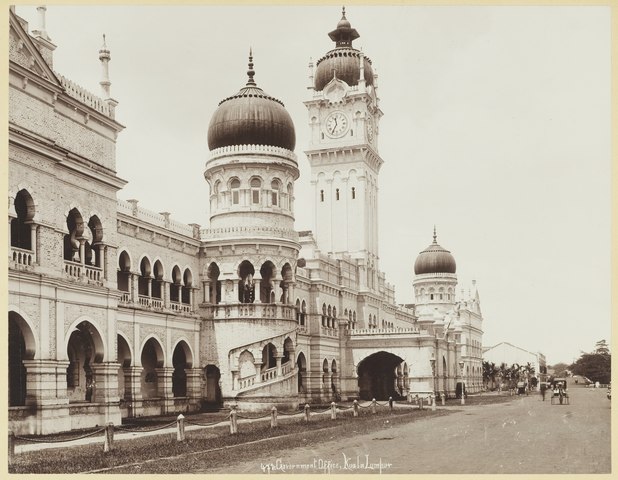
Perhaps the most distinctive visual mark of the British period was the adoption of Indo-Saracenic architecture, a hybrid style developed in British India that combined Gothic and classical forms with Mughal and Islamic decorative elements. Swettenham and his chief government architect, A.C. Norman, used the style to lend Kuala Lumpur a sense of exotic distinction that would set it apart from other colonial outposts.
The most striking example was the Government Offices complex (now Sultan Abdul Samad Building), completed in the 1890s. Its scalloped arches, onion domes, and minarets echoed Mughal palaces, while the striped brickwork and cast-iron fixtures reflected Victorian engineering. To British eyes, the style was a way to “localise” imperial architecture, even if it had little direct connection to Malayan tradition. To locals, it was something stranger—a foreign design language overlaid on their capital, but one that over time became an accepted part of the city’s identity.
An unexpected consequence of this imported style was the opportunity it created for local artisans. Indian Muslim masons, Chinese carpenters, and Malay woodcarvers all found work supplying the intricate details—stucco mouldings, tiled floors, carved timber screens—that gave these buildings their richness.
The Railway and the Spread of Civic Ornament
The completion of the Kuala Lumpur railway station in 1910, designed by Arthur Benison Hubback, was another decisive moment in the city’s aesthetic evolution. Here, Indo-Saracenic motifs were amplified: horseshoe arches, minaret-like towers, and lavish rooflines gave the station a theatrical grandeur unusual for a Southeast Asian transport hub. The station’s arrival platforms were more than a functional gateway; they became a stage on which the city could present itself to newcomers.
Rail travel also had a more subtle artistic effect. With faster access to the port in Klang and other towns, decorative materials flowed more easily into Kuala Lumpur. Imported wrought iron, encaustic tiles from England, and stained glass from Europe began to appear in public and private buildings. Colonial clubs, churches, and schools incorporated these materials into their design, signalling a growing cosmopolitanism.
By the 1920s, Kuala Lumpur’s visual identity had shifted dramatically. The riverbank shophouses of the mining era were now flanked by onion-domed civic buildings, arcaded shop rows with neo-classical columns, and railway arches that seemed transplanted from another continent. What began as an administrative overlay had become a defining visual layer—one that still shapes how the city is seen today.
Mosques, Minarets, and Islamic Ornament in the Early City
If the colonial buildings of Kuala Lumpur proclaimed governance and commerce, its mosques quietly expressed continuity and community. From the late 19th century onward, Islamic architecture provided the city not only with spaces for worship but also with a distinctive visual counterpoint to the British-built civic centre. These mosques were more than religious landmarks—they were touchstones of identity in a rapidly changing city.
Masjid Jamek and the Art of Confluence
Few buildings illustrate Kuala Lumpur’s early architectural dialogue as clearly as Masjid Jamek, completed in 1909 at the meeting point of the Klang and Gombak rivers. Designed by Arthur Benison Hubback in the Indo-Saracenic style, it nonetheless carried resonances that were deeply meaningful to the city’s Muslim community. Its three domes, flanked by slender minarets, drew on Mughal precedents, while its red-and-white banded brickwork echoed the decorative masonry seen in colonial government buildings nearby.
The location was deliberate: for centuries, river confluences had been associated with settlement, trade, and spiritual significance. By placing a mosque here, the community marked the spot as both sacred and central. The interior was defined by pointed arches and patterned tile floors, with open verandas that allowed worshippers to look out over the water. The effect was one of openness and connection—quite different from the enclosed grandeur of colonial civic halls.
Calligraphy as Architecture
Islamic calligraphy was more than a decorative element; it was a structural presence in the mosques of early Kuala Lumpur. Qur’anic verses, executed in thuluth or kufic script, were worked into arches, domes, and mihrabs, blurring the line between ornament and construction. These inscriptions did not merely sit on the surface; they often followed the architectural rhythm, tracing the curve of a vault or forming a frieze beneath the roofline.
Local artisans—often Malay craftsmen trained in village surau decoration—adapted their skills to these larger, more permanent buildings. They incorporated floral arabesques alongside the calligraphy, creating a dialogue between textual and vegetal motifs. This was not simply embellishment; it was a way of sanctifying the space itself, so that every visual element carried meaning.
In a city increasingly marked by the visual language of empire, these scriptural designs asserted a parallel visual culture—one rooted in faith rather than governance.
Geometric Precision and the Urban Landscape
Islamic ornament in early Kuala Lumpur also manifested in geometry. Star patterns, interlaced polygons, and lattice screens were not only symbolic but also practical, allowing for airflow and light control in the tropical climate. Mosques like the Masjid India, originally built in 1906, made liberal use of such features, their façades a rhythm of shadow and light as the sun shifted through the day.
These geometric motifs sometimes found their way into non-religious structures. Indian Muslim shopkeepers, for example, incorporated similar tilework into their storefronts, while Malay carpenters adapted lattice designs for domestic verandas. Over time, this visual language seeped into the city’s everyday fabric, softening the division between sacred and secular space.
By the 1920s, Kuala Lumpur’s skyline was marked as much by minarets as by domed colonial offices. The interplay between the two created a layered cityscape: one part imperial display, one part devotional art. This visual balance would continue to shape the city as it expanded, ensuring that faith and artistry remained intertwined in its growth.
Kampung Craft Traditions in an Urban Frame
While colonial planners and architects were reshaping Kuala Lumpur’s skyline with brick domes and clock towers, a quieter current of artistry flowed into the city from its surrounding villages. The crafts of the kampung—batik, songket, woodcarving, basketry—were not conceived as “art” in the Western sense, but as functional, symbolic, and communal practices. When these traditions entered the capital, they adapted to new purposes, audiences, and commercial opportunities without losing their original cultural resonance.
Batik and Songket Beyond the Village
Batik, with its wax-resist dyeing technique, had long been practiced in the east coast states of Kelantan and Terengganu, producing sarongs and kain panjang with intricate floral or geometric motifs. Songket weaving, in which gold or silver threads are brocaded into silk or cotton, was traditionally reserved for ceremonial attire, often for royalty or weddings.
In Kuala Lumpur, these textiles took on expanded roles. Traders brought bolts of batik cloth to the central market, where they were sold not only for clothing but also as decorative hangings or table covers in urban homes. Songket, once tied to courtly protocol, began to appear in the wardrobes of wealthy merchants during festive occasions, signalling both refinement and prosperity.
Urban demand encouraged experimentation. Patterns once strictly bound to regional styles became more varied, with Chinese and Indian floral motifs entering the batik vocabulary, and brighter aniline dyes replacing some of the earthier traditional pigments. What might have been seen as dilution in the village context became, in the city, a mark of cosmopolitanism.
Woodcarving in New Contexts
Traditional Malay woodcarving was deeply connected to the architecture of the rumah kampung, where panels, doorframes, and gable ends bore elaborate vegetal and geometric patterns. In Kuala Lumpur, these skills found unexpected outlets. Carvers were commissioned to create decorative elements for shopfronts, interior screens in wealthy homes, and even embellishments for colonial-era buildings seeking a “local” touch.
One surviving example from the early 20th century is the incorporation of carved timber ventilation panels into brick shophouses. These panels—often positioned above doors and windows—combined function with artistry, allowing airflow while casting patterned shadows across interiors. Such adaptations allowed the craft to thrive in a city where traditional timber houses were rare.
Carvers also began working in smaller scales for the urban market, producing elaborately worked furniture, mirror frames, and ceremonial boxes. These objects, portable and durable, could be sold to a new clientele that appreciated their beauty without necessarily sharing the traditions that had originally shaped them.
The Market as Cultural Stage
The Central Market, established in 1888 as a wet market, became by the early 20th century one of the most important spaces for the meeting of kampung craft and urban consumer culture. Here, traders displayed batik bolts alongside imported porcelain, and woodcarvers set up stalls next to spice merchants. The visual density of these markets—the stacked patterns of folded cloth, the gleam of polished timber, the clink of ceramic—created a kind of living exhibition.
Three recurring sights defined this meeting point between village craft and city life:
- Batik sarongs folded in vertical stacks, each revealing a sliver of intricate design.
- Wooden betel nut sets, their lids carved with spiralling leaf motifs.
- Songket shawls draped from overhead beams, catching the light from oil lamps.
This market environment was not curated in the formal sense, yet it offered an ever-changing display of artistry. Crafts that in the village context marked identity and tradition now also became commodities, adapting their meanings to the rhythms of urban exchange.
By the 1930s, Kuala Lumpur’s art history could not be told without these kampung traditions. They remained rooted in rural skill but had found new life in the city—embellishing homes, enriching ceremonies, and offering tangible links to the wider Malayan cultural landscape.
Migrant Communities and Cultural Cross-Pollination
From its earliest decades, Kuala Lumpur’s growth depended on migration. Chinese miners, Indian laborers, Arab traders, and others brought not only their skills and labour but also their artistic traditions. In the city’s tightly packed streets, these traditions did not remain separate for long. Overlapping daily lives created new hybrid forms—sometimes deliberate, sometimes accidental—that enriched the capital’s visual culture in ways still visible today.
Theatres, Temples, and Painted Spectacle
For the Chinese community, particularly Cantonese and Hokkien migrants, the opera stage was a central cultural institution. Temporary wooden theatres rose during festivals, their façades painted in vivid colours with scenes from classical tales. The backdrops—painted on large canvas sheets—were full of mountainous landscapes, palatial interiors, and stylised waves, each rendered in bold, theatrical perspective.
Meanwhile, permanent Chinese temples became landmarks in several districts. The Sin Sze Si Ya Temple, established in the late 19th century, combined traditional southern Chinese architectural forms with local materials. Roof ridges were crowded with ceramic figurines of warriors, scholars, and mythic beasts, all imported or made by artisans from Guangdong. Within, painted altar panels and gilded calligraphy testified to a patronage system that linked Kuala Lumpur’s temple art directly to workshops in China.
These temples were not static cultural enclaves. Malay carpenters might be hired to work on timber elements, while Indian artisans provided stone or tilework. Even the pigments for temple murals often came through trade routes shared with other communities.
Indian Guilds and Sacred Sculpture
The Indian community, many of whom arrived as labourers for railway construction or as traders from Tamil Nadu and Gujarat, left a distinctive architectural and artistic imprint. Hindu temples such as the Sri Mahamariamman Temple became important visual anchors. Its gopuram, or towered gateway, is covered in hundreds of brightly painted stucco deities, each sculpted with expressive precision.
These sculptures were originally produced by specialist craftsmen—sthapathis—who either travelled from South India or trained apprentices in Kuala Lumpur. Their work demanded not just skill but knowledge of iconography, proportion, and ritual placement. The temple’s renovation cycles meant that this sculptural tradition was regularly renewed, keeping techniques alive even as the city modernised.
Indian Muslim communities also contributed to the urban visual fabric, especially through mosque building. Their preference for domes, minarets, and elaborate stucco ornament brought fresh variations to Kuala Lumpur’s Islamic architecture, often distinguished by floral patterns and a jewel-like palette.
Peranakan Hybrids and Everyday Ornament
The Peranakan, or Straits-born Chinese, brought an especially layered visual tradition that blended Chinese motifs with Malay craftsmanship and, increasingly, European influences. Their terraced houses in areas such as Jalan Tun H.S. Lee displayed a riot of decorative ceramic tiles—floral, geometric, and Art Nouveau patterns—set into façades, stair risers, and interior walls.
Furniture in these homes combined Chinese lacquer techniques with European silhouettes, while embroidered beadwork adorned slippers and table runners. This style filtered into the wider urban market: non-Peranakan households began buying similar tiles and furniture, appreciating their colour and craftsmanship without necessarily sharing the cultural symbolism.
Three particularly vivid forms of this cross-pollination became hallmarks of early 20th-century Kuala Lumpur:
- Chinese-style timber screens carved with Malay vegetal patterns.
- Hindu temple gopuram figures painted with pigments imported via Chinese merchants.
- Peranakan floor tiles manufactured in Europe but depicting tropical fruit and flowers.
By the 1930s, such blends were so common that it was difficult to separate “pure” traditions from shared urban ones. Migrant artistry had not only found a place in Kuala Lumpur—it had fundamentally redefined what the city looked like and how it celebrated beauty.
Art Societies and the First Malaysian Painters in KL
By the mid-20th century, Kuala Lumpur had outgrown its identity as a purely commercial and administrative centre. A small but determined circle of artists, teachers, and patrons began to cultivate a space for painting, drawing, and other forms of fine art—mediums less tied to the functional purposes of architecture or craft. These efforts gave the city its first organised art societies and public exhibitions, laying the groundwork for Malaysia’s modern art movement.
The Kuala Lumpur Art Society and Its Circle
The establishment of the Kuala Lumpur Art Society in the 1950s marked a turning point. Founded by a mix of expatriates and local artists, the society provided a rare institutional platform for showing work, discussing technique, and—crucially—introducing fine art to a general public accustomed to decorative or religious imagery.
The society’s early exhibitions were often staged in borrowed spaces: a hotel ballroom, a municipal hall, even an unused colonial office. Paintings were hung on temporary screens, their styles ranging from academic realism to impressionistic landscapes. While attendance was modest, the events drew together communities that might otherwise have remained separate: English-speaking civil servants, Chinese-educated schoolteachers, Malay poets, and Indian musicians mingled in these makeshift galleries.
In this environment, artists began to see themselves not as isolated practitioners but as members of a broader cultural sphere, with responsibilities and opportunities beyond their own studios.
Abdullah Ariff, Yong Mun Sen, and the Watercolour Legacy
Two figures loomed large in the early Kuala Lumpur art scene: Abdullah Ariff and Yong Mun Sen. Abdullah, a Penang-born artist and art educator, was one of the first Malay painters to work in a modern idiom while also advocating for art education in schools. Yong Mun Sen, often hailed as a pioneer of Malaysian painting, brought a lyrical sensibility to watercolour landscapes and scenes of everyday life.
Though neither man was based permanently in Kuala Lumpur, their exhibitions and teaching visits influenced a generation of KL-based artists. The preference for watercolour in these years owed much to their example—it was relatively inexpensive, portable, and suited to quick outdoor studies of kampung houses, market scenes, and tropical vegetation.
Watercolour’s transparency also resonated with the bright light of the Malaysian landscape. Artists played with wet-on-wet washes for skies, fine brushwork for palm fronds, and controlled bleeding to suggest rain-washed streets. These techniques became part of the shared vocabulary of the KL art scene.
From Hobby to Profession
For many early painters in Kuala Lumpur, art began as an avocation rather than a career. Teachers painted in their spare time, doctors sketched on weekends, and civil servants exhibited alongside full-time practitioners. Yet by the late 1950s, a shift was underway: the idea that one could make a living—or at least a public identity—as a professional artist gained traction.
Commercial galleries were still rare, but department stores and cafés occasionally displayed works for sale. Newspapers began to cover art openings, and illustrated magazines reproduced paintings alongside stories and poems. The growing visibility of art in public life encouraged young people to consider it as more than a pastime.
By the time Malaysia moved toward independence, Kuala Lumpur had a small but cohesive community of painters who were beginning to think of themselves in national terms. Their work, modest in scale but ambitious in intent, would soon intersect with the political and cultural shifts of the late 1950s, pushing art into a new, more public role.
Nationalist Currents and Pre-Independence Visual Culture
In the decade before Malaya’s independence in 1957, Kuala Lumpur was not only the administrative heart of the country but also a focal point for political imagination. Artists, illustrators, and designers began to respond to a charged atmosphere of rallies, negotiations, and shifting identities. Visual culture—once centred on landscapes, portraits, and decorative craft—now carried overt and covert messages about self-determination, unity, and the image of a modern nation.
Posters, Caricatures, and the Art of Persuasion
Printed ephemera became one of the most potent artistic tools in the pre-independence years. Posters announced political gatherings, union meetings, and public debates; they also promoted ideals of cooperation among the Malay, Chinese, and Indian communities. The visual vocabulary drew on international propaganda styles: bold silhouettes, upward-tilting figures, and radiating lines suggesting dawn or progress.
Caricature artists thrived in this climate, their work appearing in newspapers such as Utusan Melayu and The Malay Mail. Satirical drawings lampooned colonial officials, poked fun at corrupt local leaders, and celebrated nationalist figures. The humour made the criticism palatable, but the underlying intent was serious: to challenge entrenched authority and articulate alternative visions for the country’s future.
These works blurred the boundary between art and political tool. An illustrator might spend mornings painting a still life for an art society exhibition and evenings drafting a biting cartoon for the next day’s front page.
Illustrated Magazines and the Construction of a National Image
Magazines like Majalah Mastika and Utusan Zaman combined essays, fiction, and poetry with illustrated covers and interior artworks that reflected the optimism and tensions of the era. Artists created scenes of rural harmony—paddy fields, fishing boats, village weddings—meant to symbolise cultural roots. Yet these idyllic images often sat alongside depictions of industrial development and urban growth, signalling the desired fusion of tradition and modernity.
The covers themselves became small cultural events. A brightly painted masthead scene could capture the spirit of a festive season, commemorate a political milestone, or mark the achievements of a public figure. Through these illustrated pages, Kuala Lumpur residents encountered visual interpretations of what “Malayan” identity might mean—long before the idea was fixed in law or flag.
Schools as Seedbeds of National Art
Education policy in the 1940s and 50s also shaped the city’s pre-independence art scene. Art classes in government and mission schools exposed children to both European and Asian techniques, often taught by instructors who were themselves active painters. School art competitions, sometimes sponsored by civic organisations, brought together works from across ethnic and linguistic divides.
Three elements made these school programs unusually influential:
- They trained technical skills from an early age in drawing, composition, and colour.
- They normalised the idea that art could serve civic as well as decorative purposes.
- They encouraged the portrayal of shared national symbols—flags, rural landscapes, public buildings—that reinforced a common visual vocabulary.
By the mid-1950s, Kuala Lumpur’s art world was humming with a sense of anticipation. Political change seemed inevitable, and with it came the expectation that artists would help define the new nation’s look, ethos, and aspirations. The visual culture of this period was not just a mirror of events; it was part of the machinery shaping how independence itself would be imagined.
Merdeka and the Birth of National Institutions
When the Federation of Malaya achieved independence on 31 August 1957, Kuala Lumpur became more than a capital—it became the symbolic stage on which the new nation introduced itself to the world. This political transformation was matched by an equally significant cultural one: the deliberate creation of national art institutions, public monuments, and official collections designed to express the ideals of unity, progress, and identity. For the city’s artists, it was both an unprecedented opportunity and a challenge to define what “Malaysian art” could be.
The National Art Gallery: A Modernist Mission
The founding of the National Art Gallery (Balai Seni Lukis Negara) in 1958 was the clearest expression of the state’s commitment to the visual arts. Established in a converted building on Jalan Ampang, it was spearheaded by a group of artists, cultural advocates, and government officials who believed that an independent country needed an independent artistic voice.
The Gallery’s early acquisition policy reflected a careful balance. Works by local pioneers such as Chuah Thean Teng (credited with elevating batik painting to a fine art form) hung alongside paintings by regional artists from Singapore, Indonesia, and the Philippines, signalling a desire for both national distinctiveness and Southeast Asian connectedness. Modernism, rather than academic realism, became the preferred style for many official purchases—suggesting that a forward-looking visual language was the best fit for a newly independent state.
For younger artists, seeing their works in a dedicated national institution provided both validation and a benchmark. The Gallery was not just an exhibition space; it was an archive of ambition.
Abdul Latiff Mohidin and the Modernist Turn
Among the figures who rose to prominence in this period, Abdul Latiff Mohidin stood out for his ability to merge local forms with international modernist currents. His early Pago Pago series (begun in the early 1960s) distilled Southeast Asian landscapes and architectural forms into bold, semi-abstract compositions. Though his later career would take him far beyond Kuala Lumpur, his success reinforced the idea that Malaysian art could be contemporary without severing its ties to place.
Latiff’s example encouraged others to explore abstraction, symbolism, and personal iconography. His work also demonstrated how a painter could operate simultaneously within national institutions and on the international stage—a model that would become increasingly important in the decades ahead.
Monumental Sculpture and Civic Pride
The Merdeka period also saw an investment in large-scale public monuments designed to embody the values of independence. The most famous of these was the National Monument (Tugu Negara), completed in 1966, commemorating those who died in the struggle for freedom. Sculpted by American artist Felix de Weldon, its heroic figures and dramatic composition reflected a postwar global vocabulary of public memorials, yet its placement in the landscaped gardens of Kuala Lumpur made it an integral part of the city’s civic identity.
Closer to the ground, local sculptors produced works for government buildings, public squares, and even traffic roundabouts. Relief panels depicting agricultural abundance, industrial progress, and multiethnic harmony became familiar backdrops to daily life. For the first time, art in Kuala Lumpur was being commissioned at a scale and frequency that linked it directly to the state’s image-making efforts.
By the end of the 1960s, Kuala Lumpur’s art scene was more structured than ever before. With a national gallery, official commissions, and a generation of artists finding their voices, the city had moved beyond being simply a meeting place for individual practitioners—it had become the cultural capital of a new country.
Urban Growth, Abstract Modernism, and the 1970s Avant-Garde
The 1970s transformed Kuala Lumpur in ways both visible and invisible. The skyline began to stretch upward, new expressways cut through neighbourhoods, and the population swelled as rural migrants and regional workers sought opportunity in the capital. This rapid urbanisation created a fertile yet unsettled environment for artists. The optimism of Merdeka gave way to a more questioning spirit, as painters, sculptors, and collectives began to test the limits of abstraction, experimentation, and public engagement.
Syed Ahmad Jamal and the Language of Scale
Among the most influential voices in this period was Syed Ahmad Jamal, whose large-scale abstract works redefined the relationship between Malaysian art and public space. His canvases, filled with sweeping curves, layered textures, and symbolic colour fields, moved decisively away from descriptive landscape toward emotional and conceptual evocation.
Jamal’s work was not confined to galleries. He designed monumental murals for institutions and created sculptural pieces that interacted directly with the city’s architecture. His approach suggested that art could act as both commentary on and participant in Kuala Lumpur’s urban transformation. His Lambang Satu Malaysia mural (later controversially removed) became an emblem of how art could inhabit civic space with both beauty and provocation.
“New Scene” and the Rise of Artist Collectives
In the early 1970s, a group of younger painters and sculptors launched the “New Scene” exhibitions, which showcased work influenced by global modernist trends but adapted to Malaysian conditions. Geometric abstraction, conceptual assemblage, and mixed-media experiments appeared alongside more traditional media.
These exhibitions, often held in unconventional spaces, challenged the dominance of state-sanctioned venues and offered emerging artists a sense of autonomy. The collectives behind them also facilitated dialogue across ethnic and linguistic lines, a significant achievement in a decade marked by political sensitivities following the events of 1969.
Artists explored unconventional materials—industrial scrap, batik cloth incorporated into collage, found objects from the city’s construction sites. In doing so, they mirrored the textures and contradictions of Kuala Lumpur itself: modernising but unfinished, fragmented yet interconnected.
Murals, Public Art, and the Street as Gallery
The city’s building boom provided new surfaces for artistic intervention. Government ministries, hotels, and corporate headquarters commissioned murals and reliefs, seeking to project an image of cultural sophistication. Some works followed a decorative, non-political approach, incorporating motifs from batik or Islamic geometry. Others hinted at more complex narratives, embedding subtle commentary in abstract forms.
Three trends stood out in Kuala Lumpur’s public art of the 1970s:
- Large abstract murals integrating architectural lines into their composition.
- Sculptural installations in public plazas using steel and concrete, echoing the materials of urban development.
- Temporary street-level works—often ephemeral—that brought art directly into pedestrian view.
By the decade’s end, Kuala Lumpur’s art scene had acquired a dual identity: part of a state-supported narrative of progress, and part of a more independent, experimental current that sought to question, disrupt, or reimagine that narrative. This tension would shape the decades to follow, as the city became a regional node for both the art market and the avant-garde.
KL as Regional Art Market Hub in the 1980s–90s
By the 1980s, Kuala Lumpur had entered a new phase of economic confidence. Skyscrapers climbed higher, foreign investment surged, and a rising middle class began to view art not only as a cultural pursuit but also as a marker of status and taste. Commercial galleries multiplied, corporate collections expanded, and Kuala Lumpur started to position itself as a serious player in the Southeast Asian art market.
Commercial Galleries and Private Patronage
The decade saw the establishment of some of Kuala Lumpur’s most influential commercial galleries. Spaces like Galeri Wan, Valentine Willie Fine Art (which would emerge in the early 1990s), and Artfolio introduced professional curating, targeted marketing, and collector networks to a scene that had previously relied heavily on public institutions and small artist-run exhibitions.
These galleries did more than sell paintings—they shaped careers. By promoting selected artists through solo shows, catalogues, and participation in overseas art fairs, they positioned Kuala Lumpur as a gateway between Malaysia’s art production and regional buyers in Singapore, Jakarta, and eventually Hong Kong.
Corporate patrons also began commissioning works for office lobbies, boardrooms, and headquarters façades. This influx of funds allowed artists to experiment with larger formats and more ambitious materials, though it also nudged some toward safer, more “decor-friendly” styles.
Corporate Collections as Cultural Actors
Companies in banking, oil, and telecommunications developed formal art collections, often under the guidance of hired consultants. These collections were not merely decorative—they became tools for brand-building, signalling sophistication, stability, and local rootedness.
Some corporations, such as banks, focused on acquiring works by established Malaysian modernists—Syed Ahmad Jamal, Latiff Mohidin, and Chuah Thean Teng among them—while others actively supported younger painters and sculptors. The result was a layered market: at the top, a small set of blue-chip names commanded high prices; at the middle, a growing tier of contemporary practitioners found a more reliable path to income than ever before.
This shift had a quiet but lasting effect on artistic production. The knowledge that one’s work might hang in a corporate lobby encouraged polished presentation, technical precision, and, at times, thematic restraint.
Regional Connections and Auction Culture
In the 1990s, Kuala Lumpur’s role in the regional market deepened. Cross-border collaborations with Singaporean galleries, participation in regional biennales, and the emergence of auction houses such as Henry Butcher Art Auctioneers created new pathways for art to circulate.
The auction format, in particular, altered perceptions of value. Artists who had once sold modestly at gallery prices suddenly saw their works fetching record sums under the hammer, creating a feedback loop of demand. Auction catalogues became status objects in their own right, studied as much for market trends as for artistic merit.
By the late 1990s, Kuala Lumpur had carved out a position that balanced cultural production with market influence. It was no longer only a place where art was made—it was a place where art was brokered, debated, and strategically positioned within the wider currents of Southeast Asian cultural capital.
Digital Turn and Multimedia Experimentation in the 2000s
As Kuala Lumpur entered the new millennium, the city’s art scene began to break away from the dominance of painting and sculpture. Digital technology, affordable video equipment, and an expanding internet culture opened the door to new forms of expression—video art, installation, interactive works—that challenged older ideas of what Malaysian art could be. Independent spaces emerged alongside established galleries, giving artists the freedom to experiment without market or institutional constraints.
Video, Installation, and the Biennale Stage
By the early 2000s, portable digital cameras and editing software had made video art accessible to a generation of Malaysian artists who had grown up with television but now engaged with a more fragmented, global media environment. Artists like Wong Hoy Cheong explored political and cultural themes through video installations, combining documentary footage, staged performance, and layered soundscapes.
Kuala Lumpur Biennale-like events and regional festivals provided crucial platforms for such works. Exhibition spaces were no longer just white-walled galleries; they became darkened rooms with projected images, surround sound, and immersive environments. The shift from static viewing to time-based, participatory experiences altered the way audiences engaged with art.
This period also saw the rise of large-scale installation works incorporating found objects, light, and digital components—often addressing themes of urban change, migration, and identity in ways that felt immediate and site-specific.
Independent Project Spaces and Alternative Economies
Alongside the commercial and institutional circuits, artist-run and independent spaces began to shape Kuala Lumpur’s cultural map. Initiatives like Lost Generation Space, Findars, and Rumah Air Panas operated in shop lots, warehouses, and converted homes. These spaces were inexpensive to run, often collectively managed, and allowed for programming that was riskier, more politically charged, or simply less commercially viable.
Here, exhibitions might be accompanied by zine launches, spoken word nights, or experimental music performances. The boundaries between disciplines dissolved—an installation might incorporate live dance, or a painting show might be presented alongside a short film festival. Such hybrid programming reflected both the energy of Kuala Lumpur’s underground scene and the realities of operating in a city where formal arts funding was limited.
Negotiating Censorship and Market Expectations
Even in the 2000s, the balance between creative freedom and regulatory boundaries remained delicate. Works that touched on religion, sexuality, or political critique sometimes faced removal or modification in public exhibitions. Digital platforms offered some workaround—artists could share videos or photographs online, reaching audiences beyond Malaysia’s borders—but local visibility still depended on navigating official sensitivities.
Meanwhile, the commercial market’s growing interest in contemporary Malaysian art created a paradox. On one hand, it meant higher prices, international representation, and broader audiences. On the other, it risked diluting experimental impulses if artists felt pressured to produce work that conformed to collector tastes.
By the decade’s close, Kuala Lumpur’s art ecosystem had grown more complex than ever: a web of high-end galleries, alternative spaces, digital networks, and biennale platforms, all interlinked yet pulling in different directions. The city’s creative energy lay in this very tension—between the screen and the street, the global stage and the neighbourhood shop lot.
Street Art, Heritage Conservation, and Contemporary Crossroads
By the 2010s, Kuala Lumpur’s artistic conversation had spilled fully into public space. Murals, pop-up interventions, and heritage conservation projects began to reshape how residents and visitors experienced the city. The walls of back alleys became canvases, and century-old buildings became battlegrounds between developers and preservationists. Art was no longer confined to galleries—it had become part of the city’s contested streetscape.
Murals as Urban Signatures
Street art in Kuala Lumpur emerged in parallel with global trends but carried its own local inflections. Murals along Jalan Alor, Kampung Attap, and Petaling Street mixed portraiture, folkloric motifs, and playful surrealism. Some were officially commissioned as part of city beautification programmes; others appeared unannounced, painted overnight in quiet corners.
Artists such as Ernest Zacharevic, already known for his work in Penang, brought interactive mural concepts to KL—figures that seemed to step out of the wall, objects that invited passers-by to pose with them. Local practitioners adapted these ideas to include Malaysian cultural references: teh tarik stalls, traditional kites, shadow puppet silhouettes.
These works functioned on two levels—at street height, they engaged neighbourhood residents; online, they became photographic destinations, their images circulating widely on social media and tourism platforms.
Heritage Buildings Under Pressure
While public art was enlivening certain districts, heritage architecture faced mounting threats from redevelopment. Pre-war shophouses, early 20th-century civic buildings, and even mid-century modernist structures were often viewed by developers as obstacles to be replaced rather than assets to be integrated.
Heritage conservation groups argued that preserving these buildings was not only an architectural imperative but also a cultural one. Restored facades, they pointed out, could provide atmospheric settings for cafés, galleries, and cultural businesses, blending commerce with history.
Some projects demonstrated this potential. The transformation of the Zhongshan Building in Kampung Attap into a creative complex housing art studios, bookstores, and design offices showed how adaptive reuse could foster cultural life without erasing the past. Yet such successes were often exceptions, not the rule, in a city where land values encouraged demolition.
Kuala Lumpur in the Regional Art Circuit
By the 2010s, Kuala Lumpur had firmly positioned itself within the Southeast Asian art circuit, with its artists regularly appearing at Art Jog in Yogyakarta, Singapore Art Week, and Hong Kong Art Basel’s regional sections. Local art fairs and biennale-style events attracted international visitors, while residency programmes brought foreign artists to KL for extended stays.
This increased connectivity came with both benefits and challenges. On one hand, it gave Kuala Lumpur’s artists greater visibility and opportunities for collaboration; on the other, it intensified competition and placed the city’s scene under constant comparison with better-funded or more internationally recognised hubs.
Three currents now define Kuala Lumpur’s public-facing art identity:
- A lively, if sometimes short-lived, street art culture in central neighbourhoods.
- Ongoing struggles over the preservation of historic architecture.
- A fluid integration into regional and global art networks.
At this contemporary crossroads, Kuala Lumpur’s art history feels less like a closed narrative than a living process—still negotiating the balance between memory and reinvention, between the walls it paints and the walls it chooses to keep.
Future Horizons: Education, Global Networks, and New Institutions
Kuala Lumpur’s art story is still being written, and its next chapters will depend on how the city navigates a changing educational landscape, deepening global ties, and the emergence of new cultural infrastructure. The foundations for a more interconnected, professionalised, and internationally visible art ecosystem are in place—but whether they will flourish depends on how these forces are managed in the years ahead.
Art Schools and the Next Generation
Institutions such as the National Academy of Arts, Culture and Heritage (ASWARA), Universiti Teknologi MARA (UiTM), and several private colleges have expanded their art and design programmes, producing graduates with skills in both traditional media and new technologies. These schools serve as incubators for the city’s artistic future, providing technical training while encouraging critical thinking and experimentation.
A notable shift has been the integration of interdisciplinary study—students might major in painting but also work with performance, digital media, or curatorial practice. Graduates leave with portfolios that cross genres, reflecting the blurred boundaries of contemporary art. This adaptability may prove essential in a cultural economy where survival often depends on versatility.
Art Fairs, Residencies, and the Global Web
Kuala Lumpur’s place in the international art world is increasingly mediated through its participation in global networks. Art fairs such as Art Expo Malaysia draw collectors and galleries from across Asia, providing local artists with opportunities for exposure and sales.
Residency programmes, both inbound and outbound, allow Kuala Lumpur artists to spend months abroad, building contacts and absorbing new influences, while foreign artists bring fresh perspectives into the city. These exchanges have broadened the thematic and stylistic range of work produced here—from projects engaging with climate change to collaborations merging AI-generated imagery with traditional batik patterns.
Digital platforms have further collapsed geographic distance. An emerging artist in KL can now sell work directly to a collector in Berlin, participate in a Zoom studio visit with a curator in New York, or debut a virtual reality installation to audiences on three continents simultaneously.
Balancing Growth with Identity
The risk of such global integration is that Kuala Lumpur’s art scene could become overly shaped by external market demands, losing the specificity of its local context. The challenge ahead will be to maintain a distinctive cultural voice—rooted in the city’s layered history—while engaging with international currents.
New institutions may play a decisive role in this. Plans for expanded museum facilities, specialised contemporary art centres, and permanent spaces for artist-led initiatives are already in discussion. If realised, they could give Kuala Lumpur the infrastructure it needs to support a sustainable, diverse art ecosystem.
For now, the city stands at an inflection point. Its artists are better trained, better connected, and more visible than at any time in its history. The question is not whether Kuala Lumpur will remain an art city, but what kind of art city it will choose to become—a place that mirrors global trends, or one that continues to remix them into forms no other city could produce.