Julia Prinsep Stephen was born Julia Jackson on 7 February 1846 in Calcutta, British India, into the remarkable Prinsep–Pattle family, whose members moved easily between imperial administration, artistic patronage, and literary society. Her father, Dr. John Jackson Pattle, served within the Bengal medical establishment, while her mother, Maria Theodosia Pattle, belonged to a circle of sisters widely admired for their intelligence and beauty in both India and England.
Following her father’s death in 1848, the family gradually returned to Britain. By the early 1850s Julia was growing up within London society at a moment when artistic culture depended heavily upon private salons rather than public institutions alone. The Pattles and Prinseps maintained friendships with painters, writers, and critics whose influence extended into the Royal Academy and emerging literary publishing networks.
Among her relatives were figures central to Victorian artistic life. Her aunt Julia Margaret Cameron would become one of the most innovative photographers of the nineteenth century. Another relative, Sara Prinsep, hosted gatherings at Little Holland House in Kensington, where artists debated aesthetics, morality, and religion long into the evening. Julia entered adulthood surrounded not merely by art but by people actively shaping it.
Descriptions written by contemporaries emphasized composure rather than flamboyance. She was remembered as tall, dark-haired, and unusually calm in manner. Those qualities soon made her particularly attractive to artists seeking emotional presence rather than fashionable display.
Entry into Artistic Society
By the early 1860s Julia was moving within London’s artistic circles through family association rather than professional ambition. The salons at Little Holland House introduced her to painters including George Frederic Watts and visiting intellectuals connected to Victorian publishing and criticism.
At this moment photography itself was undergoing transformation. Portrait photography in commercial studios favored stiff poses and technical precision. Artistic ambition within the medium remained uncertain until a small number of practitioners began experimenting with expressive approaches.
In December 1863, Julia Margaret Cameron received a camera at Freshwater on the Isle of Wight. Within months she began photographing family members while teaching herself exposure timing, printing techniques, and composition. Julia Jackson quickly became one of her most important early subjects.
The relationship between photographer and sitter depended upon patience and trust. Exposure times could last several seconds or longer. Cameron required subjects capable of emotional stillness, and Julia’s natural composure suited the experiment perfectly.
Key Members of the Prinsep–Pattle Artistic Circle
- Julia Margaret Cameron — photographer who began exhibiting portraits during the 1860s.
- Sara Prinsep — hostess of the Little Holland House salon.
- George Frederic Watts — symbolic portrait painter associated with the circle.
Cameron’s Photography and the Making of a Muse
Collaboration at Freshwater
Julia Margaret Cameron began serious photographic work in 1863, determined to elevate photography to the status of painting and poetry. Rather than photographing strangers, she relied heavily on family and trusted acquaintances willing to participate repeatedly in experimental sessions.
Julia Jackson became one of the sitters Cameron returned to again and again during the later 1860s. The frequency of these sittings mattered. Cameron adjusted lenses, experimented with focus, and explored dramatic lighting effects while refining her artistic philosophy. Certain sitters therefore played an essential role in the development of her style.
Photography at the time demanded endurance. Glass negatives required careful preparation, and exposure mistakes often ruined entire sessions. Cameron’s surviving correspondence makes clear that cooperation from sitters determined success. Julia’s willingness to pose repeatedly allowed Cameron to pursue emotional intensity rather than commercial efficiency.
These portraits were not simple likenesses. Cameron sought inward expression, believing photography could reveal character and spiritual depth. Julia’s calm gaze and reflective demeanor suited that ambition more than theatrical posing would have done.
Portraiture and Artistic Innovation
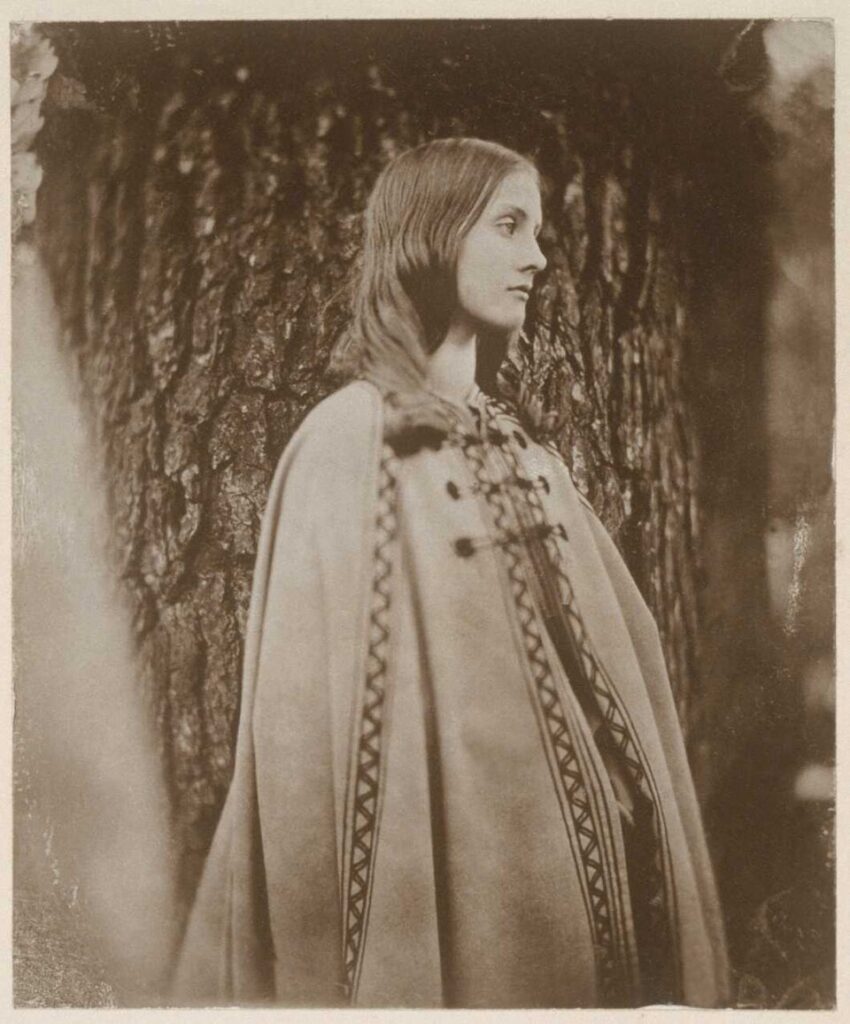
Among surviving works is a photographic portrait commonly known as:
Portrait of Mrs. Leslie Stephen (Julia Prinsep Stephen)
Artist: Julia Margaret Cameron
Date: circa 1867–1870 AD
Medium: Albumen silver print from glass negative
Dimensions: approximately 26 × 21 cm (individual prints vary slightly)
Current Location: Victoria and Albert Museum, London, with additional impressions held in major photographic collections.
The image presents Julia in downward gaze under soft natural light. Cameron allowed slight blur caused by movement during exposure, an effect critics initially dismissed as technical failure. Over time the softness came to be recognized as a deliberate aesthetic decision emphasizing emotion over precision.
Cameron frequently cast friends and relatives as symbolic figures drawn from religious or literary imagination. Julia appeared in several such studies, representing contemplation rather than narrative drama. The resulting portraits helped establish photography as a medium capable of psychological depth.
Repeated sittings created a partnership between artist and subject. Cameron’s reputation grew rapidly during the later 1860s as exhibitions and private circulation introduced her work to collectors. Julia’s image therefore became inseparable from the early development of artistic portrait photography.
Marriage, Loss, and Intellectual London
Widowhood and Responsibility
Julia married Herbert Duckworth on 1 May 1867. The marriage coincided with Cameron’s most active early photographic period. Duckworth died unexpectedly in September 1870, leaving Julia a widow at twenty-four with three children: George (born 1868), Stella (born 1869), and Gerald (born 1870).
The experience altered her life dramatically. Victorian widowhood imposed both emotional and practical responsibility. Friends later recalled a deepening seriousness in her character during the early 1870s. She devoted increasing time to charitable nursing work among London’s poor, often visiting patients personally.
Despite domestic obligations, she remained connected to artistic society through family friendships. Little Holland House gatherings and related social circles continued to bring together painters, critics, and writers concerned with moral purpose in art.
Marriage to Leslie Stephen
In 1878, she married Sir Leslie Stephen, critic and editor of the Dictionary of National Biography. Their household at 22 Hyde Park Gate became a center of literary conversation. Scholars, writers, and publishers passed regularly through its rooms during the 1880s and early 1890s.
Children born during this marriage included Vanessa Stephen on 30 May 1879 and Virginia Stephen on 25 January 1882. Books filled the house, and discussion formed part of everyday life. Julia managed the complex domestic structure created by two blended families while maintaining charitable commitments.
Although no longer sitting frequently for photographers, her earlier portraits continued to circulate privately. Visitors already familiar with Cameron’s work often recognized her from those images. The boundary between artistic subject and social presence remained unusually thin.
Death, Memory, and the Legacy of a Victorian Muse
Illness and Death
Julia Prinsep Stephen died on 5 May 1895 following complications arising from influenza. She was forty-nine years old. Her death marked a profound turning point within the Stephen household. Diaries and memoirs written later describe the sudden absence of a stabilizing presence at the center of family life.
The loss deeply affected her children during formative years. Domestic routines collapsed temporarily, and emotional consequences echoed through later recollections written decades afterward.
Her image, however, survived through photography. Cameron’s portraits preserved a visual record unlike painted likenesses shaped by fashion or status. They captured an inwardness that later viewers associated with modern psychological portraiture.
Enduring Influence in Art History
Julia Prinsep Stephen produced no public body of artwork herself. Yet artists repeatedly chose her as a subject during a formative moment in photographic history. Cameron’s experiments depended upon sitters capable of patience, emotional presence, and trust. Julia fulfilled those requirements at a crucial stage in the photographer’s development.
Through those portraits she helped define a new understanding of photographic beauty rooted in character rather than ornament. Museums today preserve Cameron’s images as milestones in the recognition of photography as art.
Her influence extended indirectly into the twentieth century through the artistic careers of her children. Vanessa Bell became a painter associated with the Bloomsbury circle, while Virginia Woolf’s literary work frequently explored memory and perception shaped by early family experience.
Julia Prinsep Stephen stands at a quiet intersection between Victorian salon culture and modern artistic expression. She was neither professional model nor practicing painter. Instead, through sustained collaboration and personal presence, she became a figure through whom artists explored new ways of seeing the human face.