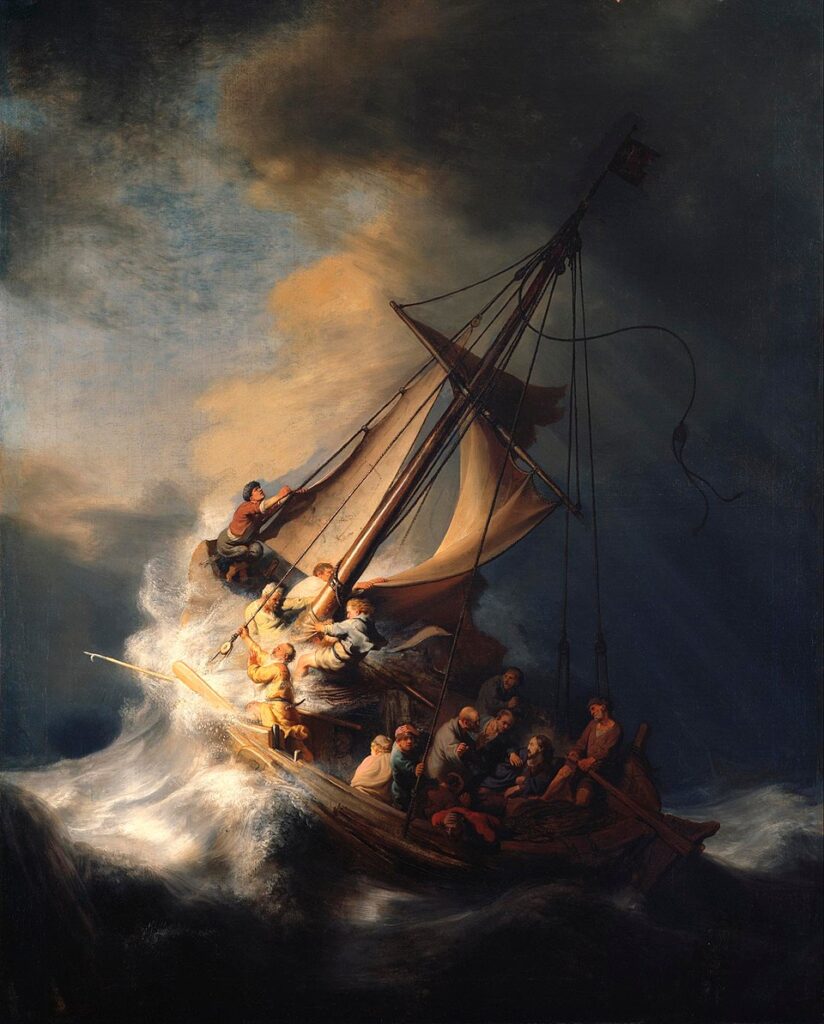
Painted by Rembrandt van Rijn in 1633, The Storm on the Sea of Galilee captures a dramatic episode from the New Testament — the calming of the storm by Jesus Christ, as recorded in the Gospel of Mark 4:35–41. In this passage, Jesus and His disciples are crossing the Sea of Galilee when a sudden and violent storm overtakes them. The disciples panic, believing they will perish, while Christ sleeps calmly in the stern. When they wake Him, He rebukes the wind and the sea, saying, “Peace, be still,” and the storm immediately subsides.
Rembrandt translates this vivid biblical narrative into a visual drama. The storm lashes the boat as terrified apostles cling to ropes, cry out in fear, or wrestle with the sails. Christ, by contrast, remains composed, reinforcing the miraculous nature of His authority over nature. The painting emphasizes contrast—between chaos and control, humanity and divinity—and shows Rembrandt’s deep understanding of scripture and human psychology. This is not simply a religious painting; it is an emotionally charged meditation on faith under trial.
Rembrandt’s Only Seascape – A Unique Work
This painting is remarkable not just for its content but also because it is the only seascape Rembrandt is known to have painted. Completed in 1633, it dates to a period shortly after Rembrandt moved from his hometown of Leiden to the bustling, prosperous city of Amsterdam in 1631. At just 27 years old, Rembrandt had already gained a reputation as a masterful portraitist, and his works were in high demand by wealthy Amsterdam merchants and collectors.
The Storm on the Sea of Galilee was painted during this early Amsterdam period, when Rembrandt was exploring new genres and gaining exposure to an elite clientele. Measuring 160 cm by 128 cm (63 inches by 50 inches), and executed in oil on canvas, the painting is signed “Rembrandt f. 1633” in the lower right corner. Its maritime subject matter may have appealed to Dutch patrons living in one of Europe’s most powerful seafaring nations. Yet Rembrandt did not take the typical route of a neutral or heroic naval scene. Instead, he presented a spiritually charged, perilous moment that brought both maritime skill and divine salvation into sharp focus.
Mastery of Light, Shadow, and Human Emotion
The painting is a masterclass in chiaroscuro—the use of stark contrasts between light and dark—which was a hallmark of Rembrandt’s early style. A violent gust of wind pushes the boat into a diagonal slant from lower left to upper right, heightening the sense of movement and danger. Light slices through the gloom, illuminating the twisting sail and certain terrified faces, while other figures are shrouded in darkness. This interplay of illumination and shadow directs the viewer’s eye across the painting, guiding us from the chaos of the waves to the calm of Christ at the stern.
Each of the apostles is rendered with a different reaction: fear, prayer, struggle, and even despair. One figure holds his cap as the wind tears at it, another vomits over the side, and a third man, face brightly lit, stares directly out of the painting. Scholars agree this is Rembrandt’s self-portrait—a small but powerful moment of personal identification with the fear and helplessness of the apostles. This direct engagement with the viewer brings the crisis off the canvas and into the viewer’s present, making it impossible to ignore the spiritual question posed: where is your faith?
Major Visual Elements (Bullet List):
- Torn sail whipping in the wind
- Sudden lightning illuminating parts of the scene
- Apostles clinging to the boat and each other in fear
- Christ calm and composed at the stern
- Rembrandt’s self-portrait gazing at the viewer
Context: Rembrandt and the Dutch Golden Age
1630s Amsterdam – A Growing Art Market
The early 17th century was a period of immense growth and prosperity in the Dutch Republic, particularly in Amsterdam. Following independence from Spain in 1648 (after decades of warfare), the Dutch built a robust economy centered on trade, shipping, banking, and overseas expansion. Art flourished in this climate, not through religious commissions, as in Catholic nations, but through a competitive private market. Wealthy merchants, doctors, and civic leaders became the new patrons.
Rembrandt, born in Leiden in 1606, moved to Amsterdam in 1631. By 1633, when he painted The Storm on the Sea of Galilee, he had already achieved fame. His portraits were in demand, and he had recently begun working for Prince Frederik Hendrik of Orange. His studio was busy with commissions and apprentices, and this maritime biblical scene may have been created either as a private commission or as a speculative work for sale. The growing appetite among Dutch collectors for dramatic religious paintings, especially those with moral and spiritual themes, created a space for such ambitious works to succeed.
Religious Art in a Protestant Nation
The Netherlands was a Protestant nation by the 17th century, and churches typically rejected religious imagery, especially anything seen as idolatrous or overly ornate. This differed sharply from Catholic regions, where religious commissions dominated the art scene. However, Dutch collectors still desired religious themes in their private homes. Artists responded by painting biblical scenes that were instructive, often moralistic, and deeply human.
Rembrandt thrived in this environment. His works were not for altars but for parlors and studies—intimate spaces where collectors could reflect on them personally. The Storm on the Sea of Galilee fits perfectly into this trend. It provides both a thrilling narrative and a deeply theological meditation. Instead of relying on gold leaf or divine halos, Rembrandt portrayed the apostles as flawed and frightened men, indistinguishable from ordinary citizens of his own time.
Maritime Themes in Dutch Art
Maritime scenes were a staple of Dutch painting, reflecting the country’s close relationship with the sea. Artists like Hendrick Vroom and Jan Porcellis had established the seascape as a respected genre decades earlier, focusing on naval battles, merchant ships, or harbors under dramatic skies. These works celebrated the Republic’s naval power and economic might.
Rembrandt’s The Storm on the Sea of Galilee was an outlier. It took the popular form of the maritime painting and imbued it with religious gravity and psychological depth. Rather than glorify Dutch seamanship, it focused on human frailty. Rather than a merchant ship, the vessel is small and fragile. The crashing wave, which consumes nearly half the canvas, isn’t just a natural force—it’s a symbol of all that men fear and cannot control. By adapting a familiar visual genre for spiritual reflection, Rembrandt created a work that stood apart in both his own catalog and in Dutch art more broadly.
Theft and Mystery: The Gardner Museum Heist
March 18, 1990 – The Night of the Robbery
On the early morning of March 18, 1990, two men dressed as Boston police officers arrived at the Isabella Stewart Gardner Museum. Claiming they were responding to a disturbance, they convinced the guards to let them inside. Once in, they overpowered the guards and duct-taped them in the basement. Over the next 81 minutes, the thieves stole 13 works of art, including The Storm on the Sea of Galilee. It remains one of the most infamous and mysterious art thefts in history.
The robbery was timed with precision. The thieves moved deliberately and knew which rooms to target. Rembrandt’s Storm was cut directly from its frame, leaving behind ragged canvas edges. Along with it, another Rembrandt (A Lady and Gentleman in Black), Vermeer’s The Concert, Manet’s Chez Tortoni, and several lesser-known works were stolen. Surveillance tapes were taken, and the alarm system disabled. No arrests have ever been made.
The Most Valuable Unrecovered Painting Ever
Rembrandt’s The Storm on the Sea of Galilee is widely considered the most valuable unrecovered painting in the world. Experts estimate its worth at over $100 million, though art stolen in high-profile heists is rarely resold on the open market. The painting has not been seen publicly since the night it was stolen. Its large size—160 by 128 centimeters—makes it hard to conceal, further deepening the mystery surrounding its disappearance.
The painting’s absence is keenly felt at the Gardner Museum. Its empty frame still hangs on the wall, exactly where it was before the theft, in compliance with Isabella Stewart Gardner’s will, which required that no changes be made to the museum’s arrangement. That empty frame has become a symbol not only of loss but of ongoing hope. The museum continues to maintain a $10 million reward for information leading to the artwork’s recovery.
Theories, Leads, and the FBI Investigation
Over the decades, numerous theories have emerged regarding the theft. The FBI has at various times linked the crime to organized crime groups in the Boston area, including factions with ties to the Irish underworld. In 2013, the Bureau announced it believed it had identified the perpetrators—members of a criminal organization—but the trail went cold, and the paintings remained missing.
Some believe the works were moved through Philadelphia and possibly overseas. Others speculate they remain hidden in New England, stored by individuals who no longer know—or dare to reveal—what they possess. Despite years of leads and even international coordination, no concrete progress has been made. In the art world, the Gardner Heist remains an open wound, and The Storm on the Sea of Galilee the most painful loss.
Gardner Heist: Stolen Works (Bullet List):
- The Storm on the Sea of Galilee – Rembrandt (1633)
- A Lady and Gentleman in Black – Rembrandt
- The Concert – Johannes Vermeer
- Chez Tortoni – Édouard Manet
- Additional items: Chinese Ku vase, bronze eagle finial, Degas sketches
Interpretation and Legacy of the Work
Human Fear vs. Divine Authority
Rembrandt’s painting is more than a narrative image—it’s a theological statement. The disciples’ terror in the face of a storm is symbolic of mankind’s condition: fragile, fearful, and subject to forces beyond control. Christ’s calm is not just miraculous; it is divine. His control over nature serves as a visual proclamation of His identity as the Son of God, and His question to the disciples—“Why are you so afraid? Do you still have no faith?”—resonates through the ages.
Viewers are invited to see themselves in the boat, tossed by storms of life—political turmoil, illness, grief, war. The painting’s relevance transcends its 17th-century origins. In a nation of sailors and merchants, where death by sea was a daily risk, Rembrandt’s message was both personal and profound: God’s presence is not the absence of danger, but the promise of peace within it.
Self-Insertion: Rembrandt in the Boat
Among the most striking aspects of the painting is Rembrandt’s own inclusion in the scene. Art historians have long identified the figure near the mast, holding onto his cap and staring directly out at the viewer, as Rembrandt himself. This wasn’t the only time he placed himself in biblical scenes, but it’s one of the most dramatic. By including himself among the panicked disciples, Rembrandt acknowledges his own fear, doubt, and need for divine intervention.
This move also bridges the gap between the viewer and the painting. Rembrandt acts as a kind of intermediary—someone like us, situated inside the chaos and questioning. His self-portrait is not elevated or sanctified; it’s desperate and real. Through it, he invites the viewer not just to admire the art, but to join him in wrestling with its spiritual challenge.
Influence on Art and Popular Culture
Since its creation, The Storm on the Sea of Galilee has inspired countless reproductions, interpretations, and homages. Its dramatic composition and emotional intensity have influenced religious painters, maritime artists, and even filmmakers. The painting has appeared in novels, such as Daniel Silva’s art crime thrillers, and in documentaries and podcasts about the Gardner Heist.
Its unresolved status has given it an almost mythic aura. As one of the most famous lost works of art, it holds a strange power over the public imagination. Reproductions hang in churches, homes, and museums, while the original remains missing. Yet even in absence, its message endures. Like the storm it depicts, the painting’s story is one of fear, faith, and the search for peace.
Key Takeaways
- Rembrandt painted The Storm on the Sea of Galilee in 1633, early in his Amsterdam career, when he was just 27 years old.
- It is his only known seascape, making it unique within his vast body of religious and historical paintings.
- The painting illustrates a biblical scene from the Gospel of Mark, showing Christ calming a violent storm and challenging the disciples’ faith.
- It was stolen in 1990 from the Isabella Stewart Gardner Museum in Boston, in what remains the largest unsolved art theft in modern history.
- Rembrandt included himself in the painting, gazing out from the chaos, inviting viewers to see themselves amid the storm.
FAQs
1. What story does Rembrandt’s Storm on the Sea of Galilee depict?
It shows the biblical account from Mark 4:35–41, in which Jesus calms a violent storm on the Sea of Galilee, testing the faith of His disciples.
2. Why is this painting especially significant in Rembrandt’s career?
It is the only known seascape Rembrandt ever painted, and it was completed during his early, experimental Amsterdam period when he was gaining elite patrons.
3. Is the painting still missing today?
Yes. It was stolen in 1990 during the Gardner Museum Heist and has not been recovered. Its empty frame still hangs in the museum.
4. Did Rembrandt include himself in the painting?
Yes, art historians widely agree that the man staring directly at the viewer is Rembrandt himself, inserting his presence into the biblical narrative.
5. How much is the painting worth today?
Estimates place its value over $100 million, but it is considered priceless due to its rarity, its historical significance, and the mystery surrounding its disappearance.