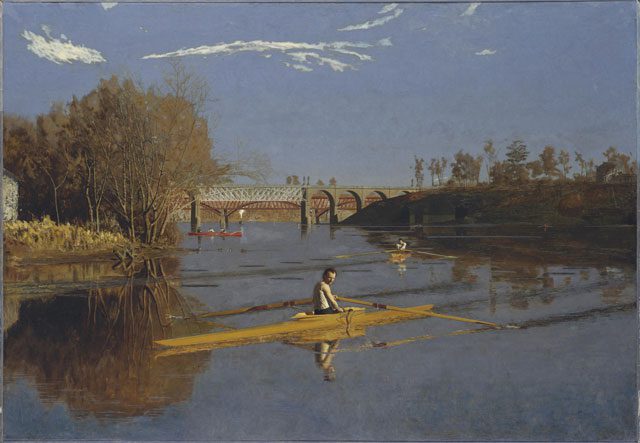
Few American paintings combine athleticism, artistry, and personal tribute as seamlessly as Max Schmitt in a Single Scull by Thomas Eakins. Completed in 1871, the work captures a solitary moment on Philadelphia’s Schuylkill River, portraying Eakins’ close friend and rowing champion, Max Schmitt. At first glance, the image is tranquil—a lone sculler floats on still water—but deeper inspection reveals layers of meaning about friendship, national identity, and the dignity of discipline.
This masterpiece emerged at a time when America was asserting itself culturally after the devastation of the Civil War. Painters like Eakins were crafting a distinctly American vision of realism—one that valued truth, grit, and quiet strength over grand European romanticism. In Max Schmitt in a Single Scull, those ideals are made visible through technical mastery and emotional restraint. The painting stands not as an escapist fantasy, but as a monument to the virtues of focus and integrity.
The painting was both a personal and professional statement. Eakins and Schmitt were members of the Pennsylvania Barge Club and shared a deep bond rooted in physical discipline and mutual respect. Rather than idealizing his friend in some distant heroic scene, Eakins chose to paint him just as he was: strong, still, and alone in his craft. The image reflects not only the athlete’s character but the artist’s vision for what American art could be.
Today, this painting is housed in the Metropolitan Museum of Art, a fitting home for a piece that honors American excellence. Its quiet power is easy to miss in an age of noise and flash, but those who stop to study it find a work rich in narrative, history, and technical achievement.
The Setting – Philadelphia’s Schuylkill River
The Schuylkill River wasn’t just a scenic backdrop; it was central to the athletic and cultural identity of Philadelphia in the late 19th century. Located just west of the city center, the river hosted a growing number of amateur rowing clubs by the 1850s. The Fairmount Water Works, completed in 1815, and the surrounding parklands had made the Schuylkill both a functional water source and a recreational haven. Rowing was emerging as a respectable and even noble pursuit, attracting the city’s middle and upper classes.
By the time Eakins painted Max Schmitt in a Single Scull, the river had become a place of serious competition. Clubs like the Pennsylvania Barge Club, which both Eakins and Schmitt belonged to, were known for their disciplined training and fierce regattas. The river’s long, straight stretches made it ideal for rowing, and its calm surface mirrored the mental clarity the sport demanded. This wasn’t just a pretty place—it was a proving ground for men committed to excellence.
In Eakins’ work, the Schuylkill becomes more than background—it is almost a character itself. The stillness of the water reflects Schmitt’s calm after exertion, while the autumnal trees on the banks suggest the fleeting nature of athletic prime. The location anchors the painting in a real and recognizable American space, unfiltered by mythology or foreign embellishment.
Painting a familiar landscape with such exacting detail also had another purpose: it rooted Eakins’ work in American soil. Unlike many contemporaries who painted vague pastoral settings, Eakins gave viewers a location they could name, visit, and understand. The river was not an escape from reality—it was the site of real achievement, captured without fantasy.
First Impressions – A Work That Captures Stillness
Upon first viewing Max Schmitt in a Single Scull, many are struck by its quietude. There is no dramatic gesture, no visible struggle, no grand celebration. Instead, the rower sits with his oars at rest, boat gliding silently over mirrored water. The eye is drawn to the central figure, but lingers on the wide, empty space around him, emphasizing isolation and calm.
This stillness is not laziness or leisure—it is earned. Schmitt has just finished a race or a long practice row, and the moment captured is one of recovery and reflection. His face is slightly turned, eyes not meeting the viewer, creating a sense of introspection. Eakins does not force a narrative; he allows the moment to speak for itself. In that silence, one can feel the discipline that brought the athlete to this point.
For 19th-century audiences, this kind of composure was closely tied to ideals of masculine virtue. It signified control over body and mind—attributes valued not only in sport but in professional and civic life. Eakins, who admired the classical restraint of ancient Greek art, channels a similar ethos here. There is no need for exaggeration when truth itself is noble.
The painting’s overall tone is meditative, even spiritual. In an era when much of the country was still recovering from civil conflict, such scenes of solitary strength offered a quiet form of reassurance. They reminded viewers that greatness could still be achieved without noise, without fanfare—through character and craft.
Thomas Eakins: Artist of Strength and Precision
Thomas Eakins was born on July 25, 1844, in Philadelphia, Pennsylvania, and remained deeply rooted in his native city throughout his life. He studied at the Pennsylvania Academy of the Fine Arts before traveling to France in 1866, where he trained at the École des Beaux-Arts under Jean-Léon Gérôme. Unlike many American painters of the era, Eakins did not fall under the spell of Impressionism; he returned home determined to tell the truth with his brush.
Eakins’ background in both science and art set him apart from his peers. He studied anatomy at Jefferson Medical College and was known to attend dissections in order to improve his understanding of the human form. This knowledge gave his work a unique physical accuracy, unmatched by many of his contemporaries. He also embraced the new medium of photography, using it to study motion and posture in ways no American painter had done before.
At the heart of Eakins’ philosophy was a deep respect for labor and honesty. He had no interest in flattering portraits or whimsical scenes. Instead, he gravitated toward subjects that revealed character—athletes, doctors, musicians, and craftsmen. His realism was not just stylistic; it was moral. To him, art was a way to honor truth, not obscure it with sentimentality.
This commitment to realism often came at a cost. Eakins’ career was marked by controversy, especially during his tenure at the Pennsylvania Academy of the Fine Arts, where he was forced to resign in 1886 for using nude models in mixed-gender classes. Yet he remained unshaken. For Eakins, truth was non-negotiable. And in Max Schmitt in a Single Scull, that principle shines through clearly.
Education and Influences
Eakins’ European training played a vital role in shaping his approach, but he remained distinctly American in spirit. At the École des Beaux-Arts, he absorbed the rigor of classical draftsmanship and the value of structure in composition. His teacher, Jean-Léon Gérôme, emphasized the importance of anatomical accuracy and traditional craftsmanship—principles Eakins would carry throughout his life.
While in France, Eakins also visited Spain to study the works of Diego Velázquez and Jusepe de Ribera, both known for their stark realism and subdued palettes. He was especially drawn to their treatment of light and texture. Yet despite these influences, Eakins never adopted the flamboyance or decorative excess common among some of his French and Spanish contemporaries.
What truly set Eakins apart was his refusal to copy trends. He did not follow the emerging Impressionist movement, which was gaining popularity in Paris during his stay. Instead, he took from the Old Masters what he found useful and adapted it to the American context. His work was not nostalgic but rooted in the present—a record of real men doing real things.
Eakins’ years in Europe were not a detour but a sharpening process. They clarified his values and refined his techniques, allowing him to return home with a vision grounded in excellence, not imitation.
Eakins’ Commitment to Realism
Eakins’ realism was not mere photographic duplication; it was a deeply moral endeavor. He believed that to portray something truthfully was to honor its dignity. Whether painting a surgeon mid-operation or a rower resting in his boat, he aimed to reveal the inner strength of his subjects. This approach put him at odds with artists who sought to please rather than to represent.
His use of live models, often nude, was not scandalous to him but essential. He wanted to understand how muscles worked under strain, how light fell across bone and skin. In this sense, Eakins approached painting like a scientist—curious, exacting, and deeply serious. Every line was earned, not guessed.
To achieve this realism, he also relied on photography. Eakins took numerous reference photos for his paintings, including studies of rowing and other athletic movements. These photographs were not slavishly copied but served as tools to ensure anatomical and compositional accuracy. For Max Schmitt in a Single Scull, such photographic studies allowed him to capture the precise positioning of the scull, the oars, and Schmitt’s relaxed yet engaged posture.
This dedication to realism, though controversial in some academic circles, is what makes Eakins’ work endure. It offers not just visual beauty but intellectual and moral substance.
Bullet List: Core Principles of Eakins’ Artistic Method
- Use of live nude models for anatomical accuracy
- Study of human dissection to master muscular structure
- Early adoption of photography as a compositional tool
- Direct observation of subjects in real environments
- Rejection of decorative styles in favor of moral realism
Who Was Max Schmitt? More Than a Rowing Star
Maximilian “Max” Schmitt was born in 1843 and, like Eakins, lived in Philadelphia. He was a dedicated athlete and a decorated rowing champion, most notably remembered for winning the single sculls championship on October 5, 1870. Schmitt’s name was well known among the rowing circles in Philadelphia, and his disciplined character made him an admirable subject for a painter who valued authenticity over showmanship.
Schmitt was not a professional athlete in the modern sense; he was a product of the American amateur athletic ideal, which emphasized sportsmanship and self-discipline over commercialization. In the 19th century, rowing was a gentleman’s sport, and Max Schmitt represented its virtues to the fullest. He trained rigorously, competed honorably, and carried himself with composure—qualities that earned Eakins’ admiration and led to this tribute in oil.
Eakins and Schmitt were both members of the Pennsylvania Barge Club, founded in 1861. Their shared experiences on the river forged a mutual respect. The rowing community at the time was tight-knit, composed largely of men who shared a commitment to physical excellence, self-improvement, and personal honor. These traits were not just admired—they were expected. In painting Schmitt, Eakins captured these values in visual form, turning a fleeting moment on the river into a symbol of enduring character.
The friendship between the two men added a deeply personal layer to the work. This was not a commission, nor was it an impersonal portrait. It was a tribute from one man to another—one who respected the quiet power of self-mastery. In the painting, Eakins even includes himself in the background, rowing away from the viewer in another single scull. It’s a humble gesture, positioning Schmitt in the foreground while the artist recedes into the scene.
Champion on the Water
Max Schmitt’s athletic career culminated in his championship victory in 1870, when he won the single sculls race hosted by the Schuylkill Navy. The event, held on October 5, drew large crowds and celebrated the rise of competitive amateur rowing in America. Schmitt’s technique, endurance, and mental focus allowed him to edge out fierce competitors, solidifying his reputation as one of the river’s best oarsmen.
Rowing in the 19th century was not merely about sport—it was viewed as a test of character. A man who could master the oar, endure hours of solitary practice, and navigate the unpredictable current was admired far beyond the boat. It was the kind of contest that reflected deeper virtues: patience, courage, and inner strength.
Schmitt rowed a single scull—a narrow, streamlined boat propelled by two oars and designed for speed. Unlike team rowing, sculling required total self-reliance. The athlete bore full responsibility for rhythm, balance, direction, and speed. Success meant complete unity between mind and muscle. Schmitt’s mastery of this form made him the perfect subject for a painter who prized self-command above theatrics.
Eakins’ decision to immortalize Schmitt just one year after this victory was a direct acknowledgment of that achievement. But it wasn’t just about winning a race—it was about what that victory represented: a life of dedication and a moment of perfect discipline.
A Personal Bond with the Artist
The closeness between Eakins and Schmitt is one of the painting’s most overlooked aspects. While little personal correspondence between them survives, their shared involvement in rowing and frequent sightings together at the Pennsylvania Barge Club speak volumes. Both men were bachelors during the early 1870s and spent considerable time on the water, practicing, observing, and refining their technique.
Eakins was never drawn to mere acquaintances as subjects. He painted those he respected, those who embodied the ideals he believed in. In choosing Schmitt for this full-length tribute, Eakins was making a clear statement: here is a man worth honoring, not for his fame, but for his quiet strength. It’s a portrait that speaks of loyalty and admiration, not vanity.
The artist even included himself in the background—an unusually modest act for a painter. His own boat is labeled “Eakins,” and he is shown mid-row, facing away from the viewer. This dual portrayal is rare in Western art: both artist and subject in the same composition, one in prominence, the other in humility. It’s not just a painting of a man—it’s a record of friendship forged in shared discipline.
This layer of personal meaning gives the painting emotional weight. It transcends the documentary and enters the realm of tribute—a gesture that elevates both men by showing their character, not just their actions.
Anatomy of the Painting: Composition and Detail
Eakins’ Max Schmitt in a Single Scull is a marvel of compositional structure and detail. Measuring 32 1/4 × 46 1/4 inches, the painting offers a panoramic view of the Schuylkill River on an autumn afternoon. The canvas is wide, allowing Eakins to depict not just the central figure of Schmitt but the surrounding environment, including two bridges, a bend in the river, and distant trees turning brown and gold.
The scene is painted with a crisp clarity that evokes the cool air and reflective water of fall. Eakins’ meticulous brushwork captures the sheen of the wooden scull, the creases in Schmitt’s shirt, and the ripple of the water behind the oars. Every element feels deliberate, as though arranged to lead the eye toward Schmitt’s poised, contemplative figure. Nothing feels accidental; everything contributes to the atmosphere of focus and recovery.
The use of light is also key. Sunlight strikes the river’s surface, creating a mirror-like effect that both grounds the scull and gives the image an almost spiritual resonance. Schmitt’s shadow, faint and broken by the water’s ripple, suggests the transience of triumph—here now, gone in a moment. The palette is muted but rich in natural tones: deep blues, amber browns, silvery grays, and warm whites.
Eakins avoids romantic flourishes. There are no dramatic skies, no fluttering flags or exaggerated gestures. The drama is internal, revealed through composition and restraint. The structure of the painting itself tells the story—a man at rest, after exertion, surrounded by the land and water that shaped him.
Diagonal Lines and Visual Balance
A key element of Eakins’ composition is his use of diagonal lines. The scull itself forms a bold diagonal across the canvas, from lower left to upper right. This line is echoed by the oars, the reflection in the water, and even the distant bridge in the background. These diagonal elements create a dynamic tension, guiding the viewer’s eye from corner to corner, keeping the scene alive despite its apparent stillness.
Diagonal lines in classical composition often imply motion or energy. Here, they give the sense that the boat has just come to rest, that Schmitt is only momentarily paused. The angles suggest a continuation—a before and after—without needing to show the race itself. It’s a brilliant use of spatial logic to convey narrative and mood.
The balance of space is also worth noting. Eakins leaves a wide margin of open water around Schmitt, isolating him and emphasizing his solitude. At the same time, the inclusion of background rowers and architectural elements provides context without crowding the main subject. This careful orchestration ensures that Schmitt remains the focus, yet never feels artificially spotlighted.
In many ways, the painting’s structure mirrors the sport it depicts: balance, symmetry, precision. Every element has a purpose, every stroke contributes to harmony. It’s not just a visual composition—it’s a metaphor for the discipline required in both art and athletics.
Subtle Symbolism and Placement
Though Eakins was not known for overt symbolism, Max Schmitt in a Single Scull contains thoughtful choices in placement and perspective that speak volumes. Schmitt is placed slightly off-center, lending the composition a naturalistic feel while also drawing attention to the broader scene. His figure is large enough to dominate but not so large as to overwhelm. The eye is allowed to wander—to the bridges, the trees, the background rowers—before returning to the main subject.
Eakins’ own placement in the background is especially significant. He is rowing away from the viewer, almost disappearing into the vanishing point. This not only shows humility but places Schmitt in the spotlight. Eakins isn’t showing off—he’s honoring a friend. The two scullers form a visual pair, separated by distance but connected by direction and discipline.
The stillness of the water also serves a symbolic function. Water in art often represents emotion, change, or the subconscious. Here, it reflects Schmitt’s controlled calm. The clarity of the river suggests mental clarity; its depth suggests emotional depth. The painting becomes not just a snapshot but a portrait of a state of being.
Even the light feels symbolic. It’s not harsh midday glare nor dramatic sunset—it’s the honest light of midafternoon. Nothing is hidden, nothing exaggerated. It’s the light of truth, illuminating a subject whose quiet strength needs no embellishment.
Realism on the River: Eakins’ Technique
The realism of Max Schmitt in a Single Scull isn’t simply about how life-like the rower or the boat appears—it’s about the authenticity of the entire moment. Thomas Eakins was committed to portraying life as it truly was, not as the public wished it to be. His technical mastery allowed him to translate lived experience—movement, resistance, fatigue, and stillness—onto canvas with striking fidelity.
Eakins spent considerable time studying the way light interacts with water and polished wood, particularly during the autumn months. His representation of reflections on the river is especially meticulous, using layered glazes to achieve depth and shimmer. Each ripple and wake is placed to reflect both the boat’s motion and the clarity of the Schuylkill River’s surface. This wasn’t guesswork—it was informed by direct observation and scientific method.
He also paid close attention to the human form. Schmitt’s relaxed posture, though seemingly casual, is anatomically precise. The way his hands rest on the oars, the slight turn of his neck, and the posture of his spine all speak to hours of careful study. Eakins knew what muscles would be engaged in sculling, and he ensured their appearance matched reality. The painting is calm on the surface, but underneath lies the suggestion of exertion, of effort just expended.
Unlike many of his contemporaries, Eakins didn’t rely on studio tricks or generalized models. He observed, documented, and synthesized his findings into a seamless whole. This devotion to craft set him apart in an age when many painters were moving toward impressionism or fantasy. Eakins remained faithful to the American ideal of hard-earned truth.
Photographic Studies Behind the Scenes
One of the least known but most critical aspects of Eakins’ process was his use of photography. In the 1870s, photography was still considered a new and controversial tool in the fine arts. Eakins, however, embraced it as a way to capture motion, posture, and lighting conditions that would be impossible to freeze otherwise. For this painting, it is believed he took multiple photographic studies of rowers in various poses to aid in composition and detail.
His brother-in-law, Edward Muybridge, was also pioneering studies in photographic motion at the time, and Eakins closely followed this work. He used photographs to understand how the body worked during action and how to translate those positions into still art. These images allowed him to eliminate guesswork and replace it with scientific accuracy.
For Max Schmitt in a Single Scull, Eakins likely took reference photos directly on the Schuylkill. Though few of these specific photos survive, we know he used them extensively in similar works such as The Champion Single Sculls (1871) and The Biglin Brothers Turning the Stake (1873–74). The result is a painting that doesn’t just look realistic—it feels real. Viewers sense that they are witnessing a specific moment, not a generalized idea.
Eakins’ embrace of photographic technology positioned him as both a traditionalist and a modernist. He upheld the values of classical composition and truth while using the newest tools to achieve them.
The Muscles of Motion
Eakins’ knowledge of anatomy, gained through medical study, shines in the rendering of Schmitt’s body. While clothed, the figure’s muscles and bone structure are unmistakably present. The tension in the arms, the settled yet ready position of the torso, and the stable placement of the feet inside the narrow scull all speak to a lifetime of rowing experience—both Schmitt’s and Eakins’.
Unlike other painters who might idealize the male figure, Eakins emphasized truth. Schmitt is not a mythological hero; he’s a working athlete, captured as he truly appeared. His physique is strong but not exaggerated. His clothing—practical rowing attire of the period—clings slightly, allowing the form beneath to show without pretension. There’s no theatrical flair, only quiet confidence.
This attention to physical truth reflects a larger moral vision. For Eakins, the human body was not something to be cloaked or glamorized. It was the instrument of discipline, labor, and mastery. In an era increasingly given to sentiment and artifice, Eakins chose instead to honor the nobility of actual strength and skill.
This fidelity to form would influence not only his portraits but his teaching as well. At the Pennsylvania Academy of the Fine Arts, he would insist on life drawing and anatomical study, even when it cost him his position. That unwavering dedication to the body as a truthful subject is fully realized in Max Schmitt in a Single Scull.
The Moral Vision of the Work
While many admire Max Schmitt in a Single Scull for its technical brilliance, fewer recognize the quiet but powerful moral statement it makes. The painting celebrates the virtues of hard work, discipline, and modesty—values deeply rooted in American tradition. In a time when European art was full of excess and romantic myth, Eakins offered something else: a picture of moral clarity through physical achievement.
Schmitt is not shown in triumph, arms raised or cheered by crowds. He’s alone, reflecting, calm. The oars rest. The water is still. It is a moment after the action, not during it. This choice emphasizes the idea that real strength is internal. It’s about what a man is when no one is watching—when the race is done, and silence sets in.
There’s also a notable absence of spectacle. No flags wave, no audience cheers, no dramatic skies loom overhead. This is deliberate. Eakins strips the scene of all distractions so the viewer must focus on the man and the moment. It’s a quiet reminder that character is built in solitude, not in applause.
In this way, the painting transcends portraiture and becomes a moral tableau. It doesn’t preach, but it teaches. It says that greatness lies not in show but in substance. And that message remains just as relevant today as it was in 1871.
Stoicism and the American Ideal
Eakins’ portrayal of Max Schmitt captures a particularly American version of stoicism—quiet, resilient, and unshaken. Unlike the flamboyant heroes of European canvases, Schmitt shows no outward emotion. His expression is calm, his body composed. Yet that composure speaks volumes. It tells of effort endured, goals met, and personal control maintained.
This kind of stoic ideal was celebrated in post-Civil War America. The country had seen enough of chaos and grandiosity. It now sought men who could build, restore, and discipline themselves. In this light, Schmitt becomes a symbol of the new American man—one who achieves not through conquest, but through control.
Stoicism also implies the ability to suffer without complaint. Rowing, especially in a single scull, demands both mental and physical endurance. Long hours on the water, repetition, and physical strain are all accepted as the price of mastery. By showing Schmitt at rest but not relaxed, Eakins underscores that commitment.
This depiction resonated with American viewers of the time. It offered a vision of manhood rooted not in sentiment, but in strength, order, and perseverance. These values, increasingly neglected in modern portrayals of masculinity, remain central to Eakins’ message.
Individualism Embodied in Art
One of the most distinctively American themes in the painting is its celebration of individualism. Schmitt is alone, responsible for his boat, his movement, his choices. In an age before widespread team sports fame or professional contracts, he embodies the idea of the self-reliant man.
This individualism aligns with Eakins’ own worldview. He believed deeply in personal responsibility and the value of mastering one’s craft. He wasn’t painting an idealized athlete meant to serve as a universal symbol—he was painting Max Schmitt, a real man who achieved real things. The specificity of the portrait only makes its message more universal: discipline, focus, and integrity matter.
The single scull itself is symbolic. Unlike team shells, it offers no help, no hiding. The rower is fully exposed, every move visible, every error his own. Success comes not from charisma or popularity, but from preparation and performance. That’s the kind of truth Eakins wanted to celebrate.
In this way, Max Schmitt in a Single Scull becomes more than a painting—it becomes a visual argument for American virtues. It shows that the individual, acting with discipline and humility, is worthy of recognition—not for spectacle, but for substance.
Bullet List: How Eakins’ Masculine Realism Contrasts Romantic European Art
- Eakins: Stoic, solitary, precise — vs. Renoir: Leisure, flirtation, softness
- Eakins: American working-class virtues — vs. European decadence and luxury
- Eakins: Focused on anatomy and effort — vs. Impressionist blur and atmosphere
- Eakins: Celebrates mastery — vs. Romantic emphasis on emotion and fantasy
- Eakins: Real men, real bodies, real labor — vs. idealized beauty and myth
The Painting’s Reception: Then and Now
When Max Schmitt in a Single Scull was first exhibited in 1871, it received a mixed response from critics and the public. While some appreciated its clarity and craftsmanship, others found it too literal, too quiet, and lacking the flourish or grand emotional tone they expected from major works of art. At a time when sentimental genre scenes and romanticized landscapes dominated American galleries, Eakins’ stark realism was an outlier.
Art critics in the early 1870s were still heavily influenced by European tastes, particularly those of the French and British schools. They sought allegory, narrative drama, and visual splendor. Eakins offered none of those. His painting was about solitude, physicality, and truth—a direct portrayal of a man on a river, rendered with scientific clarity and emotional restraint. For some, this was too subdued. For others, it was a breath of fresh air.
The painting was not widely exhibited after its initial showing, and for a time, it was virtually forgotten by the mainstream art world. Eakins himself never chased popularity. He continued to work on similar themes, exploring the lives of surgeons, athletes, and musicians with the same unflinching honesty. Max Schmitt in a Single Scull became, for many years, a hidden gem in his broader body of work.
Only in the mid-20th century did the painting receive its due recognition. As American scholars and curators began to reevaluate the country’s artistic heritage, Eakins emerged as a foundational figure in American realism. Today, the painting is considered one of his masterpieces, celebrated for its technical skill, emotional depth, and its profound embodiment of American ideals.
Critical Cold Shoulder in the 19th Century
In the conservative art circles of 1870s America, Eakins’ work was viewed as both admirable and unorthodox. Critics were accustomed to paintings that idealized their subjects or followed established academic formulas. Eakins’ decision to depict an amateur athlete in a scene stripped of allegory or theatricality puzzled many. Reviewers in publications like The Philadelphia Inquirer and The Art Journal gave the painting scant notice or dismissed it as overly mechanical.
The use of a sporting theme was also considered unconventional. At that time, fine art subjects typically included religious scenes, portraits of dignitaries, or moralistic narratives. To devote such time and talent to a sculler—an amateur rower with no social rank—seemed eccentric or even inappropriate. For Eakins, however, that choice was not only valid but deeply American.
Adding to the critical ambivalence was Eakins’ refusal to flatter. His figures were not made more attractive, more elegant, or more expressive than they were in real life. Critics who favored emotional storytelling or dreamy landscapes often found Eakins’ realism cold. In reality, it was simply uncompromising. He would not sell sentiment in place of truth.
Despite the lackluster reception, Eakins held fast to his vision. He continued to paint real Americans doing real things, whether it was rowing a boat, performing surgery, or playing the cello. His integrity would outlast the tastes of his critics.
Rediscovery by Modern Scholars
By the 1930s and 1940s, as American museums and academic institutions began to look inward for cultural identity, interest in Eakins surged. Scholars such as Lloyd Goodrich and Gordon Hendricks played pivotal roles in restoring Eakins’ reputation. They published detailed studies, mounted retrospectives, and brought works like Max Schmitt in a Single Scull back into public view.
The painting was acquired by the Metropolitan Museum of Art in 1934, signaling a major institutional recognition of its importance. Curators began to see in it what Eakins had intended all along: a deeply American image, rooted in truth, celebrating the individual without vanity. The painting was finally understood not as simple documentation, but as a philosophical statement on art, manhood, and mastery.
Modern critics now praise the work for its compositional elegance, psychological depth, and historical value. It is regularly featured in exhibitions on American realism, masculinity in art, and the evolution of sports representation in visual culture. It’s no longer a curiosity—it’s a cornerstone.
More importantly, contemporary viewers—especially those who respect hard work, discipline, and tradition—find in the painting a reflection of enduring values. In a world saturated with spectacle, Eakins’ quiet, focused vision stands as a beacon of restraint and depth.
Legacy of Schmitt and Eakins
The lasting power of Max Schmitt in a Single Scull lies in its ability to honor two legacies at once: the disciplined athlete and the devoted artist. Eakins’ tribute to his friend became a monument not just to rowing, but to the kind of life both men believed in—marked by discipline, humility, and truth.
Max Schmitt himself remained an active figure in Philadelphia’s rowing community for years after his championship. Though he never achieved national fame, his example lived on in the clubs along Boathouse Row, where younger oarsmen followed in his disciplined wake. His name, immortalized on canvas, became part of American rowing lore.
Eakins continued to refine his realist vision throughout the rest of his career, producing masterpieces such as The Gross Clinic (1875) and The Agnew Clinic (1889). He remained largely unappreciated in his own lifetime, passing away in 1916 with much of his genius still unrecognized by the art establishment. Only later generations would understand the full significance of his uncompromising vision.
Today, Max Schmitt in a Single Scull stands as an early and defining example of Eakins’ artistic philosophy. It embodies everything he held dear—physical truth, moral strength, and artistic integrity. Its presence in the Metropolitan Museum of Art ensures that future generations will continue to encounter this quiet triumph of American realism.
Influence on American Sports Art
Before Eakins, athletes in American painting were usually background figures—part of genre scenes, decorative, or symbolic. Max Schmitt in a Single Scull changed that. By devoting a full-scale, formal composition to a single amateur athlete, Eakins redefined what kind of subjects were worthy of high art.
This shift had lasting effects. Later American artists, including George Bellows and Winslow Homer, also began to explore sports and physical exertion as serious artistic subjects. Bellows’ boxing scenes, in particular, carry forward Eakins’ legacy of portraying athleticism as a vehicle for moral and physical truth. While Bellows emphasized struggle and violence, Eakins focused on discipline and grace.
Today, sports art is a genre of its own, with roots traceable back to Eakins’ rowing scenes. By showing that an athlete’s body could be as noble as that of a saint or a soldier, Eakins opened the door for generations of artists to find beauty and meaning in physical mastery.
His approach still influences modern photography and sculpture, particularly in Olympic imagery, collegiate athletics, and even military portraiture. Wherever strength, focus, and solitude are captured with dignity, Eakins’ legacy echoes.
A Rare Tribute to Friendship
There’s a uniquely touching element to Max Schmitt in a Single Scull that often goes unremarked: it’s a sincere, unadorned tribute to friendship. In an age when most commissioned portraits were about wealth, status, or lineage, Eakins’ painting honors something deeper—mutual respect between two men committed to excellence.
This kind of masculine friendship, forged through shared endeavor rather than sentiment, is rarely portrayed in fine art. There’s no melodrama, no emotional exhibition. Instead, the friendship is expressed through presence, placement, and subtlety. Eakins doesn’t dominate the canvas; he includes himself quietly in the background, acknowledging his connection to the subject without distracting from it.
That gesture—placing oneself behind a friend, offering them the foreground—is both rare and deeply telling. It shows humility, admiration, and emotional maturity. In a society that often misunderstood or trivialized male friendship, Eakins offers a model of depth and integrity.
Through this painting, their bond has been preserved. More than 150 years later, it still speaks—about honor, loyalty, and the quiet strength of two men who rowed the same waters and believed in the same ideals.
Final Reflections on a Quiet Triumph
Max Schmitt in a Single Scull may not be the loudest painting in an American museum, but it is among the most enduring. Thomas Eakins poured into it not only his technical skill but his worldview—a vision of manhood, discipline, and American character that transcends time. In the stillness of the water and the steadiness of the rower, viewers find a serenity born not of ease, but of effort.
The painting’s emotional power lies in its restraint. There is no dramatic event, no overt message, yet it holds our attention. It allows for reflection, much like the subject himself appears to be doing. Schmitt’s calm is not passive; it is the calm of a man who has faced hardship, conquered it, and now rests—not to celebrate, but to prepare again. This is an image of earned peace, not idle leisure.
For those who respect the values of personal responsibility, physical discipline, and quiet fortitude, Eakins’ painting speaks with clarity. It is a work grounded in traditional principles, uninterested in fads or applause. It reminds us that greatness is not always flashy—sometimes it sits in a boat, muscles relaxed, heart steady, eyes turned inward toward a purpose most don’t understand.
By capturing that moment, Eakins gave us more than a portrait of a friend. He gave us a vision of the American spirit at its best: solitary, focused, honest, and strong. In doing so, he left behind a legacy as sturdy as the scull that slices silently through the Schuylkill waters.
Timeless Discipline on Canvas
What makes Max Schmitt in a Single Scull timeless is not just its craftsmanship but its meaning. The painting embodies values that are often spoken of but rarely portrayed with such honesty: self-discipline, perseverance, and moral clarity. It doesn’t lecture. It shows. And in that showing, it teaches.
Discipline is not glamorous. It’s repetitive, sometimes thankless. Yet it is the foundation of greatness—whether in rowing, in art, or in life. Eakins understood this deeply. He lived it in his studio, just as Schmitt lived it on the river. This painting is their shared testimony.
The fact that the painting has endured for over 150 years without needing reinterpretation or revisionism speaks to its universal appeal. It doesn’t need to be rebranded or reframed. Its truth holds.
In a culture increasingly hostile to traditional values, Max Schmitt in a Single Scull stands as a quiet act of defiance. It reminds us that dignity is earned, not given—and that real strength often appears in silence.
Eakins as America’s Truthful Eye
Thomas Eakins was not a crowd-pleaser. He was a truth-teller. His life was not without controversy, and his methods often put him at odds with the establishment. But in Max Schmitt in a Single Scull, his character and convictions found perfect form. This is Eakins at his most honest and his most American.
He believed that art should not flatter—it should reveal. It should show what is, not what we wish to see. In doing so, it gives us something far more valuable than decoration: it gives us reality, sharpened by discipline and shaped by purpose.
Eakins captured the essence of his country not in battles or politics, but in the quiet moment after exertion, when the race is over and the man remains. That choice says everything about what he valued—and what kind of nation he hoped to reflect.
As long as Americans continue to value work, friendship, discipline, and honesty, Eakins will remain relevant. And Max Schmitt in a Single Scull will continue to row silently through time—steadfast, true, and alone.
Key Takeaways
- Max Schmitt in a Single Scull (1871) is a masterpiece of American realism by Thomas Eakins, honoring his friend and rowing champion.
- The painting embodies traditional values such as discipline, self-reliance, and masculine restraint.
- Eakins used photography, anatomical study, and careful composition to achieve stunning technical realism.
- Initially underappreciated, the painting was later recognized as a foundational work in American art history.
- It remains a timeless representation of American character, personal excellence, and authentic friendship.
Frequently Asked Questions
- Where is Max Schmitt in a Single Scull currently located?
The painting is housed in the Metropolitan Museum of Art in New York City. - Why did Eakins paint Max Schmitt?
Eakins painted Schmitt to honor his victory in the 1870 single sculls championship and as a tribute to their shared dedication to rowing. - What makes this painting significant in American art?
It was one of the first major works to treat a sports figure as a worthy subject for high art, using realism rather than romanticism. - How did Eakins achieve such realism in the painting?
He used photographic studies, direct observation, and anatomical knowledge from medical studies to portray his subjects accurately. - What values does the painting reflect?
It emphasizes personal discipline, humility, individual achievement, and the quiet strength of masculine virtue.