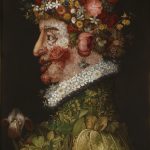
Among the strangest and most ingenious works of Renaissance art, Fire by Giuseppe Arcimboldo stands out as a hauntingly inventive portrait built entirely from objects associated with heat, combustion, and war. Painted in 1566, this masterpiece forms one-quarter of the artist’s celebrated Four Elements series. At first glance, Fire seems whimsical, even humorous. But a deeper examination reveals layered symbolism and a purposeful nod to the values and worldview of 16th-century Europe.
Arcimboldo developed a unique form of portraiture, where facial features were composed of items thematically tied to the subject’s identity. This style, known as composite or object portraiture, gained him considerable fame during his lifetime. While earlier artists flirted with allegory, Arcimboldo fully embraced it, crafting complex visual puzzles that conveyed both meaning and wit. Fire, with its smoldering eyes and flaming curls, is perhaps his most striking example.
The Four Elements series—consisting of Earth, Water, Air, and Fire—was not merely an exercise in artistry. It was a reflection of the Renaissance interest in natural philosophy, the humors, and the harmonious balance of creation. Each element corresponded to a season and was thought to govern aspects of human nature and divine order. In this context, Fire represented vigor, transformation, and sometimes judgment.
Unmistakably masculine and aggressive, Fire was created to stand opposite Winter, from Arcimboldo’s Four Seasons series. Their pairing symbolized not just heat versus cold, but force versus decay, action versus passivity. Through the element of fire, Arcimboldo praised both the destructive power and the civilizing flame that defined the imperial ambition of the Habsburg dynasty he served.
The ‘Four Elements’ Series Explained
The Four Elements series was painted around 1566 for Emperor Maximilian II of the Holy Roman Empire. These paintings reflected the Renaissance fascination with order in nature and the interdependence of all things. Arcimboldo combined science, mythology, and Christian cosmology into vivid, grotesque forms that defied tradition while exalting the classical and biblical worldview. Each painting in the series represents a different element personified through composite objects from nature or civilization.
In Earth, for instance, a face emerges from a fusion of mammals, reptiles, and forest life. Water is made up entirely of aquatic creatures—fish, crustaceans, and sea monsters—revealing a fascination with taxonomy and oceanic life. Air takes flight with feathers, birds, and wind instruments, emphasizing a more playful spirit. Fire, however, stands apart. Its composition of weaponry, flame, and metallurgy communicates a more serious tone—one of danger, dominion, and vigilance.
The elements were often believed to correspond to the four humors—fire aligning with yellow bile and the choleric temperament. People with a fire-dominant nature were considered assertive, ambitious, and quick to anger. These temperaments were thought to affect both individuals and the fate of nations. Arcimboldo’s elemental series taps directly into these beliefs, making each portrait more than decorative—it is didactic and symbolic.
Arcimboldo’s masterful blend of visual ingenuity and philosophical depth gave the Four Elements a sense of legitimacy at court. These weren’t mere curiosities for entertainment; they communicated the Emperor’s control over nature and man. Fire, in this sense, was not just art—it was a political statement rendered in oils and metaphor.
The Role of Fire in Arcimboldo’s Vision
Fire is the most aggressive and militaristic of the four elemental paintings, capturing the energy and destruction associated with the flame. The Renaissance mind saw fire not only as a destructive force but also as a purifying one. It was necessary to forge metals, prepare food, warm homes, and fight wars. For Arcimboldo, these associations made fire a perfect symbol of imperial might and masculine energy.
Rather than represent fire as a flickering flame or natural phenomenon, Arcimboldo anthropomorphized it. The fiery figure is crafted from burning logs, oil lamps, fuses, and weapons—each object tied to both everyday survival and violent conquest. The fiery expression, with glaring eyes and gritted teeth, creates an image that is more threatening than any of the other elements.
The painting also has ties to mythological imagery. In classical tradition, fire was associated with Mars, the god of war, and with Hephaestus (or Vulcan), the divine blacksmith. Arcimboldo subtly channels these associations by constructing the head from tools of metallurgy and combat. The symbolism was clear to any educated viewer in the court of Maximilian II.
Through Fire, Arcimboldo honors the strength and necessity of power—military, divine, and intellectual. The Emperor was expected to be a protector and punisher, a wielder of righteous fury when needed. Fire’s volatility and utility perfectly mirror this dual responsibility.
Arcimboldo’s Life and Imperial Commission
Giuseppe Arcimboldo was born in Milan in 1526, into a family of artists. His father, Biagio Arcimboldo, was also a painter, likely influencing his early career. Arcimboldo initially gained recognition through work on stained glass and religious tapestries in Milan Cathedral. These early commissions from the 1540s and 1550s reflect a conventional Renaissance training, but even then, there are hints of his eventual move toward the fantastic.
In 1562, Arcimboldo was summoned to the Habsburg court in Vienna by Emperor Ferdinand I. When Ferdinand died in 1564, his son Maximilian II retained Arcimboldo as a court artist. It was under Maximilian that Arcimboldo truly flourished. He was more than a painter—he became a court decorator, festival designer, and diplomatic symbol. His inventive portraits delighted the Emperor and served a propagandistic purpose.
The Four Elements series was completed in 1566 and presented as a gift to Maximilian II. Arcimboldo had a talent for combining wit and meaning, and the Emperor appreciated the intellectual playfulness of his work. Fire and its companions were more than just paintings; they were allegorical affirmations of the Emperor’s dominion over the natural world.
Arcimboldo remained at the Habsburg court until 1587 when he returned to Milan. He died there in 1593, but his legacy had already been cemented. Though later centuries forgot him for a time, he remained a favorite of Emperor Rudolf II, Maximilian’s son, who possessed a particular interest in natural curiosities and philosophical enigmas—traits Arcimboldo’s art personified.
From Milan to the Imperial Court
Arcimboldo’s early works included designing cartoons for stained glass windows in Milan Cathedral, a highly prestigious project. Records show he worked on windows depicting scenes from the lives of saints, an early sign of his detail-oriented craftsmanship. His talent was clear, but his reputation was still regional.
His move to Vienna marked a decisive shift. The Habsburg court under Maximilian II was a hub of science, art, and political power. Arcimboldo’s transition from Milan to Vienna in 1562 was not just a relocation—it was a promotion into the elite circle of European intelligentsia and statesmanship. His skills were deployed for courtly spectacles and private commissions that emphasized imperial sophistication.
Arcimboldo’s talents were particularly well suited to the Habsburgs’ self-image as rulers of a vast, diverse empire. His art blended wonder with order, humor with hierarchy. The Four Elements, composed of nature’s fragments, served as visual metaphors for the Emperor’s ability to command chaos into structure.
It’s important to note that these works were never intended for public display in churches or town halls. They were courtly treasures, private masterpieces designed to impress and instruct a narrow circle of power brokers and foreign envoys. In this setting, Fire spoke volumes.
Commissioned by Emperor Maximilian II
Maximilian II (1527–1576) ruled as Holy Roman Emperor from 1564 until his death. He was a moderate Catholic with interests in science, humanism, and governance. His taste in art reflected his intellectual curiosity and political cunning. Arcimboldo’s Four Elements fit perfectly into the Emperor’s vision of power rooted in reason and divine order.
The commission of the Four Elements in 1566 was both artistic and ideological. Maximilian’s rule was constantly under threat—from external enemies like the Ottoman Empire and internal divisions within the empire’s Protestant-Catholic split. Paintings like Fire offered symbolic reassurances: the Emperor had mastery over the volatile forces of nature and man.
Maximilian often gifted Arcimboldo’s works to foreign dignitaries and nobles as diplomatic tokens. The novelty of the composite portraits gave them international appeal, while their allegorical meaning provided serious political weight. Arcimboldo’s painting thus served as both cultural propaganda and personal flattery.
The commissioning of the Four Elements is also notable because it marks a fusion of art and early science. These were years when alchemy, astrology, and natural philosophy were not fringe ideas but mainstream tools of understanding the world. In this environment, a painting like Fire was not merely decoration—it was a visual thesis on the element’s place in the cosmos.
Visual Composition of ‘Fire’
Arcimboldo’s Fire stands as a dazzling example of visual wit and technical mastery. At its core is a head constructed from various flame-related objects. A burning log forms the torso and neck. A lit oil lamp becomes the ear. A cannon and gun barrel shape the nose and jawline, and smoldering matches act as tendrils of hair. Even the lips and eyebrows are built from curling flames and glinting metal, lending the image a theatrical intensity.
The artist’s ability to combine everyday objects into an illusion of a lifelike portrait speaks to his genius. The face in Fire is not a still-life arranged randomly—it is methodically structured to suggest depth, emotion, and strength. Each item not only contributes to the facial anatomy but also supports the painting’s broader themes. The use of iron and weaponry creates a visual vocabulary of heat, conflict, and endurance.
Arcimboldo’s color palette in Fire is dominated by rich reds, oranges, and blacks, reflecting both the color of fire and the iron tools that channel its power. The shadows and highlights are skillfully painted to suggest glowing embers and reflective metal. The painter uses a soft background to ensure the face remains the focal point, allowing viewers to concentrate on decoding each element.
The materials used were familiar to any 16th-century viewer—gunpowder horns, lit fuses, and lamp holders—things seen in workshops, kitchens, and armories. The use of these domestic and military items grounds the painting in reality while elevating it through allegory. In a world where fire could mean either survival or annihilation, Arcimboldo’s visual choices invite reflection on the dual role of this elemental force.
Materials of Destruction and Power
Arcimboldo did not randomly select the items that form Fire—each one was carefully chosen for its symbolic and practical connections to the element. The cannon and musket barrels speak directly to fire’s use in warfare. The oil lamp, positioned cleverly as the ear, symbolizes enlightenment, a nod to fire’s role in illuminating both homes and minds.
A lit match takes the place of the tongue or breath, symbolizing the spoken word or the initial spark that leads to combustion. Smoking logs, placed at the base, form the neck and suggest the aftermath of destruction. The collar is composed of golden fire strikers, referencing tools used to ignite flames—again reinforcing both the utility and the danger of the element.
Also present are fuses and powder horns, crucial tools in 16th-century warfare. These objects would have been instantly recognizable to Arcimboldo’s audience. They weren’t just decorative—they told a story of imperial readiness and control over volatile forces. They also reminded viewers of the cost of power and the necessity of harnessing fire responsibly.
The use of weaponry and combustibles places Fire firmly within a world of masculine dominion and imperial warfare. It reflects a time when control over gunpowder and metallurgy was as important as territory. The materials thus serve both a compositional and a philosophical function, declaring that fire is a servant of civilization but also a herald of its destruction.
The Fiery Head and Expression
The portrait’s head is where Arcimboldo’s compositional genius is most evident. The flaming locks form a wild, expressive hairline, suggesting both fury and vitality. The mouth, formed from flint and steel, is slightly agape, as if shouting or breathing smoke. The overall expression is one of intense focus—combining anger, energy, and vigilance.
Eyes composed of darkened coals or metal rings evoke a lifeless, burning stare. They do not glitter with human soul but rather with smoldering intensity, representing fire’s impersonal power. The use of curved iron and soot-covered components helps define the forehead and jaw, giving the illusion of three-dimensionality.
Arcimboldo’s placement of the burning match in or near the mouth may be a symbolic representation of the spoken word as a spark—capable of inspiring or inciting. The glowing materials, some active and others extinguished, portray fire in various stages: from ignition to consumption to decay. Each layer reveals a different facet of the element’s life cycle.
These choices were not just artistic; they were philosophical. The face doesn’t merely “look like” fire—it is fire, embodied and personified. In capturing the ferocity of flame, Arcimboldo offers a vision that is simultaneously grotesque and magnificent, a portrait of energy harnessed by man but never truly tamed.
Allegorical Meaning and Symbolism
The symbolism in Fire runs deep, anchored in both religious and classical traditions. In Christian doctrine, fire represents the Holy Spirit, judgment, and purification. It is the flame that burns away sin but also the fire of Hell. Arcimboldo’s composition does not shy away from this ambiguity—in fact, it embraces it. The duality of fire is its power and its danger.
Classical mythology also viewed fire as a gift of the gods. Prometheus was punished for stealing fire from Olympus and giving it to mankind, a myth that reflects humanity’s uneasy relationship with this element. In Arcimboldo’s era, fire was simultaneously an instrument of industry and a weapon of death. This double-edged nature makes it ideal for allegory.
Through Fire, Arcimboldo shows both the necessity and the volatility of this element. The painting is not simply an ode to fire’s beauty—it’s a meditation on its consequences. Used correctly, fire forges tools, bakes bread, and lights cities. Used poorly, it razes towns, burns heretics, and ends empires. In every coal and ember, there is both promise and peril.
In combining these opposing meanings, Fire becomes an embodiment of Renaissance humanism—recognizing man’s dominion over nature, but also his dependence on divine grace and natural limits. The portrait becomes more than a trick of the eye; it’s a cautionary vision of power that must be handled with respect and restraint.
Fire as a Dual-Force of Creation and Destruction
Fire’s symbolic duality—life-giver and destroyer—is central to Arcimboldo’s message. In agriculture, fire clears fields for new growth. In the forge, it shapes the tools of civilization. But on the battlefield, it consumes indiscriminately. Arcimboldo captures all of these meanings in a single face, reminding viewers that mastery over fire reflects mastery over self.
Renaissance thinkers believed that understanding the natural elements led to understanding human behavior. Fire corresponded to the choleric temperament—bold, fiery, often reckless. Rulers had to balance such traits with wisdom and restraint. By placing Fire in the Emperor’s possession, Arcimboldo subtly praised his ability to govern fierce passions with regal calm.
The artistic decision to focus on war-related items in the portrait also mirrors political realities. The Holy Roman Empire faced continuous threats from the Ottomans and religious wars within Europe. Fire as a force of defense, readiness, and divine justice fit neatly into the Habsburg narrative of God-ordained authority.
Yet there’s also the presence of beauty and control. The face in Fire is not a chaotic blaze—it is symmetrical, precise, and composed. This reflects the Renaissance ideal of reason reigning over passion, structure over chaos. It is not a wildfire but a controlled burn, and in that lies its power.
Ties to the Habsburg Empire’s Power
Arcimboldo’s portrait was as much about the Habsburgs as it was about fire. The painting subtly but powerfully reinforced imperial ideals. Just as fire enables the blacksmith to create weapons and the cook to prepare food, so too does the Emperor bring both protection and sustenance to his people. The symbolism wasn’t lost on Maximilian II or his advisors.
The Habsburgs saw themselves as stewards of divine order in a fractured world. In Fire, Arcimboldo offered a mirror of this belief. The Emperor was not just a political ruler; he was a cosmic mediator, tasked with channeling natural forces for the good of Christendom. The flaming face thus becomes a symbol of imperial justice and readiness.
By combining instruments of war with symbols of domestic use, the painting acknowledged the Emperor’s dual responsibilities: to defend and to cultivate. The message was clear—this was a ruler who wielded the sword with care and the torch with wisdom. It was both a celebration and a warning.
That Fire was paired with Winter—another masculine and harsh element—further emphasized the themes of hardship, endurance, and strength. While Fire blazes with energy, Winter stands in cold defiance. Together, they formed a powerful allegory of nature’s extremes—and the Emperor’s ability to navigate them.
Relationship to Arcimboldo’s Other Elemental Works
Fire was never meant to be viewed in isolation. Giuseppe Arcimboldo carefully designed the Four Elements series—Earth, Water, Air, and Fire—to function as a unified allegory of the natural world. When displayed together, each painting offered a visual meditation on one of the classical elements, rooted in the ancient Greek understanding of nature. These portraits were not random exercises in clever composition; they were deeply philosophical reflections crafted with courtly precision.
Where Earth features a regal profile constructed from animals of the land, and Water a face made entirely of fish and aquatic creatures, Air lightens the mood with songbirds, feathers, and flying creatures. In contrast, Fire remains uniquely intense, militaristic, and masculine in both tone and content. The set’s unity is seen not just in subject matter, but in how each element contributes to the harmony of the universe. Together, they reflect the Habsburg claim to universal order and balance.
The paintings were also meant to pair with Arcimboldo’s other major allegorical cycle, the Four Seasons. This parallel set included Spring, Summer, Autumn, and Winter. Each season was associated with a particular element—Fire was traditionally paired with Winter, forming a dual composition that explored themes of heat and cold, vigor and decay. These were not just seasonal metaphors, but commentaries on time, power, and the Emperor’s ability to rule across all phases of nature and life.
By aligning elemental theory with imperial propaganda, Arcimboldo elevated the composite portrait into something far greater than a clever gimmick. He constructed a visual cosmology in which the Emperor stood at the center, a ruler harmonizing the clashing forces of nature through wisdom and divine favor. Fire, in this web, was the symbol of action, judgment, and readiness—the attributes of a monarch in command of the flames of history.
Elemental Pairing with ‘Winter’
Arcimboldo’s decision to pair Fire with Winter was intentional and layered with meaning. Winter, like Fire, was created in 1563 and is composed of tree bark, twisted branches, and withered foliage. Where Fire is all energy and combustion, Winter is dormant, aged, and harsh. The two serve as counterpoints: one represents the peak of force and brightness, the other the stillness and suffering of cold.
The portrait of Winter often features a cracked, frozen face with dry, brittle features. It’s a season of hardship but also renewal. Paired with Fire, the result is a cycle of life and destruction, death and rebirth. Just as fire clears forests to allow new growth, winter strips away the old to make room for spring. The philosophical message was clear—each destructive phase holds the seed of regeneration.
In imperial terms, Fire and Winter worked together to represent both the punishing and protective aspects of leadership. A good ruler must know when to burn away corruption and when to preserve order through quiet strength. Maximilian II, whose reign required both martial defense and religious diplomacy, would have appreciated this dynamic.
When displayed together, the two paintings formed a powerful diptych that revealed Arcimboldo’s deeper allegorical genius. He wasn’t just painting faces; he was mapping out a cosmic and political order, with fire and frost as metaphors for the sovereign’s burden and the rhythm of divine governance.
How ‘Fire’ Stands Apart
Among the Four Elements, Fire is visually the most aggressive and thematically the most politically charged. While Earth and Water revel in abundance and natural diversity, and Air dances with whimsical energy, Fire radiates tension and readiness. It is the only element constructed primarily of man-made objects—suggesting mastery of nature, not just its observation.
The presence of weaponry, combustibles, and industrial tools makes Fire the only portrait rooted in human technology and conquest. This focus sets it apart from the other elements, which rely on flora and fauna. The symbolism of Fire is tied to man’s intervention in nature—how he shapes it, uses it, and sometimes succumbs to it.
From a visual standpoint, Fire is also the most intense. The colors are hotter, the forms more angular and sharp. There’s less harmony and more friction in the lines and shadows. This was not accidental. Arcimboldo understood that fire does not exist in gentle equilibrium—it devours and transforms. His portrait reflects this energy with deliberate boldness.
For these reasons, Fire may be the most “modern” of the elements, foreshadowing later developments in art where the destructive power of man takes center stage. Arcimboldo’s contemporaries saw fire as essential to empire; today we may see it as a symbol of control and chaos in equal measure. His vision, though steeped in Renaissance belief, continues to resonate in a world shaped by both invention and flame.
Technical Mastery and Artistic Innovation
Arcimboldo’s technical skill in Fire is as astonishing as his imagination. Though the painting may look whimsical at a glance, it reveals extraordinary control over oil painting techniques. Each object—whether it’s a smoking fuse or a polished gun barrel—is rendered with meticulous care. Light, shadow, and texture are manipulated to create a cohesive and convincing illusion.
Unlike traditional portraitists who sought to idealize the human face, Arcimboldo dismantled it. He treated each component of the composition not as part of a body but as a symbolic unit, fully committed to its dual identity as both object and feature. This technique required not only a deep understanding of anatomy but also of visual metaphor. His use of chiaroscuro—a method of strong contrasts between light and dark—further helped him model forms in a way that felt both sculptural and alive.
His brushwork is careful, layered, and deliberate. Paintings like Fire reveal no loose or rushed strokes. The materials depicted have shine, weight, and even temperature. The glowing embers seem hot, the metal cold and hard. Such effects demanded multiple layers of glazing and careful drying times—Arcimboldo’s patience and discipline were as strong as his imagination.
What makes Arcimboldo’s innovation so remarkable is that it exists within the constraints of oil on canvas and 16th-century techniques. There were no shortcuts or digital tools—only brushes, pigments, and genius. In Fire, every decision serves a larger purpose: to unite the literal and the allegorical, the artistic and the philosophical, in a single, unforgettable image.
Meticulous Oil Work and Layering
Oil painting in the 16th century required significant time and expertise. Each layer of paint had to dry before the next could be applied, especially if the goal was to achieve the kind of detail Arcimboldo pursued. His surfaces were smooth but not lifeless; they shimmer with vitality and craftsmanship.
To depict metal and fire convincingly, Arcimboldo had to master the interplay of highlights and reflections. The gun barrels, for example, reflect a cold gleam that stands out sharply against the fiery background. The burning logs glow with an inner light, created by delicate layering of transparent pigments over brighter underpainting. These techniques gave depth and realism to objects that were, ultimately, illusions.
Such skill did not go unnoticed. Arcimboldo’s work was celebrated in his lifetime not just for its strangeness but for its execution. Other court painters may have been better known for portraits of nobles, but Arcimboldo’s name was mentioned across Europe because his works challenged the very boundaries of representation.
Today, technical analyses using infrared and X-ray technologies continue to confirm the complexity of his methods. Arcimboldo was not simply toying with ideas—he was advancing the technical boundaries of his medium while doing so.
Innovation in Composite Portraiture
Arcimboldo’s composite style was without precedent. While grotesques and marginalia had long been used in illuminated manuscripts, no artist before him had dared to construct full human portraits from inanimate or living objects in this way. His method was new, daring, and deeply intellectual.
Each of his paintings is a riddle. They can be viewed as realistic still lifes, allegories, or human faces—all at once. This triple reading made Arcimboldo’s work endlessly engaging and set him apart from his peers. While Titian and Bronzino were painting noble faces and classical myths, Arcimboldo was constructing faces made of turnips, birds, and flames—and making them serve imperial propaganda.
His influence spread even beyond his lifetime, although his style was not widely copied. Few artists could match his precision and imagination. He left behind a narrow but profound legacy: the invention of a visual genre where metaphor and realism are not opposites but collaborators.
Arcimboldo’s composite portraits mark a high point in Mannerist art, where complexity, elegance, and mystery replaced the balanced simplicity of the High Renaissance. They remain unmatched in their conceptual depth and technical bravura.
Influence on Surrealism and Modern Art
Though Arcimboldo faded into relative obscurity after his death in 1593, his work experienced a major resurgence in the early 20th century. This revival was driven in part by the Surrealists, who saw in Arcimboldo a kindred spirit—an artist who subverted visual expectations and delved into the subconscious through layered imagery. Figures like Salvador Dalí, Max Ernst, and René Magritte openly admired Arcimboldo’s use of paradox and illusion.
To the Surrealists, Arcimboldo was a proto-modernist. They embraced his ability to fuse opposites: object and subject, natural and artificial, grotesque and beautiful. Dalí once described Arcimboldo as the father of surrealist portraiture, noting how the Renaissance artist anticipated ideas that wouldn’t fully emerge until centuries later. Arcimboldo’s “double images”—where one thing becomes another—aligned perfectly with the Surrealist fascination with dream logic and subconscious symbolism.
This newfound appreciation also sparked scholarly interest. Art historians began re-examining Arcimboldo’s legacy not just as a courtly entertainer, but as a serious intellectual and innovator. Museum exhibitions in the 20th and 21st centuries reintroduced his paintings to the public, where their rich details and allegorical meanings could be fully appreciated again. His blend of visual pun, philosophical depth, and technical mastery found a new audience in a modern world grappling with identity, perception, and art’s purpose.
Even outside of fine art, Arcimboldo’s influence can be seen in political cartoons, fantasy illustration, and digital media. His approach to symbolic portraiture has inspired generations of creatives working across genres. From children’s books to album covers, the echoes of his elemental faces continue to blaze across the cultural imagination.
Surrealists and the Rediscovery of Arcimboldo
The early 1900s marked the beginning of Arcimboldo’s rediscovery, thanks largely to the efforts of the Surrealist movement. When they encountered his composite portraits, the Surrealists were astounded. Here was an artist from the 1500s who had already mastered many of the visual tricks they were only beginning to explore. André Breton, the founder of Surrealism, referenced Arcimboldo’s work as an example of how the imagination could upend traditional logic.
Salvador Dalí, known for his melting clocks and morphing landscapes, drew heavily from Arcimboldo’s visual language. He praised the Renaissance painter’s ability to combine unrelated objects into coherent, often unsettling forms. Arcimboldo’s technique of visual punning—where an object means more than what it seems—deeply influenced the Surrealist goal of tapping into deeper meanings through irrational associations.
Max Ernst took this further, using collage techniques to build composite creatures and faces much like Arcimboldo had done. These modern artists did not just imitate Arcimboldo—they recognized him as a foundational figure, someone who had challenged the very nature of perception centuries before Freud or psychoanalysis.
Arcimboldo’s return to the spotlight was not just a fluke of fashion. It was a recognition of enduring genius, a tribute from modern visionaries to one of their earliest forerunners. In a time when art was increasingly psychological and symbolic, Arcimboldo’s legacy fit perfectly.
Echoes in Contemporary Symbolic Art
Today, Arcimboldo’s influence extends far beyond gallery walls. Contemporary artists exploring themes of identity, perception, and materialism frequently draw inspiration from his work. His composite style—where objects form a whole greater than their parts—resonates in everything from fashion photography to advertising campaigns.
Digital artists, in particular, have embraced Arcimboldo’s method. With software, they recreate his style using photos of modern objects—electronics, consumer goods, or urban textures—transforming them into human likenesses. These works, shared widely on social media and in installations, continue Arcimboldo’s tradition of layered meaning and surprise.
Political artists also find relevance in his work. Just as Arcimboldo used military and domestic objects to craft Fire, modern illustrators build faces from symbols of industry, ideology, or media—reflecting the forces shaping modern identity. These contemporary echoes suggest that Arcimboldo’s visual language remains powerfully current.
More than 450 years after Fire was painted, its visual DNA lives on. From surrealist canvases to digital collages, the flame of Arcimboldo’s creativity continues to kindle new artistic fire.
Where to See ‘Fire’ Today
The original painting Fire is housed in the Kunsthistorisches Museum in Vienna, Austria. This institution holds one of the finest collections of Renaissance and Baroque art in Europe, with a special focus on works commissioned by the Habsburg dynasty. Fire, along with other pieces from Arcimboldo’s Four Elements series, is displayed with great care and contextual explanation, allowing visitors to appreciate both its artistry and symbolism.
The painting is not always on permanent display, as it occasionally travels for major international exhibitions. However, the Kunsthistorisches Museum maintains detailed catalogues and high-resolution digital archives for research and public education. Visitors to Vienna can typically expect to see Fire as part of thematic displays focused on imperial art or Renaissance innovation.
In recent decades, Arcimboldo’s Fire and its companion works have featured in prominent international exhibitions. Shows in Paris, Milan, and New York have explored his legacy as a visionary artist. These events usually pair his paintings with modern reinterpretations, reinforcing the idea that Arcimboldo is not merely a historical curiosity but an enduring influence on how we see and think.
For those unable to visit in person, several museum databases and virtual tours offer high-resolution views of Fire. The painting is featured in online galleries maintained by the Kunsthistorisches Museum, and educational videos from institutions like the National Gallery provide guided analysis. These digital resources ensure that Arcimboldo’s flame reaches art lovers around the world.
Collection and Museum Location
The Kunsthistorisches Museum in Vienna, founded in 1891, holds an extensive collection of imperial treasures. Arcimboldo’s Fire entered this collection as part of the Habsburg legacy and is considered a cornerstone of the museum’s Renaissance holdings. The museum’s curation places Arcimboldo’s works alongside other court artists, emphasizing their diplomatic and ideological roles.
The painting is relatively small compared to monumental canvases of the time, measuring approximately 66 by 50 centimeters. Yet its impact is outsized, drawing viewers into its intricate details and allegorical depths. Museum placards explain the context of its creation and the elements that compose the fiery visage.
Visitors typically find Fire displayed alongside other Arcimboldo paintings, including Water and Summer, when the full sets are available. Special exhibitions often group Fire with weaponry, alchemical tools, and natural curiosities from the same era, offering a broader cultural context.
The museum’s collection is open year-round, and guided tours frequently highlight Fire as an example of Renaissance wit and philosophical complexity. Whether seen in person or online, the painting continues to captivate.
Viewings and Digital Accessibility
Thanks to digital preservation efforts, Fire can now be viewed online in astonishing detail. The Kunsthistorisches Museum offers high-resolution scans and zoomable images through its official website. These resources allow researchers and enthusiasts alike to examine every spark and soot-streaked surface.
Institutions such as the Google Arts & Culture platform have also included Arcimboldo’s works in their virtual tours. Viewers can explore the entire Four Elements series, compare them to the Four Seasons, and listen to audio guides explaining their meaning and context.
For students and scholars, the Getty Research Institute and JSTOR provide academic access to studies on Arcimboldo, including detailed examinations of Fire. These analyses cover both the visual construction and the philosophical ideas embedded within the work.
For those planning a trip to Vienna, the museum’s website includes exhibition calendars and ticketing information. Occasional traveling exhibits may bring Fire to major museums across Europe and North America, so keeping an eye on cultural calendars is worthwhile.
Final Reflections on the Genius of Arcimboldo
Arcimboldo’s Fire is more than a novelty or a clever trick of the eye—it is a masterpiece of meaning, composition, and technique. In this single painting, Arcimboldo captures the essence of an element, the temperament of a ruler, and the spirit of an age that sought to understand and master nature through art. It stands as a testament to what Renaissance art could be: imaginative, intelligent, and unapologetically symbolic.
Few artists dared to challenge the norms of portraiture in such a bold way. While others painted faces in flattering detail, Arcimboldo dismantled the face and rebuilt it from metaphor. His work was not subversive in a rebellious sense—it was grounded in a belief in divine order and imperial responsibility. Fire is a vision of authority as strength, of power as fire harnessed rather than fire unleashed.
Arcimboldo’s genius lies in his ability to use the materials of everyday life—tools, weapons, flames—and infuse them with philosophical weight. He did not need grand mythological scenes to explore deep truths. He found those truths in lamp oil and gunpowder, arranged with precision into a human form.
That Fire still speaks to us centuries later is no accident. It confronts us with the eternal realities of power, risk, and renewal. Whether viewed as a historical artifact or a timeless metaphor, Fire burns brightly in the canon of Western art.
Fire as Emblem of Arcimboldo’s Brilliance
Few paintings are as instantly recognizable or intellectually charged as Fire. Its unsettling beauty, complex symbolism, and technical excellence all point to the mind of an artist far ahead of his time. It is not merely clever—it is profound, offering layers of meaning that reward repeated viewing.
Arcimboldo’s portrayal of fire is not chaotic, but ordered and regal. This reflects his view of the Habsburg Empire and the ideal ruler—one who could control destructive forces and channel them into civilization and progress. Through Fire, he showed that even the most dangerous elements of life could be shaped into something noble.
This painting is not only an emblem of Arcimboldo’s unique style, but of his broader artistic philosophy. He believed that art should not only depict but also teach. Fire is both a mirror and a message, reminding viewers of their place in the natural and moral order of things.
It is that balance—between creativity and caution, between innovation and tradition—that cements Fire as one of the most brilliant portraits of the Renaissance.
Why Arcimboldo Still Matters
Arcimboldo continues to matter today because his art touches on eternal themes—identity, transformation, power, and the relationship between man and nature. In a world where art often struggles between entertainment and meaning, his work does both masterfully.
His influence on Surrealism and modern media confirms his lasting relevance. But more importantly, his respect for order, craftsmanship, and tradition speaks to enduring values. In an age of chaos, Arcimboldo reminds us of the strength found in structure and symbolism.
Arcimboldo’s art invites viewers to look closer, to think deeper, and to appreciate the fusion of logic and wonder. That alone would be enough to secure his legacy. But in Fire, he gives us more—he gives us a flame that continues to burn with insight and beauty.
His genius wasn’t about rebellion—it was about revelation. In that, Giuseppe Arcimboldo remains a towering figure in the story of Western art.
Key Takeaways
- Giuseppe Arcimboldo’s Fire was painted in 1566 as part of his Four Elements series for Emperor Maximilian II.
- The portrait is composed entirely of fire-related objects like burning logs, cannons, and oil lamps, symbolizing strength and controlled power.
- Fire was paired with Winter from the Four Seasons series, representing cosmic and imperial balance.
- Arcimboldo’s work heavily influenced Surrealist artists like Salvador Dalí and Max Ernst centuries later.
- The painting is housed in the Kunsthistorisches Museum in Vienna and remains one of the most studied and admired works of Mannerist art.
FAQs
- Where is Giuseppe Arcimboldo’s Fire located?
The painting is held in the Kunsthistorisches Museum in Vienna, Austria. - When was Fire painted?
Fire was painted in 1566 as part of the Four Elements series commissioned by Emperor Maximilian II. - What objects are used to form the face in Fire?
The portrait is composed of burning logs, oil lamps, gun barrels, matches, and other flame-related tools. - Why is Arcimboldo considered a proto-Surrealist?
His use of object assemblage and visual paradox influenced Surrealists centuries later, earning him renewed recognition. - Is Fire part of a larger series?
Yes, it is one of four paintings in the Four Elements series, which includes Earth, Water, and Air.