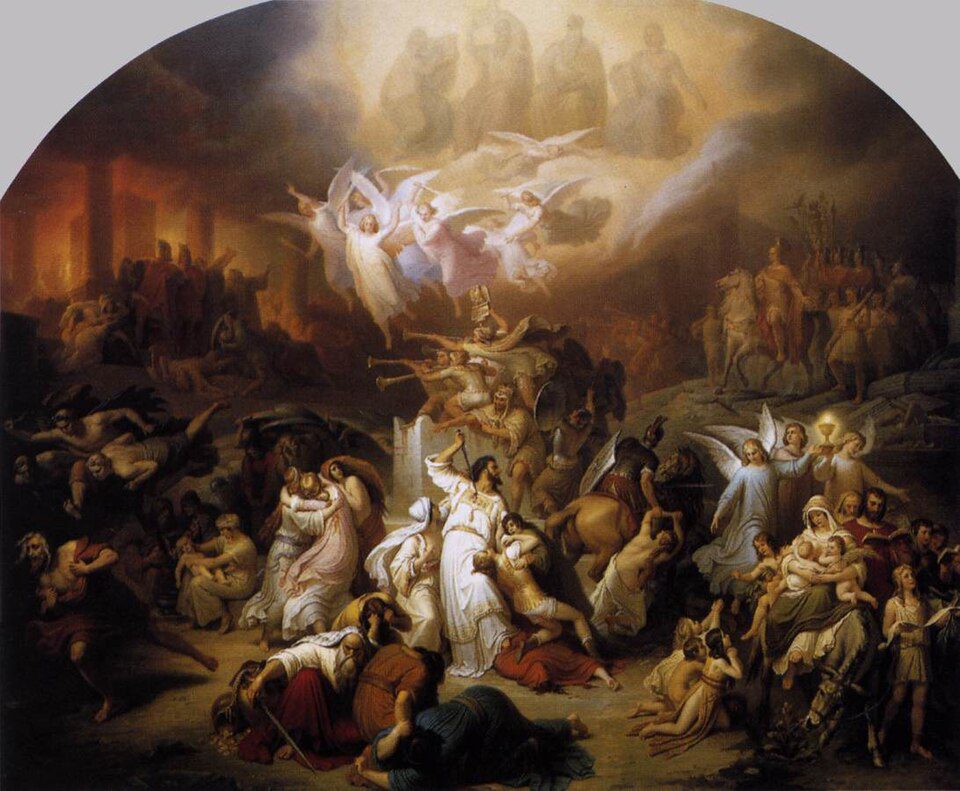
Wilhelm von Kaulbach’s The Destruction of Jerusalem by Titus is not just a painting—it’s a sweeping statement on civilization, divine judgment, and the fall of a once-sacred city. Created in 1846, this colossal mural blends historical realism with intense spiritual allegory. Standing over 19 feet high and stretching nearly 30 feet wide, it remains one of the most ambitious visual interpretations of a biblical event ever painted. It’s not merely about a military victory; it’s a canvas teeming with moral collapse and eternal truths.
The artwork portrays the brutal siege of Jerusalem in AD 70, when Roman legions under General Titus crushed the Jewish rebellion and razed the Second Temple. Kaulbach elevates the scene beyond warfare, transforming it into a moral and spiritual reckoning. The painting’s sheer scale was matched by its intent: to awaken the viewer’s conscience about the fate of nations and the cost of disobedience to divine order. It’s both visually overwhelming and intellectually demanding.
Set in the Neues Museum in Berlin, the mural was originally part of King Friedrich Wilhelm IV’s broader vision to use history and art to educate and edify the German public. Kaulbach’s piece fit perfectly into this 19th-century view of history as a moral teacher. The painting doesn’t just depict the ancient world—it critiques the modern one by holding up a mirror to humanity’s capacity for destruction and folly.
In a time when historical awareness and moral clarity are sorely needed, revisiting this painting reminds us that beauty and truth can still go hand in hand. Kaulbach’s mural offers more than an aesthetic experience; it serves as a dire warning from the past, encased in a frame of artistic excellence and biblical gravitas.
Who Was Wilhelm von Kaulbach?
Wilhelm von Kaulbach was born on October 15, 1805, in Bad Arolsen, in what is now central Germany. He was raised in modest circumstances, the son of a poor goldsmith who had fallen on hard times. Despite these hardships, Kaulbach’s talent for drawing became apparent early in life. He won a scholarship to study at the Düsseldorf Academy of Art, where he came under the tutelage of the famed German Romantic painter Peter von Cornelius.
Cornelius profoundly influenced Kaulbach’s approach to history painting, encouraging large-scale allegorical works rooted in Christian morality and classical ideals. In 1826, Kaulbach followed Cornelius to Munich, where he was brought into the courtly circle of King Ludwig I of Bavaria. The king, a passionate patron of the arts, commissioned Kaulbach for several murals intended to glorify both biblical history and the Germanic cultural identity.
Kaulbach’s stature grew quickly. By 1849, he became Director of the Munich Academy of Fine Arts, a position he held until his death in 1874. His major works include The Battle of the Huns (painted in 1850), which shows the souls of fallen warriors fighting in the heavens, and The Age of the Reformation, which explores the religious upheavals that reshaped Europe. But none of his works encapsulates his moral vision and technical mastery as fully as The Destruction of Jerusalem by Titus.
Major Works by Wilhelm von Kaulbach
- The Battle of the Huns (1850)
- The Crusaders (1847)
- The Age of the Reformation (1861)
- Shakespeare Gallery (1835–1850s)
- The Destruction of Jerusalem by Titus (1846)
Kaulbach’s legacy stands at the crossroads of art, history, and religious truth. He didn’t merely depict events—he interpreted them, placing timeless moral themes at the heart of each canvas. His style, while often criticized by modernist tastes for being overly didactic, reflects a time when art was expected to educate as well as inspire. Through his work, he helped define what German academic painting could achieve.
Historical Context: The Roman Siege of Jerusalem
The destruction of Jerusalem in AD 70 stands as one of the most devastating and symbolic events in ancient history. It marked the end of the Second Temple period, a cornerstone of Jewish religious and national identity. The event occurred during the First Jewish–Roman War, which began in AD 66 as a rebellion against Roman rule. Four years later, the Roman general Titus—son of Emperor Vespasian—led a brutal military campaign to crush the uprising and lay siege to the city.
Titus commanded four legions, totaling over 60,000 men, in a coordinated assault that began in April and culminated in the city’s fall by September. The siege was merciless. Starvation set in as the Romans cut off supply lines, and infighting among Jewish factions weakened internal resistance. Josephus, a Jewish historian who defected to the Romans, estimated that over one million people perished during the siege, although modern scholars suggest the number was likely in the hundreds of thousands.
The destruction of the Second Temple on the 9th of Av (in the Hebrew calendar) was seen by many as divine judgment. For Jews, it represented the greatest national catastrophe since the Babylonian exile. For Christians, particularly in the 19th century, it was often interpreted as punishment for the rejection of Christ, though such views must be understood within their historical-theological context rather than as a basis for modern relations.
This cataclysmic event reshaped the religious and political landscape of the region. Jerusalem was left in ruins, and Jews were dispersed throughout the Roman Empire. It was not just a military conquest—it was a civilizational rupture. Kaulbach, steeped in both Christian tradition and classical education, recognized this as more than an episode in Roman history. To him, it was a universal parable of divine justice and human failure.
Commission and Creation of the Painting
Kaulbach began conceptualizing The Destruction of Jerusalem by Titus in the early 1840s as part of a grand artistic program for the Neues Museum in Berlin. This museum, championed by Friedrich Wilhelm IV of Prussia, was designed to serve as a national educational institution. The monarch believed that art, particularly historical and biblical art, could be a moral force for the German people. Kaulbach’s commission fit that vision precisely.
The mural was completed in 1846 and installed in the museum’s main stairwell. Measuring approximately 19 by 29 feet, it was painted using the “secco” technique—where pigments are applied to dry plaster rather than wet, allowing for greater detail and revisions. Kaulbach was assisted by several students and draftsmen, but the primary design and execution were his alone. He produced dozens of preparatory sketches to refine the narrative, composition, and allegorical elements.
Kaulbach worked obsessively on this project, pouring over both historical accounts and theological interpretations of the event. He read Josephus’ The Jewish War, which served as a key source of visual and narrative inspiration. He also studied classical Roman triumphal art, early Christian iconography, and medieval depictions of judgment and apocalypse to inform his design. Every figure, from the weeping mothers to the warlike angels, was carefully conceived.
The painting took years of planning but was executed in just under two years with the help of Kaulbach’s Munich workshop. When it was unveiled, it was hailed by many as the greatest German mural of the century. The king himself declared that the painting was “a sermon in color,” and for decades it stood as a cultural landmark, tying together Prussian virtue, biblical narrative, and moral instruction.
Visual Analysis: Chaos, Judgment, and Order
Kaulbach’s The Destruction of Jerusalem by Titus overwhelms the viewer with dynamic composition, vivid expression, and tightly orchestrated chaos. At the center stands Titus, robed in Roman military garb, elevated slightly above the scene—a figure of order amid catastrophe. His posture is commanding yet contemplative, suggesting both triumph and reluctant pity. Kaulbach’s Titus is not a barbaric invader, but rather a tool of divine retribution, echoing the 19th-century tendency to imbue historical figures with moral complexity.
Around Titus, a swirling inferno of destruction consumes the once-glorious city. Flames engulf buildings, and thick clouds of smoke twist upward, blurring the boundary between earth and heaven. To the left, Jewish defenders resist to the last, while priests clutch the sacred Torah scrolls in despair. One of the most heart-wrenching images is that of a mother cradling her dead child, a direct visual echo of accounts by Josephus and a universal symbol of the human cost of war. The fallen lie in heaps, their faces contorted in agony, not just physically but spiritually.
Above the earthly violence, Kaulbach inserts a celestial realm filled with allegorical figures. Angels hover among the clouds, not in comfort, but in judgment. Some scholars interpret them as representations of divine justice, truth, and vengeance. They cast sorrowful gazes downward or extend arms as if proclaiming the verdict from heaven. These angelic forms create a direct theological line from the heavens to Titus, implying that his destruction of the city fulfills a divine will rather than mere imperial ambition.
The entire composition is structured in a sweeping diagonal from lower left to upper right, guiding the viewer’s eye from chaos toward judgment. This compositional technique reinforces the narrative structure—man’s sin on earth, divine judgment above. Kaulbach’s mastery of anatomy, architectural perspective, and facial expression is evident in every corner of the mural. Each figure tells a story, each gesture contributes to the overarching theme. The balance of idealism and realism anchors the viewer in a scene that is as much about eternal truth as it is about historical fact.
Symbolism and Moral Message
Kaulbach did not paint history for history’s sake. He was steeped in the idea that art should serve as moral instruction, a belief reinforced by his classical education and Protestant upbringing. In The Destruction of Jerusalem by Titus, symbolism flows through every element—from the figures to the architecture, from light to shadow. The mural is as much a theological commentary as it is a historical record. It warns of the spiritual dangers of rebellion, pride, and apostasy.
At the heart of the painting lies the idea of divine judgment. Titus, while a Roman general, is portrayed almost as an Old Testament instrument of wrath—akin to Nebuchadnezzar in the Book of Daniel. The destruction of the Second Temple becomes more than a military victory; it is a spiritual reckoning. This theme would have resonated deeply with 19th-century German viewers, who often saw biblical history as a mirror to their own national destiny. For them, disobedience to divine law had consequences—whether ancient Jerusalem or modern Europe.
Kaulbach goes further by inserting allegorical figures representing abstract sins and virtues. Scholars have noted female figures that may embody Idolatry, Heresy, or even Fanaticism, crushed under the weight of the city’s collapse. These are not named explicitly, but their dramatic poses and exaggerated expressions mark them as symbolic rather than literal. Such moral personifications were common in 19th-century German academic painting, especially in works commissioned for public display.
The message is unmistakable: societies that lose their moral compass invite destruction. Jerusalem, in Kaulbach’s hands, becomes a metaphor for any civilization that abandons its divine mandate. The painting doesn’t celebrate Roman power—it laments the tragedy of spiritual decline. This sober and conservative reading of history, common in the Protestant monarchies of the time, is embedded in every brushstroke of the mural.
Kaulbach’s Style: Idealism Meets Monumentality
Kaulbach’s style in this mural blends neoclassical discipline with Romantic emotionalism. He was not interested in painting battlefields littered with gore for shock value. Instead, he pursued an elevated, idealized form of expression where moral and aesthetic principles coexisted. This was consistent with the traditions of the Nazarene school, a German movement rooted in Christian idealism, and his mentor Peter von Cornelius, who emphasized the dignity of biblical subjects.
Unlike the gritty realism that would dominate later 19th-century art, Kaulbach chose to dramatize events through grand gestures, clear expressions, and structured symbolism. The figures in the mural are anatomically refined, almost sculptural in their poise. This reflects his classical training and his belief that art should be beautiful, even when depicting horror. Kaulbach’s interpretation of the destruction of Jerusalem is tragic, but never vulgar or gratuitous. The suffering is dignified, the violence purposeful.
His use of space is particularly masterful. He creates a scene that feels crowded but never cluttered. Each group of figures—soldiers, mothers, priests, angels—forms a visual unit that plays into the larger rhythm of the piece. Architectural elements of the Second Temple crumble in mathematically precise diagonals, guiding the viewer’s eye with intention. Light and shadow are used not just for realism but to underscore theological truths. Light falls more fully on Titus and the angels, while sinners remain cloaked in darkness.
Kaulbach resisted the influence of modernism throughout his career. While others moved toward looser brushwork and naturalistic scenes, he clung to the belief that art must aspire to truth, order, and moral clarity. His murals, including this one, are sometimes criticized today for being “too academic,” but to dismiss them is to ignore their power as public monuments. They were never meant for private reflection—they were intended to shape the moral vision of a nation.
Reception and Legacy
When The Destruction of Jerusalem by Titus was unveiled in 1846, it was praised widely by conservative critics and intellectuals as a high point of German academic art. The mural embodied the virtues of historical grandeur, Christian morality, and national purpose. For decades, it drew crowds of Berliners and visiting Europeans, who saw in it a reflection of their own civilizational values. Friedrich Wilhelm IV regarded it as one of the defining masterpieces of his cultural program.
Kaulbach’s reputation soared throughout the 1850s and 1860s. He became one of the most decorated painters in the German-speaking world, awarded commissions across royal houses and cultural institutions. His murals, often installed in government buildings and museums, shaped the visual culture of 19th-century Germany. His work reflected and reinforced the idea that national greatness must rest on moral and spiritual foundations. In that context, The Destruction of Jerusalem served as both artwork and warning.
However, by the late 19th and early 20th centuries, artistic tastes began to shift. The rise of Impressionism and Expressionism made Kaulbach’s style seem outdated. His idealism and didactic tone were increasingly dismissed as heavy-handed. The mural itself suffered during the bombing of Berlin in World War II, though parts of the Neues Museum, including Kaulbach’s work, have since been restored. While his name faded from popular consciousness, art historians continue to study his work for its influence on public art and moral storytelling.
In recent decades, there has been renewed interest in Kaulbach as part of a broader reevaluation of academic art. Critics and scholars alike have begun to acknowledge the technical brilliance and philosophical ambition behind his grand historical compositions. Though out of step with modernist trends, his vision of art as a vessel for truth and national memory still resonates with those who value tradition and spiritual meaning in visual culture.
Comparing Kaulbach to Other Depictions of Jerusalem’s Fall
Kaulbach was not the first artist to tackle the dramatic fall of Jerusalem, but he may have approached it with the most sweeping ambition. Earlier painters had often focused on specific moments or architectural settings. For example, Nicolas Poussin’s The Destruction of the Temple at Jerusalem (1625) presents a more restrained, classical tableau. It captures the event with poise and order, reflecting the 17th-century French taste for calm grandeur. Poussin’s work is elegant, but lacks Kaulbach’s emotional force.
David Roberts, a Scottish painter known for his travels in the Holy Land, produced a series of prints in the 1840s showing the ruins of Jerusalem and imagined views of the Temple. While rich in architectural detail, Roberts’ works are more documentary than dramatic. They show the aftermath of destruction, not its spiritual cause or emotional cost. Kaulbach, by contrast, situates the viewer in the middle of divine judgment, using allegory to deepen the message.
Other artists like Francesco Hayez and James Tissot also depicted scenes from the Jewish-Roman wars, but often with narrower focus. Hayez, for instance, emphasized the pathos of individuals—especially women and children—rather than the theological implications. Tissot, known for his detailed biblical watercolors in the late 19th century, gave more attention to ethnographic accuracy than symbolic resonance. Kaulbach’s mural, on the other hand, attempts to do it all—evoke history, emotion, and eternal truth.
Other Artists Who Painted the Siege of Jerusalem
- Nicolas Poussin (The Destruction of the Temple at Jerusalem, 1625)
- David Roberts (The Holy City Jerusalem, lithographs, 1840s)
- Francesco Hayez (The Destruction of the Temple of Jerusalem, 1867)
- James Tissot (The Siege of Jerusalem, 1886–1894)
- Gustave Doré (The Siege and Destruction of Jerusalem, woodcuts, 1860s)
Kaulbach’s uniqueness lies in his ability to combine massive scale with intimate detail, and historical record with theological interpretation. Where others offered glimpses, Kaulbach offered a vision. His work doesn’t just show what happened—it tries to explain why it mattered.
Enduring Lessons from Kaulbach’s Masterpiece
Kaulbach’s The Destruction of Jerusalem by Titus endures not simply as a masterpiece of technical achievement, but as a visual sermon on the moral consequences of cultural and spiritual collapse. He created more than a historical tableau; he built a warning in pigment and plaster. The painting serves as a cautionary tale, one that would have felt particularly poignant in the turbulent years of the mid-19th century, as Europe struggled with revolutions, rising secularism, and moral drift.
The painting’s power lies in its layered meanings. On the surface, it tells the story of a military siege. But beneath that, Kaulbach compels us to see a society that turned away from the divine order, collapsing under the weight of its own sins. This reading was deeply in line with conservative Christian values of the time, particularly within Protestant Prussia, where the idea of national destiny was closely linked to religious obedience and discipline.
For the modern viewer, Kaulbach’s work continues to offer relevant insights. In an age often marked by cultural amnesia and moral relativism, the painting reasserts the truth that civilizations are judged not just by their achievements, but by their adherence to enduring principles. Kaulbach reminds us—without ambiguity—that when the spiritual foundation crumbles, the structure above cannot hold. His work speaks of the cost of rebellion, not just in ancient Judea, but wherever truth is rejected.
While contemporary audiences may be unaccustomed to such overt moralism in art, Kaulbach’s boldness is part of what makes this work so important. He didn’t hide behind abstraction or ambiguity. He told a story with clear moral stakes, and he did so with unmatched visual force. The painting invites reflection, not distraction. Its message is not only timeless—it’s urgent.
Key Takeaways
- Wilhelm von Kaulbach’s mural portrays the AD 70 Roman siege as divine judgment and cultural collapse.
- The painting blends history, theology, and allegory to deliver a morally charged visual narrative.
- Titus is shown not as a ruthless conqueror, but as an agent of divine justice.
- Kaulbach’s style reflects idealist and academic traditions, resisting modernist tendencies.
- The mural serves as both a historical document and a moral warning still relevant today.
Frequently Asked Questions (FAQs)
- Where is Kaulbach’s Destruction of Jerusalem by Titus located?
It was originally installed in the Neues Museum in Berlin and remains associated with that institution today. - When was the painting completed?
The mural was completed in 1846 after several years of planning and preparation. - What historical event does the painting depict?
It shows the Roman siege and destruction of Jerusalem in AD 70, led by General Titus. - What artistic style did Kaulbach use?
The mural reflects neoclassical and idealist traditions, emphasizing moral allegory over realism. - Why is the painting considered important?
It combines artistic brilliance with a powerful moral and historical message, making it a touchstone of 19th-century German academic art.