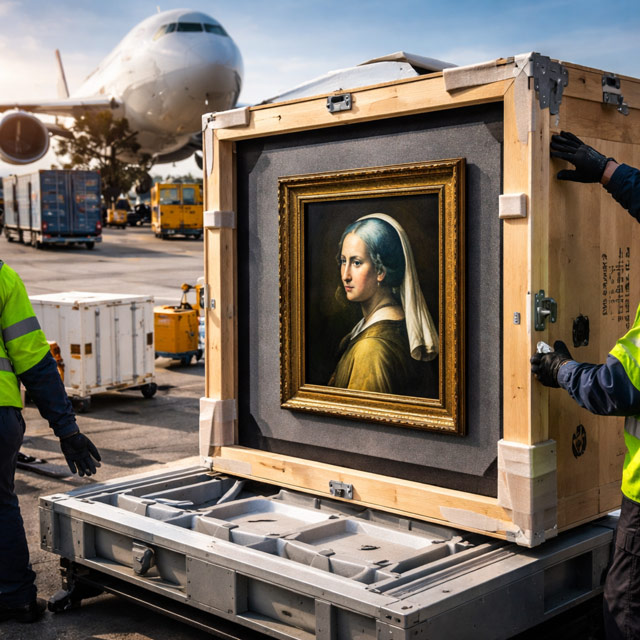
Transporting a priceless painting across an ocean is not like shipping a piece of furniture. When people ask how art is transported between countries, they are really asking how civilization moves safely from one nation to another. Masterpieces carry history, faith, and identity inside their frames. A single mistake in transit can erase centuries of heritage.
The global art market has expanded dramatically since the late twentieth century, especially after the 1980s rise of international art fairs. Major institutions such as the Louvre and the Metropolitan Museum of Art regularly lend works abroad for blockbuster exhibitions. These loans are often tied to diplomatic relationships and cultural exchange agreements signed between governments. Art becomes a quiet ambassador, traveling where politicians sometimes struggle to tread.
The Global Art Market and Cultural Exchange
Private collectors and auction houses also rely on international art transport to move works to buyers in different countries. Since the early 2000s, record-breaking auction sales in New York, London, and Hong Kong have required rapid yet secure global shipping solutions. Cultural exchange programs frequently stipulate exact transport conditions, down to humidity levels and courier accompaniment. These strict standards ensure that the physical journey does not damage the spiritual and historical value of the work.
Transporting art internationally is therefore not simply a logistical exercise but a responsibility. It blends conservation science, law, finance, and diplomacy into a single coordinated effort. While modern aviation and tracking technology have improved safety, the stakes remain high. The question of how art is transported between countries reflects a deeper concern about stewardship and respect for cultural property.
Who Handles International Art Transportation?
Behind every successful international art shipment stands a network of trained professionals. Fine art logistics companies such as Crozier Fine Arts, Momart, and Gander & White specialize exclusively in handling valuable works. These firms employ art handlers trained in packing, installation, and risk management. Many handlers complete formal conservation or museum studies programs before entering the field.
Museum registrars play an equally critical role in the art shipping process. A registrar manages loan agreements, tracks documentation, and ensures compliance with local and international laws. The profession became more formalized in the United States after the 1960s expansion of museum standards. Organizations like the American Alliance of Museums, founded in 1906, provide guidelines that shape best practices.
The Role of Museum Registrars and Fine Art Shippers
Registrars coordinate closely with shipping companies to plan each stage of international art transport. They draft facility reports, confirm climate specifications, and arrange couriers for high-value objects. Insurance providers such as AXA XL offer specialized fine art policies designed for global transit. Customs brokers, trained in import and export law, ensure that documentation is accurate and filed on time.
Collaboration is essential because no single professional controls every step. A registrar in New York may coordinate with a curator in Paris and a logistics manager in London. Each party must trust the others’ expertise and documentation. When people wonder how art is transported between countries safely, the real answer lies in this disciplined teamwork.
The Step-by-Step Process of Transporting Art Internationally
The transport journey begins with a detailed condition report. Conservators examine the artwork under bright light, noting cracks, abrasions, or frame instability. Photographs document every visible detail, creating a baseline record before departure. This report protects both lender and borrower in case of damage.
Next comes custom crating, which is tailored to the artwork’s size and fragility. Climate-controlled trucks move the crated object to an airport or seaport. International flights often carry artworks in temperature-regulated cargo holds. Customs paperwork is prepared in advance, including declarations and, when appropriate, an ATA Carnet for temporary import.
From Condition Report to Final Installation
High-value works frequently travel with a courier appointed by the lending institution. The courier oversees loading, monitors environmental conditions, and witnesses unpacking at the destination. Upon arrival, the receiving museum conducts a second condition report to compare with the original. Only after this verification does installation begin in the gallery space.
Installation teams follow precise instructions regarding light levels and mounting systems. Even small variations in humidity can affect works on paper or panel paintings. If discrepancies appear between condition reports, insurance claims procedures begin immediately. This disciplined process explains how art is transported between countries without compromising its integrity.
Packing and Crating — Protecting Art in Transit
Packing is the physical heart of international art transport. Museum-quality crates are built from treated wood and lined with archival materials. Shock-absorbent foam and vapor barriers shield the object from vibration and moisture. For paintings, travel frames may stabilize canvases during movement.
Climate control remains central to safe transit. Standard museum guidelines often aim for temperatures around 68 to 72 degrees Fahrenheit and relative humidity near 50 percent. Sculptures made of bronze, marble, or mixed media may require different internal supports. Works on paper demand particular care because they react quickly to environmental change.
Why Custom Crating Is Non-Negotiable
Custom crating accounts for an artwork’s exact dimensions and weight distribution. A sculpture weighing several hundred pounds may need internal bracing and external lifting points. Paintings with fragile gilded frames require padding that prevents abrasion. Conservators often supervise crate design to ensure that materials do not emit harmful chemicals.
The art shipping process leaves no room for improvisation. Even a minor jolt during turbulence can stress a canvas or crack a ceramic surface. Multi-layered protection systems reduce that risk dramatically. When discussing how art is transported between countries, professionals emphasize that proper crating is never optional.
Legal Requirements and Customs Regulations
International art transport operates within a strict legal framework. Export licenses may be required depending on the artwork’s age and national significance. The 1970 Convention of the UNESCO addressed the illicit import and export of cultural property. Many countries adopted stronger laws after 1970 to protect national heritage.
The Convention on International Trade in Endangered Species, known as CITES, regulates materials like ivory and certain woods. An antique object containing ivory may need special documentation before crossing borders. Provenance records must demonstrate legal ownership history. Customs authorities examine paperwork carefully to prevent smuggling.
Navigating Cultural Property Laws
Countries such as Italy and Egypt maintain particularly strict export controls on antiquities. In some cases, objects created before a specific date, such as AD 1900, cannot leave without government approval. Violations can result in heavy fines or seizure. Museums therefore consult legal experts before finalizing any loan.
Temporary imports often rely on customs bonds or ATA Carnets to avoid permanent taxation. These systems allow artworks to enter and exit a country for exhibition without being sold. Responsible institutions treat compliance as a matter of honor and national respect. Understanding how art is transported between countries means recognizing that legality is as vital as logistics.
Risks, Insurance, and Security Measures
Art in transit faces numerous risks, including theft, vibration, and environmental shifts. Insurance policies known as nail-to-nail coverage protect works from the moment they leave one wall until they hang on another. Valuations are often based on recent auction results or professional appraisals. Premiums reflect both the object’s value and travel conditions.
In the United States, the U.S. Arts and Artifacts Indemnity Program, established in 1975, helps reduce insurance costs for international loans. This federal program provides government-backed indemnity for eligible exhibitions. Security escorts may accompany especially valuable shipments. GPS tracking systems now allow real-time monitoring of crates in transit.
How Museums and Collectors Manage Risk
Risk management begins long before packing day. Institutions evaluate routes, weather patterns, and political stability in destination countries. Contracts specify liability and emergency procedures. If damage occurs, conservators assess restoration options immediately.
Collectors also rely on secure storage facilities between shipments. High-security warehouses feature surveillance cameras and restricted access controls. Claims processes require thorough documentation and prompt reporting. When examining how art is transported between countries safely, one sees that preparation outweighs luck.
Famous Examples of International Art Transport
History offers dramatic examples of masterpieces crossing oceans. In 1963, the painting known as the Mona Lisa traveled from France to the United States. The artist Leonardo da Vinci was born in 1452 and died in 1519, yet his work continued to shape diplomacy centuries later. The painting was displayed in Washington, D.C., and New York under heavy security.
Egypt also toured treasures of Tutankhamun, who ruled around 1332 to 1323 BC. Major exhibitions in the 1970s drew millions of visitors in cities across Europe and America. Crates were engineered to withstand long flights and climate changes. These tours demonstrated how art is transported between countries on a grand scale.
When Masterpieces Travel the World
Such exhibitions often involve months of negotiation and planning. Governments sign agreements specifying security, conservation, and return dates. In 1963, the Mona Lisa traveled aboard a specially outfitted vessel to reduce vibration, according to contemporary reports. While some logistical details remain sparsely documented, responsible historical speculation suggests that security protocols were adapted to Cold War concerns.
Public reaction to these traveling masterpieces can be electric. Visitors line up for hours to see an object normally housed thousands of miles away. Media coverage elevates the artwork to national conversation. These moments reveal that international art transport is not just about moving objects, but about connecting civilizations.
Key Takeaways
- Transporting art internationally requires coordinated expertise from registrars, shippers, insurers, and legal advisors.
- Custom crating and climate control are essential to prevent physical and environmental damage.
- Legal compliance, including adherence to UNESCO and CITES regulations, safeguards cultural heritage.
- Insurance programs like the U.S. Arts and Artifacts Indemnity Program reduce financial risk.
- Famous cases such as the 1963 Mona Lisa tour show how art is transported between countries with precision and diplomacy.
FAQs
- How long does international art transport usually take?
- What is a condition report and why is it important?
- Do all artworks require a courier during shipment?
- How do museums determine insurance value for traveling art?
- What happens if customs officials delay an artwork at the border?