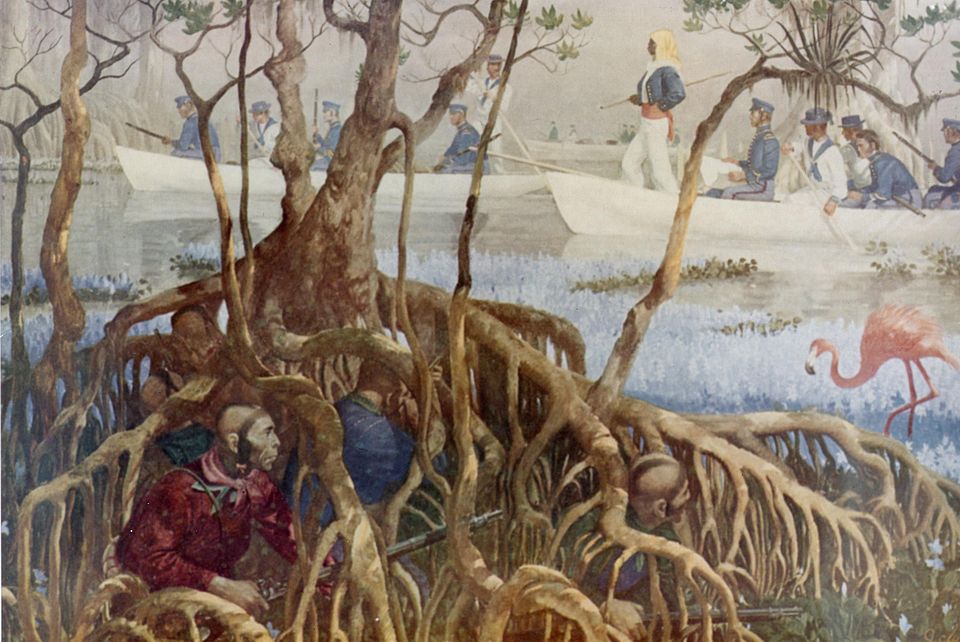
The oldest surviving art of Florida was not made with brush and canvas, but with bone, shell, and earth—materials so bound to the peninsula’s watery terrain that they seem grown from it. Long before European contact, even before the rise of historically named tribes such as the Calusa or Seminole, people were shaping Florida’s environment into visual and symbolic forms. These earliest works are fragmentary, eroded by millennia of humidity and storms, yet they still offer glimpses of imagination at work in deep time.
Shell and Bone as Early Mediums
Archaeological excavations across Florida’s rivers and coasts have uncovered ornaments fashioned from deer bone, alligator teeth, and conch shell. To modern eyes they may appear utilitarian—pendants, awls, fishhooks—but careful study reveals decisions of design: drilled holes placed for symmetry, surfaces smoothed into sheen, incised patterns that go beyond mere function. One of the most haunting objects comes from Key Marco, where a wooden figure carved perhaps a thousand years ago survived thanks to waterlogged conditions. The figure’s masklike face, with round eyes and pursed lips, suggests ceremonial use, and scholars debate whether it represents a spirit, an ancestor, or a creature of myth.
Bone and shell were chosen not only for availability but for their associations. Shell carried echoes of the sea, a force both nurturing and destructive. Bone tied the living to the cycle of the hunt. These materials made adornments that carried weight beyond beauty, anchoring personal identity to the rhythms of Florida’s ecology. When worn, they were not static objects but moving displays, catching light and sound in ceremonies and social gatherings.
What surprises many is how fine the craftsmanship could be. A 3,000-year-old carved bone pin from a midden near the St. Johns River depicts a waterbird with elongated neck and poised wings. Its maker was not merely carving decoration; the bird likely symbolized migration, abundance, or the watery worlds that sustained Florida communities. The carving transforms a scrap of animal bone into something both delicate and transcendent.
The Ceremonial Geometry of Earthworks
Beyond portable objects, Florida’s prehistoric peoples reshaped the land itself into patterns visible only from above. Mounds of shell and earth rise near river mouths and coastal inlets, some arranged in deliberate forms. While many served as burial sites, others seem aligned to cardinal directions or astronomical events. The most striking is the Great Serpent-like mound at Crystal River, where embankments and plazas hint at both ritual gathering and symbolic landscape design.
Archaeologists who map these sites find geometry embedded in the terrain: circles, crescents, even cross-like axes. These were not casual piles of refuse but engineered monuments, requiring communal labor and shared intention. In a flat peninsula where hills are rare, such mounds became artificial high points—literal stages on which ceremonies unfolded. The art here is not a sculpture to be viewed at arm’s length but a theater of earth and body, designed for participation.
A micro-narrative survives in the testimony of early Spanish chroniclers, who noted that native peoples of Florida gathered atop mounds to celebrate seasonal events. The spectacle of bodies arrayed against the horizon, drums echoing across wetlands, and torches flickering against the night sky would have been as visually powerful as any later cathedral ritual. The mound itself was the artwork: enduring, communal, and ever-changing with each use.
The surprise, often overlooked, is that these earthworks also functioned as mnemonic devices. Their layout may have embodied mythic stories, guiding movement in ways that enacted narratives of origin and renewal. Walking through the ceremonial space was itself an act of remembering—a choreography inscribed in soil.
The Mystery of the Windover Site
Perhaps the most extraordinary evidence of prehistoric Florida art lies not in carving or earthwork but in textiles. At the Windover archaeological site near Titusville, peat bog conditions preserved burials from over 7,000 years ago. Among them were fragments of woven fabric—the oldest textiles yet discovered in North America.
The Windover cloth is astonishingly sophisticated: twined and plaited, with variations in weave that suggest both functional and decorative intent. These were not crude wrappings but garments imbued with pattern and care. To hold even a scrap of this cloth is to glimpse the hands of a weaver who lived millennia ago, someone who twisted plant fibers into rhythm and order. The survival of such fragile material in Florida’s harsh climate feels like an improbable gift.
Alongside the fabric were tools of daily life, some shaped with an elegance that transcends necessity. Antler awls polished smooth, wooden stakes sharpened to precise points, and mortars carved from stone all show how the act of making blended utility with artistry. The Windover people did not leave murals or temples, yet their artifacts tell of an aesthetic sensibility rooted in material intimacy.
The Windover site also forces us to reconsider how we define art. Is a woven textile art only when displayed in a gallery, or is the very act of embedding pattern in fabric enough? The people who created these works likely did not distinguish between art and craft. Their weaving held social meaning, technological ingenuity, and visual rhythm—all inseparable.
Florida’s prehistoric carvings, mounds, and weavings remind us that art does not begin with grand civilizations or signed canvases. It begins wherever humans choose to shape matter into form that resonates beyond its immediate purpose. In the peninsula’s wetlands and coasts, early Floridians inscribed their worlds with signs still legible thousands of years later: a bird in bone, a mask in wood, a circle of earth on the horizon. These are the first visual voices of a land that would host many more.
The Glimmer of the Gulf: Shell Mounds and Iconography of the Archaic and Woodland Peoples
When the tide recedes along certain stretches of Florida’s Gulf Coast, it reveals hills of shell that rise unexpectedly above the marsh. These are not natural formations. They are the accumulated work of Archaic and Woodland peoples, who, from around 3000 BC through the first millennium AD, transformed refuse into monuments and layered everyday life with symbolism. Their shell mounds and carved artifacts show how an abundant environment could be transfigured into enduring structures of art, ritual, and meaning.
Sculptural Power in Everyday Utensils
At first glance, a shell tool or carved bone ornament from this era seems unremarkable. Yet a closer look reveals a striking attention to form. Conch shells were modified into dippers whose edges were smoothed into elegant curves. Busycon whelks became chisels with handles that suggest not only efficiency but an eye for balanced proportion. Deer bone pins were decorated with crosshatching or incised animal motifs, creating pieces that straddled utility and beauty.
Some of these items may have had dual lives. A shell cup could have been used for daily tasks but also for ritual drinking. Archaeologists have uncovered specimens stained with residues of black drink—a caffeinated brew central to ceremonial gatherings. Here, the aesthetic refinement of an everyday object elevated its role, allowing a cup to pass from kitchen to shrine.
The act of making these items was itself sculptural. Craftspeople shaped the hard surfaces of shell with deliberate pressure, grinding and polishing until they gleamed. In a society where stone was scarce, shell became a substitute medium—one that carried its own lustrous aesthetic. The glimmer of calcium carbonate, catching sunlight, must have heightened the drama of ritual and display.
Three small details exemplify this artistic sensibility:
- Shell pendants shaped into birds, with drilled holes suggesting suspension on the chest or neck.
- Bone pins whose carved heads evoke herons or fish, creatures central to survival and myth.
- Shell gorgets—circular ornaments incised with spirals—that anticipate motifs found later across the Southeast.
Each of these transforms natural debris into an emblem of identity, worn close to the body as both art and declaration.
Mounds as Landscape-Scale Artworks
Shell mounds grew across the Gulf Coast as villages discarded oyster shells and fish bones over generations. Yet their scale and deliberate shaping suggest more than refuse heaps. At places like Mound Key, mounds were arranged into ridges and platforms, creating raised ground above tidal waters. From these heights, one could survey estuaries shimmering with light—a view turned sacred by elevation.
The sheer size of some mounds conveys collective effort. The Horr’s Island site near Fort Myers, dating to around 2500 BC, contains a burial mound with hundreds of interments. Its careful layering of shells and sand shows intention, not accident. Such mounds served as both cemeteries and ceremonial grounds, anchoring community identity.
Walking across them today, one feels the strangeness of their scale. A marshy landscape suddenly produces a hill where none should exist. To those who built them, this must have felt like altering the very order of nature, inserting human geometry into flat coastal plains. The mounds are artworks of landscape transformation, akin to vast earth sculptures centuries before that term was coined.
Surprisingly, many were designed with acoustics in mind. Archaeologists testing sound at certain mound sites have found that drumming or chanting carries more forcefully from their summits. A shell mound was not only a stage but an amplifier, an instrument that extended voice and rhythm into the night. In this sense, mound-building was as much about performance as it was about monumentality.
The Persistence of Spiral Motifs
Among the most enigmatic artistic signatures of the Woodland period are spiral designs carved into shell gorgets and bone ornaments. The spiral recurs across sites from Florida to Tennessee, yet its meaning remains debated. Was it a solar symbol, a reference to whirlpools, or a sign of life’s cyclical flow?
One gorget found near Tampa Bay shows a double spiral, its lines carefully incised to create a hypnotic sense of motion. Another from the Panhandle region combines the spiral with bird figures, suggesting a cosmology that linked avian flight with celestial cycles. To wear such an ornament was to carry cosmology on the chest—a portable map of myth and nature.
The persistence of this motif across centuries suggests its deep resonance. Even today, Florida’s tidal eddies and hurricane spirals echo the same pattern. The ancient artists may have been capturing a universal rhythm of their environment: the constant spinning of water and wind that defined coastal life.
A small narrative helps bring this to life. Imagine a Woodland craftsman sitting by the shore, carving a spiral into shell as pelicans wheel overhead and tidewaters curl in eddies at his feet. The motif he inscribes is not abstract but immediate, drawn from patterns he sees daily yet infused with layers of myth. The spiral becomes a bridge between the natural cycle outside and the spiritual cycle within.
The shell mounds and carved ornaments of the Archaic and Woodland peoples reveal how art emerges when survival is secured and imagination takes hold. They turned byproducts of sustenance—oyster shells, fish bones, discarded tools—into luminous objects and monumental forms. What endures is not only their technical ingenuity but their insistence on embedding meaning in material, allowing the glimmer of the Gulf to shine as both sustenance and symbol.
Weaving Myth into Material: The Calusa and Their Courtly Artifacts
When Europeans first encountered the Calusa in the 16th century, they were astonished by the sophistication of a people who commanded southwest Florida’s coasts without relying on agriculture. Unlike many other societies of the Southeast, the Calusa derived their wealth and stability almost entirely from the sea. Fish were their bread, shell their stone, mangrove their architecture. Out of these materials they created a world of art and ritual that was both spectacular and fragile. What survives today are fragments—wooden carvings, shell ornaments, remnants of ceremonial regalia—but together they suggest a courtly culture in which artistry was inseparable from power.
Wooden Masks and Political Power
One of the most striking dimensions of Calusa art was their use of masks in ceremony. Spanish chroniclers describe elaborate festivals in which masked dancers reenacted stories of spirits and ancestors. Although very few masks survive—the humid Florida climate is ruthless toward wood—archaeological finds at Key Marco provide a rare glimpse. There, a cache of waterlogged carvings was preserved in anaerobic mud, including vividly stylized faces with bold, rounded features and piercing eyes.
These were not neutral decorations. The mask was an extension of authority. Calusa rulers, known as “caciqes,” presided over ceremonies in which dancers donned wooden visages of animals or supernatural beings. To wear a mask was to momentarily embody forces larger than oneself, collapsing the divide between human and spirit. In this way, art served as a mechanism of political legitimation. The chief’s power was not only hereditary but enacted through spectacle.
Spanish observers noted that the Calusa king lived on a massive shell mound at Mound Key, a site of architectural grandeur. There, masked ceremonies unfolded before hundreds of subjects. The combination of elevated stage, carved regalia, and choreographed ritual created what we might call a total artwork: a performance in which material art, music, and politics fused. The art of the Calusa cannot be separated from their sovereignty; it was the stagecraft of rule.
Shell Craft and Sacred Symbolism
The Calusa also excelled in crafting shell into objects of both function and symbolism. Conchs and whelks became tools, but they also became ceremonial artifacts. Some were carved into effigies of fish or birds, their outlines stylized yet recognizable. Others were polished into pendants or gorgets, worn by elites as markers of rank.
One recurring motif is the fish, unsurprising in a society built on fishing weirs and nets. Archaeologists have found shell carvings shaped like mullet and tarpon, species central to the Calusa diet. Yet these were not simply representations of food. In Calusa cosmology, the sea was a living power, and fish were intermediaries between human and divine. To carve a fish into shell was to inscribe gratitude, dependence, and spiritual alliance.
Even utilitarian objects carried aesthetic charge. Shell hammers and gouges often display symmetrical shaping, as if beauty was a necessary part of their function. When such tools were used to build houses of wood and thatch, they carried with them a visual reminder of the sea’s presence. The Calusa lived surrounded by mangroves and tidal waters, and their art reflects a worldview in which every object bore traces of oceanic identity.
Three particularly evocative finds from Calusa contexts include:
- A carved shell gorget incised with radiating lines, perhaps echoing the sun’s role in ritual cycles.
- Wooden figurines from Key Marco that may depict mythic beings, with exaggerated eyes suggesting vision beyond the ordinary.
- Fishnet weights shaped with deliberate curves, turning even practical equipment into artifacts of form.
Such works blur the boundary between sacred and mundane, suggesting that for the Calusa, all material culture was potentially ritual.
Oral Storytelling as a Complement to Object-Making
Art among the Calusa was never only visual. It was entwined with narrative and performance. Spanish accounts describe ceremonies in which dancers, adorned with painted bodies and masks, moved in rhythm while priests recited mythic tales. The carvings and costumes were props in an unfolding oral drama, where every gesture and object carried story.
One tale recounted by early chroniclers tells of the Calusa king’s descent from the sun, a myth enacted during festivals. Wooden carvings may have served as embodiments of solar beings, their bold eyes mirroring the power of celestial gaze. In this way, carving and storytelling reinforced each other. The object was not complete until animated by voice, dance, and ritual.
This reliance on oral tradition means that much of Calusa art has vanished with time. What we recover in archaeological digs are fragments of a larger aesthetic system, one in which story, song, and movement were inseparable from masks and shellwork. To imagine a Calusa ceremony is to picture not just static artifacts but a living, multisensory artwork: firelight catching on polished shell, voices rising against the sound of surf, masks shifting identities in the crowd’s gaze.
The surprise lies in how courtly and theatrical this culture was. Far from being a “simple” fishing society, the Calusa developed a ritual system rivaling the pageantry of European courts. Their art was political theater, mythic drama, and spiritual negotiation, all enacted on the shell-built stage of their coastal capital.
The fragments of Calusa art that remain remind us of a society where material culture was inseparable from myth and power. Wooden masks, shell ornaments, and ceremonial regalia were not isolated objects but parts of a larger choreography of rule. Though fragile, these remnants still carry the echo of festivals on shell mounds, where rulers, dancers, and spirits blurred together in performances that defined an entire people’s sense of self.
Contact and Collision: Spanish Arrival and the Transformation of Visual Traditions
When Juan Ponce de León landed on Florida’s shores in 1513, he unknowingly entered a landscape already dense with centuries of artistry. The shell mounds of the Archaic, the ceremonial carvings of the Calusa, and the woven traditions of earlier peoples all testified to an aesthetic order tied to the rhythms of water and land. The arrival of Spaniards and, later, other Europeans introduced not only new materials and iconography but also profound disruption. Florida became a theater of collision: local traditions were challenged, transformed, and in many cases violently erased. The artistic consequences of this encounter reveal both resilience and loss.
Mission Art and Hybrid Religious Imagery
The Spanish established missions in northern and central Florida, particularly among the Timucua and Apalachee peoples. Alongside religious instruction came a new visual language. Wooden crosses, painted saints, and silver chalices were introduced as symbols of Catholic devotion. Yet these items did not simply displace local forms—they merged with them in unexpected ways.
Mission churches, built from local timber and thatch, often contained imagery that fused Spanish models with indigenous sensibilities. For example, a crucifix carved in Apalachee territory might follow European iconography but exhibit proportions or stylizations more familiar to native artisans. The result was hybrid art: Catholic in theme, Floridian in execution.
Murals, though now mostly lost, were described by missionaries as brightly colored with natural pigments. Some may have incorporated local animal motifs alongside biblical narratives, creating visual bridges between two symbolic systems. Even as missionaries sought to impose European imagery, indigenous artists subtly reshaped those forms, embedding traces of their own worldview.
Imported Pigments and Local Materials
One of the most profound changes after Spanish contact was the introduction of new pigments, metals, and techniques. Red ochre and black charcoal had long been used in native body painting and ceremonial decoration. Spaniards brought vermilion, indigo, and metallic leaf, expanding the palette available for ritual and adornment.
But these imported materials did not circulate evenly. In many cases, they were repurposed in ways unintended by their European suppliers. Silver trinkets might be reshaped into pendants resembling older shell gorgets. Colored glass beads, introduced through trade, became prized additions to native regalia. For the Timucua and Apalachee, beadwork incorporated both ancient spiral motifs and Christian crosses, creating a new aesthetic that blended continuity with adaptation.
Perhaps most striking is the persistence of body art. Spaniards repeatedly commented on the elaborate tattooing and painting practices of Florida’s peoples, often shocked by their vibrancy. Even as European cloth replaced some traditional garments, the painted body remained a central canvas of identity. This suggests that indigenous Floridians did not simply absorb European visual culture; they reasserted their own traditions upon new materials.
Iconoclasm, Conversion, and the Loss of Older Forms
Yet the encounter was far from harmonious. Spanish colonization brought iconoclasm as well as exchange. Missionaries often destroyed native idols, masks, and ceremonial objects, deeming them pagan. The fragile wooden artifacts of the Calusa, already endangered by climate, were particularly vulnerable. By the 18th century, few of their ceremonial carvings survived intact.
Conversion also altered artistic practice. Where once masked dances had told stories of ancestral spirits, now processions reenacted biblical dramas. Indigenous artisans were encouraged—or coerced—to redirect their skills toward ecclesiastical objects: chalice stands, altar cloths, church benches. Some of these works retain echoes of earlier motifs, but the ceremonial context had shifted dramatically.
The most haunting losses were the intangible ones. Oral traditions, once performed with masks and carved regalia, began to vanish under missionary pressure. Ceremonial art, dependent on performance, proved especially fragile. What we glimpse today through archaeology and fragmentary accounts is only a shadow of a once-vibrant aesthetic world.
And yet, resilience persisted. Some groups carried older practices underground, integrating them into domestic rather than public spaces. Others incorporated fragments of their symbolic systems into new Christian rituals, creating syncretic practices that quietly maintained continuity. Even within the constraints of colonization, art remained a tool of survival.
The Spanish arrival marked a profound rupture in Florida’s visual history. It introduced new materials, imagery, and architectural forms, while simultaneously erasing or suppressing older traditions. The resulting art was not a seamless fusion but a fractured hybrid: part imposed, part adapted, part concealed. In the shadows of mission chapels and on the surfaces of beaded garments, we can still trace the negotiations of a people navigating between continuity and disruption.
Colonial Aesthetics: St. Augustine as a Cultural Crossroads
Founded in 1565, St. Augustine is not only the oldest continuously occupied European-established settlement in what is now the United States, but also a crucible of visual and cultural exchange. Its art and architecture reflect a place perpetually in negotiation—between Spanish and British empires, between Catholic and Protestant traditions, and between European colonists and the indigenous and African communities who lived alongside them. To study St. Augustine’s artistic landscape is to witness colonial aesthetics at work: eclectic, layered, and infused with both tension and adaptation.
Architecture as Imperial Display
The most visible form of colonial art in St. Augustine was its architecture. The Spanish crown invested in masonry as a show of permanence and authority, culminating in the construction of the Castillo de San Marcos, begun in 1672. Built of coquina—a porous limestone quarried from nearby Anastasia Island—the fort was itself a work of artistry as much as military engineering. Its bastions and ramparts, laid out in the star-shaped style pioneered in Renaissance Italy, proclaimed both defensive strength and imperial ambition.
The choice of coquina proved symbolic. This stone, composed of compressed seashells, gave the fortress an unusual texture, sparkling faintly in the coastal light. To European eyes it may have seemed provincial, but in practice it absorbed cannon fire with resilience. The very material of the fort embodied Florida’s hybrid condition: European design executed with local resources, producing an object that was both exotic and effective.
Domestic architecture followed similar patterns. The grid plan of St. Augustine’s streets reflected Spanish urban models, but houses were adapted to the humid climate with deep porches, internal courtyards, and tabby concrete made from lime and oyster shell. These structures were not only functional but also visual statements—signaling wealth through carved wooden balconies, iron grilles, and painted tiles imported from Spain or Mexico. To walk the streets of colonial St. Augustine was to see layers of empire materialized in plaster and stone.
Liturgical Silver and Craftsmanship
Inside churches and chapels, another dimension of colonial artistry flourished: liturgical silverwork. Chalices, monstrances, and reliquaries, many imported from workshops in Mexico or Spain, filled altars with shimmering presence. Some were repaired or modified locally, producing hybrid forms that combined European iconography with Floridian workmanship.
Silver was not the only medium. Wooden altarpieces, gilded and painted, often arrived in parts from Havana or Veracruz, then assembled in St. Augustine’s chapels. These objects were designed to assert the authority of Catholic ritual in a contested land. Their ornate surfaces contrasted sharply with the surrounding landscape of marsh and pine, marking the church as a sacred enclave of European tradition.
But even here, traces of local adaptation can be found. Parish records describe processional crosses adorned with native feathers, and textiles embroidered with patterns that may have been influenced by African or indigenous artisans. The result was a liturgical aesthetic both sumptuous and syncretic.
Minor Arts of Survival—Maps, Charts, and Decorative Furniture
Beyond monumental architecture and sacred objects, St. Augustine generated a quieter body of art: the minor arts of survival and daily life. Hand-drawn maps of the coastline, produced by Spanish cartographers, were both functional documents and works of visual imagination. Their decorative compass roses and illustrated ships reveal the aesthetic impulse embedded in utility.
Furniture, too, carried stylistic variety. Some pieces were imported from Havana, while others were built locally by craftsmen using cypress and pine. A simple chest or chair might be embellished with carved rosettes or painted motifs, small flourishes that lent dignity to otherwise modest households.
African and indigenous influences are harder to trace directly in these objects, but their presence is undeniable. Black and Native artisans labored in the workshops of St. Augustine, shaping wood, weaving baskets, and crafting pottery. Their artistry often went unrecorded, yet their techniques and styles subtly informed the material culture of the colony. A woven basket used in the marketplace, a clay pot hardened in an open fire, or a textile dyed with local plants—all were part of the visual environment, even if they did not enter official inventories.
St. Augustine’s colonial aesthetics resist simple categorization. The city was both fortress and marketplace, mission and port, a site of opulent liturgy and practical survival. Its art drew from Spain, the Caribbean, and Europe, but was constantly reshaped by the constraints and opportunities of Florida’s climate and peoples. What emerges is not a uniform style but a mosaic—coquina fortresses, silver chalices, painted maps, and woven baskets—all coexisting in a small coastal town that stood as both a stronghold and a crossroads of empires.
Territorial Frontier: Folk Arts of the Seminoles and Black Seminoles
By the late 18th and early 19th centuries, Florida had become a contested frontier. Spanish authority waned, British influence flickered briefly, and the United States pressed steadily southward. Amid this turbulence, new communities formed and defined themselves through art. The Seminoles—descendants of Creek migrants from Georgia and Alabama who had moved into Florida—developed distinctive folk arts that combined older Southeastern traditions with innovations suited to their new environment. Alongside them, Black Seminoles, communities of Africans and African-descended people who sought refuge among the Seminoles, contributed their own artistic legacies. Together they shaped a cultural identity that was resilient, inventive, and deeply expressive.
Clothing as Resistance—Patchwork Traditions
Perhaps the most recognizable art form of the Seminoles is their patchwork clothing. Emerging in the 19th century, these garments transformed necessity into bold aesthetic statement. Strips of brightly colored fabric, acquired through trade or purchase, were cut and sewn into intricate geometric bands. Diamonds, zigzags, and stepped motifs ran horizontally across skirts and shirts, turning everyday wear into visual declarations of identity.
Patchwork was more than decoration—it was an assertion of autonomy. During the Seminole Wars, when U.S. forces sought to remove the Seminoles westward, distinctive clothing became a marker of cultural persistence. Women, in particular, carried forward the tradition, producing skirts that were at once utilitarian and ceremonial. To wear patchwork was to display allegiance to Seminole heritage, stitched into fabric for all to see.
The patterns themselves carried symbolic resonance. Some were purely abstract, while others echoed natural forms—lightning zigzags, river bends, or the diamondback rattlesnake. These motifs connected wearers to the landscape, embedding Florida’s ecology in textile form. Over time, patchwork evolved into a recognized folk art, admired both within and beyond Seminole communities. It remains a living tradition today, one of the few 19th-century artistic practices to endure into the 21st.
Beadwork, Belief, and Memory
Alongside patchwork, beadwork flourished as a portable art of memory and identity. Trade beads—glass cylinders and seed beads imported from Europe—were adapted into necklaces, sashes, and belts. Seminole women layered beads in cascading strands across the chest, creating not only adornment but also audible presence; the beads clinked softly with movement, turning the body into a sounding ornament.
Beads were not random decoration. They marked stages of life, indicated kinship ties, and often carried spiritual significance. Certain color combinations were preferred for particular ceremonies. For Black Seminoles, beadwork intertwined African-derived aesthetics with Seminole practices, producing hybrid designs that spoke to dual heritage. A belt might combine geometric motifs reminiscent of West African textiles with Seminole color sequences, embodying both memory and adaptation.
This portable art also functioned as a safeguard against displacement. While houses could be burned and crops destroyed, beadwork could be carried across swamps or into exile. In this sense, it became a medium of endurance, a visual archive worn on the body even as communities faced forced migration.
Three telling features of beadwork from this era are:
- Multi-strand necklaces worn high around the neck, sometimes numbering in the dozens.
- Beaded sashes that combined decorative pattern with practical use in securing garments.
- Color symbolism, where white might connote purity or mourning, red vitality, and blue spirituality.
These choices reveal how artistry fused with both belief and social function, turning tiny glass beads into vessels of cultural continuity.
Oral and Performed Arts as Preservation
While textiles and beadwork provide tangible evidence of Seminole and Black Seminole art, performance carried equal importance. Storytelling, song, and dance were primary means of transmitting history and belief. In council gatherings, elders recited tales of migration, war, and cosmology. These narratives were not static but performed with gesture, rhythm, and dramatic inflection, making them as much an art form as any carved mask or painted canvas.
Dances reinforced communal bonds and reanimated ancestral presence. Some were accompanied by rattles made from gourds or turtle shells, their percussive rhythms setting bodies into motion. Black Seminole traditions of call-and-response singing infused these performances with additional energy, layering African-derived musical structures onto Seminole ceremony. The result was a cultural synthesis expressed not in permanent objects but in fleeting yet powerful events.
One anecdote recorded in the 19th century describes a night-long gathering in the Everglades, where dancers moved in concentric circles, lit by firelight, as elders chanted histories of resistance against removal. The performance was both commemoration and prophecy, asserting identity against overwhelming pressure. Art here was not passive expression but an act of survival, renewed each time it was performed.
The folk arts of the Seminoles and Black Seminoles reveal how creativity can be both shield and weapon in a hostile frontier. Patchwork clothing transformed fabric into defiance, beadwork carried identity across landscapes of displacement, and oral performance sustained history when written archives were hostile or absent. Together, these arts embody the resilience of communities who, against the tides of colonization and war, made beauty into a form of resistance.
Nineteenth-Century Picturesque: Florida in the Romantic Imagination
By the mid-1800s, Florida had become a place of fascination for artists and writers who cast the peninsula as a realm of wild beauty, exotic flora, and mysterious swamps. To settlers, soldiers, and naturalists, it was both a frontier of hardship and a canvas for Romantic imagination. Its landscapes—palmetto groves, live oaks draped in Spanish moss, and endless wetlands—were recorded with a mixture of scientific precision and poetic exaggeration. The resulting art helped shape how Americans and Europeans imagined Florida, transforming it from contested territory into an object of aesthetic desire.
Landscape Painting and the Allure of the Swamp
Florida entered the Romantic imagination largely through painting. Artists who had trained in the Hudson River School tradition extended their gaze southward, applying the same techniques of light and grandeur to Florida’s subtropical terrain. Thomas Moran, best known for his Western vistas, sketched along the St. Johns River in the 1870s, capturing luminous skies reflected in still waters. His canvases rendered Florida as both untamed and Edenic—a wilderness that invited awe.
Swamps, in particular, became a favored subject. To northern audiences, the swamp was exotic, dangerous, yet strangely beautiful. Painters emphasized cypress trees rising from mirrored water, their roots gnarled into fantastical forms. Light filtering through moss created a theatrical chiaroscuro, making the swamp seem both forbidding and enchanting. These images carried ambivalence: they celebrated Florida’s otherness while reinforcing its reputation as a place of peril and mystery.
Yet the swamp was not empty. Seminole communities persisted within it, and their presence occasionally appeared in paintings, often romanticized as “noble savages” against a backdrop of wilderness. The art thus participated in a paradox: it aestheticized the very landscape where displacement and conflict continued, presenting Florida as picturesque even while Seminoles fought to retain autonomy.
Naturalists as Artists—Audubon in Florida
The Romantic image of Florida was also shaped by naturalists, especially John James Audubon. During the 1830s, Audubon traveled through Florida to document bird species for his monumental Birds of America. His depictions of roseate spoonbills, flamingos, and limpkins, painted in luminous detail, combined scientific observation with dramatic staging. A spoonbill in his portfolio is shown mid-stride, feathers blazing pink against a marshy backdrop—part zoology, part performance.
Audubon’s Florida works illustrate how art and science intertwined in the 19th century. Collecting specimens, sketching in the field, and then composing theatrical tableaux, he blurred boundaries between illustration and painting. His images fixed Florida birds in the Romantic imagination, turning them into symbols of an exotic southern Eden.
Other naturalists followed. William Bartram’s earlier sketches of flora and fauna circulated widely, and lithographs based on his drawings reached audiences across the Atlantic. These works portrayed Florida not only as a land of unusual plants and animals but also as a living museum of the sublime. The artistic rendering of a heron or magnolia was thus not merely documentation; it was a celebration of Florida’s otherness, consumed by readers eager for both knowledge and spectacle.
Tourism and the Rise of “View” Culture
By the late 19th century, Florida’s Romantic allure fueled a new phenomenon: tourism. As railroads pushed deeper into the peninsula, visitors arrived seeking both health and adventure. Artists and photographers catered to this audience by producing “views”—paintings, prints, and photographs that packaged Florida’s landscapes for consumption.
Stereographs offered three-dimensional glimpses of silver springs, palm-lined rivers, and orange groves. Lithographs depicted scenes of idyllic boating, with ladies in parasols gliding past moss-draped trees. Hotels displayed murals of tropical gardens, reinforcing the sense that Florida was a paradise accessible to travelers. These images did not merely document reality; they manufactured a consumable vision of Florida as leisure destination.
Three aspects of this “view” culture stand out:
- Photographs of glass-bottom boat rides at Silver Springs, emphasizing novelty and wonder.
- Postcards featuring sunsets over the Gulf, standardized yet endlessly reproduced.
- Tourist paintings of alligators basking on riverbanks, symbols of Florida’s exoticism.
Through these media, Florida was recast from frontier to resort, its swamps and rivers transformed into attractions. The Romantic imagination, once the domain of painters and naturalists, now became a commodity sold in prints and postcards.
The 19th-century picturesque framed Florida as a land of sublime wilderness, exotic wildlife, and touristic fantasy. Painters and naturalists rendered its landscapes in glowing tones, while photographers and entrepreneurs packaged its views for eager travelers. Beneath the surface, however, lay the unresolved tensions of displacement, ecological transformation, and cultural survival. The Romantic image was powerful but partial—a vision of Florida that obscured as much as it revealed.
The Gilded South: Resorts, Railroads, and the New Patronage of Henry Flagler
By the close of the 19th century, Florida was no longer imagined solely as a wilderness of swamps and exotic birds. Thanks to industrial wealth and the vision of powerful entrepreneurs, it was recast as a playground for the affluent. At the center of this transformation stood Henry Flagler, the oil magnate turned railroad baron, whose ambitions reshaped the state’s cultural as well as economic landscape. Through his resorts, patronage, and imported artists, Flagler orchestrated a new aesthetic era: one that draped Florida’s subtropical terrain in the opulence of the Gilded Age.
Architecture in the Age of the Railroad Baron
Flagler’s Florida East Coast Railway, stretching from St. Augustine to Miami and eventually to Key West, was not merely an engineering feat. It was also an artistic project, enabling the construction of grand resorts along its route. Chief among these was the Ponce de León Hotel in St. Augustine, opened in 1888. Designed by the New York firm Carrère and Hastings, the hotel was a fantasia of Spanish Renaissance style—arched loggias, red-tiled roofs, and elaborately decorated towers that evoked Old World grandeur transplanted into the subtropical South.
The building’s very materiality was innovative. It was among the first major American structures built with poured concrete, giving it durability while allowing for decorative flourishes. Its silhouette dominated St. Augustine, proclaiming that Florida could rival Europe as a destination of culture and luxury.
Flagler’s other hotels—the Alcazar, the Royal Poinciana in Palm Beach, the Breakers, and later developments in Miami—extended this architectural spectacle. Each was designed to impress visitors with scale, ornament, and cosmopolitan flair. Together, they formed a chain of palatial spaces where art, leisure, and commerce converged.
Murals, Stained Glass, and Imported Craft
The interiors of Flagler’s hotels were no less ambitious. For the Ponce de León, he commissioned artists of national stature, including muralist Virgilio Tojetti and decorative painter George Willoughby Maynard, to adorn ceilings and walls with allegorical scenes. Angels, muses, and mythological figures floated across barrel vaults, their pastel hues harmonizing with gilded ornamentation.
Perhaps the most remarkable artistic collaboration was with Louis Comfort Tiffany, who supplied stained glass windows for the Ponce de León. The luminous panes, rich with jewel-like color, transformed the hotel into a secular cathedral of light. Guests who entered its grand rotunda encountered not only architectural splendor but also the chromatic dazzle of America’s premier glass artist.
Other crafts were imported to complete the effect. Mosaic floors, carved furniture, and ironwork were sourced from artisans across the United States and Europe. These hotels became showcases of applied arts, blending architecture, painting, and design into total environments of luxury. To vacation in Flagler’s Florida was to step into an immersive aesthetic world, curated down to the last detail.
The Decorative Arts of Luxury Hotels
The resorts did more than display art; they also generated it. Guestbooks, brochures, and postcards were designed with elaborate typography and ornament, turning ephemeral prints into objects of elegance. Hotel lobbies exhibited paintings of Florida landscapes, reinforcing the idea that the subtropical environment was itself a work of art framed for elite enjoyment.
Equally striking were the uniforms and costumes created for staff and entertainment. Waiters, musicians, and performers wore outfits designed to complement the exoticism of the setting—sometimes drawing loosely (and problematically) on Spanish or “tropical” motifs. These garments, though ephemeral, were part of the hotel’s decorative program, blurring the line between art and theater.
Three details highlight the era’s aesthetic ethos:
- Ceiling murals at the Ponce de León that depicted the four seasons, aligning Florida’s perpetual warmth with mythic cycles of nature.
- Tiffany’s stained glass windows, whose shifting colors echoed the play of light on the nearby Atlantic.
- Postcards that presented the hotels themselves as artworks, their façades staged against lush palms and clear skies.
In these ways, the resorts functioned as museums without walls, where visitors lived amid curated splendor.
Flagler’s patronage and vision left a lasting imprint on Florida’s artistic identity. His hotels fused architecture, painting, stained glass, and decorative arts into immersive environments that redefined the state as a Gilded Age destination. While this vision often exoticized Florida’s landscape and erased local histories, it nonetheless established the peninsula as a site of cultural ambition as well as leisure. In the shadow of his railroads and resorts, Florida entered the national imagination not just as a frontier or paradise, but as a stage for art itself.
The Crayon Colonies: Artist Communities of the Early 20th Century
As Florida moved into the 20th century, its artistic identity expanded beyond grand hotels and imported decoration. The state began to attract artists themselves—painters, illustrators, and performers who sought both inspiration and livelihood in its unique landscapes and growing towns. These communities, often informal and scattered, gave rise to what might be called Florida’s “crayon colonies”: enclaves where art was made with modest tools, bright colors, and deep ties to place.
The Highwaymen and the Democratization of Landscape Painting
Among the most remarkable artistic movements to emerge in Florida was the loosely organized group later dubbed the “Highwaymen.” Beginning in the 1950s but with roots in earlier itinerant traditions, these predominantly African American painters from Fort Pierce produced thousands of Florida landscapes—sunsets over wetlands, royal poinciana trees blazing red, rivers winding through palmetto scrub.
Working quickly with inexpensive materials, the Highwaymen created scenes saturated with color and light, often painting dozens in a single week. They sold their canvases directly from car trunks along highways, bypassing galleries that excluded them due to segregation. Their art democratized access to Florida’s image: anyone could own a hand-painted landscape for a few dollars.
Although critics once dismissed these works as tourist art, they are now recognized as vital contributions to American painting. Their bold brushwork, improvisational methods, and lyrical color capture a Florida at once real and mythic. Each canvas became a portable fragment of the state’s allure, carried into homes far from the swamps and coasts that inspired them.
The Highwaymen’s story, though later in date, echoes earlier dynamics: art in Florida often thrived outside elite institutions, relying instead on improvisation, community, and direct exchange. Their legacy extends the narrative of folk and frontier arts into the 20th century, linking back to the patchwork and beadwork traditions of the Seminoles in their spirit of resilience and ingenuity.
Sarasota and the Ringling Circus Legacy
If Fort Pierce nurtured painters of roadside landscapes, Sarasota blossomed into a hub of performance and spectacle. John Ringling, circus magnate and art collector, established his winter headquarters there in the 1920s. His Venetian-style mansion, Ca’ d’Zan, and the adjacent Ringling Museum of Art brought European masterworks and Baroque architecture into the subtropical setting.
The circus itself became a form of applied art in Sarasota. Costumes, posters, and set designs reflected both popular taste and avant-garde influences. Performers in sequined outfits, choreographed under striped tents, created living tableaux that blurred the line between entertainment and visual culture. Local artisans and craftspeople supported this ecosystem, producing props, wagons, and decorative elements that carried the circus aesthetic into the broader community.
Sarasota’s art schools and theaters grew in the shadow of Ringling’s patronage. Students sketched trapeze artists in motion, painters experimented with bold color inspired by circus spectacle, and architects designed theaters that echoed the grandeur of performance. The city became a nexus where fine art and popular spectacle coexisted, each enriching the other.
Folk Artists, Outsider Traditions, and Local Color
Beyond organized communities, Florida nurtured a wealth of folk and outsider artists during the early 20th century. In small towns and rural areas, self-taught painters and sculptors created works that reflected intensely personal visions of the landscape. Some carved cypress knees into fantastical creatures; others painted churches, boats, or family homesteads with meticulous devotion.
These artists often worked with whatever materials were at hand—house paint, scrap wood, leftover fabric. Their creations filled front yards, porches, and local fairs, forming an alternative art scene largely invisible to metropolitan critics. Yet these works carried profound local color, embedding the rhythms of Florida life into handmade forms.
Among such traditions were:
- Whimsical whirligigs carved from tin and wood, spinning in coastal breezes.
- Painted signs for fruit stands and fish markets, blending commerce with folk artistry.
- Visionary sculptures of angels or animals, often installed in churchyards or gardens.
These objects may not fit easily into museum categories, but they represent Florida’s deep well of grassroots creativity. They also highlight the porous boundary between art and daily life in the state—a theme stretching back to prehistoric shellwork and Seminole beadcraft.
The early 20th century saw Florida’s art moving in divergent but complementary directions: the populist energy of the Highwaymen, the theatrical splendor of Sarasota’s circus culture, and the humble yet powerful visions of folk creators. Together, these strands gave Florida a decentralized, pluralistic artistic identity—less about elite institutions than about communities finding ways to turn color, material, and spectacle into enduring expressions of place.
Postwar Florida Modernism: Concrete, Glass, and Subtropical Abstraction
The decades following World War II marked a decisive shift in Florida’s artistic identity. No longer merely a land of resorts, folk traditions, and roadside painters, the state became a proving ground for architectural and artistic modernism. Its rapid population growth, fueled by military investment, returning veterans, and waves of migration from Cuba and beyond, created a cultural environment ripe for experimentation. Concrete and glass became the new shells and bones, as architects and artists alike reimagined Florida’s forms for a mid-century world.
The Sarasota School of Architecture
Florida’s most distinctive contribution to postwar modernism emerged in Sarasota, where a group of architects developed what came to be known as the Sarasota School. Figures such as Paul Rudolph, Ralph Twitchell, and Victor Lundy designed houses and public buildings that combined the clean lines of International Style modernism with sensitivity to Florida’s climate.
The hallmark of their approach was openness: louvered panels to let in breezes, floor-to-ceiling glass to frame views of palm and sky, and lightweight roofs floating over airy interiors. Materials were chosen with both economy and elegance—concrete block, steel, and jalousie windows deployed in inventive combinations. These were not monumental skyscrapers but modest, human-scaled structures that made modernism livable in a subtropical setting.
One celebrated example is Rudolph’s Cocoon House (1950), with its tensile roof coated in experimental naval material. The house’s design blurred the line between shelter and sculpture, suggesting that Florida modernism was as much about artistic daring as practical function. In schools, churches, and civic centers, Sarasota architects translated these principles into public spaces, shaping a built environment that was both avant-garde and accessible.
Cuban Émigrés and New Currents of Expression
The 1960s brought another transformative current: the arrival of Cuban émigrés after the Cuban Revolution. Miami, in particular, became a hub of artistic energy, as exiled painters, sculptors, and performers sought to preserve cultural memory while forging new identities.
Artists such as Baruj Salinas and Rafael Soriano infused Florida modernism with Caribbean and Latin American sensibilities. Soriano’s canvases, for instance, combined geometric abstraction with luminous, spiritual undertones, echoing both Cuban traditions and the tropical light of Florida. The exilic condition gave their work a distinctive poignancy: abstraction became a means of articulating displacement, longing, and adaptation.
This influx also transformed the broader cultural landscape. Galleries and cultural centers in Miami began to host bilingual exhibitions, fusing North American modernist aesthetics with Latin American currents. Murals, posters, and graphic art reflected political tensions as well as artistic experimentation, embedding Miami firmly within hemispheric dialogues.
Abstract Painters and Miami’s Growing Scene
Beyond architecture and exile art, Florida nurtured a broader field of painters who embraced abstraction as a way of interpreting the state’s unique environment. The intensity of Florida’s light, the horizontality of its horizons, and the lush saturation of its colors lent themselves to bold, non-representational approaches.
James Rosenquist, though primarily associated with Pop Art, lived and worked in Florida for much of his career, producing large-scale canvases in studios outside Tampa. While his works often engaged consumer imagery, their scale and luminosity echoed the expansiveness of Florida’s skies. Meanwhile, local abstract painters experimented with gestural and color-field approaches that resonated with the rhythms of sea and swamp.
By the 1970s, Miami had established itself as a growing art center, no longer dependent solely on tourism or folk traditions. Galleries proliferated, universities expanded their art programs, and a new generation of artists embraced both modernist purity and regional specificity. Florida modernism was no longer a curiosity but a vital part of the state’s cultural fabric.
Three threads defined this moment:
- Architecture that combined International Style clarity with subtropical pragmatism.
- Exile art that transformed abstraction into a language of displacement.
- Local painters and sculptors who drew on light, scale, and color to situate modernism within Florida’s ecology.
Postwar Florida modernism revealed the state’s ability to absorb global movements while generating local innovations. Concrete and glass structures shimmered against palm-lined coasts; abstract canvases echoed both exile and environment. This was not a borrowed modernism but a distinctly Floridian one, shaped by climate, migration, and ambition. Out of it emerged a cultural identity that prepared Florida for the global art currents of the late 20th century.
Florida as Spectacle: Pop Art, Disney, and the 1960s–70s Boom
By the 1960s, Florida’s cultural landscape was changing at a pace few other American states could match. Rapid population growth, surging tourism, and Cold War anxieties converged to turn the peninsula into a laboratory for spectacle. From the rise of Pop Art to the opening of Walt Disney World, Florida became both subject and stage for art that embraced excess, performance, and mass media. This period marked a shift from modernist restraint to an exuberant exploration of surface, image, and fantasy.
Theme Parks as Total Artworks
The most consequential event of this era was the arrival of Disney. When Walt Disney World opened near Orlando in 1971, it transformed central Florida into a global destination. Disney’s vision was not simply entertainment but a kind of Gesamtkunstwerk—a total artwork in which architecture, design, performance, and visual art combined to create immersive environments.
The Magic Kingdom’s Main Street USA was a nostalgic reimagining of small-town America, rendered with painterly precision. Tomorrowland projected a streamlined futurism, its gleaming forms echoing mid-century optimism. Even costuming and parades were part of the aesthetic system: color, choreography, and music woven together into a living artwork experienced not in galleries but through rides and streets.
Disney’s Florida experiment blurred the boundaries between art and commerce. Critics debated whether it represented cultural decline or new artistic possibility. For many, the park’s blending of architecture, design, and narrative was closer to avant-garde performance than to amusement. In its synthesis of spectacle, control, and creativity, Disney World became one of the most ambitious artistic projects of the 20th century—albeit one that camouflaged itself as leisure.
Miami’s Countercultural Poster Art
If central Florida was constructing fantasy kingdoms, Miami was incubating a different form of spectacle. The 1960s and 70s saw a boom in countercultural art: psychedelic posters, concert fliers, and underground publications. Drawing on the aesthetics of San Francisco and New York but inflected with Florida color and rhythm, Miami artists produced bold graphics that adorned walls, stages, and storefronts.
These works often combined tropical motifs—palm trees, waves, flamingos—with the kaleidoscopic typography of psychedelic art. Concert posters for rock shows at Coconut Grove or Miami Beach doubled as visual experiments, their saturated hues and distorted lettering functioning as optical art. They were ephemeral yet powerful, embedding avant-garde aesthetics into everyday life.
This underground art scene intersected with politics. Posters circulated not only for concerts but also for protests, student movements, and cultural festivals. The visual energy of the counterculture in Miami provided an alternative to the slick surfaces of corporate tourism, channeling rebellion and experimentation into print.
Performance and Body Art in a Climate of Experiment
Florida’s atmosphere of spectacle also fostered performance art. The humid, permissive climate of the 1970s encouraged experimental practices that used the body as canvas and stage. In Miami and Key West, artists staged happenings that combined theater, dance, and improvisation, often incorporating water, sand, and tropical vegetation as active elements.
Body painting became a recognized form of expression, blurring fashion and art. Festivals featured performers adorned with intricate designs that echoed both Pop Art color schemes and indigenous traditions of body decoration. The climate itself encouraged this: in a place where skin was constantly exposed, the body became a natural surface for artistic intervention.
Even the state’s nightlife contributed. Miami Beach clubs hosted performances that fused cabaret, drag, and conceptual art, while college campuses became testing grounds for experimental theater. These practices rarely left permanent objects behind, but they redefined Florida as a site where art was lived and enacted rather than framed and hung.
The 1960s and 70s redefined Florida’s cultural identity through spectacle. Disney turned central Florida into a massive canvas of controlled fantasy, Miami’s counterculture infused posters and prints with tropical psychedelia, and performance artists used bodies and environments as living media. The result was a state where art expanded beyond traditional forms into immersive experiences, theatrical interventions, and mass cultural fantasies. In this period, Florida ceased to be only a backdrop for art—it became an artwork itself, shimmering between utopia and excess.
Art in the Age of Migration: Latin American and Caribbean Currents
Few places in the United States have been as profoundly shaped by migration as Florida, and few artistic histories illustrate it more clearly. Beginning in the mid-20th century, successive waves of arrivals from Cuba, Haiti, Puerto Rico, and across the Caribbean transformed Florida’s cultural fabric. Their art carried memories of homeland, responses to exile, and adaptations to new surroundings. Together, these artists wove Latin American and Caribbean sensibilities into the state’s evolving identity, giving Florida a visual culture inseparable from movement and diaspora.
Exile, Memory, and Cuban Artists in Miami
The Cuban Revolution of 1959 produced one of the most consequential migrations in Florida’s history. Tens of thousands of Cubans settled in Miami, bringing with them traditions of painting, sculpture, and graphic art deeply rooted in Havana’s modernist scene. For many artists, exile demanded both preservation and reinvention.
Rafael Soriano, arriving in Miami in 1962, shifted from geometric abstraction to luminous, spiritual forms that evoked both loss and transcendence. His canvases suggest portals and thresholds—images resonant for a community caught between past and present. Baruj Salinas, another Cuban émigré, combined abstraction with references to landscape and sky, creating works that bridged Havana’s artistic legacy with Florida’s light-filled horizons.
Public space also became a canvas. Murals across Little Havana carried both patriotic symbols and lyrical depictions of Cuban memory—José Martí, tropical palms, and ocean crossings rendered in bold color. These visual markers turned Miami’s streets into open-air galleries of exile, where art was inseparable from community identity.
Haitian Painting and Vodou Iconography
Beginning in the 1970s, Haitian migration brought another powerful current of artistic expression. Haitian painters, many influenced by the Centre d’Art in Port-au-Prince, settled in Miami and other Florida cities. Their canvases carried the vivid color, flattened perspective, and symbolic intensity characteristic of Haitian modernism.
Vodou iconography often infused these works: veves (ritual symbols), lwa spirits, and ceremonial scenes rendered in dynamic compositions. Yet in Florida, these motifs sometimes mingled with new imagery—Miami skylines, Everglades vegetation, or migrant boats. The result was a hybrid visual language that bound sacred tradition to the immediacy of displacement.
Haitian sculpture, particularly works carved from recycled metal, also found a place in Florida’s markets and galleries. Artists transformed oil drums into fantastical creatures or spiritual figures, merging resourcefulness with aesthetic power. These pieces resonated with Florida’s own history of repurposed materials, from shell tools to folk whirligigs, while articulating a distinctly Haitian vision.
Cross-Caribbean Aesthetics in South Florida
By the late 20th century, Miami had become a crossroads not only of Cuban and Haitian art but of the wider Caribbean. Puerto Rican, Dominican, Jamaican, and Bahamian artists joined the cultural mix, creating a polyphonic art scene. Festivals such as Carnival and Calle Ocho blurred the line between visual art and performance, as costumes, masks, and floats turned streets into theaters of collective expression.
This cross-Caribbean aesthetic manifested in several ways:
- Murals that layered Cuban patriotic imagery with Puerto Rican flags and Rastafarian color schemes.
- Sculptural installations that combined found materials with references to migration, sea crossings, and island life.
- Music and visual art collaborations, where album covers, posters, and stage designs carried as much visual impact as the performances they supported.
The diversity of these practices resisted any singular definition. Instead, they emphasized hybridity, improvisation, and fluid identity—qualities that came to define Florida’s late-20th-century art. Miami, in particular, stood not only as a hub of exile but as a laboratory where Caribbean and Latin American cultures collided, conversed, and coexisted.
Migration reshaped Florida’s art into something at once local and transnational. Cuban painters articulated exile through abstraction, Haitian artists reanimated Vodou traditions in new landscapes, and Caribbean communities turned streets into carnivalesque displays of identity. Together, they created an aesthetic grounded in movement, memory, and transformation. Florida, once seen as a peripheral cultural territory, became a central stage for the art of diaspora—a place where borders dissolved and new visual languages flourished.
Miami’s Global Stage: Art Basel and the Contemporary Scene
In December 2002, the art world shifted when Art Basel chose Miami Beach as the site for its first expansion outside Switzerland. What might have seemed an improbable decision—planting a high-profile art fair in a city better known for nightlife than for museums—has since proven transformative. Miami vaulted onto the global cultural map, not only as host of a marketplace but as an incubator of new artistic forms, institutions, and debates. The city’s contemporary scene now reflects a volatile balance between international spectacle and local identity, between market-driven glamour and grassroots creativity.
The Wynwood Walls and Street Art Internationalism
One of the most visible transformations of Miami’s art landscape occurred in Wynwood, a former warehouse district north of downtown. In 2009, developer Tony Goldman invited graffiti artists from around the world to paint the area’s blank industrial walls. The result, the Wynwood Walls, quickly became an outdoor museum of street art, drawing millions of visitors.
Artists such as Shepard Fairey, Os Gemeos, and Futura turned warehouses into monumental canvases, while local painters found new visibility alongside them. The walls shifted seasonally, creating a living, evolving exhibition. This initiative repositioned graffiti and street art from the margins to the center of Miami’s global image, transforming the neighborhood into a cultural destination.
Yet Wynwood also highlighted tensions. The murals fueled rapid gentrification, raising property values and displacing long-standing communities. Street art, once a form of defiance, became part of a curated spectacle tied to real estate development. The Wynwood Walls thus symbolize both the vitality and contradictions of Miami’s contemporary scene: art as democratizing visibility, and art as instrument of urban branding.
The Rise of Collectors and Private Museums
Parallel to public street art was the quieter but equally influential rise of private collecting. Wealthy patrons, many drawn to Miami by Art Basel, established museums that blurred the line between private gallery and public institution. The Rubell Museum, the Margulies Collection, and the de la Cruz Collection all opened their doors to the public, offering access to contemporary art otherwise confined to exclusive circles.
These spaces showcased international stars—Damien Hirst, Cindy Sherman, Jean-Michel Basquiat—while also highlighting Latin American and Caribbean artists often overlooked in New York or Los Angeles. For Miami, this influx of private institutions created a cosmopolitan atmosphere, allowing the city to punch far above its institutional weight.
But reliance on private patronage carried risks. Unlike traditional museums, these collections are vulnerable to the fortunes and tastes of individuals. Their programming reflects personal vision more than communal consensus, raising questions about sustainability and inclusivity. Still, their impact has been profound: Miami’s identity as a global art city is inseparable from their presence.
The Tension Between Market and Community
Art Basel Miami Beach itself remains both magnet and flashpoint. Each December, collectors, celebrities, and curators descend on the city, turning it into a carnival of parties, installations, and transactions. For some, the fair epitomizes art’s commodification—a spectacle where sales figures overshadow creative expression. For others, it provides unparalleled visibility for artists, galleries, and the city itself.
Local artists and communities navigate this terrain with both opportunity and ambivalence. Many benefit from the exposure, finding audiences and collectors during Basel week. Others critique the fair’s transient focus, which often overlooks Miami’s year-round cultural life. Grassroots organizations such as Locust Projects and Oolite Arts have worked to sustain local creativity beyond the December frenzy, fostering experimental practices that resist purely market-driven definitions of success.
This tension—between global spectacle and local continuity—defines Miami’s contemporary scene. It is a place where a Haitian painter may share walls with a Berlin-based installation artist, where a Wynwood mural may be photographed more than a museum piece, where glamour and grit intermingle.
Miami’s ascendance on the global stage has reshaped Florida’s cultural landscape. Through street art districts, private museums, and the magnetism of Art Basel, the city has become a laboratory for contemporary art’s possibilities and contradictions. It is at once a marketplace and a community, a brand and a lived experience. In Miami, the global and the local meet not in quiet harmony but in restless negotiation, producing an art scene as volatile, luminous, and unpredictable as the city itself.
Institutions and Infrastructure: Museums, Schools, and Cultural Policy
Art in Florida has never thrived in isolation. Behind every movement—from prehistoric mound-building to the spectacle of Art Basel—stand the institutions that preserve, teach, and promote it. In the 20th and 21st centuries, museums, universities, and philanthropic collectors have provided the infrastructure through which Florida’s art has been sustained and displayed. These structures of support, though uneven and sometimes fragile, have been as central to the state’s cultural life as the artworks themselves.
The Founding of Major Florida Museums
The earliest museums in Florida were rooted in the ambitions of wealthy individuals and civic boosters who saw culture as a marker of prestige. In Sarasota, John Ringling’s bequest of his Venetian-style mansion and art collection in 1936 created what is now the Ringling Museum of Art. Housing European Old Masters alongside circus memorabilia, the Ringling fused grandeur with local specificity, setting a precedent for eclecticism in Florida’s museum culture.
Elsewhere, institutions emerged from university initiatives. The University of Florida’s Harn Museum of Art, founded in the 1980s, and Florida State University’s Museum of Fine Arts both aimed to integrate academic study with public display. In Miami, the Lowe Art Museum at the University of Miami, established in the 1950s, became a pioneer in exhibiting Latin American and Caribbean art, reflecting the region’s demographics long before other American museums caught up.
The Pérez Art Museum Miami (PAMM), which opened its Herzog & de Meuron-designed building in 2013, symbolized Florida’s leap into the global museum scene. With its tropical modernist design, lush hanging gardens, and focus on contemporary art from the Americas, PAMM crystallized Miami’s role as a cultural crossroads. Its presence, however, was made possible not by state policy but by private philanthropy—illustrating the persistent reliance on wealthy patrons to anchor institutional life.
University Programs and the Training of Artists
Equally vital to Florida’s cultural infrastructure are its art schools and university programs, which have nurtured generations of local artists. The New World School of the Arts in Miami, founded in 1984, became a launchpad for young talent, blending high school, college, and conservatory-level training in visual and performing arts. Alumni have gone on to exhibit internationally, demonstrating how public education initiatives can shape Florida’s artistic future.
Other institutions, such as the Ringling College of Art and Design in Sarasota and Florida State University’s College of Fine Arts, provide rigorous training in both traditional and experimental media. These schools often serve as incubators for regional styles: Sarasota’s emphasis on design and architecture, Miami’s focus on cross-cultural dialogue, Tallahassee’s engagement with conceptual and political art.
The network of universities has also fostered collaborations between scholars and practitioners, producing exhibitions and publications that expand Florida’s role in national conversations. Graduate programs draw visiting artists and lecturers from around the world, bringing global perspectives to a region once dismissed as provincial.
Collectors, Philanthropists, and Local Patrons
Florida’s museums and schools could not function without the backing of collectors and patrons, whose influence has been both generative and controversial. Families such as the Rubells and the de la Cruzes established private museums in Miami, offering public access to their collections while reinforcing the dominance of private wealth in shaping the cultural agenda.
In Sarasota, the legacy of John Ringling remains palpable, but new philanthropists continue to endow theaters, galleries, and educational initiatives. Across the state, smaller-scale patrons—retirees, business owners, civic organizations—have funded local arts centers, community theaters, and historical museums. These contributions, though less glamorous than Art Basel sponsorships, sustain the everyday fabric of cultural life in smaller cities and towns.
Yet reliance on private philanthropy raises questions. What happens when patrons’ tastes dictate curatorial choices? How sustainable are institutions built on individual fortunes rather than robust public funding? Florida’s cultural policy, often fragmented and underfunded at the state level, has left much of the burden to private actors. The result is a landscape of remarkable vitality but also uneven support, where Miami may boast world-class collections while rural counties struggle to maintain small historical societies.
The story of Florida’s institutions and infrastructure reveals both the promise and precarity of its artistic life. Museums like the Ringling and PAMM, schools like New World and Ringling College, and the commitment of collectors have propelled the state into international visibility. At the same time, the absence of strong public policy has left cultural development reliant on individual vision and private wealth. Florida’s art thrives, but its infrastructure remains as shifting and uncertain as the coastline itself—constantly reshaped by forces beyond the control of artists alone.
Florida’s Ongoing Kaleidoscope: Reflections and Directions
Florida’s art history resists closure. It is a narrative of continuities and ruptures, of fragile survivals and sudden reinventions. From the prehistoric carving of birds into bone to the contemporary murals of Wynwood, the state’s artistic life has unfolded as a kaleidoscope—patterns shifting with each new turn of migration, patronage, and environment. What unites these disparate forms is less a single style than a persistent interplay of place, movement, and imagination.
The Past Echoing in the Present
Fragments of earlier eras remain embedded in Florida’s contemporary culture. The shell ornaments of Archaic peoples resonate faintly in the shimmering jewelry of Miami’s designers. Seminole patchwork continues as both fashion and heritage, worn in ceremonial contexts but also displayed in museums and markets. Even Disney’s orchestrated spectacles echo the masked performances of the Calusa, though now refracted through the lens of entertainment rather than ritual.
Artists in Florida today often draw on this layered past. Contemporary painters may reference Audubon’s birds, but render them through abstracted color fields. Installations that use found materials recall both Haitian metalwork and the resourcefulness of folk creators who transformed cypress knees or scrap tin into art. These echoes create a dialogue across centuries, reminding viewers that Florida’s art is never only of the present.
Regional Identity in a Transient State
Yet Florida is also defined by flux. Unlike older cultural centers, it has always been shaped by newcomers: migrants, tourists, retirees, and exiles. This transience complicates the idea of a stable regional identity. Instead, Florida’s art thrives on hybridity.
In Miami, Latin American and Caribbean influences dominate, producing an art scene inseparable from diaspora. In Sarasota, the legacy of Ringling continues in the form of design schools and circus-inflected performance. In the Panhandle, folk traditions persist in quilt-making, basketry, and church murals. Each region cultivates a distinct flavor, but none remains static. Florida’s artistic identity is less a rooted tree than a tidal estuary—constantly replenished, reshaped, and renewed.
This instability has advantages. It allows Florida to absorb global movements with unusual speed. Pop Art, minimalism, and street art all found fertile ground here, adapted into forms resonant with subtropical color and scale. It also encourages experimentation: artists feel freer to defy convention in a place where tradition is fluid and audience expectations diverse.
The Question of Permanence in a Place of Flux
Underlying Florida’s art is a recurring tension between permanence and impermanence. The state’s climate erodes and destroys—wooden masks rot, textiles disintegrate, murals fade under relentless sun. Hurricanes and development alter landscapes overnight, sweeping away both natural and human-made structures.
Perhaps for this reason, Florida has excelled in arts of performance, spectacle, and immediacy. From Seminole dances to Disney parades, from circus acts to ephemeral street murals, much of the state’s art is designed to be experienced in the moment rather than preserved indefinitely. Even painting traditions, such as the Highwaymen’s quick-drying landscapes, reflect this emphasis on immediacy—art made fast, sold fast, lived with rather than enshrined.
This ephemerality need not be read as weakness. It is a defining characteristic, one that links Florida’s prehistoric mounds, its folk crafts, and its contemporary installations. Art here often mirrors the environment: dazzling, mutable, vulnerable. It forces reflection on the fragility of human creations in the face of time and tide.
Florida’s artistic journey defies linear progression. It is not a story of steady refinement but of perpetual reinvention, shaped by migration, climate, and imagination. Each wave—prehistoric, colonial, Seminole, Romantic, Gilded Age, modernist, diasporic, contemporary—adds another turn to the kaleidoscope. The result is an art history as dazzling and unsettled as the state itself. If there is a lesson in this history, it is that beauty here is never fixed: it shimmers, vanishes, and reappears, like sunlight on water, always demanding another look.