The story of Egyptian art begins with geography—not in the abstract, but in the grit under the fingernails of artisans, the heft of stones hauled across mudflats, the changing texture of reeds as they dried in the sun. The Nile River, unlike the erratic Tigris or Euphrates, flooded on a reliable schedule. This rhythm allowed agriculture to flourish and, with it, a stable civilization capable of investing labor in the production of visual culture. But more than reliability, the Nile offered resources—slate, limestone, alabaster, gold, copper, mudbrick, and clay—that shaped both the methods and aesthetics of Egyptian art.
The earliest palettes, carved from schist or mudstone, were utilitarian tools that became ceremonial objects. They were ground with pigments made from earth and minerals—malachite for green, ochre for red, carbon for black. Egyptian color had geological roots, and its symbolic meanings—green for life, black for fertility—were never divorced from the material facts of the river’s geography.
This material availability dictated a preference for certain forms and formats. Flat surfaces were ideal for carving; plaster walls retained pigments beautifully; soft stones allowed fine detailing. The geography did not just provide the means—it nudged artists toward the conceptual forms that would dominate for millennia: clarity, flatness, balance, and permanence.
Three environmental factors influenced Egyptian artistic practice at its core:
- The directional flow of the Nile, which oriented temples and tombs along a north-south axis, often aligning art with solar and cardinal symbolism.
- The desert cliffs that framed the floodplain, providing quarries and symbolic separation between the world of the living (east) and the dead (west).
- The unchanging cycle of flood, sowing, and harvest, which reinforced artistic ideals of order, regularity, and divine control.
Art was not simply a mirror of this environment. It was a response—a structured, symbolic counterweight to the chaos that always loomed beyond the river’s edge.
Axes of Eternity: Spatial Order in Early Egyptian Aesthetics
From the very beginning, Egyptian art showed a near-obsessive attention to spatial orientation. Tomb paintings, stelae, and even early ceremonial knives were governed by invisible grids. Human figures were displayed in what seems, to modern viewers, a rigidly stylized manner: the head in profile, the eye frontal, the torso twisted forward, the legs in stride. But this wasn’t artistic ignorance—it was a system.
This “composite view” expressed a philosophy: to show the most essential, most recognizable aspects of the body. It aligned with a culture that viewed art as function over expression, as a means to preserve reality in an idealized and eternal state. What mattered was not how something appeared in a fleeting moment, but how it should exist forever.
The use of registers—horizontal bands organizing visual information—mirrored agricultural rows, temple courtyards, and administrative records. This system of spatial compartmentalization suggests a worldview in which each element had a rightful, divinely sanctioned place. Order was not decorative. It was theological.
A striking example is the Narmer Palette, an early ceremonial object from around 3100 BC. Carved in low relief and symmetrical composition, it depicts the unification of Upper and Lower Egypt through the king’s dual imagery—two crowns, two animals entwined, two registers of triumph. The axis is vertical: a ruler dominating both land and symbol, imposing divine rule on a world that once had two hearts.
The Sacred Horizon: Where Art Met Cosmology
Egyptian art was never purely representational—it was cosmographic. The lines on a tomb wall mirrored the shape of the world as the Egyptians understood it: a flat plane beneath the arching sky goddess Nut, supported by the god Shu, with the earth god Geb reclining below. Every visual decision had metaphysical consequences.
The concept of ma’at, often translated as “order” or “truth,” governed both governance and aesthetics. Art that broke the visual logic—disordered proportions, asymmetry, chaos—was a form of metaphysical danger. Just as the pharaoh kept the cosmic balance by warring against enemies and performing rituals, artists did so by maintaining visual clarity, legibility, and harmony. In this sense, a perfectly balanced relief on a tomb wall was not merely a depiction of religious belief; it was a contribution to the ongoing act of divine world-maintenance.
At sunrise, the god Ra traveled across the sky in a solar barque. At night, he passed through the underworld. This celestial journey became the visual schema of countless temple and tomb ceilings. Blue fields speckled with stars, figures posed in rowing stances, snakes curled beneath solar disks—all symbolized the passage of time as a loop, not a line. Egyptian art, accordingly, leaned toward cyclical themes: the rebirth of the sun, the journey of the dead, the repeatable rituals of kingship.
An unexpected insight lies in the role of negative space. In Egyptian composition, what was not shown mattered just as much. Large areas of blank wall around figures suggested openness to the divine. Gaps between limbs and bodies were not visual dead zones but invitations—for spirits to enter, for offerings to be made, for gods to interact with images that were not inert representations but living interfaces.
At its root, Egyptian art grew from a worldview where the seen and unseen coexisted. The floodplain and the stars, the mud and the myth, the body and the soul—all were entwined in forms that appeared simple but bore infinite symbolic weight.
The Nile’s influence was not just hydraulic. It was conceptual, spatial, and spiritual. It structured how Egyptians thought about time, divinity, kingship, and the body. And that structure gave birth to an artistic system whose consistency over three thousand years remains unmatched in the human record.
Pre-Dynastic Echoes: Art Before the Pharaohs
Before pyramids pierced the sky and cartouches named kings, Egyptian art spoke in a different language—one of hunters, spirits, animals, and abstracted powers whose names we will never fully know.
Hunters, Spirits, and Proto-Gods
Long before the unification of Upper and Lower Egypt around 3100 BC, the peoples of the Nile Valley were already producing objects that suggest a sophisticated visual intelligence. These early artifacts—dating back to the Badarian (c. 4400–4000 BC), Naqada I–III (c. 4000–3000 BC), and related periods—contain the seeds of Egypt’s later artistic logic, yet retain a vitality and strangeness that marks them as pre-political, even proto-religious.
Among the oldest surviving images are incised bone and ivory combs, decorated mace heads, and pottery painted with geometric and figurative scenes. These were not made by anonymous laborers in state-run workshops, but likely by craftspeople embedded in tightly knit agrarian societies. Their iconography leans toward the ecstatic and the ambiguous: dancers with raised arms, animals in aggressive motion, rows of boats with standards, sometimes surmounted by mysterious symbols that may represent early deities or totems.
The Gebel el-Arak Knife, a ceremonial flint dagger from around 3300 BC, is one of the most haunting artifacts of this era. Its handle, carved in ivory, depicts a figure in Mesopotamian-style garb grappling two lions—a motif later echoed in Mesopotamian art, but rare in Egypt. Below this, rows of boats, warriors, and animals in dynamic confrontation unfold with cinematic intensity. Whether this was made in Egypt, imported, or created in a border zone of cultural fusion remains debated. What’s clear is that the visual language was already international, violent, and charged with symbolic force.
Three recurring elements signal a shift toward codified image-making:
- The emergence of symmetry and mirrored forms, often used to structure chaos or dominance.
- A growing interest in hierarchical scale, where larger figures signify higher status.
- Repetition of animal-human hybrids and abstracted standards that prefigure divine symbology.
If there were gods at this stage, they were not yet fixed. The art reads more like invocation than doctrine—visual acts meant to secure fertility, victory, or safe passage into unknown worlds.
The Palette and the Knife: Symbolism on Slates and Blades
Perhaps no class of object better captures the threshold between pre-dynastic ritual and dynastic formalism than ceremonial palettes. These flat stones, originally used for grinding cosmetics or pigments, became highly charged symbolic tools by the Naqada III period. Their shape, decoration, and increasing monumental scale suggest a transition from the intimate to the public, from the practical to the performative.
The Narmer Palette, though often treated as a dynastic artifact, emerges directly from this lineage. Standing over two feet tall, carved in hard green siltstone, it is both a work of image-making and an instrument of state formation. On one side, Narmer wears the white crown of Upper Egypt and smites a kneeling enemy. On the reverse, he dons the red crown of Lower Egypt and oversees a battlefield strewn with decapitated foes. Between these scenes: two serpopards—mythical, long-necked beasts—whose intertwined necks form a circle, perhaps once a place to mix cosmetics, though unlikely in practice.
Earlier palettes, like the Hunters Palette or the Battlefield Palette, show less refined carving but no less symbolic intensity. Figures chase animals with spears and dogs; enemies fall under the feet of larger, dominant figures. These were not decorative works, but mythic compressions—scenes meant to be read as compact narratives of power and cosmic struggle.
Knives and blades similarly evolved. The shift from utilitarian flint tools to elaborately carved ceremonial weapons marked a conceptual leap. Art was no longer just depicting events—it was participating in them, enforcing order through representation. Violence and ritual merged; to depict the smiting of enemies was to symbolically ensure it.
The Rise of Iconic Forms: Animals, Boats, and the Eye
As the visual language matured, certain forms began to dominate. Animals, especially birds, bovines, canines, and hippopotami, appear in both dynamic and static poses. Some—like the falcon, cobra, and jackal—would eventually crystallize into the symbols of gods (Horus, Wadjet, Anubis). But at this point, their meaning remained fluid, likely varying by region and occasion.
The boat, particularly the crescent-shaped reed vessel, became a central image. Often shown in procession or paired in symmetrical arrays, boats conveyed both literal and metaphysical significance. They served as funeral transport, means of divine journey, and vehicles of military conquest. Long before the sun god Ra sailed through the sky, the boat was already an axis of passage.
Among the most enigmatic images is the Eye—later known as the Eye of Horus, or wedjat. In pre-dynastic form, it appears in simplified or abstract shapes, sometimes flanked by animals or framed by standards. Whether these early versions carried the later connotations of healing, protection, and restoration is unclear. But their repeated presence on ritual objects suggests a symbolic potency already in play.
Three micro-narratives reveal the atmosphere of this era:
- In Hierakonpolis, archaeologists uncovered a vast deposit of ceremonial artifacts buried near a temple precinct. Among them, palettes, mace heads, and ivory wands were interred together, suggesting a conscious act of ritual closure or transition—perhaps marking the birth of kingship.
- A cave painting near Elkab, dated to around 3500 BC, shows a boat carrying a figure with raised arms, flanked by animals and hunters. Its composition foreshadows the symbolic pageantry of later tomb art, yet it is wild, almost ecstatic.
- In Abydos, votive offerings in subterranean chambers suggest early cultic behavior—objects left not to be seen again, but to act, silently, beneath the ground.
Pre-dynastic Egyptian art does not feel like a prelude so much as a field of electrical tension. It holds the charge of emergence—symbols in flux, functions unfixed, a culture feeling its way toward coherence through repeated gesture. The art hums with uncertainty and power.
By the time of Narmer’s unification, the lines had begun to harden. The gods took names. The kings took form. But in the raw carvings, painted pots, and ritual knives of this earlier world, one sees not just the origins of Egyptian art, but the drama of its becoming.
Monumentality and Memory: Art in the Old Kingdom
A slab of stone can carry the weight of eternity. In the Old Kingdom—roughly 2686 to 2181 BC—Egyptian art matured into a highly formalized system whose precision and scale reflected a civilization determined to make its order endure beyond death.
Pyramids as Grammar: Building with Meaning
The pyramids are not merely tombs; they are arguments in limestone. Rising from the Giza plateau, they appear as statements of cosmic permanence. But their significance lies not only in their scale. What they revealed, for the first time in full, was Egypt’s ability to coordinate image, architecture, labor, and belief into a unified artistic logic.
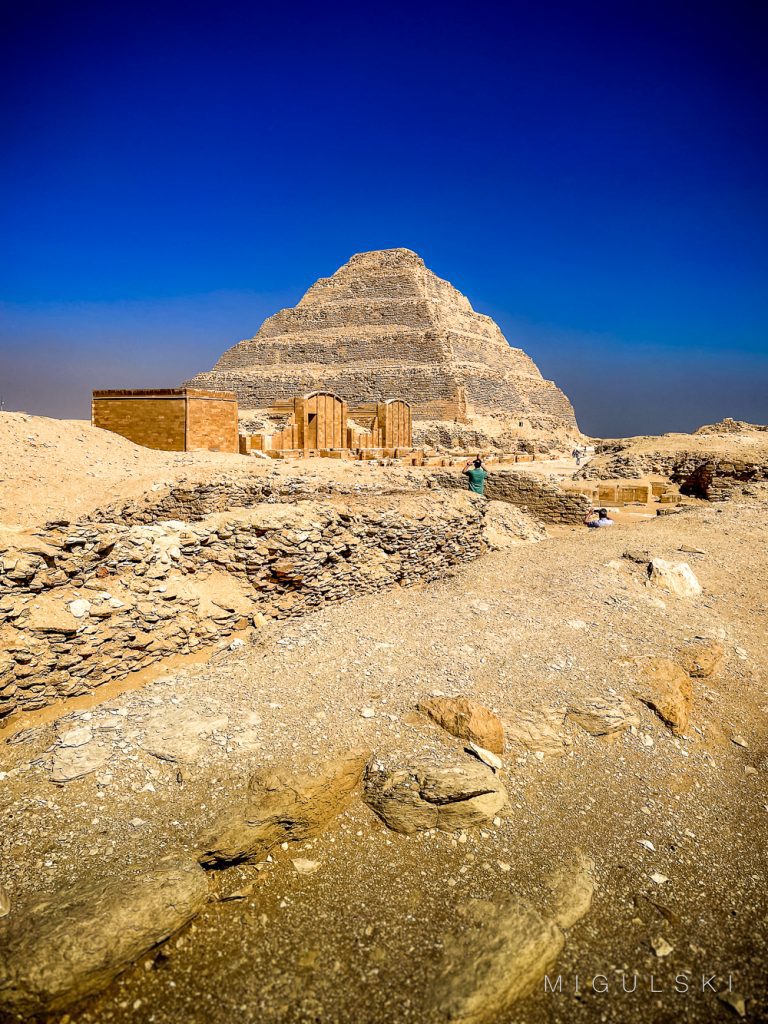
The Step Pyramid of Djoser at Saqqara, designed by the polymath Imhotep around 2667 BC, marks the turning point. Its six stacked mastabas rise like a staircase to the heavens. Around it sprawled a vast ceremonial complex with engaged columns, courtyards, and chapels—all rendered in stone but imitating earlier structures made from reeds and wood. This deliberate material translation—from ephemeral to eternal—announced a new aesthetic philosophy: art could freeze ritual in place, giving permanence to actions once confined to time.
Djoser’s pyramid was a prototype. Later pyramids under Sneferu and Khufu smoothed and sharpened the form, culminating in the Great Pyramid at Giza, a structure so precise that its alignment with the cardinal points deviates by mere fractions of a degree. Its internal chambers, corridors, and so-called “air shafts” suggest a symbolic program aligned with the stars—especially Orion and Sirius, celestial markers associated with Osiris and rebirth.
This architectural geometry was not separate from visual art. Walls within pyramids and surrounding temples bore reliefs, inscriptions, and statuary arranged in grids, sequences, and hierarchies. The pyramid was a total artwork—not in a Romantic sense, but in the literal sense that every element participated in a metaphysical machine designed to ensure the pharaoh’s resurrection and continuity.
Three innovations during the Old Kingdom entwined visual form with political theology:
- The fusion of large-scale construction with narrative and symbolic decoration.
- The institutionalization of artistic workshops that replicated motifs with standardized precision.
- The emergence of solar cults—especially the worship of Ra—that demanded new iconography centered on light, ascension, and divine fusion.
From quarry to carving, every artistic act became part of an immense civic-religious organism whose goal was not expression, but preservation.
The Canon of Proportion: Gridlines and Divinity
One of the most remarkable achievements of Old Kingdom art is its near-universal adherence to proportional systems. Human figures, gods, and architectural elements were constructed according to a grid system that divided the body into fixed units. The standard canon—later formalized into 18 squares from the soles of the feet to the hairline—began to crystallize during this period.
This was not an aesthetic choice in the modern sense. It was a theological necessity. The human form, especially that of the king, was a site of divine power. Any distortion could compromise its function as a vessel for the ka, the life force. Artistic accuracy, therefore, did not mean visual realism but metaphysical correctness.
Reliefs and wall paintings in mastaba tombs near Giza and Saqqara display this logic with crystalline clarity. Men stride forward with one foot extended, torsos twisted to show both shoulders, hands clenched or offering food, eyes wide and frontal. Women, children, and servants are rendered at smaller scales, their positions arranged around the central figure like satellites orbiting a fixed sun.
This visual hierarchy was mirrored in daily life. The tomb scenes were not decorations but spells—images that activated the deceased’s continued sustenance in the afterlife. Food, music, drink, and service were not merely depicted; they were provided, visually, for eternity. Hence the proliferation of offering scenes, fishing expeditions, cattle herding, and bread-making—ritualized views of abundance, layered with idealization.
A surprise lies in the presence of minor figures. While the pharaoh and elite are rendered with monumental stillness, bakers, brewers, and dancers appear with remarkable dynamism. Their gestures curve, their legs bend, their faces animate into expressions of exertion or joy. This contrast reflects a dual aesthetic:
- The elite and divine: eternal, unchanging, abstracted.
- The mortal and laboring: kinetic, immediate, responsive.
It’s not a failure of style—it’s a calibration of function.
Sculpting Stillness: The Pose of Power
Sculpture in the Old Kingdom achieves a kind of perfection by restraint. The statues of kings and nobles—from the serene seated Khafre to the tightly clenched, enthroned Djoser—are not portraits in the Western sense. They are cult objects. Each was designed to house the spirit of the deceased, to receive offerings, and to endure, untouched, within a closed chamber of the tomb.
The earliest large-scale stone statues appear during the reign of Djoser, but by the Fourth Dynasty, sculptors had refined the conventions that would last for two thousand years. The ideal male form was muscular, symmetrical, wide-eyed; the female form narrow-waisted, poised, serene. Children clutched parents’ legs; scribes sat cross-legged with papyrus rolls; workers crouched or carried burdens.
The statue of Khafre, carved from diorite and discovered in the Valley Temple near the Great Sphinx, exemplifies this aesthetic theology. Seated, arms on knees, he is framed by the wings of the falcon god Horus, who emerges protectively from behind his head. The throne legs are decorated with lotus and papyrus plants—symbols of unified Egypt. Every surface is smooth, every line deliberate. It is less a likeness than a cipher of kingship.
At the same time, artists developed genres of more individualized portraiture, especially in wood and limestone. The famous statue known as “The Seated Scribe,” with his slightly pudgy frame, attentive gaze, and alert posture, reveals an aesthetic tolerance for specificity outside of royal imagery. These statues did not break the canon—they supplemented it with psychological realism, used in the context of service rather than sovereignty.
Three sculptural micro-narratives convey the breadth of Old Kingdom form:
- The Ka statue of Rahotep and Nofret, found in their tomb at Meidum, shows the couple seated in formal poses, painted with startling clarity. His brown skin and white kilt contrast with her pale complexion and intricate jewelry, encapsulating gendered conventions in elite representation.
- The Sheikh el-Balad, a wooden statue of a local official found at Saqqara, struck excavators in the 19th century with its lifelike realism. Its glass inlaid eyes, carved torso, and commanding stance earned it the nickname “village chief” among the dig workers.
- The Group statue of Menkaure with Hathor and a nome goddess shows the king flanked by two female deities, all carved from a single block of stone. The unity of the forms suggests divine harmony; the forward stride signals eternal motion toward rebirth.
The Old Kingdom’s artistic system did not aim to surprise. It aimed to stabilize. But within its constraints, it achieved an extraordinary richness—layering symbolism, narrative, ritual, and material beauty into forms that still speak with unshaken authority. When later Egyptians looked back on their ancestors, it was the art of this age they regarded as the gold standard. In a civilization obsessed with time, the Old Kingdom gave art the power to hold it still.
The Middle Kingdom’s Quiet Majesty
The Middle Kingdom (c. 2055–1650 BC) is often overshadowed by the grandeur of the pyramids and the gold of Tutankhamun. Yet it is in this era—particularly under the 12th Dynasty—that Egyptian art reaches a subtler, more introspective maturity. If the Old Kingdom was about eternity carved in stone, the Middle Kingdom is about nuance, emotion, and the quiet dignity of resilience.
Faces of Melancholy: Psychological Naturalism Emerges
One need only glance at the royal statuary of the Middle Kingdom to sense a fundamental shift. Gone are the serene, impassive faces of Old Kingdom kings. In their place appear furrowed brows, downturned mouths, and heavy-lidded eyes. These kings look burdened—not broken, but aware of the weight they carry. They are less god than man-god, sovereign yet sober.
The transformation begins in earnest with the reign of Senusret III (c. 1878–1839 BC), whose statues represent a high point of psychological naturalism in Egyptian art. Dozens of images survive, showing the king with exaggerated ears, sunken cheeks, and a deeply furrowed brow. In some versions, his eyes seem to look inward more than outward. It’s a striking divergence from the divine idealism of earlier eras.
This is not a matter of artistic freedom but of ideological recalibration. The Middle Kingdom emerged after a period of fragmentation and chaos known as the First Intermediate Period. The kings of the 12th Dynasty inherited a fractured land and a memory of disorder. Their art reflects a new political theology: the ruler as vigilant custodian, the kingdom as something hard-won and precarious.
Royal portraiture was not the only medium in which this tone deepened. Reliefs and stelae from tombs and temples became denser with text, more elaborate in gesture, and more diverse in composition. The desire to record one’s piety, virtues, and service to the king became more personal, more discursive. Even the language of art turned inward.
Three characteristics distinguish Middle Kingdom royal imagery:
- A move toward realism that communicates moral seriousness and emotional gravity.
- Increased variation in facial expressions, poses, and textures within official sculpture.
- A blend of regional traditions with centralized court style, producing hybrid forms.
This introspective turn was not regression but refinement. It made Egyptian art more flexible, more human, and ultimately more enduring.
Wood and Wax: Domestic and Devotional Objects
While royal statues captured the burdens of rule, Middle Kingdom artisans also expanded the expressive range of smaller-scale works. Figurines, jewelry, furniture, and household items reveal an intense care for detail and craftsmanship, especially in wood, faience, ivory, and precious metals. These were not mass-produced trinkets. They were imbued with both personal intimacy and ritual power.
Tomb models became especially elaborate. These miniaturized scenes—constructed from painted wood—depicted boats, granaries, kitchens, and workshops, staffed by tiny figures frozen in mid-task. Unlike the static tomb reliefs of the Old Kingdom, these dioramas had kinetic energy. Bakers leaned into ovens, rowers strained at oars, scribes hunched over papyrus rolls. They were visual insurance policies for the afterlife: functional scenes meant to replicate life’s abundance in miniature, forever.
A prime example is the tomb of Meketre, a high official under Mentuhotep II and Senusret I. Discovered near Thebes in the early 20th century, it contained some of the finest wooden models ever found—fishing scenes, cattle-counting rituals, and meticulously outfitted riverboats. These models were not toys, but tools of eternal continuity. Their scale invited intimacy; their function implied immortality.
Faience, a glazed non-clay ceramic material, also reached new levels of refinement. Beads, amulets, and small figurines glistened with turquoise and lapis tones. The lotus flower—symbol of rebirth—became a favored motif, rendered with exquisite naturalism. Jewelry combined delicacy and symbolism: scarab rings, pectorals, and inlaid collars conveyed protection, status, and aesthetic pleasure in equal measure.
Three domestic art forms of special note:
- Cosmetic spoons carved in the shape of swimming girls or lotus blooms, balancing function and beauty.
- Folding headrests of wood and ivory, used in both life and burial, often inscribed with protective texts.
- Kohl tubes and mirrors, frequently made of copper and set with stone inlays, underscoring the daily rituals of elegance and purification.
These objects speak to a culture that valued refinement not only in temple and tomb, but in the textures of everyday ritual—both sacred and sensual.
Reform and Return: Artistic Trends Across Dynasties
The Middle Kingdom is also notable for its conscious revival of older forms. The 12th Dynasty, particularly under Amenemhat I and his successors, positioned itself as the rightful heir to the Old Kingdom. This cultural re-centering took artistic form in the reuse of earlier motifs: seated statues, traditional headdresses, and temple plans all hearkened back to the age of pyramids. But this was not mere imitation—it was strategic reinvention.
The pyramids of the Middle Kingdom kings, built mostly in mudbrick with stone casing, have not survived as dramatically as their Old Kingdom counterparts. Yet their internal layouts show increasing complexity—corridors, chapels, and subterranean vaults that suggest a turn inward, both physically and symbolically. Funerary architecture became more private, more concealed, and more elaborate in magical texts and decoration.
A new literary form also took hold: wisdom literature. Texts like The Instruction of Amenemhat or The Tale of the Eloquent Peasant reflect a more personal, moralized vision of the world. These stories and teachings were often copied by scribes in training, their scripts becoming works of art in their own right. The proliferation of stelae—stone slabs inscribed with autobiographical texts—marks the rise of individualism within the visual field.
This cultural self-awareness gave rise to artistic pluralism. While court art retained its formal polish, regional workshops produced variations in proportion, style, and iconography. Nubian influences entered Egyptian visual culture through trade and conquest, especially in border regions. Local deities appeared alongside state gods in temple reliefs. The boundaries of art expanded, subtly but surely.
Three sites demonstrate the period’s artistic range:
- Deir el-Bahari, where Mentuhotep II built a terraced funerary complex that prefigured the later glories of Hatshepsut’s temple.
- Lisht, where the pyramids of Amenemhat I and Senusret I revealed innovations in subterranean tomb design and decorative schema.
- Elephantine, where local temples and votive offerings show a fusion of state and regional artistic traditions.
The Middle Kingdom did not aim to astonish through scale or novelty. Its genius lay in modulation. It refined what had come before, adapted to changing political landscapes, and opened subtle emotional and stylistic avenues that would influence Egyptian art long after the 12th Dynasty fell.
It is easy to overlook quiet majesty. But in the gentle realism of a scribe’s gaze, the ordered motion of a tomb model, and the furrowed brow of a watchful king, one finds a civilization speaking with restraint—and, paradoxically, with greater intimacy than ever before.
Temples of Living Stone: Art in the New Kingdom
By the time the New Kingdom (c. 1550–1070 BC) began to rise, Egyptian art had already codified its sacred grammar. But under the 18th, 19th, and early 20th Dynasties, that grammar expanded into opera. This was the age of Karnak and Luxor, of colossal statues and gold-laden tombs, of empire and theological innovation. Artistic ambition swelled with political power, and the result was not only a flowering of visual richness but an evolution in how art shaped—and was shaped by—the apparatus of state and divine authority.
Painted Ritual: The Opulence of Tomb Decoration
Nowhere is the New Kingdom’s visual language more immersive than in its tombs. The shift from the Old and Middle Kingdoms’ mastabas and pyramids to rock-cut tombs in the Valley of the Kings and the Valley of the Queens marks not only a change in architecture but a transformation in aesthetic experience. These tombs were not designed to be seen by the living. They were color-drenched corridors through which the soul would journey, chamber by chamber, toward resurrection.
Unlike the restrained, symbolic reliefs of earlier periods, New Kingdom tomb paintings exploded with color, narrative, and theological complexity. The ceilings of tombs mimicked the night sky, dotted with stars and constellations, often presided over by the arched form of the sky goddess Nut. Walls bore sprawling scenes from funerary texts: the Book of the Dead, the Amduat, the Book of Gates. These were not illustrations, but spatial enactments—maps for the deceased to follow, filled with gods, demons, sacred animals, and cosmological cycles.
The tomb of Seti I (KV17), carved into the limestone cliffs of the Valley of the Kings, is a masterpiece of this genre. Its walls shimmered with brilliant blue, ochre, and green, its figures finely modeled and dynamically posed. In one chamber, a giant astronomical ceiling shows the hours of the night; in another, Osiris receives the king in a tightly composed tableau of divine enthronement. Every surface participates in the theological drama of death and rebirth.
These tombs also introduced innovations in perspective and composition. Figures overlap, gestures curve, and hieroglyphs dance with pictorial elements in more fluid rhythms. The human form becomes less rigid, more graceful. Gods swell with exaggerated elegance: Anubis sleek and black as ink, Thoth ibis-headed and poised, Hathor emerging from a mountain to greet the king like a mother receiving her child.
Three artistic features distinguish New Kingdom tomb painting:
- Saturated, mineral-based color palettes used on dry plaster, preserving vividness for millennia.
- Greater narrative complexity, with sequential or parallel storylines running along chamber walls.
- A theological integration of text and image—writing as art, art as magic, both as guidance.
In these darkened, secret spaces, art became a theater of divine memory. The tomb was not a monument—it was a spell.
Obelisks and Colossi: Architecture as Sculpture
If the tombs of the New Kingdom moved inward, its temples reached outward—upward, skyward, into the open air and collective ritual life. The great temple complexes of Karnak, Luxor, Abu Simbel, and Medinet Habu were not static sanctuaries but evolving architectural scripts, rewritten by successive kings and priests over centuries. Their colonnades and pylons functioned as both structural forms and visual ideograms: stone hieroglyphs of divine power.
Artistic scale exploded. Obelisks, carved from single blocks of red granite, towered above temple courtyards—narrow at the top, wider at the base, their surfaces sheathed in inscriptions that caught and reflected the sunlight. Hatshepsut’s obelisks at Karnak, among the tallest ever erected, were originally covered in electrum to blaze at dawn. These were not markers of memory, but active participants in solar worship: fixed rays of stone mimicking the light of Ra.
Colossal statues, too, grew more monumental and expressive. The seated figures of Amenhotep III at the entrance to his mortuary temple—the Colossi of Memnon—stand over 60 feet tall. Ramesses II, the most prolific builder of the period, had his features replicated in dozens of oversized images: striding forward, enthroned, spearing enemies. His most dramatic presentation is at Abu Simbel, where four towering statues of the king greet the sun each morning at the temple’s entrance. Twice a year, solar rays penetrate deep into the temple’s interior to illuminate the sanctuary—a cosmic alignment engineered in stone.
This fusion of architecture and sculpture created immersive sacred geographies. Reliefs covered every surface: triumphs in battle, divine processions, harvests and rituals. Columns in the hypostyle halls at Karnak rose like papyrus stalks; their capitals bloomed with vegetal motifs, linking the temple to the sacred marshes of creation mythology.
Three hybrid forms emerged from this period:
- The pylon façade, a massive gate flanked by flagpoles and covered in scenes of kings smiting enemies—a recurring visual of cosmic control.
- The barque shrine, housing the sacred boat of the god, often richly decorated and nested within multiple temple precincts.
- The festival court, where temporary rituals and seasonal processions occurred, filled with painted reliefs commemorating each event.
The temple was not a place of quiet contemplation. It was a calendar carved in stone, a ceremonial engine, and a visual proclamation of continuity between gods, kings, and cosmos.
Amarna’s Rupture: Akhenaten’s Radical Style
Amid the high formality of New Kingdom art, one rupture remains unmatched in Egyptian history: the Amarna period, named after the new capital city Akhetaten, founded by Pharaoh Akhenaten (formerly Amenhotep IV). His reign (c. 1353–1336 BC) introduced not only theological upheaval—the worship of Aten, the sun disk, as sole deity—but a total reconfiguration of visual style.
The changes were jarring. Akhenaten was depicted with an elongated skull, drooping belly, full lips, and exaggerated limbs—features never before seen in royal iconography. His wife Nefertiti and their daughters were rendered with similar stylization. Scenes showed the royal family in intimate, even playful settings: kissing children, reclining together under the rays of Aten, whose hands reached down from the sun disk like a divine caress.
This was not just stylistic experimentation. It reflected a new theological concept: the king and his family as the sole intermediaries between humanity and the divine. The Aten’s rays often culminated in ankh symbols, which the royal figures alone received. No other gods were depicted. Temples opened to the sky, rejecting darkness and concealment.
The art of Amarna is striking in its dynamism and candor:
- Reliefs show movement, affection, and even imperfection, suggesting a worldview less concerned with timelessness than with immediacy.
- Naturalistic details emerge: flowers, birds, domestic scenes, even the folds of linen.
- Inscriptions shift tone, emphasizing the glory of Aten and the unique role of the king above all precedent.
After Akhenaten’s death, his successors—including the young Tutankhamun—rapidly dismantled this experiment. Temples were defaced, names erased, and the art of Amarna buried under layers of convention. Yet its echoes remained. Some grace notes of its style—the softness of form, the sense of motion—would continue to ripple quietly through later New Kingdom works.
Amarna revealed that Egyptian art, for all its stability, was capable of dramatic reinvention. It dared, briefly, to imagine an alternative cosmos. And then, almost as quickly, it returned to the old forms—but not unchanged.
The Art of the Afterlife: Burial and Belief
If Egyptian art can be said to have a single, unifying purpose, it is this: to make death intelligible, navigable, and ultimately reversible. Nowhere is this more vivid than in the objects and images created for burial. From the simplest tomb offering to the grandest painted coffin, the art of the afterlife reveals a civilization that treated death not as an end, but as a structured transition—a journey that art was uniquely equipped to mediate.
Coffins as Canvases: Theology in Layers
The coffin, like the tomb, was a liminal space—not only containing the dead, but guiding and protecting them. Over the course of Egypt’s long history, the design and decoration of coffins evolved dramatically. By the New Kingdom, coffins had become richly adorned, textual, and theologically saturated.
Early Middle Kingdom coffins were box-like in shape, often made of wood and painted with simplified versions of sacred texts. But from the Second Intermediate Period onward, anthropoid coffins—carved or molded to resemble the human body—gained prominence. This form allowed for a new kind of intimacy between image and identity. The deceased was not merely entombed; they were represented, clothed in layers of art and belief.
The exterior of such coffins often bore a stylized image of the dead person’s face, framed by elaborate wigs, collars, and headdresses. The body of the coffin was painted with vertical registers of hieroglyphs: prayers, titles, names, and spells from the Coffin Texts or the Book of the Dead. The imagery emphasized divine guardians—Isis and Nephthys at the feet and head, Anubis overseeing embalming, Nut embracing the lid from above. The placement of these figures was not decorative; it was spatially strategic, creating a cocoon of divine presence.
Perhaps the most striking innovation was the rishi style—coffins painted with overlapping feather motifs, symbolizing divine protection and transformation into a ba-bird. This feathering was both literal and metaphoric: a signal that the dead could now fly between worlds, assisted by the written and visual codes inscribed around them.
Three elements made the coffin a multimedia theological device:
- Text as incantation: Spells and prayers functioned not as decoration but as operational instructions for the soul’s journey.
- Portrait as interface: The face, often idealized but specific, allowed the deceased to “see” and be seen in the afterlife.
- Symbolic layering: Colors, gods, patterns, and script all worked together to create a total protective system.
The coffin was not a passive container. It was an instrument of transformation.
The Book of the Dead: Papyrus as Portal
If the coffin was the vehicle, then the Book of the Dead was the map. Known in ancient Egyptian as the spells for going forth by day, this collection of texts and images emerged in the New Kingdom and became standard in elite burials. Written on long papyrus scrolls—sometimes over 20 feet in length—the Book of the Dead was often illustrated with vignettes that functioned as both narrative episodes and magical diagrams.
The most famous scene is the Weighing of the Heart, where the deceased stands before Osiris while Anubis weighs their heart against the feather of ma’at—truth and balance. If the heart is found wanting, the devourer Ammit consumes it; if it balances, the soul proceeds to eternal life. This scene appears in countless variations, but always with the same essential elements: the scales, the feather, the gods, the scribal deity Thoth recording the results. It is both trial and triumph.
What distinguishes these scrolls is their blend of literary clarity and visual invention. Figures are often arranged in miniature theatrical spaces—processions, doorways, serpentine rivers, islands of flame—all populated with deities whose forms combine animal, human, and symbol. The texts do not describe these places abstractly; they guide the soul through them, spell by spell.
Examples from the 19th and 20th Dynasties show increasing personalization. The Papyrus of Ani, now in the British Museum, includes carefully executed hieroglyphs, multiple colors, and intimate images of Ani and his wife Tutu interacting with the gods. The Book of the Dead was not a generic product. It was tailored—inscribed with the name of the deceased, filled with visual cues attuned to their station, hopes, and fears.
Three narrative functions governed the book’s illustrations:
- Journey: Maps of the underworld, routes through darkness, lists of gates and guardians.
- Judgment: Trials of character and truth, primarily the heart-weighing.
- Transformation: Images of rebirth—into birds, gods, light, or stars.
The Book of the Dead was not for the living. Yet its existence as a portable, visualized theology gives us a uniquely clear picture of how art operated as a functional metaphysics. The scroll was a spellbook—but also, in its design, a kind of sacred animation.
Shabtis, Shrines, and Spells in Clay
Beyond coffins and scrolls, the tomb was populated with dozens, sometimes hundreds, of ritual objects—each one a tool for securing continuity, protection, or service in the next world. Chief among these were the shabti figures, small statuettes placed in tombs to serve the deceased in agricultural tasks expected of them in the afterlife.
Originally introduced in the Middle Kingdom as simple, inscribed figures, shabtis evolved into highly stylized, often mass-produced servants. They held hoes, baskets, and farming implements. Some wore miniature versions of the deceased’s own attire. Many bore a spell instructing them to answer when the dead were called to labor. In this, they reflected a subtle inversion of earthly hierarchy: a bureaucrat in life became a land-tiller in death—unless his shabtis took his place.
Shabtis also display a range of materials and craftsmanship:
- The wealthy commissioned faience or stone figures, sometimes painted or gilded.
- Others used simple terracotta or wood, carved with basic outlines and inked spells.
- Royal tombs included overseer shabtis with whips and rods, commanding sets of subordinate figures.
Tombs also contained model shrines, symbolic offerings, funerary cones stamped with titles, and magical bricks inscribed with protective spells. These were often placed in the four corners of the burial chamber to guard against intrusion. Canopic jars, used to store the mummified organs, bore the heads of the Four Sons of Horus, each guarding a vital part of the body with divine vigilance.
The tomb, as assembled by artisans and priests, was a microcosm of the universe. Every object had a role. Every image had a function. Death was not feared as a void but prepared for as a voyage—with art as the navigational system.
Three burial elements reveal the fusion of function and form:
- Canopic chests: Elaborately decorated boxes containing jars, often shaped like miniature shrines themselves.
- Funerary amulets: Scarabs, djed pillars, and Eye of Horus charms placed on the body, each with a specific purpose—resurrection, strength, healing.
- False doors: Carved into tomb walls to allow the ka to move between worlds, often inscribed with prayers and offering formulas.
What emerges is a vision of art as active. These were not representations of faith. They were enactments of it—material extensions of ritual designed to operate in the invisible realm. The Egyptian afterlife was not abstract. It had logistics, obstacles, labor, nourishment, danger, and ecstasy. Art was not merely a commemoration. It was an intervention.
To stand before a painted tomb, or unroll a papyrus filled with spells, is to enter a system of belief that made art not the mirror of life, but its continuation.
Hieroglyphs as Image and Language
The ancient Egyptian script is often described as pictorial writing, but that phrase understates the radical hybridity of hieroglyphs. In no other major writing system of antiquity did visual image and semantic meaning remain so intimately intertwined for so long. Hieroglyphs were not simply a means of communication. They were objects of art in their own right—precise, sacred, and powerfully charged.
Signs That See: The Visual Structure of Writing
To look at a column of hieroglyphs is to enter a system where every sign is both picture and code. A bird is a bird—but it’s also the consonant value “m.” A seated man may mean “man,” but also function as a determinative, a silent sign that classifies the preceding word. Some signs are phonetic; others are ideographic; many combine both functions. What emerges is not a writing system that evolved away from the image, but one that doubled down on it.
The canonical hieroglyphic system comprised over 700 distinct signs, each carefully categorized and ordered in scribal manuals like the “Sign List” of Gardiner in modern Egyptology. These were not arbitrary shapes. They were miniaturized worlds—crafted with internal logic, visual rhythm, and often subtle mimicry of real-life textures, stances, and relationships.
Arrangement mattered. Hieroglyphs could be written in horizontal rows or vertical columns, and they could face either left or right—depending on the orientation of the first character. Readability depended on this internal directionality: you always read toward the faces. In architectural contexts, this flexibility allowed for alignment with the visual program of walls, columns, and statuary.
But hieroglyphs also had spatial plasticity. In monumental inscriptions, scribes and artists adjusted the size and spacing of signs to fit into architectonic shapes—cartouches, false doors, architraves. Unlike modern scripts, which subordinate form to content, Egyptian hieroglyphs fused both. A royal name might be stretched or compressed to fit a horizontal frieze; a prayer might wind along the edge of a sarcophagus, its signs curved and nested like leaves on a vine.
Three visual traits defined the hieroglyphic aesthetic:
- Polychromy: Signs were often painted, especially in tombs, with standard colors for each element—blue for water, green for plants, gold for gods.
- Scale modulation: Important words, like royal names or divine epithets, could be rendered larger or more prominently than surrounding text.
- Iconic harmony: In religious and funerary contexts, hieroglyphs were arranged for maximum visual balance, not only readability.
It’s no accident that a scribe was not merely a bureaucrat in Egyptian culture. He was a visual architect of the sacred word.
Sacred Scripts: Scribes as Image-Makers
The scribe held a singular place in Egyptian society—not only as a literate elite, but as a participant in the creation of spiritual and political order. Scribes were trained from a young age, often in temple schools, to memorize and replicate the complex forms of the language. Their tools—reed brush, ink palette, papyrus scroll—were as iconic as their titles. In statuary and tomb paintings, scribes are often shown cross-legged, scroll unrolled, head tilted in thought. They are among the few non-royal figures routinely granted such individualistic representation.
Beyond papyrus, scribes worked directly on walls, stelae, and sculpture. In many cases, the inscribed text came first: the master scribe would outline the placement of columns and signs, to be filled in later by carvers or painters. This reversed the modern assumption that writing is added after form. In Egypt, writing was form. It defined composition before any other visual element.
But scribes were more than craftsmen. They were custodians of divine language. Hieroglyphs were said to have been invented by the god Thoth, patron of wisdom and writing, who inscribed the universe itself into being. Thus to write was to participate in cosmic order. Each sign carried spiritual consequence. Errors in tomb inscriptions were corrected not only for legibility, but for metaphysical safety: a missing symbol could render a spell ineffective, a name invisible in the afterlife.
In certain cases, the act of writing even doubled as ritual:
- In tomb openings, priests would “activate” texts by reciting and touching each glyph.
- In temple construction, foundation bricks inscribed with protective spells were buried at the cardinal points.
- In royal ceremonies, names were ritually erased or re-inscribed to confer legitimacy or damnation.
The sacred function of writing reached its zenith in the temple. Walls, ceilings, pylons, and columns bristled with script—not random decoration, but carefully curated sequences of myth, invocation, and law. At Karnak, the Great Hypostyle Hall is not just an architectural marvel but a textual one: every inch covered in carvings that narrate cosmic battle, divine offering, royal legacy.
Scribes were, in this sense, the priests of visual order. Their labor was not silent—it spoke in stone.
Writing the Divine: Glyphs in Architecture and Ritual
Hieroglyphs were not confined to scrolls or statues. They animated the built environment, acting as both decoration and doctrine. In temples and tombs, they served as inscriptions, invocations, and identities. On obelisks, they transformed monoliths into shining proclamations of cosmic alignment. On coffins and canopic jars, they provided magical security and access to divine circuits.
In funerary architecture, glyphs encased the body in written protection. The sarcophagus of Seti I is a prime example: its lid and interior are inscribed with passages from the Amduat, complete with vignettes of the night journey. The words do not merely ornament—they chart the soul’s path through twelve hours of darkness. Without them, the journey cannot be made.
The use of cartouches—oval frames enclosing the royal name—was both protective and declarative. A name inscribed within a cartouche was metaphysically shielded, rendered eternal. Pharaohs left their cartouches carved deep into temples they built, but also into those they usurped. Reinscribing one’s name was an act of erasure and replacement, a reassertion of divine legitimacy.
In ritual contexts, glyphs were sometimes animated into figurative objects. Amulets took the shape of single hieroglyphs: the ankh (life), djed (stability), tyet (protection). These signs transcended abstraction. They were sculpted, worn, invoked. Their power lay not in metaphor, but in material form.
Three case studies illustrate hieroglyphic integration into art:
- The obelisks of Hatshepsut, whose vertical inscriptions run like veins of divine text, fusing sunlight and script into a single visual language.
- The sarcophagus of Ramesses III, inscribed inside and out with magical texts and iconography so dense it becomes an immersive architecture of resurrection.
- The lintels at Medinet Habu, where carved hymns to Amun-Re frame every threshold, turning passage through space into liturgy.
The dual nature of hieroglyphs—as seen and read, touched and recited—places them at the heart of Egyptian visuality. They are not illustrative extras. They are art. They are architecture. They are theology.
Even now, in their weathered silence, hieroglyphs retain an uncanny energy. They look back at us as we look at them—shaped with precision, poised between line and image, memory and presence.
Foreign Faces, Egyptian Frames: Late Period Hybridity
The final centuries of ancient Egypt’s independent dynasties—collectively termed the Late Period (c. 664–332 BC)—were marked by political instability, foreign incursions, and dynastic flux. Yet far from a cultural collapse, this era produced some of the most technically refined, intellectually complex, and stylistically hybrid art in Egypt’s long history. Egyptian visual tradition, deeply conservative at its core, now absorbed and refracted the presence of foreign rulers—Kushite, Assyrian, Persian, and later Greek—without relinquishing its essential symbolic logic.
Kushite Crowns and Classical Intrusions
The 25th Dynasty, known as the Nubian or Kushite Dynasty (c. 744–656 BC), originated in Napata, in what is now northern Sudan. These rulers saw themselves not as conquerors but as restorers of Egypt’s ancient religious order. They embraced traditional forms with reverence, commissioning temples, statuary, and inscriptions that closely adhered to Old and Middle Kingdom prototypes. Yet their art bore distinct marks of origin—broad facial features, double uraeus serpents on crowns (signifying dual authority over Nubia and Egypt), and an emphasis on the god Amun, whose cult had deep roots in both regions.
The colossal statues of Taharqa and other Kushite kings, discovered at temples in Nubia and Thebes, exhibit a striking blend of idealization and individuality. Unlike the exaggerated stylization of earlier periods, these figures possess thick lips, wide noses, and strong cheekbones—features rendered with sculptural dignity and confidence. In adopting and adapting Egyptian iconography, the Kushites affirmed their legitimacy not by invention, but by amplification.
This pattern of deference and innovation continued into the Saite Dynasty (26th), which ruled from Sais in the Nile Delta. Saite rulers undertook deliberate archaism: reviving Old Kingdom statuary poses, Middle Kingdom coffin texts, and early hieroglyphic styles. But these were not mere copies. They were curated quotations, part of a larger cultural project to position Egypt as the source of cosmic continuity in a world fractured by shifting powers.
Three artistic themes emerged during this period of intercultural entanglement:
- A return to earlier formal conventions, especially in sculpture, with heightened polish and proportion.
- The coexistence of regional styles—Theban, Memphite, Delta—under a nominally unified visual canon.
- The adaptation of foreign motifs (Assyrian rosettes, Levantine weaponry, Near Eastern floral designs) into Egyptian compositional structures.
Even under pressure, Egyptian art refused to dilute itself. It expanded, layered, and adapted, but it never surrendered its inner logic.
Persian Precision and Local Loyalty
The conquest of Egypt by the Achaemenid Persians in 525 BC introduced new complexities. The Persians, ruling as the 27th and later 31st Dynasties, approached Egypt less as a cultural mission than a strategic acquisition. Yet Persian kings, notably Darius I, took care to present themselves in Egyptian artistic terms when addressing their Egyptian subjects.
Reliefs from temples at Hibis and Saqqara show Darius in the traditional kilt and crown, making offerings to native gods. The inscriptions are in flawless hieroglyphic script. This careful mimicry suggests that even imperial invaders understood the power of Egyptian visual language—not merely to appease, but to participate in sacred legitimacy.
At the same time, Egyptian artists absorbed aspects of Persian court style. Acanthus leaf borders, beaded jewelry motifs, and rigid profile poses reminiscent of Persepolis appear in funerary art. Yet these foreign details were always framed within the larger grammar of Egyptian composition. A Persian element might decorate a lintel, but the overall structure remained Egyptian: gods in registers, offerings in ritual sequence, the deceased facing the sun.
The bureaucratic and priestly elite continued to commission works that adhered closely to tradition. Statuary of priests from this period is often so meticulously carved—especially in black basalt and greywacke—that individual inscriptions disappear into the polished darkness. Figures clutch divine emblems with almost exaggerated restraint, as if the weight of piety were physically embodied in stone.
Three telling objects from Persian-era Egypt:
- The Naophorous Statues: Figures holding miniature shrines, often bearing images of Osiris or other deities, blending personal devotion with political symbolism.
- Canopic Chests with Foreign Motifs: Containers shaped like traditional boxes but adorned with rosettes or lotus chains from Persian textile patterns.
- Relief Panels from Hibis Temple: Darius presenting maat to Amun, rendered with high precision in native style, suggesting a ritual script observed rather than understood.
What remains striking is not how much the Persians changed Egyptian art, but how little they could. The system resisted substitution. It could be adorned, echoed, even mimicked—but its core logic remained intact.
Alexander’s Legacy: Ptolemaic Elegance
The conquest of Egypt by Alexander the Great in 332 BC marked another radical shift. His successors—the Macedonian Ptolemies—ruled Egypt as Hellenistic monarchs for nearly three centuries. Yet their reign, rather than erasing Egyptian tradition, brought about a remarkable syncretism. Egyptian art during the Ptolemaic period reached technical and conceptual heights unseen since the New Kingdom, marrying Greek naturalism with native symbolic architecture.
At sites like Philae, Edfu, and Dendera, monumental temples were built in rigorous Egyptian style, often funded by Greek-speaking rulers whose own statuary appeared in both Egyptian and Hellenistic forms. Reliefs from these temples are among the most intricate in Egyptian history: each glyph carved with razor-sharp detail, each god elaborated with layers of regalia and divine epithets.
Yet Greek influence seeped in. Human figures in some tombs begin to adopt more volumetric modeling. Drapery gains softness, musculature more definition. The Fayum mummy portraits—painted in encaustic on wooden panels—are perhaps the most famous expression of this blend. While not strictly “Egyptian” in iconography, they were affixed to mummies and used in burial rituals, serving both as portraits and spiritual stand-ins.
Three stylistic currents defined Ptolemaic visual culture:
- Hyper-detail: An explosion of miniature hieroglyphs and multi-register decoration, often crowding temple walls in theological encyclopedism.
- Greek-Egyptian hybrids: Isis depicted in Greek robes, Horus with Alexander’s facial features, kings shown in dual headdress—diadem and nemes.
- Spatial layering: Visual fields that interwove Greek illusionism (shading, perspective) with Egyptian linearity and grid.
The temple of Horus at Edfu, built between 237 and 57 BC, stands as a culmination. Its hieroglyphic inscriptions span thousands of lines; its reliefs depict full liturgical sequences; its architectural symmetry channels Pharaonic grandeur through Hellenistic engineering.
The foreign face had entered the frame. But the frame remained Egyptian. Even as languages changed—hieroglyphic to Demotic to Greek—the visual logic endured, defiant, coherent, and vital.
This hybridity was not dilution. It was sophistication. Egyptian art had learned, across centuries of conquest and contact, how to incorporate without compromise, to absorb without erasure. Its beauty lay not only in its forms, but in its refusal to forget what form was for.
Coptic Art and the Afterglow of Empire
The twilight of ancient Egyptian religion did not extinguish its visual traditions. Instead, it transformed them. As Christianity spread across Egypt in the centuries following the Roman conquest, a new artistic language emerged: Coptic art. This term—derived from the Greek Aigyptos, meaning Egypt—refers not merely to Christian religious art produced by Egyptian believers, but to a distinctive fusion of classical, Pharaonic, and early Christian visual vocabularies. Though stripped of old gods, Coptic art retained Egypt’s obsession with sacred presence, symbolic structure, and the durability of image.
Saints, Martyrs, and Monasteries in Paint and Stone
By the 3rd century AD, Christianity had begun to take deep root in Egyptian society, especially among urban populations and ascetic communities in the desert. The martyrs and saints who populated early Coptic devotion were not abstract ideals—they were historical figures, known by name, buried in local soil, venerated with tactile immediacy. This nearness gave Coptic religious imagery a grounded, even intimate, tone.
One of the earliest and most important sites of Coptic artistic production was the Monastery of Saint Anthony, founded near the Red Sea in the 4th century. Its painted walls, especially those from the 6th to 8th centuries, depict Christ, angels, apostles, desert fathers, and local saints in an iconic mode that draws on both Byzantine and Egyptian precedents. Figures are rendered frontally, with large, almond-shaped eyes, flat garments outlined in dark lines, and gestures frozen in a stylized serenity that echoes Pharaonic statuary more than Hellenistic sculpture.
This visual idiom persisted throughout Upper Egypt’s monastic centers—Saint Paul, Saint Shenoute at White Monastery, and Saint Simeon near Aswan. The art produced in these places was not didactic illustration but liturgical presence. The images did not tell stories; they held space. Just as ancient Egyptian tomb paintings made the afterlife visible and navigable, Coptic icons and frescoes made the spiritual world proximate and inhabitable.
Three features characterize early Coptic sacred imagery:
- Hieratic frontality: Figures confront the viewer with a direct gaze, often lacking background or spatial depth.
- Symbolic compression: Visual shorthand—crosses, wreaths, flames—used to denote theological concepts without narrative elaboration.
- Local personalization: Saints often shown in Egyptian dress or with features suggesting local ethnic types, anchoring universality in specificity.
Coptic art was not immune to persecution. Under waves of Roman imperial hostility, many Christian images were destroyed or hidden. Yet by the 4th century, with Constantine’s legalization of Christianity, churches sprang up across Egypt, many built over or within older temple complexes—sometimes literally replacing gods with saints, retaining the architecture but altering the liturgy.
Encaustic Echoes: The Fayum Portraits
Perhaps the most vivid and haunting continuity between Pharaonic and Christian Egypt comes from a genre produced during the Roman period but spiritually closer to both worlds: the Fayum mummy portraits. These are painted likenesses—mostly from the 1st to 3rd centuries AD—attached to wrapped mummies, primarily from the Fayum oasis and surrounding regions.
Painted in encaustic (pigment mixed with hot wax) or tempera, these portraits depict men, women, and children with striking naturalism. Wide eyes, curly hair, jewelry, and expressions ranging from solemn to serene capture a Romanized elite, many of whom bore Greek names and followed Greco-Roman customs. Yet these images were made not for salons or display, but for burial. They were affixed over the face of the mummy—serving as both identity marker and conduit for posthumous recognition.
Though not Christian in subject, the Fayum portraits anticipate the iconographic conventions of later Coptic art:
- Frontal gaze: A visual fixation that seeks communion rather than observation.
- Flattened realism: Despite lifelike modeling, the portraits avoid background or narrative context.
- Material reverence: The use of gold leaf, costly pigments, and layered brushwork elevates each face to something more than portraiture—something approaching the sacred.
Many scholars argue that these portraits represent the earliest known “icons” in the Christian sense: not merely images, but presences. Their influence on later Christian iconography, particularly in Egypt, is hard to dismiss. Some Coptic icons from the early medieval period preserve their frontal symmetry, encaustic technique, and haunting luminosity.
The Fayum portraits also complicate neat historical divisions. They emerge from a world that was Greek, Roman, Egyptian, and increasingly Christian all at once—a cultural layering that would define Egyptian art for centuries to come.
Reusing the Past: Christian Art in Pharaonic Spaces
Perhaps the most profound visual metaphor for Egypt’s transition from paganism to Christianity lies in the physical reuse of sacred spaces. From the 4th century onward, many Pharaonic temples were converted into churches or monasteries. Reliefs of Horus and Hathor were chiseled away or covered in whitewash; apse mosaics replaced cult statues. Yet the architecture remained unmistakably Egyptian—massive columns, high lintels, axial layouts.
At Philae, the temple complex dedicated to Isis remained active into the 6th century AD. Even after official conversion, Coptic inscriptions were carved into its walls, and Christian altars were inserted between columns once reserved for offerings to Osiris. The layering is sometimes jarring: a Christian cross scratched onto the shoulder of a falcon-headed god; a gospel verse scrawled in Coptic script over a line of hieroglyphs.
But the reuse was not always iconoclastic. It often reflected continuity: a sacredness attached to place, form, and cosmic alignment that transcended theology. Many Coptic churches maintained east-facing orientations, processional axes, and symbolic numerologies that mirrored ancient Egyptian temple design. Even the structure of monastic life—with its emphasis on ritual, isolation, and divine order—has echoes of priestly functions in the old cultic system.
Three sites exemplify this architectural and spiritual palimpsest:
- Deir el-Shelwit, near Luxor, a Roman-era Isis temple reused as a Christian chapel, preserving both graffiti and frescoes.
- Luxor Temple, where Coptic murals were painted over ancient reliefs in the sanctuary, visible only after modern cleaning removed centuries of soot.
- Deir el-Medina, the workers’ village for royal tomb builders, whose small temple complex was repurposed as a Christian hermitage, linking art across millennia of belief.
Coptic art did not arise in a vacuum. It emerged from the accumulated weight of Egyptian visual tradition—transformed by new theology but grounded in the same conviction that the seen and the unseen were in constant communion.
In this afterglow of empire, Egyptian art shed its polytheism but retained its priesthood of image. Saints took the place of gods, gospels of spells, icons of statues. But the gaze remained: fixed, frontal, eternal.
Islamic Egypt and the Art of Adaptation
When Islamic rule reached Egypt in the 7th century AD, it brought a new theological worldview—one in which image-making, particularly of living beings, was regarded with suspicion or outright prohibition. Yet in this new visual climate, Egyptian art did not vanish. It adapted. It redirected its genius for geometry, calligraphy, and symbolic form into architecture, ornament, and everyday objects. Across Cairo’s mosques, minarets, palaces, and ceramics, one sees the continuity of Egypt’s artistic vitality—refined into abstraction, elevated through craft, and sharpened by centuries of cultural exchange.
Cairo’s Skyline of Minarets and Mashrabiyas
The Islamic conquest of Egypt began in 641 AD under the leadership of the general Amr ibn al-As, who established a new administrative capital at Fustat. Over time, especially under the Fatimids (969–1171), Ayyubids (1171–1250), Mamluks (1250–1517), and Ottomans (1517–19th century), the heart of Egyptian Islamic art and architecture became Cairo—a city whose skyline grew thick with minarets, domes, and intricately carved wooden screens.
These new forms were not arbitrary innovations. The mosque—a sacred, functional, and political space—became the primary site of artistic investment. Early mosques like that of Ibn Tulun (876–879 AD) show how Egyptian builders adapted Mesopotamian and North African plans to local materials and aesthetics. Its vast open courtyard, wrapped in arcades of pointed arches and capped by a unique spiral minaret, preserves a gravity and elegance that echoes Pharaonic axiality and scale.
Later structures introduced greater ornamentation. The Fatimid al-Hakim Mosque and the Mamluk Madrasa of Sultan Hasan both represent a new monumentalism: façades carved in deep relief, stone portals flanked by minarets, geometric interlace patterns covering ceilings, floors, and walls. The mashrabiya—a carved wooden screen placed over windows—allowed for light, air, and privacy while casting intricate shadows. These became a signature of Cairene domestic architecture, combining functionality with ornamented restraint.
Three architectural features defined Islamic Egypt’s visual language:
- Muqarnas vaulting: Stalactite-like niches used to transition between structural elements, often carved in stucco or stone with breathtaking intricacy.
- Sabil-kuttab structures: Combined water dispensaries and Quranic schools, often topped with domes and clad in alternating bands of black and white marble.
- Minaret silhouettes: Evolving over centuries from square towers to elegant octagons and pencil-thin spires, marking Cairo as the “city of a thousand minarets.”
In this world, Egypt’s love of architectural clarity and symbolic alignment did not disappear. It simply found new forms in which to live.
Calligraphy in Stucco, Tile, and Metal
With the human form largely absent from monumental Islamic art, writing assumed central importance. Arabic calligraphy became not just a script but a supreme artistic medium—a way of combining semantic richness with visual elegance. Egypt’s contribution to this tradition was profound, particularly under the Mamluks, whose manuscripts, Qurans, and architectural inscriptions reflect an obsessive refinement.
Kufic and later naskh scripts were inscribed in stucco, carved into marble, inlaid into wood, and painted onto ceramics. In mosques and madrasas, Quranic verses ran along the tops of walls like visual epics, each glyph carefully composed to balance line, rhythm, and ornament. Letters became frames, arcs, and even architectures of meaning. The script itself was exalted—not just for its content, but for its beauty.
In smaller forms, calligraphy adorned metalwork—brass lamps, incense burners, ewers, and trays. Mamluk artisans, in particular, mastered the inlay technique: silver and copper embedded into bronze or brass, forming inscriptions that wrapped around vessels in elegant bands. These inscriptions were not mere decoration—they often included pious phrases, the maker’s name, or dedications to patrons.
A notable example is the Baptistère de Saint Louis, a Mamluk basin now in the Louvre, misidentified for centuries as a Christian object. It bears densely packed scenes of hunting and celebration, with Arabic inscriptions carefully integrated into its structure. It reflects a world in which visual opulence and scriptural piety coexisted without contradiction.
Three calligraphic applications from Islamic Egypt stand out:
- Mihrab inscriptions: Quranic verses carved in marble or mosaic around the prayer niche, orienting worshipers and sanctifying space.
- Manuscript illumination: Qurans with gold-leaf surahs, vegetal motifs, and geometric framing devices, produced by teams of scribes and illuminators.
- Everyday calligraphy: Amulets, scrolls, and even household utensils inscribed with protective verses, bringing art into the daily and domestic.
Here, Egypt’s ancient instinct for symbolic compression—sacred meaning in beautiful form—found new voice through the curves and angles of Arabic script.
Gardens, Geometry, and the Aesthetic of Restraint
Beyond architecture and calligraphy, Islamic Egypt developed a refined decorative language grounded in abstraction, rhythm, and restraint. Without figural scenes to guide composition, artists turned to geometry and vegetal forms. The result was an art of infinite variation—repeating, interlocking, and morphing across surfaces with subtle complexity.
Geometric patterns, rooted in mathematical logic, appeared on everything from mosque floors to ceramic tiles, bookbindings to palace walls. These were not arbitrary designs. Many were based on tessellations derived from square, hexagonal, and star-shaped units, elaborated into radial symmetry or lattice-based complexity. The goal was not illusion but clarity—an ordered beauty that reflected divine unity in multiplicity.
Floral and vegetal forms—arabesques—offered a softer complement. Stylized vines, lotus forms, palm fronds, and rosettes flowed along architectural borders and panel inlays. These motifs echoed the paradise gardens described in the Quran, where flowing water and lush foliage symbolize reward and rest. Egyptian artists, drawing on millennia of engagement with plant symbolism, infused these patterns with familiar energy: the papyrus and lotus of Pharaonic art now reappeared as abstract rhythms in Islamic ornament.
The aesthetic of restraint permeated not only religious buildings but domestic and civic ones as well. The Qasr al-Yusuf in Cairo or the palaces of the Citadel used zellij tilework, painted wood ceilings, and carved stone windows to craft interiors that shimmered with quiet richness.
Three decorative practices show this refinement in daily form:
- Mamluk glassware: Enameled and gilded mosque lamps with Quranic verses and heraldic emblems, suspended in chains like floating orbs of script and light.
- Carved wooden minbars: Pulpits assembled from interlocking wooden pieces, forming star-patterned mosaics without nails or glue.
- Textile arts: Embroidered textiles, especially tiraz bands bearing inscriptions, worn as marks of status and belief.
In these forms, Egyptian art continued to perform its oldest function: turning sacred ideals into material presence.
Even as theological priorities changed, the impulse to make beauty a form of order remained intact. Islamic Egypt did not inherit ancient traditions passively. It reinterpreted them—through geometry instead of figuration, script instead of myth, gardens instead of tombs. And in doing so, it extended Egypt’s artistic lineage into a new age, one defined by abstraction and continuity.
Rediscovery and Ruin: Western Eyes on Egyptian Art
When Napoleon’s armies marched into Egypt in 1798, they brought more than cannon and ambition. Among the officers were scientists, artists, and savants whose task was not conquest but documentation. What they uncovered—temples buried in sand, colossal statues toppled and half-submerged, tombs painted with scenes brighter than daylight—would ignite the Western imagination. Egypt, long regarded as a biblical backdrop or a classical curiosity, now became a subject of obsession, scholarship, and aesthetic reappropriation. But with discovery came distortion. With study came plunder.
Napoleon’s Scholars and the Birth of Egyptology
The publication of the Description de l’Égypte between 1809 and 1829 was a landmark event in European intellectual history. This multi-volume compendium—produced by the scholars of Napoleon’s expedition—contained detailed drawings, maps, and analyses of Egyptian monuments, flora, fauna, and people. It was, in its way, an artistic act: a vast visual archive that translated ancient Egyptian culture into a form legible to Enlightenment Europe.
But this translation was not neutral. The illustrations, while careful, framed Egyptian art through a neoclassical lens. Reliefs were rendered with clean lines, figures extracted from architectural context. Temples were redrawn in idealized symmetry. What had been part of a living, symbolic environment became, in print, a set of picturesque ruins.
At the same time, the Rosetta Stone—discovered by French soldiers and eventually claimed by the British—became the key to deciphering hieroglyphs. In 1822, Jean-François Champollion announced his breakthrough: a working understanding of the script based on its use of phonetics and determinatives. This moment marked the birth of Egyptology as a modern discipline and set the stage for systematic excavation and interpretation.
Yet even this triumph bore a paradox. The more Egypt became legible to Western scholars, the more it was removed from Egyptian hands. Temples were documented, then dismantled. Tombs were explored, then emptied. The line between curiosity and appropriation blurred quickly.
Three early 19th-century moments that shaped modern views of Egyptian art:
- Giovanni Belzoni’s expeditions: A former circus strongman turned explorer, Belzoni removed colossal statues and cleared tombs with spectacular carelessness, often damaging what he revealed.
- The transport of obelisks: Monuments like the Luxor Obelisk (now in Paris) were shipped to European capitals as trophies of imperial curiosity, often stripped of their inscriptions’ sacred significance.
- The rise of Orientalism: Painters like David Roberts produced romanticized views of Egyptian ruins, blending accurate detail with exoticist fantasy—turning Egypt into a backdrop for Western reverie.
Egypt had been rediscovered, but on terms not its own.
Tomb-Raiding, Tourism, and the Ethics of Display
As the 19th century advanced, Egypt became a destination not just for scholars, but for adventurers, collectors, and tourists. The opening of the Suez Canal in 1869 and the expansion of European rail networks made travel faster and more accessible. Steamships brought visitors from London, Paris, and New York. Egyptian antiquities, once buried and sacred, became commodities.
Private collections grew across Europe. Mummies were unwrapped in public spectacles; amulets and scarabs were sold in hotel lobbies. Museums competed for acquisitions, often paying local agents to secure objects from tombs and temples—legally or otherwise. The line between excavation and looting was faint, and often ignored.
British archaeologist Flinders Petrie, one of the founders of modern archaeological method, attempted to bring order to the chaos. He emphasized stratigraphy, typology, and meticulous record-keeping. Yet even Petrie sent crates of artifacts to London museums. The logic of extraction remained dominant.
By the early 20th century, entire tombs were being cleared for foreign display. The most famous case came in 1922 with the discovery of Tutankhamun’s tomb by Howard Carter. Though the tomb was found largely intact, its contents—over 5,000 objects—were catalogued under British supervision and photographed with forensic precision. Egypt retained legal ownership, but the visual economy of the tomb—the golden mask, the nested coffins, the chariots and chairs—circulated globally through books, films, and exhibitions. Tutankhamun became a global brand.
Three consequences of this rediscovery boom:
- Depersonalization of context: Artifacts were divorced from their spatial and ritual environments, often displayed in museums as isolated objects.
- Commodification of culture: Ancient Egyptian motifs entered Western design, fashion, and advertising—decontextualized and aestheticized.
- Legal resistance: Egyptian scholars and nationalists increasingly protested the export of antiquities, laying the groundwork for modern heritage laws.
The ethical debates continue. Should museums return looted or “acquired” objects? Can ancient art ever be shown neutrally in foreign institutions? What does restitution mean for a culture whose past was systematically displaced?
Egypt’s visual legacy has become a battleground between scholarship and possession.
The Museum Era: Displacement and Desire
Today, the world’s major museums—Louvre, British Museum, Met, Berlin’s Neues Museum—house some of the most iconic works of ancient Egyptian art. From colossal statues to coffin fragments, these collections attract millions of visitors. Their presence has inspired generations of scholars and artists. But their very existence reflects a historical process of displacement—objects removed from sacred or funerary use and inserted into secular, colonial contexts.
Within museum walls, Egyptian art is often reorganized by modern categories: by dynasty, material, or function. What was once embedded in ritual is now lit by LED strips and accompanied by wall texts. The art survives—but in a frame radically different from the one in which it was made.
This new frame shapes perception. The golden mask of Tutankhamun becomes a masterpiece of design, rather than a sacred interface. The bust of Nefertiti, displayed in Berlin, becomes an icon of beauty rather than a theological representation. Visitors speak of craftsmanship, style, elegance—words that erase function and intention.
Yet museums have also preserved what might have been lost. Environmental controls, conservation techniques, and scholarly documentation have stabilized thousands of fragile objects. Digitization has expanded access, allowing scholars in Cairo, Luxor, or Aswan to study artifacts scattered across the globe.
Three competing values now shape the museum’s relationship to Egyptian art:
- Conservation: Protecting objects from decay, vandalism, or war.
- Access: Enabling public engagement and scholarly study.
- Justice: Addressing the moral implications of colonial-era acquisitions.
Egypt itself has responded with powerful institutional efforts. The Egyptian Museum in Cairo, the Nubian Museum in Aswan, and the new Grand Egyptian Museum near the Giza Plateau represent a reclamation—not only of artifacts, but of narrative control. These are not just buildings. They are acts of cultural sovereignty.
Egyptian art is no longer just studied. It is contested, curated, and reclaimed. Its future, like its past, lies in the tension between presence and possession, reverence and control.
Revival, Nationalism, and the Modern Egyptian Eye
The art of Egypt did not end with the fall of the pharaohs or the spread of new faiths. It persisted—reshaped, obscured, rediscovered, and reasserted. In the 20th and 21st centuries, Egyptian artists, intellectuals, and national institutions have wrestled with a question few cultures must ask so explicitly: how to make art in the shadow of the colossal, with ancestors staring out from stone and gold. The answers have been varied, defiant, and intensely modern.
Pharaonism and the Cairo School
In the early 20th century, Egypt stood at the crossroads of colonial occupation, nationalist awakening, and cultural renaissance. Intellectuals sought to define a modern Egyptian identity that was neither Islamic revivalist nor wholly European. Many turned instead to the deep well of Pharaonic history—a revivalist current known as Pharaonism. For its advocates, ancient Egypt represented not only artistic greatness, but political sovereignty, technological prowess, and cultural depth. Its forms could be reborn as emblems of the modern nation.
This vision took visual shape in the Cairo School, a loosely defined movement of painters and sculptors in the 1920s and 1930s who incorporated ancient Egyptian themes into modernist frameworks. Their works were neither pastiches nor archaeological fantasies. They used ancient symbols and aesthetics as raw material for contemporary expression—rendering hieroglyphs in abstraction, reinterpreting tomb scenes as modern allegories, portraying workers and peasants with the stillness and monumentality of Old Kingdom sculpture.
Mahmoud Mokhtar, Egypt’s most celebrated modern sculptor, exemplifies this ethos. His 1928 statue Nahdat Misr (Egypt’s Awakening) depicts a muscular, bare-chested peasant lifting a granite sphinx. Installed near Cairo University, the statue was not a tribute to the past, but a call to modern dignity—blending ancient form with nationalist fervor. Mokhtar’s work combines classical technique, Pharaonic symbolism, and nationalist vision in a way that redefined what Egyptian art could be.
Other artists of the period—like Mohamed Naghi and Ragheb Ayad—sought similar syntheses in painting. Their canvases often depicted rural life, historical scenes, or mythic reinterpretations, rendered in flattened perspective, frontal composition, and stylized color—echoing the formal logic of ancient tomb art while addressing contemporary themes of identity, labor, and pride.
Three characteristics unified Pharaonic revivalism:
- Iconic compression: Figures posed with deliberate rigidity, echoing statuary conventions.
- Symbolic referents: Use of ankhs, scarabs, papyrus, and lotus motifs to signal continuity.
- Civic intention: Art positioned as a tool for nation-building, education, and mass visibility.
The modern Egyptian eye did not merely gaze backward. It extracted from the past what was needed for the present.
Mahmoud Mokhtar and the Sculptural Reawakening
Born in 1891 to a village family, Mahmoud Mokhtar trained at the École des Beaux-Arts in Paris but returned to Egypt determined to create a uniquely Egyptian modernism. His early works blended classical European technique with Egyptian themes: farmers, Nile deities, village girls. But it was Nahdat Misr that vaulted him into national significance.
Commissioned in the wake of the 1919 Revolution against British rule, the statue was unveiled in 1928 to public acclaim. Its symbolism was clear: a woman in traditional dress lifting the veil from her head (signifying awakening), beside a granite sphinx (signifying national legacy). The fusion of realism, allegory, and monumentality marked a new visual idiom—at once ancient and urgent.
Mokhtar’s later sculptures deepened this synthesis. The Nile, A Peasant Girl, and Isis all present the human figure with gravitas and stillness, drawing on ancient Egyptian serenity but rendered with modern sensitivity to flesh and form. His materials—stone, bronze, marble—conjured the authority of Egyptian sculpture without imitating it.
Mokhtar’s death in 1934 at just 43 years old left a sense of unfinished promise. Yet his impact was lasting. He opened a space where Egyptian artists could claim the past not as burden, but as birthright. His legacy is housed in the Mahmoud Mokhtar Museum in Cairo, where his statues—spare, serious, serene—still carry the weight of a civilization reimagined.
Three key aspects of Mokhtar’s sculptural vision:
- Formal distillation: Reducing figures to essential volumes, avoiding narrative excess.
- Material resonance: Choosing stone that echoed temple sculpture but in modernized poses.
- National immediacy: Linking artistic revival to political and cultural renewal.
Through his chisel, the ancient body became a modern voice.
Contemporary Echoes: Ancient Motifs in Modern Media
In the postcolonial period, Egyptian artists continued to engage the ancient past, but with greater distance, irony, and diversity of form. Painters, filmmakers, installation artists, and designers all explored the ways Egypt’s visual heritage could be reactivated, deconstructed, or reinhabited.
Contemporary artists like Chant Avedissian, known for his silk-screened portraits of cultural icons framed by Pharaonic and Islamic patterns, play with nostalgia and multiplicity. Others, such as Khaled Hafez, mix ancient and global iconography—juxtaposing sarcophagus imagery with pop culture symbols, digital graphics, and contemporary political commentary.
In film, directors like Shadi Abdel Salam brought rigorous visual historicism to cinema. His 1969 film The Night of Counting the Years (Al-Mummia) remains a high point in world cinema’s engagement with ancient Egypt—not for its spectacle, but for its moral meditation on identity, inheritance, and the ethics of grave-robbing.
Digital art, too, has found in Pharaonic motifs a toolkit for experimentation. Contemporary Egyptian illustrators and game designers incorporate hieroglyphic patterns, temple structures, and god forms into speculative fiction and virtual worlds. These are not archaeological reconstructions, but speculative futures—imagining Egypt as myth reborn in code.
Even in political protest, ancient forms reemerge. During the 2011 Egyptian revolution, images of pharaohs and deities appeared in street art, graffiti, and protest banners—framing the people not as passive descendants, but as rightful heirs to a history of grandeur and resistance.
Three currents run through contemporary Egyptian visual culture:
- Reclamation: Asserting ownership over ancient forms in a globalized context.
- Hybridization: Mixing past and present, East and West, high and low culture.
- Irony and homage: Using ancient motifs with both reverence and critique.
In a world where Egyptian imagery circulates globally—on museum walls, movie posters, fashion runways—contemporary Egyptian artists face the challenge of reasserting authorship. Their work continues the long story of adaptation, from tomb wall to canvas, from monument to meme.
Egyptian art has never stood still. It remembers, it reinvents, and it resists erasure. In the hands of modern makers, it still speaks in old forms and new languages—rooted in stone, refracted in screen light.