The first traces of artistic expression on the land we now call Croatia are not painted on walls but embedded in stone, clay, and metal—objects meant to endure far longer than their makers could have imagined. Long before there was a Croatian kingdom, or even the Roman towns along the coast, the prehistoric peoples of the region left behind an archaeology of symbols that continues to speak, albeit in a language of spirals, dots, and animal forms rather than words.
Petroglyphs and Burial Sites along the Adriatic
Evidence of early human settlement along the Adriatic coast stretches deep into the Paleolithic, but it is in the Neolithic and Bronze Age that we find art with a distinctly local voice. The Vučedol culture, flourishing roughly between 3000 and 2200 BC, left behind ceramics of striking sophistication. These were not merely utilitarian vessels—they were painted and incised with geometric patterns, stylized birds, and solar motifs that may have held ritual significance. One famous artifact, the Vučedol Dove (now believed to be a vessel shaped like a bird), was found near the Danube in eastern Croatia and shows a mastery of form that bridges function and symbolic meaning.
Burial sites from the same period reveal that artistry was not limited to ceramics. Stone cairns and tumuli—mounds covering elite burials—contained metalwork of bronze and occasionally gold, suggesting a society with stratified wealth and an aesthetic investment in commemorating the dead. Archaeologists working in the Dalmatian hinterland have found personal ornaments—spiral bracelets, intricate pins, and embossed plaques—that reflect both local taste and long-distance trade networks, especially with the Aegean.
What is striking about these early works is their durability of design. The spiral, zigzag, and meander patterns etched into Vučedol pottery reappear in Illyrian metalwork centuries later, as though certain visual rhythms carried a kind of cultural memory across generations.
The Illyrian Artistic Imagination
By the first millennium BC, the Illyrians had become the dominant cultural group in much of the eastern Adriatic. Their reputation in ancient sources—warlike, seafaring, independent—sometimes overshadows the sophistication of their craftsmanship. Weapons were often adorned with decorative inlays or engraving, not merely as ornament but as markers of status. Fibulae (clothing fasteners) found in grave goods range from the practical to the exuberantly stylized, sometimes taking the shape of animals whose eyes and limbs were rendered with geometric abstraction.
Illyrian art was never purely decorative. A bronze belt plate might feature repeated solar symbols, perhaps invoking protection or fertility. Certain helmet designs—such as those with extended cheek guards and plumed crests—combined function with a theatricality that would not be out of place in later Mediterranean warfare. Decorative motifs also traveled with goods: the same stylized goat or spiral rosette can be found on Illyrian artifacts and in neighboring Italic cultures, suggesting both trade and cultural exchange.
In coastal settlements, stone carving begins to emerge as a distinct art. Reliefs depicting ships, fish, or geometric panels likely had a dual function, marking boundaries or graves while also projecting a community’s maritime identity. Inland, Illyrian tumuli were often ringed with stone slabs incised with symbolic markings—less representational than the art of Greece, but potent in their abstraction.
Echoes of the Bronze and Iron Ages
The continuity between prehistoric and Illyrian motifs hints at an enduring artistic vocabulary, one that resisted wholesale replacement even under the influence of Mediterranean civilizations. When Greek traders established colonies on the Adriatic islands, their pottery, jewelry, and sculptural styles entered Illyrian markets, but local artisans often adapted these imports to existing forms. A kylix might be decorated with a Greek meander, but the vessel shape would remain in line with older regional types.
Three particular details stand out in this long span before Roman dominance:
- Persistent geometric abstraction – circles, spirals, and zigzags retained symbolic power across centuries.
- Maritime imagery – boats and fish appearing in stone reliefs tied art to livelihood.
- Hybrid forms – Greek or Italic imports recast with Illyrian proportions and motifs.
Perhaps the most unexpected insight from recent archaeology is how these early artworks already anticipated Croatia’s later identity as a cultural meeting point. The Adriatic was never a barrier—it was a corridor—and the art of its prehistoric and Illyrian peoples reflects a constant mingling of local tradition and external influence. Even before the first Roman garrison arrived, the stones and artifacts of the region had been shaped by centuries of exchange, conquest, and adaptation.
If you stand today on a wind-swept headland above the Dalmatian coast and run your hand over the faint incisions on a weathered rock slab, you are touching the same lines carved three thousand years ago. They are not “primitive” in any pejorative sense—they are part of an unbroken human habit of making the world speak in pattern and form, a habit that would survive every empire to come.
Rome at the Shore: Classical Heritage and Coastal Monuments
When Rome reached the eastern Adriatic, it did not simply impose its architecture and decorative arts—it reconfigured the visual and urban landscape in ways still visible today. Croatia’s coast, then a patchwork of Illyrian settlements and Greek trading enclaves, became a Roman frontier of military, civic, and leisure spaces. Art and architecture were the language through which this transformation was made permanent.
Salona and the Roman Urban Vision
Salona, near modern-day Split, was the beating heart of Roman Dalmatia. What began as a strategic military post grew into a bustling provincial capital, its streets lined with forums, basilicas, and bathhouses. Roman town planning was disciplined: straight cardo and decumanus streets intersecting at right angles, paved with stone blocks still visible beneath later medieval layers. Public buildings carried the imperial aesthetic—colonnades, marble cladding, and proportioned facades that echoed the capital’s ideals.
Art was embedded in this infrastructure. Mosaics decorated the floors of both civic buildings and private villas, with geometric borders framing mythological scenes. A mosaic from Salona depicting the god Orpheus charming the animals survives as a rare example of sophisticated figurative work in the province, its tesserae laid with precision that rivals works from Italy itself. Decorative sculpture adorned temples and public spaces, often imported or carved in local limestone to imitate Italian marble.
The city’s amphitheater, capable of holding thousands, was not just for entertainment—it was an architectural statement of Rome’s cultural dominance. Even its stone seating carried a sculptural quality, the curvature of the arena a kind of monumental design in itself.
Diocletian’s Palace as a Living Monument
No Roman structure in Croatia captures the imperial imagination more vividly than Diocletian’s Palace in Split. Built around AD 300 as a retirement residence for Emperor Diocletian, it was part fortress, part villa, part ceremonial complex. Its scale was enormous—walls over 20 meters high, punctuated by towers and monumental gates. The Peristyle, a colonnaded courtyard, created an open stage for imperial rituals, framed by Corinthian columns and surmounted by sculpted entablatures.
What makes the palace exceptional is not only its preservation but its continued use. Over the centuries, its halls became houses, its temples turned into churches, and its vaults into shops. Sculptural fragments from the Roman period still sit embedded in later medieval walls, a reminder that Roman art was never entirely swept away but instead recycled and reinterpreted.
The palace’s decoration blended imported marble with local stone, Corinthian capitals carved by artisans from across the empire, and even Egyptian sphinxes brought by Diocletian himself. This was not provincial imitation—it was imperial art transplanted whole to the Adriatic shore.
Mosaic Floors and Everyday Luxury
Beyond monumental architecture, Roman Croatia was also a world of domestic artistry. Villas along the coast, such as those on the island of Hvar, boasted intricate floor mosaics with marine themes—fish, dolphins, and ships rendered in tiny tesserae. These motifs were not only decorative but a subtle expression of connection to the sea, commerce, and leisure.
Roman wall painting, though less preserved, is attested in fragments showing floral garlands, trompe-l’œil architecture, and bright pigments that have outlasted the wooden beams and plaster around them. Decorative bronze and silver objects—oil lamps shaped like mythological figures, embossed tableware—have been unearthed from urban and rural sites alike.
Three features stand out in this period’s artistry:
- Integration of art into urban planning – sculptures, mosaics, and inscriptions were part of daily routes through the city.
- Imperial scale and import – objects and materials came from Egypt, Italy, and beyond, embedding the province in the empire’s trade.
- Adaptation to local taste – while forms were Roman, motifs often reflected Adriatic life.
Roman rule in Dalmatia did not erase what came before—it layered new monumental stone over older coastal cultures, sometimes literally building on Illyrian and Greek foundations. When the empire receded, these walls and pavements remained, their artistry too deeply woven into the fabric of the land to vanish. Even today, walking through Split or among the ruins of Salona is to see Roman art not as a museum exhibit but as a lived-in inheritance.
Crossroads of Faith: Early Christian and Byzantine Influence
By the 4th century AD, the Adriatic provinces of Rome were no longer merely imperial outposts—they had become a frontier between shifting powers, religious ideas, and artistic traditions. The adoption of Christianity and the gradual integration of Byzantine influence transformed Croatia’s coastal towns and islands into spiritual and cultural crossroads. Art from this period carries the imprint of both Rome’s waning grandeur and Constantinople’s rising prestige.
Basilicas of the Adriatic
The earliest Christian churches in Croatia were often adaptations of existing Roman civic buildings, their rectangular basilica plans repurposed from forums and law courts. Salona, still the region’s urban center in the late Roman era, developed a remarkable Christian quarter with multiple basilicas, baptisteries, and episcopal residences. These were not modest chapels—their interiors were expansive, designed to accommodate a growing congregation and to proclaim the faith’s authority.
Stone columns, often spolia from older Roman structures, lined the naves, creating a visual continuity between pagan and Christian civic life. The basilica of Manastirine, for instance, was surrounded by cemeteries where martyrs of the Diocletianic persecutions were buried. The proximity of sacred architecture to burial grounds was deliberate, merging liturgy with the memory of those who had suffered for the faith.
The Adriatic location meant these churches also absorbed Mediterranean architectural ideas. Semi-circular apses, clerestory windows, and mosaic pavements reflected design patterns seen in Italy, but with adaptations for local stone and available materials.
Carved Stone Screens and Capitals
One of the most distinctive features of early Croatian Christian art lies in its carved stone furnishings. Chancel screens—low barriers separating the altar area from the congregation—were decorated with interlace patterns, vine scrolls, and stylized crosses. These motifs formed a bridge between the geometric abstraction of Illyrian tradition and the symbolic imagery of Christian liturgy.
Capitals from this period often retain traces of Roman Corinthian form, but their vegetal carvings become more stylized, flattening into rhythmic, almost textile-like patterns. Some capitals feature Christograms or peacocks—symbols of resurrection—carved in shallow relief, blending ornament with theological message.
These carvings were not limited to major cities. Coastal islands such as Krk and Rab, as well as inland sites, show evidence of skilled stoneworkers producing liturgical furniture that traveled between communities. The repetition of certain motifs across great distances hints at itinerant workshops or the dissemination of pattern books, a phenomenon well-documented in the Byzantine sphere.
The Spread of Iconography
By the 6th century, Byzantine control over Dalmatia was more pronounced, particularly in strategic coastal towns. With this came a deeper engagement with Eastern Christian iconography. Mosaics began to incorporate gold backgrounds and frontal, hieratic figures—styles rooted in Constantinople. The fragmentary mosaics from early churches in Poreč, especially in the Euphrasian Basilica, preserve this synthesis: Roman naturalism in figure proportions combined with Byzantine emphasis on symbolic clarity.
Frescoes from the period, though scarce, reveal similar tendencies. Biblical scenes were condensed into emblematic gestures—the Baptism of Christ, the Good Shepherd—each positioned to be visible from key points in the nave. Portable objects, such as carved ivory diptychs and small enameled reliquaries, suggest that the circulation of art was not confined to monumental architecture.
Three defining elements of this era’s visual culture stand out:
- Architectural continuity – reusing Roman forms while introducing Christian spatial symbolism.
- Stone carving as theological art – ornament inseparable from liturgical function.
- Byzantine stylistic influence – gold, frontal figures, and emblematic composition.
Early Christian and Byzantine art in Croatia is not a story of sudden rupture but of gradual layering. Roman civic spaces became Christian sanctuaries; pagan decorative forms evolved into carriers of scriptural meaning; and the Adriatic itself became a conduit for the flow of iconography between East and West. Standing inside the Euphrasian Basilica today, with its glittering apse mosaics and its stone furnishings worn by centuries of worship, one can sense the moment when the empire’s old stones began to speak a new religious language.
The Croatian Kingdom and Romanesque Flourish
When the Croatian kingdom emerged in the early Middle Ages, it inherited a land strewn with Roman ruins, early Christian basilicas, and Byzantine fortifications. Yet the art of this new polity developed its own voice, blending continental European Romanesque forms with a distinctly Adriatic sensibility. The period between the 9th and 13th centuries saw monumental church building, a flourishing of stone carving, and the rise of visual traditions tied closely to both royal power and monastic devotion.
Church of St. Donatus and the Stone Poets
Few buildings capture the early medieval synthesis of form and authority as vividly as the Church of St. Donatus in Zadar. Constructed in the 9th century, it is a massive, circular structure—unusual for the region—built largely from spolia taken from the abandoned Roman forum. Its thick walls, small windows, and monumental scale convey both the defensive mindset of the era and the ambition of the Croatian elite to rival the architectural achievements of neighboring powers.
The Romanesque period that followed introduced more refined proportions. Coastal towns like Trogir, Split, and Rab began erecting churches with sculpted portals, rose windows, and campaniles that reached above their defensive walls. These buildings were not only centers of worship but also statements of civic pride, visible to ships approaching from the Adriatic.
The artistry was often concentrated in stone doorways and capitals, where master masons—sometimes identified in inscriptions—created narrative and ornamental programs. These stone “poems” combined biblical scenes with intricate vegetal and geometric ornament, continuing a carving tradition rooted in both early Christian and pre-Romanesque patterns.
Interlaced Patterns and Script
One of the most distinctive visual legacies of the Croatian early medieval period is the use of interlaced stone ornamentation. Known locally as pleter, this pattern of woven bands—sometimes forming endless knots, sometimes framing crosses—adorned church screens, altars, and lintels. It is a motif that scholars often link to earlier Illyrian and Celtic designs, here Christianized and adapted to the Romanesque vocabulary.
Equally significant was the use of Glagolitic script in monumental contexts. Developed in the 9th century for the Slavic liturgy, Glagolitic inscriptions appear carved into church lintels and stone tablets, marking donations, royal decrees, or biblical verses. This script was more than a utilitarian writing system—it was a visual emblem of identity, signaling the independence of Croatian ecclesiastical life from Latin-only liturgy.
Some surviving inscriptions are as much works of art as they are texts, with letters elongated or entwined with ornamental patterns, making them a hybrid of language and decoration.
Portal Sculpture and Pilgrimage Routes
By the 12th and 13th centuries, portal sculpture became the signature form of Croatian Romanesque art. The Cathedral of St. Lawrence in Trogir boasts the celebrated Radovan Portal (c. 1240), whose sculptor, Radovan, signed his work—an unusual assertion of authorship in the medieval world. Its richly carved scenes include the Nativity, the Adoration of the Magi, and the Labors of the Months, alongside figures of saints, lions, and allegorical beasts.
These portals were not merely decorative—they were gateways in the literal and symbolic sense, marking the transition from the secular street to the sacred interior. The positioning of narrative reliefs at eye level meant they could be read almost like illuminated manuscripts in stone.
Pilgrimage routes along the Adriatic brought foreign visitors who encountered and sometimes commissioned such works, introducing elements from Italian and French Romanesque traditions. In return, Croatian sculptors adapted these influences to local stone and coastal light, creating a style that was both connected to Europe’s broader artistic currents and anchored in its maritime setting.
Three hallmarks of this flourishing stand out:
- Integration of ornament and inscription – text and decoration inseparable in meaning and design.
- Signature works by named artists – evidence of growing artistic prestige.
- Adaptation of European forms to Adriatic conditions – bright stone, compact plans, and maritime iconography.
The Romanesque period in Croatia is often overshadowed in broader European surveys by the grand cathedrals of France or the ornate cloisters of Spain. Yet within its fortified towns and island churches, Croatia nurtured an art that was deeply rooted in its own cultural soil, even as it spoke fluently in the shared visual language of medieval Christendom.
Gothic Horizons: Dalmatian Cities and Continental Monasteries
From the 13th to the 15th century, Croatian art absorbed the Gothic style that had swept across Europe, translating its vertical aspirations and intricate detailing into the context of fortified coastal cities and monastic complexes deep in the interior. The Gothic in Croatia was never a wholesale import—it was refracted through Venetian, Hungarian, and local influences, producing a blend of maritime elegance and continental austerity.
Dubrovnik’s Fortified Beauty
Dubrovnik, known in medieval times as Ragusa, was a powerhouse of trade and diplomacy, strategically positioned between Latin West and Byzantine East. Its Gothic architecture mirrored its cosmopolitan identity. The Rector’s Palace, rebuilt multiple times after earthquakes and fires, incorporated Gothic arcades into a structure that was both administrative center and seat of civic pride. The palace’s stone tracery and pointed arches bear the mark of Venetian craftsmanship, yet their restrained decoration reflects the city’s republican ethos.
Churches in Dubrovnik likewise blended function and artistry. The Franciscan Monastery, with its late Gothic cloister, is adorned with slender columns, each topped with uniquely carved capitals—some featuring biblical motifs, others whimsical animals or foliage. The variety suggests a workshop where carvers had considerable freedom to express individuality within a unified architectural scheme.
Urban Gothic in Dubrovnik was inseparable from its defensive architecture. City gates and walls were often embellished with sculpted reliefs, most famously the statue of St. Blaise, the city’s patron, above the Pile Gate. Here, Gothic stone carving met the practical realities of fortification, turning entrances into both protective structures and statements of civic identity.
Franciscan and Dominican Commissions
While coastal cities thrived on trade, the spread of Gothic art inland often came through monastic orders. Franciscan and Dominican monasteries were key patrons of both architecture and visual arts. In continental Croatia, monasteries served as centers of learning, manuscript production, and religious art.
Illuminated manuscripts from this period—though fewer in number than their Western European counterparts—show a rich interplay of Gothic calligraphy, decorative initials, and marginal illustrations. The scripts themselves, often in Latin but sometimes incorporating Glagolitic elements, were framed by delicate vine scrolls or geometric borders.
In the coastal regions, monastic churches adopted Gothic vaulting and tall lancet windows that flooded interiors with light, though often on a more modest scale than in Northern Europe. The effect was not lessened by scale: the interplay of Adriatic sunlight with pale limestone created a luminous quality that stained glass alone could not achieve.
Wood Carving and Altarpiece Innovation
The Gothic period also saw advances in wooden sculpture and painted altarpieces. Polyptychs—multi-paneled altars—were commissioned for both urban and rural churches, often painted by itinerant artists from Venice or influenced by the International Gothic style spreading through Europe in the late 14th and early 15th centuries.
In Split, the works of painter and miniaturist Blaž Jurjev Trogiran exemplify this period’s blending of local and imported elements. His figures carry the elongated grace and refined drapery of the International Gothic, yet their faces often bear features more grounded in Dalmatian portraiture, hinting at real individuals rather than idealized types.
Wood carving reached a high level of sophistication in choir stalls and pulpit decorations, with intricate tracery and figurative details. Many of these works were gilded, creating a visual dialogue between the warm tones of gold leaf and the cool white of surrounding stone architecture.
Three distinct features of Croatian Gothic art emerge:
- Urban fortifications integrated with decorative carving – blurring the line between defense and display.
- Monastic networks as art patrons – driving both manuscript and architectural production.
- Synthesis of International Gothic elegance with local portrait realism – producing works that were refined yet regionally grounded.
Gothic art in Croatia never reached the colossal scale of French cathedrals or German town halls, but it achieved something subtler: it transformed fortified cities and monastic cloisters into places where architecture and sculpture spoke not only of defense and devotion but of cultural confidence. The pointed arches and traceries of the period still shape the skylines of Dalmatian towns, reminders of an age when the Adriatic wind carried both merchant sails and the artistic currents of Europe.
Renaissance on the Adriatic: Humanism Meets the Sea
By the 15th century, the Adriatic coast of Croatia had become an active participant in the artistic revolution spreading from Italy. Venice’s growing dominance in Dalmatia brought not only political control but also a steady influx of Renaissance forms, techniques, and ideals. Yet the story is not one of simple imitation—Croatian artists, patrons, and builders adapted the Renaissance to local materials, maritime light, and civic traditions, creating a distinctive Adriatic humanism.
Šibenik Cathedral and the Master Builders
The Cathedral of St. James in Šibenik stands as perhaps the most remarkable Renaissance monument in Croatia, and one of the most original in Europe. Begun in the Gothic style in the early 15th century, its transformation into a fully Renaissance building was largely the work of Juraj Dalmatinac (Giorgio da Sebenico). A master sculptor and architect trained in Venice, Dalmatinac introduced a construction technique entirely in stone—no mortar—using precisely cut limestone blocks fitted together like the hull of a ship.
The cathedral’s façade and portal reveal a deep understanding of Renaissance proportion, yet the decorative program carries local inflections. Most striking is the frieze of 71 sculpted heads encircling the exterior apses. These faces—men, women, and children—are thought to be portraits of contemporary citizens, immortalizing the community within the fabric of the sacred building. It is a profoundly humanist gesture: the church as both house of God and civic monument.
Dalmatinac’s work was continued by Nikola Firentinac (Niccolò di Giovanni Fiorentino), who completed the dome and refined the façade. The interplay between these two masters, one Dalmatian, one Tuscan, reflects the wider dialogue between local and imported Renaissance traditions.
Courtly Portraits and Merchant Patrons
While Venice controlled the Dalmatian cities politically, its cultural influence often flowed through private patronage. Merchant families commissioned portraits in the Venetian style, with sitters depicted against distant landscapes or set within classical architecture. These works, sometimes painted in Venice and shipped across the Adriatic, sometimes executed by locally trained artists, conveyed status and cosmopolitan sophistication.
The Dubrovnik Republic, fiercely independent despite Venetian and Ottoman pressures, fostered its own portrait tradition. Here, the sober elegance of diplomatic portraiture—dark clothing, minimal background—reflected the city’s republican values. Yet even in this restraint, the Renaissance’s emphasis on individual character shone through in the detailed rendering of faces and hands.
Humanist ideals also permeated manuscript illumination, with marginalia featuring classical motifs—putti, acanthus leaves—alongside religious imagery. Libraries in Dubrovnik, Split, and Zadar accumulated not only theological works but also texts on history, law, and science, their bindings and title pages reflecting the Renaissance marriage of beauty and intellect.
Venetian Influence and Local Genius
Venetian architects and sculptors were deeply involved in Dalmatian public works. Loggias, fountains, and palaces incorporated arcades, rusticated stone, and symmetrical façades that mirrored the Piazza San Marco on a smaller scale. In Trogir, the city loggia and Kamerlengo Fortress combined defensive function with ornamental detail—proof that even military architecture could be shaped by Renaissance aesthetics.
Yet Dalmatian builders did not simply copy Venetian models. They favored local limestone over imported marble, producing a brighter, almost luminous effect in strong Adriatic light. Ornament was often concentrated on key elements—portals, cornices, window frames—while wall surfaces remained plain, a balance that gave Renaissance detail greater impact.
Three enduring characteristics define Croatia’s Renaissance art:
- Integration of civic identity into sacred architecture – as in the sculpted citizen portraits of Šibenik Cathedral.
- Portraiture as a medium of status and diplomacy – reflecting both Venetian elegance and local values.
- Adaptation of Italian forms to Dalmatian stone, light, and scale – producing a distinctly Adriatic classicism.
The Renaissance on Croatia’s coast was never a passive reception of Italian ideas—it was an active conversation. The Adriatic, long a corridor for trade and cultural exchange, became in the 15th and 16th centuries a stage where humanism met the sea, and where stone could be carved to honor both God and the living community. Standing before the sunlit dome of Šibenik Cathedral, one sees not just an imported style but the confident expression of a maritime city’s own Renaissance.
Baroque Splendor and Counter-Reformation Zeal
In the 17th and 18th centuries, Croatian art entered an age of heightened drama, gilded surfaces, and emotional intensity. The Baroque arrived not as a gradual stylistic evolution but as part of a sweeping Catholic revival following the Council of Trent. It was the art of persuasion—designed to move the faithful, affirm the Church’s authority, and dazzle with theatrical grandeur. In Croatia, Baroque took root in both coastal cities and continental centers, shaped by the patronage of bishops, Jesuit orders, and wealthy merchant families.
Zagreb’s Jesuit Churches
The Jesuits, instrumental in implementing Counter-Reformation strategies, left an unmistakable mark on Croatian religious architecture. In Zagreb, the Jesuit Church of St. Catherine, built in the early 17th century, set the tone for the city’s Baroque ambitions. Its interior is a kaleidoscope of frescoed ceilings, gilded altars, and sculptural ornament, the kind of space designed to immerse the viewer in a vision of divine glory.
The church’s main altarpiece, framed by twisted Solomonic columns and crowned with sculpted angels, typifies the Baroque fusion of architecture, sculpture, and painting into a single, unified experience. Side chapels contain devotional paintings of saints in moments of ecstatic revelation, their gestures and gazes drawing the viewer into the drama of salvation.
Elsewhere in continental Croatia, Jesuit influence spurred the construction of schools and seminaries alongside churches, reflecting the order’s dual commitment to education and evangelization. The visual arts—both sacred painting and decorative sculpture—were integral to this mission.
The Dubrovnik School
In Dubrovnik, Baroque painting found a distinctive local voice. Artists like Nikola Božidarević (active earlier, but influential into the Baroque era) had already laid a foundation for rich color and precise detail. By the 17th century, Dubrovnik painters combined this precision with the grandeur of Italian Baroque composition, often learned directly in Naples or Rome.
Altarpieces from this period depict saints and biblical scenes bathed in golden light, figures arranged in dynamic diagonals, clouds swirling around heavenly apparitions. The theatricality of these works was not mere ornament—it served a theological purpose, making the sacred tangible and emotionally immediate.
Dubrovnik’s Baroque architecture, shaped in part by the city’s reconstruction after the devastating earthquake of 1667, embraced ordered façades, rhythmic arcades, and monumental staircases. The new cityscape balanced grandeur with the practical needs of a mercantile republic, creating public spaces that were both ceremonial and functional.
Wooden Altars and Gilded Pulpits
In rural Croatia, where marble and monumental sculpture were less accessible, Baroque grandeur was often achieved in wood. Master carvers created elaborate high altars adorned with saints, angels, and ornate pediments, all gilded to catch candlelight during services. Gilded pulpits became focal points for preaching, their canopies crowned with carved cherubs or the symbol of the Holy Spirit in radiant glory.
Even modest parish churches often commissioned processional statues of the Virgin or local saints, painted in vibrant colors and adorned with real fabrics or metal halos. These objects were not static—they participated in feast day processions, bringing Baroque theatricality into the streets and squares.
Three key characteristics define Baroque art in Croatia:
- Theatrical unity of architecture, sculpture, and painting – creating immersive sacred spaces.
- Integration of local craftsmanship – especially in wood carving and gilding.
- Adaptation to both urban grandeur and rural devotion – allowing Baroque style to permeate all levels of society.
In Croatia, the Baroque was not simply about ornamentation—it was about conviction. Whether in the gilded chapels of Zagreb or the rebuilt streets of Dubrovnik, art was deployed as an act of persuasion, a visual declaration that faith could be both beautiful and overwhelming. The result was an era in which churches and cityscapes alike became stages for the performance of belief.
The 19th Century: National Awakening and Academic Art
The 19th century was a time when Croatian art became inseparable from politics, language, and the idea of a shared national identity. Under Habsburg rule for much of the period, Croatia experienced a cultural awakening—most famously through the Illyrian Movement of the 1830s and 1840s—which sought to promote Croatian language, literature, and visual culture as part of a broader South Slavic unity. Art served as both an expression of patriotic sentiment and a participant in Europe’s dominant artistic currents, particularly academic realism and historicism.
Illyrian Movement and Visual Identity
The Illyrian Movement, led by figures like Ljudevit Gaj, was primarily a literary and linguistic revival, but it quickly embraced the visual arts as a way to embody its ideals. Portraiture became a key tool: leaders of the movement commissioned formal likenesses that framed them as cultured, serious, and deeply rooted in Croatian tradition. These portraits often borrowed from the visual rhetoric of European nationalist heroes, showing sitters in dignified poses, sometimes with symbolic objects such as books, swords, or traditional costume.
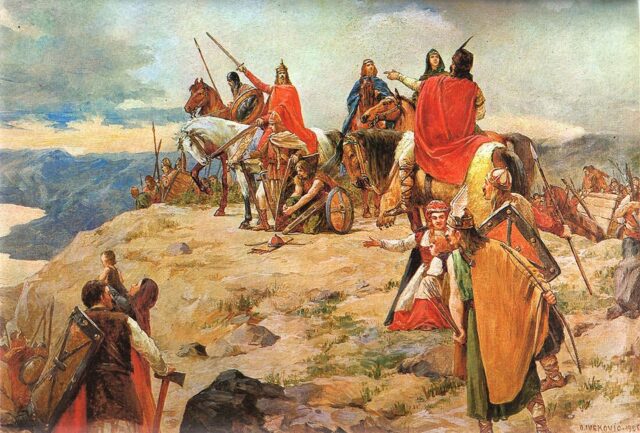
Historical painting also gained prominence, with artists depicting legendary Croatian rulers, battles, and scenes from folk epics. The choice of subject was political—these images constructed a narrative of continuity and resilience, even under foreign dominion. Works were exhibited in public spaces and reproduced in engravings for wide circulation, making visual art a partner to the era’s newspapers and pamphlets.
Even architecture participated in this identity-building. Neo-Romanesque and Neo-Gothic styles were often chosen for public buildings to evoke a medieval Croatian past, while inscriptions in the Croatian language began to appear on civic monuments.
Historicist Architecture in Zagreb and Split
The second half of the century saw rapid urban development, particularly in Zagreb, which was transformed from a provincial town into a modern capital. The city’s Lower Town (Donji grad) was laid out in a grid pattern, lined with public buildings and parks. The architecture reflected the historicist trends of the era—Neo-Renaissance, Neo-Baroque, and Neo-Gothic façades projected stability, order, and a connection to Europe’s great capitals.
The Croatian National Theatre in Zagreb, completed in 1895, epitomizes this spirit. Designed by Viennese architects Ferdinand Fellner and Hermann Helmer, its opulent façade, gilded interiors, and monumental staircases were not just for opera and drama—they were statements of cultural legitimacy on the European stage.
Split and other coastal cities also saw historicist projects, often blending local stone and Venetian influences with central European design principles. In both continental and coastal contexts, these buildings acted as visible signs of modernization while still referencing a romanticized past.
Lithography and Print Culture
One of the century’s most transformative developments for the visual arts was the growth of lithography and illustrated print culture. Workshops in Zagreb, Rijeka, and Zadar produced illustrated books, newspapers, and sheet music covers, many featuring patriotic motifs. These images reached audiences far beyond the elite who could commission oil portraits or own original paintings.
Printmaking also democratized art education. Reproductions of European masterpieces circulated in Croatian schools, introducing students to the canon while also inspiring local artists to experiment with new themes and compositions.
Three defining features of Croatian 19th-century art emerge:
- Nationalist subject matter in painting and architecture – reinforcing historical continuity.
- Urban modernization with historicist façades – projecting cultural parity with European capitals.
- Mass circulation of images via printmaking – widening art’s audience and influence.
By the end of the century, Croatia’s visual culture was both looking inward—drawing on its medieval heritage and folklore—and outward, engaging with European academic standards and urban sophistication. This dual focus laid the groundwork for the modernist breakthroughs of the early 20th century, when artists would begin to question the very academic traditions that the 19th century had so proudly embraced.
Modernism and the Birth of a Croatian Avant-Garde
The turn of the 20th century brought an unmistakable shift in Croatian art. The careful historicism and patriotic narratives of the 19th century began to give way to new ideas about form, color, and subject matter. Croatian artists traveled to Munich, Paris, and Vienna, absorbing modernist innovations and returning with ambitions to transform their own cultural landscape. Modernism here was not a rejection of national identity but a reimagining of it—aligning Croatian art with European avant-garde movements while grounding it in local experience.
Vlaho Bukovac and Parisian Connections
No single artist embodies this transition more vividly than Vlaho Bukovac (1855–1922). Born in Cavtat, Bukovac’s career took him from South America to Paris, where he studied at the École des Beaux-Arts under Alexandre Cabanel. His early works, steeped in academic realism, gradually absorbed the freer brushwork and luminous color of French Impressionism.
When Bukovac returned to Croatia in the 1890s, he brought with him a vision of painting that fused modern Parisian technique with Croatian subjects. His portraits of Dubrovnik aristocrats and national figures glowed with light and color, breaking from the darker tonalities of the 19th century. Even in historical compositions, Bukovac favored a livelier palette and looser handling, signaling that Croatian painting could participate in the visual language of modern Europe.
Bukovac’s influence extended beyond his canvases. As a teacher at the Prague Academy, he mentored a generation of Croatian artists who would push modernism further in the decades to come.
Proliferation of Secessionist Architecture
While painting embraced Impressionist and Symbolist currents, Croatian architecture absorbed the sinuous lines and ornamental inventiveness of the Secession movement—Central Europe’s answer to Art Nouveau. Zagreb became a showcase for this style, with façades adorned in floral stucco reliefs, curved balconies, and stained-glass panels. Architects such as Viktor Kovačić began to move away from pure historicism, seeking a modern architecture rooted in both function and artistry.
Public and private commissions alike embraced Secessionist design, from grand hotels to residential villas. These buildings often integrated sculpture, decorative ironwork, and murals into their design, creating a total work of art in the spirit of the Vienna Secession.
Artists’ Colonies and Open-Air Painting
Another hallmark of this period was the rise of artists’ colonies and plein-air painting, where painters gathered in rural or coastal settings to work directly from nature. These communities, such as those in Cavtat and along the Dalmatian coast, fostered a sense of camaraderie and experimentation.
Here, Croatian modernists developed a distinctly local Impressionism—bright Adriatic light rendered in quick, broken brushstrokes, fishing boats and market scenes treated with the same seriousness as grand historical subjects. These works captured the rhythms of everyday life while embracing a painterly freedom that would have been unthinkable in the academic salons of the previous century.
Three defining currents emerged from this modernist awakening:
- Synthesis of European avant-garde styles with local themes – particularly in Bukovac’s generation.
- Secessionist architecture integrating art and design – reshaping urban aesthetics in Zagreb and beyond.
- Plein-air painting as a bridge between realism and abstraction – turning everyday scenes into modern compositions.
By the eve of World War I, Croatian art had entered a new phase of confidence. It no longer sought legitimacy solely through historicist grandeur or nationalist iconography; instead, it claimed a place in the ongoing dialogue of European modernism. This was the groundwork from which the interwar avant-garde would launch, taking the experimental spirit to bolder extremes.
Between Wars: The Search for a Modern Identity
The period between World War I and World War II was one of intense artistic experimentation in Croatia, as in much of Europe. The collapse of empires and the creation of new states—including the Kingdom of Serbs, Croats, and Slovenes (later Yugoslavia)—forced artists to reconsider the relationship between tradition, nationhood, and modernity. This was not simply a time of stylistic change; it was an era when Croatian art grappled with what it meant to be modern without severing ties to the local landscape, history, and social reality.
The Zemlja Group’s Social Vision
Perhaps the most important collective of the interwar period was the Zemlja Group (Earth), active from 1929 to 1935. Founded by Krsto Hegedušić, the group rejected purely decorative or academic art in favor of socially engaged realism. Their paintings and prints depicted rural life, poverty, and the struggles of the peasantry, often in stark, unidealized terms. This was modernism with a moral purpose—rooted in Croatia’s villages rather than its cafés.
Hegedušić’s own works, such as his scenes of ploughing fields or village gatherings, combined a bold, simplified form with a muted, earthy palette. His style owed something to German Neue Sachlichkeit (New Objectivity) but was also shaped by Croatian folk art traditions—flattened perspective, strong outlines, and symbolic detail.
The group’s politics and critical stance toward official art made them controversial, and they faced censorship. Yet their influence endured, especially in showing that modernism in Croatia could be tied to social commentary rather than solely to formal innovation.
Interwar Photography and Graphic Arts
The interwar years also saw an explosion of photography and graphic design. Modernist photographers in Zagreb and Split experimented with unusual angles, stark contrasts, and the use of light and shadow to create almost abstract compositions. Studios produced both commercial and artistic work, blurring the boundaries between fine art and mass communication.
Graphic arts flourished in posters, book covers, and magazine layouts. The integration of typography, photography, and illustration reflected trends in European modernist design, especially the Bauhaus and Constructivism. Croatian designers adapted these influences to local publishing markets, producing arresting visuals for theater programs, political journals, and literary magazines.
This period marked the first time Croatian visual culture was shaped so heavily by reproducible media, with images circulating nationally and internationally far beyond the confines of galleries.
Public Monuments and Political Messaging
Sculpture in the interwar period occupied a complex position—caught between commemorating national history, celebrating new political realities, and engaging with modernist form. Public monuments often honored fallen soldiers of World War I or celebrated cultural figures, blending realistic portraiture with simplified, monumental lines.
One striking example is the work of Ivan Meštrović, Croatia’s most internationally acclaimed sculptor of the era. His public monuments combined classical grandeur with modern expressiveness, often depicting heroic or allegorical figures that spoke to national pride while appealing to universal human themes. Meštrović’s ability to bridge tradition and modernism made him a key figure not only in Croatia but across the international art world.
Three key threads defined Croatian art between the wars:
- Socially engaged realism – most powerfully expressed by the Zemlja Group.
- Integration of modernist design into mass media – photography, posters, and publications.
- Monumental sculpture balancing national identity with international style – epitomized by Meštrović.
The interwar period was not a stable golden age—political tensions and looming war cast long shadows over the cultural scene. Yet it was a time when Croatian artists refused to choose between the local and the modern, instead forging a hybrid identity that carried both into the turbulent decades ahead.
Socialist Realism, Experimentation, and the Yugoslav Years
After World War II, Croatia became a constituent republic of socialist Yugoslavia, and the arts entered a new ideological landscape. The immediate postwar years were dominated by Socialist Realism, the official style across much of the Eastern Bloc, which prescribed optimistic, heroic depictions of workers, soldiers, and collective life. Yet Yugoslavia’s eventual political break with the Soviet Union in 1948 opened the door to a more pluralistic approach, allowing Croatian artists to experiment far beyond the limits of state-mandated art.
Partisan Art and War Memorials
The war left deep physical and emotional scars, and monumental art became a way of both commemorating the fallen and shaping the memory of the conflict. In the late 1940s and 1950s, monumental sculptures and reliefs depicted Partisan fighters in dynamic, idealized poses, often accompanied by scenes of liberation or reconstruction. Public squares and city entrances were marked by such works, designed to be both inspirational and didactic.
By the 1960s and 1970s, however, war memorials in Croatia—and across Yugoslavia—took a radically different turn. Abstract, geometric, and often colossal in scale, these “spomenik” monuments, such as Dušan Džamonja’s Memorial to the Revolution in Podgarić, abandoned figuration entirely. They evoked resilience and unity through pure form, using poured concrete, steel, and stone to create futuristic shapes that stood apart from both Western minimalism and Eastern monumentalism.
These later memorials remain some of the most distinctive public artworks of the 20th century, simultaneously utopian in design and deeply tied to the specific history of the region.
The New Tendencies Movement
In the 1960s, Zagreb became the epicenter of a pioneering international art movement known as New Tendencies (Nove tendencije), which brought together artists from across Europe and Latin America to explore optical, kinetic, and computer-generated art. Croatian participants such as Ivan Picelj and Julije Knifer embraced geometric abstraction, serial structures, and experiments with viewer perception.
This was an extraordinary divergence from the Socialist Realist orthodoxy of earlier years—proof of Yugoslavia’s cultural openness compared to much of the Eastern Bloc. Exhibitions in Zagreb showcased cutting-edge work that placed the city firmly in the global avant-garde network, and the movement’s catalogues became influential beyond the region.
Abstract and Conceptual Practices
By the late 1960s and 1970s, Croatian artists were pushing further into abstraction, performance, and conceptual art. Groups such as Gorgona, active in the early 1960s, embraced anti-art gestures, ironic manifestos, and ephemeral works that resisted commodification. Members like Mangelos (Dimitrije Bašičević) painted over books and maps, creating objects that blurred the line between image and text, while Ivan Kožarić produced sculptures that redefined the role of form in public space.
Three key dynamics characterized Croatian art in the Yugoslav years:
- Official monumentalism evolving into radical abstraction – especially in war memorials.
- Zagreb as a hub of international avant-garde exchange – through the New Tendencies exhibitions.
- A coexistence of state-supported and independent experimental art – unusual in a socialist context.
This was a period when Croatian art navigated a careful balance between political expectations and creative freedom. While certain public commissions continued to serve ideological purposes, the broader artistic scene became a laboratory for ideas that connected Croatia to the most innovative tendencies of the 20th century. The result was a cultural landscape as varied as it was unexpected—where a concrete monument in a rural field and a conceptual performance in a Zagreb gallery could both claim a place in the national narrative.
Contemporary Croatia: Global Dialogues and Local Voices
Since gaining independence in 1991, Croatian art has unfolded in a landscape marked by postwar reconstruction, shifting political realities, and integration into global cultural networks. The collapse of Yugoslavia ended a unified state system of art patronage, replacing it with a more fragmented but also more pluralistic environment. Galleries, biennials, artist-run spaces, and digital platforms have all played roles in shaping a scene that is both internationally connected and deeply engaged with local realities.
Post-1991 Cultural Rebuilding
The Homeland War (1991–1995) left both physical destruction and psychological wounds. In the immediate aftermath, art often served as a means of documentation and testimony. Photographers recorded the devastation of cities such as Vukovar, while installation artists created works that addressed loss, displacement, and the fragility of memory.
Museums and galleries, many damaged or looted during the conflict, underwent reconstruction. Institutions like the Museum of Contemporary Art in Zagreb took on new importance, not just as exhibition spaces but as cultural anchors in a rebuilding society. The postwar period also saw a revival of interest in pre-1991 avant-garde movements, with retrospectives of New Tendencies and Gorgona reframing them as part of a continuous Croatian modernism.
Biennials, Galleries, and Street Art
In the 2000s and 2010s, Croatia’s art scene diversified in scale and approach. The Zagreb Biennial of Contemporary Art and events such as the Split Salon provided platforms for both emerging and established artists. Independent galleries in Zagreb, Rijeka, and Osijek championed experimental and cross-disciplinary work, often operating outside traditional funding structures.
Street art gained a visible presence, particularly in Zagreb’s industrial districts and Rijeka’s waterfront areas. Murals ranged from politically charged commentaries to purely aesthetic compositions, contributing to a broader public engagement with contemporary visual culture. For many younger artists, public space became both canvas and stage, bypassing institutional gatekeeping.
International residencies and exchange programs brought Croatian artists into dialogue with peers across Europe, Asia, and the Americas. At the same time, foreign artists began exhibiting in Croatia with greater frequency, creating a two-way exchange that was rare in the country’s earlier history.
Digital Media and New Generations
The most recent wave of Croatian art reflects a comfort with digital tools and online platforms. Video installations, interactive works, and internet-based projects are increasingly common, often exploring themes of identity, migration, and environmental change. Younger artists draw on the country’s layered history—not as nostalgia, but as material for reinterpretation.
Three defining threads of contemporary Croatian art stand out:
- Engagement with historical memory – addressing both the recent war and deeper cultural layers.
- Plurality of platforms – from biennials to street walls to digital screens.
- Global mobility paired with local specificity – artists who can exhibit in Berlin or New York without losing a rooted sense of place.
Today’s Croatian art is less about a single style or dominant ideology than about an ongoing negotiation between heritage and innovation. Whether in a restored 18th-century palace gallery in Dubrovnik, a converted warehouse in Zagreb, or a mural on a coastal fishing harbor, Croatian artists continue to work at the intersection of history and experiment—proving that the Adriatic remains, as it has always been, a place where cultures meet and transform each other.