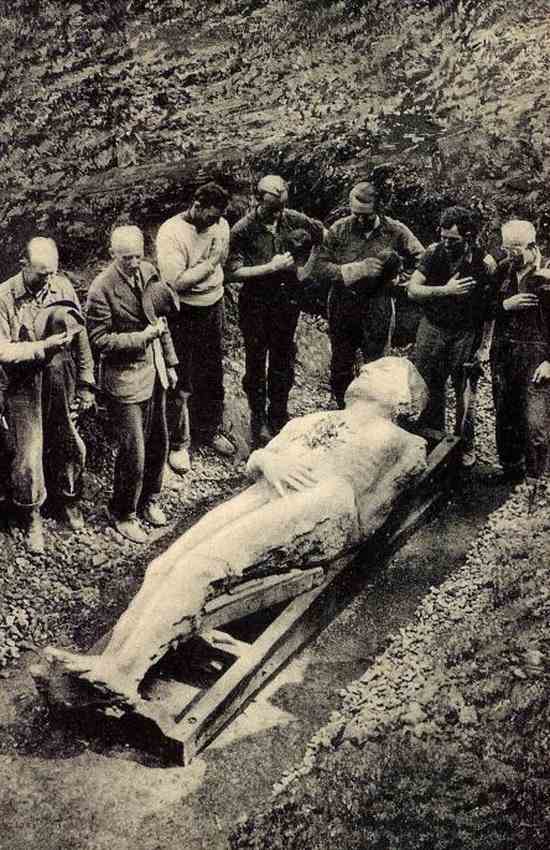
On October 16, 1869, two unsuspecting workers digging a well behind a barn in Cardiff, New York, stumbled upon what appeared to be a ten-foot-tall petrified man buried beneath the soil. The moment they hit what looked like stone, they quickly realized this was no ordinary find. Word spread almost instantly through the small farming community. People poured in by the hundreds to see the “Cardiff Giant,” some convinced it was an ancient fossil, others proclaiming it biblical proof of a time when giants roamed the earth.
The land where the discovery occurred belonged to William “Stub” Newell, a local farmer. He quickly took advantage of the situation, erecting a tent around the excavation site and charging 50 cents a head to view the remarkable figure. The sheer size and human-like features of the giant captivated imaginations. Some visitors knelt in awe, convinced they were in the presence of a religious relic, while others simply enjoyed the spectacle for what it was—an unusual curiosity.
Newspapers from Syracuse to New York City ran stories almost daily, speculating on the giant’s origin. Clergy members suggested it might be a pre-flood Nephilim referenced in Genesis 6:4. Amateur scientists guessed it could be a remnant of a lost race. Everyone had a theory, but no one yet knew the truth—that the giant was an elaborate fraud hatched in secret and planted with great care.
The Discovery on Stub Newell’s Farm
Newell had agreed to let his cousin-in-law George Hull bury the figure on his property nearly a year earlier. When the stone figure was unearthed, Newell feigned shock but wasted no time in monetizing the event. Crowds of as many as 3,000 people arrived over the first few weeks. Carriages lined the roads, and vendors popped up nearby to sell refreshments, souvenirs, and pamphlets filled with pseudo-scientific theories.
Local authorities had to get involved just to manage the flood of onlookers. It was as though a traveling circus had taken root in rural Onondaga County. Newell claimed he had no idea what the giant was or how it came to be in his yard. His act was convincing enough that almost no one suspected he was part of the hoax.
Public Reaction and Media Frenzy
The American public had a longstanding appetite for the extraordinary, and the Cardiff Giant arrived at just the right moment. In the post-Civil War era, people were hungry for something that would distract them from national divisions and economic hardships. The media, quick to capitalize on this hunger, printed both sober analysis and wild speculation.
Several newspapers referred to the figure as the “American Goliath.” Tourists arrived from as far as Boston and Philadelphia. Ministers took to their pulpits to warn or celebrate the discovery. Even skeptics were drawn in by the scale of the deception. What no one yet realized was that this massive statue had never been buried by nature—but by design.
- Popular Theories Circulated in 1869:
- The petrified remains of a giant human.
- A statue carved by ancient Native American tribes.
- A religious relic, possibly a Nephilim.
- A fossilized man from pre-Flood times.
- A natural geological formation shaped like a man.
George Hull: The Man Behind the Myth
George Hull, a cigar manufacturer from Binghamton, New York, was the mind behind the Cardiff Giant. A known atheist, Hull was incensed by a literalist preacher he had argued with in Iowa in 1867. The preacher insisted that everything in the Bible should be taken literally, including the passage about giants once walking the earth. Hull saw this as not just poor reasoning but as dangerous ignorance. He decided then and there to craft a scheme that would expose how easily people could be fooled when they wanted to believe.
Hull’s background gave him the means to fund such a venture. He was no wealthy tycoon, but he had enough resources and a sharp enough mind to plot a hoax of national proportions. More than anything, Hull was a skeptic determined to prove a point: that the masses, especially when driven by religious zeal or scientific arrogance, could be duped with shocking ease. He didn’t just want to trick the public—he wanted to mock the institutions they trusted.
A Hardened Skeptic with a Grudge
Hull’s frustrations with religious dogma had been building for years. He viewed the public’s blind acceptance of biblical literalism as a threat to rational thought. His plan wasn’t just about making money; it was a form of ideological revenge. He believed that if he could create a convincing fake, he would expose both religious and scientific authorities as gullible or complicit.
He began by designing a statue that would resemble a petrified man, complete with pores, veins, and a pained expression as if he had died in agony. The point was to make it just realistic enough to cast doubt in the minds of believers and skeptics alike. This wasn’t just showmanship—it was psychological warfare.
The Creation and Transportation of the Giant
Hull purchased a 10-foot-long block of gypsum in Fort Dodge, Iowa, for $26 (roughly $500 in today’s dollars) under the pretense of it being intended for a war memorial. He then hired German stonecutters in Chicago to secretly carve the figure. These artisans, unaware of Hull’s true intentions, worked under strict secrecy and were paid handsomely.
Once the statue was complete, Hull arranged for it to be shipped by rail and wagon to Cardiff, New York. There, with Newell’s help, he buried it in November 1868. Nearly a year passed before Hull gave Newell the go-ahead to “discover” the giant. By then, the stone had absorbed enough weathering to seem ancient. The groundwork for America’s greatest hoax was complete.
The Business of Deception
What began as an ideological prank quickly turned into a lucrative business. Hull and Newell found themselves at the center of a goldmine. People were willing to pay just for a glimpse of the stone figure. Within the first few weeks, over $7,000 had been made—an astronomical sum in 1869, equivalent to more than $150,000 today. Hull realized his hoax wasn’t just working—it was thriving.
To manage demand and increase profits, Hull sold shares in the giant to a group of local businessmen for $30,000. These investors moved the figure to Syracuse to reach a broader audience. The move was a smart one, and interest only grew. Newspapers were now printing editorials, religious organizations were forming public positions, and lecturers were drawing huge crowds by simply debating the giant’s authenticity.
Admission Fees and Investor Frenzy
The businessmen who bought Hull’s stake charged 50 cents for general admission and $1 for VIP access. Long lines formed outside the exhibition halls. Churches sent delegations to view the statue, hoping to confirm its alignment with Scripture. Museums expressed interest in acquiring the artifact, and regional universities sent teams to investigate its origin.
This flood of attention meant enormous profits. Hull, for a brief time, was flush with cash. He had started the hoax to make a point, but he was now a wealthy man because of it. He once remarked that the only mistake he made was not charging more.
- Financial Highlights of the Hoax:
- $26 for gypsum purchase.
- $2,000+ in carving and transport costs.
- $7,000 in revenue from first three weeks.
- $30,000 sale to Syracuse investors.
- Barnum’s $50,000 offer refused.
Barnum’s Attempt to Cash In
P.T. Barnum, the great American showman, took notice. Known for his exhibitions of the odd and extraordinary, Barnum offered to buy the Cardiff Giant for $50,000. The owners refused, believing they could make even more money on their own. Barnum, never one to take no for an answer, had a duplicate made and began exhibiting it in New York City.
He advertised his version as the “original,” claiming the Syracuse one was the fake. The public didn’t know what to believe anymore. Arguments broke out in newspaper columns. Clergy debated rival theologians. And Barnum, ever the master of promotion, was laughing all the way to the bank.
Science vs. Spectacle
From the moment the Cardiff Giant was unveiled to the public, scientific voices began expressing doubt. Many geologists and archaeologists immediately recognized the problems with the supposed “petrified man.” The stone used was clearly gypsum—a soft, soluble mineral that would never withstand centuries underground without damage. Moreover, the carving showed chisel marks and other indications of human craftsmanship. But in a time when the scientific community had little formal authority over public belief, these warnings were easily drowned out by spectacle and faith.
James Hall, New York’s state geologist and a respected figure in paleontology, examined the statue and concluded it was “a most decided humbug.” Others echoed his skepticism. Scholars from Yale, Cornell, and the Smithsonian Institution agreed that the figure was man-made, citing its unrealistic anatomy and fresh tool marks. Despite this, the public remained divided, and the crowds kept coming. People preferred mystery over facts, awe over analysis.
Religious figures were often the most vocal defenders of the Cardiff Giant’s authenticity. Some preachers declared it was evidence of a pre-Flood world described in Genesis, where “there were giants in the earth.” One clergyman insisted it must be a fossilized man destroyed in the great deluge. The hoax fed into the lingering tensions between religion and science that had been inflamed by Darwin’s On the Origin of Species just a decade earlier.
Early Scientific Doubts
Professor Othniel C. Marsh of Yale was among the first to denounce the statue as a fraud. After a brief inspection, he pointed out that real fossilized human remains would not retain such soft detail and would have shown signs of decomposition. Marsh’s report should have settled the matter, but instead it sparked even more debate. People accused him of being closed-minded or motivated by envy.
The scientific community was frustrated. They saw the public falling under the spell of what was clearly a manufactured object. But the growing cult-like excitement around the Cardiff Giant made rational arguments feel like background noise. The truth was less exciting than the possibility that giants had once roamed America’s heartland.
Religious Defenders and Gullible Believers
Despite mounting scientific evidence, many Americans clung to the belief that the giant was a divine sign or biblical proof. This reaction reveals more about the 19th-century American mindset than it does about the giant itself. At the time, the Bible was considered literal historical truth by a large portion of the population. Any potential confirmation of that truth, however implausible, was seized upon eagerly.
Ministers printed sermons defending the statue, and one group even attempted to have it moved to a Christian college. Letters to the editor poured into newspapers, accusing skeptics of “blasphemy” and “godlessness.” For many, the Cardiff Giant wasn’t just a curiosity—it was a touchstone in the broader battle for the American soul between scientific rationalism and religious tradition.
Barnum’s Counterfeit and the Lawsuit
P.T. Barnum was never one to let a good hoax pass him by. After failing to purchase the Cardiff Giant from its new owners in Syracuse, he quickly built his own. Barnum’s replica was made from plaster and displayed in Manhattan starting in December 1869. True to form, Barnum advertised his version as the “true” Cardiff Giant and claimed the original was a fake. His fake of a fake drew crowds just as large.
Barnum’s challenge forced the original owners to respond. They accused him of deception and attempted to sue for damages. But Barnum, already an experienced showman and legal dodger, handled the situation with skill. What followed was one of the most bizarre legal episodes in American entertainment history.
The Creation of a Competing Fake
Barnum’s sculptors in New York crafted his version with great speed, though it lacked the weathering and detail of the original. Still, to the average viewer, it was close enough. He exhibited it in his American Museum and charged admission just like the original owners. To further muddy the waters, he published flyers and posters mocking the Syracuse exhibition, calling it a hoax of the “cleverest kind.”
The public now had two “authentic” Cardiff Giants to choose from. Ironically, Barnum’s fake began drawing even bigger crowds than the original. His advertising was more aggressive, and his reputation for thrilling attractions gave him an edge. In the world of 19th-century show business, truth mattered far less than presentation.
The Infamous Court Case
The owners of the original Cardiff Giant filed a lawsuit against Barnum for defamation and loss of revenue. The case, however, collapsed under its own absurdity. When asked to prove that Barnum’s statue was a fake, the plaintiffs were cornered—they would have to admit their own statue was fake too. In a legendary moment, the judge reportedly told them, “Bring your giant here, and if he swears to his own authenticity, you shall win the case.”
Though probably apocryphal, the judge’s quip captured the farcical nature of the whole affair. In the end, the lawsuit was dismissed. Barnum, as usual, walked away with more fame and money than before. Hull and the other investors were left to deal with the public’s growing suspicion. The hoax was on the verge of collapse.
The Hoax Unravels
In December 1869, just two months after the “discovery,” the truth came out. George Hull, perhaps sensing that the game had gone as far as it could, confessed everything to the press. He explained how he had conceived the plan, financed the sculpture, and orchestrated its burial with Newell’s help. His confession, printed in multiple newspapers, stunned the public.
People felt betrayed, but also amused. The hoax had taken in thousands, including clergy, investors, and academics. For some, Hull’s trickery was unforgivable. For others, it was a brilliant commentary on the gullibility of society. It revealed how easily people could be fooled when something played into their existing beliefs.
Hull Comes Clean
Hull gave a detailed interview to the New York Tribune in which he laid out the entire scheme. He admitted that the statue had been carved in Chicago by a team of artisans he had sworn to secrecy. He even revealed the names of the transport companies he used to move the figure to Cardiff. The story was corroborated by shipping records and testimonies from workers involved in the project.
Hull’s tone was unapologetic. He insisted that the hoax had served a noble purpose: to expose the intellectual laziness of both religious zealots and self-proclaimed experts. Though many were angry, a surprising number of people admired the hoax for its ingenuity. Hull had not only fooled the public—he had embarrassed their most trusted authorities.
Public Reaction and Moral Outcry
The admission sparked fierce debate across the country. Editorials denounced Hull as a “liar,” a “fraudster,” and worse. Religious leaders tried to salvage their reputations by claiming they had suspected the hoax all along. Investors who had put money into the statue tried to recoup losses by continuing to exhibit it under the banner of “America’s Greatest Hoax.”
At the same time, popular culture embraced the giant. Cartoons appeared in satirical magazines like Puck and Harper’s Weekly. Poets wrote humorous verses about the statue, and traveling lecturers used it as a case study in human foolishness. The Cardiff Giant, even as a known fraud, had become an American legend.
Cultural Aftermath and Enduring Fame
The Cardiff Giant might have been exposed as a fraud, but that didn’t stop people from wanting to see it. In fact, its notoriety gave it new life as a cultural artifact. Rather than fading into obscurity, the statue found a second act as a sideshow attraction. It continued to draw crowds long after the truth was known, not as a relic of the ancient world, but as a symbol of one of the greatest hoaxes in American history.
After the public confession, the statue was moved several times. It was displayed at fairs, circuses, and museums across the country. The novelty no longer lay in the question of whether it was real, but in the boldness of the ruse. People admired the sheer ambition of the hoax and the cleverness of its execution. It had become a piece of Americana—both a cautionary tale and a curious delight.
The story of the Cardiff Giant seeped into American popular culture. It was referenced in books, mocked in editorials, and even used in college debates about ethics and public trust. It tapped into something deep in the national character: the love of spectacle, the tension between faith and science, and the dangers of gullibility. The hoax didn’t die—it evolved.
From Sideshow to Museum Piece
The original Cardiff Giant eventually found a permanent home at The Farmers’ Museum in Cooperstown, New York. The museum acquired the statue in the 1940s and has kept it on display ever since. Visitors can view the massive gypsum figure and learn about the elaborate fraud that made it famous. It remains one of the museum’s most visited exhibits.
The museum display emphasizes the hoax’s place in American history rather than its connection to archaeology or mythology. Educational panels explain how the statue was made, how it was transported, and how it was received by the public. School groups, tourists, and history buffs come to see the figure not just for its size, but for the story it represents.
The Cardiff Giant in Pop Culture
Over the decades, the Cardiff Giant has been referenced in a range of artistic and cultural outlets. It has appeared in short stories, television episodes, and comic strips. One notable mention came from author Mark Twain, who was fascinated by hoaxes and used the Cardiff Giant as inspiration in his 1873 novel The Gilded Age.
The giant also appears in American folklore as a kind of warning—a symbol of how easily people can be deceived by their own expectations. In modern times, it’s even been used as a teaching tool in schools and universities, where students analyze the event as a case study in media literacy, crowd psychology, and ethics. Its story, once buried in a quiet New York field, has become part of the nation’s moral and historical imagination.
American Hoaxes and National Identity
The Cardiff Giant wasn’t just a prank—it was a mirror held up to the American soul. It revealed how Americans, particularly in the 19th century, were caught between old-world religious beliefs and the emerging world of scientific inquiry. The country was growing, industrializing, and changing fast. In that environment, something like the Cardiff Giant could thrive precisely because people were unsure what to believe.
Hoaxes have always had a home in American culture. From phony spiritualists and snake-oil salesmen to fake news and staged spectacles, deception has often walked hand-in-hand with entrepreneurship. The Cardiff Giant fit perfectly into that tradition. It was a product of its time, but also a reflection of enduring national traits: curiosity, credulity, and the drive to profit from both.
A Nation Drawn to the Extraordinary
In 19th-century America, there was a deep hunger for the marvelous. The rise of newspapers, traveling shows, and a mobile population made it easier than ever for stories—real or fake—to capture the public imagination. People craved wonders, whether they were natural, spiritual, or manufactured. The Cardiff Giant provided that in spades.
America’s Protestant culture also played a role. Many rural communities interpreted the Bible literally and saw the world through a lens of miracles and divine signs. Anything that could potentially support Scripture was embraced without hesitation. This cultural backdrop created fertile ground for Hull’s hoax. He knew exactly which buttons to push—and he pushed them all.
What the Cardiff Giant Says About 19th-Century America
The Cardiff Giant’s story isn’t just about one man’s deception—it’s about a society willing to believe. It reveals the limits of expertise, the power of media, and the influence of personal belief. The hoax succeeded not because it was particularly convincing, but because people wanted it to be true. It validated religious narratives, it offered scientific novelty, and it was just weird enough to be irresistible.
It also underscores a truth that still holds today: the line between education and entertainment can be dangerously thin. In a nation built on personal freedom and private enterprise, people have the right to believe what they want—but that freedom comes with risks. Hull understood that better than most. His hoax wasn’t just a scam—it was a commentary on America itself.
Lessons from the Stone Colossus
Though it happened over 150 years ago, the Cardiff Giant remains relevant. It’s more than just a curious footnote in history—it’s a warning. In an era when misinformation spreads faster than ever, the lessons of the giant are more important than ever. Critical thinking, skepticism, and humility in the face of the unknown are as necessary today as they were in 1869.
The hoax also reminds us that belief is often more powerful than fact. People tend to accept what aligns with their worldview, even when contrary evidence is plain to see. The Cardiff Giant revealed this human tendency in dramatic fashion. It’s one thing to be fooled—it’s another to defend the lie even after it’s been exposed.
Critical Thinking in an Age of Sensationalism
The Cardiff Giant teaches that not every expert should be believed—but neither should every critic. The truth usually lies somewhere in between. Hull’s hoax worked because people didn’t stop to ask the right questions. They trusted headlines, preachers, and their own hopes instead of digging deeper. It’s a lesson that applies just as well in the internet age.
Schools today use the Cardiff Giant as a case study in logic and skepticism. Students learn how to evaluate sources, weigh evidence, and resist emotional reasoning. The statue has become more than a relic—it’s a teaching tool. Its silent stone face speaks volumes about the dangers of unchecked belief.
Why the Giant Still Matters Today
In the end, the Cardiff Giant isn’t just about a 19th-century prank. It’s about how a free people handle truth. Do we seek it, no matter the cost? Or do we cling to illusions that make us feel good? Hull believed the answer said everything about a person’s character. His hoax was his answer to a world he saw as gullible and lazy.
Yet there’s a paradox at the heart of the story. The hoax succeeded not just because people were foolish—but because they were hopeful. They wanted to believe in giants. That hunger for wonder, for a glimpse of something bigger than ourselves, is deeply human. And perhaps that’s the most enduring truth the Cardiff Giant has to offer.
Visiting the Cardiff Giant Today
Today, the Cardiff Giant rests in a quiet corner of The Farmers’ Museum in Cooperstown, New York. Far from the headlines and hysteria of 1869, it now sits behind glass, drawing curious glances rather than frenzied crowds. But its presence remains powerful. Visitors come not just to see a stone man, but to experience a story that once captivated a nation.
The museum has done a careful job of preserving not only the statue but the history that surrounds it. Informational plaques, photographs, and original newspaper clippings guide visitors through the story. The exhibit offers a look at both the physical object and the cultural storm it created. It’s a place where history, legend, and education intersect.
Location and Accessibility
The Farmers’ Museum is located at 5775 State Hwy 80, Cooperstown, NY, and is open seasonally. The Cardiff Giant is one of its most prominent attractions. Admission includes access to both the statue and the surrounding historical village, offering a full day of exploration for history lovers and families alike.
The museum staff are well-versed in the giant’s history and are often available for informal tours and questions. The statue is displayed in a temperature-controlled environment to preserve the gypsum. Photography is allowed, and many visitors take the opportunity to pose beside the giant’s massive feet.
Museum Display and Interpretation
Rather than mocking or glorifying the hoax, the museum takes a balanced approach. It presents the giant as a teaching moment—an example of how belief, business, and media can combine into something powerful and deceptive. Visitors leave not just entertained, but informed. The Cardiff Giant, exposed long ago, continues to shed light on the present.
For those who can’t make the trip in person, the museum’s website offers a virtual exhibit, complete with interactive timelines and archival images. Whether seen in person or online, the Cardiff Giant remains a stone-faced reminder that sometimes the biggest lies are the ones people want most to be true.
Key Takeaways
- The Cardiff Giant was an elaborate 1869 hoax that fooled thousands of Americans.
- George Hull created the statue to mock biblical literalism and gullible belief.
- Despite early scientific skepticism, public excitement made the hoax wildly profitable.
- P.T. Barnum created a competing fake, escalating the spectacle and legal battles.
- Today, the statue is displayed in Cooperstown, NY, as a cultural and historical artifact.
FAQs
- Where was the Cardiff Giant discovered?
It was unearthed on Stub Newell’s farm in Cardiff, New York, on October 16, 1869. - Who created the Cardiff Giant?
George Hull, an atheist cigar maker from Binghamton, masterminded the hoax. - Why did Hull create the giant?
He wanted to expose the gullibility of both religious literalists and the general public. - Where is the Cardiff Giant now?
It is on permanent display at The Farmers’ Museum in Cooperstown, New York. - Was P.T. Barnum involved?
Yes, he created a rival replica when denied purchase of the original and exhibited it as the “real” giant.