Eilert Adelsteen Normann was born on May 1, 1848, in the parish of Bodin, near the town of Bodø in Northern Norway. Raised in a merchant family, he grew up surrounded by the natural grandeur of fjords, mountains, and northern skies. His father intended for him to pursue a business career, and young Normann was even sent abroad for schooling, including time in Copenhagen. Despite these plans, he eventually turned away from commerce in favor of painting—a bold and unconventional move at the time.
The coastal landscape of his youth left a profound impression on Normann. Long days under Arctic light, deep shadows from jagged cliffs, and the quiet power of the sea became etched in his visual memory. Although he had no formal art education during these years, he developed a natural eye for light, water, and landscape. This deep connection to place would later distinguish his work from other European landscape painters.

Norway in the mid-19th century was still forging its cultural identity. While literature and music began to emerge nationally, professional visual artists remained few. Normann’s decision to become a painter aligned him with a rising generation of Norwegians who sought to give visual form to their homeland’s unique beauty. His personal background—rooted in the remote north—gave him a special sensitivity to the themes he would later paint.
Even before he touched a brush in an academic setting, Normann’s worldview had been shaped by the austere and majestic geography of Northern Norway. His career would become a lifelong homage to this formative landscape. He carried with him the memory of endless summer light and winter shadow, both of which later found their way onto canvas.
Training at the Kunstakademie Düsseldorf
In the early 1870s, Normann left behind his mercantile upbringing to formally study painting. He enrolled at the Kunstakademie Düsseldorf in Germany, one of Europe’s leading centers for academic art at the time. There, he trained under Eugen Dücker, a respected Estonian-born landscape painter known for his mastery of light and atmospheric effect. This training deeply shaped Normann’s future style, combining technical precision with poetic expression.
The Düsseldorf School of Painting emphasized both naturalism and romantic mood. Normann absorbed these principles, especially the importance of careful composition and attention to detail. He also gained exposure to other prominent landscape painters and German romantic traditions. Though he was Norwegian by birth, this German academic background would play a lasting role in his visual language.

As a student, Normann began developing the themes that would come to define his career—crystalline fjords, sweeping horizons, and mirror-like waters. By 1872, he was already exhibiting works at galleries in both Düsseldorf and Copenhagen. These early successes hinted at the wider recognition he would eventually achieve.
Upon completing his studies, Normann did not immediately return to Norway but remained in Germany to further develop his craft. He would often travel back to the fjords during the summer, sketching and photographing scenes that he later translated into large oil paintings. This dual life—rooted in both Norway’s wild nature and Germany’s cultured art circles—became his permanent artistic rhythm.
Finding His Signature Style: The Norwegian Fjordscapes
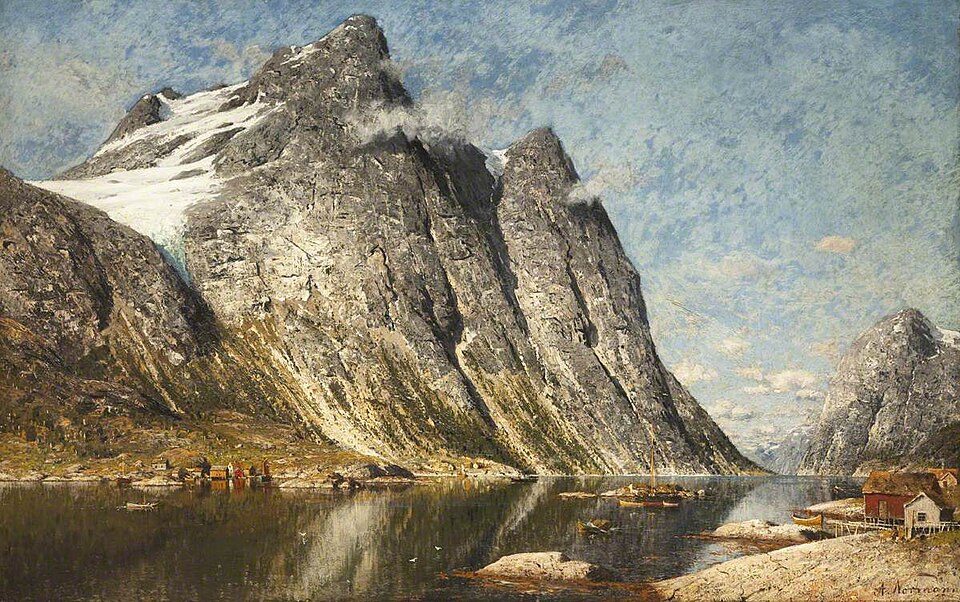
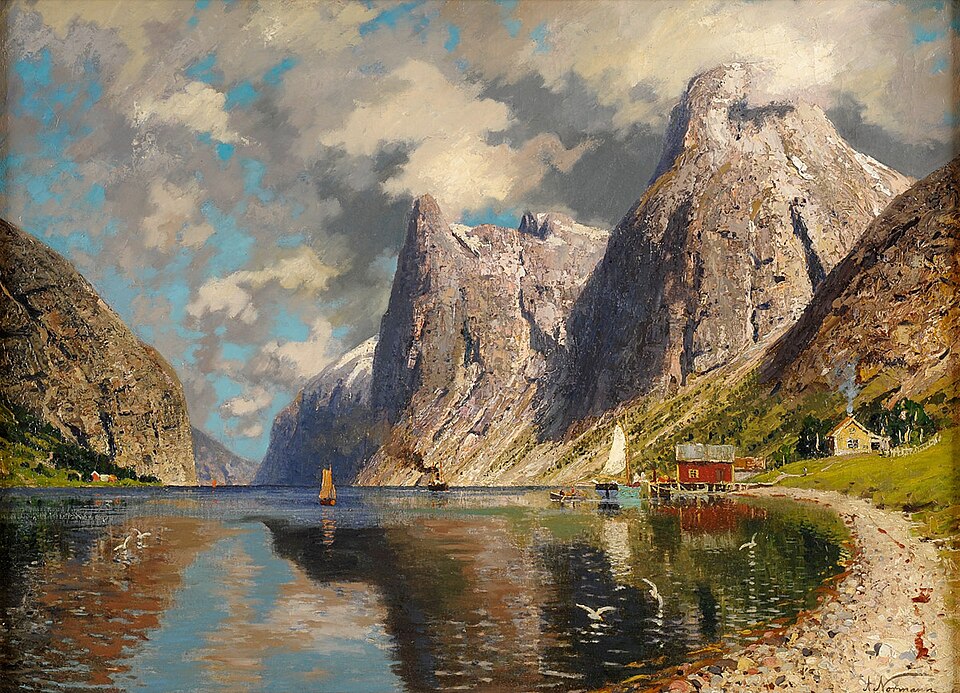
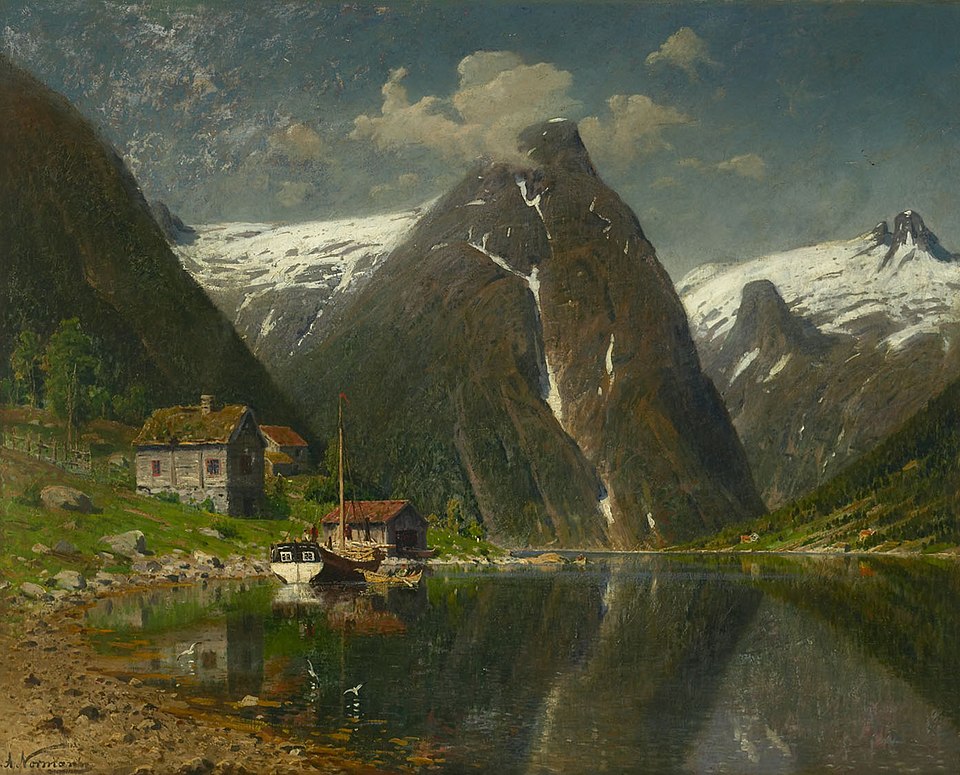
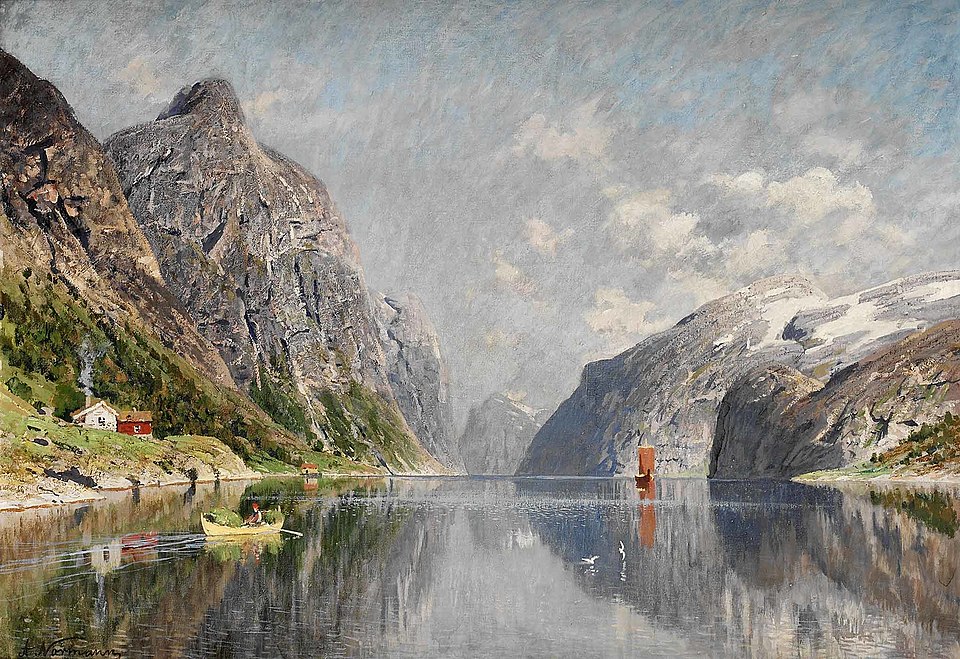
By the late 1870s, Normann had found his voice as an artist. His works focused primarily on Norway’s fjords—deep, narrow inlets flanked by steep cliffs, often bathed in soft light or moody shadow. These landscapes were not only visually dramatic but deeply personal to Normann. His love for his homeland’s scenery came through in every canvas.
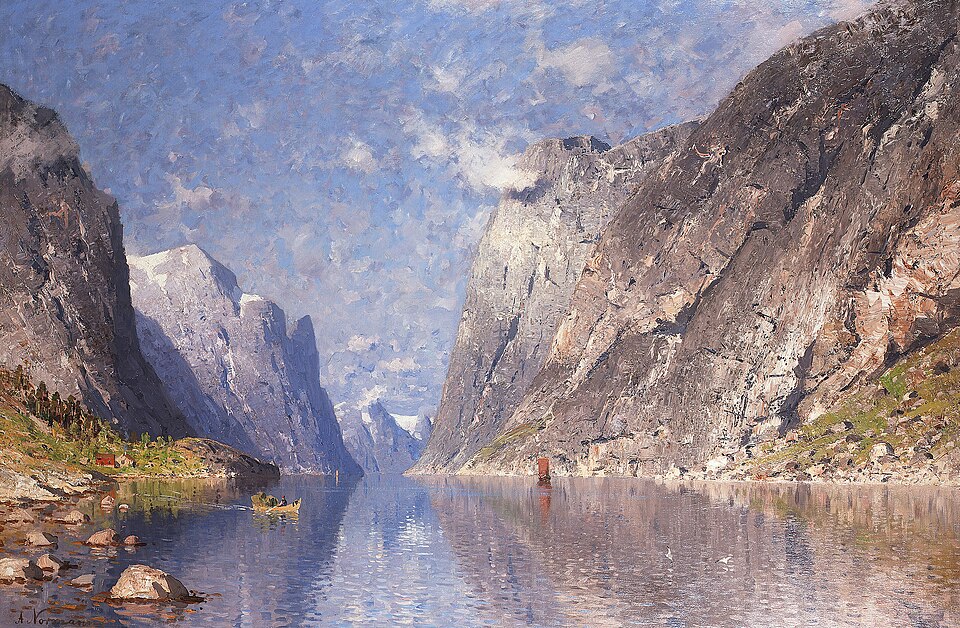
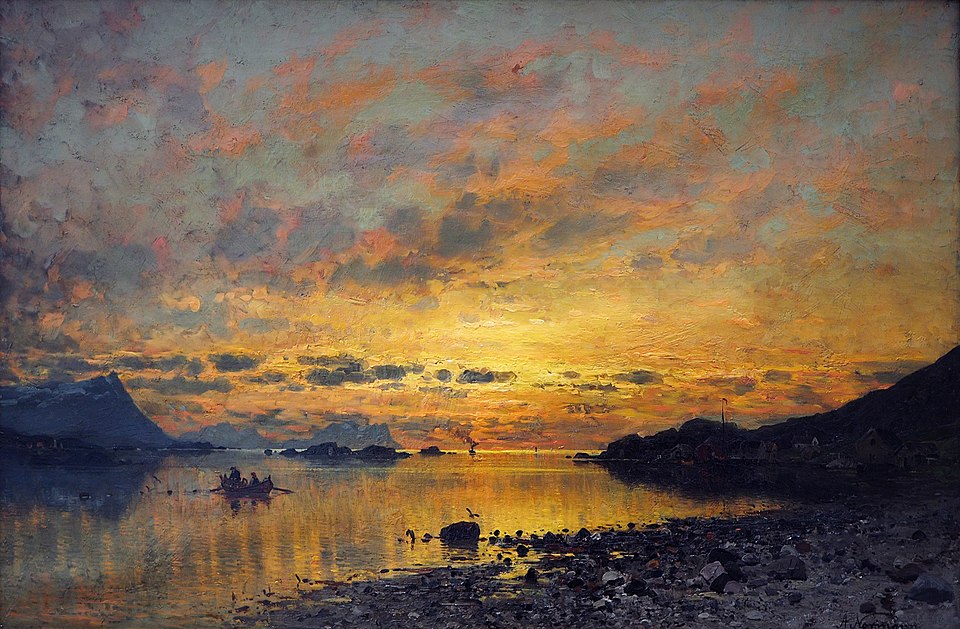
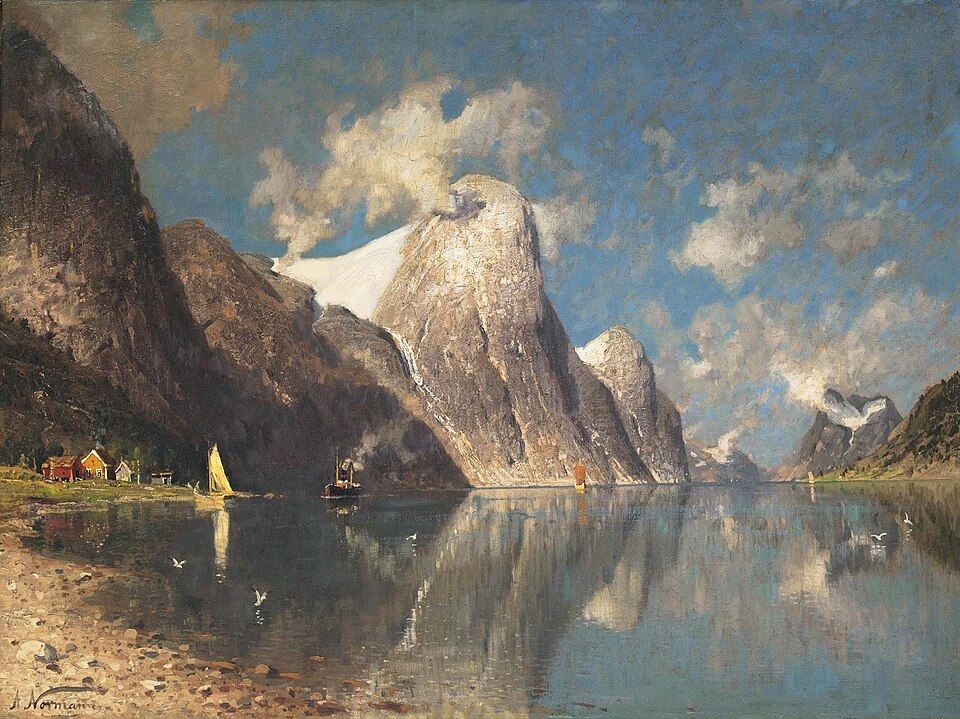
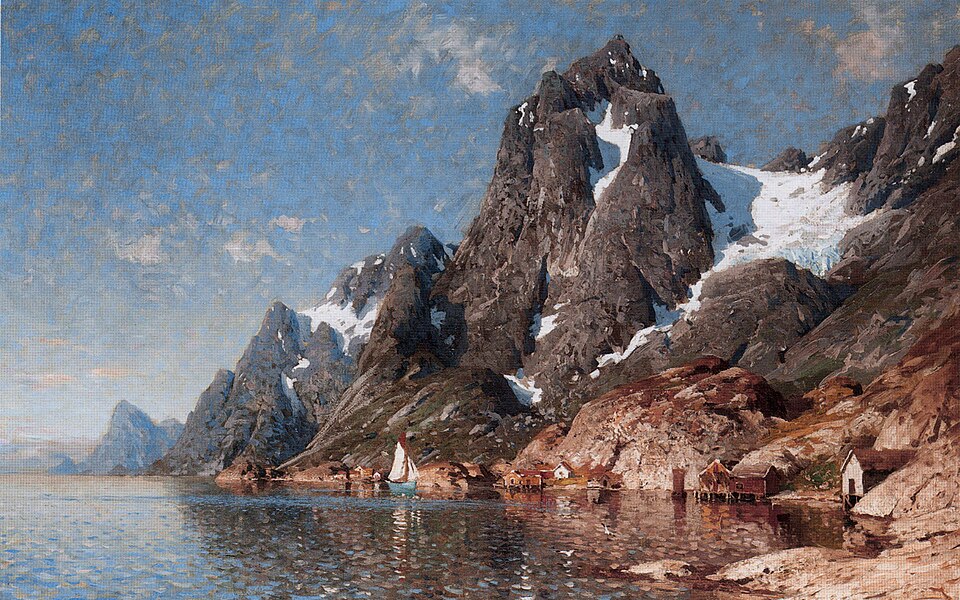
His most iconic works depict places such as Geirangerfjord, Sognefjord, and the Lofoten Islands. These compositions often included small details—rowboats, sailing ships, distant figures—that lent intimacy to otherwise monumental settings. Normann’s keen eye for atmosphere allowed him to capture the interplay of fog, water, and sunlight in a way few others could.
Romanticism Meets Realism in His Art
Normann blended romantic awe with realism’s fidelity to nature. His fjordscapes possessed a near-mystical stillness, yet remained faithful to topographical reality. He painted light with surgical precision: glowing skies, reflective waters, and snow-tipped peaks rendered with luminous care. At the same time, his works conveyed the quiet grandeur and isolation of Norway’s landscape.
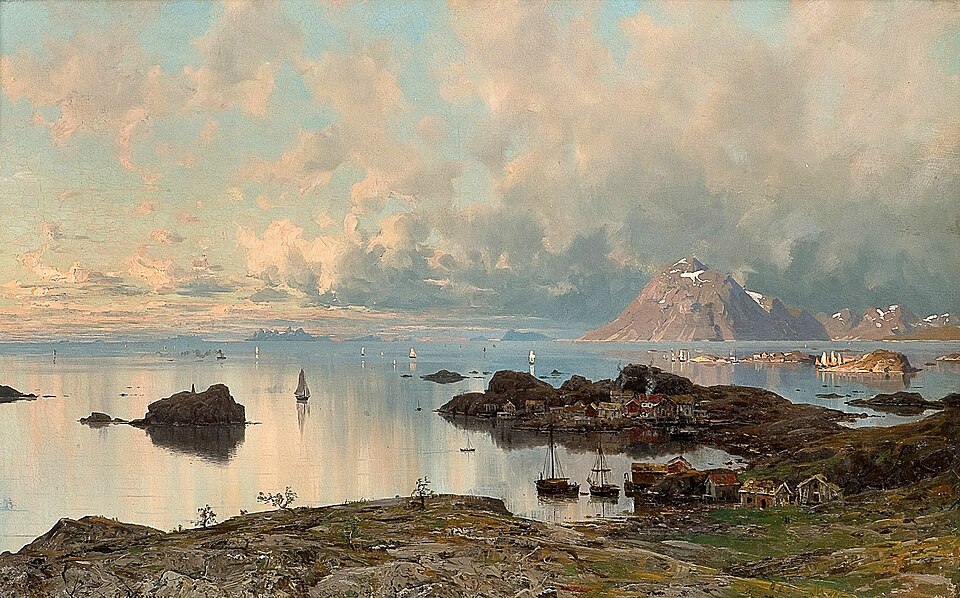
He took multiple study trips to Norway each year to gather material—sketches, studies, and photographs—which he used to compose large paintings back in his studios. His brushwork was refined yet expressive, and his color palette cool but full of depth. Through these methods, he established himself as the foremost visual interpreter of Norway’s coastal wilderness.
International Recognition and the Paris Exhibitions
Normann’s success in Norway and Germany eventually opened doors across Europe. In 1882, he began exhibiting regularly at the prestigious Salon de Paris, the most influential art exhibition in the world at that time. There, he earned a Mention Honorable in 1884 and a bronze medal in 1889. These accolades gave him international prestige and secured his place among the top landscape painters of his generation.
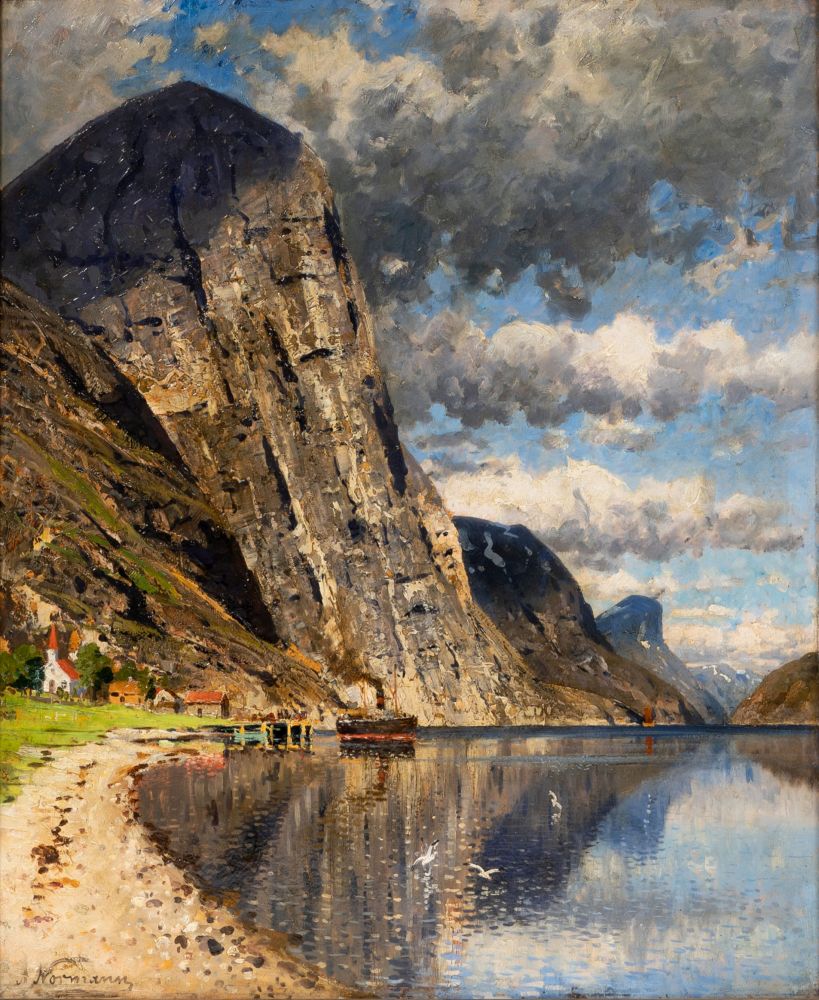
Paris was the cultural capital of the 19th-century art world, and for a Norwegian painter to win awards there was no small feat. Normann’s detailed and emotionally resonant fjordscapes stood out amid a sea of classical landscapes and historical themes. His work offered something new: a romanticized yet truthful vision of a land few Parisians had seen.
His success in Paris helped open markets in cities like Vienna, London, and Berlin. Collectors across Europe sought his fjord scenes as both art and cultural artifacts. These paintings began appearing in royal collections and bourgeois homes alike. Normann had succeeded in turning the rugged edges of Norway into sought-after visions of beauty.
Boosting Awareness of Norwegian Landscapes
Normann’s art did more than decorate walls—it played a role in shaping Europe’s perception of Norway. Through his vivid portrayals, he helped turn the country into a destination. As steamships and railways made travel easier, many European tourists were inspired to visit the fjords they had seen in his work. In a very real sense, Normann’s paintings served as early visual advertisements for Norwegian tourism.
Berlin Years and Personal Life
By 1883, Normann settled in Berlin, which had become a major European cultural center. There, he established a successful studio and integrated into elite artistic and social circles. Berlin provided access to patrons, critics, and the kind of cosmopolitan environment that encouraged both competition and innovation. From this base, he was able to manage a thriving international career.
His role in Berlin’s art scene extended beyond painting. He became active in the Verein Berliner Künstler, contributing to group exhibitions and mentoring younger artists. One of the most famous moments in his career came in 1892 when he invited fellow Norwegian Edvard Munch to exhibit in Berlin. Although Munch’s works sparked controversy and caused a rift in the artists’ union, the event marked a turning point in modern art history.
Normann’s personal life flourished alongside his career. He married Catharina Hubertine Weitgan and had four children: Emma, Otto, Olga, and Walter. After her death in 1911, he remarried Luise Rostalski, and their son Adelsteen was born shortly thereafter. Despite his German base, Normann never cut ties with Norway. He spent summers in Balestrand, a picturesque fjord village where he built a richly decorated wooden villa.
A Family in the Arts
Normann’s home in Balestrand became a social and artistic hub. There he hosted gatherings with other artists, including fellow landscape painter Hans Dahl. These summer retreats strengthened the Norwegian artist colony and nurtured a shared commitment to portraying national landscapes. His daughter Emma and other family members also dabbled in the arts, making creativity a lasting part of the Normann household.
Artistic Legacy and Influence on Landscape Painting
Normann’s impact on Norwegian art cannot be overstated. He established fjord painting as a recognized genre within European landscape traditions. His technical skill and romantic vision elevated what had once been considered provincial scenery to a place of international admiration. His paintings continue to hang in major institutions, including the National Gallery in Oslo and the Nordnorsk Kunstmuseum in Bodø.
Normann also helped shift public and artistic attention toward the north of Norway. His visual narratives celebrated the stark beauty of a landscape few outsiders knew. These works reinforced a sense of national pride at a time when Norway was developing its cultural independence. His paintings became part of a broader movement toward national romanticism.
In addition to his own accomplishments, Normann played a role in advancing the careers of others. His invitation to Munch in 1892, while controversial, introduced the world to a new form of expressionist art. Normann himself preferred traditional landscapes, but his openness to newer voices showed a willingness to engage with evolving artistic dialogues.
Inspiring Later Generations
Normann’s legacy lives on not only through his work but also through those he influenced. Modern Norwegian painters often cite him as a foundational figure. His careful study of light and nature remains a benchmark in landscape art. And for those who view his paintings today, they offer a timeless reminder of the deep, silent beauty of the Norwegian fjords.
Final Years and Enduring Reputation
Normann continued to paint and exhibit throughout his life, though his final years were marked by fewer public appearances. He maintained studios in both Berlin and Balestrand, splitting his time between the urban energy of Germany and the tranquility of the Norwegian fjords. Despite the growing popularity of modernist movements, he remained faithful to his classical landscape style.
He died on December 26, 1918, in Kristiania, the city now known as Oslo. At the time of his death, he was regarded as one of Norway’s most respected painters. Though his fame had dimmed slightly as avant-garde styles took center stage, he was still widely admired for his dedication to national themes and technical excellence.
In the decades following his death, Normann’s works experienced a revival in interest. Auction houses, museums, and private collectors rediscovered the value of his fjordscapes, both as art and as cultural documents. Today, his paintings routinely sell at major European auctions, and his name is firmly enshrined in Norwegian art history.
Death and Posthumous Honors
Normann’s life came full circle—from the north of Norway to the heart of European art, and back again in memory. The landscapes he captured so lovingly continue to inspire artists, tourists, and viewers across the world. His paintings remain powerful visual testaments to a land where water meets mountain, and silence meets splendor.
Key Takeaways
- Eilert Adelsteen Normann was born in 1848 in Bodin, Norway, and died in 1918 in Oslo.
- He studied at the Kunstakademie Düsseldorf under Eugen Dücker from 1870 to 1877.
- Normann became famous for painting Norwegian fjords with a blend of realism and romanticism.
- He exhibited internationally, earning recognition in Paris, Berlin, and Vienna.
- His works helped popularize Norwegian fjords and inspired both artists and tourists.
Frequently Asked Questions
- What style of art did Eilert Adelsteen Normann paint in?
He painted in a romantic realist style, focusing on detailed and atmospheric fjord landscapes. - Where did Normann study art?
He trained at the Kunstakademie Düsseldorf in Germany in the 1870s. - Did Normann have any notable artistic relationships?
Yes, he invited Edvard Munch to exhibit in Berlin in 1892, helping launch Munch’s international career. - Where can I see Normann’s paintings today?
His works are held in the National Gallery in Oslo, Bodø’s art museum, and various European collections. - What was Normann’s impact on tourism in Norway?
His paintings of fjords inspired many Europeans to visit Norway, making him an early promoter of Norwegian tourism.