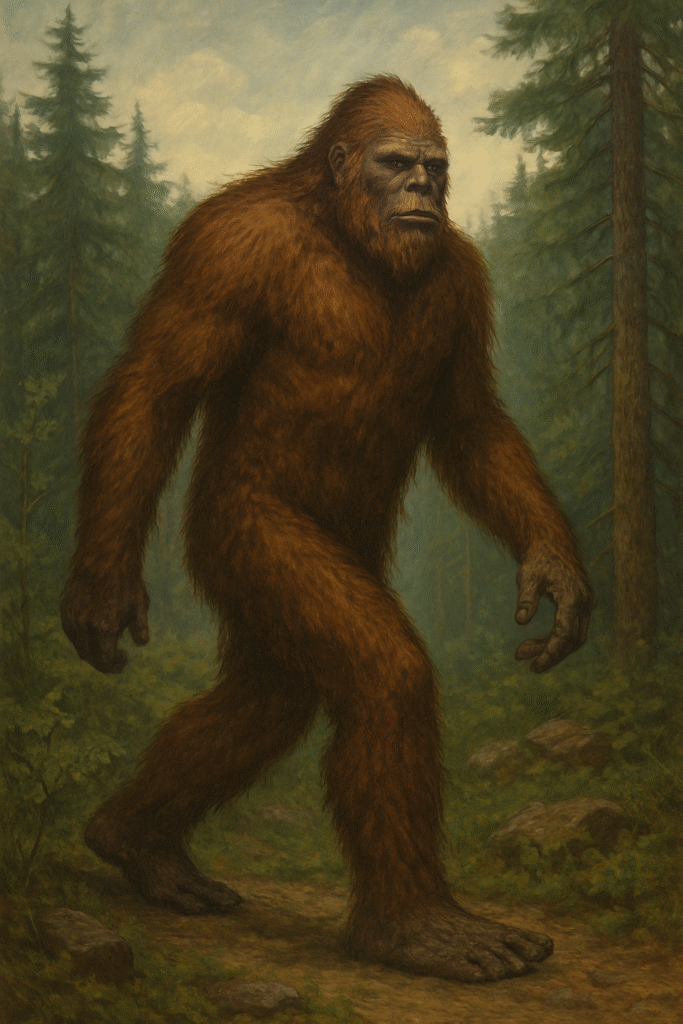
The creature known as Bigfoot—or Sasquatch, wild man of the woods—has lodged itself firmly in the cultural imagination of North America. Rooted in Indigenous oral traditions of the Pacific Northwest, this figure appears as a towering, ape-like guardian of the forest, a being slightly beyond human yet deeply tied to nature’s rhythms. In these narratives the “hairy man” evokes wilderness, mystery, and the boundary between civilization and the wild. Over time, this folklore crossed into visual art, as storytellers and artists began to imagine and depict the creature in sketches, carvings, and paintings, merging myth and image in one.
The Roots of the Legend: Art Meets Folklore
In the art of First Nations peoples—such as the Haida, Tlingit, and Coast Salish—the wild man figure appears in totem poles and masks, sometimes depicted as a forest spirit or supernatural visitor. These artistic traditions date back centuries and embed the creature into a visual language of bark, wood, and stone that speaks of land, lineage, and legend. The visual motifs—hairy limbs, deep set eyes, ambiguous posture—reflect a being that straddles human and animal. When modern popular culture picked up the Bigfoot story, artists drew from those visual echoes, giving the creature a form that looked at once familiar and uncanny.
Over the decades, Bigfoot’s shape shifted in popular art—from an echo of Indigenous spirit to a symbol of American frontier myth and speculative wonder. Its hairy silhouette became a kind of icon, showing up in roadside signs, posters, cartoons and gallery pieces alike. The transformation from oral legend to visual symbol cemented Bigfoot’s place in cultural consciousness. As we move into considering early depictions, we see how art and myth fed each other in shaping the creature’s identity.
This interplay of folklore and image sets the stage for the rest of the story. Bigfoot is not just a legend told around campfires; it is a visual presence, a motif that invites reinterpretation. In that sense, the art of Bigfoot is as much about belief as it is about representation. The creature persists because it looks back at us from the woods—and on canvas and wood and metal, its eyes still glint with the unknown.
Early Depictions of Bigfoot in Folk and Indigenous Art
Long before commercial posters and novelty statues, art makers along the Pacific Northwest carved and painted figures that resemble what we now call Bigfoot. In Indigenous art from the Haida, Tlingit and Coast Salish peoples, figures often stand tall, shaggy of form, limbs extended—reminding one of the wild man of the woods. These images appear on totem poles, carved house posts, and masks produced as early as the 18th and 19th centuries. They capture both the reverence and mystery of nature’s borderlands.
Totem Poles, Petroglyphs, and the Sasquatch
Petroglyphs and pictographs constituting human-like figures with exaggerated hair and large footprints have been found in Indigenous sacred sites. For example, at Painted Rock in Tule River Reservation, a mural has been interpreted by some as showing a “Bigfoot family.” These carved and painted images functioned not only as decoration but as storytelling devices: reminders of a world where humans and wild spirits rubbed shoulders. The iconography of the forest’s wild man resonates with larger mythic traditions—the European Green Man, the wood-wose of medieval art, for instance—showing a shared human fascination with wilderness.
Folk art from logging towns and remote cabins also picked up on the wild man motif. Loggers in the mid-20th century carved wooden hair-covered figures, painted foot tracks on their cabins and celebrated “man of the woods” tales. These pieces did not emerge in a vacuum—they drew from Indigenous traditions, frontier folklore, and the burgeoning Bigfoot legend of the 1950s and 1960s. Through these early depictions, the creature’s visual identity began to harden.
These art forms—totems, carvings, murals, petroglyphs—laid the visual foundation for Bigfoot’s transition into welcome absurdity and pop culture. The hairy stranger of the woods was no longer just an oral memory; it had a face, a stance, an aesthetic. And in the next section we will trace how that visual presence exploded into popular art and Americana.
Bigfoot Enters Popular Art and Americana
By the mid-20th century, the legend of Bigfoot surged into the mainstream, and artists responded. One pivotal moment was a short motion picture shot on October 20, 1967 by Roger Patterson (1933–1972) and Robert Gimlin (born 1931). The film captured a large, hairy biped on horseback near Bluff Creek, California, and consolidated Bigfoot’s visual brand for popular art. Suddenly the hairy figure went from obscure folklore to poster figure, t-shirt design, cartoon subject.
The 20th Century Explosion of the Bigfoot Image
In the decades after 1967, Bigfoot became a staple of magazine covers, comic books, novelty prints and roadside art. Commercial illustrators adopted its silhouette—deep set eyes, broad shoulders, hairy limbs—and applied it to motel signs, bar signs, souvenir statues, and roadside attractions. Wall-art vendors now carry Bigfoot prints, with captions like “You are not alone!” and figure shapes lurking in dark forests. The creature’s image turned into Americana, bridging kitsch and legend.
Mass-market pieces often leaned into humor: Bigfoot chasing campers, Bigfoot holding beer mugs, Bigfoot footprints stamped on wood. This playful representation co-exists with the more serious symbolic usage in fine art. Commercial art helped cement Bigfoot as a visual icon: recognizable instantly, even if its meaning is fuzzy. The fact that dozens of prints, posters and sculptures exist for purchase speaks to its enduring appeal.
As an art subject, Bigfoot in touring catalogue form also reflects changing attitudes toward wilderness and myth. The creature stands at the intersection of frontier nostalgia, environmental unease, and pop humor. For many artists and buyers, Bigfoot represents something lost in modern urban life: a wild, unknown presence. The next section focuses on how fine artists have taken the figure further—to metaphor, commentary, and satire.
Bigfoot in Fine Art: Satire, Symbol, and Subversion
Bigfoot’s image didn’t remain confined to roadside novelties or cryptozoological curiosities. As postmodern art expanded in the late 20th century, fine artists began to adopt Bigfoot as a vehicle for social commentary. Rather than presenting the creature literally, these works often used Bigfoot to speak about isolation, masculinity, human arrogance, and even religious longing. Exhibits in urban galleries throughout the 1980s and 1990s began to include such representations, elevating the wild man from pop icon to cultural metaphor.
From Cryptid to Commentary on the Human Condition
Take the work of contemporary artist David Huffman (born 1963), who featured a Black astronaut wandering through landscapes—often with Bigfoot-like figures lurking in the distance. Huffman used these figures as symbols of estrangement and the African-American experience in alienating modern environments. Other artists, like Joshua Barber (born 1977), created minimalist Bigfoot forms set against stark mountain scenes, evoking themes of loneliness and lost innocence. In both cases, Bigfoot wasn’t just a creature; he was a commentary.
In 2003, the Portland Art Center hosted a themed exhibit titled “Bigfoot in Contemporary Culture,” showcasing over 30 artists. Curator Carol Smith described the creature as “America’s last clean slate—part joke, part myth, part mirror.” Installations ranged from life-sized fur sculptures to haunting forest projections featuring flickers of movement just out of focus. The art world embraced Bigfoot not because it believed in him literally, but because he offered space for questions about belief, truth, and what we fear being watched by.
Many of these pieces have circulated through academic spaces, university galleries, and regional museums. They present Bigfoot as a canvas—sometimes blank, sometimes filled with irony or yearning. The diversity of styles reflects a common theme: the desire to locate mystery in an increasingly known world. This drive toward the unknown next migrated into more public spaces, as Bigfoot began to appear in alleyways, street murals, and cityscapes.
Street Art and the Urban Bigfoot
In the last two decades, Bigfoot has become a recurring figure in urban art scenes. Unlike gallery works, these appearances often spring up anonymously: wheat-pasted silhouettes on alley walls, hairy foot stencils crossing sidewalks, or murals looming over buildings. Cities like Seattle, Portland, and Los Angeles have seen a proliferation of such works, where Bigfoot doesn’t just haunt the woods—he roams among high-rises and concrete. Street artists use his form to signal otherness, resistance, and even environmental nostalgia.
Murals, Graffiti, and the Sasquatch in the City
One prominent example is the recurring Bigfoot tag by an anonymous artist known as “SQUATCHMEAT” seen throughout Portland since 2012. The stencil—long limbs, hunched back, feet turned inward—suggests both vulnerability and defiance. Another mural in Seattle’s Capitol Hill area features a neon-painted Bigfoot lounging in a hammock above the skyline, surrounded by faded logging trucks. This juxtaposition of wild myth and urban decay highlights the tension between old landscapes and new development.
Thematically, urban Bigfoots are not typically meant to scare. Instead, they evoke a kind of melancholy amusement. They ask questions silently: Who belongs here? Who’s out of place? And what have we paved over? For environmentally-conscious artists, the creature becomes a warning—not just of nature lost, but of our growing numbness to mystery itself. Some murals even include messages like “He saw it all—and left.”
Street art thrives on immediacy and impermanence, which suits Bigfoot’s elusive nature. The same wall that features him today may be whitewashed tomorrow. Yet this fleeting presence seems appropriate. Bigfoot, after all, has always been about brief sightings, vanishing evidence, and the hint of something more. It was only a matter of time before the digital realm found him next.
Digital Art, NFTs, and the Crypto-Cryptid
As the art world shifted into virtual spaces, Bigfoot followed. Digital artists began exploring the creature through animated short films, augmented reality projects, and, more recently, NFT collections. These works don’t merely recreate Bigfoot—they reimagine him through code, glitch, and algorithm. In digital form, the cryptid becomes something more abstract: a meme, a brand, a token of speculative worth.
Bigfoot in the Digital Art Renaissance
One notable NFT series, “Sasquatch Sightings,” released in 2021 by crypto-artist Jake Thorne, featured 500 procedurally generated Bigfoot variants, each embedded with different patterns, environments, and eye shapes. The series sold out in under 48 hours and now trades on secondhand markets. These digital representations strip Bigfoot of consistent identity, reinforcing his status as a creature seen differently by everyone. In many cases, collectors never believe in the creature itself—they buy the myth.
Virtual reality installations have also featured Bigfoot, with artists like Clara Yoon creating immersive forest simulations where viewers catch fleeting glimpses of the creature behind trees. These moments parallel actual Bigfoot lore—always just out of reach, always potentially imagined. For artists, the digital space offers room to play with presence and absence, memory and trace.
Some critics dismiss Bigfoot NFTs as gimmicky, mere speculative novelty. But others argue they reflect an enduring truth: in a world saturated with information, myth endures through adaptation. Bigfoot, whether carved in wood or minted in code, symbolizes the persistence of belief in an unbelieving age. This is the essence of his appeal—and it’s why he continues to inspire.
From prehistoric walls to augmented reality headsets, Bigfoot has never stopped changing. His image may be blurry, but his presence is sharp—and wherever artists go next, the big guy is likely to follow. We now return to the reason he still haunts the imagination of painters, sculptors, and creators of all kinds.
Why Bigfoot Endures in the Visual Imagination
Bigfoot continues to inspire artists not because he is proven real, but because he represents something we know instinctively: not everything must be seen to be believed. The visual image of Bigfoot is charged with tension—between past and present, wilderness and suburbia, legend and media. For many, he is a blank slate, filled with personal meaning. Art thrives on ambiguity, and Bigfoot offers that in abundance.
The Art of Belief and the Appeal of the Unknown
Psychologically, Bigfoot stands in for the modern world’s lost mysteries. As maps filled in and frontiers closed, the idea of an undiscovered giant roaming the forests became compelling. Artists use him as shorthand for the unknown, the wild, and the things humans have not yet categorized. His very implausibility gives him mythic strength, which is why so many return to him as a subject.
His image adapts easily—from fearsome brute to sympathetic loner, from comic relief to environmental icon. In sculpture, he’s often hulking and heavy; in painting, sometimes gentle and sad. The variety speaks to the flexibility of the archetype: Bigfoot as wilderness, Bigfoot as witness, Bigfoot as us. The more we imagine him, the more we reveal about ourselves.
Looking forward, Bigfoot’s artistic legacy is likely to expand, not fade. As new generations of artists work in hybrid media and digital platforms, the myth has space to grow. Whether it’s a lonely figure in the fog or a brightly colored street mural, Bigfoot will remain one of art’s most enduring, shape-shifting icons—always just beyond full focus, yet ever present in our creative vision.
Key Takeaways
- Bigfoot has deep roots in Indigenous art, particularly among Pacific Northwest tribes.
- The 1967 Patterson-Gimlin film launched Bigfoot into popular visual culture.
- Artists across genres use Bigfoot to explore isolation, nature, and modern alienation.
- Street art and digital art have given Bigfoot new roles in urban and virtual settings.
- Bigfoot’s ambiguity makes him a powerful symbol for belief, myth, and imagination.
FAQs
- Is Bigfoot based on a real creature?
While no scientific proof exists, folklore and sightings span many cultures and centuries. - When did Bigfoot become popular in art?
He entered popular visual culture in the 1960s, but Indigenous depictions date back centuries. - Why do artists use Bigfoot as a subject?
Bigfoot symbolizes the unknown and serves as a metaphor for isolation, nature, and belief. - Where can I see Bigfoot-themed art?
From Indigenous museums to modern galleries, street walls, and NFT platforms, he appears widely. - Is Bigfoot art considered serious or humorous?
Both—some artists use him playfully, while others employ his image for deep symbolic purposes.