There are cities whose identities are inextricably linked to their art. Then there is Beirut—a city where art does not simply reflect life but contends with it, reshapes it, sometimes defies it altogether. As a city perched on the edge of the Mediterranean and cradled by centuries of conquest, commerce, migration, and catastrophe, Beirut is both a subject and an engine of artistic creation. Its story is not told in a straight line but in fragments: bursts of aesthetic energy, interludes of silence, and eruptions of bold experimentation. It is a city that rebuilds not just its skyline, but its very sense of self, through brushstrokes, installations, photography, and performance. The art history of Beirut, then, is not a mere academic pursuit—it is a living archive of trauma, resistance, beauty, and unrelenting reinvention.
To understand the art of Beirut is to confront the city’s paradoxes. It is simultaneously ancient and modern, parochial and cosmopolitan, war-torn and defiantly creative. These tensions have seeded a unique artistic landscape. From the classical mosaics unearthed beneath its streets to the political photomontages projected on its bullet-riddled buildings, Beirut pulses with a restless creativity that refuses to be silenced, even in the face of disaster.
Art in Beirut is not just aesthetic—it’s political. It is a way of remembering what official histories often erase. It is also deeply personal, forged in the crucible of civil war, colonial residue, economic collapse, and mass displacement. In this way, Beirut’s artists often function as archivists, healers, critics, and prophets. They document, but they also dream. They mourn, but they also imagine.
The city’s cultural lineage stretches back thousands of years—to its Phoenician maritime roots and its Roman urban planning—but modern Beirut came of age in the twentieth century, and its art scene evolved in tandem with its dramatic political and social changes. The French Mandate introduced academic art training and European sensibilities, but it was in the 1960s and 70s that Beirut emerged as a cultural hub, a place where Arab intellectuals, European artists, and diasporic thinkers converged. The civil war shattered this momentum, sending many artists into exile or into the underground. Yet even amidst rubble, art persisted.
What emerged from the postwar period was not a return to tradition but a radical reevaluation of what art could do and be. New institutions arose—like the Arab Image Foundation and Ashkal Alwan—that prioritized the conceptual, the archival, and the interdisciplinary. Photography became a key medium, especially in processing the ambiguities of memory and history. Artists like Walid Raad, Lamia Joreige, and Akram Zaatari pushed boundaries, using installations, video, and found material to interrogate both personal and national narratives.
In recent years, Beirut’s art scene has contended with new ruptures. The 2020 port explosion, one of the largest non-nuclear blasts in history, devastated vast swaths of the city, including cultural spaces. The aftermath saw an outpouring of artistic response—raw, grieving, angry. Artists turned again to their practices as a way of processing trauma and imagining futures. Many left the city. Others stayed, turning homes into makeshift galleries or collaborating in digital spaces.
Yet through every cycle of collapse and reconstruction, Beirut’s artists have returned to the city as both muse and battleground. They continue to grapple with its contradictions, its beauty, its ghosts. They ask uncomfortable questions. They make space for silence, for ritual, for provocation. And in doing so, they assert—again and again—that Beirut is not a city to be forgotten or reduced. It is a city whose story must be continually told, reimagined, and re-inscribed in the visual.
This deep-dive will trace that story: from the earliest cultural traces in antiquity to the boldest experimental forms of the present. Along the way, we will meet artists, movements, and institutions that shaped Beirut’s evolving identity. We will examine how art has served as both mirror and megaphone—reflecting lived realities and amplifying voices long silenced. We will navigate the city’s fragmented terrain not just geographically, but artistically: from the destroyed walls of downtown to the converted warehouses of Mar Mikhael, from underground film screenings to international biennials.
Beirut’s art history is not just about what was created. It is about what survived. What was lost. And what is still being dreamed into being.
Phoenician and Classical Roots: Foundations of a Visual Culture
Long before it became a crucible of modern conceptual art or a battleground of political aesthetics, Beirut was part of one of the most artistically sophisticated and commercially dynamic civilizations of the ancient world: the Phoenicians. Known for their seafaring prowess and mercantile networks, the Phoenicians were also purveyors of a rich visual language—one that blended religious symbolism, ornamental design, and cosmopolitan motifs drawn from Egypt, Mesopotamia, and the Aegean. While the Phoenician city-states of Tyre, Sidon, and Byblos are more frequently cited in art historical accounts, Beirut—then known as Berytus—also played a role in this maritime cultural web.
Though few large-scale Phoenician structures remain visible in Beirut due to centuries of overlaying construction and seismic shifts, archaeological excavations continue to uncover fragments of this deep artistic past. Tombs adorned with carved sarcophagi, votive statuettes, and intricate jewelry speak to an aesthetic sensibility rooted in the symbolic and the sacred. The Phoenicians did not produce art in isolation; their work carried echoes of Egyptian faience, Hellenistic realism, and Assyrian monumentality. This syncretic quality would become a defining characteristic of Beirut’s art across millennia.
Following the decline of Phoenician power, Beirut fell under the sway of successive empires—Persian, Hellenistic, Roman—all of which left indelible marks on the city’s visual and architectural identity. During the Roman era, Berytus rose to prominence as a center of jurisprudence, home to one of the most prestigious law schools in the empire. But it was also a city of mosaics, sculptures, and monumental architecture. Roman columns, theater fragments, and temple remains still peek through Beirut’s urban fabric, revealing a city deeply embedded in the aesthetics of classical antiquity.
The Roman mosaics discovered in and around Beirut—such as those depicting Orpheus, Dionysus, or mythological scenes—demonstrate a high level of craftsmanship and an integration of Greco-Roman visual culture with local traditions. These floor mosaics, often found in private villas and bathhouses, served not only decorative functions but also narrative and cosmological ones. The artistic choices in these mosaics—whether mythic, geometric, or vegetal—reflected both elite tastes and the broader intellectual culture of the time.
Of particular note is the way urban planning itself became a form of art. Roman Beirut was laid out in the typical cardo and decumanus grid, adorned with colonnaded streets and public spaces designed for civic spectacle. This sense of public aesthetic—of art as an organizing principle of daily life—resonates even in contemporary Beirut, where debates about urban heritage preservation continue to frame art as a political and spatial practice.
The transition from pagan antiquity to early Christianity also marked an important moment in the city’s visual evolution. With the rise of Byzantine influence, religious iconography began to replace mythological imagery. Churches adorned with frescoes and mosaics took the place of temples, though sadly many have been lost to time, earthquakes, and war. Nonetheless, this shift from polytheistic to monotheistic visual culture set the stage for future transformations in Beirut’s artistic identity, especially with the coming of Islam.
What is striking about Beirut’s ancient art history is how much of it lies beneath—literally buried under layers of construction, conflict, and reinvention. In this way, the city’s contemporary artists are not only innovators but inheritors of a subterranean visual past. The Phoenician obsession with ritual form, the Roman love of urban spectacle, the early Christian embrace of sacred symbolism—all of these elements echo, sometimes subtly, in Beirut’s ongoing artistic dialogue.
Today, fragments from this ancient past resurface in multiple forms: a sculpture unearthed during a downtown excavation; a mosaic preserved in the Sursock Museum’s holdings; an artist’s reinterpretation of Phoenician myth. In a city where the ground itself is an archive, the ancient roots of Beirut’s art history remain an active presence—less as nostalgic artifacts and more as provocations, reminders of the city’s deep entanglement with form, function, and the eternal human drive to create.
Islamic and Ottoman Aesthetics: Spiritual Geometry and Urban Ornamentation
As the Islamic conquests swept across the Levant in the 7th century, Beirut—along with the rest of coastal Lebanon—entered a new aesthetic and cultural paradigm. While never as central to Islamic art as cities like Damascus or Cairo, Beirut developed a distinct character as a port city situated at the edges of empires. It absorbed, interpreted, and often localized Islamic artistic traditions, particularly through architecture, calligraphy, and ornamental design. From the austere grandeur of Mamluk mosques to the decorative flourishes of Ottoman-era buildings, the city became a canvas for sacred geometry, vegetal arabesques, and hybrid vernacular forms.
One of the defining features of Islamic art is its resistance to figural representation in religious contexts, which redirected artistic energies toward the abstract and the symbolic. In Beirut, this manifested in intricate tilework, muqarnas (stalactite-like vaulting), and calligraphic panels that adorned mosques, madrasas, and hammams. These weren’t merely decorative features—they were cosmological diagrams, theological statements, and mnemonic devices. The Arabic script, especially in its kufic and later thuluth forms, became a visual art in itself. Carved into stone, painted onto wood, or glazed into ceramics, it elevated language to the status of divine ornament.
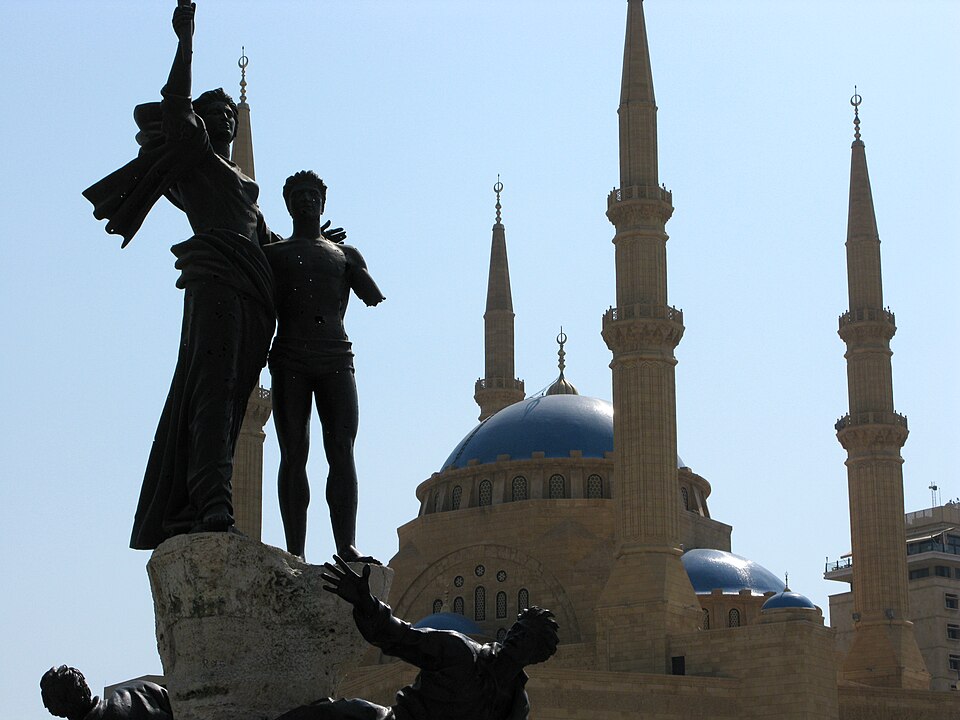
During the Mamluk period (1250–1517), Beirut saw the construction of several key buildings, some of which remain, though often heavily restored. These include the Al-Omari Grand Mosque—originally a Crusader church transformed into a mosque—which retains its Gothic architecture but incorporates Mamluk decorative elements, particularly in its mihrab (prayer niche) and minbar (pulpit). This architectural palimpsest is emblematic of Beirut’s visual history: layers of conquest, belief, and adaptation woven into stone and space.
When the Ottomans assumed control of Beirut in the early 16th century, the city underwent further transformations. The Ottoman imperial aesthetic—marked by domed silhouettes, floral Iznik tilework, and centralized mosque layouts—was adapted to Beirut’s smaller scale and Mediterranean sensibility. While Beirut was not a major provincial capital, it benefited from its strategic importance as a port, and Ottoman-era buildings began to dot its landscape, especially during the 18th and 19th centuries as the empire invested more directly in Levantine infrastructure.
Residential architecture in this period reveals as much about aesthetic values as do public or religious structures. The traditional Lebanese-Ottoman house—typically a rectangular stone structure with a central liwan (hall), red-tiled roofs, and triple-arched windows known as moucharabieh—became a vernacular form of visual identity. These houses were not only functional responses to the climate but also expressions of status, taste, and cultural fusion. The use of carved wooden ceilings, painted tiles, and decorative stone masonry demonstrated how Ottoman visual language was localized in Beirut through craftsmanship and adaptation.
The late Ottoman period also saw the emergence of Beirut as a city of print and education. As printing presses proliferated and modern schools opened, calligraphy began to move beyond religious manuscripts and into civic and pedagogical domains. The art of the book, central to Islamic visual culture, transitioned into modern graphic design—another example of Beirut’s elasticity when it came to artistic forms.
Perhaps most notably, the Ottoman era set the groundwork for Beirut’s modern cosmopolitanism. With increased trade, immigration, and missionary activity, the city became a melting pot where Muslim, Christian, Jewish, and Druze communities coexisted, each contributing to the city’s evolving aesthetic texture. Church murals might share pigments with mosque calligraphy. Urban layouts were reconfigured to accommodate both minarets and bell towers. The visual culture of Beirut in this era was not a monolith but a pluralistic mosaic.
Today, traces of Islamic and Ottoman aesthetics remain visible in Beirut’s historic districts—especially in neighborhoods like Basta, Zoqaq al-Blat, and Gemmayze. However, much has been lost due to war, urban development, and neglect. Heritage activists continue to fight for the preservation of Ottoman-era buildings, many of which are endangered by unchecked construction and economic pressures. Meanwhile, contemporary artists increasingly draw on this past—reinterpreting calligraphy, Islamic geometry, and architectural motifs in digital art, installations, and performance.
In this way, Islamic and Ottoman aesthetics in Beirut are not confined to the past. They remain active vocabularies—sources of inspiration, identity, and resistance. Whether etched into a crumbling archway or projected in a video art installation, these forms remind us that Beirut’s visual language has always been one of synthesis, translation, and spiritual inquiry.
The French Mandate and Early Modernism: Colonial Influence and Artistic Awakening
The end of Ottoman rule in 1918 and the establishment of the French Mandate over Lebanon in 1920 marked a pivotal shift in Beirut’s artistic evolution. Though it came wrapped in the rhetoric of civilization and progress, the French Mandate was ultimately a colonial enterprise—reconfiguring Lebanon’s borders, politics, and institutions to align with European interests. But along with political reorganization came cultural infusion. For Beirut, this meant the introduction of French-style education, European art academies, architectural modernization, and new forms of visual sophistication that would lay the groundwork for Lebanon’s artistic modernity.
Under the Mandate, French became not only the language of administration and law, but also of culture and instruction. New schools, such as the Collège des Frères and the French Mission’s institutions, emphasized Western art history and techniques in their curricula. In 1937, the Lebanese Academy of Fine Arts (ALBA) was established in Beirut, becoming the country’s first formal institution dedicated to the visual arts. Its foundation was a watershed moment: it created a professional path for artists in Lebanon and connected local students with European techniques, especially those rooted in classical realism, Impressionism, and academic drawing.
Beirut’s artists in this period were increasingly cosmopolitan. Many traveled to Paris or Rome to study painting and sculpture before returning to the city. Others were influenced indirectly through textbooks, correspondence, and the proliferation of European art journals. This exposure brought with it not only technical refinement but also a profound identity tension. Artists grappled with questions that remain central to Lebanese art today: Should one mimic the European masters or seek a uniquely Lebanese expression? Was modernism a universal language or a colonial imposition?
One of the early figures who navigated these tensions was César Gemayel (1898–1958), often credited as one of the pioneers of modern Lebanese painting. After studying in Paris, Gemayel returned to Beirut and began incorporating Post-Impressionist techniques into his work, painting Lebanese landscapes and portraits with a distinctly modern palette and brushstroke. His work hinted at a new possibility: that one could be both modern and rooted, both global and local.
Other early modernists included Omar Onsi (1901–1969), whose plein-air landscapes captured the light and atmosphere of Mount Lebanon with lyrical precision, and Saliba Douaihy (1915–1994), whose work would eventually move toward abstraction. These painters, while deeply influenced by French aesthetics, began to articulate a Lebanese modernism—a visual language that reflected local geographies, social customs, and emotional registers.
This period also saw a transformation in Beirut’s urban architecture, reflecting broader shifts in artistic sensibility. French engineers and architects redesigned portions of downtown Beirut in the image of Paris, introducing Haussmann-style boulevards, Art Deco facades, and Beaux-Arts institutions. The city’s new architectural skin was symbolic: it was meant to signal Beirut’s place in the “modern” world, even as it often displaced older Ottoman and Arab structures. This colonial visual language has remained controversial, with contemporary artists and scholars interrogating its legacy in the cityscape.
Cultural salons flourished during the Mandate, hosted by wealthy families and intellectuals who curated gatherings of writers, artists, and musicians. These spaces served as incubators for artistic dialogue and creative experimentation. They were also sites where debates about nationalism, identity, and modernity played out—through poetry, painting, and political discourse. Beirut was not just absorbing French culture; it was remixing it.
Photography, too, began to emerge as an artistic form during this period, though it was still largely confined to portraiture studios and documentary work. Armenian photographers, many of whom had fled the genocide and resettled in Lebanon, played a major role in documenting this era. Studios such as Photo Mario and Armand’s Studios captured a city in flux, from formal family portraits to bustling street scenes.
The tensions between colonial aesthetics and emerging national consciousness would not be resolved during the Mandate period. But they would give birth to a generative paradox: Beirut’s artists, even as they borrowed from European styles, began asserting their own vision—one that looked inward as much as outward. The seeds of Lebanon’s post-independence cultural boom were sown here, in the friction between influence and autonomy, imitation and innovation.
By the time Lebanon gained independence in 1943, Beirut was no longer a peripheral outpost. It was a vibrant cultural center, home to an emerging class of artists who were beginning to see themselves not just as painters or sculptors, but as cultural architects. They were laying the foundation for a distinctly Lebanese modernism—one that would come into full bloom in the decades ahead.
The Golden Age of the 1960s and 70s: Cosmopolitanism and Avant-Garde Energy
By the 1960s, Beirut had emerged as the beating cultural heart of the Arab world—a city of cafés and curation, poetry readings and political manifestos, experimental theater and emerging modern art. It was a city suspended between eras: flush with the optimism of post-independence nationhood, yet increasingly aware of the tensions brewing beneath the surface. And in the two decades before Lebanon’s civil war erupted in 1975, Beirut’s art scene exploded with a cosmopolitanism and creative daring that remains legendary.
The post-Mandate generation of artists came of age during this period, pushing Lebanese modernism beyond its earlier mimicry of European styles toward a more confident, hybrid expression. The Lebanese painter and sculptor Michel Basbous, for instance, drew on both modernist abstraction and the organic forms of the Lebanese landscape in his work. Alongside his brother Alfred Basbous and colleague Youssef Howayek, he founded the Rachana art village in the 1950s, which became an open-air laboratory for sculptural experimentation—a symbol of Lebanon’s modern artistic ambition.
Another leading figure was Shafic Abboud (1926–2004), whose vibrant canvases fused gestural abstraction with a lyrical sense of memory. Trained in Paris, Abboud was deeply influenced by the École de Paris but remained emotionally tethered to his Lebanese roots. His work moved fluidly between the personal and the formal, often invoking the colors and textures of his childhood in the Lebanese countryside.
Perhaps the most iconic artist of the era was Etel Adnan. A poet, essayist, and painter, Adnan straddled multiple identities—Lebanese, Greek, French, American—and multiple media. Her small-scale abstract landscapes, painted with a palette knife in rich, saturated colors, reflected both her philosophical training and her diasporic sense of place. As she would later write, “I found myself at the intersection of many worlds.” Her work was a vivid metaphor for Beirut itself.
Galleries flourished in this fertile period. Venues like Galerie One and Contact Art Gallery became vital spaces for showcasing modern and experimental art, often blending Arab modernist painting with international trends. Art was not just confined to gallery walls—it spilled into poetry festivals, political discourse, and salon gatherings. Interdisciplinarity thrived. Painters were in dialogue with poets like Adonis and Mahmoud Darwish, with theater directors, architects, and musicians. The boundaries between the visual and the verbal, the aesthetic and the political, were porous.
This was also the era when Beirut began to connect more robustly to the global art world. Lebanese artists exhibited in Paris, Rome, and New York. International figures visited Beirut, enchanted by its Mediterranean allure and intellectual energy. The city’s cafés and art schools became meeting grounds for exiles, revolutionaries, and visionaries—from Palestinian activists to French surrealists. It was, in every sense, a golden age of cross-pollination.
A key institutional development was the 1961 founding of the Sursock Museum, housed in a Venetian-Ottoman mansion in Ashrafieh. It was—and remains—a central pillar of Beirut’s art infrastructure. The museum’s Salon d’Automne, an annual juried exhibition of contemporary Lebanese art, helped establish critical legitimacy for emerging artists while anchoring a sense of national aesthetic identity.
Photography, too, underwent a transformation in these years. No longer merely a documentary tool, it began to take on artistic and narrative dimensions. Photographers like Hashem el Madani and Emile Boulos documented street life, portraits, and everyday rituals, preserving the textures of prewar Beirut with striking intimacy. Their archives, rediscovered in later decades, now serve as vital repositories of a city on the brink of fracture.
But this golden age was not free from contradictions. The very cosmopolitanism that made Beirut a regional cultural capital also masked deepening sectarian and class divisions. The art world, often dominated by Francophone elites, did not always reflect the lived realities of the broader population. Tensions between Beirut’s image as a liberal haven and its role in regional geopolitics—especially in the Palestinian question—created dissonances that would soon erupt into violence.
And yet, this period remains a touchstone for many Lebanese artists and intellectuals. It is remembered not in a spirit of naive nostalgia, but as a moment when the city seemed to embody the possible. A place where form and freedom, debate and design, politics and poetics, all converged. Where Beirut, for a brief and brilliant time, believed in the redemptive power of art.
Civil War (1975–1990): Art in the Midst of Ruin
When the Lebanese Civil War broke out in 1975, Beirut’s golden age came to a sudden, violent halt. The very qualities that had once defined the city—its cosmopolitanism, its artistic energy, its openness to difference—were torn apart by a brutal conflict that would last fifteen years. And yet, remarkably, art did not disappear. It transformed. It fractured. It went underground. It mourned, resisted, documented, and reinvented itself. The war years were not a cultural vacuum but a period of deep introspection and radical experimentation, in which artists grappled with the immediacy of death, the unreliability of memory, and the collapse of their urban and national worlds.
The war’s impact on Beirut’s artistic infrastructure was catastrophic. Many galleries shut down. Museums ceased programming. Artists fled or went silent. The Sursock Museum, once the jewel of Lebanon’s art scene, closed its doors for most of the war. The destruction of the city’s physical spaces—particularly the downtown area that had housed many cultural venues—symbolized the erasure of shared civic identity. But in the ruins, new forms of artistic expression emerged.
One of the most profound shifts during this time was the turn from painting and sculpture toward ephemeral and conceptual practices—especially photography, film, performance, and installation. These were mediums more adaptable to instability, more attuned to loss and disappearance. Artists like Aref Rayess, who had once painted grand canvases of Lebanese unity and folklore, began producing darker, more introspective work that reflected the despair of the moment. His “Massacres” series from the late 1970s depicted tortured, fragmented bodies—a far cry from the nationalistic romanticism of his earlier work.
In the absence of traditional exhibition venues, artists began showing their work in alternative or improvised spaces—private apartments, abandoned buildings, even refugee camps. Art collectives formed in response to the war’s fragmentation, such as the ephemeral networks of artists and intellectuals working in West Beirut, where leftist solidarity often merged with cultural activism. These artists understood their work not just as commentary, but as resistance: to sectarianism, to amnesia, to the obliteration of the city.
Perhaps one of the most emblematic figures of this era is Marwan Rechmaoui, who emerged during the later years of the war and would later become known for his large-scale conceptual works about Beirut’s geography and fragility. His early work was shaped by the everyday surrealism of war—how city maps were redrawn by militia checkpoints, how silence became as loud as gunfire. He, like many artists of his generation, developed a practice rooted in mapping, memory, and urban ruins.
War photography took on heightened urgency. While foreign journalists documented the broader devastation, Lebanese photographers captured the intimate horror of daily life. Raw, unfiltered images—of bombed-out buildings, funerals, street clashes—became both testimony and art. These photographs, often published in underground publications or circulated informally, challenged official narratives and provided an alternative visual archive of the war.
Yet the war was not merely a backdrop—it entered the very form and language of the art. Time itself became unstable, as artists grappled with the impossibility of linear narrative. Works from this period often eschew chronological coherence in favor of fragments, echoes, and circular structures. This was particularly evident in the early video works and experimental films that began to appear in the late 1980s, laying the groundwork for the postwar conceptual turn.
Exile also shaped this period profoundly. Many artists left Lebanon—voluntarily or by force—and continued their practices abroad. In Paris, New York, Montreal, and Cairo, diasporic Lebanese artists created work that oscillated between mourning and distance. Some, like Etel Adnan and Rabih Mroué, used their exile to explore the fragmentation of identity, memory, and language. Their art did not attempt to represent the war in realist terms, but to evoke its psychic and symbolic weight.
Importantly, the civil war also seeded the conceptual foundations for what would become Beirut’s most intellectually rigorous and internationally recognized art scene in the 1990s and 2000s. Artists began to see themselves not merely as creators of beauty or truth, but as archivists, forensic investigators, and theorists of trauma. They questioned what it meant to represent violence, to remember ethically, to speak after catastrophe.
In this way, the war years were both an ending and a beginning. While they marked the collapse of Beirut’s cultural institutions and its modernist optimism, they also forced a radical rethinking of what art could be—and what it was for. Out of rubble and silence emerged a generation of artists who would not only reshape Lebanese art but help define contemporary Arab conceptualism for decades to come.
Postwar Recovery: Memory, Ruins, and the Rebirth of the Art Scene
When the guns finally fell silent in 1990, Beirut emerged from fifteen years of civil war not with celebration, but with an uneasy breath. The city was physically shattered and psychically scarred. Entire neighborhoods lay in ruins, their buildings riddled with bullet holes and their street maps redrawn by violence. But beneath the debris, a strange kind of energy simmered—one that would, over the next two decades, spark a profound reimagining of what art could be in the context of trauma, amnesia, and survival. Beirut’s postwar art scene was not a return to what had been lost—it was an entirely new language built on the fragments.
At the heart of this transformation was the desire to confront memory. Lebanon’s postwar political arrangement, enshrined in the 1989 Taif Agreement, was built on amnesty and silence. There would be no truth commissions, no national reckoning. Former warlords rebranded themselves as statesmen. Historical narratives were fragmented along sectarian lines. In this context of collective forgetting, artists stepped in to become unofficial archivists, anthropologists, and witnesses.
One of the central figures in this movement was Walid Raad, whose fictionalized yet deeply researched project The Atlas Group blurred the line between documentary and invention. Presenting fabricated documents, photographs, and testimonies as archival material, Raad challenged the idea of historical authenticity in a postwar society riddled with competing truths. His work suggested that memory in Lebanon could not be pinned down—it had to be re-performed, questioned, and often fictionalized to reveal deeper truths.
This era also witnessed the rise of Akram Zaatari, a co-founder of the Arab Image Foundation (AIF) in 1997. The AIF became a landmark initiative—an archive of vernacular photography from across the Arab world, but particularly Lebanon. Zaatari’s own work, blending found photography with video, examined themes of loss, intimacy, and archival labor. His practice did not just preserve memory; it exposed the mechanisms of how memory is curated, obscured, or fetishized.
Another key voice was Lamia Joreige, whose multimedia work often explored the relationship between personal memory and public history. In Objects of War, she interviewed individuals about personal items they had preserved from the war, weaving together a mosaic of loss and remembrance. Her practice, like that of her peers, embraced the fragment—not as a flaw, but as the essential form of postwar truth-telling.
What distinguished Beirut’s postwar art scene was its turn toward the conceptual and the interdisciplinary. Rather than returning to painting or sculpture in traditional forms, artists embraced video, sound, installation, performance, and digital media. They mined archives, constructed fictional documents, and treated the city itself as a living text to be read, annotated, and disrupted.
This intellectual rigor was matched by a surge in institutional activity. Ashkal Alwan—The Lebanese Association for Plastic Arts—founded in 1993 by curator Christine Tohme, became a crucial incubator for this new generation. Through its events, publications, and the landmark Home Works Forum (launched in 2002), Ashkal Alwan connected Beirut’s artists to international networks while fostering local experimentation. The forum became a crucible for dialogue between artists, theorists, curators, and activists, positioning Beirut at the forefront of post-conflict cultural theory in the region.
Yet this revival was not limited to institutions. Independent spaces and artist-run initiatives proliferated, many of them in the post-industrial neighborhoods of East Beirut like Gemmayze and Mar Mikhael. Warehouses and abandoned buildings were converted into studios, galleries, and project spaces. This spatial reuse was not merely economic—it was poetic. Artists were reclaiming the war-scarred city, repurposing its ruins into laboratories for aesthetic inquiry.
Architecture, in fact, became a frequent subject of postwar art. The contested memory of Beirut’s demolished downtown, reconstructed under the controversial Solidere project, became a metaphor for the erasure of history itself. Artists like Marwan Rechmaoui responded with works like Beirut Caoutchouc (2004), a rubber map of the city carved with its 60 districts—flexible, black, silent. It was both a critique of urban erasure and an invitation to walk the city’s surface as though through a wound.
While international visibility increased—Beirut artists began showing at major biennials, festivals, and museums—there remained an acute awareness that this art was rooted in a very specific local trauma. The city’s cultural rebirth was fragile, haunted by unprocessed grief and vulnerable to economic and political instability. And yet, it persisted, not in spite of the fractures but because of them.
This period established Beirut as a hub of postwar conceptualism—not a return to aesthetic normalcy, but a radicalization of the idea that art must respond to its time, even if it means abandoning beauty for unease, narrative for interruption, presence for trace.
The Rise of Conceptual Art and Political Discourse in the 2000s
As Beirut settled into the uneasy rhythms of postwar life, a new generation of artists emerged who were not content to merely remember. They wanted to interrogate, unsettle, and reframe. By the early 2000s, Beirut had become a vibrant node in the global art world—not for its market value, but for its intellectual intensity. This was not a city of blue-chip galleries and luxury collectors, but of sharp-edged conceptualism, where artists treated memory, identity, and history as unstable materials to be deconstructed and reimagined. Beirut’s art scene in this era was less about objects than about ideas—less about what you see, more about what you’re made to think or question.
At the forefront of this movement were artists like Walid Raad, Akram Zaatari, Lamia Joreige, and Rabih Mroué—figures who became internationally recognized not just for their aesthetic innovation but for their deep philosophical engagement with Lebanon’s unresolved past. Their work blurred the lines between fiction and documentation, performance and installation, private and public memory. They weren’t just reflecting on postwar trauma—they were dissecting it, picking apart the visual and narrative structures through which trauma is mediated.
Walid Raad’s The Atlas Group reached its critical peak in this era, with works like My Neck is Thinner than a Hair and Hostage: The Bachar Tapes, which fused pseudo-historical documents with real archival material to explore how the Lebanese Civil War is remembered—and misremembered. Raad’s lectures, installations, and bookworks were themselves performances, inviting viewers into a game of recognition and doubt. His work didn’t offer clarity; it made you sit in the discomfort of ambiguity.
Akram Zaatari, meanwhile, expanded his archival investigations through video and photography. In This Day (2003), he juxtaposed Arab television footage with intimate interviews and staged scenes to explore how the media shapes collective memory. Zaatari’s practice exemplified the era’s shift toward the “archival turn”—art as excavation, curation, and critique. He didn’t just show images; he asked what it means to preserve, to look, to believe.
Rabih Mroué took this interrogation further by making performance central to conceptual art in Beirut. In works like How Nancy Wished That Everything Was an April Fool’s Joke (2007) and The Inhabitants of Images (2009), Mroué blended monologue, projected images, and video clips to destabilize narratives of martyrdom, militancy, and state violence. His practice extended into theater, performance art, and visual installations, reflecting Beirut’s porous boundaries between disciplines.
These artists were not working in isolation. They were part of a rich intellectual ecosystem sustained by institutions like Ashkal Alwan, which had by this time evolved from a support network into a full-fledged think tank for art and critical theory. The Home Works Forum, held biennially from 2002 onward, became a major platform for artists, curators, and scholars from the Middle East and beyond to engage in discussions around aesthetics, politics, and knowledge production. The forum was less an exhibition than a gathering of minds—keynote lectures, screenings, performances, and panels that turned Beirut into a classroom of the avant-garde.
Meanwhile, the Beirut Art Center, established in 2009 by Lamia Joreige and Sandra Dagher, provided a formal exhibition space for contemporary art with an emphasis on installation, video, and research-based practices. It offered a curatorial model rooted in Beirut’s conceptual traditions, hosting shows that often questioned the role of institutions, the ethics of representation, and the politics of visibility.
What defined this period was not simply the rise of conceptual art, but the merging of conceptualism with political discourse. The unresolved legacy of the civil war, the 2006 Israeli bombardment, the Syrian refugee crisis, and the collapse of Lebanon’s infrastructure all fed into the art being produced. But rather than make overtly didactic or propagandistic work, Beirut’s artists approached these crises through nuance, irony, and reflection. Their art was often self-aware, skeptical of grand narratives, and keenly attuned to the gaps and absences in the historical record.
International attention followed. Beirut’s artists became fixtures at the Venice Biennale, Documenta, and museums like MoMA and Tate Modern. Yet even as they gained global recognition, they remained deeply rooted in local concerns. This dual orientation—local in content, global in discourse—became a hallmark of Beirut’s conceptual art scene.
Importantly, this era also witnessed a critique of the very systems in which art operates. Artists began to question the ethics of funding, the pressures of international visibility, and the commodification of trauma. Who gets to speak for Beirut? Who is listening? And what stories get circulated in the name of representation?
In a city still recovering from war, with no real mechanisms for transitional justice, art became the space where difficult questions could be asked. Beirut in the 2000s wasn’t simply a site of cultural production—it was a zone of philosophical inquiry. It was, as one critic put it, “a place where art doesn’t just happen—it argues.”
Institutions, Galleries, and Art Fairs: Infrastructure of a Scene
Behind every cultural renaissance lies an ecosystem—not just of artists and ideas, but of institutions, curators, patrons, and spaces that make production and visibility possible. Beirut’s postwar and post-2000 art boom, particularly in the conceptual and interdisciplinary realm, could not have flourished without the scaffolding of institutions that nurtured experimentation, offered platforms for discourse, and connected local practices to global circuits. These institutions didn’t simply reflect the vitality of the scene—they actively shaped it, and often, in the case of Beirut, did so while navigating political instability, financial precarity, and infrastructural collapse.
At the heart of this ecosystem is Ashkal Alwan (The Lebanese Association for Plastic Arts), founded in 1993 by Christine Tohme. More than an organization, Ashkal Alwan has been a conceptual engine for contemporary art in Beirut and the Arab region. Its programming is deliberately non-commercial and intellectually rigorous, focusing on workshops, residencies, publications, and lectures. The Home Works Forum, launched in 2002, became a defining event—not just for Beirut but for contemporary Arab art more broadly. Drawing artists, theorists, and curators from around the world, Home Works offered a rare space in the Middle East where art and critical theory intersected without compromise.
Ashkal Alwan also pioneered the Home Workspace Program, a tuition-free arts education initiative launched in 2011. Designed as an alternative to traditional art schools, the program emphasized critical practice, cross-disciplinary research, and collective learning. Its guest faculty have included internationally recognized artists and thinkers like Jalal Toufic, Walid Raad, and Mona Hatoum. In a country where public arts funding is minimal and private education often caters to elites, this program became a radical act of democratizing knowledge.
Complementing this intellectual hub was the Beirut Art Center (BAC), opened in 2009 by artists Lamia Joreige and Sandra Dagher. Located in an industrial building in Jisr El Wati, BAC provided a much-needed physical space for contemporary art exhibitions, artist talks, and screenings. With its minimalist design and commitment to experimental practices, BAC served as a bridge between Beirut’s conceptual core and a wider public. Exhibitions by artists like Mona Hatoum, Emily Jacir, and Etel Adnan helped position the center as a key player in the global contemporary art conversation.
Galleries also played a significant role, though Beirut’s commercial art scene has always been somewhat distinct from Western gallery systems. Spaces like Galerie Janine Rubeiz, named after the influential cultural activist who helped nurture Lebanon’s modernist generation in the 1960s and 70s, continued to promote local artists in the postwar years, often emphasizing painting, sculpture, and photography with strong national and diasporic ties.
Other notable galleries included Agial Art Gallery, known for its focus on modern and contemporary Arab art, and Galerie Tanit, which showcased a mix of regional and international artists. These spaces often operated with limited resources but maintained a high level of curatorial sophistication, helping local artists gain visibility abroad while sustaining dialogue at home.
The role of independent and artist-run spaces also cannot be overstated. In the early 2000s, a wave of DIY initiatives began repurposing abandoned buildings and underutilized urban areas into sites of cultural experimentation. 98weeks Research Project, co-founded by Mirene Arsanios and Marwa Arsanios, functioned as both an exhibition space and a research platform. Its focus on language, temporality, and collective production echoed the broader ethos of Beirut’s conceptual scene: art as inquiry, not commodity.
Art fairs entered Beirut’s landscape in the 2010s, most notably the Beirut Art Fair, launched in 2010 with the aim of connecting Lebanese and regional artists with collectors, curators, and galleries from around the world. Though more commercial in orientation, the fair helped draw international attention to the city’s artistic output and offered a platform for young artists. It also provided a litmus test for the marketability of conceptual and politically engaged work, often provoking discussions about the commodification of memory and trauma.
But perhaps the most remarkable feature of Beirut’s art infrastructure was its resilience. Institutions and galleries operated under extreme conditions: frequent blackouts, political paralysis, economic crises, and violent flare-ups. In 2006, during the Israeli bombardment of Lebanon, many art spaces were forced to close. Yet in the aftermath, exhibitions and performances resumed—often taking the war itself as subject matter. Similarly, after the 2019 protests and the 2020 port explosion, many institutions were damaged or forced to suspend activity, but artists and curators adapted quickly, staging open-air shows, digital exhibitions, and mutual aid efforts.
This adaptability reveals something fundamental about Beirut’s art infrastructure: it is not just a network of buildings or funding sources, but a mode of thinking—a shared commitment to art as public discourse, social critique, and survival strategy. Institutions in Beirut don’t just host art; they host conversations that the state refuses to have, memories that public curricula omit, and dreams that politics cannot contain.
In the absence of robust public support, Beirut’s art institutions have had to be radically creative, often combining roles: exhibition space, classroom, archive, protest site. They function as nodes of resistance and reconstruction, shaping not only how art is made and seen, but how history is imagined.
Beirut Blast and the 2020s: Art in a Broken City
On August 4, 2020, a massive explosion tore through the port of Beirut, killing over 200 people, injuring thousands, and destroying entire neighborhoods in seconds. The blast—caused by improperly stored ammonium nitrate—was not simply a freak accident. It was a cataclysm born of state neglect, endemic corruption, and systemic decay. In one blinding flash, it exposed everything Beirut’s artists had been trying to name, archive, and resist for decades. And once again, the city’s art world found itself at the epicenter of catastrophe—physically shattered, emotionally wrecked, but profoundly activated.
The devastation to Beirut’s cultural infrastructure was immediate and widespread. The Sursock Museum, still recovering from previous decades of instability, was badly damaged—its stained-glass windows blown out, its art collections exposed to debris and chaos. Nearby galleries in Gemmayze and Mar Mikhael—two neighborhoods at the heart of Beirut’s creative economy—were also destroyed or heavily affected. Studios, archives, personal collections: gone in a moment.
But artists, curators, and cultural workers responded with extraordinary speed and solidarity. Even as many suffered personal losses or trauma, they mobilized. Mutual aid networks sprang up overnight. Artists offered their skills to relief efforts, whether by designing posters, organizing fundraisers, or documenting the aftermath. The collective trauma was profound, but so too was the collective will to respond—to make meaning out of devastation.
In the immediate aftermath, art became a tool of mourning and rage. Walls across the city were graffitied with slogans like “My government did this.” Artists projected images of victims onto building facades. One of the most iconic images was Mohamad Said Baalbaki’s ash-and-charcoal work Black Paintings, echoing Mark Rothko’s grief-laden canvases, but rooted in the rubble of Karantina and the memories of neighborhoods flattened by the blast.
The act of documenting destruction became an aesthetic in itself. Photographers like Myriam Boulos and Tamara Saade captured raw, unfiltered portraits of the wounded city—images that oscillated between photojournalism and art. Their photographs didn’t seek to sanitize; they insisted on the immediacy of grief, the unrepaired flesh of both people and place.
At the same time, many artists began to reflect more slowly, returning to Beirut’s long history of trauma and asking: How many times can a city be reborn? In this moment, the aesthetic of the ruin—already central to postwar art—returned with renewed urgency. But it was now imbued with fatigue, anger, and existential questioning. Was the city still salvageable? Could art still function as resistance? Or was it now merely elegy?
Institutions attempted to adapt. The Beirut Art Center, damaged in the explosion, suspended regular programming but began to host online conversations and emergency initiatives. Ashkal Alwan redirected efforts toward mutual aid, offering housing stipends, mental health resources, and small grants to artists affected by the blast. In this way, cultural institutions became humanitarian ones—providing not just platforms but lifelines.
Art also began to emerge from the diaspora in new and potent forms. Artists in exile—many of whom had left in the aftermath of the war or the 2019–2020 protests—produced work that grappled with the blast at a distance. Etel Adnan, already in her 90s, wrote a series of poems reflecting on the collapse of her beloved Beirut. Younger artists turned to video, animation, and digital media to reconstruct the city in virtual form, as a kind of ghost terrain.
Exhibitions in Paris, Berlin, and New York began to feature Lebanese artists prominently—not as token gestures of solidarity, but as urgent aesthetic interlocutors in a world shaken by its own crises. Shows like Beirut Year Zero at the Stedelijk Museum Bureau Amsterdam and virtual installations curated by Lebanese collectives reached global audiences. Once again, Beirut’s trauma had become globalized—but this time, its artists claimed the narrative.
But this visibility came with its own anxieties. Some artists questioned whether the international art world’s attention would fade once the images lost their shock value. Others worried about being pigeonholed into narratives of destruction. In response, many doubled down on work that resisted voyeurism and romanticized suffering—art that asserted the complexity of Beirut’s identity beyond the blast.
In the years since 2020, Lebanon’s ongoing economic collapse, political paralysis, and mass emigration have reshaped the cultural landscape once again. Many artists have left the country, not out of choice but necessity. Others remain, creating under conditions of extreme austerity. Yet creativity persists—in underground performances, in street murals, in small, fiercely defiant exhibitions in gutted storefronts.
What emerges from this moment is not a single style or school, but a sensibility: raw, fragmented, emotionally acute, skeptical of institutions but deeply committed to the city. Beirut’s artists have become, once more, its chroniclers, mourners, architects, and alchemists. They continue to create not in spite of disaster, but through it—turning ruin into reflection, debris into language.
In this way, the Beirut art scene of the 2020s stands as a testament to a kind of radical perseverance. Not hope in the sentimental sense, but an insistence on staying present, staying haunted, staying awake. In a city where the future remains uncertain, art is no longer just about beauty or critique. It is, simply and profoundly, about survival.
Diaspora and Digital: Expanding the Beirut Art Identity Beyond Borders
Even before the catastrophic port explosion of 2020, Beirut’s art scene had already begun to stretch beyond its geographic confines. The Lebanese diaspora—vast, multilingual, and scattered across continents—has long played a critical role in shaping and sustaining Beirut’s artistic identity. But in the 2020s, as crises compounded and digital networks matured, the notion of what it means to be a “Beirut artist” became more fluid, more distributed, and in some ways, more powerful.
In many respects, the diaspora has always been central to Lebanese art. Whether driven abroad by civil war, political repression, economic collapse, or creative opportunity, artists have historically maintained complex relationships with the city—simultaneously distant from it and defined by it. What changed in the digital age was the immediacy and intimacy of that relationship. Through social media, digital exhibitions, online archives, and virtual residencies, Beirut’s diaspora no longer existed at the periphery of its art world—it became a crucial extension of it.
One of the most visible outcomes of this shift has been the proliferation of digital platforms dedicated to Beirut’s visual and political memory. Instagram accounts like @thawraarchives and @lebanesememoryproject began curating vast collections of protest art, archival footage, and ephemeral materials—images that might otherwise vanish from physical history. Artists in the diaspora contributed their own works, reflections, and remixes, creating a collaborative visual language that spanned time zones and borders.
This explosion of digital cultural production was not simply a workaround for crisis. It offered new creative possibilities. Artists began producing video essays, interactive archives, and online-only exhibitions that challenged traditional ideas of space, audience, and temporality. For instance, during the COVID-19 pandemic and the aftermath of the 2020 blast, exhibitions like “Our Dreams Are Made of Cement” (curated virtually by a Beirut-based team) emerged as both political statement and aesthetic experiment, featuring voices from both inside and outside Lebanon.
The internet also became a vital site of memory work. Diasporic artists like Rania Stephan, whose video installations often explore archival erasure and cinematic memory, continued to draw on Lebanon’s fractured narratives, even while working abroad. Others, like Ziad Antar, used digital photography to capture moments of absurdity and silence within the Lebanese experience—works that gained even more resonance when viewed from afar.
This period also witnessed a resurgence in collaborative, transnational projects. Artists formed collectives that ignored the borders imposed by governments or airlines. Aesthetic kinships formed between Beirut and Berlin, Montréal and Marseille, New York and Paris. These were not just networks of convenience—they were communities of solidarity. Artists supported each other emotionally and materially, often stepping in where state institutions had failed.
At the same time, the role of language shifted. While French and Arabic remained dominant in local discourse, English increasingly became the lingua franca of globalized art criticism and curatorial framing. This linguistic adaptation—though sometimes critiqued as catering to Western audiences—also allowed for greater dissemination of Beirut’s narratives to international platforms. Exhibitions in London, conversations at the Venice Biennale, residencies in South America or Southeast Asia—all became part of Beirut’s expanded art map.
Yet this digital and diasporic expansion also came with tensions. Some artists inside Lebanon voiced frustration with what they saw as a commodification of the city’s pain—a tendency by external observers (and sometimes diasporic artists) to aestheticize suffering or speak on behalf of those still enduring its realities. In response, many Beirut-based collectives emphasized hyperlocal storytelling, rooted in lived experience and direct action. Art became both a call and a counter-call, a conversation across proximity and distance.
This tension was especially visible in the ways artists dealt with themes of nostalgia and belonging. While some embraced Beirut as a symbolic or mythic homeland, others rejected romanticization entirely. For many younger artists born or raised abroad, the city was not a memory but an inherited fracture—a story passed down through images, music, and silences. Their work often questioned the authenticity of longing, the politics of return, and the ethics of representation.
At the same time, new media technologies allowed for hybrid forms of storytelling that blurred the line between presence and absence. Virtual reality, augmented reality, and interactive installations became tools for simulating Beirut’s urban space and history. Artists like Mounira Al Solh, who often weaves oral histories and humor into her multimedia pieces, used the digital realm to reflect on exile, identity, and the performance of memory.
The result is a Beirut art scene that is no longer tethered to geography but still deeply anchored in place. Its center is both everywhere and nowhere—fractured, networked, mobile, polyphonic. The diaspora is not an addendum to Beirut’s art history; it is one of its most vital chapters.
In an age when cities are increasingly mediated through screens and feeds, Beirut’s digital diaspora has ensured that the city’s artistic voice is not only heard but echoed, challenged, and reimagined. Whether through a pixelated performance, a scanned photograph, or a livestreamed conversation, the spirit of Beirut—resilient, ironic, fiercely creative—continues to travel, to adapt, to insist on its relevance.
Conclusion: Art as Resistance, Archive, and Dreamwork in Beirut
To trace the art history of Beirut is to follow a thread that weaves through conquest and collapse, through silences and uprisings, through exile and return. It is not a linear history. It is a palimpsest—layered, interrupted, often illegible, and yet undeniably rich. Beirut’s art is not born of stable institutions or enduring peace; it grows instead from rupture, from absence, from the very refusal of erasure. In this, it is both archive and dreamwork—a repository of memory and a sketch of possible futures.
From the mythic rituals of the Phoenicians to the geometric spiritualities of Islamic ornamentation, from French colonial salons to the conceptual investigations of the postwar generation, Beirut has always produced a visual culture that reflects its historical tensions. It is a city that contains contradictions: secular and sacred, Eastern and Western, elite and underground. And in the art that emerges from these contradictions, we find not a resolution, but a mirror—a site of confrontation and complexity.
What is perhaps most striking is how deeply political Beirut’s art has always been—not in the propagandistic sense, but in its commitment to truth-telling, to rupture, to re-inscription. When official histories erase, artists document. When governments collapse, artists build. When trauma threatens to mute, artists speak—haltingly, obliquely, defiantly. Even the most abstract or conceptual works produced in Beirut often carry within them the pulse of political urgency, a refusal to forget.
Art in Beirut has also functioned as resistance—not only against external violence, but against internal amnesia. In a country where sectarianism fragments memory and the state enforces silence, the artist becomes historian, anthropologist, witness. This role has been taken up with particular force by the postwar generation, whose work interrogates archives, dissects narratives, and experiments with what it means to represent the unrepresentable.
But if Beirut’s art is archival, it is also speculative. It does not merely record what has happened; it imagines what could be. There is a dreamlike quality that runs through much of the city’s most powerful art—a belief in reinvention, in new forms, in the unfinished project of making meaning out of ruins. Artists like Etel Adnan, Walid Raad, and Lamia Joreige invite us to see not only what has been lost, but what might yet emerge. Their works hover between mourning and futurity, grounded in place but never confined by it.
Institutions, though fragile, have played an outsized role in sustaining this vision. Ashkal Alwan, the Sursock Museum, the Beirut Art Center, and countless independent initiatives have created not just venues but vocabularies. They have helped Beirut become not merely a producer of art, but a producer of ideas—about art’s relationship to history, to violence, to ethics. These institutions often operate at the margins of functionality, yet they persist, driven by collective will and creative resilience.
In the wake of the 2020 blast and Lebanon’s deepening economic collapse, the question of survival looms large. Can art sustain itself in a city where electricity is intermittent, where young people are fleeing en masse, where public support is nonexistent? The answer is neither simple nor optimistic. Yet Beirut’s art scene has always existed in conditions of precarity. And it has never stopped.
Perhaps what defines Beirut’s art history most profoundly is its refusal of closure. The city is always in a state of becoming—unfinished, wounded, alive. Its artists, in turn, do not offer resolution or redemption. They offer fragments. Echoes. Interruptions. They offer us the tools to look again, to remember differently, to imagine otherwise.
In a world increasingly marked by displacement, crisis, and surveillance, Beirut’s art stands as both caution and beacon. It reminds us that cultural production does not require stability—it requires necessity. That beauty can exist in rupture. That memory, however fragmented, can be mobilized. And that a city, even when broken, can still speak through its images, its performances, its silences.
In Beirut, art is not an ornament of civic life. It is civic life. It is the archive. It is the refusal. It is the dream.