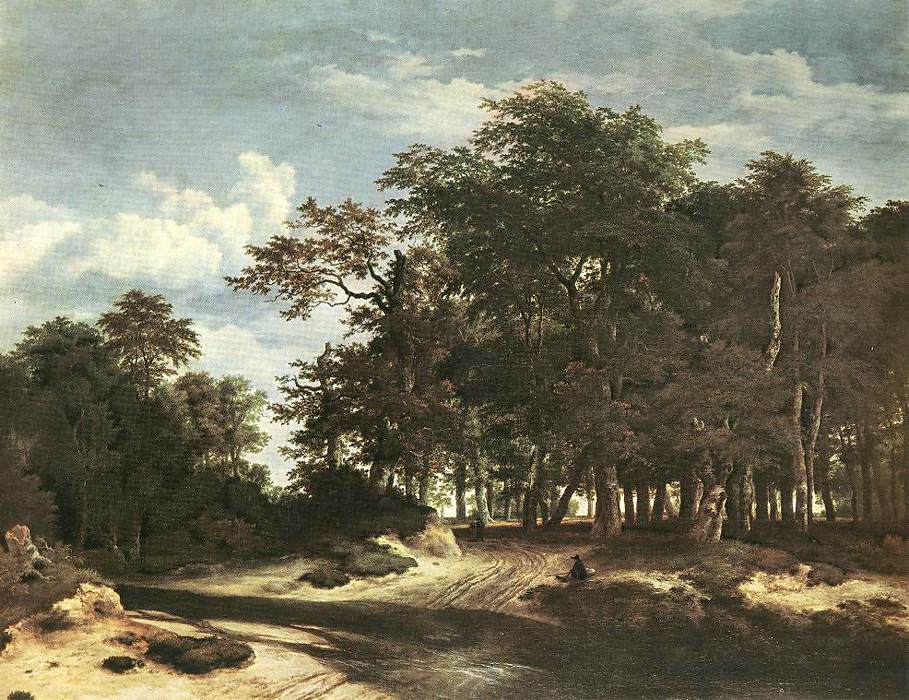
Step into The Large Forest, and you do not simply see trees — you feel them. Massive trunks rise like ancient columns. Light spills through an opening in the canopy. A quiet path bends inward, drawing your eye deeper into shadow. The painting is calm, but it is not gentle. It carries weight. It feels enduring, steady, and strong.
Painted around AD 1653–1655 by Jacob Isaacksz. van Ruisdael, this monumental forest scene represents one of the high points of Dutch landscape painting. The work is oil on canvas, measuring 139 by 180 centimeters. It is signed at the lower right and is today housed in the Kunsthistorisches Museum in Vienna. The painting does not depict a specific named forest. Instead, it presents an idealized woodland built from close study and disciplined imagination.
Ruisdael was born in AD 1628 or 1629 in Haarlem and died in AD 1682 in Amsterdam. His career unfolded during the Dutch Golden Age, a time when private citizens collected art in large numbers. Unlike many European painters of the 1600s, he did not depend on royal commissions. He painted for a market of serious buyers who valued craftsmanship and truth to nature.
The Large Forest shows why he rose above his peers. It transforms a simple woodland into something monumental. Nothing is exaggerated. Nothing is theatrical. Yet the effect is powerful.
The Man Who Made the Forest
Haarlem Beginnings
Jacob van Ruisdael was born into a family of artists. His father, Isaack van Ruisdael, worked as a painter and art dealer. His uncle, Salomon van Ruysdael, was an established landscape painter known for river scenes. Growing up in Haarlem, young Jacob absorbed technique and discipline from both.
He entered the Haarlem Guild of Saint Luke in AD 1648. That year marked the official end of the Eighty Years’ War between Spain and the Dutch Republic. The newly secure nation enjoyed economic growth. Middle-class citizens purchased paintings for their homes. Landscapes became especially popular because they reflected national identity and daily life.
Early works from the late 1640s show dunes and wooded areas near Haarlem. Even in these modest paintings, Ruisdael demonstrated careful control of atmosphere. His skies were never empty. His trees were never flat. From the beginning, he aimed for depth and structure.
Travel and Expansion
Around AD 1650, Ruisdael likely traveled to the Bentheim region near the German border. The Castle of Bentheim appears in several paintings from the early 1650s, suggesting firsthand observation. These travels introduced hilly terrain that differed from the flat Dutch landscape.
By AD 1657, Ruisdael had moved to Amsterdam. The city was wealthy and growing fast. Here, he expanded his range. He painted waterfalls, forests, seascapes, and panoramic views. His output during the 1650s and 1660s includes some of his most ambitious works.
He never abandoned landscape as his central subject. While others turned toward portraiture or history painting for higher prestige, Ruisdael refined the landscape genre itself. By the time of his death in AD 1682, he had set a new standard for natural realism and emotional depth in Dutch art.
Structure and Composition in The Large Forest
Monumental Design
The Large Forest is carefully constructed. Towering oak trees dominate the foreground and middle ground. Their trunks angle slightly, creating a natural rhythm across the canvas. The composition feels stable, almost architectural.
A narrow path curves through the scene. It leads the viewer’s eye toward a lighter clearing in the distance. This device creates depth without clutter. The viewer enters the painting naturally, as though stepping onto the woodland floor.
Three small human figures appear near the center. They are almost insignificant in size compared to the trees. Their presence establishes scale. The forest dwarfs them. Nature holds the greater weight.
Light and Atmosphere
Light in this painting is deliberate and restrained. The foreground lies in cool shadow. The middle ground brightens gradually. In the distance, a patch of sky opens above a clearing. This contrast between shade and illumination guides the eye forward.
Ruisdael uses controlled tonal variation rather than dramatic color contrast. Greens, browns, and muted earth tones dominate. The palette is unified and natural. Nothing appears decorative.
The sky, though partly obscured by foliage, plays a crucial role. It introduces movement. Clouds suggest shifting weather. The forest is not frozen in time. It breathes.
Technique and Surface
The paint surface reveals close observation. Tree bark is textured with layered strokes. Leaves are built up with small touches of the brush. The water in the foreground reflects light in subtle highlights.
Ruisdael worked in oil, allowing for rich layering. He varied brush pressure to differentiate rough trunks from softer foliage. The technique is controlled but not stiff. It balances precision with vitality.
The canvas measures 139 by 180 centimeters. Its large scale intensifies the experience. Standing before it, the viewer feels surrounded by woodland.
Meaning and Interpretation
Nature and Order
Seventeenth-century Dutch society viewed nature as a reflection of divine order. While The Large Forest contains no overt religious symbols, its structure suggests balance and harmony. The trees rise in strong verticals. The path curves gently forward. Light emerges through darkness.
The small human figures reinforce proportion. Man is present but not dominant. The landscape is enduring. It existed before the figures arrived and will remain after they depart.
This quiet hierarchy gives the painting moral gravity without preaching. It presents nature as stable, dignified, and worthy of respect.
National Landscape
During the mid-1600s, landscape painting flourished in the Dutch Republic. Citizens valued images of their homeland. Unlike grand mythological scenes popular elsewhere in Europe, Dutch collectors favored realistic terrain.
Ruisdael did not paint identifiable national monuments here. Instead, he constructed an ideal forest built from observation. It embodies the wooded areas found in the eastern provinces of the Republic.
This approach reflects pride in local terrain. The painting affirms that familiar land can be monumental. Grandeur does not require ancient ruins or classical myths.
Emotional Tone
The mood of The Large Forest is steady rather than dramatic. There is no storm, no violent wind, no theatrical lightning. The scene is quiet. Yet it carries weight.
The scale of the trees and the depth of the composition create a sense of permanence. The forest feels older than the figures within it. It feels grounded and secure.
Key interpretive themes include:
- Human smallness within vast nature
- Order and balance in the natural world
- Quiet endurance rather than spectacle
- Pride in local landscape
- Stability over chaos
Influence and Legacy
Impact on Dutch Painters
Ruisdael influenced many younger artists, including Meindert Hobbema, who likely studied with him in the late 1650s. Hobbema’s woodland scenes show structural similarities in path placement and tree framing.
Ruisdael’s approach to forests differed from earlier tonal painters. Instead of soft atmospheric blending, he emphasized solidity and form. This shift shaped Dutch landscape painting for decades.
His works circulated widely in Amsterdam collections during the later 1600s. His reputation was secure even before his death in AD 1682.
Influence Beyond the Netherlands
In the 1700s and 1800s, British landscape painters admired Ruisdael’s work. John Constable studied his paintings carefully and praised their truth to nature. The English landscape tradition absorbed lessons in structure and atmospheric depth from Dutch precedents.
Collectors across Europe sought his paintings in the eighteenth century. By the nineteenth century, he was widely recognized as a master of landscape art.
Today, The Large Forest remains one of the most imposing woodland paintings of the seventeenth century. It demonstrates how careful observation, disciplined composition, and respect for nature can elevate a simple subject into enduring art.
Its power lies in restraint. It does not overwhelm with drama. It persuades through structure and quiet authority. Stand before it long enough, and the forest begins to feel real — not imagined, but remembered.
Nature changes. Empires rise and fall. Yet a painted forest from AD 1655 can still command attention. That is the mark of mastery.
If you ever find yourself in Vienna, take the time to stand before it. Let your eyes adjust to the shade. Follow the path inward. The forest is waiting.