Spirit photography emerged in the 19th century at the intersection of light, loss, and belief. During an era when photography was still new, many people viewed the camera as a powerful tool that could capture more than just the visible world. At a time when death seemed ever near due to disease outbreaks and the bloody American Civil War, families longed for visual proof that their loved ones endured beyond death. Spirit photography took that hope and placed it into images that suggested the presence of unseen presences standing alongside the living.
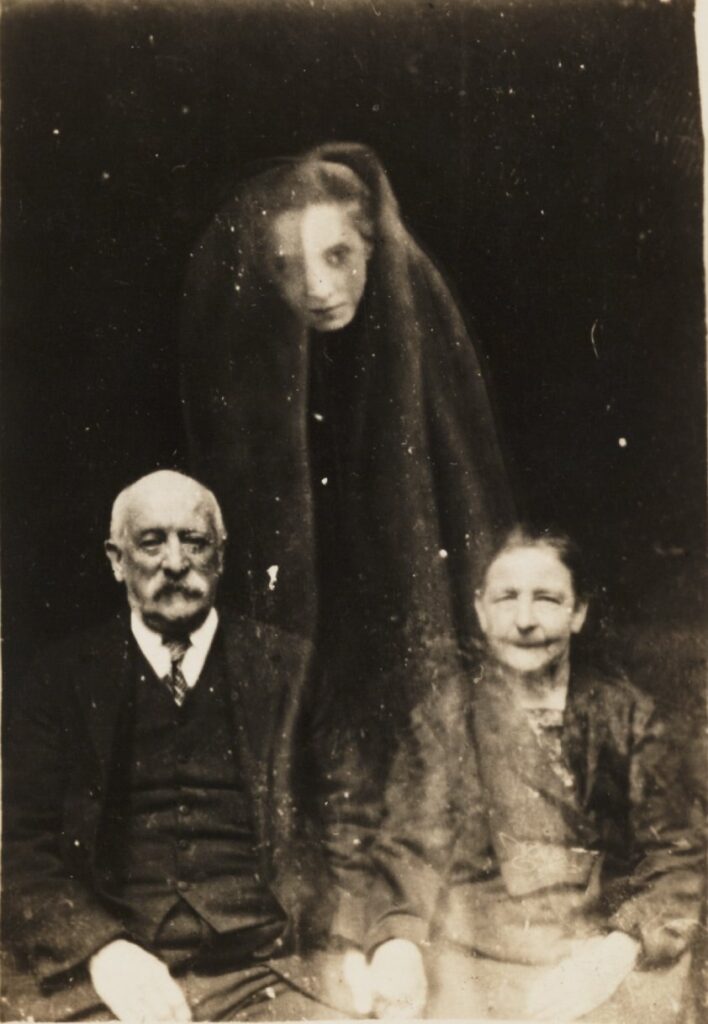
The earliest spirit photographs date to the early 1860s, when photographers began exploiting the technical quirks of the medium to produce ghostly images that defied ordinary explanation. These images featured faint, translucent figures appearing behind or beside unsuspecting sitters, encouraging belief that the dead were truly present. Although skeptics later revealed the mechanics behind these pictures, at the time many viewers interpreted them as evidence of life after death. As an aesthetic phenomenon, spirit photography fused technical experimentation with cultural longing, leaving an indelible mark on the history of both photography and supernatural fascination.
The Birth of a Genre
Spirit photographers did not start with a unified technique but rather with a set of practices that played on the very mechanics of photography. By manipulating negatives, overexposing plates, or using long exposures, operators could create the illusion of ghostly figures that seemed to hover within the frame. Such images tapped into the Romantic era’s fascination with the unseen and its reverence for the spiritual. Over time, these techniques were refined — and sometimes exploited — by photographers who capitalized on the public’s desire to believe they had glimpsed the other side.
Though later largely discredited as fakery, these spirit images remain compelling objects of art history and visual culture studies. They remind us that art and belief often intertwine, especially when people yearn for comfort in mourning. In the coming decades, artists and critics alike would revisit these spectral photographs as visual phenomena that reveal more about societal longings than about what lies beyond the grave. The haunting visual language developed during the 1860s continues to echo in today’s fascination with paranormal photography and supernatural aesthetics.
William H. Mumler: The Accidental Pioneer
William H. Mumler was born in 1832 in Lawrence, Massachusetts, and began his working life not as a photographer but as an engraver. In the early 1860s, while living in Boston, Mumler took a self-portrait that seemed to reveal the faint image of his deceased cousin standing behind him. What began as an accidental overlap of exposures quickly captured the imagination of viewers, who saw in the image a tantalizing hint of contact with the beyond. Mumler soon quit engraving and set up a studio where he exclusively produced what he called spirit photographs.
As Mumler’s reputation grew, so did his clientele, drawn from those grieving the recent losses of the Civil War years. Standing before his camera, they posed with solemn faces, hoping that the spirit of a lost loved one might appear beside them in the developed print. Two of Mumler’s most famous images included a portrait of Mary Todd Lincoln with the purported spirit of her assassinated husband, Abraham Lincoln, and an evocative image of a medium surrounded by ethereal guides. These haunting compositions circulated widely, provoking admiration, skepticism, and debate about their authenticity.
From Engraver to Ghost Photographer
In 1869 Mumler faced legal challenges when he was taken to court on charges of fraud and larceny. Showman P. T. Barnum testified against him, alleging that Mumler knowingly exploited grieving families for profit. Though Mumler was ultimately acquitted, the trial brought intense scrutiny to his methods and forced the public to confront the uneasy line between belief and deception. Despite this controversy, he continued his photographic work for many years, leaving a legacy as both a provocateur and a pioneer in the world of spirit imagery.
Mumler’s contributions resonate today not just as curiosities but as early explorations of photographic manipulation long before digital editing existed. His work challenged assumptions about photography’s capacity to represent truth, opening a space where illusion and emotion could coexist. Whether seen as an opportunist or a visionary, Mumler’s images remain some of the most iconic and provocative photographs of the Victorian era. His legacy endures in photography’s continued struggle with the question of what is real and what is merely believed.
The Ghost Club and the Cultured Paranormal
The Ghost Club was founded in London in 1862, emerging from earlier discussions at Cambridge University in the 1850s. Its members were drawn from intellectual circles interested in investigating ghostly phenomena and psychic claims. Charles Dickens, one of the club’s early participants, exemplified the intersection of literary and paranormal curiosity that defined the group. Over time, the club became a selective society for those who wished to debate and explore supernatural topics seriously, blending skepticism with fascination.
This club stood apart from popular spiritualist circles in that it attracted figures from science, journalism, and literature who sought to understand — not simply believe in — paranormal phenomena. Members like Sir William Crookes and Sir Arthur Conan Doyle lent the group cultural weight, even as they sometimes disagreed on methods and conclusions. The club did not produce spirit photographs itself, but its existence contributed to a broader environment in which supernatural inquiry was respected, discussed, and taken seriously. For photographers and viewers alike, the Ghost Club’s endorsement of paranormal study helped give spirit images a veneer of legitimacy.
A Society of Specters
Women were initially excluded from membership, reflecting broader Victorian norms, though the club’s discussions of séance reports, hauntings, and unexplained events drew interest from people beyond its ranks. Over decades, the club underwent revivals, adding new members and evolving in its approach while remaining a niche forum. Although never a producer of imagery, it became a touchstone for cultural validation of supernatural interest. Its existence offered both encouragement and structure for those who sought a blend of belief, inquiry, and artistry.
The Ghost Club’s influence was more social than scientific, but it played a valuable role in keeping alive the public’s fascination with ghosts, particularly during the late 19th and early 20th centuries. It helped frame the ghost as a figure not only of fear but of curiosity and even comfort. In this way, the Ghost Club mirrored the shifting boundaries between science, art, and faith — a perfect context for the era’s fascination with spirit photography.
Visual Tricks and Haunted Techniques
Spirit photographers employed a variety of clever methods to conjure ghosts in their images. The most common technique was double exposure — photographing a scene, then reusing the same plate to capture a second image, allowing a ghostly figure to appear faintly over the original. Long exposures also allowed sitters to be partially captured, then exit the frame, leaving a ghostly imprint. Others used props like gauzy veils or hidden assistants to simulate spiritual apparitions in real time.
These images were not crude forgeries but often carefully composed works of visual illusion. Spirit photographers mimicked the aesthetics of classical art, drawing on traditions of chiaroscuro and romantic symbolism. Drapery, halos of light, and ghostly wisps were all part of a visual language meant to suggest the sacred and the mysterious. For Victorian viewers steeped in religious and poetic imagery, these photos struck a powerful chord between memory and longing.
How They Made Ghosts Appear
The creation of these ghostly visuals demanded not only technical skill but also dramatic sensibility. Photographers became performers, directing their clients through an emotional journey as much as a photographic session. They curated the sitter’s posture, gaze, and costume, constructing narratives within each frame. These weren’t just images; they were mourning rituals in photographic form.
For this reason, spirit photography can be understood as an early form of performance art. The illusions were not incidental; they were intentional, meant to elicit belief, wonder, and sometimes catharsis. Spirit photographers engaged their audiences through emotional appeal and sensory design, creating moments that felt both sacred and personal. The ghost, in these images, became a visual metaphor for grief itself — persistent, half-visible, and hovering.
Ghosts for the Grieving: Death, Emotion, and Memory
The Victorian period was shaped by a heightened awareness of death, fueled by high mortality rates and wars. Photography arrived during this era as a novel tool for memorializing loved ones, especially when painted portraits were too costly. In this context, spirit photography served a deeply emotional function — it offered a glimpse, however artificial, of reunion. It allowed families to imagine their departed as still nearby, still watching, still part of their world.
Many spirit photographs featured widows, mothers, or children — subjects steeped in mourning and social vulnerability. Women were the primary clients of spirit photographers, reflecting their cultural roles as keepers of memory and emotion. These images often emphasized comfort, not terror, portraying spirits as gentle guardians or heavenly visitors. Through this lens, spirit photography aligned with traditional feminine ideals of love, purity, and sorrow.
Portraits of Loss
Post-mortem photography, popular during the same period, also shaped the emotional terrain. Families commissioned images of the deceased posed as if sleeping or cradled by the living. Spirit photography extended this practice into the metaphysical, presenting the dead not only as remembered but as returned. It was a visual form of wish fulfillment, satisfying the desperate need to believe in continued connection.
These portraits functioned as private devotional objects, tucked into albums or displayed on mantels. They served as silent companions, suggesting that the bonds of love could transcend the grave. Spirit photographs, in their blurred boundaries between reality and illusion, became a kind of emotional technology — one that soothed the ache of absence with the comfort of appearance. Even when disbelief crept in, the image’s power endured.
Artistic Legacy: From Hoax to High Art
Though spirit photography was originally dismissed by critics as trickery, the 20th century brought a shift in how these images were understood. Artists and scholars began to recognize the genre’s deeper cultural and emotional significance. Beyond mere deception, spirit photographs expressed timeless human longings: for contact, for closure, for meaning. Their layered visuals, emotional gravity, and symbolic power have drawn the attention of modern and contemporary artists seeking to explore similar themes.
Susan Hiller, born in 1940 and active until her death in 2019, was among the artists who integrated spirit photography into conceptual frameworks. Her work often dealt with unconscious memory, the paranormal, and the psychological residue of personal and collective histories. In series like “Belshazzar’s Feast” and “Witness,” she used archival and found materials to reflect on unseen presences and spiritual traces in modern culture. Rather than treating spirit photos as curiosities, Hiller treated them as haunted documents that invited reflection on belief and evidence.
Echoes in Modern and Conceptual Art
Contemporary visual art continues to revisit these images in multimedia and installation works. Artists have recreated spirit photographs, incorporating them into collages, film, and performance art. Others have embraced the aesthetic of spectral blurring and faint outlines, evoking the ghost as a metaphor for trauma or memory. What was once dismissed as hoax now serves as inspiration for sincere exploration of the human need for unseen truths.
Major museums and galleries have displayed spirit photography in exhibitions focused on photography’s manipulations and mysteries. These images have been recontextualized as examples of early surrealism, feminist art, and proto-conceptualism. Their ability to provoke emotional and intellectual reaction makes them enduringly relevant. Spirit photography’s artistic legacy lies in its capacity to inhabit the liminal — between image and memory, evidence and illusion.
Beyond the Lens: The Enduring Appeal of Haunted Imagery
Even in the digital age, ghost photography continues to capture the public’s imagination. Smartphone apps now simulate spectral overlays, allowing anyone to make their own “spirit photo” in seconds. Ghost-hunting shows, social media, and online communities are filled with blurry snapshots claiming to show apparitions or unexplained figures. The modern viewer, like the Victorian one, is caught between skepticism and the powerful desire to believe.
Many of the visual tropes used in horror films today — misty figures, sudden apparitions, darkened corridors — descend directly from the visual language of 19th-century spirit photography. The ghost remains a central figure in storytelling, and the image remains the key medium of its appearance. Haunted mirrors, faded photographs, and flickering screens all echo the motifs first explored by early spirit photographers. The aesthetic continues to tap into shared psychological spaces of fear, grief, and longing.
From Cabinet Cards to TikTok Ghosts
Spirit photography has evolved from cabinet cards and studio portraits to viral videos and TikTok filters. Yet the core emotional dynamic remains the same: a blend of uncertainty, hope, and fascination. As the medium of photography changed, so did its capacity for manipulation — but also for storytelling. The modern ghost photo, whether believed or not, still operates as a form of narrative, connecting people to something beyond the literal image.
Today, the legacy of spirit photography lives on in both fine art and popular culture. It is present in museum collections, art installations, internet folklore, and family photo albums. As long as humans continue to wonder about what lies beyond death, the desire to visualize that unseen world will persist. Spirit photography, born in the shadows of Victorian mourning, remains an enduring artifact of that timeless curiosity.
Key Takeaways
- Spirit photography emerged in the 1860s as both an emotional and artistic phenomenon.
- William H. Mumler pioneered the genre, blending photographic trickery with cultural belief.
- The Ghost Club provided intellectual legitimacy to paranormal inquiry in Victorian society.
- Spirit photography’s techniques involved early double exposures and dramatic compositions.
- Contemporary artists have reinterpreted these images as part of conceptual and emotional art.
Frequently Asked Questions
- Was spirit photography considered art or fraud?
It was often seen as fraud in its time, but today it’s studied as a cultural and artistic form. - How were ghostly images created before Photoshop?
Techniques included double exposures, composite negatives, and staged tricks. - Did the Ghost Club make or sponsor ghost photographs?
No, but it created an intellectual atmosphere that supported supernatural exploration. - Why were women so prominent in these images?
Women were often the primary mourners and clients, reflecting Victorian ideals of memory and emotion. - Are any spirit photographs held in major museum collections today?
Yes, several institutions include spirit photography in exhibitions on historical photography and visual culture.