Before there was a name for Oklahoma, there was a language of images carved, painted, and engraved into its soil. The earliest visual expressions in this region were not made for public display or aesthetic pleasure in the modern sense. They were created to serve a world of meaning that has partially vanished but remains legible through the discipline of archaeology and the persistence of form. Among the mound complexes, caves, and scattered artifacts of ancient Oklahoma, a story unfolds—not only of settlement and ceremony, but of design, abstraction, and deliberate visual order.
Spiro and the Aesthetics of Power
The Spiro Mounds, near the Arkansas River in present-day Le Flore County, were occupied and culturally active from approximately AD 800 to 1450. Their significance has long been recognized by archaeologists, but they also merit close attention as a center of visual sophistication. Within the burial chambers of the Craig Mound—a key structure at Spiro—excavators uncovered a concentration of ceremonial objects unlike anything else in the Mississippian world. These were not merely utilitarian items. They were visual instruments, full of symbolic charge and crafted with extraordinary technical skill.
Many of the engraved marine shell cups, for instance, display complex narrative scenes involving winged figures, serpents, dancers, weapons, and celestial bodies. The carving is precise, executed in shallow incisions with a confident hand. A recurring figure—a composite being often referred to as the Birdman—appears in active, even athletic poses, surrounded by objects of ritual importance. These were not illustrations in the modern sense; they were depictions of a cosmological order made visible. The shells, sourced from the Gulf Coast and intricately worked far inland, testify to the range and ambition of the makers.
Copper plates, hammered thin and shaped into stylized forms, display a different but equally deliberate aesthetic. One particularly well-preserved example shows a human figure in profile with elaborate headdress, winglike arms, and a belt of serpents. The symmetry is rigorous; the line work is forceful. Every element is placed with an understanding of visual hierarchy and symbolic density. These were objects designed not just to be seen, but to be understood—within a specific cultural grammar now partially lost but still legible in formal terms.
Shell, Stone, and the Visual Code
Three types of material recur across the most compelling Spiro artifacts: marine shell, copper, and polished stone. Each carried functional, symbolic, and aesthetic implications. Shell, with its luminous surface and fine grain, allowed for precise line work and intricate engraving. Copper, prized for its color and malleability, was shaped into plaques and ornaments through methods that required both technical expertise and physical endurance. Stone was ground, polished, and occasionally carved into effigies—animal or human forms that likely had ceremonial roles.
The visual vocabulary across these materials was not chaotic. It was ordered. Certain motifs—spirals, concentric circles, serpents, raptors—appear again and again, varying slightly but adhering to an identifiable logic. This repetition suggests not mere decoration, but a system of signs, akin to heraldry or script. Aesthetics and cosmology were not separate domains. The visual structure of these objects conveyed power, lineage, myth, and ritual obligation.
Even in their damage—many were looted, fragmented, or weathered—these objects retain a sense of compositional strength. One broken shell cup, showing only the lower half of a seated figure with crossed legs and an axe at rest, still holds an implicit narrative tension. The figures are not naturalistic, but they are consistent. Their stylization is a form of authority. They do not suggest a personal vision, but a shared one: a collective visual culture formed over generations.
Images in Stone: The Caves and Their Markings
Not all early visual culture in Oklahoma was portable. In the limestone caverns of northwest Oklahoma, faint ochre pictographs mark the interior walls. These red figures—mostly geometric patterns, spirals, and occasional anthropomorphic shapes—were applied directly to rock surfaces using iron-based pigments. They are not as elaborate as the shell engravings from Spiro, but they are no less intentional.
Because these images are fixed in place, they are difficult to date precisely. Stylistic analysis and archaeological context suggest they likely date from a similar period, roughly between AD 1000 and 1400. Some appear to be aligned with natural light phenomena—rays entering at specific angles during solstices or equinoxes—suggesting a ritual or calendrical function. Others are located in places that require physical effort to reach, implying restricted access or ceremonial significance.
The act of creating such images—grinding pigment, choosing placement, applying it to cave walls—was a form of devotion as well as design. Unlike the portable artifacts of Spiro, these works were tied to specific sites, suggesting that the land itself was part of the visual expression. The image and its context were inseparable. In that sense, they form one of the earliest known integrations of art and landscape in the region.
The Artist and the Artisan
It is impossible to assign names to the creators of these works, and equally impossible to separate artist from artisan in the modern sense. These makers were not pursuing originality. They were participating in an inherited visual system that required skill, discipline, and deep cultural knowledge. The shell engraver who carved the interlaced serpents on a ceremonial disk was likely trained in specific techniques and motifs, just as the copper smith followed established compositional forms in shaping sacred figures.
And yet within that structure, there was space for variation. No two Birdman figures are identical. Some have broader wingspans, others hold different weapons or wear different headdresses. The variance suggests authorship—not of a romantic or autobiographical kind, but of subtle inflection within form. These were not mass-produced items. Each one carries signs of handwork, attention, and intention.
The emphasis on symmetry, precision, and repetition across these works indicates a visual culture that prized clarity over complexity. But that clarity was not simplicity. It was the result of refinement—of selecting, repeating, and perfecting motifs over time. The resulting objects remain immediately legible as images, but layered with meaning. They are still capable of holding a viewer’s attention for long moments, even centuries after their original function has passed.
Excavation and Aftermath
Much of what is known about Spiro and related sites was uncovered during the 1930s, when WPA-funded teams excavated the mounds under professional supervision. Unfortunately, the most significant mound—Craig Mound—had already been looted by commercial diggers, resulting in the loss of many key artifacts. Some were sold to collectors and eventually found their way into museums. Others disappeared entirely. The damage was not just physical but interpretive: the context of many objects was destroyed, making it harder to understand their placement and relation to each other.
Despite this, enough remains to reconstruct a coherent picture. The visual culture of ancient Oklahoma was not peripheral or derivative. It was central to the Mississippian world and distinctive in its own right. It displayed a mastery of form, a disciplined sense of composition, and a commitment to symbols that endured across centuries.
These works mark the beginning of the region’s art history—not as a prelude to modern developments, but as a fully developed chapter in itself. They show that long before European-American painters arrived with canvas and oil, Oklahoma was already home to a visual tradition of depth, authority, and beauty.
Chapter 2: Settlement and Sketchbooks
The earliest Euro-American images of Oklahoma were drawn not for galleries, but for reports. They emerged in the quiet margins of surveyor field books, army journals, and engineering diagrams. The sketches that survive from the early 19th century are visual fragments—tentative attempts to grasp a landscape that had, for their makers, no familiar contours. These drawings are cautious, practical, and precise, but they also carry traces of the strangeness their makers felt. The prairie horizon was too wide. The rivers were too red. The land didn’t fit into eastern pictorial conventions. And so they sketched what they saw—not always with skill, but with accuracy—and in doing so, began the first drawn record of what would later become Oklahoma.
Engineers with Pencils
Between 1819 and 1850, a series of U.S. Army expeditions moved through what was then known as Indian Territory, led by officers tasked with mapping, describing, and evaluating land for military and federal use. With them came topographical engineers and illustrators trained to observe and record. These men, often educated at West Point or through naval mapping programs, were skilled in technical drawing—an art that valued proportion, clarity, and utility over personal style.
One of the most important early efforts came with the 1819–1820 Long Expedition, which passed near present-day Oklahoma’s western border and set the tone for many expeditions to follow. While Long himself was unimpressed with the region’s prospects, the illustrations produced during this and subsequent surveys revealed a territory filled with visual drama: broad, slow rivers winding through plains, sandstone bluffs rising out of flat earth, and low, knotted trees under immense skies.
What distinguished these drawings was their rigor. A distant ridge would be labeled with its angle of elevation. Trees would be drawn with identical hatch marks, not to suggest individuality, but to show consistency in type. Rivers were usually the focal point—both for navigation and as visual anchors in a landscape otherwise difficult to pin down. In the best examples, these drawings approach a kind of minimalist beauty: stripped of romantic embellishment, they allow the starkness of the land to speak.
The Survey Sketch as Proto-Landscape
As federal surveys intensified in the 1830s and 1840s, particularly with the relocation of Native populations and the establishment of military roads, sketching remained central to documenting progress. Artists attached to these expeditions often worked under difficult conditions, moving quickly and drawing while in motion. The resulting works—mostly pencil or ink wash on small paper sheets—were intended to accompany written observations in field reports submitted to Washington.
Yet even in their brevity, these images contain the seeds of what would become a visual vocabulary for the region. Low-slung hills drawn in rhythmic waves, stand-alone cottonwoods by riverbanks, and the emptiness of grasslands broken only by distant ridges: these are recurring compositional patterns that would appear later in Oklahoma’s more formal landscape paintings. The survey sketch, in this sense, was not only documentary. It was generative.
What separates these works from academic landscape painting is their functional orientation. They were not meant to evoke emotion or beauty. But their discipline—their insistence on what was physically there—gives them a different kind of weight. There is no idealization. If a hill was bald and rocky, it was drawn that way. If the sky was dull and overcast, no sunlight was added. In this visual honesty lies a peculiar power. These drawings captured the landscape as it presented itself: unadorned, unframed, and unsettling in its scale.
Towns Take Shape in Pencil
By the late 19th century, after the Civil War and as the pressure for settlement increased, artists—both amateur and professional—began to sketch the towns, camps, and forts that dotted the territory. The drawings from this period shift in tone. While still largely documentary, they begin to show a growing visual confidence. Buildings are drawn in clearer perspective. Figures are included with more detail. There is, increasingly, a sense of place.
Some of the earliest published images of Oklahoma towns appeared not in museums or books but in newspapers. Illustrated weeklies in the East were eager to show readers scenes of the expanding frontier, and artists dispatched to the region sent back sketches to be converted into woodblock prints. These were scenes of activity and promise: general stores, railway depots, post offices, and churches under construction.
In one such image, a group of men gather around a new telegraph pole outside a temporary courthouse. The drawing is rough, but the details are specific: a saw horse left on the ground, a dog lying in the dirt, the unfinished second floor of the building open to the sky. The viewer understands immediately what the sketch communicates—not only the physical scene, but the energy of rapid development.
Others took a quieter approach. Some sketchbooks from the 1880s and 1890s, now housed in regional archives, contain pastoral scenes of small settlements on the edge of prairie: a fenced yard, a single tree, a clothesline, and the soft ridge of hills beyond. These are not dramatic images. But they mark a turn: from surveying a wilderness to inhabiting it.
The First Artists of Record
Unlike the artists who would follow in the 20th century, the makers of these early works were mostly anonymous or identified only by rank and surname. They were not part of any art movement. They rarely signed their work. But their influence was foundational. By sketching what they saw with restraint and care, they created the first visual consensus about the region: a land marked by openness, horizontality, and a quiet, underlying force.
Even in the absence of color, their drawings suggest the light of the region—the flat, high sun that washes out shadow; the long twilight that stretches across fields; the sudden darkness under thunderclouds. These qualities would later define Oklahoma painting. But here they appear as accidental discoveries, the byproduct of close observation.
The military artist, the surveyor, the railroad illustrator: these were Oklahoma’s first image-makers in the Western tradition. Their work was not poetic, but it was precise. And in its precision, it laid down the lines that others would later follow—lines that defined the rivers, measured the roads, and first saw the shape of the land not just as geography, but as subject.
Chapter 3: The Land Run and the Artist’s Eye
No event in Oklahoma’s early history captured the national imagination more vividly—or demanded a more immediate visual response—than the Land Run of 1889. On April 22 of that year, tens of thousands of settlers lined the borders of the Unassigned Lands, waiting for the signal to race forward and claim plots of land in what would become central Oklahoma. It was a spectacle of movement and ambition, engineered by the federal government and consumed by the public through newspapers, magazines, and traveling exhibitions. Artists were there, too—some embedded in the event itself, others working quickly from descriptions, eyewitness sketches, or memory.
The result was a sudden outpouring of visual material. Paintings, woodcuts, and drawings attempted to render the chaos and novelty of a moment that, by design, had no precedent. These images shaped the first lasting public impressions of Oklahoma as a place not only of open land, but of human velocity—land transformed by claim and counterclaim, structure built from stampede.
Drawing the Stampede
The first images of the Land Run came not from trained artists, but from illustrators working for national periodicals. Harper’s Weekly and Frank Leslie’s Illustrated Newspaper dispatched correspondents to the Oklahoma Territory to sketch the race and its aftermath. Their depictions were often dramatized, but they were based on first-hand observation. One widely circulated engraving shows riders mid-gallop, their horses raised in dust, with wagons and pedestrians tangled behind them. Flags flutter from claim markers; tents rise hastily; chaos reigns.
The composition is frantic but legible. The eye is drawn to the middle distance, where a man leaps from his horse to hammer a stake into the ground. It is less a record of fact than a distillation of feeling: the urgency of opportunity, the confusion of proximity, the spectacle of transformation. While these illustrations were prepared quickly—often within days of the event—they shaped how the Land Run would be remembered and visualized for decades to come.
Other artists, arriving later, attempted more composed interpretations. They worked from journals, interviews, and surviving sketches to create paintings that aimed not at journalistic immediacy but at historical narrative. One such work, now in a regional museum collection, shows a wide panorama of settlers sweeping across the prairie, with dust clouds rising and the early shadows of evening lengthening behind them. The perspective is elevated, almost cinematic. The individual faces are indistinct, but their collective movement is clear. In these works, the Land Run becomes mythic.
The Camp as Studio
In the days and weeks that followed the Run, temporary settlements sprang up with astonishing speed. Artists who remained in the territory documented this new phase of life in a different register. Gone was the drama of motion. In its place came a focus on improvisation and labor. Sketches from this period show makeshift tents, wagons converted into shelters, and lines of laundry stretched between saplings.
These were not sentimental images. They were exercises in observation. A woman lifts a bucket from a well dug just the day before. A boy sits beside a campfire, his face drawn in profile as he waits for bread to bake. A field that, days earlier, had been untouched prairie now holds three dozen tents, a blacksmith’s anvil, and a hastily erected wooden frame with a hand-painted sign: “Bakery.”
What these sketches reveal is a rapid shift in subject matter. The land itself recedes as the frame fills with people and their constructions. The artist becomes a recorder of architecture-in-progress: boards, ropes, fences, and lean-tos. Even without formal training, many of these artists achieved a striking visual immediacy. Their work, often unsigned and tucked into county archives, carries the authenticity of lived experience, drawn on the spot or from vivid memory.
From Image to Icon
As the years passed, the Land Run became both a source of civic pride and a cornerstone of regional identity. Artists returned to the event not simply to document, but to commemorate. Public murals, dioramas, and large-scale paintings began to appear in courthouses, libraries, and state buildings. These works tended to adopt a heroic tone: the lone rider, the brave family, the distant American flag caught in the wind.
What had once been chaotic and contested was now presented as orderly and inevitable. In these later works, the Run becomes a procession. The land, once resistant and unknown, is framed as receptive. The dust is cleaner. The lines of riders are more evenly spaced. These were not revisions in the name of deceit, but adaptations shaped by the desire to tell a usable past. The artist was no longer a witness. He was a memorialist.
In one prominent painting from the early 20th century, a young man leads a wagon through a narrow ravine, his hat held in one hand and his eyes fixed on the horizon. The details are idealized: the horse gleams, the woman beside him smiles faintly, and the hills seem more rounded than they likely were. But the image served its purpose. It gave form to a memory, sanctioned by institutions and taught to schoolchildren for generations.
The Aesthetic of Acceleration
Beneath these images—early and late—runs a consistent formal challenge: how to depict motion on a scale so large, and so uncoordinated, that it defies traditional composition. The Land Run, as subject, resists stillness. Artists had to invent new ways to show speed, dust, noise, and crowding, often borrowing techniques from battle painting, panoramic photography, and even comic illustration.
This challenge produced a distinctive visual energy. Riders are shown leaning forward, with lines of motion implied by repeated curves. Wheels blur. Dust rises in arcs. Flags bend with exaggerated flourish. The horizon, often low and unbroken, allows the foreground action to dominate. The result is a compressed dynamism—a crowd in motion, frozen just long enough to be seen.
In some ways, these visual strategies anticipated the 20th century’s obsession with speed and movement. But they were born of necessity. The artist faced an event that was simultaneously too large and too quick to be fully seen. He chose fragments. He invented clarity. And in doing so, he created the first aesthetic vocabulary for depicting not just Oklahoma’s land, but the way it was seized.
Chapter 4: Prairie Impressionism
By the early 20th century, Oklahoma had entered a new phase—not only politically and economically, but visually. The violence and spectacle of the Land Run gave way to settled towns, growing schools, and permanent civic structures. With this shift came a change in artistic tone. The artists who now painted the Oklahoma landscape were not documentarians of chaos but interpreters of permanence. The land was no longer just a subject of record. It became a subject of mood, color, and light.
This change mirrored broader developments in American art. As Impressionism, Tonalism, and early Modernism filtered into regional studios, Oklahoma artists absorbed and reshaped these ideas to fit the specific contours of their environment. The wide skies, rust-colored earth, and hard horizon lines lent themselves to experimentation—not with form alone, but with the atmosphere of place. The result was a visual language that blended national trends with unmistakably local elements: an Oklahoma Impressionism, grounded in observation but attentive to evanescence.
Light on Red Dirt
The most immediate challenge faced by painters working in Oklahoma’s early statehood years was the land’s uncompromising clarity. Unlike the soft, misted hills of New England or the deep greens of the Hudson Valley, Oklahoma offered a harder palette. The red earth, so vivid after rain, shifted to chalky brown in the heat. The sky dominated every composition. Trees, when they appeared, did so in isolation or in thin, stunted lines. Yet for artists sensitive to these differences, this starkness became a strength.
Working en plein air, painters began to explore the subtleties of Oklahoma’s shifting seasons. A row of cottonwoods could be rendered in quick, flickering brushstrokes. A wide pasture under early morning mist required a delicate modulation of whites and grays. A storm building on the western horizon—so fast, so immense—called for a painterly shorthand that suggested movement without sacrificing structure.
One of the striking features of this period is the range of techniques employed to capture these effects. Some artists used dry-brush methods to mimic the texture of grass and soil. Others adopted palette knives to create the abrupt lines of rocky ridges. The goal was not photographic realism but sensory precision: to make the viewer feel the heat, the wind, the quiet.
Oscar Jacobson and the Organized Eye
No figure was more central to this transformation than Oscar Brousse Jacobson. A Swedish-born painter trained in both Europe and the United States, Jacobson became director of the University of Oklahoma’s School of Art in 1915. Under his leadership, the department grew into a regional center of artistic activity, attracting students and fostering exhibitions across the state.
Jacobson’s own work exemplified the emerging prairie aesthetic. His landscapes are composed but open, with careful attention to horizontal rhythm and atmospheric depth. He avoided grandiosity. Instead, his paintings dwell on the stillness of evening, the low heat of noon, the subtle shift of color in a fall pasture. He understood the Oklahoma land not as background, but as character.
More importantly, Jacobson built an institutional framework that allowed art in Oklahoma to develop with autonomy. He organized exhibitions, brought in outside critics, and encouraged his students to paint the land around them with seriousness. His presence gave legitimacy to a regional visual language at a time when cultural centers elsewhere still regarded the Midwest as marginal.
Jacobson’s circle included not only Euro-American painters, but Native artists and students whose work would later become nationally recognized. But in his own landscapes—quiet, orderly, and exacting—he helped define what it meant to see Oklahoma not as a frontier, but as a subject worthy of sustained visual inquiry.
Georgia O’Keeffe in Canyon Shadow
In 1916 and 1917, a young Georgia O’Keeffe taught briefly at what is now the University of Central Oklahoma in Edmond. Though her time there was short, it marked a formative period in her development. The Oklahoma landscape—especially the vastness of sky and the abruptness of its ravines—entered her early charcoal drawings and watercolors with an intensity that lingered.
These works are spare, often reduced to a few lines or tonal gradients. A single ridge. A lone tree. A swath of cloud. Yet their restraint captures something essential about the land: its scale, its quiet, its refusal to be domesticated. O’Keeffe would later move to New Mexico, where she became synonymous with desert imagery. But her Oklahoma period reveals an early instinct for paring landscape down to its elemental forms.
What connects O’Keeffe to her Oklahoma contemporaries is not just geography but an approach: to treat landscape not as scenery, but as force. Whether rendered in color or monochrome, these images share a commitment to structure, to clarity, and to the suggestion of space as something lived in rather than looked at.
Mood and Method
Unlike the grand academic paintings of the East Coast or the romanticized Western scenes of 19th-century illustrators, prairie Impressionism in Oklahoma was fundamentally local. It did not aim to impress so much as to reveal. Painters worked with what was near: a weathered barn, a dirt path, a fenced field under broken sky. Their techniques varied—some worked with fast, loose brushstrokes; others built up slow, layered textures—but their subject remained consistent.
Three recurring motifs dominated:
- The lone structure: A farmhouse or barn set against an empty field, often placed low in the composition to emphasize sky.
- The weather front: Storms and sunsets rendered with dramatic color shifts, emphasizing movement and light.
- The working land: Plowed fields, windmills, cattle trails—scenes that merged labor with landscape.
These were not grand narratives, but quiet studies. Yet in their restraint, they made space for complexity. The Oklahoma land, as rendered by these artists, was both harsh and generous, static and changing. It did not lend itself to easy metaphor. It demanded attention and rewarded patience.
Toward a Regional Vision
By the 1930s, the patterns established by Jacobson and his peers had become embedded in the visual identity of the state. Art schools emphasized observation over idealization. Regional exhibitions favored landscape over abstraction. The prevailing mood was one of modesty: to render what was there, no more, no less.
And yet within that modesty, a genuine artistic culture had taken root—one not borrowed from Europe or imposed from New York, but developed in response to a particular place. The painters of this period did not seek fame beyond the prairie. They sought fidelity. In fields of red soil, in skies that refused to end, in light that could shift in minutes from clarity to storm, they found a subject that required no embellishment.
Chapter 5: The University as Patron
The sustained growth of visual art in Oklahoma during the 20th century depended not only on individual talent but on the emergence of institutions willing to support, display, and teach art as a serious endeavor. Chief among these was the University of Oklahoma, which played a decisive role in shaping the state’s cultural trajectory—not through grand gestures or avant-garde ambitions, but through steady investment, careful mentorship, and the cultivation of regional excellence.
Universities in the American interior have often served as cultural anchors, and Oklahoma was no exception. In the absence of major private collectors or entrenched art markets, it was the academic institution that provided artists with stable employment, students with rigorous instruction, and the public with access to exhibitions and collections. The university became not just a place of learning, but a patron in the truest sense: enabling the production, preservation, and dissemination of art across generations.
Foundations in Norman
The University of Oklahoma’s School of Art was formally established in 1915, though informal art instruction had occurred earlier. Its growth into a recognized center of artistic activity was rapid, due in large part to the leadership of Oscar B. Jacobson. As director from 1915 to 1945, Jacobson brought both administrative vision and painterly experience to the position. He understood the university as more than a training ground. It was a cultural institution with a civic responsibility to shape Oklahoma’s visual language.
Under Jacobson’s direction, the university did three crucial things:
- Established a dedicated curriculum in drawing, painting, design, and art history, with faculty hired from both American and European schools.
- Built a permanent art collection, initially through gifts and later through purchases, giving students direct access to original works.
- Opened exhibition spaces that welcomed the public and attracted artists from outside the region.
By the 1920s, the School of Art had become a magnet for aspiring painters and sculptors. Students came not just from Oklahoma but from neighboring states, drawn by the promise of serious instruction in a place still closely tied to the land and its visual possibilities.
A New Kind of Studio
Jacobson’s personal commitment to landscape painting influenced the tone of the school. He did not encourage imitation, but he did insist on discipline: the artist must know his subject, observe it directly, and approach it with formal clarity. This ethos shaped the work of dozens of students, many of whom went on to teach or exhibit throughout the region. The university was not producing radical experimenters. It was producing working artists, grounded in technique and attuned to their environment.
One of the most important innovations introduced under Jacobson was the field study. Students were sent into the countryside with sketchbooks and easels, encouraged to paint farmsteads, creeks, and small-town scenes without theatricality. The goal was not to dramatize Oklahoma, but to see it accurately—to understand the curve of a hill, the fall of shadow on rusted tin, the way light settled over winter fields.
This approach produced a body of work that was diverse in style but unified in purpose. Whether realist or slightly abstracted, the paintings that emerged from the university studios shared a commitment to specificity. They rejected cliché. They valued stillness. They honored what was near.
Beyond the Easel: The University as Collector
Recognizing the importance of exposure to finished art, the university began acquiring works for what would eventually become the Fred Jones Jr. Museum of Art. While the collection would not officially adopt that name until much later, its foundation began under Jacobson’s tenure and grew steadily through gifts, state support, and judicious acquisitions.
The collection developed with both breadth and local relevance. European prints, American paintings, and regional works were all represented, allowing students to place their efforts in a wider historical context. Unlike many university collections, which skew heavily toward canonical works, this one included significant attention to contemporary and Oklahoma-based artists. It was a collection with pedagogical intention.
More than a resource, the museum became a point of pride—a way for the university to assert that serious artistic engagement could happen far from the coasts. Exhibitions, lectures, and juried competitions gave the broader public access to a world that, in many rural towns, remained remote. For many Oklahomans, their first encounter with original art occurred not in a private gallery or metropolitan museum, but in a university hall.
Jacobson’s Broader Legacy
Though Jacobson retired in the 1940s, his influence continued. His former students took up teaching positions across the state. His organizational structure remained intact. And his belief in the importance of regional art persisted, guiding institutional decisions long after his death.
Perhaps most significantly, he left behind a working model for how art could thrive in a non-metropolitan setting: through stable institutions, clear instruction, and respect for local subject matter. This model would be adopted—explicitly or implicitly—by other universities in the region, including Oklahoma State University and the University of Central Oklahoma, each of which developed their own programs over time.
Even today, many of the most committed art professionals in the state can trace their lineage—directly or indirectly—to the university’s early 20th-century efforts. The studio model he helped shape, the exhibitions he organized, and the collection he nurtured have endured.
A Different Kind of Patronage
What makes the University of Oklahoma’s role in art history notable is not just the caliber of its artists, but the nature of its support. Unlike the grand patronage systems of older cities—built on wealth, social ambition, or aristocratic legacy—this was a system grounded in education and continuity. It lacked glamour but provided stability. It did not chase trends but cultivated discipline.
In doing so, the university helped define what art could look like in the center of the country. It did not merely reflect the land—it helped give it form, memory, and meaning. The studio became a mirror for the prairie, and the university, quietly and persistently, became its steward.
Chapter 6: The Painters of the Plains
In the late 1920s and 1930s, a distinct style of painting emerged in Oklahoma that was unlike anything else in the country. It was flat, composed, and formal—yet deeply expressive in its restraint. This movement came to be identified with a small group of artists trained at the University of Oklahoma under Oscar B. Jacobson and often referred to collectively as the Kiowa Six. Their work has been widely exhibited and discussed, but it remains best understood not through political framing or theoretical jargon, but by examining the paintings themselves: how they were made, what they depicted, and how they subtly reshaped American art.
Though Jacobson played a significant role in bringing their work to national and international attention, the success of these artists was not imposed from above. It came from their own disciplined efforts to translate inherited traditions of image-making into the visual language of watercolor and paper. They were not folk painters. They were studio artists. And their style—at once pared down and refined—changed how viewers understood the visual potential of the American plains.
A Style of Ceremony
The group that would become known as the Kiowa Six included Spencer Asah, James Auchiah, Jack Hokeah, Stephen Mopope, Monroe Tsatoke, and later Lois Smoky. All were young Kiowa artists from southwestern Oklahoma who had been trained first at St. Patrick’s Mission School in Anadarko and later encouraged by Sister Olivia Taylor and Susan Peters, a local government field matron who recognized their talent.
When they arrived in Norman, Jacobson provided studio space, materials, and encouragement, but he did not attempt to reshape their style. Instead, he protected it—shielding it from dilution and helping to organize exhibitions that allowed the work to be seen on its own terms. The results were immediately striking. The paintings were small in scale, executed primarily in watercolor and gouache, and dominated by single figures or scenes presented against flat backgrounds.
Figures were rendered in profile, in a visual tradition that owed much to Kiowa hide painting and ledger art. Horses, dancers, drummers, and warriors appeared not as narrative subjects but as icons—silent, still, centered. Negative space was used deliberately. Color was opaque and unmodulated. Every element had its place.
The effect was formal but not rigid. Each figure was individualized, and each gesture carefully composed. Movement was suggested by posture, not by blur. Expression came not through facial detail but through the position of the hand, the angle of a foot, the lean of a torso. The result was a style that balanced clarity with presence, structure with emotion.
From Studio to World Stage
Jacobson’s most important contribution was not stylistic, but logistical. He arranged for the Kiowa painters to be exhibited at the First International Art Exposition in Prague in 1928. This event introduced their work to European audiences and art critics, who responded with admiration to its discipline and integrity. The paintings were later shown in Germany, France, and the United States, attracting attention from collectors and institutions that had previously ignored Native artists as serious contributors to the art world.
For the artists themselves, this international exposure did not alter their approach. They continued to work in their chosen mode, often depicting ceremonial life—dances, regalia, animal forms, seasonal rituals—with the same visual economy and formal control. The goal was never to exoticize or dramatize. It was to present.
Three qualities set their work apart from contemporaries:
- Formal stillness: Compositions are almost architectural, with a balanced use of space and symmetry.
- Economy of detail: Instead of ornate patterning, most works use clear shapes and limited color variation.
- Cultural precision: Clothing, instruments, and gestures are drawn with ethnographic accuracy, without sentimentality.
These qualities gave their work a seriousness that critics were not prepared for. It was not decorative. It was declarative.
Techniques and Materials
The materials used by the Kiowa Six were simple but effective. Watercolor on heavy paper was the most common format, sometimes supplemented by gouache for opacity. Brushes were small. The surface was kept clean and untextured. In many works, the background remains untouched—a deliberate void that isolates the figure and emphasizes its presence.
This technique required confidence. Unlike oil painting, watercolor does not allow easy correction. A misjudged line or wash could not be covered. As a result, these paintings bear the mark of planning. The figures are not tentative. They arrive fully formed, with the assurance of someone who has already imagined the finished work before touching the paper.
While the visual language they employed drew on traditional Kiowa motifs, the medium itself was European. This tension—between inherited image and acquired technique—produced a hybrid style that was both rooted and new. It was not a compromise. It was a resolution.
Reception and Legacy
The response to the Kiowa painters was immediate and sustained. Museums, collectors, and universities began to purchase their work. Art schools across the West took notice. Younger Native artists, both in Oklahoma and beyond, saw in this style a way to express cultural identity without sacrificing formal rigor.
But beyond influence, the deeper legacy of these artists lies in what they demonstrated about the possibilities of regional studio art. In an era dominated by coastal institutions, the Kiowa Six emerged from a modest studio in Norman with no allegiance to trends, movements, or commercial fashion. Their commitment was to the integrity of the image.
Their work reminds us that regional art is not a lesser category. It is not a deviation from the main line. In Oklahoma, the studio became a site of quiet revolution, where ceremony and design met with discipline, and where a visual tradition long excluded from national discourse forced its way into the center by sheer force of clarity.
Chapter 7: Murals, WPA, and the Depression Eye
In the 1930s, as the Great Depression reshaped the economic and cultural life of the United States, a new kind of art appeared across the walls of Oklahoma’s public buildings. It was large, direct, and narrative-driven. These were murals commissioned under federal work-relief programs—especially the Treasury Department’s Section of Painting and Sculpture and the Works Progress Administration (WPA). The murals that emerged from this effort did not simply decorate courthouses and post offices. They offered a public image of the state at a moment of hardship, capturing the rhythms of labor, the tension between past and future, and the hope that order and dignity might still be found in work.
For many towns, these murals became the most visible—and often the only—works of art accessible to the general public. Their style varied, but their subjects rarely did. They depicted harvests, cattle drives, train depots, civic meetings, and homesteaders clearing brush. Some included historical scenes, but most focused on the recent past or the working present. The effect was cumulative. A visual archive of Depression-era Oklahoma began to appear—not in museums, but in the most ordinary buildings of daily life.
Painting the Post Office
The post office was the centerpiece of this federal mural effort. Under the Treasury Department’s art programs, artists were commissioned to produce site-specific murals for new federal buildings, especially in rural towns. These commissions were awarded through competitions, judged not on radical innovation but on clarity, appropriateness, and craftsmanship.
In Oklahoma, dozens of post offices received murals between 1935 and 1943. Each was designed to reflect the local character of the town—its industry, landscape, or historical significance. In Okemah, a mural showed cotton pickers in the field. In Anadarko, cowboys and cattle moved across the plains. In Seminole, drill rigs and oilmen worked under a blazing sun.
These works were not monumental in scale—most were no more than 12 to 16 feet across—but they were placed prominently, above the lobby or near the postmaster’s window, and they became part of the daily visual environment. What made them striking was their legibility. Figures were clear. Gestures were readable. The land was familiar.
Artists worked in egg tempera, oil on canvas, or fresco, depending on the building and budget. Most were trained in academic drawing, but many had backgrounds in commercial art or regional illustration. Their styles ranged from softly idealized realism to a more muscular, blocky modernism. What unified them was an emphasis on work—both the work depicted and the work of painting itself.
Scenes of Labor and Harvest
The content of these murals was not politically strident, but it was grounded. Farmers plant. Women sew. Men shoe horses or swing hammers. These are not allegories. They are accounts. And while they may have smoothed the rough edges of reality, they did not flinch from its weight.
One recurring subject was the wheat harvest—a familiar and essential ritual across western Oklahoma. In one mural, men lift sheaves of grain into a wagon, their muscles taut, their clothes simple. A barn sits in the background. The sky is high and empty. The lines are clean, the colors muted but warm. There is no drama. But there is dignity.
Another common subject was the train depot, rendered with a focus on convergence: goods, people, time. In these works, trains are not symbols of progress—they are part of the everyday machinery of life. A child waits with a suitcase. A man carries a crate. The moment is neither idealized nor bleak. It simply is.
In this sense, the murals shared the perspective of the people who viewed them. They did not elevate or condescend. They observed.
The Regional Hand
Many of the artists who created these murals were from Oklahoma or nearby states. They understood the climate, the crops, the gestures of local labor. This regional knowledge gave the paintings an authenticity that cannot be taught. A horse is not a horse; it is a particular kind of draft horse, fitted with worn tack. A plow is not a symbol; it is a real tool with chipped paint and a broken handle.
Three artists stood out for their clarity and control:
- Edith Mahier, who taught at the University of Oklahoma and designed murals that emphasized color harmony and compositional balance.
- Charles Banks Wilson, a young painter whose work would later become central to Oklahoma’s visual identity, but who began with mural commissions that demonstrated acute observational skill.
- Ethel Magafan, a Colorado artist who completed murals in southeastern Oklahoma, known for her poised figures and strong sense of design.
These painters approached the mural not as an opportunity for self-expression, but as a civic task. They studied the town. They walked the fields. They talked to residents. Then they painted what they saw—or what they sensed should be seen.
Monument Without Monumentality
What distinguishes Oklahoma’s WPA-era murals from those in larger states is their tone. They are not grand. They do not strain for the epic. They operate at the scale of memory and routine. Their ambition is not to dazzle, but to endure.
In many ways, this restraint is their strength. Because they do not impose meaning, they allow it to emerge. A viewer in 1940 would have seen his own life reflected—a stoop, a grain sack, a face. A viewer now sees the same moment, frozen with care, unaffected by irony or fashion.
The murals, like the towns they were painted in, were modest in size but rich in specificity. They remain some of the most honest images of Oklahoma life ever made.
Chapter 8: The Western Boom and Cowboy Realism
By the mid-20th century, Oklahoma had become one of the primary cultural producers of Western-themed art in the United States. This was not a product of accident or romantic nostalgia, but of deliberate effort—by artists, collectors, and institutions—to define a visual tradition centered on ranch life, frontier labor, and cowboy lore. At the heart of this movement was a commitment to realism. Artists sought not to mythologize the West, but to capture it with fidelity: its dust, its hardship, its occasional grandeur. Nowhere was this effort more visible than in Oklahoma, where a generation of painters translated the rhythms of ranch life into paint with a clarity and confidence that still defines the state’s visual identity.
The movement was never academic in tone, nor was it avant-garde. It was rooted in drawing, grounded in field observation, and shaped by the belief that Western life—stripped of cliché—was worth serious artistic attention. The result was a robust body of work often dismissed by coastal critics, but embraced by audiences who recognized in it not only regional pride, but artistic discipline.
Charles Banks Wilson: Draftsmanship and the Figure
At the center of this Western realist revival was Charles Banks Wilson. Born in Arkansas and raised in Miami, Oklahoma, Wilson was both a gifted draftsman and an articulate advocate for representational art. His portraits, murals, and genre scenes brought an uncommon level of anatomical accuracy and expressive restraint to a field often dominated by caricature.
Wilson’s best-known works focused on real people—cowboys, blacksmiths, wheat farmers, musicians—rendered with meticulous detail and tonal control. His drawings were lean and precise; his paintings, though restrained in palette, carried a quiet intensity. Unlike earlier Western artists who leaned on sweeping vistas or theatrical lighting, Wilson focused on the figure. Hands were important. So were tools, belts, boots, and wrinkles. His cowboys are not decorative types but working men, their clothing worn, their expressions unreadable.
In interviews, Wilson often emphasized the importance of sketching from life. He spent hours in barns and stockyards, working quietly as cattle moved through the chutes. He observed how fabric hung from shoulders, how posture shifted with fatigue, how dust clung to the creases of a hat. This attention to detail gave his work not only technical polish, but moral weight. The subject was never glorified. It was simply rendered—carefully, patiently, and without irony.
A Museum with Spurs: The Cowboy Hall of Fame
In 1955, Oklahoma City became home to the National Cowboy Hall of Fame, later renamed the National Cowboy & Western Heritage Museum. From the beginning, it was more than a tourist attraction. It was a cultural project: a place to collect, preserve, and promote art that treated the American West as a serious subject. With funding from oil money and private donors, the museum built a permanent collection, hosted juried exhibitions, and established awards for living artists working in the Western tradition.
The museum’s impact was immediate. It provided an institutional base for artists who had often worked in isolation, giving them national exposure and a venue for large-scale projects. It also created a set of standards. Paintings and sculptures were judged not only on dramatic content, but on anatomical accuracy, technical control, and knowledge of subject matter.
What emerged was a kind of visual canon. Certain themes recurred: the trail drive, the branding pen, the moment of rest after a storm. Certain materials dominated: oil on canvas, bronze in cast. And certain artists became fixtures, returning year after year with new work that deepened rather than expanded their focus.
Critics sometimes complained of repetition. But for the artists involved, repetition was part of the ethic. They were not interested in novelty. They were interested in refinement.
Realism with Dirt Under the Nails
What distinguished Oklahoma’s Western realists from earlier generations of cowboy painters—like Frederic Remington or Charles M. Russell—was a shift in tone. The older school had emphasized myth and motion: the shootout, the charge, the clash. The new school focused on stillness. A man loading a rifle. A woman saddling a horse. A rider pausing on a ridge, not in glory, but in fatigue.
These were not stories, but moments. And they were grounded in observation. Artists often kept notebooks of gestures, animal postures, and weather conditions. They painted not just what the West looked like, but how it felt: the heat on the back of the neck, the smell of sweat and rope, the isolation of work done far from any audience.
Three elements defined the best of this realism:
- Accurate anatomy: Horses and humans are rendered with studied precision, not stylized for effect.
- Natural color: Earth tones, muted skies, and worn fabrics replace the saturated hues of earlier cowboy art.
- Compositional balance: Figures are often centered or set in tight groups, emphasizing gravity over action.
This wasn’t nostalgia. It was testimony.
The Role of Oil Wealth and Private Patronage
The rise of Western realism in Oklahoma was supported not only by museums but by collectors—particularly oilmen and ranch owners who saw in this art a reflection of their own values. These patrons were not interested in abstraction. They wanted paintings that recognized labor, skill, and environment. Many commissioned portraits of their ranch hands or scenes from their land. Others donated works to public institutions or endowed prizes at regional exhibitions.
This private support system helped insulate the movement from the shifting preferences of coastal galleries. While modernism and conceptual art dominated the East and West Coasts, Oklahoma’s Western realists built a parallel world—smaller in scale, perhaps, but deeper in consistency. They developed workshops, mentorships, and an informal network of critics and buyers who spoke a common language.
The result was a self-sustaining ecosystem. Younger artists were trained by older ones, exhibitions were well-attended, and the art itself continued to evolve—not in content, but in craft.
No Irony, No Apology
The strength of Oklahoma’s cowboy painting tradition lies in its refusal to posture. It neither mocks nor sanctifies its subjects. It treats the working West as a lived experience, full of complexity but worthy of respect. This seriousness of purpose gave the work its clarity—and, for many viewers, its appeal.
The best of these paintings ask nothing of the viewer but attention. They do not moralize or mystify. They offer a hand on a saddle, a coil of rope, a trail of dust behind a tired horse. And in that focus, they reveal something more enduring than romance: a culture of work, seen clearly.
Chapter 9: The Tulsa Aesthetic
Tulsa’s rise in the early 20th century was sudden, immense, and transformative. Fueled by oil wealth and a civic ambition to become not only an industrial center but a cultural beacon, the city developed a distinctive visual identity—what might be called the Tulsa aesthetic. It was shaped by affluence, but also by discipline; by cosmopolitan aspiration, but grounded in regional material. Tulsa’s art scene did not imitate the coasts. It built its own vocabulary of form, ornament, and collection—visible in its architecture, museums, and the quiet determination of its patrons.
This aesthetic was not confined to paintings and sculpture. It extended into the very streets and buildings of the city. In the oil boom years, Tulsa became a testing ground for visual coherence: art was embedded in walls, lobbies, stained glass, and ironwork. The result was an environment where art was not rarefied or abstract, but integrated—a part of the public and private life of the city.
A Mansion Turned Museum
Nowhere is Tulsa’s cultural ambition more clearly visible than in the Philbrook Museum of Art. Originally built in 1927 as a private residence for oilman Waite Phillips, the 72-room villa was designed in the Italian Renaissance style by architect Edward Buehler Delk. It was not only a house—it was a statement of taste, a deliberate effort to evoke European grandeur in the middle of the American plains.
In 1938, Phillips donated the estate to the city of Tulsa for use as an art museum, along with a selection of his own art collection. From its earliest days, the Philbrook embraced a dual mission: to educate and to elevate. It exhibited European masters, American landscapes, and regional work, presenting them in a setting that rivaled many older institutions in atmosphere and quality.
But the building itself was also part of the collection. Its ornamental plaster ceilings, iron balconies, terraced gardens, and hand-painted tiles turned the act of entering the museum into a kind of total aesthetic experience. Visitors did not merely see art—they entered a space designed according to artistic principles.
This synthesis—between fine art and applied design—helped shape the way Tulsa viewed culture. Art was not separate from daily life. It was built into it.
Art Deco and the Industrial Ornament
In the same years that the Philbrook rose in elegant proportion, Tulsa’s downtown underwent a transformation of a different kind. Fueled by oil money and rapid expansion, the city became one of the nation’s premier centers of Art Deco architecture. Between the 1920s and early 1940s, banks, office buildings, and public institutions were built in bold geometric styles, decorated with carved limestone, polished metal, and colored glass.
These buildings were not merely functional. They were designed as expressions of optimism, rhythm, and modern precision. The Boston Avenue Methodist Church, completed in 1929 and designed in part by artist Adah Robinson, is among the finest examples of ecclesiastical Art Deco in the country. Its stepped spire, angular ornament, and stylized reliefs form a unified architectural language: austere, ordered, and filled with subtle symbolism.
Elsewhere, the Philcade Building and the Union Depot station combined classical proportions with Deco flair—fanned motifs, zigzags, and vertical thrusts that made the skyline itself a kind of sculptural achievement. These were not anonymous glass towers. They were civic objects, meant to be read.
Tulsa’s Art Deco was not imported wholesale. It adapted international trends to local material and taste. Terracotta tiles, native stone, and custom ironwork reflected both regional identity and industrial confidence. In this sense, the city became its own canvas—its skyline a gallery of craftsmanship.
Private Patrons, Public Vision
Behind much of Tulsa’s cultural infrastructure was a class of patrons with specific tastes. Unlike the robber barons of New York or Chicago, Tulsa’s oilmen tended to favor grounded themes: Western realism, classical portraiture, and old-world landscapes. Their collections—often kept in private homes—were traditional in subject but refined in quality. When they donated or built public institutions, they brought this taste with them.
Many of these patrons were not interested in fashion. They were interested in endurance. They funded sculpture for public parks, stained glass for churches, and endowed scholarships for serious study in drawing and painting. Their aim was not to chase the avant-garde but to establish stability: a culture built to last, not to provoke.
Three characteristics defined Tulsa’s art patronage:
- Institutional commitment: Support was given not just to individual artists, but to museums, schools, and conservators.
- Architectural integration: Art was embedded in buildings, not added later. It was part of the structure.
- Local investment: Though many collectors admired European art, they also supported Oklahoma artists through commissions and acquisitions.
This long-term thinking helped Tulsa avoid the boom-and-bust character of some other oil towns. Even as industries shifted, the city’s art institutions remained active, anchored by decades of consistent support.
The Tulsa Painter’s Circle
While much of the city’s artistic fame in this period focused on institutions and architecture, Tulsa also fostered a quiet network of working painters. Some were trained at the University of Tulsa; others came from commercial backgrounds. They worked in modest studios or out of their homes, producing portraits, still lifes, and landscapes for private buyers and regional exhibitions.
These artists rarely chased national recognition. Instead, they focused on refining their craft and serving local audiences. A portrait for a law firm. A mural for a church. A landscape for a corporate office. Their work may not have entered major collections, but it shaped the visual life of the city.
Over time, this network developed its own informal standards. Drawing mattered. Color was subdued. Composition was careful. Gimmicks were avoided. Even when modernist elements appeared—abstract backgrounds, simplified forms—they were integrated quietly, without fanfare.
In this way, Tulsa’s painting scene mirrored its architecture: elegant, reserved, and built on structural logic.
A City Drawn with Care
What emerged in Tulsa between the 1920s and 1950s was not a movement, but a mood. It was defined not by manifestos or schools, but by decisions—how to build, how to collect, how to see. The result was a city that treated visual coherence as a civic virtue. Streets lined with ornament. Museums housed in villas. Portraits that did not flatter, but clarified.
The Tulsa aesthetic did not seek attention. It sought permanence. And in doing so, it left behind a visual record not of grand ambitions, but of sustained effort—a record still visible in stone, canvas, and steel.
Chapter 10: Midcentury Modern and the Plains Studio
By the 1950s, the American art world was dominated by abstraction, experimentation, and the lingering effects of European modernism. While New York overtook Paris as the international capital of art, most regional scenes had to decide whether to follow or to hold their own. In Oklahoma, a quiet but decisive response emerged—neither fully aligned with the coastal avant-garde nor locked in regional traditionalism. A new generation of artists embraced formal innovation without abandoning the particularities of place. The result was a strain of midcentury modernism that was distinctly rooted: modern in structure, but grounded in the physical and cultural realities of the plains.
This movement was not collective in the sense of manifestos or group exhibitions. It developed in scattered studios, on university campuses, and in architectural experiments that merged design with environment. It was shaped by returning veterans, trained architects, and painters who had studied abroad but returned home to think seriously about form, material, and space in an Oklahoma context.
The Bavinger House and the Total Environment
In 1955, architect Bruce Goff completed one of the most striking buildings ever constructed in the state: the Bavinger House, designed for painter Eugene Bavinger and his wife, Nancy. Located in Norman and built almost entirely from local stone, recycled glass cullets, and unconventional materials, the house embodied an approach to design that blurred the line between architecture and installation.
Its spiral structure, suspended sleeping pods, and absence of conventional rooms made it as much a sculptural object as a dwelling. The house was not just where Bavinger lived—it was where he painted. The design reflected his desire for a total environment, one in which line, color, and space could interact freely.
Though the Bavinger House was later damaged and ultimately demolished, it remains a defining expression of Oklahoma’s midcentury studio culture: eccentric, resourceful, and deeply engaged with the land. Its ethos—rejecting rectangular confinement, embracing organic form—mirrored the work of several Oklahoma painters who, around the same time, began to explore abstraction not as a break from tradition but as an extension of it.
The Studio in Transition
Oklahoma’s art schools in the postwar decades became crucibles for experimentation. Veterans returned from the Second World War with the GI Bill in hand, enrolling in studio programs that encouraged boldness over convention. Faculty members, often trained in Chicago, New York, or Europe, brought with them a mix of Bauhaus discipline, gestural abstraction, and color theory.
At the University of Oklahoma and Oklahoma State University, the curriculum shifted away from strict realism. Design and composition were emphasized. Figure drawing remained foundational, but students were encouraged to explore new media, scale, and conceptual structure.
What made this period distinct was its balance. While the influence of artists like Hans Hofmann, Josef Albers, and Willem de Kooning could be felt in the studios, Oklahoma artists did not attempt to mimic them outright. Instead, they applied modernist principles to local subjects. A cattle gate became a grid. A windbreak suggested vertical rhythm. Storm clouds dissolved into color fields. The land was abstracted—not erased.
Landscapes Reimagined
Many painters from this period maintained landscape as their central subject, but rendered it in nontraditional terms. Brushstrokes became looser. Forms dissolved. Perspective flattened. A hill might be reduced to a single band of ochre; a fence post rendered as a vertical slash of rust. The goal was not to describe, but to distill.
Three stylistic shifts emerged:
- Color as structure: Earth tones were replaced or complemented by saturated fields of blue, orange, or black—colors chosen not for realism, but for compositional balance.
- Line as anchor: Linear elements—fences, telephone wires, furrows—were used to stabilize otherwise fluid compositions.
- Negative space as presence: The vastness of Oklahoma’s open land was conveyed not by detail, but by absence. Blank areas became active.
This was not abstraction for abstraction’s sake. It was a new way of seeing what had always been there.
Sculpture, Form, and Regional Minimalism
While painting evolved toward abstraction, sculpture in Oklahoma took on a different trajectory. Artists began working with industrial materials—welded steel, salvaged machinery, concrete—and applying minimalist principles to forms inspired by the agricultural and industrial landscape.
A grain silo, a tractor axle, a corrugated roofline—these elements were not depicted but reimagined as compositional ideas. Sculptors created works that stood firmly on the land, echoing its rhythms in steel and stone. Some installations appeared on university campuses; others in public parks or private gardens. Most were unlabeled, unceremonious, and often unsigned.
This minimalism was not derivative of coastal trends. It emerged from the physical character of the state itself: flatness, space, structure. Oklahoma, with its long sightlines and industrial silhouettes, lent itself naturally to geometric restraint.
A Language of Restraint
Despite these formal innovations, Oklahoma’s midcentury artists rarely adopted the rhetoric of revolution. Their work spoke in a different register—quiet, methodical, and consistent. They were not interested in scandalizing viewers or breaking institutions. They were interested in refining their craft, questioning inherited forms, and exploring the possibilities of structure without abandoning subject.
This restraint, though sometimes dismissed by critics hungry for radicalism, gave the work its durability. Paintings and sculptures from this period continue to resonate not because they shocked, but because they saw clearly.
Even when artists turned toward pure abstraction, the Oklahoma landscape remained present—not as image, but as force. Its lines, colors, and vast spaces lingered in the compositions, grounding them in a place and a way of seeing that no manifesto could explain.
Chapter 11: Art Museums and Local Legacies
By the late 20th century, Oklahoma had developed a constellation of museums that quietly rivaled those in larger states—not in size, but in depth, care, and regional fidelity. These institutions were not parachuted in from the outside. They were built from within, often by local patrons, educators, and artists determined to preserve and exhibit the state’s growing body of visual work. As a result, Oklahoma’s art museums became more than repositories of objects. They became markers of identity, education, and continuity—anchoring the state’s past and guiding its visual future.
Unlike many metropolitan museums, which built their reputations through blockbuster loans and international acquisitions, Oklahoma’s museums focused on cultivating long-term collections that reflected both local heritage and national conversation. Their exhibitions rarely chased trends. Instead, they reinforced what had been growing for generations: a culture of seriousness, rooted in observation, form, and the lived environment.
The Philbrook’s Dual Identity
The Philbrook Museum of Art in Tulsa, originally covered in Chapter 9 for its architectural and patronage significance, matured in the second half of the 20th century into a full-scale institution. Expanding beyond its original collection of European works and decorative arts, the Philbrook began to acquire American paintings, Native American art, and contemporary works by Oklahoma-based artists.
Its distinctive strength was—and remains—its ability to show disparate traditions without collapsing them into a single narrative. A visitor might walk from a Renaissance portrait to a Kiowa watercolor to a midcentury oil painting of Oklahoma fields. The sequence was not forced. It was intentional. Art in Oklahoma did not need to imitate one center. It could hold multiple centers at once.
The museum also expanded its educational role, with artist residencies, youth programs, and lecture series. Its staff, drawn increasingly from the region, saw their role not just as caretakers, but as stewards of a visual language still in development.
The Fred Jones Jr. Museum and the Academic Archive
In Norman, the Fred Jones Jr. Museum of Art at the University of Oklahoma formalized what had long been a core part of the university’s mission: the integration of art with education. Originating in the early collections built under Oscar Jacobson, the museum grew throughout the 20th century, eventually acquiring works of American Impressionism, Taos School painting, and regional modernism.
The Fred Jones Jr. Museum became particularly important for students—not only art majors, but anyone studying architecture, history, or the humanities. Its collection allowed firsthand access to works that were typically seen only in books. And because many of the works were created in or about the American West, students could connect image to place in a way few universities could offer.
The museum also took seriously the legacy of studio-trained Native artists—not only the Kiowa Six, but later generations who expanded and reinterpreted that tradition. It displayed their work without exoticism or editorialization. The emphasis was on form and innovation, not narrative framing.
The Oklahoma City Museum of Art: From Civic Hall to Cultural Hub
The Oklahoma City Museum of Art (OKCMOA) had its roots in several earlier institutions, eventually consolidating in 2002 into a modern facility downtown. Its collection leaned toward American and European works, with a particular strength in contemporary glass, thanks to the acquisition of a major Dale Chihuly collection.
But beyond glass, the museum positioned itself as a place where Oklahoma viewers could encounter national and international art without cultural distortion. Its traveling exhibitions brought in works from masters like Georgia O’Keeffe, John Singer Sargent, and Edward Hopper, but were carefully curated to dialogue with regional interests.
OKCMOA also invested heavily in public programming, drawing audiences from across the state. In doing so, it bridged the gap between academic seriousness and civic accessibility—a model that mirrored the larger goals of Oklahoma’s visual culture as a whole.
Regional Museums and County Collections
Outside the major cities, smaller institutions played a vital role in preserving and displaying art relevant to local communities. Museums in places like Muskogee, Lawton, Enid, and Bartlesville built collections that focused on regional artists, historical illustration, and folk traditions. These were not vanity projects. They were often founded by local educators or civic groups determined to anchor their towns in something lasting.
Many of these collections featured works that never reached broader markets but were deeply known to the communities that housed them. A painting of a local grain elevator. A portrait of a retired judge. A mural of a 1910 street scene. These were not art as commerce or spectacle—they were art as memory, structure, and record.
Their preservation helped maintain a lineage. Younger artists, seeing their town represented with dignity, understood that their work, too, might find a place on a gallery wall.
A Culture of Stewardship
Across all these institutions, one theme recurs: stewardship. The museum in Oklahoma is not a monument to wealth or prestige. It is a tool—for education, for memory, and for the ongoing development of a visual tradition. Directors tend to stay for decades. Donors tend to give quietly. Staff often include practicing artists who understand both the objects and their context.
This culture of stewardship explains the consistency of Oklahoma’s visual record. Art here does not vanish into trends or controversies. It is kept. It is taught. It is hung on walls where the public can see it without mediation.
Museums in Oklahoma are not merely places where art is stored. They are places where it is translated: from private vision to public form, from local scene to civic symbol.
Chapter 12: The Studio and the Storm
Among all the forces that shape Oklahoma’s visual imagination—history, land, architecture, labor—none has been more constant, more immediate, or more visually commanding than the weather. For painters, sculptors, and photographers working in the state, the sky is not background. It is the subject. Light moves fast. Storms appear out of nowhere. Colors change in a matter of minutes. The environment is not passive. It is alive with instability.
Oklahoma’s weather, particularly its thunderstorms and tornadic activity, has entered the state’s art not as spectacle, but as structure. Artists have used it to explore contrast, solitude, rhythm, and tension. The open land offers no hiding place. The studio, in this context, becomes both a retreat and an observatory—where silence competes with wind, and the edge of the canvas becomes a kind of shelter.
The Weight of Sky
Few places in North America have skies as large and varied as Oklahoma. The state’s topography, mostly flat or gently rolling, provides little to block the view. Clouds arrive fully formed. Weather systems travel fast. A line of storms can stretch the entire length of the horizon. Artists in Oklahoma have long understood that the drama is above, not behind.
In many midcentury and contemporary Oklahoma landscapes, the land occupies only the lower third of the composition. The rest is sky. Not decorative sky, but weighty, structured, and often threatening. These skies are not mere gradients of blue or orange—they are built with form: towering cumulus heads, sheets of rain, distant lightning, or the eerie green pallor that precedes a tornado.
Painters have developed a vocabulary for these conditions. Thin vertical brushstrokes suggest falling rain. Wide, dry-brush arcs imply rotation. Pale underpainting glows beneath thunderheads. The sky becomes a diagram of pressure and movement. It carries both metaphor and meteorology.
The Isolated Structure
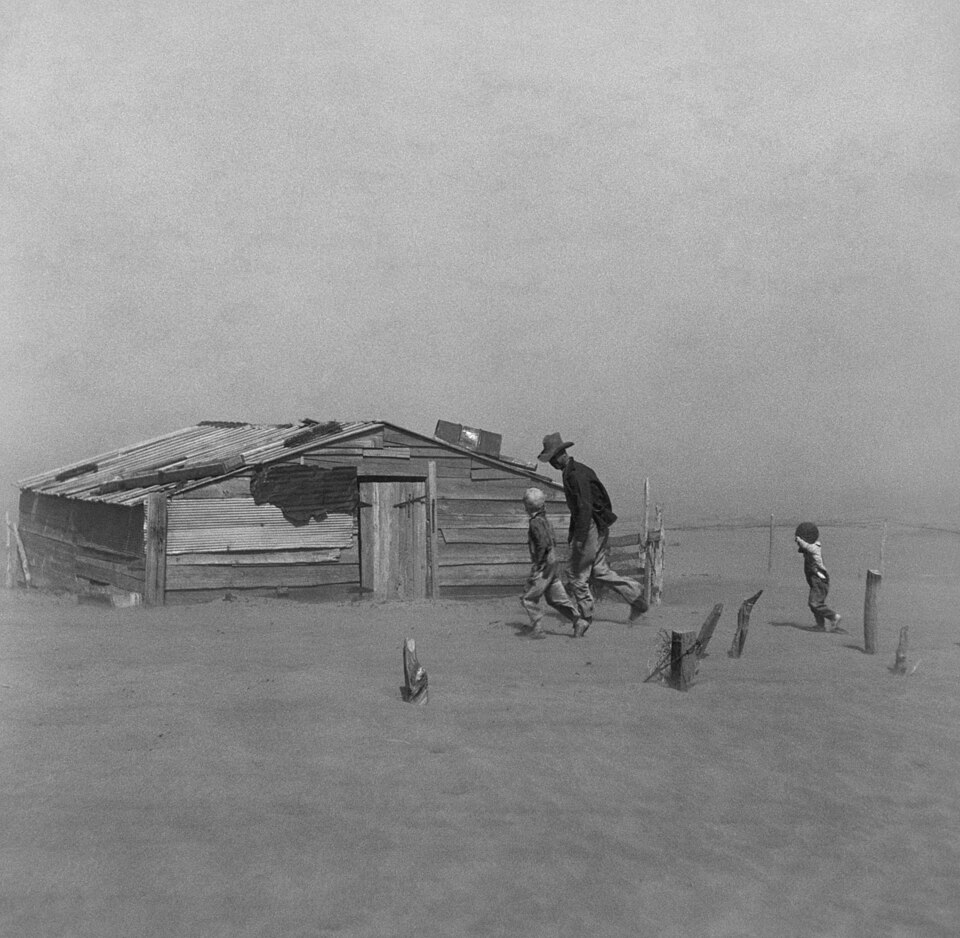
Another recurring motif in Oklahoma’s contemporary art is the solitary building: a barn, a storm shelter, a grain silo, or a rural church. These are not symbols. They are realities—common structures found throughout the state—but when placed against an immense and often unstable sky, they take on a new visual intensity.
The contrast is always present: manmade geometry against natural movement. A shed huddles beneath a thunderhead. A schoolhouse sits in the middle of a wind-bent plain. The structures do not dominate. They endure. Often painted in muted tones—grays, browns, rust—they become anchors, steadying the chaos above.
Three visual strategies recur in these works:
- Low horizon placement: Emphasizes the sky’s dominance and the structure’s humility.
- Subtle texture: Suggests aging materials, often rendered with dry brush or palette knife.
- Implied wind: Fences that lean, grass that blurs, telephone wires that sag.
These elements form a visual grammar of exposure—where the viewer feels, rather than simply sees, the force of the weather.
The Storm as Formal Device
In the hands of many Oklahoma artists, the storm becomes more than subject matter. It becomes a way of structuring the image. The buildup, the calm before, the point of tension, the release—these echo not only meteorological patterns, but compositional logic.
A storm allows for contrast: light against dark, cool against warm, stillness against motion. It provides drama without narrative. It lets the painter work with force and subtlety at once. In this sense, the storm functions like a musical motif: repeated, varied, resolved.
Some artists have approached it directly—rendering specific weather events, storm fronts, or tornadic clouds in literal detail. Others have abstracted it, using color fields or expressive gestures to suggest instability. In both cases, the influence is not theoretical. It is lived. The storm outside becomes the storm on the wall.
Interior Weather
Not all Oklahoma artists respond to weather by painting it directly. Some internalize it. The mood enters the studio. Palette darkens. Edges soften. Compositions isolate their subjects. There’s a quality of restraint—of watching, waiting, absorbing the pressure.
In still life and figure work, this influence shows up in tone. Shadows stretch. Objects seem lit from unpredictable angles. Human figures appear alone, quiet, reflective. These are not images of fear or tragedy, but of heightened awareness. Weather becomes a psychological condition.
A painter may not show a storm, but its energy remains present—in the tension between brushstrokes, the push and pull of color, the unspoken presence of something just beyond the frame.
Continuity in the Studio
The Oklahoma studio is not a retreat from the land. It is an extension of it. Even when abstract or experimental, work made here carries the imprint of its environment. The artist looks out the window and sees horizon. He hears wind. He measures light in seconds. This changes the work, whether intentionally or not.
In rural studios, where silence is total, concentration becomes physical. The weather, audible through walls, becomes part of the painter’s rhythm. In urban studios, windows still open onto sky, onto light that changes without warning. There are no stable hours. Only observation.
This has shaped a regional studio culture that values patience, repetition, and structural clarity. Flash is rare. Intensity, when it appears, is earned through form.
A Weathered Vision
If there is a unifying element in the best of Oklahoma’s recent art, it is this sense of atmospheric tension. Not nostalgia. Not ideology. Just attention—paid closely, over years, to a place where wind shapes thought and storms shape form.
Oklahoma artists do not decorate the weather. They register it. They translate it into weight, into color, into structure. And in doing so, they continue the long tradition that has defined the state’s visual identity from its earliest makers to its contemporary studios: not the search for spectacle, but the practice of seeing what moves, what holds, what threatens, and what remains.