New Jersey has long been an afterthought in American art history—dismissed, misunderstood, or flattened into the margins of more dominant narratives centered in New York and Philadelphia. Yet tucked between these two cultural giants is a state with its own textured geography, self-contained traditions, and fiercely local artistic currents. To trace the arc of New Jersey’s art history is to move not in one direction, but across a map of contrasts: shoreline and farmland, pine forest and industrial ruin, colonial town and suburban sprawl. It is a story of decentralized creativity, shaped as much by brick kilns and glassblowers as by painters or museum curators.
The Problem of Proximity
New Jersey’s central curse—and its strange blessing—has been its proximity to two of the most dominant art cities in American history. In the north, Newark, Paterson, and Jersey City sit in the gravitational pull of Manhattan; in the south, Camden and Burlington historically leaned toward Philadelphia’s orbit. For more than a century, critics, collectors, and even local artists themselves often assumed that serious artistic ambition meant leaving the state entirely. As a result, much of New Jersey’s cultural output has been treated as either derivative or provincial, its homegrown traditions eclipsed by its neighbors’ shadows.
But this assumption begins to collapse when the map is turned sideways—when the gaze shifts not toward the skyline of Manhattan but toward the deep woods of the Pine Barrens, the quiet riverside towns along the Delaware, the aging resort architecture of the Jersey Shore, or the tight-knit boroughs of central counties like Monmouth and Hunterdon. Here, the state reveals not one aesthetic identity, but many.
Geographies of Division—and Creativity
Art in New Jersey has never been dictated by a single school or capital. It is profoundly regional, shaped by the cultural habits, economic conditions, and physical landscapes of its distinct zones. North Jersey—with its denser urban populations and industrial legacy—has its own story, which includes WPA murals in civic buildings, the brief flare of the Newark School, and the migration of commercial illustrators to towns like Montclair. But it is in Central and South Jersey where a different rhythm emerges: slower, more tactile, deeply rooted in land and water, and often fueled by a kind of creative solitude.
Central Jersey’s counties—Mercer, Middlesex, Monmouth, Somerset, and Hunterdon—form a liminal zone between the megacities. These towns produced their own art leagues, county fairs, and local museums throughout the 20th century. A place like Princeton University Art Museum, founded in 1882, managed to build a world-class collection in the middle of horse country and academic quiet. Trenton, once the capital of American ceramics, became both a factory town and an unlikely craft capital. Meanwhile, high school art departments in Freehold or Flemington were staging student exhibitions long before such programs became standard across the country.
Further south, the state’s visual traditions become even more distinct. In Millville, a rich local supply of iron-rich clays and pure river sands gave rise to a thriving pottery and glass industry in the 19th century. By the 20th, this legacy was reborn in the WheatonArts center, a rural campus devoted to the studio crafts—glassblowing, ceramics, printmaking—that often fall outside the boundaries of academic art history but were central to the state’s creative economy.
A Mural for Freehold, a Myth for the State
One of the more vivid illustrations of how art, myth, and geography intertwine in New Jersey can be found on the wall of the Freehold Post Office. Painted in 1939 by Gerald Foster under the Federal Art Project, the mural Washington Crossing the Delaware recasts a national icon as a local event. Though the crossing itself happened farther west, the mural anchors it to Monmouth County, not merely as a patriotic flourish but as a kind of cultural claim: history happened here too.
This instinct—to localize grandeur, to make the national intimate—is a defining trait of New Jersey’s art history. While other states built their reputations around central institutions or avant-garde breakthroughs, New Jersey’s creative identity has always been scattered, modest, and embedded in everyday life. Its beauty lies in the accidental, the habitual, the remembered.
Three examples underscore this point:
- A church basement gallery in Ocean Grove that hosted summer exhibitions of shore painters from 1905 onward.
- An amateur sketching club in Bordentown that met weekly from 1928 to 1956, producing hundreds of drawings now archived in the county historical society.
- A forgotten series of landscape oils painted by a schoolteacher in Hammonton, discovered after her death and later featured in a regional retrospective on “Pine Barrens Imagery.”
None of these stories made national headlines. But taken together, they form a pattern—one that resists centralization and thrives in the margins.
More Than a Crossroads
It is tempting to characterize New Jersey as a state caught “between.” Between New York and Philadelphia. Between urban and rural. Between industry and nature. But the state’s artistic legacy suggests something richer: a network of localized traditions, shaped by material conditions, family ties, and stubborn pride. The southern counties are not merely “lesser New Yorks” or “outer Philadelphias.” They are places where artists worked because they lived there, and where they stayed not out of resignation but out of attachment.
Even the state’s infrastructural sprawl—the Turnpike, the Parkway, the shore traffic and the freight rails—contributed to a visual vocabulary distinct from other regions. Painters of the mid-20th century found strange beauty in the roadside diner, the empty overpass, or the motel sign glowing against cranberry bog dusk. These were not romantic gestures, but observational ones: New Jersey as it is, not as it ought to be.
Opening the Archive
To take New Jersey seriously as an artistic subject requires the same patience it demands from the traveler: a willingness to exit the highway, to pass through small towns without famous galleries, and to appreciate work that doesn’t announce itself with shock or spectacle. Much of the state’s best art has been local in every sense—produced for local audiences, reflecting local concerns, and archived in local collections.
But that does not mean the art lacks reach. The mural in Freehold, the collections in Princeton, and the glassworks in Millville are part of a coherent if underacknowledged tradition—one that binds the state not by style, but by fidelity to place.
This is not a blank canvas. It’s a hidden one, layered in barn dust, salt air, factory smoke, and bog light.
Chapter 2: Colonial Impressions and Early Craft Traditions
Before New Jersey became a modern state, it was a collection of distinct colonial outposts—Dutch, Swedish, English, and Quaker—each leaving its own imprint on the tools, buildings, and decorative objects that defined daily life. The art of this period was not framed and hung, but carved, thrown, dyed, and built. Its beauty was born out of function, restraint, and long apprenticeship. In towns like Salem, Burlington, and Trenton, craftsmanship became the quiet language of permanence, one that still echoes in surviving pieces of pottery, ironwork, and wood.
Quaker Restraint and Material Precision
Burlington County, founded by Quakers in the late 1600s, offers one of the clearest early examples of how religion shaped aesthetics in colonial New Jersey. Quaker philosophy discouraged lavish decoration and ostentation. This did not eliminate beauty from material culture—it redirected it. Craftsmanship had to speak without vanity. Cabinetmakers in Burlington and Salem produced finely made chests, highboys, and tables whose elegance came from proportion, joinery, and subtle grain rather than carving or inlay. Surviving probate inventories from the early 18th century list specific furniture types and tools, confirming the presence of regional artisan economies. Though few signed works survive from this era, tax and court records place named craftsmen like Isaac Pearson and James Antram in Mount Holly and Bordentown by the 1720s.
This emphasis on form over flourish extended to architecture. The Brainerd Schoolhouse, built in 1759 in Mount Holly, is a prime example. A single-room brick structure with arched lintels and Flemish bond masonry, it reflects the Quaker ideal: dignified simplicity, built to last. It has outlived centuries of more elaborate buildings precisely because its design is restrained and functional. Such structures are often excluded from artistic histories, but they represent an early, integrated form of visual expression in the colonial world—architecture as both utility and symbol.
Clay, Fire, and the Origins of New Jersey Ceramics
In the southern half of the state, geology and geography conspired to create one of colonial America’s earliest centers of pottery production. Along the Delaware River in places like South Amboy, Perth Amboy, and later Trenton, natural clay deposits were abundant and of high quality. By the mid-1700s, potters in the region were producing both red earthenware and salt-glazed stoneware. While much of it was utilitarian—jugs, crocks, and storage jars—its forms and glazes reflected a continuity of English and German techniques. Salt glazing in particular, introduced by European immigrants, created a distinctive pitted texture and glossy finish that became common throughout the region.
Trenton’s rise as a ceramics hub is often associated with its 19th-century industrial output, but its colonial roots run deep. Local tradition holds that Captain James Morgan, an officer in the Revolutionary War, supervised pottery operations near what is now the city center in the late 18th century. Surviving examples—thick-walled jugs with looped handles and incised decoration—suggest a blend of English form and American improvisation. The Kemple family, operating near Trenton in the 1780s, also produced salt-glazed stoneware now found in private collections and regional museums.
These vessels were not decorative in a modern sense, but they carried with them the artistry of repetition. The best among them achieved a kind of rhythmic elegance—fluted sides, carefully pulled handles, cobalt slip flourishes added just before firing. They were art made to be used, which only deepened their meaning.
Fraktur and the Painted Page
Not all colonial art in New Jersey lived in wood and clay. In German-speaking communities, especially in Salem and Cumberland Counties, a different kind of visual tradition took root: fraktur. This was a hybrid form of calligraphy and painting, often used to record births, baptisms, and marriages. Rendered in bright inks on paper, these documents combined gothic script with birds, hearts, tulips, and religious motifs. Each one was unique, made to commemorate a singular moment in a family’s life.
Unlike the anonymous forms of ceramics or architecture, many fraktur artists signed their work or developed recognizable styles. While Pennsylvania is often credited as the home of fraktur, South Jersey produced its own lineage. The Salem County Historical Society maintains a small but significant collection of these works, including hand-drawn certificates dated to the 1790s. Their colors remain vivid: ochres, rust-reds, and deep blues, likely derived from local pigments and plant-based dyes. The fact that paper—a fragile medium—has survived at all speaks to the value these items held within families.
Fraktur stands apart from the sober utility of most colonial New Jersey art. It is joyful, decorative, almost whimsical. Yet even this exuberance remained bounded by faith and function. These were sacred documents, not gallery pieces. Their artistry was never an end in itself, but a vessel for memory, piety, and lineage.
Tools of the Trade
A walk through the Museum of Early Trades & Crafts in Madison reveals the material world of the colonial artisan in painstaking detail. On display are the very tools used by 18th-century coopers, blacksmiths, leatherworkers, and joiners: adzes, augers, gouges, and planes. These are not relics of hobbyists but instruments of skilled labor, worn by decades of daily use. Many were imported; others were forged locally. The museum’s collection, drawn from across the state, makes clear that early New Jersey was neither culturally barren nor artistically inert. It was filled with men and women who shaped their environment with care and competence.
Consider a set of cobbler’s lasts used in Monmouth County around 1760—each carved from hardwood, smoothed to the curve of a foot, and blackened by years of touch. Or the engraved harness buckles made in Salem for local carriage-makers. These objects may not bear signatures, but they reveal a shared visual culture: one rooted in durability, rhythm, and the tactile pleasures of skilled making.
South Jersey’s Silent Legacy
What sets South Jersey apart in this early period is its persistence. While cities like Boston and Philadelphia moved quickly toward academic art and patronage systems, southern New Jersey remained decentralized and rooted in craft. Salem and Cumberland Counties continued to produce hand-thrown pottery and hand-hewn furniture well into the 19th century. There was no sudden shift from “craft” to “art,” but rather a slow evolution, where each generation refined the forms they inherited.
In many of these towns, art remained embedded in utility. A fencepost was carved with care. A chest bore hand-painted initials. A quilt carried both warmth and meaning. These were not declarations of status but quiet assertions of place. And in this context, even the most modest object—if shaped with precision and intention—became a kind of monument.
Chapter 3: Landscapes Before the Hudson River School
Before the Hudson River School made dramatic wilderness scenes a staple of American painting, a quieter kind of landscape emerged in early New Jersey—one rooted not in sublime spectacle but in habitation, topography, and observation. These early images, produced between 1780 and 1830, reflect a visual culture still defining itself: a land settled but still rough, towns modest yet growing, and nature depicted less for philosophical meditation than for its daily presence. In Central and South Jersey especially, the terrain offered painters and engravers subjects that were subtle, human-scaled, and recognizably local.
Before the Movement Had a Name
The term “landscape” in American art history often begins with Thomas Cole in the 1820s, but New Jersey was already being depicted in visual terms decades before that—especially by engravers and itinerant painters who straddled the line between documentation and art. These were not yet “landscape artists” in the modern sense. They were draftsmen, topographers, teachers, and amateur painters working without an established canon. They made what they saw.
Among the most influential early publications to capture New Jersey landscapes was The Country Seats of the United States of North America (1808) by William Birch, an English-born engraver based in Philadelphia. Birch’s prints were intended to document the estates and natural scenery surrounding America’s emerging cities. Two plates from this series—“View of Perth Amboy” and “Country Seat Near Bordenton”—offer some of the earliest formalized depictions of Central New Jersey’s riverfront and rural architecture.
These images are restrained but telling: neat rows of trees, gently sloping meadows, frame houses with deep porches and brick chimneys. They echo the visual language of English estate views but are tempered by American humility. The landscape is not grand or threatening—it is cultivated, cooperative, and mild. In this early phase, New Jersey appeared less as a stage for Romantic transformation than as a place to live and work.
The Engraver’s Eye: John Hill and Mount Holly
Another key figure in this early visual record is John Hill, a British engraver who collaborated with several American publishers. His 1816 “View of Mount Holly, New Jersey”, created for a series of town and river views, captures the gentle topography and built environment of a South Jersey township. The composition includes low hills, wooden houses with steep roofs, and a tidy cluster of trees flanking a river. It is neither romanticized nor crude—it shows a town in situ, shaped by the land but also shaping it.
Hill’s works functioned as both artistic objects and visual documents. They were collected not only by connoisseurs but by lawyers, landowners, and merchants who saw their homes reflected in the new republic’s imagery. These early prints helped fix a place like Mount Holly—or Bordentown or Amboy—not as anonymous settlements but as meaningful entries in the visual map of America.
Such images also underscored the deep regionalism of early American art. Painters in Boston or Baltimore had their own settings, but the marshes of South Jersey, the pine flats of Burlington County, and the riverside towns of Hunterdon were their own visual worlds. They were not backdrops for moral allegories or grand narratives; they were complete in themselves.
The Unnamed Painters: Itinerants and Amateurs
Beyond engravers and published prints, early New Jersey also hosted a wide range of itinerant portrait painters, many of whom included stylized landscapes in the backgrounds of their commissioned works. These anonymous artists—often self-taught, traveling between towns by wagon or ferry—painted family portraits that now sit in historical society collections across the state. Though the figures were the main attraction, the painted curtains, windows, and landscapes behind them often reveal much about the region’s perceived natural identity.
A portrait of a Monmouth County landowner, for instance, might include a rolling field and distant orchard, with rows of fence posts diminishing into mist. Another, painted in Salem, might show the edge of a marsh with a skiff moored quietly in the background. These elements weren’t literal renderings—they were imagined composites, informed by the real visual language of South Jersey’s working landscapes.
The cumulative effect is a record of how people saw their place: orderly, fertile, and mild. It lacked the drama of the Catskills or the White Mountains, but it offered something more intimate—land that was farmed, fenced, and named. These portraits, though not landscapes in the formal sense, preserved a sense of regional identity tied to the land.
Shaw’s Etching of the Delaware Gap
By 1820, a more stylized form of landscape was beginning to emerge. Joshua Shaw, an artist and publisher of Picturesque Views of American Scenery, included a rendering of the Delaware Water Gap that shows an early flirtation with grandeur. Shaw was a transitional figure: trained in English watercolor techniques, he brought a painter’s eye to topographic subjects.
His view of the Water Gap, technically on the northern fringe of New Jersey, was one of the first to treat the state’s natural features as worthy of elevated artistic treatment. The print emphasizes the scale of the cliffs, the dark tonality of the forested slopes, and the meandering river slicing through the gap. It is, in tone and ambition, a direct precursor to the Hudson River School. But it is still anchored in observation rather than theater. The exaggeration is modest, the composition still grounded in clarity and order.
Shaw’s work hints at the shift to come—a time when artists would go looking for drama, mood, and symbolic power in the landscape. But in the 1820s, that movement hadn’t fully arrived. Instead, what we see is the persistence of realism, the regional eye, and the tension between accuracy and art.
Land, Not Legend
The early landscapes of New Jersey rarely indulged in mythmaking. There were no thunderous waterfalls, no noble savages, no visions of manifest destiny. Instead, there were marshes, shorelines, clay pits, ferry docks, hayfields, and modest homes framed by trees. This was not the wilderness—it was the working land. And the people who painted and engraved it did not treat it as a spectacle but as a setting for life.
Three early landscape motifs recur in these works:
- River crossings, especially around ferry landings on the Delaware and Raritan. These served as both literal and symbolic thresholds, connecting commerce and community.
- Domestic agriculture, where split-rail fences, outbuildings, and grazing livestock appear not as decoration but as evidence of human labor and settlement.
- Clearings in the pine, showing how civilization edged into the wilder forests without yet transforming them entirely.
The absence of bombast in these works is not a weakness—it is a feature. New Jersey was one of the first thoroughly settled colonies, and its landscape art reflects an inhabited world. The people who shaped this land—and were shaped by it—produced images that were spare, quiet, and true.
Chapter 4: The Rise of Shore Art Colonies
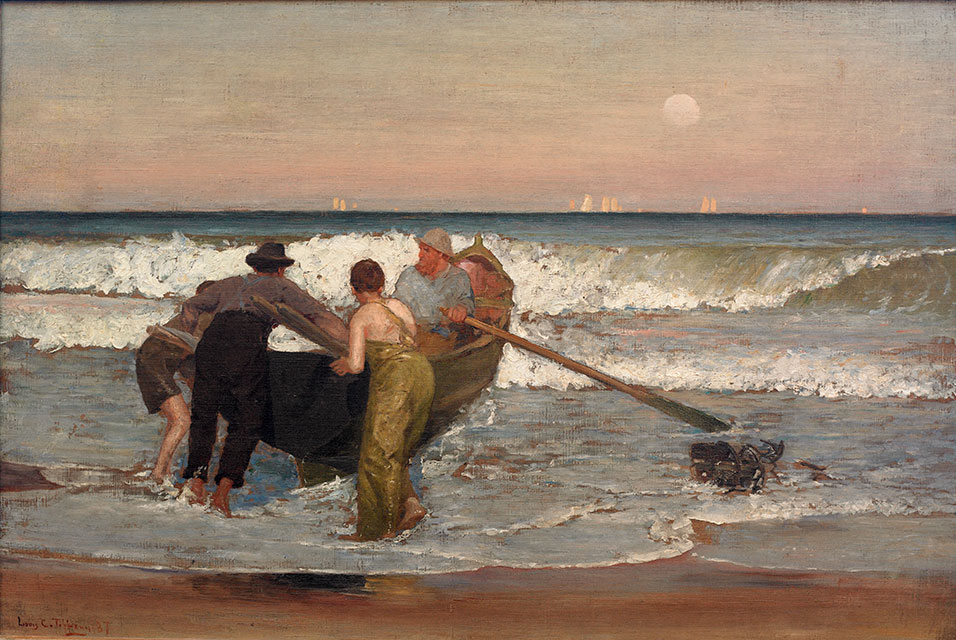
There was a time, before the shore was a weekend escape or a marketing slogan, when the coast of New Jersey was still a frontier—not of danger, but of opportunity. In the late 19th century, as trains brought summer visitors from Philadelphia and New York to places like Cape May, Long Branch, Ocean Grove, and Long Beach Island, they also carried a different kind of traveler: the painter with a satchel of brushes and a hunger for open light. For these artists, the coast was not just a place of rest but of work. And in the years between 1880 and 1930, scattered enclaves of seasonal creativity quietly formed up and down the shoreline—art colonies without grand declarations, but with lasting influence.
A Different Kind of Seaside Attraction
Unlike the highly structured artist colonies of Provincetown or Ogunquit, the Jersey shore’s creative gatherings were modest, semi-formal, and deeply tied to the rhythms of local life. Painters came not to escape civilization but to study a particular mix of land, water, and light—conditions specific to the mid-Atlantic coast, where ocean haze, sand, and the sharp geometry of boardwalks offered a different palette from New England’s rocky grandeur.
In Cape May, long known as a genteel resort for Philadelphians, an informal sketch club had formed by the 1890s. Members—many of them women trained at the Pennsylvania Academy of the Fine Arts or the School of Industrial Art in Philadelphia—spent summers painting porches, sailboats, beach scenes, and local residents. Some sold their works to vacationers; others kept them in personal portfolios. Their names rarely made it into major art journals, but their work circulated in parlors, church halls, and seasonal shows.
A local newspaper in 1896 announced “an exhibition of marine scenes by Miss E.L. Hargrave and others, open to the public this Friday evening at the Music Pavilion.” These kinds of short announcements tell a larger story: of artists embedded in seasonal culture, showing work alongside musical performances, lectures, and religious meetings. The art was part of life—not set apart from it.
Ocean Grove and the Sacred Canvas
One of the more curious intersections between faith and painting occurred in Ocean Grove, a religious seaside community founded by Methodists in 1869. Its strict moral code—including Sabbath closures, prohibition, and gender rules—might seem antithetical to artistic expression. And yet, by the early 20th century, Ocean Grove hosted summer art exhibitions in its Assembly Hall and tent-side porches. These shows, while modest in scope, gave space to amateur and professional painters who found inspiration in the town’s unique blend of Victorian architecture, dunes, and devotional culture.
The key was restraint. Unlike the nude studies or tavern scenes of northern ateliers, art in Ocean Grove emphasized natural beauty, moral clarity, and familiarity. A 1905 listing for a “Gallery of Shore Scenes and Cottage Views” advertised “tasteful renderings suitable for the Christian home.” This language was not accidental; it reflected the tension artists negotiated between personal vision and communal values. But it also demonstrated the adaptability of art itself—how it could be shaped to fit new environments without losing its essence.
By situating art within a spiritually charged, family-centered culture, Ocean Grove created an unlikely but enduring model: an art colony without bohemia, one that elevated the domestic over the avant-garde.
Long Beach Island: Plein Air in the Pines and Salt Air
Further north, Long Beach Island developed a distinct artistic scene that blended plein-air tradition with the easy sociability of summer visitors. By the 1890s, artists were exhibiting watercolors and oils in borrowed storefronts or temporary tents. The LBI Sketch Club, though never formally incorporated, organized seasonal painting outings, informal critiques, and late-summer exhibitions. Some artists had ties to New York schools; others were local or self-taught. What united them was the sense that the island offered both aesthetic variety and logistical ease.
The bay side gave views of oyster boats and marsh grass under changing skies. The ocean side offered surf, dunes, and weather-beaten architecture. Between them lay stretches of pine and cedar scrub, providing tonal contrast and textural interest. Painters worked fast—storms could blow in without warning, and sunlight changed minute by minute. These conditions trained an observational sharpness that shows in surviving works: tight compositions, restrained color palettes, and attention to atmospheric effects.
Some of these works survive in local museums and family collections:
- A 1908 watercolor of Barnegat Light, its structure stark against a stormy sky.
- A series of pastel dune studies by a schoolteacher from Toms River, dated 1921.
- An oil-on-board painting of a clamming skiff in low tide, unsigned but inscribed “Harvey Cedars, Aug. 1915.”
Each one reflects the local color—both literally and figuratively—of artists working in step with the environment.
Between the Train and the Dune
Access played a crucial role in shaping these colonies. With rail lines from Philadelphia and North Jersey terminating at shore stations, it became increasingly feasible for working-class and middle-class artists to travel for a few weeks each summer. Unlike the elite art colonies of New England, which often required long travel or elite patronage, New Jersey’s coast was reachable in a few hours. This compressed geography helped define the character of the art produced there: fast, responsive, and often personal.
Three recurring motifs appeared in these coastal works:
- Boardwalk structures—pavilions, bathhouses, and hotels rendered in drybrush or pen-and-ink, emphasizing geometry and repetition.
- Working boats, especially oyster sloops and fishing skiffs, shown in calm harbors with minimal embellishment.
- Weather studies, with attention to sea mist, approaching storms, and post-rain light—offering dynamic lessons in shifting light.
These weren’t grand allegories or historic tableaux. They were glimpses: transient, specific, and atmospheric.
A Legacy Without a Name
The shore colonies of New Jersey never coalesced into a named movement or recognized school. They left behind no manifestos, no museums of their own, and few artists who entered national prominence. But their influence lingers in regional visual culture—in postcards, county art leagues, family scrapbooks, and church fairs. They created a model of art-making that was both accessible and grounded, seasonal but serious.
In the decades to come, these modest colonies would feed into broader state art networks, enriching county fair exhibits, influencing public school art teachers, and seeding local galleries. They left behind more than paintings—they left a method: observe what’s around you, return to it often, and paint it without pretense.
Chapter 5: Clay and Fire — The South Jersey Pottery Boom
The surface of South Jersey is soft with clay—red, yellow, white, and iron-rich—layered between sand deposits and pine forest loam. Long before fine art arrived in galleries or salons, the region’s artists were already at work, though they wouldn’t have called themselves that. They were potters and glassblowers, brickmakers and kiln tenders. Their medium was earth, and their fires shaped the tools of daily life: crocks, jugs, chimneys, window glass, flasks, and flagons. By the 19th century, South Jersey had quietly become one of the most important centers of ceramic and glass production on the Eastern seaboard. Its traditions were not just industrial—they were artistic, even if few at the time used the word.
The Land Itself: Clay, Sand, and Fire
The natural ingredients for ceramic and glasswork were unusually abundant in the region. The riverbanks near Vineland, Millville, and Bridgeton offered thick seams of clay, easy to mine and quick to fire. Meanwhile, the sands around Maurice River and the Pine Barrens were nearly pure silica—ideal for glassmaking. These raw materials gave rise to a network of kilns, workshops, and small factories by the early 1800s, often attached to family farms or modest rural industries.
In Millville, glass production began in earnest by 1806 with the founding of Millville Glass Works. While it quickly became an industrial operation, it retained many of the traits of artisanal practice: handblown bottles, mouth-finished rims, and irregular coloring that revealed the human hand behind the object. Glass was art in function, and South Jersey’s workers were among the best in the trade. They had to be—glass was unforgiving, and clay unpredictable. Every misstep cost fuel and time.
In the surrounding counties, potteries emerged to meet regional demand. One of the better-documented examples, Vineland Pottery, produced utilitarian wares well into the 20th century. These included milk crocks, butter churns, storage jars, and spittoons—often salt-glazed or slip-decorated, depending on the clay and market. Many of these pieces, now held in local museums and private collections, were unsigned, but their forms are distinctive: slightly bulbous bodies, pulled handles, and an economy of line that makes them timeless.
A Working Tradition, Not a Studio Movement
Unlike the studio pottery movements that developed later in New England or the Midwest, South Jersey’s ceramic tradition was largely unacademic and deeply pragmatic. Potters worked to supply local households and merchants, not collectors. But their work had all the hallmarks of regional style: limited but confident decoration, practical shapes, and glazing adapted to the local mineral content.
Three features stand out across the surviving work:
- Cobalt slip flourishes—usually simple flowers or abstracted leaves—applied with speed and grace before the second firing.
- Stamping or incising initials or maker’s marks into the neck or shoulder, sometimes with a cross or circle.
- Variation in glaze tone, from deep olive to silvery gray, often caused by uneven firing in wood-fueled kilns.
The anonymity of these objects was a kind of statement. The potter’s work spoke for itself, and its success was measured not by applause but by survival: Did it hold water? Did it stack evenly? Did it crack in the frost?
Millville’s Second Fire: WheatonArts and the Studio Revival
By the mid-20th century, much of South Jersey’s ceramics and glass industry had collapsed or been absorbed into larger operations. But the memory—and the materials—remained. In 1970, a retired chemist and collector named Frank Wheaton Sr. founded Wheaton Village (now WheatonArts) in Millville as a living museum and working studio campus. His vision was to preserve the techniques of traditional glassblowing and to provide space for contemporary artists working in the medium.
WheatonArts did more than revive craft—it anchored a serious regional art movement. With its public studios, artist residencies, and exhibition spaces, it became a magnet for ceramicists and glass artists from across the country. The Studio Glass Movement, which had begun in the 1960s in places like Toledo and Madison, found a lasting home in South Jersey. The facility’s skilled demonstrators not only produced technically complex pieces; they taught, mentored, and expanded the local audience for hand-crafted work.
Today, the Wheaton collection includes both traditional forms and modern sculpture:
- Delicate flameworked animals crafted on torch stations, a nod to Victorian curiosity glass.
- Large-scale blown vessels with abstract color patterns, clearly in dialogue with international studio trends.
- Reproductions of 19th-century Millville paperweights, a regional form prized by collectors for its complexity and visual density.
What’s striking is the continuity. Even in the most experimental works, the roots in local technique and material are still visible.
Functional Beauty, Regional Identity
South Jersey’s ceramic and glass tradition was always function-forward, but this didn’t mean it lacked artistry. A butter churn that sits evenly and is easy to grip has been shaped not just by utility, but by aesthetics of proportion, surface, and balance. The potter’s decisions—rim angle, shoulder curve, thickness of handle—are formal ones, guided by instinct and experience. There is no academic theory here, only an unbroken knowledge passed hand to hand.
The glassworkers, too, operated within a vocabulary of form: the lip, the neck, the bulge, the twist. Their gestures were codified by labor but elevated by fluency. Watching a skilled blower at WheatonArts or reading an inventory of Millville’s 19th-century output reveals a regional design intelligence, rooted in material realities and refined over time.
It’s no accident that the Pine Barrens, with their hard soil and soft clay beneath, produced such tactile traditions. Nor is it a coincidence that the Delaware Bay’s ports—Bridgeton, Salem, Greenwich—served as points of export for these wares, spreading South Jersey’s aesthetics to other parts of the Mid-Atlantic. The work was local, but its reach was broad.
Legacy in the Ground and the Hands
Many of the finest examples of South Jersey pottery have been dug up from old wells, cellar holes, and trash pits—discarded when chipped or broken, now preserved as archaeological artifacts. Others sit on kitchen shelves in farmhouse kitchens, handed down for generations without ever entering the museum circuit.
Three types of surviving forms give the region its recognizable profile:
- Gray salt-glazed crocks with stamped floral medallions.
- Brown alkaline-glazed jugs, often with finger grooves from hand-turning.
- Porous red earthenware bowls, likely used for mixing or rising bread.
These objects endure not because they were rare, but because they were made to last. And in their persistence, they tell a story of South Jersey’s deep entwinement of craft, industry, and art—a story shaped not by galleries or critics, but by the soil itself.
Chapter 6: Central Jersey’s Academic and Institutional Anchors
If a region’s artistic legacy is shaped by the soil and the light, it is sustained by its institutions—the museums, schools, and local programs that make the difference between isolated talent and a living tradition. Central Jersey, long overshadowed by the metropolitan gravitational fields of Newark and Philadelphia, quietly built one of the most enduring and democratic art infrastructures in the state. It did so not through elite patronage or avant-garde ferment, but through public education, regional universities, civic programming, and a rare commitment to accessibility.
From the brick corridors of Kean University to the sculpture paths of Hamilton Township, Central Jersey’s artistic institutions have served as both proving grounds and safe harbors—for working artists, teachers, students, and audiences alike.
Princeton’s Museum: Elite Roots, Broad Reach
Founded in 1882, the Princeton University Art Museum is the state’s most historically significant fine art institution. Its collection rivals those of many major urban museums, and yet it remains housed in a university town that still retains the rhythm of Central Jersey farmland and commuter train schedules. From its earliest decades, the museum’s mission extended beyond serving faculty and alumni; it built an outreach program that engaged public schools, regional artists, and visiting scholars.
By the mid-20th century, Princeton was hosting traveling exhibitions that made stops in Trenton, New Brunswick, and Flemington. It ran public lectures and weekend programming long before such things were common. Its curators also took a serious interest in New Jersey-based artists—not merely as side exhibits, but as part of a regional narrative worth preserving. In this way, Princeton’s elite identity paradoxically enabled it to elevate the local: a Renaissance print collection might hang beside an exhibition on Central Jersey portraiture from the 1800s, giving context and dignity to both.
Still, the museum was only one node in a broader web. If Princeton offered prestige, other institutions offered access.
Kean University: Art in the Public Curriculum
The story of Kean University begins not with canvas and pigment, but with chalk and blackboards. Founded in 1855 as the Newark Normal School, Kean’s original purpose was to train public school teachers—men and women who would go on to staff the classrooms of every town from Elizabeth to Toms River. But from the outset, the curriculum included art education, not as an afterthought but as a foundational element of civic instruction.
By the mid-20th century, after relocating to Union and adopting its current name, Kean had developed a full Fine Arts program, complete with studio instruction, art history, and exhibition opportunities. Its influence radiated outward: many of Central Jersey’s public school art teachers between 1950 and 1990 were Kean graduates. They staffed the high schools of Middlesex, Monmouth, Somerset, and Union counties—not only teaching drawing and design, but organizing local shows, student competitions, and even town mural projects.
Kean’s role in New Jersey’s art ecosystem has always been practical, populist, and quietly powerful. It is the kind of institution that shapes culture without ceremony. Its campus galleries have shown student work alongside community exhibitions, and its faculty have long blurred the line between artist and educator.
By serving those who would go on to serve others, Kean embedded art into the daily fabric of Central Jersey life—not in collectors’ homes, but in libraries, auditoriums, and school corridors.
Trenton’s Dual Identity: Industry and Instruction
Long known as a manufacturing city—home of the slogan “Trenton Makes, the World Takes”—Trenton also became a hub for vocational art education in the early 20th century. The Trenton School of Industrial Arts, founded to prepare students for careers in design, drafting, and applied arts, emphasized both craft and discipline. It produced technical illustrators, engravers, display artists, and later, advertising designers.
Though many of its students entered commercial fields, the school laid down an educational infrastructure that supported the fine arts as well. Its graduates formed art clubs, showed work at the Trenton City Museum at Ellarslie, and mentored younger artists in the surrounding counties. In a city defined by its factory skyline and labor politics, art was never far removed from work—but it remained a source of pride and identity.
Trenton’s story reveals a deeper truth about Central Jersey’s art institutions: they emerged not despite the working-class character of the region, but because of it. They were institutions of purpose, not ornament—meant to train, to uplift, and to endure.
Grounds For Sculpture: A Monument to Accessibility
When Seward Johnson—sculptor and heir to the Johnson & Johnson fortune—opened Grounds For Sculpture in 1992, many dismissed it as a novelty. Built on the former New Jersey State Fairgrounds in Hamilton Township, the 42-acre park seemed at first like a whimsical vanity project: oversized bronze statues of people eating lunch or walking dogs, placed amid manicured landscapes.
But in time, the institution revealed its deeper ambition. Grounds For Sculpture became one of the most visited art destinations in the state, attracting not just art aficionados but entire families, school groups, and retirees. It democratized sculpture, offering tactile, navigable, and photogenic encounters with three-dimensional art in an outdoor setting.
Beyond its playful surface, the site supports serious artistic engagement:
- A rotating series of exhibitions in its museum spaces features contemporary sculptors from New Jersey and beyond.
- Residencies and workshops draw emerging artists to Central Jersey, some of whom stay and continue to work in the region.
- Its education programs, including K–12 field trips, lectures, and hands-on sculpture classes, make it an extension of the public classroom.
Grounds For Sculpture embodies a principle that runs throughout Central Jersey’s artistic history: art does not need to be remote, or difficult, or elite—it can be immersive, immediate, and integrated into daily life.
The County Fair Circuit and Public Schools
Perhaps the most underappreciated art institutions in Central Jersey are its county art leagues, school programs, and agricultural fair competitions. From the 1920s onward, counties like Monmouth, Middlesex, and Somerset held annual or seasonal exhibitions of local art—often juried by public school teachers or university faculty. These events displayed everything from oil paintings and ceramics to quilts, photographs, and pen-and-ink studies by students.
Three elements made these programs lasting:
- They created local feedback loops—artists showing to neighbors, students learning from mentors within their own towns.
- They gave rural and suburban students the same exhibition opportunities as their urban peers.
- They emphasized craft and discipline over trend and novelty—reinforcing traditional techniques even as styles changed.
Public school art rooms in Central Jersey, especially from 1950 to 1980, were unusually well-equipped thanks to this educational infrastructure. Supplies were shared across districts; retired artists were brought in as guest instructors; and school corridors became gallery walls. Art was not an elective—it was a community language.
Chapter 7: The WPA in the Garden State
In the darkest years of the Great Depression, when work was scarce and morale scarcer, the United States government did something extraordinary: it hired artists. Through the Federal Art Project and the Treasury Section of Fine Arts, painters, sculptors, and printmakers were commissioned to create public art in schools, post offices, libraries, and municipal buildings. The idea was simple but profound—that beauty and civic pride were not luxuries, but necessities in a democracy under strain. In New Jersey, especially across Central and South Jersey, this initiative left behind a gallery of murals, reliefs, and posters embedded in the very bones of public life.
Some of these works still survive, fading quietly in post offices or preserved behind glass. Others have been lost—painted over, torn down, or stolen. But together, they mark one of the most significant periods in the state’s visual history: a moment when federal policy and regional identity briefly moved in harmony, and when even the most modest town could become home to a nationally sponsored mural.
Freehold’s Mural: History on the Post Office Wall
One of the most visible and enduring WPA-era murals in Central Jersey hangs in the Freehold Post Office. Painted in 1939 by Gerald Foster, Washington Crossing the Delaware is a formal, slightly theatrical composition showing the famed military maneuver of 1776. The real crossing took place farther upriver, near Titusville—but that didn’t matter. Foster’s mural wasn’t concerned with strict geography. It aimed to localize national myth, to give Freehold’s residents a sense that their town was not peripheral but central to the American story.
The mural’s style is typical of the time: academic in tone, readable at a glance, and reverent in mood. Washington stands in full heroic posture, surrounded by soldiers braving the winter river. But Foster adds small touches of regional specificity—a rendering of the local terrain, for instance, or hints of New Jersey militia uniforms drawn from historical sources.
Installed in a civic space used daily by working people, the mural wasn’t just decoration. It was public storytelling, commissioned not by aristocrats but by the federal government, paid for with taxpayer dollars. Its very existence signaled that art belonged to everyone.
Bridgeton: Murals on the Edge of the Pine Barrens
Farther south, in Bridgeton, the impact of WPA art was quieter but equally meaningful. Several murals were painted under the Treasury Section of Fine Arts, a program separate from the Federal Art Project but part of the New Deal’s broader support for public art. These works were housed in post offices and schools, often depicting local industries, agricultural scenes, or allegorical figures of justice and education.
Though few of the Bridgeton murals survive in full, archival records from the U.S. General Services Administration describe works that blended realism with idealism. One mural showed canning factory workers—men and women side by side, assembling crates of tomatoes and peaches. Another portrayed children in a schoolyard under a banner of American flags and rising sun imagery. These were not abstract symbols. They were images of South Jersey as it was: agrarian, small-scaled, and proud of its labor.
In communities like Bridgeton, the WPA murals weren’t simply artistic gestures. They were visual affirmations that the lives of ordinary people deserved to be seen and recorded—that their work, their landscape, and their values were worthy of attention and permanence.
Bordentown’s Hidden Heritage
In Bordentown, a small Central Jersey town perched above the Delaware River, the WPA left its mark in more modest forms—murals, relief sculptures, and decorative motifs in public schools. Some of these were created in collaboration with local art teachers; others were installed by traveling WPA artists assigned to rural regions.
The Bordentown Historical Society preserves accounts of art competitions and workshops run through federal programs in the late 1930s. One particularly vivid description recounts a mural in a school auditorium, showing a timeline of American invention—from early blacksmithing to electric light. The mural, now lost or painted over, was the result of a collaboration between a WPA artist and a local science teacher. It blended visual narrative with educational content—a hallmark of the era.
What emerges from Bordentown’s record is not the image of a town transformed by art, but of a town that quietly integrated art into its daily routines. The murals were background to school plays, PTA meetings, and student assemblies. And that may be their greatest legacy: they made art part of the environment, not an exception to it.
Trenton’s Graphic Arts and Industrial Imprint
As the state capital and an industrial powerhouse, Trenton served as a natural hub for WPA activity. In addition to mural work, the city was home to several graphic arts workshops affiliated with the Federal Art Project. These studios produced silkscreen posters, educational prints, and design prototypes for other regional offices.
Some of the posters created in Trenton—preserved now in the Library of Congress—promoted public health, literacy, and conservation. Others advertised local cultural events: a chamber concert at a public library, a children’s puppet show at a community center. Rendered in bold typography and simplified forms, these posters embodied the ethos of the WPA: clarity, function, and purpose, joined to striking design.
Trenton’s artists, many of them trained in commercial illustration or industrial design, approached their work with technical skill and civic conviction. They weren’t interested in personal expression or aesthetic rebellion. They wanted their images to work—to communicate, to inform, and to last.
Their success lay in subtlety: the careful spacing of letters, the balance of image and text, the honest charm of a well-made poster pinned to a school hallway or a public kiosk.
The Artists Behind the Work
While few WPA-era New Jersey artists achieved national fame, some deserve mention. Gerald Foster, the Freehold muralist, had studied in New York and painted in a social realist mode common to his generation. His work showed the influence of Thomas Hart Benton—curving forms, heroic figures, American themes—but was less theatrical. Louis Lozowick, though not a WPA muralist in New Jersey, made several New Jersey-based lithographs during the 1930s. His industrial scenes of Weehawken and Jersey City showed a crisp modernist style that contrasted with the more homespun murals of the period.
Other artists remain anonymous, their names lost in bureaucratic reports and mural inscriptions worn smooth by time. But their work survives—not always on walls, but in photographs, memory, and the changed expectation that art could belong to every town, not just every museum.
What Remains—and What’s Gone
Many WPA murals and artworks have disappeared. Painted over in renovations, lost in school demolitions, or removed without preservation, their absence is a quiet reminder of how vulnerable public art can be. Yet enough survives to piece together the legacy.
In Central and South Jersey, that legacy is one of local dignity. The murals didn’t depict myths or gods—they showed teachers, farmers, shipbuilders, schoolchildren, and factory hands. They turned civic buildings into civic symbols, giving beauty and form to otherwise plain spaces.
More than that, they marked a moment when the federal government believed that art was infrastructure—as essential as bridges and roads. For a time, even the smallest New Jersey towns could see themselves reflected on a wall, painted in the confident strokes of public purpose.
Chapter 8: Painters of the Pines
The Pine Barrens begin where the highways thin out and the soil turns sandy and pale, a landscape defined as much by what it withholds as what it reveals. To the untrained eye, the pines can appear monotonous—scrub, cedar swamps, cranberry bogs, and long stretches of silence. But to the artists who sought them out, this vast region became a kind of inland coast, a place where weather, light, and solitude shaped a visual world unlike anything else in the state. The Pines are a test of perception: what you see depends on how long you are willing to look.
A Landscape of Subtle Intensities
What drew painters and photographers to the Pine Barrens was not spectacle but restraint. The pines do not offer sweeping mountain vistas or romantic ruins. Instead, they stretch outward in low undulating forms—fire-scarred trunks, ghostly white sand paths, still-water bogs where cloud reflections hover like apparitions. To translate such a landscape requires attentiveness, a willingness to dwell on nuances of light and texture. The artists who committed themselves to this region often did so not for fame or purchase but for the discipline of observation.
Among the most dedicated interpreters of the Pines was George Tice, whose photographic work from the 1960s through the 1980s forms a quiet epic of South Jersey’s interior. Tice approached the Pines not as wilderness but as inhabited land, shaped by small towns, weathered signage, abandoned structures, and the geometry of cranberry bogs. His photographs have a clarity that comes from walking, waiting, and returning: a boarded-up gas station glowing under a winter sky; a narrow road framed by pines that seem to press inward; a solitary house standing against a field of snow. Tice understood that the Pines do not announce themselves—they accumulate.
Howard Boyd and the Intimate Landscape
While photographers like Tice recorded the region in crisp monochrome, painters such as Howard Boyd explored it through watercolor and ink. Boyd’s work from the mid-20th century reveals a different entry point into the Pines: an intimacy with the plant life, waterways, and cottages tucked along forgotten routes. His watercolors often center on a single visual anchor—a leaning tree, a cranberry bog sluice, a stretch of marsh grass caught between tides. He dispensed with grandeur and focused instead on atmosphere.
Boyd’s prints and paintings circulated widely through South Jersey towns and were often used in local publications about natural history. His art carried the sensibility of a field guide: attentive, unhurried, rooted in firsthand knowledge. If Tice offered the Pines as a meditative interior world, Boyd presented them as a living habitat, where subtle variations in hue and shadow recorded the region’s shifting seasons.
Both artists shared a belief that the Pine Barrens were not empty but full—full of stories, structures, and slow changes that could only be captured through persistent looking.
The Early Landscape Tradition
Long before the mid-20th century, the southern regions of New Jersey had attracted painters working in the early American landscape tradition. Artists like Pierce and Curran—represented in regional museum and historical society collections—made small oil studies of South Jersey clearings, bogs, and cedar marshes in the early 1900s. These works rarely reached a national audience, but they set a precedent for depicting the region with clarity rather than exaggeration.
What distinguishes these early painters is their resistance to the dramatic tendencies of the Hudson River School. Where those northern painters sought waterfalls, cliffs, and sublime turbulence, the artists who gravitated to New Jersey’s interior favored flat horizons, low skies, and the austere beauty of repetition. A line of pines along a sandy road can be as visually commanding as a mountain range when rendered with the right balance of depth and restraint.
Three motifs recur consistently in these early works:
- Bog structures: sluice gates, pump houses, and wooden frames reflected in still water.
- Fire lines: the stark contrast between charred pine trunks and new green growth.
- Solitary dwellings: farmhouses or cabins placed in wide, open swaths of muted color.
These were not idealized scenes—they were based on lived familiarity with the terrain.
The Pines as Solitary Haven
Artists often came to the Pine Barrens seeking solitude. The sprawling forest offered what suburbanizing Central Jersey increasingly lacked by the mid-20th century: quiet, distance, and intact horizon lines. Painters who worked in oils would load their supplies into cars and vanish onto sandy roads for days at a time, setting up easels in open clearings, sometimes visited only by hunters or surveyors passing through.
The Pines rewarded patience with surprises. A bog at dawn turns lavender for only a few minutes. A cedar swamp glows rust-colored under certain winter skies. After a controlled burn, the ground becomes a kind of glowing mineral field, streaked with ash and neon-green sprouts of new growth. These transformations, subtle but dramatic to the attentive eye, gave artists material that changed continually, resisting formula and cliché.
Some painters created series over decades, returning to the same cedar run or firebreak year after year. The changes, and the constancies, became a record of both place and time. Even small works—a 6×8‑inch study of a cranberry bog under late-summer haze—could hold an entire region in miniature.
Local Circulation and Quiet Influence
Much of the art inspired by the Pine Barrens never entered major museums. Instead, it circulated through regional exhibitions, county fairs, small galleries, and local historical societies. Some works were sold from the trunks of cars at community events; others hung for years in doctor’s offices, libraries, or municipal buildings. The modest circulation did not diminish their importance. If anything, it strengthened their connection to the communities around them.
The Pines also became a favored subject for postcards, prints, and small watercolors produced between 1900 and 1950. These images—marsh sunsets, cedar bridges, sandy crossroads—formed part of South Jersey’s everyday visual vocabulary. They were the pictures people sent to relatives out of state as evidence of home.
Artists working in the region often collaborated with naturalists, surveyors, or writers. Field guides to the Pines included ink drawings by Boyd and others; local conservation pamphlets featured paintings of bog wildlife. The line between art and documentation blurred, and the Pines gained a dual identity: both ecological site and creative subject.
Solitude as Method
The defining characteristic of Pine Barrens art is not style but temperament. The artists who found their way into the region tended to work with deliberation, embracing places that required persistence. They admired the landscape not for what it could represent symbolically but for what it was—a stretch of woods and water shaped by fire, weather, agriculture, and long habitation.
This slow, steady observational approach formed a tradition that influenced later generations. Young artists encountering Boyd’s watercolors or Tice’s photography often recognized a discipline they themselves wished to cultivate: the ability to remain still long enough for a landscape to reveal its structure.
In this sense, Pine Barrens art is less about the final picture and more about the experience that produced it. To paint the Pines is to accept that the land will not perform for you. You have to follow its pace.
A Region That Shapes the Work
It is no surprise that the Pines continue to attract artists today. Even as development presses in from the north and west, the region remains vast, evasive, and visually exacting. Its beauty lies not in spectacle but in resilience—burned, regrown, flooded, drained, wind-swept, and enduring.
Artists who work there find a terrain that resists easy interpretation. It demands a kind of humility. And that humility is precisely what gives the resulting art its force. Whether rendered in watercolor, pencil, or black-and-white film, the Pines refuse extravagance. They ask only for attention, and in return they offer clarity.
In the history of New Jersey art, the Pine Barrens form a world apart—one shaped not by institutions or critics, but by the land itself and the artists willing to walk into its quiet and stay long enough to understand it.
Chapter 9: From Diners to Highways—Postwar Realism and Roadside Aesthetics
After the war, New Jersey remade itself in steel, asphalt, chrome, and neon. The turnpike carved a diagonal across the state’s industrial spine. Route 130, Route 1, Route 9—these became arteries not just of commerce, but of image. Gas stations, diners, motels, billboards, power lines, drive-ins: this was the architecture of the new American ordinary. For the artists who came of age in the 1950s and ’60s, it offered a different kind of landscape—flattened, illuminated, and endlessly reproducible. And many of them, particularly in New Jersey, embraced it not as kitsch or critique, but as a subject worthy of serious depiction.
Postwar realism in New Jersey did not arrive in museums. It flickered in diners, glowed in vacant lots, shimmered on wet pavement under streetlamps. This was not the pastoral Jersey of bogs and pines, nor the colonial restraint of brick towns. It was a new visual grammar of speed, signage, and solitude.
Charles Sheeler and the Precision of Industry
Though his most iconic works were national in scope, Charles Sheeler spent part of his career recording New Jersey’s industrial forms with rare compositional clarity. His photographs and paintings from the 1930s to 1950s frequently included sites in Camden, Trenton, and along the Delaware River corridor. Silos, smokestacks, and transformers became his vocabulary—rendered not with romantic gloom, but with surgical stillness.
Sheeler’s realism was mechanical in the best sense: devoid of sentiment, precise in proportion, and austere. A photograph of a New Jersey substation or a rail overpass in Trenton, stripped of human presence, becomes a meditation on geometry and mass. These images prefigure what later New Jersey artists would find in the postwar roadside world: abstraction hidden in the functional, beauty born of repetition.
While Sheeler’s New Jersey works were not explicitly about highways or diners, they established a method—a way of seeing the built environment as worthy of sustained attention. That method would echo decades later in photography and painting across the state.
George Tice: Neon, Formica, and Silence
No artist captured the postwar face of New Jersey more completely than George Tice. Though best known for his photographs of rural and industrial subjects, his work from the 1960s through the 1980s includes some of the most iconic roadside imagery in American photography. His 1974 image Petit’s Mobil Station, Cherry Hill, New Jersey remains one of the defining images of mid-century roadside aesthetics: a gas station at dusk, glowing like a beacon, its signs sharp against the fading light, the atmosphere saturated with quiet tension.
Tice’s diners—particularly the White Rose Diner in Linden and others along Route 1—are studies in symmetry, gloss, and solitude. Chrome reflects neon; empty booths suggest paused lives. These images are neither nostalgic nor ironic. They are composed with respect, as if to say: this too is America, and it deserves to be seen.
His work has often been compared to Edward Hopper, but where Hopper’s world hints at narrative—the aftermath of something—Tice’s images are stilled moments without plot. They are records of design, weather, and time.
The Road as Subject
In the postwar decades, the highway became the most prominent organizing force in the New Jersey landscape. Artists, especially photographers and realist painters, began to see its visual potential. Signs, poles, wires, and fast-food architecture offered repeating forms and bold color blocks. Roadside structures were built to be seen quickly, but artists slowed them down, froze them, and re-presented them as fixed points in a moving world.
Three visual elements defined this era’s aesthetic:
- Billboard layering: old ads peeling over newer ones, creating accidental collage.
- Neon signage: especially in shore towns and suburban strip corridors, glowing at dusk or in rain.
- Mid-century vernacular architecture: diners, drive-ins, motels—often prefab, often idiosyncratic, often temporary.
Painters responded with a realism that was photographic in its crispness but painterly in its decisions. One Monmouth County painter, active in the 1970s, built an entire career on oil renderings of South Amboy gas stations and strip malls, shown under late-day light or winter skies. His work, while never collected by major museums, circulated in county arts leagues and small galleries, becoming a kind of visual diary of the era.
Asbury Park: Decay as Aesthetic
By the 1980s, places like Asbury Park had begun to shift from boomtown to ruin. The boardwalk, once luminous with arcades and grand hotels, took on a new role in regional art: that of the picturesque decayed. Painters and photographers alike turned their attention to collapsed roofs, rusted rides, broken signs, and faded murals.
The decaying Convention Hall, the skeletal carousel building, the ghost signage of long-shuttered casinos—all became emblems of an era not entirely gone but visibly eroding. Artists documented this slow unraveling with careful precision. In these images, decay wasn’t tragedy—it was texture.
Local high school art programs in the 1990s began assigning boardwalk documentation projects, and their student works—charcoal sketches, watercolor studies, pastel abstractions—became an unintentional archive of the Jersey Shore’s architectural decline. These studies, now held in places like the Monmouth County Arts Council, show how regional realism became intergenerational, moving from professionals to students with barely a stylistic break.
Realism Without Irony
What makes New Jersey’s postwar roadside realism distinctive is its lack of irony. Elsewhere, diners and highways became symbols of American excess or alienation. But in New Jersey, the tone remained steadier. Artists didn’t parody the diner—they depicted it. They didn’t mock the motel—they studied its shadow at noon.
This seriousness is rooted in familiarity. These weren’t exotic or nostalgic scenes—they were daily ones. The artist who painted the Route 130 diner had eaten there; the photographer who captured the neon hotel sign had likely driven by it hundreds of times. There was no aesthetic distance, only attention.
Some artists worked in oils, others in black-and-white film. A few incorporated early color photography or experimental acrylics. But the formal characteristics remained consistent: rectilinear composition, neutral perspective, muted palette, and a calm that borders on reverence.
Even the most mundane subjects—a payphone outside a laundromat, a parking lot viewed from a second-story window—were rendered with clarity and care.
A State Seen From the Side
By the end of the 20th century, New Jersey’s roadside realism had formed a cohesive, if unofficial, school of thought. It was not driven by any one institution, but by a shared geography: the roads between towns, the edges of things. These were the spaces between destinations, rendered by those who understood that art could live in the unremarkable, if one looked closely enough.
The Turnpike, the Parkway, the shore roads—they were all scenes in motion. But the artists of this era turned them into still life, as quiet and composed as a Dutch interior.
And in doing so, they gave New Jersey a new visual legacy: a realism of restraint, rooted in place, untouched by artifice.
Chapter 10: The Delaware River School
There is no formal movement called the Delaware River School. No manifesto was signed, no stylistic doctrine declared. Yet along the slow, winding stretch of river between Titusville, Lambertville, and Frenchtown, a body of artistic work emerged over the 20th century that shared something stronger than ideology: a commitment to place. The artists who painted and printed along this corridor did not need to invent a school—they lived it. Their canvases, woodblocks, and etchings reflect a deep, persistent attention to the rhythms of river towns, the changing seasons, and the conversation between land, water, and settlement.
Though often overshadowed by the more famous Hudson River painters or the Pennsylvania-based New Hope School just across the bridge, the New Jersey side of the Delaware cultivated its own quiet artistic culture—one rooted in craft, community, and constancy.
Between Two Banks: The Cross-River Art World
In the early 20th century, artists began to settle in the hamlets along the Delaware River, drawn by the light, affordability, and proximity to both Philadelphia and New York. Lambertville—once a mill town and ferry crossing—became an artistic hub that mirrored and occasionally mingled with the New Hope colony just across the bridge in Pennsylvania.
The New Hope School, centered around painters like Edward Redfield, Daniel Garber, and Fern Coppedge, was known for its vibrant plein-air landscapes and strong colorism. While many of its best-known figures lived on the Pennsylvania side, their view often faced New Jersey. Several, including Garber, painted Coryell’s Ferry, the river’s edge at Lambertville, and the New Jersey hills rising beyond.
The Hunterdon County Historical Society holds numerous exhibition records from the 1920s through the 1950s showing Lambertville artists staging their own shows—first in storefronts and church halls, later in dedicated galleries. These exhibitions rarely featured radical experiments or theoretical innovation. Instead, they displayed seasonal studies: ice on the river, spring floods, autumn foliage near Stockton, snow-covered mills, and the flickering reflections of gaslight on cobblestone streets.
This was not nostalgic art. It was observant, attuned to weather, architecture, and time.
Printmakers and the Black Line
Alongside the painters, a strong printmaking tradition flourished in the Delaware Valley, particularly from the 1930s through the 1960s. Working in linocut, woodblock, and etching, these artists captured the geometry of riverside towns with a crispness painting sometimes smoothed away. Their works featured canal locks, truss bridges, church steeples, and Victorian facades, all reduced to bold lines and careful shadows.
One etching by an unnamed artist in the New Jersey State Museum collection, dated 1946, shows a row of houses on Bridge Street in Lambertville during a flood. The water laps quietly against porches, the power lines sag, and a figure in boots stands alone in the center of the frame. Nothing dramatic happens, yet everything is observed. This kind of visual narrative—precise, atmospheric, human-scaled—typifies the Delaware River School’s approach.
The printmakers had their own rhythms: editions pulled during the winter, drypoint plates scored by lamplight, shows mounted in town libraries and school gymnasiums. Their work was intimate in scale but enduring in detail.
Lambertville as Working Town and Working Studio
Unlike other American art colonies that became enclaves of wealth or taste, Lambertville remained stubbornly mixed. Its industrial base—paper mills, pipe foundries, and boat works—meant that artists lived alongside machinists and clerks. Studios were carved out of old storefronts, attics, or second floors above barbershops. The aesthetic was not rarefied; it was embedded in daily life.
This proximity gave the art a particular tone. You see it in the way artists painted river barges in thaw, workers on break, or old trusses backlit by winter sun. There was no theatrical framing, no high concept. These were painters who understood how the river shaped labor and rest, and their work reflected that rhythm.
Three recurring themes define this regional style:
- Transition—bridges under repair, houses with half-painted shutters, the turning of seasons.
- Reflection—not symbolic, but literal: water as mirror, always present, always changing.
- Structure—architectural precision balanced with the softening effects of time and weather.
These themes appeared across media, from oil on panel to ink on paper, linking disparate artists into a shared visual language.
Art Festivals and Exhibition Culture
By the mid-20th century, the towns along the Delaware began formalizing their artistic presence through seasonal festivals, cooperative galleries, and juried exhibitions. The Lambertville–New Hope Spring Arts Festival, still running today, traces its roots to small community shows held in fire halls and church basements starting in the 1950s.
These events were more than exhibitions—they were gatherings of a self-aware artistic culture, drawing painters, printmakers, potters, and photographers from both sides of the river. They blurred the line between amateur and professional, offering shared walls to regional masters and weekend hobbyists alike. For many, the festivals were also sales events—an essential source of income that helped sustain year-round creative work.
Over time, permanent venues emerged. The Riverrun Gallery, Artists’ Gallery of Lambertville, and others gave structure to the local art economy. But the informality persisted. Artists still hung work by hand, still met buyers face-to-face, still delivered paintings in the backs of station wagons or on bicycle racks.
This tradition preserved a kind of regional authenticity, avoiding the inflated rhetoric of the gallery circuit while maintaining artistic rigor.
Not a School, But a Continuity
To call this movement the “Delaware River School” is not to impose a style, but to name a continuity. These artists did not share a formal doctrine, but they shared ground. They observed the same river, painted the same fogs, studied the same mill ruins and orchard light. Their work rarely entered national museums, but it saturated local life—hanging in town halls, dentist offices, and family collections from Lambertville to Stockton.
If their legacy has been overlooked, it may be because their ambition was not to revolutionize art, but to hold a place still—to record, faithfully, what the Delaware showed them.
In an age of accelerated image-making and rapid development, the Delaware River artists worked slowly, in plein air or quiet studios, making marks in sympathy with weather and time. That is their school: not bound by theory, but by attention.
Chapter 11: Shore Realism and the Decline of the Resort Aesthetic
The New Jersey shore has always been more than boardwalk lights and summer crowds. By the mid‑20th century, it was also a subject of serious art, not as myth but as lived environment—where sea breezes, salt spray, and economic cycles shaped not just the land but the way it was seen. In earlier decades, painters captured sunny seaside leisure: sailboats in calm bays, children on warm sand, Victorian pavilions gleaming in afternoon light. But as the century progressed, the shore itself became something more complex—a terrain of passing seasons, abandoned structures, and quiet decline. This chapter examines how artists responded to that tension between pleasure and wear, between summer spectacle and year‑round reality.
From Endless Summer to Quiet Winter
In the first half of the 20th century, painters drawn to towns like Cape May and Long Beach Island celebrated the coast’s recreational appeal. They showed umbrellas and bathing suits, gentle surf, and orderly promenades. But as the decades wore on, patterns of tourism and economy shifted. Rail lines that once delivered crowds gave way to highways. Resorts that had flourished in the 1920s and ’30s faced stiff competition from newer attractions outside the region. By the 1970s and ’80s, many shore towns exhibited a phenomenon common to older resort areas everywhere: deferred maintenance, vacant storefronts, and seasonal emptiness.
Artists began to see the shore not just at its height but in its transitions. Boardwalk scenes in works from the later 20th century often show empty arcades in early spring, peeling paint on closed pavilions, or rusted rides waiting out the off‑season. The compulsion was not to document decay as horror, but to see beauty in the patina of age and the ecology of abandonment—the way a splintered sign catches low sun, or how sea fog blurs the horizon on an October afternoon.
This approach did not come out of nowhere. It was rooted in the realist traditions discussed in earlier chapters, but it shifted focus: not from nature to object, but from leisure as ideal to leisure as lived experience. The sea remained the central subject, but the stories were now more layered.
Asbury Park: A Shore Town’s Second Act
Nowhere is this shift more visible than in Asbury Park. Once one of the shore’s most glamorous resorts, boasting grand hotels, concert halls, and a celebrated boardwalk, Asbury entered a period of commercial decline in the postwar decades. By the 1980s and early 1990s, many of its iconic structures were shuttered or underused.
Artists working in and around Asbury responded with images that fused realism with architectural observation. They did not sensationalize deterioration; instead, they treated it as material texture, akin to the way a landscape painter might welcome the subtle gradations of a marsh at dusk.
Paintings and photographs from this period show:
- Closed arcades with chipped paint and empty benches
- Faded neon signage reflected in rain‑slicked pavement
- Boardwalk planks worn smooth by seasons of wind and footfall
- Empty beaches under gray winter skies
This was not nostalgia for a lost golden age. It was engagement with the shore as a place of cycles—growth and retreat, brightness and quietude. In these works, the absence of people does not register as vacancy but as invitation: to see the structures themselves, shaped by weather and time.
A New Shore Realism Emerges
The realism practiced at the shore in this period shared key qualities with other regional art movements—clarity, restraint, focus on place—but it also developed its own vocabulary. Where earlier painters might emphasize sunlight and color, later practitioners emphasized surface and shadow. Where once the goal was “charming seaside,” it became honest shore: an aesthetic that acknowledged both the romance and the wear.
Three visual traits became common in this strand of shore realism:
- Muted palettes dominated by grays, beiges, and weathered hues
- Architectural rhythm—repetition of columns, rails, and façade lines
- Low light conditions—early mornings, twilight, and overcast days
These choices were not stylistic affectation but responses to the actual conditions artists found. The New Jersey coast is not a place of dramatic mountains or stark desert colors; it is shaped by sea spray, shifting dunes, and long seasonal shadows. Painters who worked here absorbed those conditions into their method.
Photographic Witnessing and Documentary Tone
Photographers played a key role in this chapter of shore art history. Like the painters, they turned their attention to everyday surfaces and quiet moments. Black‑and‑white sequences of the Asbury boardwalk in winter, grainy studies of closed amusement rides in Cape May, or high‑contrast shots of storm‑blown dunes all convey a sense that the shore, like any lived place, has epochs of occupancy and repose.
One mid‑century image from a photographer working in the 1970s shows a once‑elegant pavilion bathed in low winter light. The windows are dark, the benches empty. There is no drama—only presence. The image’s power lies in its neutral fidelity to what is there, rather than in emotional cueing or scenic embellishment.
In this work and similar images, the shore becomes a portrait subject, with its own temperament and history.
High School Walls and Local Exhibitions
Just as in the postwar realism of diners and highways, the tradition of documenting the shore passed into educational settings. Central Jersey and shore county high schools included shorescape projects in their curricula—students painting local piers, photographing abandoned concessions, or sketching the interplay of light on surf. These works often appeared in county fair exhibitions and community galleries, contributing to the continuity of regional realism.
Their presence in school art shows is significant not because they were youthful efforts, but because they demonstrate how the shore aesthetic became part of local visual literacy. Students learned not to sentimentalize the coast, but to see its forms, surfaces, and history with clarity.
Reframing the Resort: A Lasting Legacy
By the turn of the 21st century, the New Jersey shore had begun to transform again—some towns revitalized, others rebranded, new architecture rising alongside the old. But the visual legacy of shore realism remains distinct: art that does not retreat from the ordinary, the weathered, the overlooked. It records a place in its actual conditions, not in idealized memory.
In this strand of New Jersey art history, the shore becomes more than a backdrop. It becomes a character—seasonal, mutable, resilient. It is a place that looks different at dawn than at high noon, that changes from one decade to the next, and that invites the viewer to consider what is permanent not in form, but in presence.
And in that presence, artists found not decay, but material—a rich and honest subject worthy of their attention.
Chapter 12: Memory and Revival—New Jersey Art in the 21st Century
Art never disappears. It recedes, it shifts location, it rests in boxes and basements, but it waits—sometimes for a century—for the right eye to see it again. In Central and South Jersey, the 21st century has brought not a rupture but a return: a renewed attention to the past, a reassertion of regional identity, and a quiet flourishing of art grounded in place. It is a revival not of styles but of awareness, as institutions, artists, and audiences alike rediscover the depth and variety of their own inheritance.
New Jersey’s art culture today doesn’t chase trends or follow coastal art capitals. Instead, it continues to grow through restoration, education, and persistence, often led by organizations that have been part of the landscape for decades.
Grounds For Sculpture: Sculpture as Living Landscape
In Hamilton Township, Grounds For Sculpture remains one of the most active and evolving art institutions in the state. Founded in 1992 on the site of the former New Jersey State Fairgrounds, the park has expanded its mission well into the 21st century. Its combination of indoor galleries and landscaped sculpture gardens has proven uniquely durable, welcoming not just fine art audiences but families, school groups, and casual visitors.
Over the last two decades, Grounds For Sculpture has hosted solo exhibitions of regional sculptors, multi-artist thematic shows, and installations that blend figuration with abstraction. Artists like Willie Cole, Joyce J. Scott, and Bruce Beasley have all had work shown on-site—testament to the institution’s wide curatorial reach.
But equally important are the educational programs and residencies, many of which are aimed at younger or mid-career artists working in New Jersey. These initiatives support a new generation of creators while maintaining the institution’s commitment to accessibility. The park’s long-term success rests not in novelty, but in its sense of continuity: art that lives in the open air, that occupies public space without pretense.
Princeton’s Expanding Role
The Princeton University Art Museum, already long established as a central cultural force in the region, has stepped more deliberately into the role of regional steward. In addition to its world-class holdings in classical and global art, the museum has increasingly turned attention to New Jersey-based artists, staging exhibitions and acquisitions that reflect the state’s own history.
Exhibitions in the past two decades have included:
- Shows featuring mid-century Trenton-area painters and printmakers
- Thematic exhibits on landscape and infrastructure in the Garden State, tying together historic works with contemporary photography
- Collaborations with regional arts educators and alumni of New Jersey institutions
Even while undergoing major renovations and expansion, the museum has kept its regional identity present, incorporating lectures, local artist panels, and partnerships with Central Jersey schools.
What Princeton offers is a kind of intellectual ballast—an academic institution that recognizes the artistic gravity of its surrounding geography.
WheatonArts: Craft in the Present Tense
In Millville, WheatonArts continues to demonstrate how legacy and innovation can coexist. Originally founded to preserve South Jersey’s glassworking heritage, WheatonArts now functions as a living campus, where history, technique, and experimentation meet. Its glass studio remains central, but ceramics, printmaking, and mixed media are now fully integrated into its programming.
Wheaton’s Fellowship Programs bring artists from across the country to South Jersey, embedding them in the traditions of regional material culture while encouraging contemporary expression. The results are works that often straddle categories—objects that might function as sculpture, as vessels, or as conceptual commentary.
Public exhibitions at Wheaton over the last two decades have included:
- Retrospectives on traditional South Jersey pottery techniques
- Cross-disciplinary shows linking glass and photography
- Contemporary installation works using reclaimed industrial materials from the region
These programs reinforce the idea that New Jersey’s craft traditions are not static—they are evolving, vital, and engaged with broader conversations in art and design.
Recovering the Forgotten
A powerful theme in 21st-century New Jersey art culture has been rediscovery. Local historians, museum curators, and arts councils have undertaken efforts to recover and recontextualize artists who had been lost to time. Whether through exhibitions of previously unknown painters, or digitization of fragile archives, the goal has been not only to preserve but to reclaim ownership of the state’s artistic past.
Projects of note include:
- The New Jersey State Museum’s periodic exhibitions focused on regional artistic history, such as Art of the Garden State, which brought together works spanning the 18th to 21st centuries
- County-level retrospectives in Hunterdon, Monmouth, and Burlington counties, showcasing long-neglected painters, photographers, and educators
- School-led initiatives in which students researched, curated, and recreated works based on locally produced art from earlier eras
These efforts operate at multiple levels—academic, municipal, and community-based—creating a layered recovery of visual heritage. Often the artists being recovered were not part of any formal movement; their significance lies in their persistence, their documentation of place, and their influence on the culture around them.
The Present as Archive
In many ways, 21st-century New Jersey art practice has become archival in nature. Not merely in the sense of preserving old works, but in recognizing that contemporary artistic production is part of a long visual record. Artists today working in Trenton, Toms River, or Cape May are increasingly aware of the aesthetic genealogies behind them.
This sensibility manifests in multiple ways:
- Painters who draw directly from 20th-century South Jersey landscape traditions
- Photographers who use modern tools to document the same diner signs and highway corridors their predecessors did
- Sculptors who incorporate historic industrial materials—brick, glass, iron—recovered from local demolition sites
There is a deliberate sense of locational fidelity: the work remains specific to New Jersey not by theme but by embedded knowledge.
Continuity Without Nostalgia
What marks this revival is its resistance to nostalgia. While there is reverence for the past, the tone is not sentimental. Artists and institutions alike recognize that the past is uneven, that some traditions deserve critique, and that not every aesthetic needs to be preserved.
Instead, the focus has shifted to active continuity:
- Restoring murals that still speak to civic values
- Maintaining small-town art fairs that offer meaningful visibility
- Supporting public school art teachers trained at institutions like Kean and Rowan, who pass down regional traditions through the classroom
These forms of continuity matter more than major institutional declarations. They root art where it always lived in New Jersey—in utility, in place, in quiet pride.
A Durable Future
New Jersey’s art culture does not aspire to make national headlines. It has never needed to. Its strengths lie elsewhere: in endurance, in structure, and in the intergenerational movement of knowledge. As artists and institutions across Central and South Jersey continue to work, teach, and exhibit, they add to a deep and layered history that stretches from Quaker craftsmen to post-industrial photographers.
The materials may change. The forms will evolve. But the fidelity to place—the commitment to observing, recording, and understanding New Jersey through the act of making—remains. Art in New Jersey is not a trend. It is a record. And it continues.