The land that would become South Dakota was a studio long before it was a state. Carved into cliffs, painted on hides, and woven into utilitarian objects, its earliest art traditions emerged not from detached contemplation, but from a direct, lived relationship with geography, weather, animal migrations, and spiritual obligation.
Rock Faces and Sacred Sites
At the heart of this early visual culture are the petroglyphs and pictographs etched and painted into the stone outcrops and canyon walls of the region—particularly in areas like the Black Hills and the Missouri River basin. These forms, dating back centuries and in some cases millennia, represent some of the oldest known artistic marks in the Upper Midwest. They are not ornamental in the modern sense, nor are they purely narrative. Instead, they function as part of a larger cosmological system—spiritual maps, mnemonic aids, ceremonial marks.
Unlike European cave art, which often celebrates the hunt or depicts animals in isolation, many of these images emphasize symbols over scenes—grids, spirals, animal tracks, hands, and mysterious humanoid forms. They’re not visual records of events but part of what might be called a sacred syntax. Some of these forms—especially the thunderbird and the double-curve—survive today in beadwork and painted designs passed through generations. But others remain unreadable, orphaned from their original context.
The stone canvases of South Dakota were not neutral surfaces; they were chosen for spiritual reasons. Certain bluffs, caves, and hillsides held ritual significance, especially those overlooking water or facing celestial alignments. Rock art in the Slim Buttes and the Black Hills, for example, is often located in places associated with visions or fasting—a kind of open-air chapel, not a public gallery.
Three unusual examples of early site-specific art in South Dakota include:
- A cluster of deeply pecked bison tracks and bear paws near Hot Springs, only visible under specific seasonal lighting.
- A carved humanoid figure with exaggerated fingers found in Fall River County, whose posture suggests a dance or invocation.
- A panel near the Missouri River displaying a sequence of concentric circles and dotted lines—believed by some archaeologists to correspond with astronomical cycles.
Lakota Cosmologies in Color and Line
By the 18th century, as the Lakota moved westward into the Plains, a new wave of visual traditions entered the region. Although known more for their mobility and warfare than for monumental architecture, the Lakota and Dakota peoples developed an expansive symbolic language across their daily and ceremonial objects: painted tipis, winter counts, hide robes, and later, ledger books. These were not isolated decorative items but carried forward a worldview in which color, geometry, and gesture each held narrative and spiritual weight.
The winter count—a spiral or chronological design recording major yearly events—combined text and image long before literacy in the European sense. The pictographs were not meant for outsiders. They spoke to kinship, dreams, omens, battles, and ceremonial obligations. Art was not a separate discipline; it was bound up with memory and responsibility. A buffalo-hide robe might feature a vision received during a Sundance, painted in mineral pigment using a sharpened bone or porcupine quill. A painted shield design might replicate a dream-symbol passed from father to son.
One of the most visually striking elements of Lakota art is its balance between symmetry and asymmetry. While beaded moccasins or cradleboards often exhibit perfect geometric balance, other objects—like spirit sticks or painted drums—favor irregular, almost improvisational arrangements. This variety reflects not inconsistency but intentional spiritual variation: the understanding that power lies in difference, not repetition.
Color, too, held specific associations:
- Red was connected with the south, the sun, and vitality.
- Black evoked the west and was often used for protective designs.
- Yellow stood for the east and enlightenment, particularly in visionary paintings.
These codes were rarely standardized across all communities but reflected localized traditions passed through family lines or ceremonial societies.
Trade, Travel, and Hybrid Expression
Despite modern assumptions about isolation, the Dakota region was never culturally remote. It was a convergence zone: rivers, trails, and seasonal camps brought different tribes, traders, and later settlers into periodic contact. This exchange influenced artistic materials and styles. By the early 1800s, European trade goods—glass beads, metal awls, synthetic dyes—had begun to replace traditional tools and pigments, altering the look of Plains art without erasing its symbolic core.
The rise of equestrian culture in the 18th and 19th centuries also transformed the visual world. New forms of horse regalia—beaded saddle blankets, quilled bridles, ceremonial whips—became both functional and aesthetic markers of status. Horse effigies carved from wood or antler began to appear as personal tokens, sometimes buried with warriors or attached to medicine bundles. These weren’t abstract symbols of animals but embodied presences, part of the everyday spiritual economy.
At the same time, intertribal and cross-cultural marriages introduced stylistic hybrids. A Dakota woman married to a French trader might incorporate silk ribbonwork into her clothing designs. A Lakota camp near a fur-trading post might barter painted robes for tin or colored paper, integrating foreign materials into traditional iconography. These changes were not passive assimilations but acts of selective incorporation—artistic pragmatism without ideological compromise.
In the archaeological record, this hybridity shows up as:
- Quilled rawhide cases lined with trade cloth.
- Beaded pipe bags with floral patterns derived from Métis embroidery.
- Ledger drawings using pencils and ink on ruled accounting paper—marking the arrival of industrial tools into native visual storytelling.
This pre-statehood period closes not with a singular style, but with a deep visual memory, encoded in surfaces both fragile and enduring. Its art survives not only in museums or archives, but in the forms still made and used—by hand, on land, and in reverence.
Ledger Art and the Colonial Archive
A single sheet of lined paper, torn from an accountant’s book, can hold more history than an entire battlefield report. In the late 19th century, as the Plains world changed at a pace no one could have anticipated, artists across the Dakota region began working with new materials—pencils, ink, watercolors, and the ruled pages of discarded ledgers—transforming them into vivid, personal records of a world in motion.
The Camp, the Fort, and the Drawing Pad
Ledger art did not begin as a stylistic movement but as an adaptation to material scarcity. Traditional hide painting—long the preferred medium for recording victories, ceremonial visions, and communal events—depended on buffalo hides, which were becoming increasingly difficult to obtain in large quantities by the 1870s. What replaced them were the notebooks circulating through trading posts, missions, and military forts.
At first, these books were simply the most accessible surfaces. A Lakota or Dakota visitor to a fort might exchange a small drawing for tobacco, cloth, or a pocketknife. But many ledger books served a more intimate purpose: they were carried by individuals, tucked inside clothing or bags, used to recall episodes of bravery, travels, hunts, and dreams. For some artists, a ledger became a portable biography, updated whenever a moment felt significant enough to record.
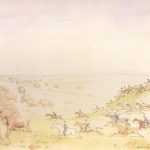
Among the most striking qualities of early ledger drawings is their movement. Horses surge across the page in diagonal sweeps, riders lean forward with spears extended, and the lines of the ruled paper tilt beneath the action like a stage set unfit to hold it. The pages could not contain the momentum of the scenes; artists often let a horse’s head or tail spill beyond the margins, suggesting the wider world just outside the frame.
Three visual habits appear again and again in ledger books from the Dakotas:
- Elongated horses, their legs stretched into straight, parallel lines that emphasize speed rather than anatomical accuracy.
- Compressed detail on clothing and weaponry—beadwork, feathers, pipe axes, and shield designs rendered with patient precision.
- Sparse backgrounds, leaving the white of the paper to stand in for open prairie, snow, or sky.
The physical settings in which these drawings were made varied dramatically. Some were created in quiet winter camps, by firelight, while relatives or friends recounted the day’s stories. Others were made inside military prisons, where drawing became one of the few available means of occupying the mind. A handful emerged from chance encounters—moments when a soldier or trader offered a blank page and asked for “a picture of a fight.” In all these cases, the act of drawing preserved a continuity of visual memory even when the world around the artist was shifting.
Survival and Subversion in the Book of Accounts
One of the most unexpected qualities of ledger art is its relationship to the object it reuses. A page that once tabulated flour, ammunition, tobacco, or cavalry supplies becomes the backdrop for a horse raid or a victory dance. The result carries a quiet irony: the bureaucratic ordering of frontier life is overwritten—literally—by the personal record of someone living outside that system.
This layering creates moments of unplanned poetry. A warrior charging across the page may be galloping over faint numerical columns. A dance circle may appear on top of price lists or shipment tallies. The visual tension between the printed lines and the drawn story gives ledger art a dual energy: it is both spontaneous and constrained, a free-flowing image laid onto a surface designed for measurement and control.
Yet the drawings themselves rarely express bitterness or commentary. They are direct, confident, and often celebratory. The artists used the materials at hand without dwelling on the circumstances that made those materials available. The surprise for modern viewers is how little resentment is visible in the line work. What emerges instead is continuity—the steady hand of someone preserving a cultural practice through whatever medium is present.
Ledger drawings also reflect a meticulous sense of accuracy. A warrior’s clothing, for instance, might feature specific patterns that identify his society or achievements. Certain feather arrangements indicate honors. Painted hoofprints beneath a horse may reference past deeds or spiritual associations. Even when artists adapted to pencil and ink, the logic of hide painting endured.
Some pages depict battles with remarkable clarity:
- Opposing warriors are differentiated through shield designs, hairstyles, or horse markings.
- The direction of movement is indicated by subtle tilt or the flow of a horse’s tail.
- A single spear or rifle may appear in multiple drawings if it played a meaningful role in memory or reputation.
These images are not exaggerations; they are compressed reports of lived experience. To modern eyes, they may appear stylized, but to the artists they were exact, faithful visual statements.
Collections, Misattributions, and Market Value
By the early 20th century, ledger books from the Plains had begun circulating far beyond their original communities. Some were given as gifts, others sold, and still others taken or purchased by travelers, museum curators, or amateur collectors. As a result, many ledger drawings have uncertain origins. Names were lost, dates misremembered, and entire books separated into individual pages and scattered.
This dispersal created a lineage problem. Museums sometimes attributed drawings to the wrong artist or tribe. Collectors misread symbolic details and built speculative narratives around them. A few artists—known by name because they signed or were mentioned in contemporary accounts—became disproportionately famous, while others remained anonymous despite producing equally skilled work.
The market for ledger art grew throughout the mid-20th century, shaped by rarity, condition, and completeness. A full ledger book, intact and coherent, became a prized object. Single pages also gained value, especially if they depicted battles or complex scenes. This market, while expanding awareness of the tradition, led to fragmentation: books were dismantled for sale, and context disappeared.
Still, the drawings themselves retain their authority. Their clarity of line, confidence of gesture, and directness of narrative resist misinterpretation even when attribution is uncertain. They remain some of the most vivid primary sources of life on the Plains during a period when written accounts were often filtered through outsiders.
Three unusual archival stories illustrate the unpredictable journeys of these works:
- A ledger book once used to track steamboat cargo on the Missouri River was later found to contain more than 50 battle scenes by a single hand, all likely drawn during a winter camp.
- A group of pages discovered in a courthouse basement turned out to be the work of a young artist who had traveled with a delegation to Washington, recording the trip in quick, lively sketches.
- A partially burned ledger recovered from an abandoned building near a reservation border contained a mix of dance scenes and hunting episodes, some unfinished, suggesting it had been used intermittently over many seasons.
Ledger art stands today not as a political statement but as a form of biography—personal, precise, and unbroken despite the shifting materials of its era. Its pages, many of them modest in scale, carry the weight of people recording their world with clarity and conviction.
Ghost Dance Imagery and the Art of Mourning
In the late 1880s, a wave of spiritual urgency swept across the Plains, carried not by conquest but by vision. The Ghost Dance—part prophecy, part prayer, part performance—emerged from Nevada and spread eastward like wildfire among tribes desperate for deliverance from disease, displacement, and death. Among the Lakota in South Dakota, it became more than a ritual. It was a response to annihilation, and with it came a distinct visual language: garments, painted objects, and symbolic designs that expressed a yearning for restoration as much as a reckoning with grief.
Aesthetic Grief after Wounded Knee
The massacre at Wounded Knee Creek on December 29, 1890, often marks the end of the Ghost Dance movement in the historical record. In reality, the emotional and visual consequences of that day reverberated for decades. More than 200 Lakota men, women, and children were killed by U.S. troops, many of them wearing Ghost Dance shirts believed to be spiritually protective. These garments, often misunderstood as “bulletproof” in later accounts, were not talismans of magic but deeply symbolic extensions of hope.
The shirts were made from canvas or muslin, sometimes deerskin, and were painted with a distinctive iconography—sunbursts, sacred animals, handprints, crescent moons, and human figures in communion with spirits. Each was unique. These designs were not arbitrary decoration, but visual prayers worn on the body, stitched and daubed with belief. When found on the bodies of the dead at Wounded Knee, they became charged with tragic irony. What had been intended as protection became a shroud.
The creation of Ghost Dance regalia often involved more than one person. Women typically sewed the garments, while designs were dictated by visionary men or spiritual leaders. The act of making the shirt was itself a kind of ritual, filled with specific prohibitions and steps. In many cases, the paint was made from natural pigments mixed with animal fat or plant oils, and it was applied only after days of fasting or preparation. The designs were not mass-produced or ceremonial uniforms. They were singular objects of mourning and resistance, as complex and serious as a Christian altarpiece or a Jewish Torah scroll.
After the massacre, surviving examples of these garments were collected—by soldiers, missionaries, and eventually museum curators. Today, many are held in institutions far from the Plains, sometimes in drawers, sometimes behind glass. In their stillness and silence, they pose difficult questions: Can an object of faith, torn from its purpose, still speak? And if it does, what language does it use?
Three Ghost Dance shirts held in museum collections show the range of their symbolic vocabulary:
- One shirt, collected by an Army officer shortly after Wounded Knee, bears a vivid red sun at the chest and radiating lines that appear to mimic both eagle feathers and lightning.
- Another, preserved in Germany after being traded abroad, features faint blue figures of dancers surrounding a central star.
- A third, returned to the Lakota in a 1990s repatriation effort, contains handprints in black and yellow, spaced rhythmically across the front and shoulders like marks of blessing or touch.
Spirit Figures and Forbidden Designs
Beyond the garments themselves, the Ghost Dance gave rise to a wider visual culture—fleeting, fragile, and largely undocumented. Dancers painted their faces and bodies with symbols received in visions: stripes, circles, stars, and animal forms. These designs were meant to render the dancer visible to the dead and invisible to bullets. They invoked a return to a time before railroads, soldiers, and forced schooling. But because they were drawn on skin and made for momentary use, very few survived. What remains are secondhand descriptions, a handful of photographs, and speculative reconstructions.
Photographs taken by military personnel or ethnographers in the late 19th century occasionally capture dancers, but the context is almost always lost. The movements are frozen, the expressions unreadable. In a few cases, dancers were asked to re-create designs on paper or cloth, but these re-creations often lost their power in translation. The act of painting one’s body was not merely representational—it was performative, ephemeral, and sacred.
Some Ghost Dance symbols filtered into other media. Quillwork patterns, parfleche designs, even winter counts from the 1890s occasionally include ghostly references: dancing figures, concentric circles, or birds in flight. These were not labeled as such, but in context, they suggest the persistence of the Ghost Dance spirit in other forms.
However, in the years immediately following Wounded Knee, many of these designs were suppressed. Drawing or painting Ghost Dance imagery was sometimes treated as subversive by reservation authorities. Mission schools discouraged their use. Some elders cautioned against repeating them, fearing further violence. Yet the impulse to depict visions never disappeared—it simply changed form.
Three lesser-known examples of post-1890 spiritual art include:
- A set of beaded moccasins from the Rosebud Reservation featuring a red-and-white sunburst motif not seen in earlier designs.
- A painted drum head from the early 20th century showing a line of human figures with rays extending from their heads—a visual echo of earlier Ghost Dance symbolism.
- A set of sketches attributed to a prisoner at Fort Sheridan, including a faint drawing of dancers encircling a central star, surrounded by spirit animals.
The Role of Art in Cultural Resilience
Though the Ghost Dance ended in tragedy, the visual traditions it helped catalyze became part of a broader repertoire of survival. The art of mourning in South Dakota did not disappear with the 1890s—it deepened. Throughout the early 20th century, many Lakota artists, both named and anonymous, continued to produce work that carried the emotional weight of the Ghost Dance era, often without naming it.
Grief became a mode of expression, but not a passive one. It was active, constructed, and dignified. Painted shields, for instance, began to feature birds or celestial imagery with a kind of melancholic gravity. Tipi liners were decorated with scenes of ancestors or past migrations. Quilts—an art form adopted from Euro-American styles but reshaped into something deeply personal—became a new canvas for memory and ceremony.
In this period, many artistic decisions became encoded gestures of remembrance. A certain color placement, a repeated pattern, or a silence in the design could communicate as powerfully as any inscription. Art was no longer only celebratory—it was testimonial. It bore witness to what had happened, not in protest, but in continuity.
This thread of visual mourning, begun with the Ghost Dance, would eventually inform the work of later artists across South Dakota. Painters like Arthur Amiotte and beadworkers like Alice Blue Legs drew from this legacy—not directly, but through inherited sensibility. Their works are not reconstructions of the past but continuations of a line that never broke.
The Ghost Dance, as a movement, ended in violence. But its art did not end. It transmuted—into pattern, pigment, rhythm, and silence. And through those forms, it survived.
Prairie Realism and the Frontier Myth
By the early 20th century, South Dakota’s image had been largely fixed in the American imagination: a place of open land, rugged settlers, and stoic endurance. This myth, born from literature and federal land policy, found fertile ground in visual art. Painters, illustrators, and photographers leaned into a style that blended documentation with idealization—a visual realism that both described and helped invent the idea of the frontier. South Dakota became not just a state, but a scene, and its artistic legacy during this period reflects the tension between reality and the story being sold.
Drawing the Homestead
The Homestead Act of 1862 set the stage for a massive influx of settlers to Dakota Territory. By the time South Dakota achieved statehood in 1889, the land had already been surveyed, divided, and imagined as a new American Eden. Artists followed—or in some cases led—the wave of migration. What they produced was not abstract or speculative but grounded, descriptive, and plainly representational: sod houses, team plows, sunrise fields, women at washboards, and children feeding chickens.
This realism served a double purpose. On one hand, it documented a way of life that was physically demanding and often unforgiving. On the other, it contributed to the national narrative of agricultural triumph. Paintings, engravings, and later chromolithographs depicted order carved out of chaos, with neat furrows replacing wild grass and fenced pastures supplanting open range.
Many early depictions of South Dakota homesteading came not from trained artists but from surveyors, soldiers, and settlers themselves. Sketches in field journals, watercolors sent home in letters, and rudimentary oil paintings hung in parlor rooms created a foundation of visual culture rooted in direct experience. These were not masterpieces, but they were earnest, and their blunt honesty shaped the region’s aesthetic from the ground up.
Later, as the state matured, more academically trained artists arrived—often as teachers, journalists, or travelers. They brought with them not just technique, but a point of view: a romantic belief in the moral value of frontier life. Their work smoothed the edges of hardship and emphasized community, resilience, and divine favor.
Some recurring motifs in early prairie realism include:
- Sunset light casting long shadows across wheat fields, symbolizing both the day’s labor and its reward.
- Isolated figures in vast landscapes, reinforcing the theme of individual struggle.
- Weather as drama—a thunderstorm, a blizzard, or even high summer heat rendered with emotional force.
The prairie, once viewed as empty, became a subject worthy of attention in its own right. The color palette of South Dakota art shifted from subdued earth tones to bolder contrasts—deep greens, golden yellows, and bright blues—as artists sought to capture the light and space that defined the region.
Postcards, Panoramas, and the Selling of the West
While painters were developing an aesthetic of the prairie for private viewing, photographers and illustrators were busy turning South Dakota into a product. The era of the postcard and the panoramic photo coincided with the rise of railroad tourism and town promotion. Every new settlement needed a Main Street image, a schoolhouse portrait, a Fourth of July parade documented for the ages. Visual accuracy served boosterism; a wide-angle view of Aberdeen or Mitchell was as much a sales pitch as a record.
The camera, far from being a neutral observer, became an active participant in myth-making. Photographers often staged their scenes: aligning wagons just so, posing livestock in neat rows, instructing children to smile or stand solemnly according to the moment. In towns like Deadwood and Pierre, local studios competed to create the definitive image of civic pride, agricultural abundance, or frontier dignity.
Panoramic photography became particularly popular during county fairs and harvest festivals. Entire communities would line up in front of new courthouses or grain elevators, framed against their own handiwork. These images, often over four feet wide, were mailed to relatives, hung in town halls, and reprinted in regional newspapers. They reinforced a specific identity: productive, peaceful, and proud.
Notably, the landscape itself was rarely shown in its untouched state. Forests, riverbanks, and hills appeared only when they had been transformed—into farms, pastures, or roads. Nature was background, not subject. Even the Black Hills, with their dramatic formations and sacred significance to the Lakota, were more likely to be shown with a lodge, a mine, or a hunting party in the foreground.
Some photographers did attempt to portray the land without embellishment. Solomon D. Butcher, though more active in Nebraska, influenced South Dakota’s visual record through his stark images of sod houses and migrant families. His work, reprinted and circulated widely, set a tone for later regional chroniclers who valued plainness over prettiness.
Meanwhile, tourism companies used imagery of buffalo hunts (real or reenacted), powwows, and “pioneer days” to draw visitors. These scenes, often fabricated or staged, blurred the line between documentation and pageantry. The result was an archive of images that appear factual but are steeped in narrative intent.
Visual Propaganda and Pioneer Identity
As the 20th century progressed, South Dakota’s art began to serve more overtly ideological functions. During state anniversaries, centennial celebrations, and school curricula, certain images were chosen and amplified to promote a coherent identity. Murals in public buildings—often created through federal funding—depicted heroic settlers, benevolent traders, and industrious townsfolk. Indigenous presence, if shown at all, was relegated to a distant past or treated as an exotic subplot.
This narrative art wasn’t sinister, but it was selective. It elevated certain truths while omitting others. The violence of the frontier, the instability of early settlements, and the fragility of crop-based economies rarely appeared on canvas or wall. Instead, viewers saw cleanly dressed pioneers, symmetrical farms, and glowing fields beneath wide Midwestern skies.
In schools and civic buildings, this imagery became canonical. Children drew covered wagons, teachers hung reproductions of Charles Russell and Frederic Remington, and local contests encouraged drawings of “life on the prairie.” These habits built a regional visual vocabulary, one that favored values like self-reliance, cleanliness, and forward motion.
By the 1930s and ’40s, this realism began to mature. South Dakota artists trained at Midwestern colleges brought back a more refined eye, influenced by American Regionalists like Grant Wood and Thomas Hart Benton. They retained the subject matter—farming, harvest, weather, toil—but added complexity, depth, and sometimes critique. While still representational, their work hinted at ambivalence: a recognition that the land was beautiful and hard, generous and demanding.
One painter, scarcely known outside the state, depicted abandoned homesteads in winter twilight—not as ruins, but as memorials. Another drew a series of small-town interiors: pool halls, church basements, and lunch counters, rendered with unflinching detail. These works mark the transition from myth to memory, from celebration to reflection.
The Art of the WPA in Dust Bowl Dakota
In the 1930s, as the Great Depression gripped the nation and dust turned farmland into wasteland, South Dakota’s artists found an unlikely benefactor in the federal government. The Works Progress Administration (WPA), part of President Franklin D. Roosevelt’s New Deal, provided not only jobs but validation. For the first time, painters, sculptors, muralists, and craftworkers in South Dakota were paid to make art—not for the market, not for the church, not for vanity, but for the public.
What they created was neither avant-garde nor purely decorative. It was earnest, accessible, and deeply regional: murals on school walls, sculptures in post offices, painted maps, dioramas, and posters that brought clarity and dignity to lives worn thin by wind and debt. In this crucible, South Dakota’s public art traditions were reborn.
Murals in Courthouses and School Walls
The WPA’s Federal Art Project (FAP) encouraged visual work that was educational, historical, and above all public. In South Dakota, where rural towns were separated by long distances and few cultural institutions existed outside churches and libraries, these projects were revolutionary. A bare school hallway in Gregory might now feature a scene of threshing wheat. A courthouse in Faulkton might display a mural of Dakota Territory settlers arriving by ox cart. The art was there to be seen by everyone—students, farmers, postal workers, judges—and it changed the visual landscape of the state.
One of the leading figures in South Dakota’s WPA mural program was Ada B. Caldwell, a professor at South Dakota State College and mentor to Oscar Howe. Though already well-established by the 1930s, Caldwell embraced the federal projects as a chance to shape young artists and expand art’s role in civic life. She supervised student work and contributed her own murals in a quiet but insistent style: flattened figures, warm tones, and scenes of community labor and rural domesticity.
Another contributor was Robert I. Barr, a Pierre-based artist who painted a series of murals depicting the fur trade, early missions, and the building of railroads. His work avoided sentimentality without denying optimism. In one panel, he showed surveyors using chains and tripods as Dakota men observed from horseback—a moment of transition rendered without editorializing, just observation.
Murals were often designed with input from local residents. Artists interviewed elders, consulted photographs, and even visited homesteads to ensure accuracy in costume, architecture, and landscape. While the style leaned toward realism, it was not academic. These artists worked in situ, on ladders and scaffolds, with limited materials and tight timelines. The results are often uneven in execution but rich in sincerity.
Typical mural subjects included:
- Agricultural scenes, such as plowing, planting, threshing, and canning—emphasizing labor as dignity.
- Historical episodes, like the signing of treaties, wagon trains, or town founding celebrations.
- Allegorical representations, including figures like Justice, Liberty, or Education set against prairie backdrops.
Many of these murals remain today, faded but intact, in post offices, courthouses, and schools across the state. They’re rarely remarked upon, but they represent the first coordinated statewide effort to embed art in public space.
New Deal Aesthetics and Rural Labor
The WPA’s aesthetic ethos was practical, not radical. While some of the movement’s better-known artists—like Jackson Pollock or Mark Rothko—would later break into abstraction and modernism, most of the work produced under New Deal patronage was figurative and grounded in local experience. In South Dakota, this meant depicting farm life with dignity but not embellishment.
Printmakers working under the WPA created bold woodcuts showing wheat harvests, river crossings, and county fairs. Poster artists designed educational materials about soil conservation and crop rotation—many of which were displayed in extension offices and 4-H clubs. Sculptors carved low-relief panels for federal buildings showing blacksmiths, ranchers, and rail workers in profile, their tools rendered with careful fidelity.
In many cases, the WPA’s South Dakota artists were not full-time professionals. They were teachers, sign-painters, hobbyists, or craftspeople who adapted quickly to new roles. They were often paid between $20 and $35 per week—a modest sum, but one that meant survival during years when bank failures and droughts had hollowed out the rural economy.
The art was not romantic, but neither was it bleak. It showed toil, fatigue, endurance. A woman hanging laundry in a windstorm. A man fixing a broken wagon axle. A family eating supper by oil lamp. These were not symbols but scenes—rendered not to decorate, but to affirm.
Three distinct WPA projects in South Dakota combined art and education:
- A series of painted geographic maps that filled classroom walls with topographical information, county lines, and agricultural data—many of which survive today in rural schools.
- A collection of agricultural murals painted for the State Fair in Huron, combining charts, scenes, and slogans in a blend of fine art and visual instruction.
- The creation of museum dioramas in Rapid City and Vermillion, showing prehistoric animals and Native American life with surprising technical skill, blending sculpture, painting, and habitat modeling.
The result was an art movement not born in studios but in barns, basements, classrooms, and civic halls—a populist aesthetic without slogans or manifestos. It simply did the work.
Local Artists on Federal Payrolls
The WPA didn’t just fund artwork; it cultivated a generation of regional artists who might otherwise have abandoned the field. One of the most important figures to emerge from this environment was Oscar Howe, a Yanktonai Dakota artist whose early training was supported in part through WPA-era educational initiatives. Howe would go on to challenge the conventions of Native art across the country—but his roots were in the mural programs and public art efforts of the 1930s and ’40s.
Other artists, like Eleanor Hays and Robert Penn, remained local but left a strong impression on South Dakota’s visual culture. Hays, based in Brookings, painted a series of rural portraits that captured the stoic warmth of aging farmers and their families. Penn, active in Mitchell and Sioux Falls, focused on landscapes—especially winter scenes—painted with a restrained palette and a deliberate hand.
These artists weren’t famous, but they became fixtures in local schools, libraries, and fairs. Their art was part of life, not set apart from it. The idea that a small town might have its own painter, muralist, or sculptor—someone who knew the land and the people—became possible during the WPA years.
By 1943, as wartime needs shifted the country’s focus, the WPA art programs ended. But the legacy remained. A generation had learned that art could be made here, by hand, and that it could serve not just the artist but the town, the classroom, the state.
Oscar Howe and the Fight Against “Studio Style”
The most influential artist to emerge from South Dakota in the 20th century did not merely add to the state’s artistic history—he changed its terms. Oscar Howe (1915–1983), born on the Crow Creek Reservation and raised within the Dakota cultural tradition, spent his career battling artistic pigeonholes imposed from outside. His challenge was not to be accepted as an artist—he already was—but to be accepted on his own terms: as a modernist who refused to be frozen in someone else’s idea of “Indian art.”
Through paint, pedagogy, and public defiance, Howe forced institutions to confront their own limitations. His work, rooted in heritage and shaped by formal innovation, broke from the sentimental clichés of Plains Indian imagery and helped reframe Native American art not as a static relic but as a living, evolving visual language.
The Redefinition of Native Modernism
Howe’s early training followed the path laid out for many Native artists of his generation. He studied at the Santa Fe Indian School, where instructors promoted the so-called “Studio Style”—a formulaic approach to Native painting emphasizing flatness, clear outlines, and culturally “authentic” themes like animals, ceremonies, and community scenes. Though aesthetically cohesive and well-intentioned, the style became a straitjacket. It preserved tradition only by limiting innovation.
From the beginning, Howe bristled at its constraints. His early paintings showed technical fluency, but even then, there was a dynamism that set him apart: motion in the linework, tension in the forms, and a refusal to render cultural identity as a museum display.
Later, after studying at Dakota Wesleyan University and receiving an MFA from the University of Oklahoma, Howe found the tools to break free. Influenced by Cubism, German Expressionism, and Plains abstraction, he developed a distinctive style that fused geometry with emotion. His lines curved and collided; his figures leapt from the canvas. Colors clashed in deliberate dissonance. He invoked Lakota myth and ceremony not as illustration, but as structural force.
In works like Sun Dance, Ghost Dancer, and Paha Sapa, Howe used form to evoke spiritual intensity. Figures were angular, stretched, almost flame-like—suggesting ecstasy, transformation, and ritual. Perspective collapsed, background vanished, and what remained was gesture distilled into symbol.
Key features of Howe’s mature style include:
- Segmented bodies rendered in overlapping planes, evoking both motion and fragmentation.
- Sharp color contrasts—reds and blacks, ochres and whites—used to convey emotional and ceremonial intensity.
- Visual references to Dakota motifs (such as the circle or the four directions) reimagined through abstraction.
This was not a rejection of heritage. It was a reinterpretation—a proof that modernism was not foreign to Native experience, but deeply compatible with it.
Rejection Letters and Institutional Bias
Despite his growing acclaim, Oscar Howe’s career collided repeatedly with institutional gatekeeping. The most public episode came in 1958, when his submission to the Philbrook Museum’s annual Native American painting competition was rejected—not for lack of quality, but for failing to conform to what judges considered “traditional Indian style.” The decision provoked a sharp and now-famous response from Howe, delivered in a letter that circulated far beyond the museum’s walls.
In it, he wrote:
“Are we to be held back forever with one phase of Indian painting, that is the most common way? Are we to be herded like a bunch of sheep, with no right for individualism… Indian art can compete with any art in the world, but not as a suppressed art.”
It was not a plea for inclusion. It was a refusal to comply.
The controversy brought national attention to the quiet policing of Native aesthetics, especially by institutions that claimed to support Indigenous creativity while enforcing narrow definitions of authenticity. Howe’s letter was a turning point. It forced curators, critics, and audiences to reckon with the difference between preservation and confinement.
Following the incident, Philbrook reversed course and changed its criteria. Other museums followed. Howe continued to exhibit widely, receiving solo shows across the country and teaching at the University of South Dakota for over two decades. His influence spread not only through his own work but through his students, many of whom carried his philosophy of independence and rigor into their own practice.
Abstraction, Identity, and the University Circuit
From the 1960s onward, Howe’s role expanded. He was no longer just a painter—he was a cultural figure, a teacher, a public intellectual in the quiet Midwestern sense. He lectured across the country, curated exhibitions, and advised museums on Native representation. But his studio work remained the core of his legacy.
Unlike some contemporaries, Howe never abandoned narrative content. Even at his most abstract, his images retain a sense of presence: a dancer’s leap, a warrior’s motion, a bird in descent. His paintings are not puzzles but condensed stories—moments of intensity rendered in fractured geometry.
His process was deliberate. He often drew dozens of preparatory sketches before committing to a canvas. He read widely, studied both Dakota oral history and European art theory, and approached painting as both ritual and research. In later interviews, he resisted being cast as either a “Native artist” or a “modernist,” insisting on a third space entirely his own.
His teaching, too, defied the era’s stereotypes. At the University of South Dakota, he trained students of all backgrounds in formal technique, visual structure, and artistic discipline. He demanded craftsmanship, but also imagination. For those willing to listen, he offered not just instruction but a worldview: that tradition is not what is repeated, but what is re-expressed.
Three major public collections that preserve Oscar Howe’s work include:
- The South Dakota Art Museum in Brookings, which holds a deep archive of his paintings and sketches.
- The University of South Dakota’s Oscar Howe Gallery, part of the institution where he taught and mentored.
- The Smithsonian’s National Museum of the American Indian, which includes several key pieces in its permanent collection.
By the time of his death in 1983, Howe had won numerous honors, including a Guggenheim Fellowship and participation in international exhibitions. But his deeper accomplishment lies elsewhere: in the way he redrew the map of what Native American art could be—not a style, not a genre, but an evolving language shaped by vision, discipline, and defiance.
The Ghost of Mount Rushmore
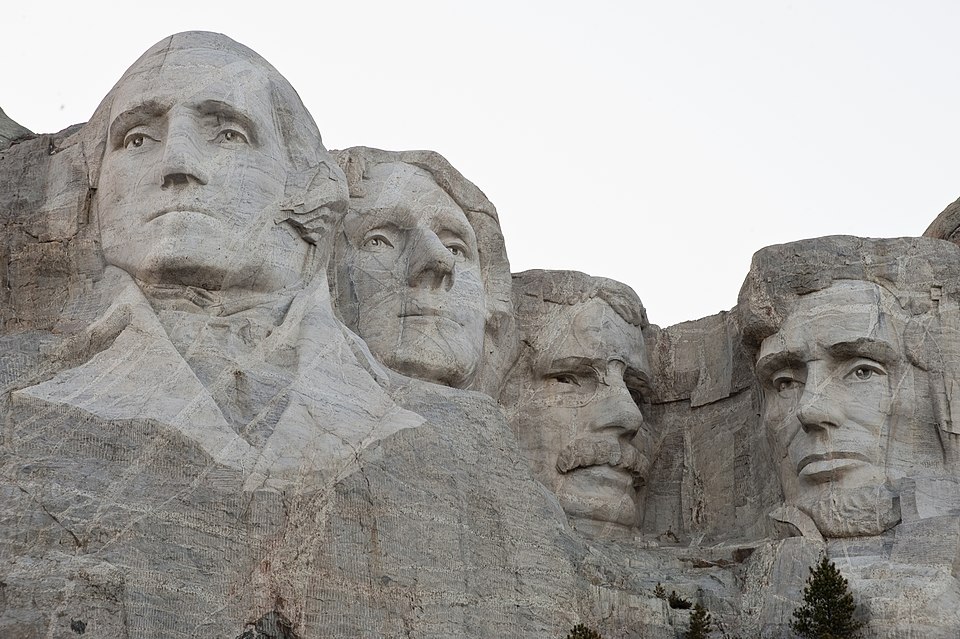
Few works of public art are as instantly recognizable—or as persistently uneasy—as Mount Rushmore. Carved into the granite face of the Black Hills between 1927 and 1941, the monument features the colossal heads of four U.S. presidents: George Washington, Thomas Jefferson, Theodore Roosevelt, and Abraham Lincoln. From its inception, Mount Rushmore was conceived not merely as a sculpture but as a symbolic statement—a project of political messaging, national mythmaking, and aesthetic ambition undertaken with dynamite and drill.
But the monument’s relationship to South Dakota’s artistic history is not a simple story of achievement. Mount Rushmore exists not just as a literal work of art, but as a visual contradiction—a triumph of scale built on contested ground, shaped by a controversial artist, and shadowed ever since by the erasures it embodies.
The Granite Monument as a Political Canvas
The idea for Mount Rushmore began not with Gutzon Borglum, its eventual sculptor, but with South Dakota historian Doane Robinson, who in the early 1920s sought to attract tourism to the Black Hills. His original vision included frontier figures like Buffalo Bill Cody and Lewis and Clark, depicted in a kind of Wild West tableau. It was Borglum who transformed the concept into a national project, arguing for presidents instead of regional heroes. He saw in the cliff face a stage for American destiny, carved into permanence.
Borglum, who had previously worked on the now-abandoned Confederate memorial at Stone Mountain in Georgia, brought with him a belief in monumentalism as moral architecture. For him, art was political, and scale was power. Each head on Mount Rushmore measures about 60 feet tall. The work required blasting thousands of tons of rock, suspending workers on cables over sheer drops, and executing minute facial details from plans that extended over two decades.
Yet Borglum’s artistic vision was never purely about craft. He styled himself as a nationalist, aligning his project with ideals of unity, strength, and continuity. His design choices were shaped less by aesthetics than by ideological symbolism. Washington represented the nation’s founding, Jefferson its expansion, Lincoln its preservation, and Roosevelt its emergence on the world stage. Together, they formed a pantheon—a secular Mount Olympus in South Dakota granite.
For many viewers, particularly those visiting during the postwar decades, the monument succeeded in its aim: it overwhelmed, inspired, and impressed. It made South Dakota into a destination. But for others—especially those who saw the Black Hills not as available space but as sacred ground—Rushmore was never just a sculpture. It was an assertion.
Gutzon Borglum’s Legacy in Stone and Silence
To understand the deeper tensions around Mount Rushmore, one must understand Borglum himself. Born in Idaho to Danish immigrants, Borglum was trained in Paris and influenced by Rodin. He was talented, charismatic, and ambitious. But he was also politically erratic and, in certain moments, overtly aligned with ethno-nationalist sentiments. His brief but documented association with the Ku Klux Klan during the Stone Mountain project has complicated his legacy—though the connection to Rushmore is indirect, it casts a long shadow over his ideological motivations.
In South Dakota, Borglum commanded near-complete control over the project. He selected the site, chose the subjects, managed the staff, and courted donors and political allies. His son Lincoln Borglum completed the work after his death in 1941, just before the United States entered World War II.
Despite the monument’s fame, few visitors pause to consider the aesthetics of the work itself. The faces are rendered with skill, but they lack expressive detail. The eyes are hollowed domes, the mouths fixed and impassive. The monument’s power lies in its mass and permanence, not its intimacy or nuance. It does not invite contemplation—it asserts. It is art not as question but as answer.
From an artistic standpoint, Mount Rushmore is a masterpiece of engineering more than sculpture. Its execution required tremendous ingenuity, including custom tools, novel safety methods, and meticulous geometric scaling. But it also marked the end of a certain kind of ambition: few works since have attempted to use natural geography on such a scale for ideological purposes.
And yet, what the monument shows is only part of the story. What it omits—the people, histories, and claims it leaves unacknowledged—is equally vital. Borglum never addressed the significance of placing this monument in the Black Hills, a region guaranteed to the Lakota in the 1868 Fort Laramie Treaty and later seized after the discovery of gold. The very rock used for the sculpture was, in legal and moral terms, already spoken for.
Three less-discussed facts about Mount Rushmore complicate its legacy:
- The original design included full torsos and inscriptions but was never completed due to funding shortages and Borglum’s death.
- The mountain itself was known to the Lakota as Tȟuŋkášila Šákpe—“The Six Grandfathers”—long before any carving began.
- Several Lakota elders, when interviewed in the 1940s and ’50s, referred to the monument not as offensive, but as irrelevant—describing it as “the white man’s story written on stolen stone.”
Tourism, Spectacle, and Historical Erasure
Since its completion, Mount Rushmore has served as both magnet and mask. It draws over two million visitors a year, generates millions in revenue, and anchors South Dakota’s image in brochures and travel guides. The monument appears on state license plates, postage stamps, and television advertisements. Its presence dominates regional identity in ways that no other artwork does.
But this visibility comes with cost. For decades, the monument’s prominence has effectively narrowed the state’s artistic narrative. South Dakota’s visual history becomes, for many, reduced to four stone faces and the gift shop below them. Meanwhile, the deeper and more diverse traditions—plains abstraction, WPA murals, ledger drawings, and contemporary experimental work—remain marginalized.
In response to this imbalance, Lakota artist Korczak Ziolkowski, who had worked briefly under Borglum, began the Crazy Horse Memorial in 1948—another mountain carving, this one unfinished, depicting the Oglala leader pointing into the distance. Though its scale rivals Rushmore, and its intentions are positioned as corrective, it has generated its own controversies regarding funding, design, and purpose.
Even so, the juxtaposition of the two monuments—Mount Rushmore and the Crazy Horse Memorial—illustrates the ongoing struggle to define whose vision belongs on the landscape. Is the mountain merely a surface for grand national symbols, or is it part of a deeper continuity of meaning that predates sculpture altogether?
In recent years, conversations around Mount Rushmore have intensified, though largely in media and academic circles rather than in South Dakota itself. For many locals, the monument is simply part of the landscape now—an established fact, no more movable than the granite it’s carved from.
But the question remains, floating just behind the granite profiles: what story does this monument tell, and what stories does it silence? In its scale, its ambition, and its omissions, Mount Rushmore stands as South Dakota’s most famous artwork—and its most haunting.
The Black Hills as Contested Canvas
The Black Hills rise from the plains of western South Dakota like a geological rebuttal to everything flat and predictable. Dark with pine and steeped in legend, the region has long served as more than a scenic backdrop—it is a place of convergence, contention, and layered meaning. For artists, the Black Hills are not merely a subject to be painted or photographed. They are a surface already marked, a contested canvas inscribed with spiritual resonance, historical fracture, and aesthetic exploitation.
From sacred site to tourist attraction, the Black Hills have inspired countless images—and just as often, provoked resistance to those images. The artistic history of this region is not only about what was made, but also about what was altered, what was obscured, and what was stolen.
Landscape Painting and Sacred Territory
In the 19th and early 20th centuries, as landscape painting grew in popularity across the United States, the Black Hills became an irresistible motif for regional artists. The combination of rugged rock formations, forested slopes, and open skies provided a dramatic contrast to the surrounding prairie. Painters trained in the European tradition approached the Hills as a wilderness sublime: dark, brooding, and romantic.
Yet from the start, these images carried a contradiction. What artists often depicted as unpeopled nature was, in fact, a deeply inhabited and spiritually charged landscape. For the Lakota and other Plains tribes, the Black Hills—known in Lakota as Pahá Sápa—were the spiritual center of the world, a site for vision quests, prayer, and sacred gathering. To paint the Hills as a virgin wilderness was to participate, even unwittingly, in a kind of visual dispossession.
Painters such as Harvey Dunn, best known for his prairie subjects, occasionally turned his attention to the Black Hills. His canvases, though accomplished, often emphasized rugged beauty without reference to human history—rendering the land in a kind of aesthetic isolation. Others followed suit, producing postcards, calendars, and murals that showed rock formations like the Needles or Bear Butte against sunset skies, stripped of cultural context.
The resulting visual tradition—widely circulated in the early 20th century—presented the Black Hills as scenery, not sovereignty. These images reinforced the idea that the land was there to be admired, visited, and consumed. Even well-intentioned artists contributed to a cultural mythology in which presence became absence: the sacred was seen, but not seen as sacred.
Three recurring motifs in early Black Hills landscape art reveal its selective framing:
- Crescent-shaped valleys used as visual anchors for composition, but never identified as ceremonial sites.
- Eagle flights over cliff tops, symbolizing freedom, but divorced from their place in Lakota cosmology.
- Stormlight on granite formations, emphasizing drama, while erasing human connection to those formations.
Photographers, Miners, and the Stolen View
While painters romanticized the Black Hills, photographers and commercial artists helped commodify them. The discovery of gold in the 1870s, and the subsequent influx of miners and settlers, transformed the region’s visual identity. Suddenly, the Hills were no longer just beautiful—they were profitable. Cameras followed the gold.
Early photography in the Black Hills focused heavily on extraction and expansion. Towns like Lead and Deadwood became subjects of industrial fascination: mines, mills, rail lines, and camps documented in dense, dusty compositions. Photographers like John C. H. Grabill and F. Jay Haynes captured scenes of blasting operations, prospecting groups, and claims being staked—often staged to emphasize optimism and modernity.
Yet even as they documented economic life, these photographers helped construct a new image of the Hills: not sacred, but surveyed; not mysterious, but mapped; not spiritual, but extractive. Landscapes once regarded as places of revelation were now settings for technology and toil.
Some photographers, such as William Henry Jackson, did produce images with greater sensitivity. His early pictures of Bear Butte and Sylvan Lake convey a stillness absent from the industrial work of his peers. But even Jackson’s photographs were used to promote tourism and land speculation.
This visual transition—from prayer to panorama—played out in every medium. Travel brochures in the 1920s described the Black Hills as “America’s Alps,” ignoring their Native significance. Tourist posters featured stylized mountain silhouettes with cowboys and convertibles in the foreground. Art became advertisement. The Hills were no longer depicted for what they meant, but for how they could be used.
Three artifacts from this period exemplify the shift in perspective:
- A colorized postcard of Bear Butte with a handwritten caption calling it “Indian Rock,” a vague term devoid of spiritual meaning.
- A panoramic photo of gold miners at the Homestake Mine, labeled “Progress in the Black Hills,” taken near a former Lakota fasting site.
- A WPA tourism poster promoting the Black Hills as a “playground of the plains,” complete with cabins, trails, and picnic sites—no mention of its contested history.
Environmental Art and Legal Claims
By the late 20th century, a new generation of artists began to reckon with the deeper meanings of the Black Hills—not as tourists or chroniclers, but as commentators. Some Native artists, trained in Western techniques but grounded in tribal identity, began to reassert the sacred geography of the region through sculpture, installation, and site-specific work. These efforts did not restore the land to tribal control, but they reclaimed its symbolic terrain.
Artists like Arthur Amiotte, a Lakota painter and collage artist, invoked the Black Hills in layered compositions that combined family photographs, spiritual imagery, and archival maps. His work, far from nostalgic, suggests a palimpsest of memory and erasure, where stories long buried beneath tourist trails re-emerge in fragment and form.
Others, such as photographer Victor Masayesva Jr., explored the theme of “stolen view”—documenting sacred sites that had been fenced, mined, or domesticated. His photographs challenge the viewer not by condemning the landscape, but by refusing to render it neutral.
Parallel to these artistic efforts, the legal battle over the Black Hills gained momentum. In 1980, the U.S. Supreme Court ruled in United States v. Sioux Nation of Indians that the government had illegally taken the Black Hills and awarded a financial settlement—money the tribes refused, insisting that the land, not compensation, was owed. This refusal became, in effect, a kind of non-monetary artwork: a political gesture shaped by principle and permanence.
Contemporary environmental artists have also engaged the Black Hills as a subject. Installations that highlight deforestation, over-tourism, and sacred site desecration have emerged at festivals and in galleries across the Midwest. These works often use natural materials—pine needles, river stones, elk hide—to emphasize fragility and interconnection.
Three recent projects that challenge dominant portrayals of the Black Hills include:
- A temporary land sculpture outlining tribal treaty boundaries in flour across a Rapid City field, visible only until the wind erased it.
- A photographic series documenting abandoned tourist sites overlaid with archival treaty maps.
- A community mural in Pine Ridge blending spiritual symbols of the Hills with images of protest and resilience.
Together, these works do not seek to restore an imagined past. They confront a present shaped by absence—where the land remains, but the meaning has been displaced. They offer not resolution, but insistence: that the Black Hills are more than backdrop, more than scenery, more than tourist destination. They are still speaking. The question is whether anyone is listening.
The Boom and Bust of Regional Art Markets
Art has always been entangled with commerce, but in South Dakota, that entanglement took on uniquely local forms. The state’s vast geography, sparse population, and deep cultural traditions created an art market defined not by galleries or critics, but by roadside shops, tribal fairs, tourist corridors, and seasonal ebbs. What emerged over the 20th century was a regional economy of aesthetic labor: craft and art woven into daily life, sold for survival, ceremony, or both.
Yet the very features that allowed South Dakota’s regional art markets to flourish—local pride, cultural distinctiveness, handcraft—also made them vulnerable to shifts in taste, policy, and economy. Over time, what was once a robust, if informal, ecosystem of exchange would face pressure from tourist fatigue, mass production, and the ambiguous line between authenticity and demand.
Reservation Craft Economies
By the early 20th century, Indigenous artisans on reservations across South Dakota had developed networks for selling beadwork, quillwork, painted hides, and textiles to non-Native buyers. These transactions weren’t always equitable, but they were widespread—and for many families, they were essential.
Beaded moccasins, cradleboards, pipe bags, and buckskin dresses were created with skill and care, then sold through trading posts, reservation gift shops, or directly to collectors and travelers. The work was labor-intensive, requiring hours of design and stitching. Prices varied wildly. Some items fetched only a few dollars; others, especially older or unusually fine pieces, brought in much more.
This market was shaped by both opportunity and constraint. Government schools and mission programs had often discouraged traditional arts, but families passed down techniques anyway. In some cases, state fairs and exhibitions began offering prizes for “Native crafts,” creating incentives—but also imposing standards that favored tourist-friendly designs over ceremonial ones.
Artisans responded with pragmatic creativity. Some began developing hybrid objects that straddled tradition and market:
- Dance regalia made with commercial beads but traditional patterns.
- Souvenir items—keychains, coin purses, jewelry—adorned with motifs drawn from older forms.
- Miniatures, such as tiny tipis or canoes, crafted for display rather than use.
These craft economies were not static. Artists adapted constantly to materials, trends, and buyers. Plastic beads replaced glass; dyed feathers appeared where eagle feathers were protected; synthetic fabrics stood in for tanned hides. For some purists, this shift represented a decline. For others, it was survival through adaptation.
But even as the art flourished, the infrastructure supporting it was fragile. There were few protections for artists. Buyers sometimes underpaid or misrepresented the work. Trading posts often took large cuts. And while many artisans were women, the names attached to the objects—especially in catalogs or museum records—were often those of male traders or collectors.
Despite these challenges, the reservation craft economy in mid-century South Dakota created a body of work that remains among the most technically refined and culturally resonant ever produced in the state. Much of it still circulates in private collections, antique shops, and museum drawers—some attributed, some anonymous, all shaped by the demands of both heritage and necessity.
Tourist Galleries and the Ethnic Souvenir
As automobile tourism expanded in the 1940s and ’50s, the art market in South Dakota entered a new phase. Roadside galleries, souvenir stands, and curio shops began to spring up along major routes—especially around the Black Hills, Badlands, and reservation boundaries. These shops catered to travelers seeking tangible proof of their “Western” experience: something handmade, something “authentic,” something exotic.
What they found was a curated version of Native and frontier life—both real and imagined. Storefronts featured painted signs with tipi silhouettes, feathered headdresses, or Old West typography. Inside, the offerings ranged from genuine beaded work to mass-produced trinkets made in other states or even overseas.
The market didn’t just grow—it diversified. Artists and entrepreneurs from outside the region moved in, setting up galleries that sold landscape paintings, bronze sculptures, or Western-themed prints alongside locally made items. Some shops specialized in high-end crafts; others trafficked in kitsch. A hierarchy formed, with fine art galleries at the top, roadside stands in the middle, and gas-station souvenirs at the bottom.
For Native artists, this environment was both an opportunity and a trap. The market demanded a particular style—often based on 19th-century stereotypes—and rewarded repetition over innovation. Feathered headdresses, painted warriors, bison, and eagles dominated the merchandise. More nuanced or experimental work was harder to sell.
Artists navigated this landscape in different ways. Some leaned into the imagery, refining it into high-quality decorative art. Others resisted, working in obscurity or turning to teaching. A few attempted to educate buyers—offering stories, context, or explanations—but the structure of the market made this difficult. Tourists wanted souvenirs, not lessons.
Three typical gallery types emerged during the mid-century boom:
- The “Indian arts” store, often reservation-adjacent, offering beadwork, leather goods, and silver jewelry—some authentic, some not.
- The Western fine art gallery, featuring paintings and bronzes of cowboys, cavalry, and mythic plains scenes, often by non-Native artists.
- The general curio shop, blending local crafts with imported items under a single theme of “the Old West.”
By the 1970s, the market had reached its peak. Summer tourism poured dollars into the state, and many families relied on these seasonal economies. But the cracks were already visible: cheap imports, inconsistent quality control, and a growing disconnect between buyer expectation and cultural reality.
Auctions, Authenticity, and Decline
As the 20th century drew to a close, the regional art market in South Dakota began to fracture. One source of pressure was the rise of auction culture, in which Native artworks were sold—often anonymously—at estate sales, antique fairs, or online. This new venue valued rarity and provenance, often rewarding older, undocumented pieces over new, well-made ones. The result was a kind of aesthetic fossilization, where the past was prized and the present ignored.
Meanwhile, questions of authenticity began to dominate the conversation. Federal laws such as the Indian Arts and Crafts Act of 1990 sought to curb fraudulent marketing, requiring that anything sold as “Indian-made” be produced by a recognized tribal member. While the intent was protective, the effect was complex. Some artists lacked the documentation to prove their status. Others found their work scrutinized for tribal “purity,” even if it was rooted in genuine tradition.
At the same time, global trends began to reshape consumer taste. Buyers grew more interested in modern and minimalist art. The elaborate beadwork and detailed quill patterns of South Dakota craftwork began to seem out of sync with gallery fashion. Younger artists, finding few markets for their work, turned to other careers.
This decline was not total. Certain galleries persisted, and some artists adapted. But the old roadside economy—based on the long drive, the impulse purchase, the romance of the plains—was no longer enough. Tourism fluctuated with gas prices and weather. Generational memory faded. The market, once personal and seasonal, became dispersed and digital.
Still, the legacy of this era remains: in shoeboxes and shelves, in family collections, in museum archives, and on the walls of people who bought something once because it felt real. The boom and bust of South Dakota’s regional art markets tells a story not just of commerce, but of value: how it’s made, how it’s lost, and how it might one day be regained.
Contemporary Indigenous Artists and Urban Hybridity
Today’s Indigenous artists in South Dakota work within a vastly different context than their predecessors. They are no longer confined to the visual conventions of ledger drawings, WPA realism, or souvenir craft—nor are they shielded from the pressures of digital media, global art markets, and institutional gatekeeping. What has emerged over the last several decades is a generation of artists who blend traditional forms with contemporary mediums, rooted in place but not restricted by it.
Many of these artists grew up on reservations but live and work in cities—Rapid City, Minneapolis, Santa Fe, even Brooklyn. Their work reflects this duality: not a departure from tradition, but an extension of it into new materials, formats, and audiences. They are painters and printmakers, installation artists and graphic designers, beadworkers and performance artists. And they operate in a creative field shaped as much by memory as by media.
From Pine Ridge to Brooklyn Studios
The movement of Indigenous artists out of rural South Dakota and into urban centers is not simply economic—it is strategic. Cities offer resources, networks, and visibility. Grants, residencies, and museum shows are overwhelmingly concentrated in metropolitan areas. For many artists from the Dakotas, the path forward has required leaving home in order to speak about it.
Yet this movement does not signify abandonment. Artists like Dyani White Hawk, who is Sičháŋǧu Lakota and raised in Minneapolis, have built careers by explicitly bridging two visual worlds. Her large-scale canvases draw from Lakota quillwork and beadwork patterns but are executed in the language of contemporary abstraction: flat color fields, rhythmic geometry, and monumental scale. White Hawk’s work resists the binary between Indigenous and modern. She asserts that the two are not only compatible but historically linked—that Native aesthetics have always been modern.
Similarly, printmaker and digital artist Keith BraveHeart, based in South Dakota, uses his practice to examine education, visual memory, and Lakota cosmology. His works often combine screen printing with found imagery, archival photos, and personal symbolism. BraveHeart is also a teacher, committed to developing young artists within reservation communities—an act of aesthetic continuity as much as pedagogy.
The current generation operates fluidly between tradition and innovation. A beaded medallion might be designed on a tablet. A buffalo skull might be painted with aerosol instead of mineral pigment. A tipi might be constructed in a gallery, not for shelter, but as an installation about absence and inheritance.
Examples of hybrid practice that challenge genre lines:
- A video installation combining hand drum songs with urban street sounds, set against slow-motion footage of powwow dancers in city parks.
- A series of bead-embroidered Nike sneakers that reference both regalia and consumer culture.
- A photographic series showing reservation highways overlaid with star quilts, digitally composited to suggest spiritual infrastructure beneath concrete.
Graffiti, Beadwork, and Global Conversation
For many Indigenous artists, the shift toward hybridity has been not just aesthetic, but communicative. Global Indigenous networks, social media platforms, and digital publishing have allowed Lakota, Dakota, and Nakota artists in South Dakota to engage with peers across the U.S., Canada, New Zealand, and Australia. Themes of land, sovereignty, language, and survival echo across borders.
Graffiti has become a surprising site of artistic expression in urban South Dakota. In Rapid City, alleyways and warehouse walls display works by Indigenous street artists who use spray paint not to mark territory, but to reclaim visibility. Some of these murals feature stylized buffalo, thunderbirds, or phrases in Lakota syllabary. Others depict faces—grandmothers, children, ancestors—rendered with bright color and reverence.
Beadwork, too, has undergone a transformation. Once confined to moccasins and belts, it now appears on skateboards, handbags, and canvas panels. Artists like Monique Renee create portraits composed entirely of seed beads, translating contemporary figures into the pixelated logic of traditional craft.
This crossover into high-concept contemporary art has led to invitations from biennials, universities, and design firms. Yet the language remains local. A painting may hang in Los Angeles, but its geometry traces the constellations visible from the Pine Ridge sky. A sound piece may debut in Berlin, but it carries recordings from a family drum circle in Rosebud.
Three recurring strategies define much of this contemporary work:
- Appropriation in reverse: reworking colonial or Western imagery—maps, portraits, textbooks—through Native visual frameworks.
- Ceremony as performance: adapting rituals for gallery space, often to question the boundary between sacred and staged.
- Language integration: embedding Dakota or Lakota words into visual work, not as translation, but as meaning in its own right.
These artists are not interested in being spokespeople or representatives. They do not illustrate their culture—they extend it.
Language Revitalization and Visual Form
One of the most powerful developments in recent South Dakota art has been the convergence of visual work with language revitalization. For years, Dakota and Lakota languages faced decline, threatened by generational loss and the long shadow of boarding schools. Now, artists are helping to reverse that trend—not through pedagogy, but through image.
Artists are embedding syllables and full sentences into their work. A quillwork panel might incorporate the word woláȟča (truth). A digital collage might feature an old boarding school photograph with hand-written Lakota phrases added in ink. A mural in a reservation school might list colors in both English and Dakota, turning walls into vocabulary tools.
These integrations are not decorative. They reassert the presence of language in space, body, and story. They make the unseen audible. In some cases, artists collaborate with linguists and elders to ensure accuracy and dialect. In others, they take poetic license, using fragments and repetition to evoke sound as structure.
Notable examples include:
- A video piece where each scene corresponds to a verb in Lakota, showing the action without translation.
- A painting series using the four directions—north, south, east, west—as thematic anchors, labeled only in Dakota.
- A textile work combining Morse code and Lakota phrasing, exploring hidden transmission across cultural divides.
This synthesis of language and image deepens the work. It resists reduction and invites active engagement. It asks viewers to pause, to sound out syllables, to wonder. And it frames art not just as expression, but as continuity—of voice, of people, of place.
Museums, Fairs, and the Politics of Display
The way art is displayed often says as much about its audience as it does about the art itself. In South Dakota, where cultural identity has long been shaped by contested histories and complex allegiances, the institutions that house and present visual art—museums, state fairs, cultural centers—occupy a fraught and formative role. These are not neutral spaces. They are arenas of selection, framing, omission, and emphasis, and their choices have defined what kinds of art are seen, preserved, and celebrated.
From the early showcases of settler memorabilia to the development of professionalized art institutions, the history of display in South Dakota reveals a gradual and sometimes uneasy evolution—from possession to presentation, from nostalgia to curation, from myth to multiplicity.
The South Dakota Art Museum and Its Dilemmas
Founded in 1970 and located on the campus of South Dakota State University in Brookings, the South Dakota Art Museum has become the state’s leading institution for collecting and exhibiting both Indigenous and non-Indigenous art. Its collection is broad—spanning paintings, prints, textiles, photographs, and folk objects—but it is best known for its holdings of Oscar Howe’s work, along with other Native artists of the 20th and 21st centuries.
From the start, the museum’s mission was shaped by both aspiration and caution. On one hand, it aimed to become a hub for the visual arts in a state where no major art school or urban arts infrastructure existed. On the other, it inherited a visual culture deeply embedded in romantic frontier imagery and touristic display. The museum had to define art in a landscape where many still considered it a luxury—or a curiosity.
Its most successful exhibitions have leaned into this tension. Shows that place Oscar Howe’s fiercely individualist paintings alongside contemporary Lakota beadwork, for example, or that juxtapose WPA-era paintings of the Dust Bowl with new photographic interpretations of rural decay. In doing so, the museum has positioned itself as a site of continuity—less about creating trends than about recognizing threads.
Still, the museum has faced persistent dilemmas. Chief among them: how to balance the demand for regional representation with the pursuit of critical rigor. Should a museum in Brookings privilege artists from the state, even if their work is uneven? Should it accept every donation of local painting or craft, regardless of merit? What constitutes excellence in a region where formal training and artistic exposure are unevenly distributed?
There is also the matter of tribal sovereignty and museum authority. While the museum has built respectful partnerships with many Native artists and educators, it operates under state and university governance. The deeper question—who has the right to preserve, interpret, and exhibit Indigenous cultural expression—remains unresolved, not just in Brookings, but across all American institutions.
Curation, Community, and Representation
Beyond the formal museum space, South Dakota’s visual culture has been shaped by a web of smaller institutions: tribal colleges, local historical societies, reservation cultural centers, university galleries, and seasonal exhibitions. These venues operate on shoestring budgets but wield outsized influence, often serving as the only contact point between artists and the public.
Curation in these settings is often an act of advocacy. Curators must be part historian, part diplomat, part educator. They work to assemble shows that reflect the lived experience of their communities, even when the available resources are limited. A school hallway might double as a gallery. A library corner might host a beadwork exhibition. A tribal archive might mount a show using laminated reproductions of ledger drawings because the originals are held in a museum hundreds of miles away.
The challenges are considerable. Climate control, security, and storage are minimal. Archival materials are often scattered or uncatalogued. Yet these spaces offer something that larger institutions sometimes lack: direct engagement with artists, families, and elders, and a context in which the work is not exotic but familiar.
Fairs and festivals also play a major curatorial role—if not in a traditional sense, then in terms of public exposure and reception. The annual Sioux Empire Fair in Sioux Falls, the Black Hills Powwow, and numerous tribal arts markets provide artists with platforms that are informal but vital. Here, artwork is judged not by curators, but by peers and passersby. Success depends on craft, resonance, and appeal.
Three kinds of community-based display settings serve as cultural barometers:
- Reservation art fairs, where beadwork, painting, and sculpture are sold and judged within a familiar, often familial context.
- University galleries, which provide professional display opportunities for emerging and mid-career artists from the region.
- Hybrid spaces—such as cafes, tribal council chambers, and health clinics—where art coexists with everyday life and serves both decorative and symbolic roles.
These venues, while often overlooked in art histories, are where many South Dakotans first encounter visual art not as abstraction, but as statement, memory, or challenge.
What Belongs Behind Glass?
The question of display ultimately leads to a more sensitive and philosophical inquiry: what belongs in a case, and what does not? The line between artifact and artwork is not fixed. In South Dakota, where cultural objects are often still in use—ceremonially, communally, or privately—the act of display can risk freezing the living.
Museums and fairs alike have had to wrestle with the ethics of showing sacred or ceremonial items. A pipe bag, for instance, might be a family heirloom, a work of artistic brilliance, and a spiritual tool—all at once. To frame it as “art” is not necessarily wrong, but it is incomplete.
Some institutions have responded with increased consultation. Exhibits are now more likely to be shaped by input from Native artists and elders. Labels explain not just what something is, but how and why it is used. Objects may be rotated or covered periodically, especially during certain seasons or ceremonies. Digital exhibits allow items to be shown in context, without risking damage or desecration.
Still, tensions persist. Repatriation—though supported by federal law—remains slow and uneven. Many objects collected under dubious circumstances remain in university vaults or private collections. Even when returned, the question of where and how to reintroduce them is complex. Art does not simply go home. It must be re-integrated, re-remembered, re-used.
Artists themselves are now leading this conversation. Some create work that responds to museum collections—questioning how items were taken, interpreted, or altered. Others refuse to participate in institutional exhibitions altogether, preferring to exhibit within their own communities, or through digital platforms they control.
One recent project featured photographs of museum-held artifacts—taken without flash or manipulation—and displayed alongside contemporary objects made in response. The result was a visual dialogue between what has been kept and what has been continued.
In South Dakota, display is not just a technical matter. It is an act of translation—between time periods, between cultures, between meanings. Every choice—a title, a wall text, a mounting—shapes how a viewer understands what they see. And in a place where so much has been misinterpreted, mistranslated, or misunderstood, the politics of display are not peripheral. They are central.
New Generations: Teaching, Technology, and the Future
The history of art in South Dakota does not end with museums, murals, or monuments. It continues—restlessly, unevenly, and sometimes quietly—in classrooms, studio basements, digital workshops, and mobile homes. Here, far from the institutions and headlines, a new generation of artists is learning not only how to make, but how to live as artists in a landscape that offers beauty, challenge, and contradiction in equal measure.
Their future is uncertain, but their direction is unmistakable: toward a form of art that is local without being provincial, digital without being detached, and rooted in memory without being burdened by nostalgia. They work with new tools and old symbols, under sparse funding but rich instruction, in physical isolation but with unprecedented connectivity.
Art Education Across a Sparse Landscape
Training the next generation of South Dakota artists begins with geography. The state’s vast distances, small towns, and low population density make access to formal art education difficult. Many rural high schools offer little beyond basic instruction; art teachers often juggle multiple roles, with minimal budgets for materials or exhibitions.
Yet these limitations also foster ingenuity and resilience. Young artists frequently develop strong skills through independent work—sketching, beading, woodworking, or digital design—before they ever encounter a structured program. Regional colleges such as South Dakota State University, the University of South Dakota, and Black Hills State University have become critical hubs, offering degree programs, mentorship, and exposure to broader artistic conversations.
The role of tribal colleges in this ecosystem is essential. Institutions like Oglala Lakota College, Sinte Gleska University, and Sisseton Wahpeton College provide culturally grounded curricula that emphasize both traditional techniques and contemporary creativity. These programs often involve elders, language instructors, and community historians, integrating cultural continuity with technical instruction.
Still, the challenges remain steep. Talented students often face economic pressure to pursue more “practical” careers. Others lack transportation, internet access, or support networks. Art education in South Dakota is not just about teaching technique—it is about carving space for the idea that making art is a valid, even vital, way to live.
Some efforts have emerged to bridge the gap:
- Summer art camps on reservations, where youth learn from local artists in a communal setting.
- Artist-in-residence programs that bring working artists into K–12 schools, exposing students to creative careers.
- Scholarship networks that support Native students pursuing art degrees in and out of state.
These are not large-scale solutions, but they are seeds—and in South Dakota, seeds know how to grow in unlikely soil.
Digital Platforms and Remote Collaboration
Where the physical distances of South Dakota once limited artistic connection, the internet has opened new frontiers. Young artists are now building careers without needing to relocate or wait for local recognition. Through social media, e-commerce, video conferencing, and online exhibitions, they can share work, collaborate, and sell to audiences far beyond the state line.
Instagram has become a primary portfolio space. TikTok and YouTube offer process videos, tutorials, and time-lapse insights. Etsy and Shopify allow for direct sales of beadwork, prints, and sculpture. These platforms give emerging artists something they rarely had before: agency over distribution and pricing.
More importantly, the internet has created spaces for collective learning. Artists who might be the only painter in their town now have access to lectures, critiques, and peer groups. Online workshops, artist talks, and critique sessions connect artists from Rapid City to Minneapolis, from Pine Ridge to Santa Fe.
Remote collaboration has also flourished. South Dakota artists are co-authoring zines, editing digital journals, creating shared Spotify playlists to accompany visual works, and participating in Zoom-based exhibitions. These practices are reshaping what counts as “artmaking”—from solitary mastery to distributed creativity.
Three notable examples of digital innovation from South Dakota artists:
- A virtual reality installation that recreates Lakota star knowledge using immersive celestial mapping.
- A collaborative TikTok series blending Dakota language lessons with animation and painting.
- An online beadwork archive, curated by young artists, that documents and tags regional variations of traditional designs for educational use.
Digital tools do not erase material traditions. On the contrary, they allow artists to preserve, reinterpret, and reintroduce tactile forms into new formats. A pair of moccasins, photographed and 3D-scanned, becomes both artifact and curriculum. A hand-drawn ledger image, digitally animated, becomes a short film viewed around the world.
Who Will Stay, and What Will They Build?
For all the innovation, one question haunts the future of art in South Dakota: who will stay? The state’s best-known artists, historically, have often left—drawn to centers of art education, commerce, and influence. Many still do. The infrastructure for a full-time art career in-state remains slim. Public arts funding is limited. Opportunities for gallery representation are sparse. The burden of cultural expectation—for Native and non-Native artists alike—can be heavy.
Yet something is shifting. A growing number of young artists are choosing to remain—or to return. They do so not out of nostalgia, but out of conviction: that art made here matters, and that presence is itself a form of contribution. These artists are not waiting for institutions to appear. They are building their own: pop-up shows in barns and garages, co-ops in church basements, online galleries hosted on personal sites, murals painted on water towers and grain silos.
They’re also reshaping what artistic success looks like. For some, it means local teaching. For others, it’s running a small beadwork business that supports a family. For others still, it means making art that doesn’t need to leave—work that stays embedded in community, ceremony, and kinship, where meaning doesn’t depend on recognition.
This generation isn’t chasing the center. It’s redrawing the map.
Three signs of artistic resurgence grounded in place:
- A new artist-run print shop on the Cheyenne River Reservation, offering workshops and custom design services.
- A mobile art van that brings supplies and exhibitions to rural schools, complete with a collapsible gallery wall.
- A public art project in Vermillion in which high school students paint storm drains with images from Dakota cosmology and water stories.
If the past century of South Dakota’s art history has been shaped by movement—across land, across traditions, across markets—the next may be shaped by stillness: staying put, digging in, re-rooting. The future of art in South Dakota will not be determined by trends from New York or Berlin. It will be determined by how many young artists decide that this place, with all its tension and beauty, is enough.
And if they do—if they stay, and build, and teach, and make—then the next chapter of South Dakota’s art history may be its most important yet.