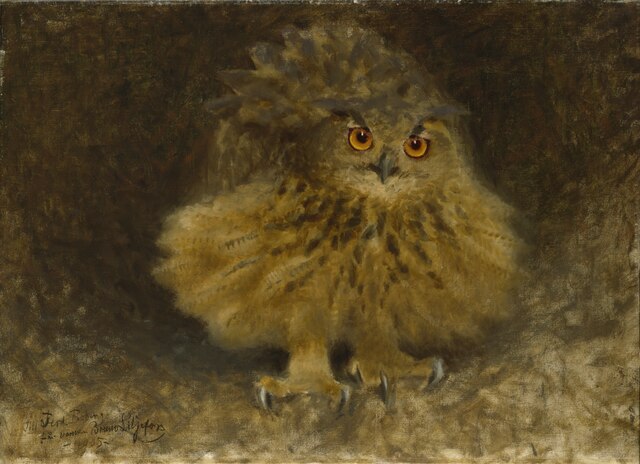
The owl’s place in Western art begins with the ancient Greeks, who tied the bird directly to Athena, the goddess of wisdom and steady judgment. Greek coins from the fifth century BC often show her owl with clear, watchful eyes, a reminder that learning and thoughtful action were central virtues of the city. Artists carved owls into pottery, painted them on household items, and placed them near figures of scholars or guardians. These early images gave the owl its lasting reputation for clear sight and calm thought. Even after the fall of the ancient world, that association lingered in the minds of artists who admired the old civilizations.
What made the owl so appealing to classical artists was its quiet presence. The bird sees in the dark, moves without stirring the air, and watches before acting. These traits fit perfectly with the ancient idea that wisdom is not loud or showy but measured and enduring. When later cultures looked back to the Greeks for inspiration, they revived these calm and thoughtful qualities.
Medieval Views
Medieval art, however, gave the owl a more complicated identity. On one hand, its connection to ancient learning still survived in a faint way. On the other, the owl’s nighttime habits made it seem to some medieval writers like a creature tied to confusion or spiritual blindness. In certain manuscripts, you see owls perched in the shadows while brighter birds flock toward the light. These scenes were moral lessons, reminding the viewer to seek clarity rather than stumble through life without direction.
Yet even with these cautionary uses, medieval artists often showed genuine curiosity about the owl’s appearance. Carvers placed owls on choir stalls, manuscript illuminators drew them with real care, and metalworkers included them in household objects. The mixture of respect and warning gave the bird a stronger presence in medieval art than many people realize today. It was a creature that encouraged reflection, whether positive or negative.
The Renaissance Shift
Humanist scholars of the Renaissance brought the owl back to its classical roots. As artists rediscovered ancient texts, Athena’s owl returned as a steady emblem of learning and discipline. Painters placed owls in the studies of scholars, near shelves of books, or beside instruments of measurement. The bird became a companion to clear thinking in a world newly committed to careful study and revived tradition.
Renaissance artists also began to observe nature more closely, giving owls greater detail and accuracy. With sharper anatomy and richer texture, the owl gained dignity again. It was no longer a creature of warning, but a calm witness to human thought. Artists liked the contrast between the warm glow of lamplight and the owl’s pale, alert face, which made the bird a natural fit for quiet interiors and scenes of contemplation.
Romantic Interpretations
By the 1800s, the owl entered the world of Romantic painting, where mood and emotion shaped the scene. Artists used the owl’s soft feathers and steady gaze to heighten the feeling of evening or early nightfall. In some works, the owl watches from a branch as the landscape sinks into silence. In others, it glides across a moonlit sky, giving the scene a hint of mystery and depth.
While Romantic artists loved atmosphere, they still respected the owl’s connection to insight and careful observation. The bird often appears in paintings that carry a reflective tone, as if the owl is considering the world in the same quiet way the viewer is meant to. Artists of this era appreciated the owl’s ability to suggest both calm and hidden meaning.
Decorative Uses
In the decorative arts, the owl became a favorite subject for bookplates, prints, household items, and small carvings. People placed it on writing desks, library furnishings, and study walls to symbolize learning and steadiness. Its round eyes and clear silhouette made it well suited for metalwork, ceramics, and engraved designs. Even when simplified, the owl carried its old heritage with it.
By the early 1900s, the owl even made an appearance in Art Nouveau decoration, where its soft curves and graceful posture fit easily into the style’s flowing lines. Whether carved into a wooden frame or printed on a small piece of stationery, the owl brought a sense of quiet intelligence into the home.