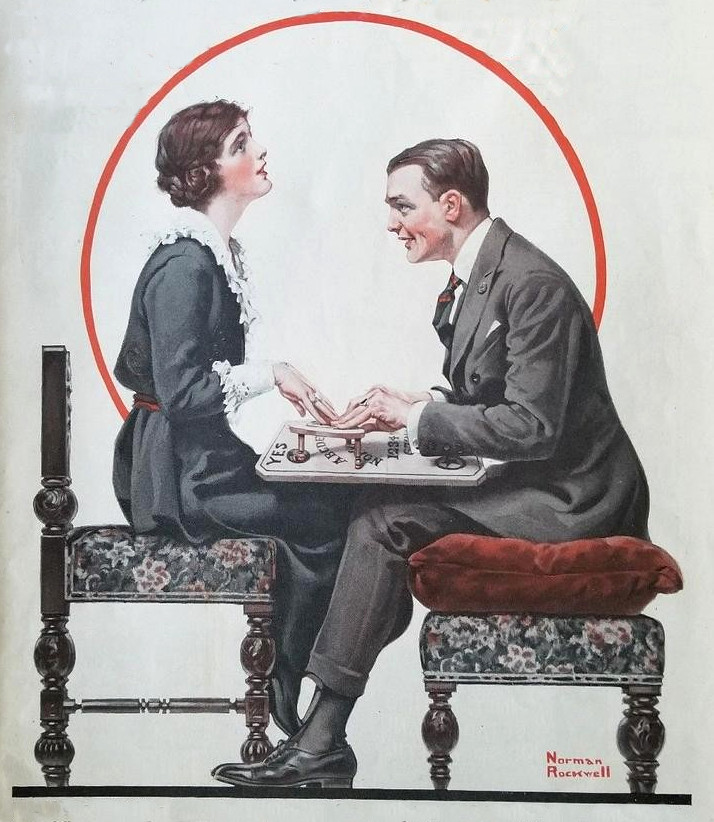
The Ouija board has long occupied a space between the spiritual and the visual. While most people associate it with séances, parlor games, or horror movies, its lasting power lies just as much in its design as in its legend. Since its commercial release in 1890, the board has remained an iconic object of popular visual culture—instantly recognizable, deeply symbolic, and carefully crafted to evoke both mystery and beauty. Behind every letter, symbol, and curve is a story of aesthetic intention, cultural mood, and artistic influence.
Whether rendered in ornate Victorian script or in glowing modern plastic, the board’s layout hasn’t changed much over 130 years. Yet each version reflects the era in which it was produced, capturing shifts in typography, occult fashion, commercial printing, and social expectations. The simplicity of its form—a flat board, a set of letters and numbers, the words “Yes,” “No,” and “Goodbye”—belies the graphic precision and symbolic language behind it. In short, the Ouija board isn’t just a spiritual device. It’s a visual artifact that reveals the artistic undercurrents of the society that made it.
Artifacts of Belief and Aesthetics
The goal of this article is to trace the visual and cultural history of the Ouija board through the lens of art and design. By understanding how its aesthetic has evolved—from 19th-century Gothic revival motifs to psychedelic rebrands in the 1970s and minimalist reinterpretations in the 21st—we can see how it operates as more than just a game. It becomes a designed ritual object, deliberately created to conjure a mood and guide an experience. This history connects artistic movements, spiritual beliefs, mass-market trends, and even political shifts—all through a single object’s evolving appearance.
Spiritualism and the Rise of Automatic Communication
To understand the visual roots of the Ouija board, we have to go back to the spiritualist movement of the mid-1800s. Spiritualism—rooted in the belief that the dead could communicate with the living—gained traction in the United States and Europe starting in the 1840s. This wasn’t fringe mysticism; it was a mass movement that counted Mary Todd Lincoln and Sir Arthur Conan Doyle among its followers. Spiritualism gave rise to a unique set of visual practices, from elaborate séance room decor to symbolic paintings and spirit photography. These environments were rich in sensory detail, often using velvet curtains, candlelight, and ornate furnishings to heighten the sense of crossing into another world.
One of the key techniques used by mediums during séances was automatic writing—a method in which the hand moved seemingly without conscious control, believed to be guided by spirits. This practice soon gave rise to automatic drawing, where art was produced by the same means. Artists like Georgiana Houghton in England and Victorien Sardou in France produced highly detailed, colorful drawings that they claimed were dictated by spirits. These works, filled with swirls, symbols, and layered colors, prefigured modern abstraction and played a foundational role in the link between spirituality and artistic expression.
Writing with Spirits, Drawing with Symbols
These automatic practices paved the way for alphabet boards—precursors to the modern Ouija—which allowed users to spell out messages letter by letter. Before the commercial version existed, people created their own spirit boards with hand-drawn letters and pointers, often decorated with stars, crosses, or religious symbols. These early examples reflect the handmade, devotional quality of spiritualist art. They weren’t just communication tools—they were objects of belief, created with artistic care to invoke a sacred or mystical energy. These roots would shape the look and feel of the first mass-produced boards that followed.
The Birth of the Commercial Ouija Board
The first commercial Ouija board was patented in 1890 by Elijah Bond, a Baltimore attorney. Its production was handled by the Kennard Novelty Company, which aimed to capitalize on the public’s fascination with spirit communication. The original board design was relatively simple, but even in its earliest form, it showed a keen visual sensibility. The layout was elegant, symmetrical, and highly readable. It featured the full Roman alphabet, the numbers 0–9, and the words “Yes,” “No,” and “Goodbye,” arranged in a balanced arc. It also included celestial imagery, like crescent moons and stars, to evoke the metaphysical realm.
By 1892, William Fuld had taken over production and quickly became the face of the Ouija board’s development. Fuld didn’t just manufacture the board—he refined its aesthetic, giving it a more polished, professional look. Under his leadership, the board gained features that mirrored the Art Nouveau movement, which emphasized flowing lines, organic shapes, and a return to classical beauty. Fuld’s 1898 design introduced bolder typography, deeper engraving, and sharper lines, creating a balance between functional clarity and mystical appeal.
Aesthetic Intent in a Mass-Market Object
These early boards were built to be both usable and enchanting. Fuld understood that design wasn’t just about legibility—it was about emotion. The typefaces were carefully chosen to feel old-world yet legible, and the planchette—a teardrop-shaped pointer with a glass window—was designed to hover lightly over the board, like a spirit itself. Fuld even claimed the Ouija board had named itself, giving the illusion that the object possessed inherent mystery. Though it was mass-produced, the board’s look was anything but generic. It was tailored to evoke awe and suggest that it had a life beyond the factory.
Typography and Design as Communication with the Beyond
The typography of the Ouija board plays a critical role in its function and its psychological impact. Most boards use serif fonts that resemble 19th-century printing styles, reminiscent of antique books or gravestones. These fonts feel archaic but legible, connecting the user to a sense of historical authority. The arched arrangement of the alphabet, often mirrored with numerical lines beneath, creates a sense of structure and completeness. Nothing about the board’s layout is random—every element is placed to guide the eye and to reinforce its mystical legitimacy.
The other major visual elements—the “Yes” and “No” in the corners, the “Goodbye” at the base, and the presence of the sun and moon—each play symbolic roles. “Yes” and “No” give the board a binary authority, making it feel almost judicial, while “Goodbye” suggests closure or ritual. The sun and moon aren’t just decorative; they reference celestial cycles and spiritual dualities, implying that the board bridges night and day, light and shadow, life and death. In design terms, they balance the board visually while adding an emotional weight.
Form Follows Function (and Mystery)
Even the spacing on the board matters. A well-designed Ouija board has wide kerning between letters to allow the planchette to glide smoothly. It also uses a symmetrical frame to center the user’s focus and reduce visual noise. Over time, boards have experimented with Gothic fonts, stylized flames, glowing ink, and embossed symbols, but the core layout remains unchanged. This consistency speaks to the power of the original design, which functions as both a tool and a talisman. The typography and symbols do more than display language—they create atmosphere, guiding users into the right emotional state to believe.
Occult Revival and the Board in Modern Art
While the Ouija board has always existed at the fringes of belief, it began to make its way into the art world during the early 20th-century occult revival. Artists associated with Dada and Surrealism, such as André Breton, Joan Miró, and Max Ernst, were fascinated by automatism—the idea of creating art without conscious control. This was directly inspired by the techniques of mediums and spiritualists from earlier decades. Instead of contacting the dead, these artists used similar methods to contact their own subconscious, producing wildly imaginative works filled with dream logic and symbolic forms.
One of the most striking examples of spiritualist-inspired art is Hilma af Klint, a Swedish painter who began producing abstract, symbolic paintings as early as 1906—predating Kandinsky. She believed she was guided by spirits and saw her work as mystical diagrams representing deeper truths. Her aesthetic included geometric forms, color symbolism, and script-like markings that echoed the design logic of the Ouija board. Though largely unknown during her lifetime, af Klint is now considered a pioneer of abstract art, and her work demonstrates the deep connections between spiritual belief and visual language.
From Parlor Tool to Artistic Symbol
Contemporary artists have continued this exploration. Multimedia artist Tony Oursler has used the Ouija board in installations critiquing technology and belief, while conceptual artist Mark Dion has referenced it in displays exploring the boundaries of science and superstition. The board’s symmetrical layout and recognizable iconography make it an ideal visual reference point—it instantly evokes the uncanny. Whether used literally or metaphorically, the Ouija board has become a symbol of intuition, fear, and hidden knowledge, capable of carrying deep emotional and cultural weight in fine art settings.
Pop Culture, Horror, and Kitsch
By the mid-20th century, the Ouija board was no longer just a spiritualist tool or artistic curiosity—it had become a mainstream toy. In 1966, the board was purchased by Parker Brothers, who mass-marketed it alongside games like Monopoly and Clue. This shift transformed its visual presentation. Boards from this era featured slicker, more modern fonts, brighter colors, and even packaging that showed smiling teens using the board at slumber parties. The aesthetic became less about mystery and more about accessibility, but the design still retained enough of its symbolic language to maintain a sense of the supernatural.
However, the board’s popularity as a harmless game was short-lived. The 1973 horror classic The Exorcist changed everything. In the film, young Regan begins her descent into possession after using a Ouija board alone, which introduces the notion that the board is inherently dangerous. This sparked a cultural backlash that ironically boosted the board’s image as a tool of real power. In response, manufacturers leaned into this darker aesthetic. Ouija board designs from the 1970s and 1980s began using Gothic fonts, rich blacks and purples, and heavy framing to make the board look more sinister and dramatic.
The Board as Visual Icon in Mass Culture
By the 1990s and 2000s, the Ouija board had crossed fully into pop iconography. It appeared on t-shirts, Halloween decorations, and album covers. Musicians and artists like Nirvana and Marilyn Manson referenced it for its countercultural symbolism, while films like Paranormal Activity (2007) revived its association with terror. New editions of the board included glow-in-the-dark designs, digital versions, and even themed editions like “Stranger Things” or “Hello Kitty.” Visually, it became a versatile symbol—able to shift between goth, camp, vintage, and kitsch depending on the context. What once was a sacred tool had now become an endlessly adaptable graphic motif.
The Ouija Board in Contemporary Art and Design
In recent years, the Ouija board has found new life in the world of contemporary art, indie design, and identity politics. Independent artists have created hand-painted boards with feminist slogans, queer symbolism, or minimalist Nordic aesthetics. Etsy is full of customized spirit boards made from wood, resin, or metal, often emphasizing craftsmanship and artistry over spiritual use. These boards serve less as tools of divination and more as personal altars or decor items—artifacts of style and belief that reflect the user’s identity and values. In these forms, the board becomes not just a communication tool, but a statement piece.
In the fine art world, artists continue to explore the symbolic power of the Ouija board. Exhibits have featured oversized installations of boards, embroidered planchettes, or sculptural reinterpretations. Artists like Sally Mann and Ann Hamilton have drawn inspiration from the themes of communication, loss, and the unseen—echoes of the board’s cultural role. In zines, tarot decks, and graphic novels, the board’s clean structure and symmetrical type layout lend themselves to strong visual impact, and its symbolic association with the beyond gives it emotional resonance even when used ironically or playfully.
Reclaiming the Mystical Aesthetic
One major trend is the reclamation of occult aesthetics by marginalized artists and communities. The visual language of the Ouija board—long associated with forbidden knowledge—is now used to explore themes of empowerment, identity, and resistance. For example, artists have created spirit boards featuring phrases like “Ask Your Ancestors” or “Speak Truth,” positioning the board as a symbol of intergenerational wisdom rather than danger. These updated designs often use pastel palettes, bold modern fonts, or hand-lettered styles, shifting the board’s energy from fear to affirmation. It’s a reinvention of the board’s message through a new visual lens.
Symbolism, Superstition, and the Semiotics of the Ouija
The enduring appeal of the Ouija board lies not only in its visual design but also in its semiotic richness. Every symbol—whether a crescent moon, the word “Goodbye,” or the very shape of the planchette—carries layers of meaning. The planchette, for example, is often shaped like a teardrop, heart, or eye, symbolizing intimacy, vulnerability, and revelation. Its small lens, through which letters are revealed, gives it the feel of a magnifying glass or psychic window, reinforcing the idea that hidden knowledge is being revealed. These subtle design elements deepen the user’s emotional and psychological experience.
The board’s fundamental structure—letters, numbers, yes/no responses—is minimal, yet its symmetry and layout are loaded with ritual power. The arc of the alphabet mimics the idea of a sacred circle, while the placement of the sun and moon often mirrors religious or cosmological diagrams. In many designs, these symbols act as guardians of the threshold, watching over the communication. The board’s ability to carry meaning comes from its consistency over time—users recognize it instantly, and that recognition brings an intuitive sense of both reverence and anxiety. It’s not just a toy or tool—it’s a cultural sigil.
A Designed Object of Cultural Memory
Ultimately, the Ouija board’s design communicates not just with spirits, but with human memory. Its visual language reminds users of everything from Victorian séances to horror films, pop music to protest art. The fact that it has remained mostly unchanged in form for over a century is a testament to the power of its design. That it still appears in new cultural settings—in galleries, games, fashion, and installations—shows its continued relevance as a designed object. It holds a mirror to our collective fears, fascinations, and aesthetic shifts—proof that visual art doesn’t need to be in a museum to carry meaning.
Key Takeaways
- The Ouija board originated in 1890 and reflects spiritualist art and design trends from its earliest days.
- Its visual elements—fonts, layout, symbols—are deeply intentional and have barely changed over time.
- Artists from Hilma af Klint to contemporary designers have drawn inspiration from its mystical aesthetics.
- The board has been rebranded across decades, reflecting cultural attitudes through typography and imagery.
- In modern art and design, it functions as both a spiritual tool and a cultural symbol of hidden knowledge.
Frequently Asked Questions
- When was the first Ouija board made?
It was patented in 1890 by Elijah Bond and first sold by the Kennard Novelty Company. - Who designed the Ouija board’s layout?
William Fuld standardized the board’s iconic design starting in the 1890s. - Why are sun and moon symbols used on Ouija boards?
They represent cosmic balance and lend spiritual authority to the board’s design. - Did artists really use spiritualist techniques?
Yes—automatic writing and trance drawing were used by spiritualists and inspired early modern art. - Is the Ouija board still used in contemporary art?
Absolutely—many artists and designers reinterpret it as a visual symbol of belief, fear, and identity.