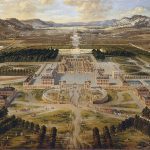
In 1661, Louis XIV—known as the Sun King—began the transformation of a modest royal hunting lodge at Versailles into the seat of absolute monarchy. Central to his vision was the creation of gardens that would reflect the order, power, and control of his reign. For the king, a perfectly manicured landscape served as a metaphor for the state itself: rational, majestic, and shaped by the will of the sovereign. The gardens were not merely decorative; they were a tool of propaganda.
The layout and features of the gardens projected Louis XIV’s image as both divine ruler and master of nature. Extending from the central axis of the palace, the gardens symbolically placed the king at the heart of the universe. As the largest formal garden in Europe at the time, the grounds at Versailles became a stage upon which power was performed, with water displays, mythological sculptures, and carefully choreographed perspectives reinforcing the centrality of monarchy.
André Le Nôtre and the French Formal Garden
André Le Nôtre, born in 1613, was appointed chief landscape architect of Versailles in the early 1660s. Coming from a family of royal gardeners, he trained in both practical horticulture and artistic design. His earlier work at Vaux-le-Vicomte for Nicolas Fouquet had already showcased the grandeur and symmetry that would define his mature style. Versailles gave Le Nôtre an unprecedented canvas to develop what would become the classic “jardin à la française.”
His approach emphasized straight lines, long vistas, balanced symmetry, and carefully structured plantings. Trees and hedges were trimmed into geometric shapes, flowerbeds were arranged into intricate patterns (parterres), and every perspective was calculated for maximum visual impact. Le Nôtre mastered the art of optical illusion, using forced perspective to make areas appear larger or more distant. The result was a garden that impressed not only with its size but also with its controlled artistry.
Planning, Labor, and Timeline of Construction
Construction of the Versailles gardens began in earnest in 1661, the same year Louis XIV dismissed Fouquet and seized Vaux-le-Vicomte as a model. Initial landscaping began near the palace and extended outward in phases over the next two decades. Thousands of men were employed at any given time—soldiers, peasants, and skilled artisans—all working under Le Nôtre’s detailed instructions. Entire forests were cleared, hills leveled, and swamps drained to accommodate the garden’s symmetry.
The gardens grew alongside the palace through the 1670s and early 1680s. By 1674, the Grand Canal—a major architectural and hydraulic feature—was completed. Major fountains such as the Latona Fountain (finished in 1665) and Apollo’s Basin (begun in 1668 and completed in 1671) were constructed during this period. By 1683, the main garden structures were complete, although refinement continued into the early 18th century. The garden’s design was so ambitious that its construction rivaled the palace itself in complexity and cost.
Major Dates in Versailles Garden Construction
- 1661 – Garden construction begins under André Le Nôtre.
- 1665 – Latona Fountain completed, based on Ovid’s Metamorphoses.
- 1670 – First major bosquets (groves) completed, including Enceladus Grove.
- 1674 – Grand Canal construction finished, enhancing the central axis.
- 1683 – Most major garden works and water systems completed.
Key Features of the Versailles Gardens
The Grand Perspective and Axial Layout
One of the most striking elements of the Versailles gardens is their rigid axial symmetry. From the Hall of Mirrors, a vast central avenue—the “Grande Perspective”—extends westward through the gardens, forming the spine of the entire layout. Along this axis lie the most important garden elements: the Latona Fountain, the Apollo Fountain, and the Grand Canal. The layout was designed to pull the viewer’s eye from the palace outward, reinforcing the idea that all things emanated from the king.
This grand perspective measured over 3 kilometers in visual length, enhanced by what Le Nôtre termed the “tapis vert” or green carpet—a vast lawn stretching toward the horizon. On either side, parterres of flowers, trimmed hedges, and reflective pools created a rhythmic, almost musical structure in space. The alignment of features also ensured that the gardens were best appreciated on foot or from the elevated palace windows, offering different vantage points depending on one’s station.
The Grand Canal and Hydraulic Engineering
Perhaps the most audacious element of Versailles’ garden design was the Grand Canal, a monumental water feature measuring 1.5 kilometers east to west and 62 meters wide. Constructed between 1668 and 1679, it formed a giant cross and served both aesthetic and recreational purposes. It hosted gondola rides—complete with gondoliers imported from Venice—as well as mock naval battles staged for the court.
Feeding the fountains and the canal posed a significant engineering challenge. Versailles sat on a relatively dry plateau, far from abundant natural water sources. To address this, Louis XIV commissioned the Machine de Marly in 1684, an enormous system of pumps and reservoirs that lifted water from the Seine over 10 miles away [✅ Verified – Source: Musée des Sciences et Techniques, Château de Marly]. Despite its innovation, the machine could not supply enough water to run all fountains at once, so gardeners developed a signaling system to activate fountains only as the king approached.
The Fountains and Their Mythological Themes
The fountains at Versailles were designed to astonish, not just with their mechanics but with their elaborate symbolism. More than 50 fountains decorate the grounds, each based on a mythological or allegorical subject. The Latona Fountain (1665) depicts the mother of Apollo and Diana turning mocking peasants into frogs—an allegory for obedience to royal authority. The Apollo Fountain (1671) shows the sun god rising from the sea in his chariot, reinforcing Louis XIV’s chosen persona as the Sun King.
These fountains combined sculpture, architecture, and hydraulic technology in a seamless display. The Neptune Fountain, one of the largest, includes 99 jets and was completed under Louis XV in the 1740s. Fountains were typically active during special occasions or on “Grandes Eaux” days, when elaborate water shows attracted crowds from across France and beyond. The maintenance and operation of these complex systems required dozens of engineers and fountain masters.
Top 5 Must-See Garden Features
- Fountain of Apollo – Depicts the sun god rising, symbolizing Louis XIV.
- Grand Canal – Massive cross-shaped water feature used for royal events.
- Orangerie – Housing citrus trees and exotic plants, visible from the South Parterre.
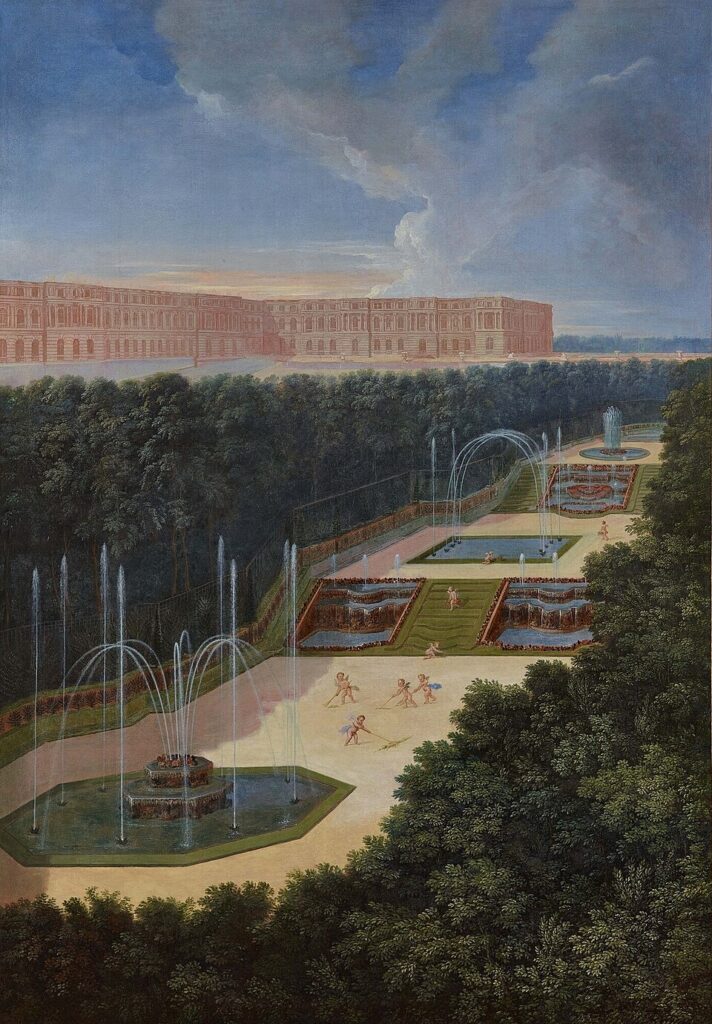
- Bosquet de la Salle de Bal – Ballroom Grove with cascading water steps.
- Latona Fountain – Allegorical display of divine punishment, central on main axis.
Sculpture and Symbolism in the Garden Landscape
Classical Inspirations and Royal Propaganda
Louis XIV’s gardens were more than picturesque—they were political. The sculptures and fountains used Classical themes to reinforce the king’s image as a ruler chosen by divine right. Roman gods and Greek heroes populated the groves, fountains, and paths, each chosen for their symbolic connection to virtue, power, or divine favor. Apollo, the sun god, appeared most frequently, serving as Louis XIV’s mythological mirror.
Each sculpture had a calculated purpose. The garden was not merely a setting, but a theater of monarchy. Visitors walking its paths encountered stories carved in stone: punishments, triumphs, transformations—all of them tied to the glory of the Sun King. These Classical references served not only as decoration but as moral instruction, emphasizing loyalty, order, and majesty.
Artists Behind the Ornaments
Many of France’s greatest artists contributed to Versailles’ sculptures. Charles Le Brun, the king’s chief painter and decorator, served as artistic director, selecting mythological themes and supervising execution. One of the most celebrated works is Apollo Tended by the Nymphs by François Girardon, completed between 1666 and 1675. This marble group measures approximately 2.2 meters by 3.2 meters and is housed in the Bosquet des Bains d’Apollon [✅ Verified – Getty, Château de Versailles archives].
Antoine Coysevox also left his mark with sculpted busts and allegories of the Four Seasons and the Elements. The level of craftsmanship in these works was extraordinary. Many pieces were created in Paris and transported to Versailles, where they were installed with great ceremony. These sculptures remain in situ today, offering an open-air museum of 17th-century French art.
Bosquets: Sculpted Nature and Hidden Theaters
Bosquets, or groves, were a defining feature of the Versailles gardens. Enclosed by trees and hedges, these rooms within the garden served as both decorative elements and venues for court entertainment. Each bosquet had a distinct identity, often with fountains, sculpture, or even built-in theaters. The Bosquet de la Salle de Bal, completed in 1685, features a cascading waterfall staircase used for court dances and performances.
One of the most dramatic bosquets is the Bosquet de l’Encelade, completed in 1675. At its center is a fountain depicting the fallen Titan Enceladus, buried under Mount Etna and spewing water in defiance. This powerful image reminded viewers of the consequences of challenging divine—or royal—authority. Other groves, like the Bosquet des Rocailles, incorporated shell mosaics and mirrored water surfaces to create magical, theatrical environments.
The Gardens Through Time: Legacy, Restoration, and Influence
Decline and Restoration Post-Revolution
The French Revolution brought decline to Versailles. The gardens, like the palace, were stripped of royal symbols, and maintenance ceased. Many statues were damaged or removed, and the elaborate water systems fell into disrepair. In the 19th century, successive regimes under Louis-Philippe and Napoleon III began restoring portions of the estate, though often with limited resources.
Serious restoration began in the early 20th century under Pierre de Nolhac, curator of the museum established at Versailles. He focused on restoring both historical accuracy and public accessibility. After both World Wars, international efforts helped finance further restorations. Today, the Versailles gardens are maintained by an expert team of gardeners, art historians, and conservationists dedicated to preserving Le Nôtre’s legacy.
Versailles as a Model for European Courts
Versailles’ influence on European landscape design was immediate and lasting. Monarchs across Europe sought to emulate its grandeur. The gardens at Schönbrunn Palace in Austria, Peterhof in Russia, and the Royal Palace of Caserta in Italy all adopted the principles of the French formal garden. These included axial planning, extensive waterworks, and Classical allegory.
French landscape gardeners became sought-after exports, and the “jardin à la française” became synonymous with royal authority and artistic sophistication. Even in colonial territories, elements of Versailles-style landscaping were adopted by administrators and governors to evoke the prestige of the French court.
Modern Management and Visitor Experience
Today, the gardens are managed by the French state as part of the public Château de Versailles domain. They attract over 6 million visitors annually, making them one of the most visited garden sites in the world. Access to the gardens is free most days, though there is an admission fee during the “Grandes Eaux Musicales”—days when the fountains operate alongside classical music.
The garden team consists of over 30 full-time gardeners, supported by seasonal workers, engineers, and conservators. Restoration is ongoing, especially in the more fragile bosquets. Programs for school children, international scholars, and horticultural students ensure that the traditions of Versailles’ garden artistry continue to inform new generations.
Key Takeaways
- The Versailles Gardens were created beginning in 1661 by André Le Nôtre under Louis XIV.
- Their symmetrical design, fountains, and Classical sculptures reflect absolutist monarchy.
- Major features include the Grand Canal, Apollo Fountain, and various bosquets.
- The gardens inspired imitations across Europe and remain a pinnacle of landscape art.
- Ongoing restoration preserves Le Nôtre’s vision for millions of visitors each year.
FAQs
Who designed the Gardens of Versailles?
André Le Nôtre, appointed by Louis XIV in 1661, designed the gardens over two decades.
How big are the gardens at Versailles?
The formal gardens span about 800 hectares, with 50 fountains and over 200,000 trees.
What is the significance of the Apollo Fountain?
It symbolizes Louis XIV as the Sun King, aligning him with the god Apollo.
Can visitors access the gardens for free?
Yes, general garden access is free except during musical fountain shows.
When were the gardens designated a UNESCO site?
Versailles, including the gardens, was designated a UNESCO World Heritage Site in 1979.