The first impression of Lecce is almost always one of stone. Not the cold, gray stone of northern fortresses, but a golden, malleable limestone that seems to glow in the Apulian light. Known locally as pietra leccese, this soft, workable stone has shaped every contour of the city’s identity, from its earliest settlements to its Baroque efflorescence. The very look and feel of Lecce’s art cannot be separated from the geology beneath its streets. To understand the city’s artistic history, one must first linger on the character of its stone.
The gift of a pliable material
Unlike marble, which resists and demands mastery, Lecce’s limestone invites the chisel. It allows for deep carving, flowing detail, and a kind of sculptural exuberance that other Italian centers could only envy. Quarrying the stone was never just a technical enterprise but the birth of an aesthetic. The softness of the material gave rise to both opportunity and fragility: exquisite flourishes could be realized in architectural ornament, yet centuries of weathering demanded continual care and reinvention. From the beginning, this duality fostered a culture of both daring creativity and practical craftsmanship, linking artists and masons in a continuous dialogue with the medium.
A crossroads bathed in light
Geography reinforced this material destiny. Lecce lies on the Salento peninsula, only a short distance from both the Adriatic and Ionian seas. The quality of light here—sharp, bleaching, and almost theatrical—works in concert with the pale stone, producing dramatic contrasts of shadow. Every façade, every sculpted detail, seems to shimmer by day and glow softly at dusk. Artists across the centuries adapted to this optical environment, shaping surfaces not only for structural solidity but for maximum play with illumination. Visitors today may marvel at the three-dimensional exuberance of Baroque portals, but even in earlier centuries artisans exploited the contrast between stone and sun to heighten the expressive force of their work.
The foundation of a visual identity
This fusion of stone, light, and geography set Lecce apart long before its Baroque age. The Messapian tribes, who settled the region in pre-Roman times, drew from the same quarries that would later supply grand churches. Roman builders, impressed by the material’s malleability, left behind amphitheaters and mosaics framed by the glowing limestone. Early Christian communities found in the stone both permanence and malleability, embedding their sacred visions into structures meant to endure. What began as a pragmatic resource gradually solidified into a cultural signature. Lecce would come to be known as the “Florence of the South,” but unlike Florence, whose art was bound to marble and fresco, Lecce’s soul was inseparable from this honey-colored stone.
The stage, then, was set not by kings or bishops alone, but by the land itself. In Lecce, art history begins underground, in the quarries where craftsmen and laborers extracted the raw material that would become both ornament and identity. Every era layered its own style upon this foundation, but the continuity of stone bound the centuries together, turning the city into a living sculpture. The story that follows is one of adaptation and renewal, in which artists consistently discovered new possibilities within the same ancient material. Lecce’s stone is not a backdrop—it is the protagonist.
Messapian Roots and Roman Foundations
Before Lecce’s façades blossomed into theatrical Baroque splendor, its artistic story began with far older civilizations whose traces still linger in fragments of stone and earth. To walk the streets of Lecce is to tread over layers of forgotten cities, each contributing to the cultural soil from which later art would flourish. The Messapians and Romans—two very different peoples—laid the first visible foundations of Lecce’s visual identity, embedding both local traditions and imperial grandeur into the cityscape.
Messapian forms of memory
The Messapians, a pre-Roman people inhabiting the Salento from roughly the 8th century BC, left behind traces that are less monumental than Rome’s but no less telling. Their artistry revealed itself primarily in funerary practices. Excavated tombs show carefully carved limestone chambers, often accompanied by pottery decorated with geometric motifs and occasional figural scenes. These objects were not designed for public display, yet they reveal a sensitivity to form and ornament that foreshadows Lecce’s later visual vitality.
What is striking is the Messapian use of stone not simply for shelter or defense but as a medium of memory. Walls were incised with patterns, burial chambers marked with modest yet deliberate sculptural effort. While these works lack the virtuosity of later ages, they root Lecce’s art history in a deep Mediterranean dialogue. The Messapians traded with Greeks, absorbing stylistic hints from Attic vases and Italic bronzes, yet filtered them through a local sensibility. They preferred durable stone markers over fragile luxury items, suggesting a culture already attuned to the permanence of carved form.
Rome’s amphitheater and the language of power
The arrival of Rome transformed Lecce from a tribal settlement into a city of empire. Renamed Lupiae, it acquired the hallmarks of Roman urban design: gridlike streets, baths, theaters, and temples. The most dramatic survivor is the partially excavated amphitheater, still visible in Piazza Sant’Oronzo. Constructed in the 2nd century AD, it could hold more than 20,000 spectators—an extraordinary scale for a city on the periphery of imperial power.
The amphitheater’s arches, carved from local limestone, show how Rome adapted its architectural vocabulary to provincial materials. While not as imposing as the Colosseum, the structure radiated the same symbolic authority. It was not merely an entertainment venue but a physical declaration of Rome’s presence, embedding imperial order in stone. Nearby mosaics from private villas add a more intimate layer: patterned floors of dolphins, sea creatures, and mythological figures attest to the aesthetic tastes of local elites who sought to live in harmony with the broader Roman world while asserting regional flair.
The layering of two worlds
What emerges from the combination of Messapian and Roman traces is not a story of replacement but of layering. Roman amphitheaters often swallowed earlier sacred sites, yet elements of local identity persisted. Messapian stone-working traditions continued under Roman rule, blending with imported techniques. Religious practices overlapped: Roman temples rose near older cult sites, creating a visual palimpsest of devotion.
This layering set a pattern for Lecce’s future. Rather than erasing, each era inscribed its own designs atop the last, producing a city that accumulates meaning rather than replacing it. The Messapians gave Lecce its first vocabulary of carved memory; the Romans supplied the grammar of urban monumentality. Together, they established a dual rhythm of intimacy and grandeur, of private devotion and public spectacle, that would echo through the city’s later churches and piazzas.
The ruins of Lupiae may seem fragmentary today, yet they serve as quiet reminders that Lecce’s later artistic confidence grew not from sudden invention but from centuries of inherited practice. To understand the city’s Baroque façades, one must recall the Messapian tombs and the Roman amphitheater—they whisper beneath the golden stone, urging the city always to carve memory into form.
Byzantine Shadows and Early Christian Flourishes
If Rome gave Lecce its amphitheater and civic grid, the Byzantines left behind subtler marks—marks less concerned with spectacle than with spiritual endurance. Between the fall of the Western Empire and the rise of Norman rule, Lecce belonged to a shifting frontier where Eastern and Western traditions overlapped. The art of this period reflects a city negotiating its religious identity while absorbing the iconography and liturgical practices of Constantinople.
Frescoes in the crypts
The most vivid testimonies of this age are found underground. Across the Salento, and particularly in Lecce’s hinterland, cave churches and crypt chapels were carved into soft limestone. Within these dim spaces, fresco painters decorated walls with saints, biblical narratives, and austere portraits of Christ Pantocrator. The style is unmistakably Byzantine: frontal poses, wide eyes, and bold lines that emphasized spiritual presence over naturalistic detail.
In Lecce itself, remnants of these frescoes survive in small chapels and subterranean oratories, often overlooked by visitors dazzled by Baroque excess above ground. Yet these modest works tell of communities who clung to faith during turbulent centuries, when political control shifted repeatedly between Lombards, Byzantines, and Saracens. The art was not about grandeur but about continuity—keeping alive the visual language of Christianity even in obscurity.
Icons and the power of repetition
Alongside frescoes, portable icons circulated in Lecce, further embedding Byzantine aesthetics into local worship. Wooden panels of the Virgin and Child, sometimes adorned with gilded backgrounds, provided focal points for devotion in both public and domestic settings. These icons relied on repetition rather than novelty: their authority derived from faithfulness to prototype, believed to be linked ultimately to miraculous origins in the East.
This reliance on repetition influenced Lecce’s later art in surprising ways. Even in the riotous ornament of the Baroque, one finds echoes of the Byzantine emphasis on recognizable forms—saints identified by fixed attributes, Christ portrayed with familiar gestures. The Baroque sculptor might multiply these forms exuberantly, but the visual grammar remained anchored in a tradition centuries old.
Churches as palimpsests of faith
Byzantine influence in Lecce was not confined to imagery; it also shaped the architecture of early Christian basilicas. Though few intact examples survive, foundations reveal apses oriented eastward, plans adapted for Orthodox liturgy, and modest exteriors that concealed richly painted interiors. Later conquerors frequently built atop or expanded these structures, leaving only traces of Byzantine masonry. Yet the layering of architectural memory remained.
One can see this in Lecce’s Basilica di Santa Croce, which—though celebrated as a masterpiece of Baroque—occupies ground long held sacred, layered over centuries of devotion. The continuity of place, if not form, suggests that Lecce’s Christian identity was less a matter of rupture than of slow accretion.
The Byzantine centuries in Lecce were never about dazzling innovation. They were about holding ground, spiritually and artistically, in an era of uncertainty. The shadows of crypt frescoes and the gleam of small icons testify to a community maintaining its sense of the sacred. These works may appear minor compared to Roman amphitheaters or Baroque façades, but they represent the quiet persistence that made later grandeur possible. Without this period of whispered devotion, Lecce’s later artistic voice might have lacked its depth of resonance.
Norman Lords and the Shaping of Medieval Lecce
When the Normans extended their power into southern Italy in the 11th century, Lecce entered a new chapter marked by feudal consolidation and renewed artistic ambition. These northern conquerors—descendants of Viking adventurers settled in Normandy—brought with them a taste for Romanesque architecture, martial display, and ecclesiastical reform. In Lecce, their rule created both stability and opportunity, allowing art and architecture to move above ground again after centuries of subterranean worship.
Castles and civic identity
The Normans were first and foremost builders of fortifications. Lecce’s early medieval defenses were strengthened under their rule, setting the stage for later expansions of the city’s castle. Though the present fortress owes much to later Angevin and Aragonese interventions, its core originated in this period as a military outpost and symbol of authority. The castle’s thick walls, squared towers, and strategic siting underscored the Normans’ need to assert dominance over both territory and population.
Yet the castle was more than a military structure. It served as the administrative nucleus of the city, anchoring Lecce’s civic identity. The presence of such fortifications infused the local visual culture with a language of strength and order. Artists working in Lecce during this era were never far from the looming image of the fortress—a reminder that stone could serve not only as spiritual vessel but also as instrument of power.
Romanesque churches and sculptural programs
The Normans also spurred a flowering of Romanesque architecture in Lecce and the surrounding Salento. Churches such as the early versions of San Matteo and Santa Maria della Grazia incorporated the rounded arches, sturdy columns, and sculptural portals characteristic of the style. Though often modest in scale compared to the cathedrals of northern Italy, these structures embodied a new ambition: to project the authority of Latin Christianity after centuries of Byzantine presence.
Sculptural decoration played a crucial role. Capitals were carved with foliage, beasts, and occasionally biblical scenes—motifs that married northern imagination with local craftsmanship. Doorways were framed with archivolts teeming with symbolic imagery, guiding the faithful into sacred spaces through a passage of stone storytelling. For the first time in centuries, Lecce’s sacred art moved confidently into the open air, visible to all who entered.
Imported artisans, local adaptations
The Norman conquest also brought an influx of artisans from other parts of Italy and beyond. Stonemasons from Apulia, Sicily, and even northern Europe contributed to Lecce’s building projects, creating a hybrid style that blended northern Romanesque severity with the softer, more luminous qualities of local limestone. The result was not mere imitation but adaptation: Lecce’s Romanesque churches possessed a lightness and warmth absent in their northern counterparts.
These collaborations also fostered a cosmopolitan atmosphere. While the Messapians and Romans had left traces of Mediterranean exchange, the Normans reconnected Lecce to broader European currents. Artistic ideas traveled with craftsmen, and Lecce’s workshops absorbed techniques that would later serve the exuberance of the Baroque.
The Norman era thus shaped Lecce in three crucial ways: it fortified the city physically, it endowed it with a Latin Christian architectural vocabulary, and it opened its workshops to international influence. If the Byzantine centuries had been about preservation, the Norman centuries were about projection—projecting power, faith, and identity through stone. In these solid forms, Lecce began to find the confidence that would later blossom into ornament.
The Swirl of Gothic and Renaissance Currents
By the 13th and 14th centuries, Lecce had become a city attentive to wider artistic winds, absorbing influences from northern Italy, France, and even Spain. This was the period when Gothic tracery began to soften the Romanesque solidity of Norman churches, and when the first inklings of Renaissance humanism filtered into southern courts. Lecce’s art of this age was not yet fully confident in its own identity—it borrowed, experimented, and combined. But in the swirl of styles lay the seeds of its future originality.
Gothic flourishes on southern portals
The Gothic arrived in Lecce not through soaring cathedrals like those of northern Europe but through details: pointed arches, ribbed vaults in select chapels, and decorative portals that lightened otherwise solid walls. The Church of San Francesco della Scarpa, for example, displayed these Gothic refinements, with its delicate tracery and sense of upward aspiration. Such touches suggested a city eager to align itself with contemporary European tastes, even if it lacked the vertical ambition of northern cathedrals.
Gothic ornament also found its way into funerary sculpture. Tombs of local nobles and bishops bore effigies framed by cusped arches and slender pinnacles, a visual vocabulary that spoke of prestige and continuity with continental aristocracy. Yet the execution often retained a southern warmth, with softer carving and an emphasis on decorative pattern over structural daring.
Humanist tastes and the early Renaissance
By the 15th century, Lecce was drawn into the orbit of Renaissance humanism spreading from Florence, Naples, and Urbino. Local elites began to commission works that reflected new ideals of proportion, perspective, and classical reference. Altarpieces depicted saints within balanced architectural frames, painted with increasing naturalism. Stone carvers experimented with classical motifs—acanthus leaves, fluted pilasters, medallions—that hinted at antiquity reborn.
The University of Lecce, founded later but foreshadowed by humanist circles in the city, helped nurture this appetite for intellectual renewal. Poetry, scholarship, and art were intertwined in noble households, where collecting antiquities and patronizing painters became marks of refinement. Though Lecce never rivaled Florence in innovation, its artists translated Renaissance ideals into the language of local limestone, preparing the ground for a uniquely southern flowering.
Noble patronage and the shaping of taste
The shift from medieval to Renaissance art in Lecce was not spontaneous but driven by patronage. Aristocratic families such as the Acaya and the Palmieri sponsored chapels, palaces, and civic projects that carried their coats of arms alongside decorative flourishes. Their ambitions were twofold: to assert political power within the Kingdom of Naples and to project sophistication aligned with broader Italian currents.
This patronage produced a lively interplay between imported artisans and local craftsmen. Venetian painters occasionally left works in Lecce, while sculptors trained in Naples collaborated with native stonemasons. The result was a hybrid idiom—neither purely Gothic nor fully Renaissance, but something transitional, marked by experimentation and eclecticism.
This swirl of Gothic pointedness and Renaissance clarity gave Lecce a taste for stylistic mixture, a taste that would become central to its Baroque. The city learned to adapt foreign forms into local stone, to treat ornament as a site of invention rather than strict imitation. By the end of the 15th century, Lecce was ready for a new artistic chapter, one that would draw on these eclectic experiments and explode into a style of its own making.
The Birth of the Barocco Leccese
When people speak of Lecce today, they inevitably speak of its Baroque—the exuberant, almost theatrical style that transformed the city’s skyline in the 16th and 17th centuries. Unlike the Gothic or Renaissance phases, which came to Lecce as imported fashions, the Barocco Leccese was something native, a style that bloomed from the city’s own material, climate, and sensibility. The union of soft limestone, religious fervor, and aristocratic ambition produced a visual language that remains one of the most distinctive in Italy.
Stone as an invitation to flourish
The qualities of pietra leccese—soft, fine-grained, and easy to carve—were perfectly suited to the Baroque impulse toward movement, depth, and excess. Where marble restrained sculptors to certain conventions of polish and solidity, Lecce’s stone permitted fantastical undercutting, curling volutes, and crowded surfaces of ornament. Artisans could carve saints with windswept drapery, angels in mid-flight, or foliage that seemed to sprout from the walls themselves.
This pliability gave Lecce’s Baroque façades their signature density. Churches became stone tapestries alive with figures, scrolls, cherubs, and grotesques. Courtyards and palaces blossomed with balconies supported by carved beasts or laughing masks. The city itself turned into a gallery, where civic and religious pride manifested not in restraint but in display.
A theatre of devotion
The Counter-Reformation provided the spiritual context for this artistic flowering. After the Council of Trent (1545–1563), the Catholic Church emphasized clarity of teaching, emotional engagement, and sensory power in its art. In Lecce, religious orders such as the Jesuits and Franciscans commissioned churches that embodied these principles. Their façades preached in stone: saints pointing heavenward, allegorical virtues carved in niches, symbols of martyrdom embedded in friezes.
The interiors amplified the spectacle. Altars blazed with polychrome marble and gilded wood, framed by sculpted reliefs that guided the eye toward the Eucharist. Light, filtered through narrow windows, dramatized the contours of stone and plaster. For the faithful, entering a Lecce Baroque church was less a quiet meditation than a sensory immersion—a theatrical experience of devotion.
Patrons and civic ambition
Aristocratic families and religious orders alike fueled the boom. Nobles competed to adorn their palaces with ornate balconies and heraldic emblems, each trying to outshine rivals in generosity and taste. Their investments were not purely pious; they were also statements of civic standing. The more elaborate a façade, the more indelibly the family name was carved into the city’s fabric.
Religious patrons added their own urgency. Orders such as the Celestines or the Jesuits sought to manifest their influence through architecture that both glorified God and broadcast institutional authority. In doing so, they gave local architects and stonemasons extraordinary freedom to experiment, pushing ornament to its limits.
The result was not a borrowed style but a local invention: the Barocco Leccese. While Roman Baroque emphasized monumental scale and theatrical space, Lecce’s version reveled in intimacy and intricacy. The city became known as a southern Florence, but in truth it surpassed imitation—its façades crackled with an energy found nowhere else.
The birth of Lecce’s Baroque was therefore not an accident of fashion but the natural flowering of centuries of layering. Messapian memory, Roman monumentality, Byzantine spirituality, Norman solidity, and Renaissance experimentation all converged. Out of this convergence, nurtured by stone and sunlight, Lecce found its authentic artistic voice—a voice loud, joyful, and impossible to ignore.
Masters of the Chisel: Architects and Sculptors of Lecce
Every style requires its interpreters, and Lecce’s Baroque would not have reached its extraordinary heights without the hands and minds of architects and sculptors who turned pliable limestone into living ornament. The Barocco Leccese is not an anonymous phenomenon: it bears the signatures, sometimes literal and sometimes stylistic, of master craftsmen who shaped the city’s artistic destiny.
Giuseppe Zimbalo and the new vision
At the heart of Lecce’s Baroque stands Giuseppe Zimbalo (1620–1710), often called “Lo Zingarello.” His career embodies the confidence of a city discovering its own artistic identity. Zimbalo’s best-known work, the Basilica di Santa Croce, showcases a façade that is both disciplined and exuberant. Its lower registers display a classical balance of columns and pilasters, while the upper section explodes with sculpted animals, cherubs, and intricate vegetal motifs.
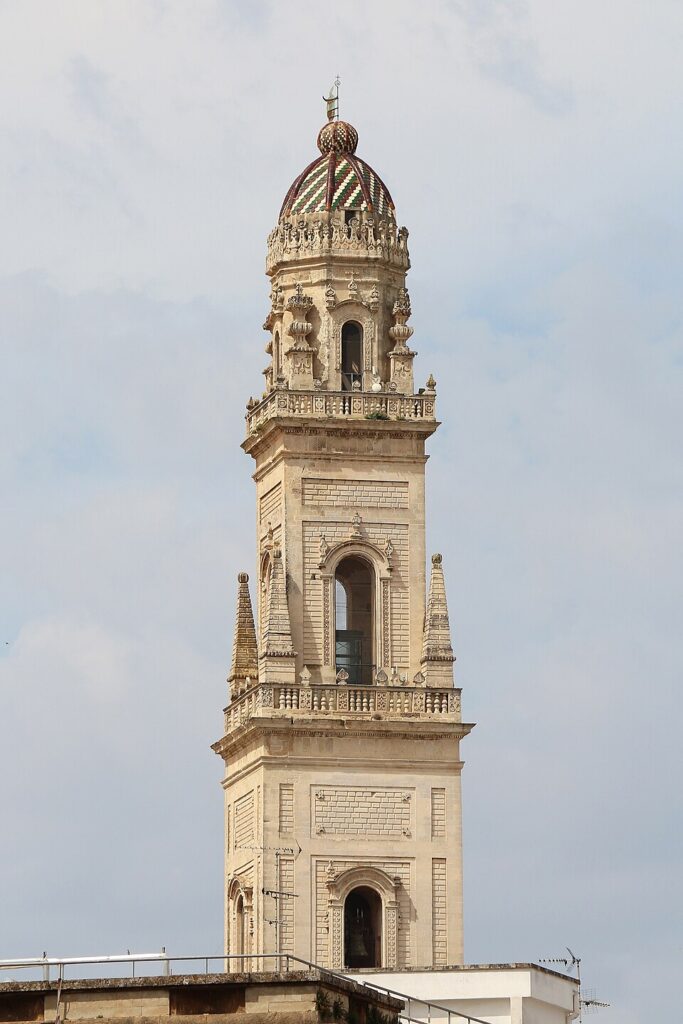
Zimbalo’s genius lay in blending order with excess. He understood proportion but delighted in ornament, demonstrating that the two need not be opposed. Beyond Santa Croce, he contributed to the design of the Duomo’s bell tower, a soaring landmark that gave Lecce not only a skyline but also a symbol of civic pride. His career set the tone for generations of local artisans who saw in him both a model of ambition and a license for invention.
Workshops, guilds, and collective labor
Behind Zimbalo stood networks of workshops and guilds that sustained Lecce’s artistic boom. Baroque ornament is rarely the work of a single hand; it requires armies of chisels, apprentices, and journeymen who translate grand designs into physical reality. Lecce’s stonemasons were organized into corporations that regulated training, protected trade secrets, and maintained standards of craftsmanship.
These workshops developed a vocabulary of motifs—grotesque masks, winged putti, swirling foliage—that could be adapted to different commissions. The repetition was not monotonous but generative: variations on a theme gave each façade a unique character while maintaining a recognizable local style. The guild system also ensured that skill passed from one generation to the next, creating continuity even as individual masters rose and fell.
The signatures of individual hands
Though the style was collective, certain figures besides Zimbalo stand out. Cesare Penna, another leading architect-sculptor, left his mark on palaces and churches with façades that balance elegance and complexity. The Riccardi family of artisans contributed to the diffusion of ornamental patterns across domestic and civic buildings. Each workshop developed subtle signatures—a way of carving a leaf, the tilt of a cherub’s head—that connoisseurs can still trace today.
What is striking is how these masters embraced Lecce’s stone not as a limitation but as a gift. They pushed its softness to extremes, carving depths and undercuts that seemed impossible in harder materials. Where marble might have resisted, Lecce’s limestone yielded, and the sculptors responded with bravado. In their hands, balconies became stages, corbels became grotesque masks, and façades became living walls of narrative.
The Barocco Leccese thus bears not only the stamp of patrons or the pressure of religious reform but also the artistry of individuals who dared to let stone speak. Their names may not resonate globally like Michelangelo or Bernini, yet within Lecce their presence is everywhere. To walk the city’s streets is to encounter their imagination at every turn, a reminder that art history is often written not only by great masters but also by guilds of craftsmen who, through patient labor, carved a city into existence.
Sacred Drama: Churches as Stages of Devotion
In Lecce, churches were never simply houses of worship; they were theatres where faith was performed in stone, light, and ritual. The Baroque spirit found its most complete expression in these sacred buildings, where every façade, altar, and sculpted figure contributed to a drama of salvation designed to captivate the senses and stir the soul.
Facades that preached in silence
The exteriors of Lecce’s churches read like sermons carved into stone. The Basilica di Santa Croce remains the most famous, its façade a swirling composition of animals, foliage, saints, and symbols, culminating in a great rose window that seems to pulse with energy. The message was unmistakable: faith was not an abstract doctrine but a living, breathing force manifest in the very skin of the city.
Other churches followed suit. The façade of Santa Chiara, with its exuberant ornament, and that of San Matteo, with its dynamic curves, turned architecture into spectacle. These were not buildings that receded into the urban fabric; they commanded attention, drawing the eye upward and outward. For citizens and visitors alike, the façades functioned as public catechisms, proclaiming religious truths to anyone who passed.
Interiors alive with narrative
Step inside, and the theatricality deepened. Altars were conceived as stage sets, where sculptures, reliefs, and paintings converged to focus the gaze on the Eucharist. In the Duomo, side chapels teem with altarpieces framed by gilded wood, while sculpted angels hover as if frozen mid-flight. Pulpits were carved with biblical scenes, their surfaces animated with writhing vines and allegorical figures.
Light played its role as well. Narrow, strategically placed windows cast beams across sculpted reliefs, making saints emerge from shadow or halos glow with sudden brilliance. The interplay of natural illumination with carved detail turned liturgical rituals into performances of divine presence. To participate in mass was to enter a choreography of sight, sound, and stone.
The fusion of ritual and spectacle
The drama of Lecce’s churches extended beyond architecture and into the rituals they framed. Processions emerged from ornate portals, carrying statues of saints adorned with flowers and candles. Music reverberated against carved walls, amplifying the theatrical atmosphere. In this context, art was not static decoration but part of a sensory symphony orchestrated to move hearts and minds.
The Jesuits, masters of theatrical devotion, excelled at this integration of art and ritual. Their church in Lecce combined intellectual clarity with overwhelming visual effect, embodying the Counter-Reformation’s call to engage the faithful through emotion as well as doctrine. The result was a sacred environment where worshippers became both audience and participants in a drama of salvation staged daily in stone.
Lecce’s churches remain the city’s most vivid expression of Baroque imagination. They are not merely monuments to a past age but enduring theatres of faith, where the boundary between art and devotion dissolves. Even today, entering one of these spaces can feel like stepping into a performance that has never truly ended.
Civic Pride in Stone: Palaces, Piazzas, and Urban Art
If churches were Lecce’s theatres of devotion, its palaces and piazzas were the stages of civic pride. The Baroque impulse extended beyond sacred spaces, spilling into the secular fabric of the city where aristocratic families, municipal leaders, and guilds carved their ambitions into limestone. The result was an urban environment where art and politics intertwined, and where the streets themselves became an exhibition of power, prestige, and identity.
Palaces as dynastic statements
Lecce’s aristocratic palaces rose not only as residences but as stone manifestos. Families such as the Palmieri, Marrese, and Tamborino commissioned grand façades that rivaled church fronts in complexity. Balconies projected outward, supported by corbels sculpted as grotesque faces, lions, or mythical beasts. Each detail carried symbolic weight: strength, fertility, vigilance, or sometimes a sly humor that revealed the artisan’s hand.
The Palazzo dei Celestini, though tied to a monastic order, embodied this blending of civic and aristocratic ambition. Its façade stretched across the city like a continuous stage, combining classical order with riotous ornament. For noble families, such buildings were declarations of permanence, their stone coats of arms carved above doorways to proclaim lineage and authority. In a society where political fortunes could shift quickly, stone provided an enduring guarantee of visibility.
Piazzas as theatres of public life
At the civic scale, Lecce’s piazzas became architectural ensembles designed to impress. Piazza del Duomo, enclosed on three sides by the cathedral, bell tower, and episcopal palace, offered a uniquely Baroque sense of spatial theatre. Entering the square was like stepping into a set, where each building played its role in a larger composition. The piazza was at once civic center, religious stage, and social gathering place—a setting where the boundaries between sacred and secular blurred.
Piazza Sant’Oronzo, with its Roman amphitheater exposed at one edge and Baroque buildings framing the rest, epitomized the layering of Lecce’s identity. Here, ancient ruins conversed with modern facades, reminding citizens that their city’s grandeur stretched back to Lupiae while also proclaiming a present defined by spectacle and pride.
Sculptures, fountains, and the ornament of the street
Beyond the monumental palaces and squares, smaller works of urban ornament enriched Lecce’s streetscape. Fountains adorned with carved figures provided both water and delight. Public statues—such as those of saints erected on tall columns—watched over neighborhoods as both protectors and emblems of communal faith. Even street corners bore decorative niches, where small statues transformed everyday passageways into moments of visual surprise.
These embellishments were not mere decoration. They were a language of civic belonging. A grotesque mask on a balcony could mock enemies or symbolize vigilance. A fountain adorned with dolphins and tritons proclaimed the city’s Mediterranean identity. A column surmounted by Sant’Oronzo, Lecce’s patron saint, asserted divine protection over the urban body.
Taken together, Lecce’s civic Baroque was not an afterthought but an essential dimension of its identity. The city’s secular spaces matched the energy of its churches, ensuring that the Barocco Leccese was not confined to worship but infused daily life. To stroll through Lecce was—and still is—to inhabit an environment where faith, politics, and artistry are fused in stone, each street corner a reminder that civic pride, like devotion, finds its truest expression in form and ornament.
The Ebb of the Baroque and the Age of Neoclassicism
Every artistic flowering carries within it the seeds of exhaustion. By the late 18th century, Lecce’s Baroque had reached a saturation point. Facades so dense with ornament risked becoming unreadable, and the very exuberance that once astonished began to feel excessive to new generations educated in Enlightenment ideals. Out of this fatigue emerged a turn toward restraint, balance, and reason—the principles of Neoclassicism. Lecce, like much of Europe, entered a period in which the ornate gave way to the orderly.
Changing tastes and aristocratic commissions
The city’s noble families, once eager to outdo each other in carving ever more elaborate balconies and portals, began commissioning buildings and interiors marked by cleaner lines and classical references. Columns grew straighter, capitals simpler, and facades more symmetrical. Where cherubs and grotesques once crowded cornices, now pediments and friezes evoked the dignity of antiquity.
Palaces erected during this period reveal the shift in taste. Their façades retain Lecce’s honey-colored limestone but display a restraint unimaginable in the Baroque heyday. Interior decoration likewise softened: painted ceilings borrowed motifs from Roman temples, and stuccowork imitated the clarity of Pompeian frescoes recently uncovered in Campania. Aristocratic ambition had not vanished, but it had learned to clothe itself in moderation.
Academic influence and the discipline of design
The intellectual currents of the Enlightenment and the rise of academies also shaped Lecce’s artistic direction. Students trained in Naples and Rome returned with sketchbooks filled with Vitruvian proportions and Palladian ideals. Local builders increasingly adhered to principles of geometry and order, reflecting a Europe-wide belief that beauty lay in rational clarity rather than sensory overload.
Painting, too, followed this turn. Religious commissions declined as secular portraiture and historical subjects gained favor. Artists sought to align themselves with the “noble simplicity” advocated by theorists such as Johann Joachim Winckelmann. Even when depicting biblical scenes, they avoided the tumultuous drama of Baroque canvases, favoring instead calm compositions modeled on ancient statuary.
Negotiating tradition and modernity
Yet Lecce did not abandon its Baroque past entirely. The Neoclassical turn was layered atop, rather than replacing, the city’s existing character. Many Neoclassical projects reused Baroque structures, remodeling interiors while leaving exuberant facades intact. In some cases, the juxtaposition created a dialogue between old and new—an ornate portal opening onto a restrained courtyard, or a Baroque church housing a Neoclassical altar.
This negotiation reflected Lecce’s position in southern Italy: tied to broader European currents yet rooted in a distinctive local identity. The city could not erase its Baroque inheritance, nor did it wish to. Instead, it adapted, moderating excess without rejecting the artistry that had defined it.
The Age of Neoclassicism in Lecce was thus not a rupture but an ebb—a calming of energies, a moment of repose after centuries of exuberance. Its clean lines and measured forms offered balance to the flamboyant façades still dominating the streets. Together, they gave Lecce an urban fabric that spoke not only of a single style but of a dialogue across centuries, where reason and passion, order and ornament, continue to coexist in stone.
Twentieth-Century Turns: Lecce Between Preservation and Innovation
The twentieth century confronted Lecce with a dilemma shared by many historic cities: how to preserve its artistic inheritance while responding to the pressures of modernity. The golden façades of its Baroque churches and palaces were at once its greatest cultural treasure and a fragile inheritance requiring care, adaptation, and sometimes sacrifice. The century’s political upheavals, shifting economies, and new artistic movements all left their imprint on Lecce’s stone cityscape.
Fascist restorations and ideological visions
During the Fascist era, Lecce’s monuments were drawn into the regime’s campaign of national identity. Restoration projects focused on stripping away later additions to reveal what was perceived as “original” Baroque or Roman form. The excavation of the Roman amphitheater in Piazza Sant’Oronzo, for instance, was carried out with great fanfare, aligning Lecce with the glory of ancient Rome.
While these interventions preserved significant ruins, they also reflected ideological agendas, often privileging monumental clarity over historical nuance. Baroque structures were sometimes “cleaned” of what restorers considered excess, a process that risked altering the very exuberance that defined Lecce’s identity. Yet these projects also brought renewed attention to the city’s heritage, embedding it firmly in the narrative of Italy’s cultural patrimony.
Modernist interventions and local resistance
The postwar decades introduced pressures for modernization. New housing projects, administrative buildings, and transport infrastructure altered Lecce’s urban landscape. Architects influenced by rationalist and modernist principles experimented with concrete and steel, setting starkly contemporary lines against the soft contours of Baroque limestone.
These interventions sparked debate. For some, modernism offered progress and functionality; for others, it represented a threat to the city’s artistic soul. The contrast between sleek, austere structures and ornate historic façades was jarring. Yet the very tension between old and new highlighted Lecce’s ongoing dialogue with its past. The city was not a museum but a living organism, forced to negotiate between preservation and change.
Rediscovery of local craftsmanship
By the late twentieth century, a countermovement arose: renewed appreciation for Lecce’s traditional stone carving. Local artisans, whose craft had languished under industrial modernity, found new audiences as restoration projects demanded skilled hands capable of replicating Baroque detail. Workshops revived techniques passed down through generations, ensuring that the city’s identity remained tied to its limestone.
This revival intersected with growing tourism. Visitors drawn to Lecce’s “Florence of the South” reputation sought not only monuments but also the living traditions behind them. Artisans adapted, producing both faithful restorations and contemporary works inspired by Baroque vocabulary. In this way, Lecce’s stone carving was not fossilized but reinvented, bridging heritage and innovation.
The twentieth century left Lecce with scars, experiments, and rediscoveries. It revealed how fragile yet resilient the city’s artistic fabric could be, exposed to ideological manipulation, economic necessity, and cultural fashion. Yet through it all, Lecce’s stone endured—weathered, repaired, and reinterpreted—reminding its citizens that their identity was not only inherited but continually made anew.
Lecce Today: Tourism, Conservation, and Living Heritage
Lecce in the twenty-first century stands at once as a monument and a living city. Its honey-colored façades, celebrated in guidebooks and social media alike, attract waves of visitors eager to witness the “Florence of the South.” Yet the city is more than a picturesque backdrop: it is a place where centuries of artistry remain entangled with the daily lives of residents, where the challenges of preservation, tourism, and contemporary creativity continually collide.
UNESCO ambitions and the marketplace of beauty
The international appetite for heritage tourism has transformed Lecce’s Baroque into a global brand. Walking through Piazza del Duomo or Santa Croce today, one is as likely to encounter a crowd of cameras as a procession of worshippers. The city’s leadership has embraced this visibility, promoting Lecce as a jewel of southern Italy and positioning its architecture within the broader heritage economy.
This promotion brings both opportunity and risk. On one hand, tourism generates resources for restoration and ensures that Lecce’s monuments remain in the public eye. On the other, the sheer volume of visitors threatens to reduce complex artistic histories to a consumable spectacle. The façades that once proclaimed civic pride and theological drama risk being flattened into postcards. The challenge for Lecce lies in balancing visibility with authenticity, ensuring that its art remains more than an aesthetic commodity.
Conservation as daily labor
Preserving Lecce’s limestone is no small task. The very softness that enabled Baroque exuberance also leaves the stone vulnerable to erosion, pollution, and careless intervention. Conservation teams face the delicate work of cleaning surfaces without erasing the patina of age, of consolidating fragile carvings while respecting their original spirit.
Projects often reveal surprises. A façade scrubbed of soot may expose hidden details, or a crumbling balcony may uncover traces of older construction beneath. In this sense, conservation becomes not only a technical necessity but also a form of discovery, renewing awareness of Lecce’s layered past. Artisans continue to play a crucial role, bringing ancestral knowledge of tools and techniques into dialogue with modern science.
A city of living heritage
Despite the pull of preservation, Lecce is no static museum. Its artisans carve contemporary works in pietra leccese, from modern sculptures to playful reinterpretations of Baroque motifs. Festivals animate the streets with music and processions, echoing centuries-old rituals while adapting to modern rhythms. Artists and designers draw inspiration from the city’s stone fabric, weaving its motifs into fashion, furniture, and digital media.
This vitality ensures that Lecce’s artistic history remains unfinished. Each generation adds its own layer, just as the Messapians, Romans, Byzantines, Normans, and Baroque masters did before. The façades of today may host light projections during festivals; palaces may house art schools or cultural centers; churches continue to frame both devotion and spectacle.
Lecce today is a dialogue between permanence and change, between the stone that resists and the life that reshapes it. Its art history is not locked in the past but lives in every restoration, every carving, every procession down a sunlit street. The city remains a carved theatre—one in which both residents and visitors are participants, witnesses, and inheritors of a story still unfolding in golden stone.