The first impression of Edinburgh is architectural rather than pictorial: a skyline bristling with spires and turrets, its weight of stone pressing against the changing sky. Few cities bind their artistic identity so closely to geology. Edinburgh’s Old Town rises from volcanic rock, Castle Rock anchoring the medieval fortress above, with Arthur’s Seat looming nearby like a guardian giant. This terrain has dictated not only the city’s physical shape but also the symbolic imagination of its artists. To depict Edinburgh has always meant engaging with its stone and its stories, its drama of cliffs and closes, its solemn endurance and sudden vistas.
The volcanic cradle: Castle Rock and its symbolism
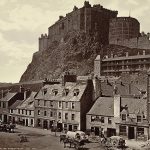
Castle Rock has functioned as Edinburgh’s primordial image, a motif that appears again and again in prints, paintings, and travel accounts. Early engravers seized on the sheer improbability of a fortress perched on a basalt outcrop, while Romantic painters later transformed the rock into an emblem of Scottish resilience. Even in contemporary art, Castle Rock remains a shorthand for permanence, survival, and the mingling of natural and human power.
One striking example is Alexander Nasmyth’s late-18th-century depictions of the city, which frame Castle Rock against expansive skies. Nasmyth, often called the father of Scottish landscape painting, did not treat the fortress merely as military architecture but as a stage where geology and nationhood meet. His careful balance of cloud and stone speaks to Edinburgh’s dual identity as a city of nature and intellect.
The rock’s symbolic reach extends beyond canvas into literature. Walter Scott’s poetry regularly drew upon the visual authority of the castle, his words reinforcing the city’s already potent silhouette. Artists of every period since have had to reckon with this dominating image, either by incorporating it or deliberately turning away.
A medieval skyline as civic identity
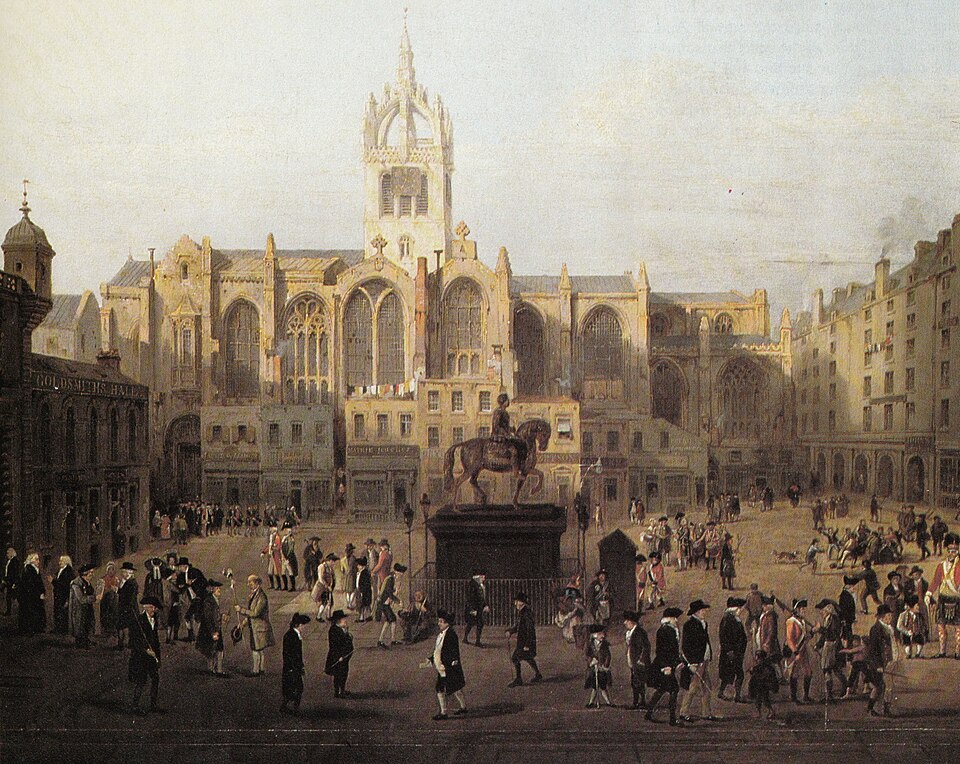
If Castle Rock provides the anchor, the medieval spires and closes give Edinburgh its unmistakable texture. St. Giles’ Cathedral, with its distinctive crown steeple, has long been both a spiritual and visual landmark. Artists frequently rendered its lantern crown not only as an architectural curiosity but as a mark of the city’s independence of character.
Equally crucial are the closes and wynds—narrow passages dropping steeply from the Royal Mile. Painters such as David Octavius Hill later captured their play of light and shadow, revealing how ordinary dwellings and stairways could assume a theatrical grandeur when crowded into steep gradients. These enclosed spaces, with their sudden shafts of sunlight or lingering fog, fostered an art of contrasts: sharp silhouettes, half-glimpsed figures, and a palette attuned to stone’s subtle hues.
Such imagery cultivated civic pride. To see the skyline in engraving or oil painting was to affirm Edinburgh’s identity as something distinct, neither a provincial burgh nor a pale echo of London. Art, in this sense, solidified the idea of Edinburgh as a “city of towers,” its verticality mirroring its aspirations.
The sense of permanence in stonework and atmosphere
More than a backdrop, stone itself became Edinburgh’s medium of self-expression. Grey sandstone and basalt, weathered by centuries of wind and rain, imposed a mood that painters and poets alike have struggled to escape. John Piper in the 20th century, visiting Edinburgh, remarked on its “granite solemnity,” a phrase that captures how the very materials of the city resist frivolity.
Yet permanence is never simple. Artists who focused too closely on Edinburgh’s monumental aspects risked missing its mercurial qualities. The city’s atmosphere changes by the hour: a sudden clearing of mist reveals a spire in crystalline detail, only for drizzle to soften it minutes later. The Impressionists found little foothold here, but local artists translated this instability into sharp tonal contrasts rather than fleeting brushstrokes.
Three details, often overlooked, reveal how artists perceived this duality:
- The soot-stained facades of the Old Town, which many 19th-century painters darkened further to heighten the drama.
- The volcanic crags of Salisbury and Arthur’s Seat, looming in background vistas as symbols of raw time set against urban ambition.
- The persistent presence of weather—cloud shadows, drizzle, sudden shafts of light—rendered as active participants in the city’s portraits.
What results is a city imagined not only in its built form but in its endurance. To paint or draw Edinburgh was to acknowledge its stubbornness, its stony insistence that memory is as solid as rock. Yet even here lies a paradox: permanence invites reinvention. Each generation of artists has approached the same stones and streets with new eyes, finding fresh meanings in their hardness.
The story of Edinburgh’s art begins, then, not in galleries but in geology and urban fabric. Before portraits or abstract experiments, before academies and festivals, there was the skyline—etched against shifting light, held fast by volcanic stone, and endlessly available for retelling. It is this image, rooted in place yet open to imagination, that gave Edinburgh’s art its enduring ground.
Sacred Beginnings: Religious Art and Architecture
Before Edinburgh became a city of Enlightenment salons and Romantic vistas, it was above all a place of worship. The earliest art that survives in its churches and chapels bears the imprint of devotion, ritual, and the tensions of faith. To walk through the remnants of this sacred world is to glimpse a city where the visual and the spiritual were deeply entwined, long before the stern reforms of the 16th century altered the landscape of Scottish art.
St. Giles’ Cathedral and the medieval guilds
At the heart of medieval Edinburgh stood St. Giles’ Cathedral, rising on the Royal Mile with its crown-shaped steeple already marking the skyline. Inside, the building served not only as a parish church but as a hub of civic and guild life. Merchants and craftsmen endowed altars, commissioning painted panels and carved decorations to demonstrate both piety and prosperity. Each guild maintained its own chapels and imagery—shoemakers, hammermen, and skinners all leaving their mark in stone, paint, or wood.
Although much of this imagery was destroyed during the upheavals of the Reformation, fragments survive to suggest its richness. Carved bosses on the cathedral’s ceiling still bear heraldic symbols, while records mention painted retables and gilded statues. Such art was not merely decoration: it was meant to instruct, to honor patron saints, and to remind both guild members and passersby of the spiritual dimension of everyday work.
One vivid micro-narrative survives in the form of a carved effigy of the 15th-century Provost, Sir William Preston, who gifted a relic of St. Giles’ arm to the church. The effigy, with its careful detailing of armor and heraldry, illustrates how individual acts of devotion became embedded in the fabric of the building, fusing civic pride with sacred duty.
Painted ceilings, carvings, and iconography before Reformation loss
Beyond St. Giles’, Edinburgh’s churches and convents were once filled with painted ceilings, wall paintings, and sculpted figures. Trinity College Kirk, founded in the mid-15th century by Mary of Guelders, boasted intricate stone carving and richly painted furnishings. Though demolished in the 19th century to make way for railway expansion, accounts describe its ornamentation as among the finest in Scotland.
In parish churches, painted timber ceilings often displayed biblical narratives or decorative motifs. Such works brought color into otherwise dim interiors, bridging the distance between scripture and daily life. Sadly, very little of this imagery remains, swept away in the iconoclastic fervor of the 1560s. Yet even the absence has shaped Edinburgh’s identity: the city carries within it a ghostly memory of lost art, a silence where once there were images.
Carvings fared better than paint. Capitals adorned with foliage or animals, misericords with humorous grotesques, and surviving fragments of stone altars all hint at a medieval world alive with imagination. The emphasis on carving reflects both the durability of stone and the Scottish love of structural solidity. To study these remnants is to piece together a once-vivid artistic culture now mostly concealed by destruction and rebuilding.
The tension between devotion and iconoclasm
The 16th century brought a violent rupture. The Scottish Reformation, driven by theological zeal and political upheaval, targeted visual art as a form of idolatry. In 1559, mobs swept through Edinburgh’s churches, tearing down statues, smashing stained glass, and whitewashing walls. For artists, this meant the collapse of a patronage system that had sustained workshops for generations.
Yet destruction did not mean the end of artistic impulse. Some works were hidden rather than destroyed. Fragments of painted panels and illuminated manuscripts resurfaced centuries later, preserved in private collections or buried in archives. Domestic interiors sometimes concealed traces of sacred imagery—small devotional paintings or carved figures that escaped the reformers’ gaze.
This tension between presence and absence has continued to shape Edinburgh’s art. The city remembers itself as both ornamented and stripped, a place where beauty and violence coexisted in the very act of worship. Later artists, from antiquarians of the 18th century to Gothic revivalists of the 19th, often treated these ruins and absences with reverence, using imagination to restore what had been lost.
The sacred beginnings of Edinburgh’s art, then, are defined as much by absence as by survival. The city’s first artistic flowering in stone, paint, and glass was shadowed by the memory of its loss, a paradox that continues to inform Edinburgh’s relationship with art: reverence for tradition, awareness of fragility, and a persistent drive to rebuild what time and ideology have taken away.
Renaissance Echoes in a Northern Capital
When the Renaissance spread across Europe, its glow reached Scotland more faintly than Italy or France, yet Edinburgh absorbed its light in distinctive ways. Courts, scholars, and merchants carried ideas northward, and while the city never became a Florence of the North, it developed a hybrid artistic language that mingled imported humanism with local tradition. The results can still be glimpsed in manuscripts, decorative arts, and fragments of architecture, each bearing witness to an age when Edinburgh imagined itself part of a wider European world.
Continental influence through trade and scholarship
Edinburgh’s location as a trading hub meant that continental influences arrived by ship as much as by book. Merchants linked the city to the Low Countries, France, and beyond. Alongside cargoes of cloth and wine came engravings, illuminated manuscripts, and small devotional objects that introduced local viewers to new visual vocabularies. Flemish artists, especially, left their mark, as their crisp detailing and rich color harmonized with Scottish tastes.
Scholars traveling abroad also brought back artistic knowledge. The University of St. Andrews and the court of James IV attracted thinkers attuned to Renaissance currents, many of whom passed through Edinburgh. Humanist ideals translated into a new appetite for portraiture, heraldry, and classical motifs in architecture. These elements did not erase local styles but rather overlaid them, creating a hybrid aesthetic that set Edinburgh apart from more orthodox northern traditions.
An unexpected consequence of this cultural traffic was the spread of printed images. Imported woodcuts and engravings circulated widely, offering Edinburgh’s artists templates for biblical scenes, allegories, and classical themes. Even modest households might have owned a single print, a small but significant connection to the grandeur of continental art.
Courtly art under James IV and James V
The Scottish court, shifting between Stirling, Holyrood, and other residences, played a pivotal role in fostering Renaissance imagery. Under James IV (1488–1513), music, poetry, and pageantry flourished, accompanied by a growing taste for painted decoration. James V continued this trend, marrying Madeleine of Valois and later Mary of Guise, both of whom strengthened Franco-Scottish cultural ties.
At Holyrood Palace, Italian craftsmen were brought to work on decorative schemes, introducing motifs of Renaissance architecture and ornament. While little survives intact, records describe frescoes, gilded ceilings, and painted emblems that adorned the royal apartments. These embellishments were intended not only to please the eye but also to affirm dynastic legitimacy and continental sophistication.
Anecdotes from royal pageants give further glimpses of this culture. During public entries, the king was greeted with allegorical tableaux, painted arches, and performances that borrowed heavily from Renaissance symbolism. These events transformed the streets of Edinburgh into temporary theatres of art, blending politics with visual imagination.
Decorative manuscripts and civic pageantry
Alongside court commissions, illuminated manuscripts offer some of the finest surviving examples of Renaissance art in Edinburgh. Works such as the Bannatyne Manuscript, though primarily literary, were sometimes adorned with intricate initials and marginalia reflecting continental styles. More elaborate were Books of Hours, imported or locally produced, which circulated among noble families and displayed the refined miniature painting associated with the Renaissance.
Civic pageantry also absorbed Renaissance influence. Records of the Incorporation of Mary’s Chapel, the masons’ guild of Edinburgh, describe elaborate processions featuring painted banners, costumes, and symbolic figures. These events, though ephemeral, reveal a visual culture alive with allegory and color, where even stonemasons and artisans engaged with the broader language of Renaissance spectacle.
Three glimpses illustrate the vitality of this era:
- The painted ceilings of houses in Edinburgh’s Old Town, some of which still survive, combining heraldic devices with Renaissance arabesques.
- Imported Flemish altarpieces, like the Trinity College Altarpiece (now in the National Gallery of Scotland), which reveal the taste of Edinburgh’s elite for richly detailed devotional imagery.
- The decorative carving at Holyrood Abbey, where classical motifs appear alongside Gothic structures, signaling the gradual shift in aesthetic language.
The Renaissance in Edinburgh was never a wholesale transformation. It was selective, adapted, and often fleeting, interrupted by political turmoil and ultimately swept aside by the austerity of the Reformation. Yet its echoes endure—in a fragment of carving, a painted beam, a pageant described in a ledger. These scattered traces remind us that Edinburgh, though distant from Florence or Rome, nonetheless partook in the shared European endeavor to reimagine beauty, knowledge, and civic life.
The Shock of the Reformation
Few events in Edinburgh’s history left such a visible scar on its art as the Reformation. In 1560, Scotland formally broke with Rome, and the city became one of the central stages for iconoclastic fervor. Edinburgh’s churches and chapels, once rich with images, were stripped bare almost overnight. For artists, patrons, and ordinary worshippers alike, this was a profound rupture: a cultural earthquake that replaced color with austerity and transformed the role of visual art in civic and private life.
Destruction of imagery in churches and cloisters
The violence was sudden and theatrical. In St. Giles’ Cathedral, statues were toppled, altars smashed, and stained glass shattered. Contemporary accounts speak of mobs surging through the kirks, tearing down “idolatrous monuments” with a mix of zeal and fury. Holyrood Abbey, which had once housed fine tombs and rich ornament, was vandalized, its sacred furnishings destroyed. Across the city, friaries and chapels were ransacked; their artworks reduced to rubble or scattered fragments.
What is striking is not only the scale of destruction but its thoroughness. Unlike England, where some medieval imagery survived in remote parishes, Edinburgh’s central role in the Scottish Reformation meant that few works escaped. The result was a sudden erasure: centuries of accumulated artistry were lost in the space of weeks. Only fragments—carved bosses, architectural details, or buried manuscripts—survived the purge.
This iconoclasm was not simply an outburst of anger but a deliberate theological statement. Reformers such as John Knox preached that images corrupted worship by distracting believers from God’s word. To remove them was to purify faith, to scrape away centuries of error. Yet in doing so, they left Edinburgh’s churches stripped, stark, and silent—spaces where architecture endured, but ornament was excised.
Austerity and suspicion of ornament
The new Presbyterian order that took root in Edinburgh had little use for traditional visual art. The pulpit replaced the altar as the focal point of worship, and plain wood supplanted gilded decoration. Whitewashed walls became the norm, the better to emphasize the spoken sermon rather than painted narrative.
Artists who had once relied on church patronage faced an abrupt collapse in demand. Panel painters and carvers either adapted to secular commissions or vanished from records altogether. Manuscript illumination, once a thriving art form, dwindled rapidly. Even in domestic interiors, suspicion of imagery lingered. Decorative schemes were simplified, ornament pared back, and religious motifs avoided.
The distrust of art extended beyond the church into civic life. Pageantry, once filled with allegorical tableaux and painted spectacle, grew more restrained. Edinburgh’s visual culture narrowed, leaving words—whether in sermons, legal records, or printed tracts—to dominate public expression.
Survival in domestic interiors and hidden chapels
Yet not all was obliterated. Some art survived, hidden in private spaces or adapted to new uses. Painted ceilings in Old Town tenements, dating from the late 16th and early 17th centuries, reveal a curious hybrid: Renaissance-style motifs interwoven with biblical verses and moral maxims. These ceilings suggest that while the church rejected imagery, households still valued decoration—though now carefully framed within acceptable religious boundaries.
Certain Catholic households continued to harbor devotional objects in secret. Small painted panels or carved crucifixes were concealed in cupboards or behind shutters, to be revealed only in private worship. Archaeological finds occasionally unearth such fragments, offering tantalizing glimpses into a clandestine visual culture that resisted erasure.
The most poignant survival is perhaps not physical but cultural memory. Stories of lost altarpieces, demolished chapels, and destroyed tombs became part of Edinburgh’s identity, shaping how later generations imagined the city’s past. Antiquarians of the 18th century scoured ruins and archives, piecing together fragments of a vanished artistic world.
Three contrasts highlight the paradox of this era:
- Churches became visually barren, yet tenement ceilings blossomed with painted ornament.
- Public suspicion of imagery intensified, even as private households preserved small devotional objects.
- The memory of destruction itself became a creative force, inspiring later artists to reconstruct or romanticize what had been lost.
The Reformation did not extinguish Edinburgh’s artistic spirit, but it redirected it. From this period of austerity emerged a culture of word over image, moral discipline over display, restraint over exuberance. And yet, in the cracks of this new order, visual imagination persisted—waiting for the Enlightenment to give it new forms of expression.
The Enlightenment and the City of Ideas
By the 18th century, Edinburgh had undergone a startling metamorphosis. From a city once defined by religious austerity, it emerged as the intellectual capital of Britain, often nicknamed the “Athens of the North.” Philosophers, scientists, poets, and lawyers filled its coffeehouses and lecture halls, debating reason, morality, and the mechanics of the universe. In this climate, art assumed a fresh importance—not as religious ornament but as a visual partner to thought. Portraiture, architecture, and civic design became the tools by which Edinburgh projected its new identity: rational, elegant, and worldly.
Edinburgh’s thinkers and the visual imagination
The city’s intellectual elite were not content to restrict themselves to words. They understood that ideas gain permanence when given form, and art offered just that. David Hume, Adam Smith, and their contemporaries frequented the drawing rooms of patrons who commissioned portraits, busts, and architectural schemes to embody the values of the age. To be painted by a leading artist was not merely vanity—it was a declaration of participation in a culture of reason.
Art also served a didactic role. Engraved illustrations in scientific treatises, architectural diagrams for civic planning, and allegorical frontispieces for books extended the visual imagination of the Enlightenment. Edinburgh’s reputation as a publishing hub amplified this, as prints and illustrations carried local artistry across Europe.
An anecdote captures the mood: when James Tassie, the Edinburgh-born modeller in glass paste, produced hundreds of portrait medallions of contemporary intellectuals, collectors clamored for them as tangible tokens of the city’s intellectual climate. These small objects condensed the spirit of an age, miniaturizing the Enlightenment into something one could hold in the palm of the hand.
Portraiture as philosophy in paint
The leading figure in this new art world was Sir Henry Raeburn, whose portraits gave flesh and presence to Edinburgh’s thinkers and leaders. Raeburn’s canvases were not mere likenesses; they conveyed the intellectual gravitas and individuality prized in the Enlightenment. His sitters—lawyers, scientists, philosophers—emerge as figures of thought, their expressions poised between introspection and authority.
Portraiture in this context was almost philosophical. To paint a sitter was to engage in a dialogue about character, morality, and intellect. The measured composition, the restrained yet rich color, the interplay of shadow and clarity—all mirrored the Enlightenment’s balance between reason and sensibility. Raeburn’s portraits, and those of his contemporaries, became a gallery of Edinburgh’s intellectual aristocracy, preserving for posterity the faces of those who shaped modern thought.
Even less celebrated artists contributed to this portrait culture. Engravers reproduced likenesses for circulation, making Edinburgh’s thinkers recognizable across Europe. Collectors arranged series of portraits in their libraries, surrounding themselves not only with books but with painted embodiments of reasoned debate.
Architectural visions of rational order
While portraiture flourished indoors, the very shape of Edinburgh changed outdoors. The construction of the New Town from the mid-18th century onward embodied Enlightenment ideals in stone. Designed by James Craig and elaborated by architects such as Robert Adam, the New Town’s grid plan, classical facades, and elegant proportions stood in deliberate contrast to the cramped, medieval Old Town.
This was architecture as philosophy. The orderly streets reflected belief in rational planning, civic virtue, and harmony between individual and community. Edinburgh’s skyline now combined the irregular silhouette of the Old Town with the measured lines of the New, a visual dialogue between tradition and progress. Artists captured this transformation in engravings and watercolours, spreading the image of a city reborn through reason.
Three features of the New Town illustrate the marriage of art and thought:
- The symmetry of Charlotte Square, designed by Robert Adam, a demonstration of classical balance and civic dignity.
- The use of broad avenues such as George Street, embodying ideals of circulation, light, and public order.
- Decorative details—friezes, doorways, ironwork—executed with a refinement that echoed the intellectual elegance of the age.
What emerged was not just a city of philosophers but a city that looked like philosophy. To stroll its new streets was to move through a carefully constructed argument in stone, where geometry and beauty reinforced the authority of reason.
In the Enlightenment, Edinburgh’s art shifted from sacred devotion to secular thought, from church altarpieces to portraits of thinkers, from medieval clutter to neoclassical clarity. The city became an image of itself—rational yet romantic, proud of its intellect yet keenly aware of its beauty. The ideals born in coffeehouses and lecture halls found visual expression in paint and stone, ensuring that Edinburgh’s “city of ideas” was also unmistakably a city of art.
Sir Henry Raeburn and the Scottish School of Painting
Every great artistic era has its face, and for Edinburgh in the late 18th and early 19th centuries that face was painted by Sir Henry Raeburn. His portraits gave visual form to the self-confidence of a city at the height of its Enlightenment power, bridging intellectual seriousness with painterly brilliance. Raeburn was not merely Edinburgh’s leading portraitist—he became the architect of a Scottish school of painting, forging a style that stood proudly beside London’s and Paris’s without mimicking them.
Portraits of power and personality
Raeburn’s genius lay in his ability to turn likeness into character. Where some portraitists produced stiff formalities, Raeburn infused vitality. His sitters appear caught in thought, their eyes alert, their postures poised between ease and authority. The famous Skating Minister (officially Reverend Robert Walker Skating on Duddingston Loch) captures this quality with unusual wit: a dignified minister, in clerical black, gliding across the ice with graceful abandon. It is both playful and profound—a portrait of reason balanced by joy.
In portraits of figures such as Sir Walter Scott or Lord President Robert Dundas, Raeburn wielded shadow and light with dramatic effect. His backgrounds often dissolve into deep, atmospheric tones, placing the figure in sharp relief. This simplicity allowed character to dominate over setting, aligning his art with the Enlightenment emphasis on the individual mind.
Raeburn’s Edinburgh clientele included judges, advocates, physicians, and aristocrats, all eager to see themselves painted in a style that conveyed both gravitas and individuality. The city became his gallery: portraits hung in townhouses, country estates, and eventually the Royal Scottish Academy, forming a visual record of Scotland’s ruling and intellectual elite.
National style versus international taste
Raeburn’s work raised a question that would echo throughout Scottish art: how to cultivate a distinct national style while engaging with international currents. Trained initially as a goldsmith’s apprentice, he received little formal instruction until a late study trip to Rome. This unconventional path freed him from slavish imitation of London or Italian models. Instead, he developed a bold, direct manner, characterized by broad brushwork, strong chiaroscuro, and a focus on psychological immediacy.
In this sense, Raeburn stood apart from the more polished, idealizing tradition of Sir Joshua Reynolds in London. Where Reynolds sought to elevate sitters into paragons of classical dignity, Raeburn allowed them to remain themselves, dignified yet recognizably human. His style was unmistakably Scottish: robust, forthright, attuned to character rather than myth.
Yet Raeburn did not reject international taste. He absorbed the lessons of continental portraiture—the grandeur of Van Dyck, the chiaroscuro of Rembrandt—and fused them with a native sensibility. This blend allowed his work to appeal broadly without losing its local identity. When he was knighted in 1822 and appointed King’s Painter in Scotland, it confirmed that a painter rooted in Edinburgh could command respect on a national stage.
Legacy in shaping Scotland’s self-image
Raeburn’s influence extended far beyond his lifetime. His portraits became the enduring image of Scotland’s Enlightenment and Romantic figures, shaping how later generations visualized this pivotal era. To study Raeburn’s paintings today is to encounter not only likenesses but an entire social order: lawyers in wigs, ministers in black, writers with thoughtful gazes, each captured with a dignity that matched their intellectual or civic stature.
He also laid the groundwork for a Scottish school of painting. His bold handling of paint inspired later artists such as William Allan and David Wilkie, who expanded portraiture into history painting and genre scenes. The Royal Scottish Academy, founded in 1826, drew much of its early prestige from Raeburn’s legacy, positioning Edinburgh as more than a provincial outpost.
Three dimensions of his legacy stand out:
- He provided Scotland with a visual archive of its Enlightenment generation, from philosophers to judges.
- He demonstrated that a painter working in Edinburgh, rather than London, could achieve international recognition.
- He established a style that blended international technique with local honesty, influencing generations of Scottish artists.
Raeburn’s portraits are more than paintings—they are acts of cultural self-definition. They show a nation comfortable in its intellect, dignified in its bearing, confident in its difference. In his work, Edinburgh’s art ceased to be merely a reflection of foreign trends and became a force in its own right. For a city still negotiating its identity between local and global, his example remains enduring.
The Royal Scottish Academy and the Institutionalizing of Art
If Henry Raeburn gave Edinburgh’s art a face, the Royal Scottish Academy gave it a home. Founded in 1826, the Academy was more than a professional body; it was an institution that transformed art from the pursuit of gifted individuals into a civic enterprise. By offering training, exhibitions, and a public voice for artists, it formalized the place of art in Scottish society and established Edinburgh as a cultural capital whose influence stretched beyond its walls.
The Academy’s founding and mission
The Academy was born out of frustration. For years, Scottish artists had struggled to secure recognition equal to their peers in London, where the Royal Academy dominated. Edinburgh’s painters, sculptors, and architects wanted an institution that would not only showcase their work but also train future generations and advocate for their interests.
Led by figures such as William Allan and Thomas Hamilton, the Academy declared its mission to promote “the advancement of the fine arts in Scotland.” Its creation marked a decisive shift: art was no longer just a matter of private patronage or individual ambition but a shared civic responsibility. With royal patronage and increasing public support, the Academy established itself as a central pillar of Edinburgh’s cultural life.
The decision to situate its building on Princes Street, designed by William Henry Playfair, was both practical and symbolic. Facing the Old Town across the valley of Princes Street Gardens, the neoclassical façade stood as a statement of Enlightenment ideals applied to art: order, dignity, and accessibility. Visitors ascending its steps entered not a private salon but a national institution.
Exhibitions as civic spectacle
From its earliest years, the Academy’s exhibitions became highlights of Edinburgh’s calendar. For artists, they offered the chance to secure commissions and reputations. For the public, they provided an education in taste and a sense of participation in the city’s cultural conversation.
The annual shows brought together portraits, landscapes, history paintings, and sculpture, transforming galleries into arenas of civic pride. Crowds moved through the halls not only to admire but to debate—comparing styles, praising innovation, or dismissing perceived excess. Newspapers reported on standout works, while critics shaped reputations with sharp penstrokes.
The spectacle also extended to social life. To attend the Academy’s exhibition was a statement of cultural engagement, much like attending a concert or theatre performance. Edinburgh’s middle class, enriched by commerce and law, seized upon the Academy as a stage where they could display both refinement and civic virtue.
These exhibitions did more than entertain—they elevated Scottish art in the eyes of the wider world. Paintings shown in Edinburgh sometimes traveled to London or continental cities, linking local achievement with international discourse. The Academy thus became a bridge between Scotland and Europe, ensuring that Edinburgh was not a provincial backwater but part of a broader artistic network.
Education, training, and the rise of professional artists
Perhaps the Academy’s most enduring contribution was its role in training artists. By offering structured education in drawing, anatomy, and design, it raised the status of art from craft to profession. Students who might once have apprenticed informally to painters now learned in classrooms, developing technical skills alongside a sense of shared identity.
The emphasis on rigorous training produced generations of artists whose work bore the Academy’s stamp. History painters such as William Allan and David Wilkie drew on both academic discipline and Scottish storytelling traditions, creating scenes that resonated far beyond Edinburgh. Landscape painters benefited from anatomical studies, applying lessons in structure and form to depictions of Highland grandeur or Lowland gentleness.
The Academy also fostered dialogue between different disciplines. Sculptors, architects, and painters mingled in its halls, broadening their horizons and raising standards across the board. This collegial atmosphere encouraged ambition: artists began to think not only of private commissions but of public monuments, national projects, and works that would stand for Scotland itself.
Three achievements illustrate the Academy’s impact:
- It secured a permanent architectural presence in the city, with Playfair’s buildings now iconic parts of Edinburgh’s urban fabric.
- It created a platform for artists to exhibit and be judged by peers and public alike, elevating standards and ambition.
- It institutionalized training, transforming artistic practice from individual craft into a recognized profession.
By the mid-19th century, the Royal Scottish Academy had made Edinburgh a beacon for the arts, rivaling London in seriousness if not in scale. It formalized what Raeburn had embodied: that Scottish art could stand on its own, with institutions to nurture and preserve it. In doing so, the Academy ensured that art was not a passing flourish of Enlightenment brilliance but a permanent part of Edinburgh’s civic life.
Romanticism and Landscape in Edinburgh’s Orbit
By the early 19th century, Edinburgh had become more than a city of thinkers and portraits; it was also a city of dreams. Romanticism, sweeping across Europe, found fertile ground in Scotland, where history, myth, and dramatic scenery invited artistic elaboration. Edinburgh itself—half-medieval, half-classical, framed by crags and sea—served as both subject and stage. Painters, poets, and architects turned to landscape and legend, reshaping the city’s artistic identity from one of rational order to one infused with sentiment, imagination, and spectacle.
Sir Walter Scott’s cultural project
No single figure shaped Romantic Edinburgh more profoundly than Sir Walter Scott. Through novels such as Waverley and The Heart of Midlothian, Scott transformed Scotland’s past into vivid narrative, popularizing Highland landscapes, medieval castles, and episodes of rebellion. His influence extended far beyond literature: painters and engravers rushed to illustrate his works, while architects and sculptors sought to give physical form to the moods he conjured.
Scott’s home at Abbotsford, though outside Edinburgh, became a kind of Romantic manifesto in stone. Its turrets, heraldic carvings, and Gothic details blended history and fantasy, offering a model for how architecture might embody national myth. In Edinburgh itself, the Scott Monument, designed by George Meikle Kemp and completed in 1844, rose on Princes Street as a colossal Gothic spire—both memorial and stage-set, its dark pinnacles silhouetted against the sky.
Scott’s project was not solitary. He tapped into a widespread hunger for national storytelling. Artists such as William Allan painted historical episodes with Romantic fervor, while David Wilkie captured scenes of Scottish life infused with pathos and humor. Together, they gave visual form to a cultural revival that blended history with imagination.
Painters of Highland and Lowland scenery
Romanticism in Edinburgh was not confined to historical subjects; it thrived in landscape painting. Artists ventured into the Highlands, sketching mountains, lochs, and glens, and then exhibited canvases that presented Scotland as a land of sublime beauty. The very ruggedness once seen as forbidding was now celebrated as picturesque.
Horatio McCulloch became especially associated with Highland landscapes, his sweeping views bathed in golden light and mist. His works appealed to both local pride and international fascination, feeding the tourist trade that Scott’s novels had sparked. Meanwhile, Alexander Nasmyth and his pupils explored Lowland scenery with equal care, capturing rolling hills, rivers, and rural towns in compositions that balanced grandeur with intimacy.
Edinburgh’s position as both urban center and gateway to the Highlands made it a natural hub for this landscape art. Exhibitions at the Royal Scottish Academy displayed canvases that transported viewers to glens and lochs they might never visit. Prints and engravings multiplied the effect, spreading images of Scotland’s romantic scenery far beyond its borders.
The landscapes were not always literal. Painters often heightened drama, exaggerating clouds or light to achieve emotional impact. The result was less geography than mood—a vision of Scotland as a land steeped in majesty and melancholy, where nature itself seemed to carry history in its contours.
The merging of myth, history, and tourism
Perhaps the most distinctive feature of Romanticism in Edinburgh was its fusion of myth with commerce. The past was not only remembered but packaged for visitors. Ballads were illustrated, castles restored, and landscapes painted in ways that invited both admiration and consumption.
Three elements reveal this intertwining:
- Tourist prints: Engravings of Highland scenes, often paired with verses from Scott, were sold as souvenirs to visitors eager to take home a piece of Scotland’s romance.
- Restoration projects: Castles such as Edinburgh’s own were selectively preserved or dramatized to emphasize medieval drama over sober history.
- Public spectacles: Events such as George IV’s visit to Edinburgh in 1822, orchestrated by Scott, employed tartan, pageantry, and symbolic décor to stage-manage Scotland’s identity.
This merging of art and tourism was not without critics. Some accused painters of sentimentalizing poverty or glorifying violence. Yet the Romantic vision proved enduring. It gave Scotland an international image, cementing Edinburgh’s role as the city where myth and history met on canvas and stone.
By the mid-19th century, Edinburgh’s art had moved far from the austerity of the Reformation and the rationality of the Enlightenment. Romanticism gave it color, emotion, and spectacle. The city itself became part of the story: a place where landscapes and legends converged, where Gothic monuments pierced the sky, and where art invited the world to fall in love with Scotland’s imagined past.
Victorian Expansion and Artistic Patronage
The Victorian era brought to Edinburgh not only industrial growth and population expansion but also a flourishing of monumental art and civic display. Where the Enlightenment had prized reason and Romanticism had exalted mood, Victorian culture sought grandeur and permanence. The city’s architecture, monuments, and galleries reflected a belief that art could embody civic pride, moral instruction, and imperial ambition. For artists, this period offered new patrons and opportunities, though it also imposed the weight of public expectation.
Monumental Edinburgh: The Scott Monument and beyond
The defining emblem of Victorian Edinburgh remains the Scott Monument, completed in 1844. George Meikle Kemp’s soaring Gothic spire was dedicated to Sir Walter Scott, who had by then become a symbol of Scotland’s cultural prestige. Its size and elaboration—over 200 feet tall, adorned with statues of characters from Scott’s novels—made it not just a memorial but a spectacle. Visitors climbed its spiral staircases for panoramic views, turning the monument into both shrine and attraction.
Other monuments followed. Calton Hill became a showcase of memorial architecture, with the National Monument, Nelson Monument, and Dugald Stewart Monument creating a landscape of stone tributes visible across the city. Princes Street Gardens grew lined with statues of poets, statesmen, and reformers, turning Edinburgh into an open-air gallery of civic identity. Each figure celebrated not only individual achievement but the city’s collective pride in its intellectual and moral heritage.
This proliferation of monuments was not without irony. The National Monument, conceived as a Scottish Parthenon, was left unfinished due to lack of funds, earning it the nickname “Edinburgh’s Folly.” Yet even incomplete, it spoke to the era’s ambition: to align Edinburgh with the grandeur of Athens, Rome, and empire.
Collectors, patrons, and civic pride
Behind the monuments stood networks of collectors and patrons who fueled Edinburgh’s art world. Wealth from law, commerce, and industry flowed into galleries and private collections. Middle-class families commissioned portraits and landscapes, while aristocrats sponsored larger projects that enshrined their status.
Prominent figures such as William Forbes of Pitsligo and Archibald Campbell Tait (later Archbishop of Canterbury) exemplify the patron’s role in fostering art as both personal adornment and civic contribution. The collecting of Old Masters also became fashionable, with Edinburgh’s elite acquiring works by continental painters to lend sophistication to their homes.
Civic pride drove institutional collecting. The National Gallery of Scotland, opened in 1859 and also designed by William Henry Playfair, represented a landmark moment. For the first time, Scotland had a national repository for art, situated prominently on the Mound between Old and New Towns. Its neoclassical façade proclaimed the seriousness of the project: to preserve the finest works for public edification, not merely private enjoyment.
The emergence of public galleries
The Victorian belief in art’s moral and educational value found expression in the creation of public galleries. The National Gallery of Scotland and its neighbor, the Royal Scottish Academy building, formed a cultural core, accessible to ordinary citizens as well as elites. Their exhibitions mixed Old Masters with contemporary works, encouraging both reverence for tradition and engagement with living artists.
The galleries became stages for national identity. Hanging side by side, Raeburn’s portraits of Enlightenment figures, McCulloch’s Highland landscapes, and European masterpieces created a narrative that placed Scottish art within a grand continuum. Visitors were invited to see themselves not as isolated provincials but as participants in a global culture.
Three developments highlight this Victorian expansion:
- Monumental ambition: Gothic and classical memorials reshaped Edinburgh’s skyline, projecting civic pride.
- Civic collecting: The National Gallery of Scotland offered a permanent, public home for art.
- Middle-class engagement: Portrait commissions, private collections, and gallery attendance expanded art’s reach into everyday life.
The Victorian era left Edinburgh with much of the monumental and institutional framework it still carries today. Its statues, galleries, and grand facades reflect an age that believed art could uplift society and inscribe memory in stone. If the Enlightenment gave the city ideas and Romanticism gave it mood, the Victorians gave it permanence—sometimes pompous, often ambitious, but undeniably enduring.
The Scottish Colourists and Modernism
In the early 20th century, Edinburgh’s art world faced a paradox. On one hand, the city was steeped in Victorian grandeur—its galleries filled with portraits, landscapes, and monumental painting in sober tones. On the other, young Scottish painters were traveling abroad, encountering the radical experiments of Paris, and returning with a palette that blazed with light and colour. The result was the movement known as the Scottish Colourists: a small group of artists who brought modernism into dialogue with Scottish tradition, reshaping Edinburgh’s artistic landscape in ways that would take decades to be fully appreciated.
International encounters in Paris and beyond
The four artists most closely associated with the Scottish Colourists—Francis Cadell, Samuel Peploe, John Duncan Fergusson, and George Leslie Hunter—each absorbed modernist currents abroad. Paris was the crucible: Peploe and Fergusson in particular immersed themselves in the cafés, studios, and salons where Matisse, Cézanne, and Picasso were redefining painting. They saw firsthand how colour could be liberated from descriptive accuracy, how form could be simplified into bold planes, how brushwork could vibrate with energy.
When they returned to Edinburgh or Glasgow, their work shocked conservative audiences. Local critics, accustomed to the brown tonalities of Victorian realism, found the Colourists’ canvases garish. A still life by Peploe, with its stark black outlines and blocks of pure crimson, blue, and white, seemed almost indecent in its refusal of subtle shading. Fergusson’s nudes, influenced by Fauvism, appeared more sculptural and abstract than naturalistic.
Yet the international dimension was key to their innovation. The Colourists were not provincial imitators; they engaged directly with the avant-garde, then translated it into a Scottish idiom. Cadell’s interiors of Edinburgh townhouses, painted in luminous blocks of colour, demonstrate how Parisian style could be applied to local subject matter without losing intensity.
Light, colour, and Edinburgh’s reception
Edinburgh’s reception of the Colourists was uneven. Early exhibitions drew sharp criticism, with reviewers dismissing the work as incomprehensible or excessively foreign. Galleries hesitated to purchase their paintings, and collectors often preferred safer Victorian masters. For years, the Colourists survived on the margins, sustained by small circles of private patrons and friends.
But the qualities that made their art controversial also made it enduring. Their treatment of light—sharp, crystalline, and saturated—captured something of Edinburgh’s own atmosphere. Cadell’s depictions of the city’s New Town interiors, with sunlight spilling across polished floors and white walls, gave modernist clarity to familiar settings. Hunter’s still lifes, with bowls of fruit rendered in blazing colour, brought Mediterranean brightness into Scottish parlors.
By the 1920s and 1930s, attitudes began to soften. Younger audiences, exposed to international trends, recognized the Colourists as pioneers rather than outliers. Exhibitions in Edinburgh drew larger crowds, and critics grudgingly acknowledged their technical brilliance. The city, once wary of their palette, began to embrace them as part of its evolving artistic story.
Resistance, scandal, and eventual acclaim
The struggle for recognition produced its share of anecdotes. Peploe’s bold still lifes were sometimes rejected from conservative exhibitions, prompting indignation from his supporters. Fergusson, based partly in Paris and later London, faced suspicion for his cosmopolitanism. Hunter, less stable financially, often battled poverty despite his critical talent. Their careers illustrate the precarious position of artists who were too modern for their time, yet too Scottish to abandon home entirely.
What transformed their fortunes was the slow realization that their modernism was not alien but deeply compatible with Scottish traditions. Their bold handling of colour echoed the intensity of Highland landscapes; their structural simplifications paralleled the solidity of Raeburn’s portraiture. By mid-century, the Colourists were celebrated as national treasures, their works entering the National Galleries and commanding pride of place in Edinburgh’s collections.
Three aspects of their legacy are especially striking:
- Fusion of local and international: They translated Parisian modernism into a distinctly Scottish idiom.
- Transformation of taste: They forced Edinburgh audiences to broaden their definitions of art, paving the way for later experimentation.
- Enduring influence: Their luminous palette and bold forms continue to shape Scottish painting, inspiring artists well into the present.
The Scottish Colourists did not overturn Edinburgh’s art overnight. They worked in tension with a conservative city, facing skepticism and resistance. Yet by daring to import modernism into a local context, they expanded the boundaries of what Scottish art could be. In their hands, Edinburgh was no longer merely the city of Enlightenment portraiture or Romantic monuments; it became a participant in the 20th-century search for new forms, new colours, and new ways of seeing.
Twentieth-Century Experiments and the Festival City
As the 20th century unfolded, Edinburgh’s art world found itself negotiating between the weight of tradition and the lure of innovation. The Scottish Colourists had opened the door to modernism, but the decades that followed witnessed a far more diverse array of experiments—abstraction, social realism, surrealism, and public sculpture—each testing the city’s appetite for change. Against this artistic restlessness stood a new institution that would alter Edinburgh’s cultural identity permanently: the Edinburgh International Festival, launched in 1947. Together, artistic experimentation and festival culture reshaped the city from a conservative capital into a cosmopolitan stage for the arts.
The Edinburgh International Festival and Fringe as artistic catalysts
The devastation of the Second World War left Europe searching for cultural renewal. Edinburgh, spared the worst of the bombing but eager to reassert itself, offered the setting for a bold project: a festival of music, theatre, and art that would promote international cooperation through culture. The Edinburgh International Festival opened in 1947 with concerts, operas, and exhibitions, immediately attracting global attention.
Visual art played a central role from the outset. Major exhibitions at the Royal Scottish Academy and the National Galleries were programmed alongside performances, giving festival audiences a chance to encounter both classical masters and modern innovators. By the 1950s, the festival was hosting major retrospectives of artists such as Picasso and Braque—names that might otherwise have seemed distant from Edinburgh’s conservative milieu.
Equally transformative was the birth of the Fringe, initially an informal cluster of unsanctioned performances but soon a vast parallel festival. Its ethos of experimentation spilled into visual culture, encouraging artists to stage happenings, installations, and alternative exhibitions. The city’s streets became part of the performance, blurring boundaries between theatre and art. For Edinburgh’s artists, the festival was both an opportunity and a challenge: a stage on which to be seen, but also a reminder that international voices now shared the spotlight.
Postwar painters and sculptors redefining Scottish identity
Within Edinburgh itself, a generation of postwar artists pursued new directions. William Gillies and Anne Redpath, both associated with Edinburgh College of Art, developed styles that blended modernist influence with a distinctly Scottish sensibility. Gillies’ landscapes, with their bold simplification, and Redpath’s interiors, with their textured handling of colour, represented a continuity with the Colourists but also a step toward post-impressionist experimentation.
Sculpture, too, entered a new phase. Sir Eduardo Paolozzi, born in Leith, became one of the most influential figures of postwar British art. His collages, sculptures, and later large-scale public works embodied the spirit of Pop Art, though rooted in Edinburgh’s industrial and urban textures. Paolozzi’s mosaics in London’s Tottenham Court Road station and his monumental sculptures eventually returned him to prominence in his native city, where his influence is still palpable in the embrace of large-scale public commissions.
The city also hosted more radical tendencies. In the 1960s and 70s, abstract painters such as Alan Davie pushed Scottish art into international conversations, incorporating jazz-like improvisation and mystical symbolism. Their work, often exhibited during festival season, challenged local audiences to reconsider the limits of painting itself.
The tension between local and global voices
By mid-century, Edinburgh had become a paradox. On one hand, its institutions—galleries, academies, and universities—remained bastions of tradition, teaching life drawing and valuing technical discipline. On the other, its role as a festival city exposed it to avant-garde currents that could not be ignored. Artists negotiated this duality, sometimes leaning into local motifs, sometimes embracing international abstraction.
This tension played out in public debate. Was Edinburgh a guardian of national heritage, or a stage for global experimentation? Could it be both? The city’s critics often worried that the festival overwhelmed local voices, turning Edinburgh into a temporary showcase rather than a year-round cultural hub. Yet others argued that this very exposure forced Scottish artists to measure themselves against the world, raising standards and ambitions.
Three developments capture the ferment of the period:
- The international exhibitions: Picasso, Miró, and other European masters were shown in Edinburgh decades before such work became widely accepted in Britain.
- The rise of Edinburgh College of Art as a center of modernist teaching, producing generations of painters and sculptors who shaped the national scene.
- Public commissions and controversies: from Paolozzi’s sculptures to modern murals, artists challenged the city to incorporate new forms into its historic fabric.
By the late 20th century, Edinburgh was no longer simply the city of Raeburn and Scott monuments. It had become a testing ground where tradition and modernism collided, often uneasily but always productively. The festival ensured that each August, at least, the world’s eyes turned to Edinburgh. Local artists could either resist or embrace the influx, but they could not ignore it. In this crucible, Edinburgh forged a new identity: a city where the gravity of heritage met the restless energy of experiment.
The Sculptural City: Monuments, Memorials, and Controversies
To walk through Edinburgh is to move through a museum without walls. Few cities possess such density of statues, memorials, and monumental structures, each vying for attention against the skyline of spires and crags. From Victorian tributes to poets and soldiers, to modern commissions in squares and gardens, sculpture has been a constant means by which Edinburgh has negotiated memory, pride, and identity. Yet these works are not static; their meanings shift, and debates about them reveal as much about the present as the past.
Commemorating empire, industry, and intellect
The 19th century was Edinburgh’s great age of memorialization. Monuments proliferated across the city, creating what some contemporaries described as a “necropolis of memory.” Poets, philosophers, and statesmen were immortalized in bronze and stone: Robert Burns gazes from Regent Road, David Hume strides in classical dignity on the Royal Mile, and Adam Smith peers contemplatively from the same thoroughfare. These figures embodied Scotland’s intellectual heritage, a pantheon of Enlightenment and literary achievement.
Military and imperial subjects were equally prominent. The Duke of Wellington stands triumphantly astride his horse outside Register House, while regimental memorials line Princes Street Gardens, each inscribed with campaigns fought across the empire. Such monuments reflected both civic gratitude and imperial confidence, projecting Edinburgh’s role in a global story of conquest and commerce.
Industrial and civic leaders also claimed space. Monuments to benefactors, engineers, and reformers filled squares and parks, creating a gallery of civic virtue. These statues conveyed a clear message: Edinburgh was a city that remembered, one that enshrined its greatness in visible form.
Changing attitudes to public statuary
Yet as decades passed, attitudes shifted. What Victorians regarded as noble tributes, later generations sometimes saw as excessive, even oppressive. The sheer proliferation of statues led to fatigue, and critics questioned whether marble likenesses and bronze generals truly captured the essence of a city alive with culture.
By the 20th century, modernist sensibilities demanded new forms. Abstract sculpture, playful fountains, and architectural reliefs began to appear, standing uneasily alongside their neoclassical predecessors. Public commissions sparked debate: should Edinburgh preserve its monumental dignity, or embrace contemporary experimentation?
The 21st century has intensified these questions. Statues associated with imperial conquest or slavery have become flashpoints for discussion, prompting calls for removal, reinterpretation, or contextualization. Edinburgh, like many cities, faces the challenge of balancing respect for heritage with recognition of historical injustice. The debates surrounding these statues reveal how sculpture remains a living art, never frozen in meaning but constantly renegotiated by the societies that surround it.
New commissions and recontextualizations
Despite controversy, new works continue to reshape Edinburgh’s sculptural landscape. Eduardo Paolozzi’s modernist sculptures, with their fragmented forms and industrial textures, assert a bold counterpoint to Victorian marble. His work on the campus of the University of Edinburgh and in public spaces offers a reminder that sculpture can reflect modern industry as well as ancient myth.
Temporary installations, particularly during the Edinburgh Art Festival, have introduced more experimental voices. Contemporary artists have used the city’s historic backdrop as a stage for conceptual works, challenging viewers to reconsider familiar streets and monuments. Even statues long overlooked gain new attention through reinterpretation projects, plaques, or curated walking routes.
Three aspects illustrate Edinburgh’s evolving sculptural identity:
- Continuity of presence: The city remains thick with monuments, a landscape of stone memory.
- Fluidity of meaning: Statues once celebrated uncritically now prompt debate and re-evaluation.
- Space for innovation: Contemporary commissions and festival works ensure that sculpture remains a living dialogue rather than a fossilized tradition.
Edinburgh’s sculptural identity is paradoxical: it celebrates permanence yet thrives on reinterpretation. The same monuments that once proclaimed imperial pride now spark conversations about justice; the same city that erected Gothic spires for Scott now hosts abstract bronzes by Paolozzi. To trace these shifts is to understand that sculpture, more than any other art, binds Edinburgh’s past and present into a dialogue carved in stone and cast in bronze.
Contemporary Edinburgh: Galleries, Studios, and Global Reach
In the present day, Edinburgh’s art scene is marked by diversity, resilience, and an increasingly global perspective. The city’s history of Enlightenment salons and Victorian grandeur lingers, but contemporary artists, curators, and collectives have redefined its cultural life, building a network of galleries, studios, and festivals that link local creativity with international conversations. Edinburgh remains steeped in its past, yet its art world now thrives on experimentation, collaboration, and the interplay between heritage and the new.
Collective spaces and grassroots initiatives
While Edinburgh boasts major institutions, much of its vitality comes from smaller, artist-led spaces. Collectives have played a crucial role in nurturing experimental work, often occupying former warehouses or modest venues where flexibility allows for risk-taking. These initiatives—ranging from cooperative galleries to shared studios—offer platforms for younger artists who might struggle to enter more established institutions.
Places such as Collective Gallery on Calton Hill or Embassy Gallery in Leith exemplify this grassroots energy. They provide not only exhibition space but also a community in which ideas are tested, challenged, and refined. Such collectives often operate with limited resources, yet their influence is disproportionate: they push boundaries, encourage dialogue, and ensure that Edinburgh’s art scene does not ossify into heritage alone.
The spirit of collaboration extends beyond the visual arts. Cross-disciplinary projects—combining performance, sound, installation, and digital media—reflect the city’s festival-driven character, where boundaries between genres are porous. Edinburgh’s grassroots spaces thrive precisely because they embrace this hybridity, fostering art that is experimental yet grounded in the city’s fabric.
Edinburgh Art Festival and its significance
Since its founding in 2004, the Edinburgh Art Festival has become a cornerstone of the city’s cultural calendar. Running alongside the more established International Festival and Fringe, it provides a dedicated platform for visual art, drawing together major exhibitions, public installations, and site-specific commissions.
The festival has transformed how residents and visitors encounter the city. Contemporary artworks appear in historic courtyards, abandoned warehouses, or public squares, inviting viewers to see familiar places anew. Installations on Calton Hill, projections in closes, or sculptures in gardens disrupt the sense of Edinburgh as a static monument and instead present it as a living canvas.
International participation has been central to the festival’s impact. By bringing global artists into dialogue with local ones, it ensures that Edinburgh remains connected to broader trends in contemporary art. At the same time, it highlights the city’s unique character—its medieval closes, neoclassical squares, and volcanic landscape—as settings that inspire and challenge artistic practice.
Navigating heritage and contemporary urgency
For contemporary artists in Edinburgh, the central challenge is how to navigate a city so steeped in history without being overwhelmed by it. Some embrace the tension, using heritage as raw material. Others resist it, insisting on work that looks outward to global crises, digital futures, or questions of identity.
This negotiation produces striking contrasts:
- A neon installation blazing against the backdrop of a Gothic monument.
- A conceptual performance staged in a centuries-old tenement courtyard.
- A digital projection that transforms the medieval skyline into a canvas of shifting light.
Such juxtapositions remind viewers that Edinburgh is not frozen in its Enlightenment or Romantic image. Its art scene is shaped as much by present urgencies—climate change, technology, migration, urban development—as by the legacies of Raeburn or Scott.
Institutions like the Fruitmarket Gallery and Talbot Rice Gallery reinforce this duality. They host international exhibitions while supporting Scottish artists, balancing the pull of global networks with commitment to local practice. For Edinburgh, global reach is not a matter of abandoning heritage but of expanding the city’s cultural vocabulary.
In the 21st century, Edinburgh has become both stage and studio. Its festivals attract the world, its grassroots collectives sustain experimentation, and its institutions connect past with present. The city’s art is no longer confined to portraits, monuments, or landscapes—it is a dynamic conversation between history and innovation, local identity and global imagination.
Memory, Place, and the Future of Art in Edinburgh
Every city carries its past into the future, but in Edinburgh the weight of memory is unusually palpable. Its skyline of spires and crags, its neoclassical terraces, its monuments and galleries—all speak of a city that has long used art to define itself. Yet Edinburgh’s artistic vitality lies not only in reverence for what has been but in its capacity to reinvent, to turn memory into resource rather than burden. The future of art in this city will be shaped by how it balances continuity with change, heritage with innovation.
The pull of history on present creativity
Artists in Edinburgh cannot easily ignore the city’s layered history. The Old Town’s closes, the Enlightenment squares of the New Town, the looming castle rock—all impose themselves on the imagination. Some artists embrace this, drawing directly from local architecture, folklore, or topography. Others resist, seeking to carve out spaces of modernity that break free from the city’s image as a living museum.
This tension between past and present has produced some of the city’s most memorable contemporary works. Installations that reimagine Gothic monuments, performances staged in medieval courtyards, or exhibitions exploring the legacies of empire all show how history can be interrogated rather than simply celebrated. Edinburgh’s future artists are likely to continue this dialogue, not by discarding memory but by questioning and reshaping it.
The city as both subject and stage
Edinburgh is not only depicted in art; it performs as art. Festivals transform its streets into galleries, while its dramatic topography ensures that even temporary works acquire a sense of permanence. Few other cities offer such a potent interplay between site and artwork, between performance and architecture.
Artists increasingly exploit this theatrical quality. Projection mapping turns stone facades into canvases; public art installations invite passersby to interact with familiar spaces in new ways; temporary sculptures challenge the authority of long-standing monuments. In this sense, Edinburgh itself becomes collaborator rather than backdrop.
The city’s role as stage also links to its global presence. Each summer, the eyes of the world focus on Edinburgh, and with them comes an opportunity—and a responsibility—for local artists to engage in dialogue with international peers. The future will likely bring even more cross-disciplinary work, as visual art merges with performance, sound, and digital media in ways that reflect both the city’s heritage and its cosmopolitan energy.
Imagining Edinburgh’s artistic future
What, then, might Edinburgh’s art look like in the decades ahead? Several possibilities suggest themselves:
- A deeper integration of technology, with digital installations and interactive works becoming fixtures alongside traditional galleries.
- Continued debate over monuments and memory, as the city negotiates how to honor its past while acknowledging its complexities.
- A growing emphasis on sustainability, as artists respond to climate change and reimagine how art can inhabit the city responsibly.
Yet perhaps the most important element will remain the dialogue between permanence and change. Edinburgh is a city that endures in stone yet transforms through imagination. Its art will continue to mirror that paradox: rooted in history, restless for the new.
The future of Edinburgh’s art lies not in choosing between past and present but in weaving them together—allowing Castle Rock and Princes Street, Raeburn and Paolozzi, monuments and projections, to coexist in a city that thrives on contrast. In that coexistence lies the promise that Edinburgh will remain, as it has for centuries, both guardian of memory and workshop of ideas.