Baal, one of the most prominent gods of the ancient Near East, emerges in history as a storm, fertility, and war deity central to Canaanite and Phoenician belief systems around 2000–1200 BC. His name, meaning “lord” or “master,” appeared in multiple local variations, each tied to different cities and regions such as Ugarit, Tyre, and Sidon. In Ugaritic mythology, discovered on clay tablets in the 1920s at Ras Shamra in modern-day Syria, Baal was a heroic figure who fought the sea god Yam and the death god Mot to secure prosperity for the land. These myths, preserved in poetic form, laid the groundwork for the earliest artistic depictions, which often showed Baal as a warrior armed with a thunderbolt.
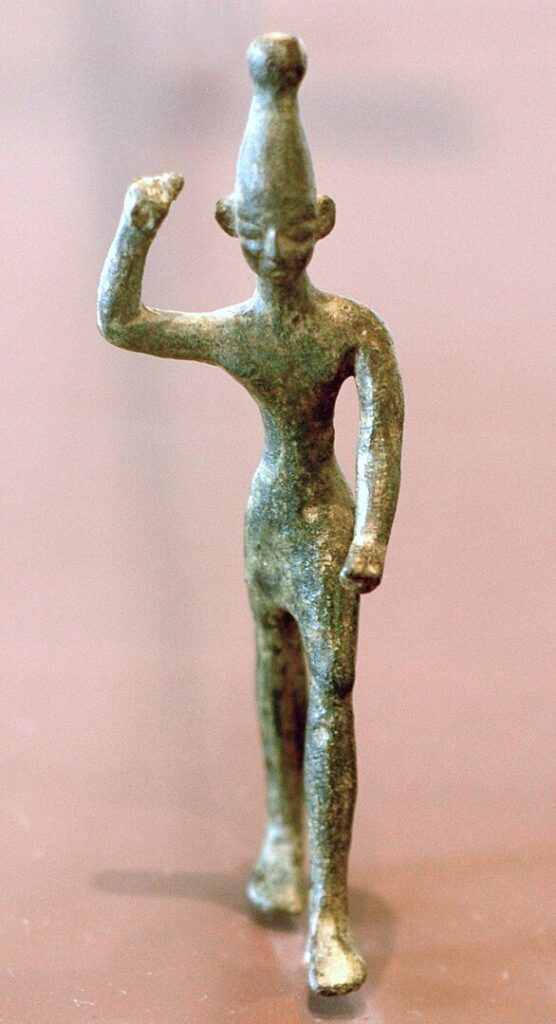
Artists and artisans of the ancient Levant often presented Baal as a powerful human-like figure, standing tall with a muscular build, a horned helmet symbolizing divinity, and a raised right arm ready to strike. His left hand frequently held a club or spear, linking him to both war and agriculture—tools of power and survival. These images were not merely decorative; they carried deep theological meaning for the people who relied on Baal for rain and harvests. The storm god’s visual identity was further shaped by cross-cultural exchanges with neighboring Mesopotamian and Egyptian iconography.
Baal in Ancient Texts and Archaeological Evidence
The Ugaritic Tablets, dating to around 1400 BC, provided scholars such as Charles Virolleaud (1879–1969) with the first coherent literary framework for Baal’s mythology. Archaeological discoveries in the Levant, especially at Ras Shamra, revealed stone stelae and bronze figurines with inscriptions dedicated to Baal-Hadad. One famous basalt stele from the 14th century BC depicts him poised mid-strike, lightning bolt in hand, a direct visual translation of the texts. These archaeological pieces now reside in collections such as the Louvre Museum in Paris and the National Museum of Damascus.
By the late Iron Age, biblical narratives—particularly those in the Books of Kings—began to cast Baal in opposition to the God of Israel. These negative portrayals would later influence Christian interpretations and reshape how Baal appeared in later Western art. Yet even in these critiques, the image of Baal retained elements of his original grandeur: a being of immense power, weather-controlling might, and symbolic authority over life and death.
Baal in Ancient Near Eastern Art
Baal’s image in the ancient Near East was molded by centuries of cultural interconnection between Canaanite, Mesopotamian, and Egyptian traditions. In cities like Ugarit, Tyre, and Byblos, temple reliefs and statuary frequently featured Baal as a warrior-striker, his body adorned with a short kilt, his stance wide and commanding. Artists from around 1500–800 BC perfected a visual shorthand: the raised arm with a weapon for martial strength, the horned helmet for divine authority, and the stylized beard for maturity and wisdom. This image carried over into ivory carvings, cylinder seals, and temple friezes, allowing Baal’s presence to permeate daily and religious life.
Phoenician traders spread Baal’s imagery across the Mediterranean, influencing art as far west as Carthage and as far east as Babylon. In Carthaginian reliefs from the 5th century BC, Baal’s depiction merged with that of Melqart, a maritime protector and ancestral hero. This fusion demonstrates how deities adapted and evolved visually when crossing cultural and geographical boundaries. The artistry was both functional and theological, embedding Baal’s iconography into objects of worship and statecraft alike.
Iconography of Power and Fertility
One of the most consistent features in Baal’s ancient iconography is his dual role as both a bringer of life and a bringer of destruction. The lightning bolt, often depicted as a spear or stylized ray, served as a visual metaphor for rain—vital for crops but deadly in storms. Fertility was implied through scenes of Baal standing over tilled fields or flanked by symbols like bulls, which represented virility and agricultural abundance. Art historians like William Foxwell Albright (1891–1971) noted the balance in these works: Baal was never purely benevolent or malevolent; his power was both feared and celebrated.
Reliefs from the temple of Baal at Ugarit, now fragmented and housed in multiple museums, also reveal sophisticated narrative composition. In some panels, Baal battles chaotic forces like Yam, depicted as serpentine waves, while in others he stands in a serene posture beside a sacred tree. This duality—combat and peace—would later influence medieval and Renaissance depictions of biblical conflict and divine authority.
Baal in Biblical and Early Christian Imagery
By the 1st millennium BC, Hebrew scripture had firmly positioned Baal as the rival of the God of Israel. Passages in 1 Kings and 2 Kings recount confrontations between the prophet Elijah and the prophets of Baal, moments which inspired later manuscript illustrations. These portrayals began to shift the visual language: Baal was no longer the majestic storm-bringer but a false idol, sometimes shown as a grotesque statue or as a lifeless, toppled image in church art. Artists used visual contrast—broken limbs, dim lighting, or unnatural proportions—to communicate theological judgment.
In early Christian mosaics and frescoes, particularly those from the 4th to 6th centuries AD, Baal was reinterpreted through the lens of demonology. Influenced by Greco-Roman imagery of underworld beings, artists began to incorporate animalistic features such as wings, claws, or goat-like horns. These changes aligned with a broader Christian artistic strategy of warning the faithful against idolatry by associating foreign gods with dangerous, deceptive spirits. Manuscripts produced in monasteries across Europe during the Carolingian Renaissance (8th–9th centuries AD) often depicted Baal worship scenes to illustrate Old Testament warnings.
From Deity to Demon
The transformation of Baal into a demonic figure was solidified during the Middle Ages when theologians, including Isidore of Seville (AD 560–636), equated Baal with Beelzebub, the “lord of the flies.” This identification, though linguistically and historically debatable, was visually potent. Artists such as those illuminating the Winchester Psalter (circa 1150 AD) portrayed Beelzebub as a monstrous creature presiding over the damned. These depictions helped create an enduring Western image of Baal as a figure of ultimate corruption.
By embedding Baal within Christian cosmology as a demon, artists effectively erased his earlier role as a revered god from collective memory in Europe. The visual language of this transformation—dark palettes, monstrous anatomy, and chaotic surroundings—remained influential well into the Renaissance, ensuring that Baal’s biblical vilification would overshadow his ancient grandeur in the West.
Baal in Medieval and Renaissance Art
During the medieval period, Baal, often under the name Beelzebub, became a staple in illuminated manuscripts, cathedral sculptures, and morality plays. Monastic scribes in the 13th century, such as those working at the Abbey of Saint Gall, created elaborate marginalia showing Baal being mocked or defeated by angels. These images were not merely decorative; they reinforced theological teachings for largely illiterate congregations, making visual art a primary tool for moral instruction. Cathedral façades in cities like Chartres and Reims sometimes included grotesque demonic figures thought to represent Baal or his associates, symbolically placed to guard against evil.
The Renaissance brought a renewed interest in classical antiquity, but it also allowed artists to reinterpret biblical subjects with heightened realism. Painters like Hieronymus Bosch (circa 1450–1516) used surreal, densely packed compositions to represent hellscapes where Baal-Beelzebub might appear as a hybrid of man, insect, and beast. These works drew from both scriptural exegesis and folk superstition, blending theology with popular culture. Baal was now firmly in the realm of Christian allegory, an example of pride and rebellion against God.
Symbolism and Allegory in European Masterpieces
Symbolism in this era often portrayed Baal as a cautionary figure in moralizing art. In Pieter Bruegel the Elder’s works (1525–1569), though not always explicitly named, figures resembling Beelzebub appear in chaotic battle scenes or processions of the damned. The use of animal features—flies, toads, and serpents—linked Baal to decay and corruption, aligning with his biblical condemnation. These visual metaphors resonated strongly in an age concerned with moral discipline and societal order.
By the late 16th century, Protestant Reformation artists also used Baal imagery to critique Catholic traditions they viewed as idolatrous. While Catholic artists maintained Baal as a demonic adversary, Protestant prints sometimes placed him among allegories of false worship, using the same medieval iconography to serve new theological arguments. This ensured Baal’s image remained both adaptable and polemical, reflecting the religious tensions of the time.
Romantic and 19th-Century Revivals
The late 18th and 19th centuries saw a revival of interest in Baal through the twin forces of biblical archaeology and Romantic Orientalism. Archaeologists such as Austen Henry Layard (1817–1894) and Paul-Émile Botta (1802–1870) uncovered Assyrian and Phoenician sites, bringing ancient reliefs and statues to European museums. These discoveries ignited the imagination of artists eager to visualize the biblical past with archaeological accuracy. Painters and sculptors began reintroducing Baal in grand, exoticized settings, emphasizing the grandeur of ancient civilizations.
The Romantic movement, with its fascination for the sublime and the foreign, embraced Baal as a symbol of both power and mystery. Artists like Jean-Léon Gérôme (1824–1904) painted imagined scenes of ancient worship, bathed in golden light and rich color. Though not all depictions were historically accurate, they captured the emotional drama associated with the god’s mythic battles. This era also saw academic painters consult directly with archaeologists to incorporate authentic details into their compositions.
Archaeology Meets Art
One notable case was the influence of the Baal stele from Ugarit, discovered in the early 20th century but inspired by 19th-century reports of similar finds. The stele’s raised-arm pose and lightning weapon were reproduced in sculptures displayed at the British Museum. Orientalist painters, such as Lawrence Alma-Tadema (1836–1912), drew on archaeological publications to create settings that combined architectural accuracy with artistic imagination. Their works often placed Baal in lavish temples, surrounded by worshippers and offerings.
By blending academic precision with theatrical composition, these 19th-century revivals gave Baal a new life in Western art. He was no longer purely a villain but a complex, almost tragic figure—embodying both the majesty of lost empires and the moral caution of biblical narratives. This nuanced portrayal would pave the way for Baal’s appearance in the experimental art of the 20th century.
Baal in Modern and Contemporary Art
In the 20th century, Baal’s image diversified beyond traditional painting and sculpture. Surrealist artists, fascinated by myth and the unconscious, incorporated Baal as a symbol of primal forces. Salvador Dalí (1904–1989) referenced storm and fertility deities in works that merged dreamscapes with ancient iconography, though he rarely named Baal directly. The god’s association with chaos and elemental power fit well with modernist explorations of the irrational and the sublime.
Fantasy artists and illustrators in the late 20th century, including Frank Frazetta (1928–2010), embraced Baal as an archetype of the dark, warrior-god. His likeness appeared in pulp magazines, role-playing games, and fantasy book covers, often with exaggerated musculature and dramatic lighting. These depictions leaned heavily into the mythic rather than theological aspects, emphasizing Baal’s warrior persona over his demonized Christian counterpart.
From Canvas to Pop Culture
By the 21st century, Baal had entered mainstream entertainment media. Video games like Diablo II (2000) portrayed him as a final boss, blending demonic aesthetics with mythic grandeur. Comic book series such as Hellboy incorporated Baal-like figures as part of elaborate supernatural worlds. These modern adaptations rarely strive for historical accuracy, but they ensure Baal remains a living figure in popular imagination.
Contemporary fine artists also revisit Baal with new intent—sometimes as a critique of power structures, sometimes as an exploration of humanity’s relationship with myth. While some of these interpretations are overtly secular, they still tap into the same visual cues that have defined Baal for millennia: the raised arm, the weapon of storms, and the commanding gaze.
The Enduring Legacy of Baal in Visual Culture
From his first appearance on Bronze Age stelae to his pixelated form in modern video games, Baal’s image has proven remarkably adaptable. His journey through art history mirrors humanity’s shifting relationship with religion, power, and cultural identity. Each era has projected its own values and fears onto him—turning him from divine protector to demonic adversary, from archaeological curiosity to pop culture icon. This visual evolution is a testament to the enduring symbolic power of myth.
Baal’s staying power lies in his ability to embody universal themes: the struggle between order and chaos, the dependence on nature’s cycles, and the dangers of hubris. Artists continue to find in him a rich source of imagery, capable of evoking awe, fear, or fascination depending on the context. Even in secular art, Baal’s ancient aura of authority remains palpable.
Why Baal Still Captivates Artists Today
The reason Baal endures in artistic imagination is partly due to his versatility. He can be majestic or monstrous, ancient or futuristic, literal or symbolic. This flexibility allows each generation to reinterpret him according to its own artistic and cultural priorities.
As long as humanity continues to tell stories about the forces that shape our lives—storms, fertility, war, and the divine—Baal will find a place in our visual narratives. His image, forged in the temples of the ancient Near East, will continue to echo through the galleries, screens, and public spaces of the future.
Key Takeaways
- Baal’s earliest depictions date to around 2000–1200 BC in Canaanite and Phoenician art.
- Biblical narratives redefined Baal from a revered god to a symbol of idolatry and evil.
- Medieval and Renaissance artists used Baal as a moral allegory in religious art.
- 19th-century archaeology sparked renewed, more nuanced portrayals of Baal.
- Baal remains a potent figure in modern and pop culture imagery.
FAQs
- Who was Baal in ancient history? A Canaanite storm, fertility, and war god worshipped from around 2000 BC.
- When did Baal become associated with demons? During early Christian theology and especially in the Middle Ages.
- What is the Baal stele? A 14th-century BC basalt relief from Ugarit showing Baal in a raised-arm warrior pose.
- Which artists depicted Baal? Hieronymus Bosch, Jean-Léon Gérôme, and Lawrence Alma-Tadema, among others.
- How is Baal shown in modern media? As a fantasy warrior, a video game villain, or a symbolic figure in contemporary art.