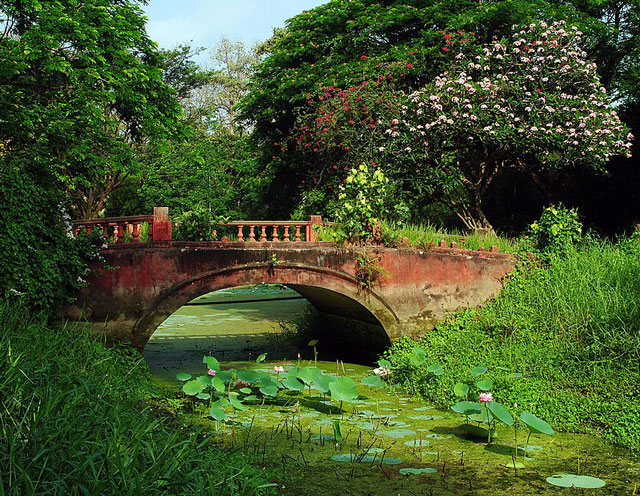
The Acharya Jagadish Chandra Bose Indian Botanical Garden in Kolkata isn’t just a place for scientists or tourists—it’s a natural masterpiece that has inspired generations of artists, writers, and thinkers. Spread over 273 acres on the western bank of the Hooghly River, this garden is a study in balance, blending curated order with wild splendor. From winding paths and still ponds to towering trees that shape the skyline, each element feels intentionally placed, almost as if guided by the hand of a landscape painter. Whether you’re walking under the layered canopy of a palm avenue or sitting beside a lily-covered pond, the effect is immersive and deeply visual.
The garden was established in 1787 by Colonel Robert Kyd of the British East India Company. While Kyd’s primary goal was economic—he aimed to grow tropical plants for trade—the garden was designed with aesthetic considerations rooted in English landscaping principles. Open lawns, long sightlines, and careful clustering of plants were laid out to appeal not just to botanists but to the senses of visitors. The influence of 18th-century landscape gardens such as those at Stowe or Kew is visible in the spatial planning of Kolkata’s garden. This colonial approach combined classical European garden design with the rich, organic palette of Bengal’s tropical flora.
One of the most striking features is how different areas of the garden present distinct moods, a quality not often found in rigidly structured spaces. The cactus house, for example, evokes a dry, almost surrealist stillness, while the orchid house bursts with color and scent, mimicking the vitality of a tropical rainforest. Reflections from water bodies—particularly the expansive lily pond—double the impact of the surrounding foliage, creating layered compositions that shift throughout the day. Artists and photographers often speak of these spots as “natural vignettes,” compositions ready for framing.
As the day moves from dawn to dusk, the garden’s mood transforms in ways that would challenge any painter to capture. Early morning mist softens the outlines of trees, creating a watercolor-like softness. By noon, the sun casts hard-edged shadows that highlight the architectural structure of palms and cycads. In the evening, golden light plays across the paths and tree trunks, creating contrasts reminiscent of classical oil paintings. These changes are not accidental—they are part of what makes the garden a living, breathing canvas for anyone with an eye for beauty.
The Garden’s Origin as an Aesthetic Vision
Colonel Robert Kyd’s establishment of the garden in 1787 was driven by more than just economic ambition. A military officer with an eye for the strategic and the aesthetic, Kyd envisioned a space that would both serve the interests of the East India Company and demonstrate the grandeur of British imperial ambition. The choice of site—along the Hooghly River—offered not just fertile soil, but sweeping views and dramatic lighting that enhanced the visual impact of plantings.
The garden’s early design followed principles drawn from the English landscape movement, particularly the works of Lancelot “Capability” Brown. Rather than the rigid formality of French gardens, English-style gardens were designed to appear “natural,” with open spaces framed by groves and bodies of water. Kyd applied these ideas to the Indian climate and flora, resulting in a blend of foreign design and local plant life that was visually compelling and ecologically viable. The goal was not to mimic nature but to elevate it.
William Roxburgh, who took over the garden after Kyd’s death in 1793, built upon this foundation. Known as the “Father of Indian Botany,” Roxburgh introduced a detailed system of classification and introduced thousands of new plant species, all while maintaining the garden’s aesthetic harmony. His tenure saw the construction of features like the Orchid House and the Herbarium, which were as much about display as they were about science. These structures became visual focal points and were often sketched by visiting artists and scientists.
The garden became a popular stop for British officials, artists, and travelers throughout the 19th century. Journals and travel accounts from the time frequently mention the garden’s beauty, its exotic atmosphere, and the calming, almost contemplative nature of a walk through its groves. It wasn’t merely a place of learning—it was a showcase of the Empire’s reach and a visual testament to the marriage of order and wildness.
Nature’s Geometry – Artistic Symmetry in Plantings
Throughout the garden, the arrangement of plants often follows hidden geometric logic. Wide avenues, particularly the Palmyra and Mahogany avenues, are laid out with such precision that they resemble the nave of a cathedral. The spacing, height, and symmetry create a sense of rhythm and progression as one walks along. These formal arrangements contrast beautifully with the more naturalistic plantings nearby, allowing visitors to experience both structure and spontaneity.
In the Palmetum, for example, various species of palm trees are grouped in concentric circles, each radiating out like the spokes of a wheel. The visual impact of such planning is significant—it draws the eye inward and encourages visitors to pause, observe, and contemplate. These design elements were not simply for decoration. They were intended to display botanical diversity in an accessible and visually engaging way, marrying function and beauty.
Similarly, the cactus house displays its specimens in raised beds and radial rows, echoing patterns found in ancient Indian temple design. The symmetrical layout and the contrast between harsh, spiny textures and soft earthen paths create a dramatic effect. The garden’s designers understood that how a plant is displayed can influence how it is perceived and appreciated—not just scientifically, but artistically.
The Orchid House, perhaps the most sensuous area of the garden, arranges its vibrant blooms by color and height, forming chromatic waves that guide the viewer’s eye. The effect is comparable to a pointillist painting—up close, each flower is distinct, but from a distance, they form a unified composition. Artists who sketch here often describe the space as a natural gallery, where the exhibits rearrange themselves with each season.
Key Visual Zones with Artistic Symmetry:
- Palmyra Avenue: Grand linear perspective with tall symmetrical palms
- Cactus House: Concentric raised beds resembling ancient stone mandalas
- Palmetum: Radiating patterns of fan-shaped palms
- Mahogany Grove: Evenly spaced vertical columns creating rhythm
- Orchid House: Color gradation patterns, resembling floral mosaics
Light, Texture, and Perspective in Natural Design
Light transforms the garden more dramatically than in any man-made space. The tall canopies filter sunlight in delicate beams, creating patches of moving light and shadow that shift as the day progresses. Photographers often favor the early morning hours when mist hovers above the grass and dew catches light in iridescent flashes. This natural lighting gives depth and contrast to the garden’s textures—rough bark, glossy leaves, velvety petals—all playing off one another in visual harmony.
Texture is another artistic element embedded in the garden’s layout. There are plants with leaves like feathers, others with sharp ridges or spines, and some that reflect sunlight like polished stone. Walking from the spongy soil of the bamboo grove to the dry paths near the cactus house is akin to moving through different visual media—each area has its own tactile and visual vocabulary. Painters and illustrators who come here often note how these textures challenge and expand their approach to form.
Perspective also plays a role in how the garden is experienced. The long walkways create a forced perspective, drawing the eye toward a central point. Whether that’s a statue, a tree, or a distant pond, the effect adds drama and structure to the journey. These perspective lines mirror classical techniques used in Renaissance and Baroque painting, suggesting that the garden was designed with visual storytelling in mind.
Even from above, the garden presents itself as a thoughtfully composed image. Aerial photographs reveal circles, arcs, and lines formed by rows of trees and the curvature of paths. The result is an organic geometry, both deliberate and softened by nature. Artists seeking inspiration here are not limited to individual plants—they find meaning and beauty in the full composition.
The Great Banyan Tree – A Natural Sculpture of Time
No visit to the Acharya Jagadish Chandra Bose Indian Botanical Garden is complete without standing beneath the immense canopy of the Great Banyan Tree. This ancient tree, a species of Ficus benghalensis, is one of the largest in the world and has come to symbolize the garden itself. Planted sometime around the early 19th century, it has thrived for over 250 years, spreading across more than 3.5 acres. What appears to be a dense grove is, in fact, a single organism—its aerial roots have grown into what looks like hundreds of separate trunks.
The central trunk of the tree died in 1925 after being struck by lightning, but by then the tree had already sent down hundreds of prop roots that continued to grow into secondary trunks. Today, the Great Banyan Tree has over 3,600 such support trunks, and it continues to expand. From a distance, it resembles a forest—an illusion that only enhances its legendary status. For artists and sculptors, the tree offers more than size—it’s a study in form, movement, and resilience.
This tree has often been likened to a cathedral. The arched spread of branches, the natural columns formed by roots, and the dappled light filtering through its thick canopy create a reverent atmosphere. Visitors describe the experience of walking under the tree as stepping into a living temple. The structure evokes sacred architecture—not in stone, but in living, breathing wood. This natural monument transcends botany and becomes a powerful artistic subject.
Over the decades, artists have returned to this tree repeatedly, attempting to capture its vastness and intricacy. Painters, photographers, and even sculptors find inspiration in its intertwining forms. Like the twisted spires of a medieval cathedral or the knotted pillars of Romanesque architecture, the banyan’s roots and limbs invite the imagination. Indian miniaturists, British etchers, and modern illustrators alike have all tried to do justice to its quiet grandeur.
Structural Majesty – Form Without a Central Trunk
The Great Banyan Tree is unique among trees in that its most iconic feature is also its greatest anomaly—it has no visible central trunk. When the original trunk was removed in 1925 due to fungal infection after lightning damage, the tree did not perish. Instead, its aerial roots had already anchored themselves deeply into the earth, allowing it to thrive independently of its origin. What remains is a radial structure that expands outward, forming new trunks and canopy zones in all directions.
Architecturally, the tree is a marvel of natural engineering. Its branches are not linear but arc gracefully, sagging gently under their own weight before launching downward in root form. These roots, once in contact with the soil, thicken and harden, becoming indistinguishable from primary trunks. This creates a layered, complex geometry that has fascinated biologists and artists alike. In architectural terms, it resembles the vaulting systems found in medieval churches, with each support transferring weight outward.
When viewed from inside, the tree’s structure takes on a different character. The shifting thickness of its branches and the spacing of its support roots form a sort of rhythm—one that changes depending on your angle and distance. Light penetrates in waves, highlighting the high arches and casting patterned shadows across the ground. The natural symmetry of the tree, while imperfect, carries the same visual weight as man-made domes or colonnades.
This growth pattern has influenced Indian architects and designers interested in biomimicry—designing buildings inspired by nature. The banyan’s ability to build support from within and expand organically has made it a model for sustainable architecture. But even more than a model, it remains an enduring source of wonder—something that invites viewers to look longer, think deeper, and admire the art of life itself.
Cultural Symbolism and Visual Power
In Indian culture, the banyan tree has long held symbolic significance. Referred to in Sanskrit texts as Vata Vriksha, it is considered sacred, often associated with Lord Shiva and the goddess Savitri. Temples are frequently built under or beside banyan trees, and it is commonly seen as a symbol of eternity, wisdom, and shelter. Its inclusion in this botanical garden adds not just botanical weight but spiritual resonance, especially for artists and storytellers.
The banyan has been featured in countless Indian folktales and paintings, often depicted as a place of refuge or meditation. In miniature painting traditions, especially from Rajasthan and Bengal, the banyan often serves as the central element in compositions that explore human relationships, divine encounters, and natural cycles. The tree’s sprawling form allows artists to create layered narratives within its branches.
Photographers, too, are drawn to the tree’s symbolic power. Wedding shoots, religious observances, and cultural documentaries frequently use the Great Banyan Tree as a backdrop. Its roots are not just physical—they connect with the cultural memory of the land. Artists tap into this power when capturing or depicting the tree, knowing that it speaks to more than just the eye—it touches the heart of Indian heritage.
In the context of the botanical garden, the tree functions on multiple levels: as an ecological giant, an artistic marvel, and a cultural monument. Visitors may first be impressed by its size, but those who linger find something deeper—a sense of timelessness, continuity, and natural majesty that transcends generations. It is this layered significance that makes it one of the most artistically powerful trees in the world.
(Continued in next response…)
2/2
You said:
continue
ChatGPT said:
Artistic Interpretations Through the Ages
From the early 19th century, artists—both Indian and European—have been captivated by the grandeur of the Great Banyan Tree. Some of the earliest artistic interpretations can be found in the travel journals and lithographic collections of British officers and botanists. Artists like James Baillie Fraser, who was active in India during the 1820s and 1830s, made detailed sketches of Indian landscapes, including the famous banyan. These early drawings emphasized the tree’s vast scale and its almost mythical presence in the landscape.
During the height of the British Raj, the tree became a subject of both artistic and scientific documentation. Botanical illustrators working under William Roxburgh and later Nathaniel Wallich produced numerous pen-and-ink and watercolor depictions of the banyan, often combining artistic style with botanical accuracy. These works were later published in collections like Roxburgh’s Flora Indica and Wallich’s Plantae Asiaticae Rariores. While their primary aim was classification, the care and beauty of the illustrations reveal an unmistakable artistic sensitivity.
Indian artists, especially those working in the Bengal School of Art in the early 20th century, found renewed inspiration in native trees and landscapes. The banyan appeared in the works of artists like Nandalal Bose, who used the tree not only as a literal subject but also as a metaphor for rootedness and cultural strength. Bose’s ink drawings and woodcuts capture the complexity of the banyan’s form in minimalist strokes, showing how Indian artists interpreted the tree differently from their European counterparts.
Today, the tree continues to inspire creative expression. Photographers from across the country visit the garden to capture the banyan in different lights and moods. Painters often hold plein air sessions beneath its canopy, while digital artists use drone footage to create symmetrical mandala-like patterns from aerial views. The Great Banyan Tree has become more than a botanical wonder—it is a recurring motif in India’s visual arts, evolving with each generation of creators.
Colonial Elegance and Botanical Artistry
Beyond its botanical marvels, the garden reflects the aesthetics of its colonial creators, who viewed landscaping not only as science but also as an expression of civilizational order. The British Empire used architecture, gardens, and public spaces to demonstrate both control and refinement. In this context, the garden became a stage upon which man’s mastery over nature—and by extension, over empire—was subtly performed. But the artistic legacy of this approach is undeniable.
One of the defining figures of the garden’s early development was William Roxburgh, who took over from Robert Kyd after his death in 1793. Roxburgh, trained as a botanist in Scotland, had a deep appreciation for both botanical science and visual documentation. Under his guidance, the garden’s herbarium expanded rapidly, and he commissioned detailed botanical illustrations that were both accurate and beautiful. These were produced by Indian artists employed at the Calcutta Botanic Garden, many of whom remain unnamed but left behind a significant visual legacy.
The architectural features of the garden also contribute to its artistic appeal. The Herbarium Building, constructed in the mid-19th century, is a fine example of colonial institutional architecture, with its arched verandas and classical proportions. Small pavilions and iron bridges scattered throughout the grounds create moments of visual punctuation, breaking up the greenery with elegant forms. These structures were placed not at random but with an eye for composition, enhancing sightlines and creating scenic rest points.
The juxtaposition of tropical plant life with classical European architecture produces a kind of aesthetic tension—one that many artists have found irresistible. The straight lines and pale stone of the colonial buildings contrast sharply with the sinuous, wild forms of banyans, palms, and bougainvillea. This contrast is not just visual but symbolic—a reminder of the meeting of two worlds, each bringing its own artistic language to the landscape.
The Role of Colonial Garden Designers
Colonial garden designers, particularly in the 18th and 19th centuries, saw themselves as cultural ambassadors. Their goal was not merely to catalog or cultivate plants but to create spaces that reflected Enlightenment ideals—order, rationality, and beauty. Colonel Robert Kyd and William Roxburgh were pioneers in this regard, turning the Calcutta Botanic Garden into a model of artistic and scientific ambition.
Kyd’s original plan was to develop the garden as a space for cultivating economically useful plants, especially teak and spices, but he did so by creating a layout that mimicked the great European gardens of his day. He incorporated broad walkways, water bodies, and designated plant zones that encouraged leisurely exploration and aesthetic appreciation. These features were inspired by places like Kew Gardens in London and the Royal Botanic Gardens in Edinburgh.
Roxburgh, who took over from Kyd, brought a heightened sense of visual order to the project. He not only cataloged thousands of new plant species but also insisted on their visual documentation through illustration. He believed that a drawing could capture more information than a written description alone. This insistence turned the garden into a hub for botanical illustrators—many of them native Indian artists trained under British supervision.
The impact of these designers on Indian garden art cannot be overstated. Their work laid the groundwork for a visual tradition that continues to influence Indian garden design today, blending formal Western layouts with local flora. Their legacy also survives in the countless sketches, watercolors, and lithographs produced under their direction—works that are now prized in collections from Kolkata to London.
Classical Structures Amidst Tropical Wilderness
Amid the lush, semi-wild plantings of the garden, colonial-era structures stand as visual anchors. These include gazebos with intricate wrought ironwork, a modest but elegant garden house, and a series of cast iron bridges that cross the garden’s small canals. These features add architectural rhythm to the natural setting, creating points of interest that guide visitors visually and physically through the space.
The Herbarium Building, one of the oldest scientific structures in the garden, is built in the neoclassical style with a long colonnaded front and large wooden windows. It holds over 2.5 million preserved plant specimens and offers a space of cool repose amid the garden’s more humid environments. Its symmetry and design are intentionally grand, in keeping with Victorian ideals of scientific greatness and public education.
One of the most beloved structures is a Victorian-style cast iron bridge spanning the Lotus Pond. The ornate railing, painted in deep green and gold, mirrors the lotus flowers below and serves as a favorite subject for photographers and artists. It often appears in travel sketches from the 19th century, and even today, its charm remains untouched by time.
These structures serve more than practical purposes—they shape the way the garden is viewed and experienced. Framing devices like pavilions and pergolas function like the borders of a painting, helping viewers to focus their gaze and appreciate the scene as a complete composition. This blending of art and function is part of what gives the garden its unique and lasting visual appeal.
Botanical Illustration as Artistic Documentation
One of the most enduring contributions of the botanical garden to the arts is the treasure trove of botanical illustrations it helped generate. These works were not mere scientific diagrams—they were carefully rendered images that brought out the beauty and complexity of each plant. Many of these illustrations were commissioned by William Roxburgh and later by Nathaniel Wallich, and executed by native Indian artists whose skill remains evident in the works today.
These illustrations were gathered into volumes like Flora Indica and Wallich’s Catalogue, many of which were published in London during the 19th century. The detail and artistry in these illustrations rival that of European botanical masters like Pierre-Joseph Redouté. The Indian artists—often trained in Mughal miniature painting—brought a distinctive precision and delicacy to their subjects. Their work bridged the gap between Eastern and Western artistic traditions.
Some of the most famous botanical subjects depicted include the Nelumbo nucifera (sacred lotus), the Areca catechu (betel nut palm), and the Nymphaea nouchali (blue water lily). These illustrations helped spread knowledge of Indian flora across Europe and were used in scientific studies, public exhibitions, and even interior decoration. The beauty of these works continues to inspire artists and designers today.
Though the names of many native illustrators were not recorded, recent scholarship has begun to recognize their vital role in this artistic heritage. Their contributions deserve to be remembered not just for their scientific accuracy but for their role in elevating Indian flora into the realm of fine art.
Major Botanical Illustrators and Works Linked to the Garden:
- William Roxburgh – Flora Indica (1832)
- Nathaniel Wallich – Plantae Asiaticae Rariores (1829–1832)
- Vishnupersaud – Indian botanical illustrator (early 19th century)
- K. Rangaiah – Contributed to Wallich’s collection in the 1830s
- John Fleming – Catalogued specimens with detailed visual notes
(Continued in next response…)
You said:
go
ChatGPT said:
The Artist’s Garden Today – A Muse for Modern Creators
While rooted in history, the Acharya Jagadish Chandra Bose Indian Botanical Garden continues to inspire contemporary artists and creators in powerful and diverse ways. Far from being a relic of the colonial past, the garden has become a dynamic space where art, nature, and modern sensibilities intersect. Local painters, sketch artists, photographers, and filmmakers visit regularly to engage with its vast botanical and visual diversity. The seasonal changes, shifting light, and living textures provide an endless supply of inspiration, much like an outdoor studio that reshapes itself every day.
Today, the garden also serves as an educational space for emerging artists. Institutions like the Government College of Art & Craft in Kolkata often conduct field studies, plein air painting sessions, and botanical drawing workshops within the garden grounds. These sessions are not merely academic; they are deeply artistic, encouraging students to interpret natural forms through their own lens. The quiet, contemplative atmosphere of the garden offers a rare refuge from the distractions of urban life, making it ideal for concentrated creative work. The heritage trees and colonial structures add layers of history and memory to the visual experience.
Several exhibitions and art shows in Kolkata have featured works inspired by time spent in the garden. These range from traditional watercolor landscapes to abstract compositions that use plant textures, leaf forms, and color gradients as their central motifs. Some artists create multimedia pieces using pressed leaves, bark textures, or even natural dyes sourced from the garden’s plants. This evolving relationship between the artist and the natural world highlights the garden’s enduring role as muse and mentor.
The connection between art and ecology has become more prominent in recent years, and the garden fits naturally into this growing movement. Artists working in the eco-art tradition often use the space to raise awareness about conservation, biodiversity, and sustainability. Whether through temporary installations or permanent pieces, the garden becomes both subject and collaborator in the creative process. This contemporary engagement is proof that the artistic significance of the garden is not frozen in the past—it is alive and growing, just like its trees.
Contemporary Artists and Creative Retreats
Modern artists in Kolkata and beyond view the botanical garden as a vital retreat—a space where creativity is nurtured by the rhythms of nature. Numerous painters and illustrators maintain a practice of regular visits to the garden, sketching scenes in real time or collecting visual material for use in their studios. The garden’s vastness and variety ensure that no two visits are the same. Each walk through the grounds uncovers new shapes, colors, and compositions.
Art schools in the region frequently organize plein air sessions here. The Government College of Art & Craft, established in 1854, has maintained a long-standing relationship with the garden. Students are often assigned to study leaf patterns, tree bark, or landscape composition as part of their curriculum. These sessions produce not only technical studies but often yield deeply personal interpretations of natural forms—sketches and paintings that carry the artist’s emotional response to the garden’s tranquility.
Several noted contemporary artists have credited the garden as a key influence. For instance, printmaker Sanat Kar and watercolorist Samir Aich have both mentioned the botanical garden in interviews as a place where they reconnect with silence and visual complexity. The textural contrasts and organic patterns found here often appear in their compositions, even when abstracted beyond recognition. For these artists, the garden is not just scenery—it is a source of form, structure, and inspiration.
Occasionally, group art events and creative retreats are hosted in the garden itself. These gatherings bring together painters, illustrators, photographers, and writers to reflect on the relationship between environment and expression. The setting promotes collaboration, observation, and artistic dialogue, reviving an older tradition of drawing inspiration from nature in community rather than isolation.
Photography and Cinematic Influence
The garden’s visual richness has not gone unnoticed by photographers and filmmakers. For decades, it has served as a backdrop for editorial photo shoots, documentaries, and even scenes in Indian cinema. Its diverse scenery—ranging from sun-drenched open lawns to mysterious banyan groves—makes it a versatile location for storytelling through the lens. The atmospheric lighting and sense of space add cinematic value that’s difficult to replicate on a soundstage.
Indian photographers like Rathika Ramasamy and Arati Kumar-Rao have documented the garden’s birdlife and botanical forms, producing work that blends fine art and environmental awareness. Many wildlife photographers use the garden as a training ground, capturing rare birds, butterflies, and insects in the soft natural light that filters through the trees. The slow pace of nature photography aligns well with the tranquil environment of the garden, allowing for thoughtful composition.
Cinematographers, too, find the garden’s unique mix of colonial architecture and tropical plant life to be a compelling visual motif. Films set in Kolkata—such as Chokher Bali (2003) and Piku (2015)—have featured short scenes filmed near or inspired by the garden. Though not always credited directly, its iconic settings—the lily ponds, wide paths, and monumental trees—are instantly recognizable to locals. In art-house cinema and documentaries, the garden frequently serves as a visual metaphor for time, memory, or natural continuity.
In addition to motion pictures, fashion and lifestyle photographers have used the garden as a backdrop for shoots. Saree catalogs, nature calendars, and eco-tourism campaigns often choose the site for its rich textures and balanced compositions. The interplay of foliage, filtered sunlight, and human figures results in images that are simultaneously natural and curated—a duality that lies at the heart of good photography.
Nature-Inspired Installations and Eco-Art
As environmental consciousness becomes a more central theme in contemporary art, the garden has seen an uptick in eco-inspired installations and performances. These works use natural materials—fallen leaves, branches, clay, and seed pods—to create temporary art pieces that both honor and engage with the environment. Often ephemeral, these installations decay naturally over time, echoing the cycles of growth and death present in the garden itself.
Local artist collectives occasionally collaborate with garden authorities to host environmental awareness events that include interactive art. Children and students build leaf collages, create clay sculptures of endangered species, or weave temporary wall hangings from plant fibers. These workshops serve both educational and artistic purposes, instilling a respect for nature through hands-on creativity.
Installations have included mandala-style ground art created with colored leaves, floating arrangements on ponds, and woven structures tucked between tree roots. These pieces invite quiet reflection and often emphasize the themes of harmony, fragility, and regeneration. While not permanent, their impermanence is part of their message, reminding viewers that beauty and time are inseparable.
In 2019, a small exhibition titled The Green Imagination was held in a temporary gallery space near the garden entrance, showcasing photographs, drawings, and sculpture all inspired by time spent within the botanical garden. The event drew attention to the garden not just as a historical site but as a vibrant source of contemporary artistic dialogue. It also reaffirmed that the garden’s role as an artistic muse continues well into the 21st century.
Key Takeaways
- The garden is a masterclass in visual design, blending British landscape principles with tropical Indian flora.
- The Great Banyan Tree stands as both a scientific marvel and a symbol of spiritual and architectural grandeur.
- Colonial designers like Robert Kyd and William Roxburgh integrated aesthetics with function, leaving a lasting artistic legacy.
- Botanical illustrations from the 18th and 19th centuries are prized for their beauty as well as their scientific value.
- Today, the garden continues to inspire contemporary artists, photographers, and eco-artists with its living, changing beauty.
Frequently Asked Questions
- What year was the botanical garden in Kolkata established?
It was established in 1787 by Colonel Robert Kyd of the British East India Company. - Who was William Roxburgh and what was his role?
Roxburgh succeeded Kyd and is considered the “Father of Indian Botany”; he greatly expanded the garden and emphasized artistic botanical documentation. - How large is the Great Banyan Tree and why is it significant?
It spans over 3.5 acres and appears to be a forest, although it’s a single tree with thousands of aerial roots. - Can the public access the garden for artistic purposes?
Yes, artists and students frequently visit to sketch, paint, photograph, or study plant life for creative projects. - Are there any notable artistic works or publications linked to the garden?
Yes, illustrations in Flora Indica and Plantae Asiaticae Rariores were based on plant specimens from the garden and are considered works of botanical art.