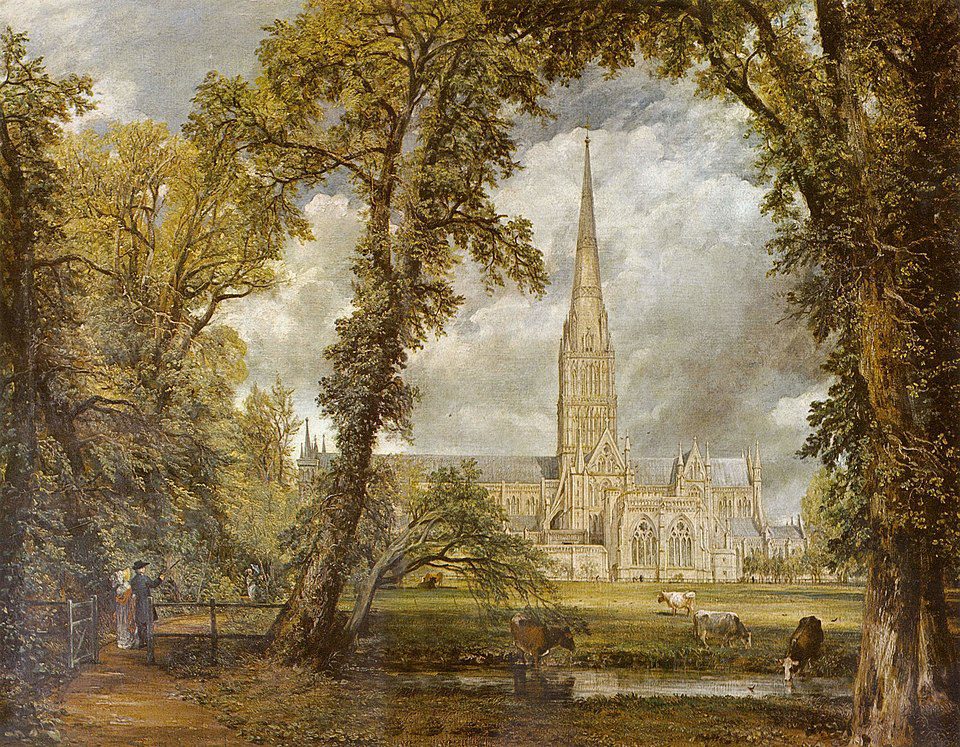
John Constable’s Salisbury Cathedral from the Bishop’s Grounds (1823) is a cornerstone of British landscape painting and a testament to Constable’s spiritual and artistic convictions. The painting, now in the collection of the Victoria and Albert Museum in London, depicts the grand cathedral from the southwest, framed by trees and clouds that serve both aesthetic and symbolic purposes. The work combines architectural fidelity with a poetic interpretation of the natural world, making it one of Constable’s most admired and studied paintings. Its balance of stormy skies and sunlit stone captures the artist’s belief in the divine presence within nature.
The composition was commissioned by Constable’s close friend and patron, Bishop John Fisher, who had deep personal and spiritual ties to the cathedral. Fisher, Archdeacon of Berkshire at the time, and later Bishop of Salisbury, provided Constable with lodging and access to the cathedral and its grounds. The painter visited Salisbury multiple times between 1811 and 1823, frequently sketching and painting en plein air in the bishop’s gardens. The result is a scene that carries both geographical accuracy and intimate sentiment, crafted not from imagination but from life and friendship.
This particular painting differs from later versions in tone and mood. The 1823 V&A version is marked by relative tranquility and compositional clarity. Unlike the later 1831 version, Salisbury Cathedral from the Meadows, with its dramatic storms and brooding symbolism, the Bishop’s Grounds painting exhibits a more measured harmony between man-made structure and natural world. Constable integrates details like cattle in the meadow and arching elms with reverent care, emphasizing rural order rather than chaos.
Constable wrote that the sky was “the chief organ of sentiment in a painting.” In Salisbury Cathedral from the Bishop’s Grounds, the sky is dynamic but not menacing—a mosaic of white clouds and pale blue, gently backlighting the cathedral. It reinforces the theme of divine providence in the ordinary, a cornerstone of Constable’s conservative worldview. This painting isn’t just a view—it’s a statement of belief.
A British Icon in Paint
Though often categorized broadly as a Romantic, Constable was in many ways a traditionalist. His landscapes weren’t emotional outbursts or abstractions—they were carefully constructed meditations on order, continuity, and divine design. In this painting, the cathedral rises not in opposition to nature, but as part of it. It is this vision of harmony, not disruption, that gives the work its enduring power. Rather than inventing idealized settings like many of his continental peers, Constable painted what was in front of him—faithfully and lovingly.
The decision to frame the cathedral with large trees on both sides was not just a compositional strategy, but a philosophical one. Constable emphasizes continuity—both with the land and with the faith that built such a monument. The trees also serve as a symbolic archway, a kind of natural cathedral nave leading the eye to the great stone spire. This sense of order and reverence elevates the entire painting beyond simple landscape into something spiritual.
Constable’s palette here is rich but restrained. He uses cool greens and warm ochres to unify the earth and sky, and his brushwork is crisp and deliberate. There’s a calm dignity in the way the light strikes the stone, drawing the viewer’s eye gently upward to the steeple. That subtle lift of the gaze—first to the trees, then to the tower, then to the heavens—mirrors the path of prayer and contemplation. This is the kind of visual theology that marks Constable’s finest work.
From a national point of view, Salisbury Cathedral from the Bishop’s Grounds serves as a celebration of English Christianity and heritage. In an age where revolutions had swept across Europe and church authority was under attack, Constable offered a quiet but clear counterpoint: tradition, rooted in place and faith, is beautiful and worth preserving.
Why Salisbury? Constable’s Personal Connection
Constable’s deep relationship with Salisbury stemmed largely from his friendship with Bishop John Fisher, whom he had met around 1811. The two men shared more than artistic interests; they were both firm believers in the Anglican tradition and in the moral power of nature. Fisher commissioned the 1823 painting to be a personal and spiritual image—something to reflect the grandeur of the cathedral and the grace of the surrounding countryside.
The Bishop’s invitation allowed Constable to make several extended visits to Salisbury, where he completed sketches and studies that would eventually feed into the final painting. His letters from the period mention the beauty of the light, the majesty of the cathedral spire, and his growing attachment to the town. Fisher’s support was not just financial—it was emotional and spiritual, giving Constable a sense of belonging during difficult years.
In choosing to paint the cathedral from the bishop’s garden, Constable was showing more than a pretty view. He was offering a vision of Anglican stability and personal connection—a kind of visual thanksgiving for the comfort and camaraderie he found in Salisbury. This reinforces the idea that the landscape is not just scenery, but a site of meaning and memory.
Importantly, this version of the painting was presented to Bishop Fisher as a gift of esteem. It was Constable’s way of expressing gratitude and reverence—not just for the place, but for the man who embodied the values Constable admired: faith, dignity, and a deep love for England’s heritage.
Versions of Salisbury Cathedral by John Constable:
- Salisbury Cathedral from the Bishop’s Grounds (1823, Victoria and Albert Museum)
- Salisbury Cathedral from the Bishop’s Grounds (smaller version, Frick Collection, New York)
- Salisbury Cathedral from the Meadows (1831, Tate Britain)
- Oil sketch for Bishop’s Grounds version (1822, Yale Center for British Art)
- Preliminary drawings and cloud studies (Various collections)
John Constable: Defender of England’s Green Legacy
John Constable (1776–1837) was not simply a painter of picturesque scenery; he was a custodian of English identity through the medium of art. Born in East Bergholt, Suffolk, on June 11, 1776, Constable grew up immersed in the rural rhythms of the Stour Valley, a place he would later call the “noblest scene in England.” His upbringing in this bucolic environment laid the foundation for his lifelong devotion to the English countryside. More than mere nostalgia, Constable’s landscapes conveyed a conviction that England’s moral and spiritual strength was rooted in its land, traditions, and Christian values.
Though he trained at the Royal Academy in London beginning in 1799, Constable never adopted the fashionable tastes of the continental academies. He resisted the theatrical grandeur of Baroque or Neoclassical compositions, focusing instead on accurate depictions of real places he loved. He found inspiration not in myth but in meadows, hedgerows, and churches. His commitment to realism and natural light was at odds with the idealized forms popular at the time. In this sense, Constable was not a rebel but a stalwart—standing firm in the belief that beauty, truth, and national identity were found in the familiar English landscape.
Constable’s marriage to Maria Bicknell in 1816 marked a joyful turning point in his personal life, though it was opposed by her family due to his uncertain finances. Their union brought stability and inspiration, and many of his most famous works, including The Hay Wain (1821), were painted during this period. However, the joy was short-lived. Maria’s health declined soon after the birth of their seventh child, and she died of tuberculosis in 1828. Her death devastated Constable and cast a shadow over his later work, which took on darker tones and more brooding atmospheres.
After Maria’s passing, Constable wore black for the rest of his life and often infused his paintings with deeper emotional undercurrents. His art became less about pastoral serenity and more about moral and spiritual struggle. While he never abandoned the themes of order and divinity in nature, his skies grew stormier, and his brushwork looser. This tension is visible even in the more serene Salisbury Cathedral from the Bishop’s Grounds, painted just before this emotional decline. It serves as a transitional piece between his earlier optimism and later sorrowful grandeur.
Rooted in Suffolk: Early Influences
Constable’s roots in Suffolk were not just geographical—they were moral and aesthetic. His father, Golding Constable, was a prosperous miller and merchant, which gave John access to education and the freedom to explore his artistic interests. The countryside around East Bergholt, especially Flatford Mill and Dedham Vale, became recurring subjects throughout his life. These weren’t just pretty locations—they were part of his identity, woven into his moral framework.
His early studies show a fascination with light, movement, and seasonal change. Even as a young man, Constable resisted the tradition of sketching ruins or Alpine peaks, focusing instead on the gentle undulations of English farmland. He saw in this landscape a kind of eternal truth—something divinely ordered and inherently good. It’s no accident that he later chose to depict Salisbury Cathedral not as a monument of distant awe but as part of a working, living countryside.
While still in Suffolk, Constable developed his method of painting skies based on direct observation. He would fill sketchbooks with cloud studies, noting time of day, wind direction, and temperature. This empirical approach grounded his art in reality and demonstrated a discipline that paralleled his moral seriousness. He was not interested in novelty but in truth—and for Constable, truth lived in the land of his birth.
Throughout his career, Constable remained loyal to Suffolk even as he worked in London or traveled elsewhere. When he said, “I should paint my own places best,” he meant it quite literally. His loyalty to localism over exoticism was both aesthetic and ideological—a quiet but firm affirmation of English soil, English sky, and English soul.
Marriage, Loss, and Spiritual Growth
Constable’s love for Maria Bicknell was both passionate and enduring. The two were engaged for seven years, often writing letters full of devotion, before finally marrying in 1816. Their early married life was productive and happy, though not without hardship. They moved to London, where Constable hoped to attract patrons, and began raising a family. These years saw the creation of many of his masterworks, but also increasing financial strain and health problems for Maria.
Her battle with tuberculosis intensified after the birth of their seventh child in 1828. The disease progressed rapidly, and Maria died on November 23 of that year. Constable never fully recovered from the loss. He poured his grief into his work, often using nature to explore themes of mortality and divine mystery. He became more withdrawn, devoting time to the Royal Academy as a lecturer and serving as a single father to his children.
His deepening sorrow did not erode his faith but gave it a more somber tone. He believed that suffering was part of God’s providential plan, and this belief is echoed in his later paintings. The gentle clouds of Salisbury Cathedral from the Bishop’s Grounds would give way to more dramatic skies, yet his core philosophy remained intact: that beauty reveals the divine order, even in the midst of personal sorrow.
Maria’s death also impacted Constable’s view of legacy. He became more invested in ensuring his works would be understood and preserved. He began revisiting themes and locations from earlier years, including Salisbury, as if to reconnect with better times and express truths that now carried more weight. This emotional evolution makes the 1823 painting feel all the more poignant, marking the last light before the storm.
A Conservative Painter in a Changing Age
The early 19th century was a time of great upheaval—politically, socially, and artistically. Revolutions had swept across Europe, industrialization was transforming daily life, and Romanticism often leaned toward radicalism. Constable stood apart from these trends. He remained loyal to the Church of England, traditional values, and the rural landscape as a source of moral clarity. While others painted allegories or exotic ruins, Constable painted plowed fields, parish churches, and village scenes.
His conservatism was not reactionary but rooted in a deep belief in continuity and virtue. He saw no need to break from tradition when tradition had given birth to cathedrals, farmland, and a moral society. In this light, his landscapes become more than art—they become quiet acts of cultural resistance. By painting England as it was, and should remain, Constable offered a visual argument for stability over revolution, faith over frenzy, and truth over trend.
This position didn’t always make him popular. Critics often misunderstood his lack of theatrical flourish, and his major works were rarely purchased during his lifetime. Yet Constable remained undeterred. He believed that genuine beauty would eventually be recognized and that the public would come to appreciate art that reflected their heritage rather than challenged it.
It was this fidelity to truth—natural, moral, and national—that makes Constable’s legacy so enduring. He didn’t just preserve England’s countryside on canvas; he elevated it to a symbol of enduring faith and order. In Salisbury Cathedral from the Bishop’s Grounds, that mission is crystal clear: to show what is sacred, not through myth or metaphor, but through the land and institutions that shaped English civilization.
The Subject: Salisbury Cathedral as a Beacon of Faith
Salisbury Cathedral stands as one of the great monuments of English Christianity—an architectural and spiritual beacon rooted in centuries of tradition. Built between 1220 and 1258 AD, the cathedral is a masterpiece of Early English Gothic architecture. Its elegant spire, added around 1320 AD, remains the tallest in the United Kingdom at 404 feet. Situated on the edge of the city in the county of Wiltshire, the cathedral’s location in a flat valley allows it to dominate the surrounding countryside, reinforcing its presence as a literal and figurative high point of the Anglican tradition.
John Constable, ever mindful of history and symbolism, was drawn to Salisbury not only for its beauty but for what it represented: continuity, faith, and permanence in an era of uncertainty. The cathedral’s sacred purpose and visual prominence aligned perfectly with his own artistic and moral sensibilities. For Constable, the structure was not simply stone and mortar; it was a visual expression of English Christianity—solid, enduring, and sanctified. Painting it was more than an artistic endeavor; it was a spiritual act.
Unlike many artists who viewed cathedrals as aesthetic curiosities, Constable approached Salisbury with reverence. His close relationship with Bishop John Fisher gave him both emotional proximity and physical access to the cathedral and its grounds. Fisher, who became Bishop of Salisbury in 1817, was a devout Anglican with strong traditionalist views. He and Constable shared a mutual concern for the preservation of England’s spiritual and cultural heritage. Through Fisher’s patronage, Constable was invited to stay in the Bishop’s Palace, where he studied the cathedral from different angles and under varied lighting conditions.
It’s important to understand that Constable chose to paint the cathedral not from the town or a popular tourist vantage point, but from the Bishop’s Grounds—a private, sheltered area filled with mature trees and bordered by peaceful meadows. This location framed the cathedral not just as a landmark, but as part of a living spiritual landscape. In placing it within nature, Constable reinforced the message that sacred order permeated the land itself. The cathedral does not overshadow the earth, but rises naturally from it—rooted in both faith and soil.
Gothic Grandeur and Historical Weight
The architectural character of Salisbury Cathedral is deeply significant. Its design marks the transition from Norman to Gothic, emphasizing verticality, light, and order. Constable, though not an architectural draftsman by training, rendered the structure with careful attention to its proportions, vaulting, and spire. His depiction avoids over-dramatization. Instead of exaggerating the spire’s height or making the cathedral ominous, he presents it as noble and graceful—an emblem of God’s presence and man’s craftsmanship united.
Salisbury’s architectural purity appealed to Constable’s moral sensibilities. Built in just 38 years, the cathedral displays a rare unity of style—a harmony that Constable admired and echoed in his composition. In an age of revolution and fragmentation, such unity was a visual balm. He saw in the structure a message of hope and stability: that man, guided by faith, could produce enduring beauty without chaos or disorder.
The site also has scriptural significance. The Book of Genesis speaks of God’s creation as good, and Constable believed that great cathedrals—built to honor that creation—were extensions of divine order. In painting Salisbury, he was not merely cataloguing architecture; he was affirming God’s ongoing presence in the world. The placement of the cathedral in open space, bathed in light, with trees and animals nearby, underscores the idea that faith belongs not only in buildings but in all of life.
The image of the cathedral also carried patriotic meaning. In an England grappling with industrialization, urban crowding, and social unrest, the cathedral stood as a reminder of what was good and unshakable in the national character. It represented craftsmanship, continuity, and a covenant with God—a legacy that Constable saw as worth honoring and defending.
Salisbury and Constable’s Friendship with Bishop Fisher
Constable’s friendship with Bishop John Fisher was one of the most significant relationships of his adult life. They met in 1811 and corresponded regularly until Fisher’s death in 1825. Their letters reveal mutual admiration, shared humor, and a joint concern for the soul of the nation. Fisher was not merely a patron but a spiritual mentor who encouraged Constable to see his painting as a form of moral testimony.
Fisher commissioned the 1823 painting of Salisbury Cathedral from the Bishop’s Grounds as a personal gift to his nephew, also named John Fisher, who had recently become the Archdeacon of Berkshire. This familial connection deepened the painting’s significance—it wasn’t just a landscape but a work tied to legacy, succession, and clerical vocation. Constable took the commission seriously, working through several oil sketches before completing the final canvas.
The two men shared similar views on art and its purpose. For Fisher, the cathedral symbolized Anglican strength and divine providence, while Constable believed that landscape painting could elevate the viewer’s soul. Their shared ideals found perfect expression in this work. Constable often remarked that he painted to make people “feel the beauty and solemnity of the English countryside.” With Fisher’s blessing, he extended that mission to the sacred heart of Salisbury.
When Fisher passed away in 1825, Constable was deeply affected. He considered the bishop one of the few people who truly understood his art. The 1823 painting, completed during Fisher’s lifetime, thus stands as a visual summation of their friendship—a serene image of faith and fellowship captured on canvas. It remains a lasting tribute to both men’s belief in the union of nature, Church, and nation.
Faith Rendered in Stone and Sky
Constable’s approach to Salisbury Cathedral can be understood as a theological statement. He viewed the cathedral as not just the work of human hands but the result of divine inspiration channeled through a Christian society. The spire, pointing heavenward, functions symbolically as a bridge between earth and eternity. In Constable’s painting, it cuts cleanly through a layered sky, its verticality mirrored by tree trunks and reflected in the river’s surface—a trinity of visual echoes.
He framed the cathedral with trees, but not so closely as to obscure it. The branches part just enough to allow light to stream through, guiding the viewer’s eye toward the sacred. It’s a painterly gesture, but also a devotional one. Constable is saying that the sacred is not hidden or locked away—it is present and visible, if we only know where to look. Nature, for him, was a scripture in itself.
The choice of weather in the painting reinforces this mood. The sky is animated with soft, wind-blown clouds—neither tempestuous nor dull. There’s movement, but not menace. Constable’s meteorological choices were never arbitrary; he kept detailed weather notes, sometimes on the back of his cloud studies. For him, the sky was an active theological space where God’s presence could be felt.
This sense of integrated holiness—where cathedral, cloud, cow, and clergyman all share the same canvas—speaks to Constable’s belief in divine order. It is not a utopian fantasy, but a deeply English affirmation that the sacred lives in the familiar. In a time of philosophical skepticism and political revolution, Constable painted a vision of faith that was enduring, rational, and deeply rooted in place.
Analyzing the V&A Version: Storms and Stillness
The 1823 Salisbury Cathedral from the Bishop’s Grounds, now housed in the Victoria and Albert Museum in London, is widely regarded as one of Constable’s finest expressions of sacred harmony in the English landscape. Measuring 87.6 x 111.8 cm (34.5 x 44 inches), the oil-on-canvas work is both intimate in scale and grand in ambition. It was originally commissioned by Bishop John Fisher for his nephew, but the final composition exceeded the expectations of a personal gift—it became a visual articulation of Constable’s deepest convictions. In this version, Constable combines detailed architectural realism with a spiritual atmosphere that transcends mere representation.
The composition presents the cathedral as viewed from the Bishop’s Grounds, framed by great elm trees that act like a natural proscenium arch. A path in the foreground draws the viewer’s eye into the space, inviting contemplation rather than spectacle. The spire is slightly off-center, balanced by the play of light through the trees on the left and the open meadow on the right. Unlike the later, moodier Salisbury Cathedral from the Meadows (1831), this version feels stable and serene—less theatrical, more devotional. The use of balance and measured spacing suggests a classical harmony, though rendered with Romantic sensitivity to nature’s moods.
A small group of figures populates the lower right of the painting, likely intended to be the bishop and a companion. Their inclusion not only provides scale but reinforces the ecclesiastical context. This isn’t merely a view of a building; it’s a portrait of a living religious community. The inclusion of cattle grazing in the meadow connects the sacred to the pastoral, reinforcing the traditional English ideal that faith and daily life are inextricably linked. Everything in the painting—from its proportions to its details—speaks to a worldview of continuity, order, and divine design.
Though less dramatic than some of Constable’s later works, this painting demonstrates an exquisite command of technique and atmosphere. The sky, often described as the emotional key in his compositions, is complex but not stormy. A patchwork of cumulus clouds allows soft light to strike the cathedral stone, giving it a golden hue. The weather in this painting does not threaten—it blesses. It is the sky of Genesis, not Revelation; creation, not judgment. That tone—calm yet sublime—defines the character of the entire canvas.
Composition and Perspective Choices
Constable’s framing of the cathedral from the bishop’s grounds was a conscious departure from the grand, centralized architectural portraits common in his day. Rather than elevating the cathedral above the viewer, he positions it within a gently sloping terrain, making the sacred feel accessible. The perspective leads the eye naturally along a diagonal line, from the figures in the foreground up to the cathedral’s spire, and then into the sky. This visual journey mimics the path of the soul—from daily life to divine reflection.
The use of large trees on both sides creates a sense of enclosure and intimacy. These are not incidental—they form a natural arch, inviting the viewer to see the cathedral as part of a living canopy. Constable employed this “window of nature” motif in other works as well, but rarely with such balance. The trees serve both aesthetic and symbolic functions: they frame the cathedral, root it in the land, and create a sense of sacred space.
Depth is achieved through overlapping planes and subtle tonal changes rather than dramatic foreshortening. Constable’s eye for topographical accuracy does not constrain his ability to manipulate perspective for emotional effect. The path winding toward the cathedral is slightly exaggerated in its curve, drawing the eye more deliberately and reinforcing the sense of pilgrimage. Everything leads toward the house of God—not with pomp, but with purpose.
The architectural details of the cathedral itself are handled with care. The flying buttresses, narrow lancet windows, and the soaring spire are rendered with sufficient precision to satisfy any knowledgeable viewer, but not at the expense of atmosphere. Constable avoids sterile draftsmanship. Instead, his brushwork maintains a lively texture, allowing the stone to breathe within the scene. This balance of realism and vitality is a hallmark of Constable’s mature style.
Use of Light, Color, and Texture
Color in this painting is naturalistic but not dull. The greens of the grass and trees are varied, reflecting both sunlight and shadow. The cathedral is a warm grey-white, tinged with soft gold from the afternoon sun. Constable does not exaggerate the contrast between light and dark, but rather uses gentle gradations to suggest a divine radiance that permeates the scene. This use of light functions symbolically—it is not just sunshine, but grace.
His use of impasto—the buildup of thick paint—is restrained but effective. In the foliage, for instance, short dabs of green and brown build the sense of leafy texture. In the sky, smoother strokes create soft transitions between clouds and blue. The handling of paint varies across the surface, reflecting Constable’s attention to the tactile reality of different elements: bark is rough, stone is firm, cloud is vaporous. This attention to texture is part of his realism, but it also reinforces the spiritual theme—each created thing bears its own character.
The shadows are cool, often tinged with blue or violet, but never lifeless. They serve not just to suggest time of day but to deepen the sense of dimension and presence. By contrast, the light is never garish. It rests gently on surfaces, as if blessing them. This “light from above” effect is consistent with Constable’s belief in divine providence, a belief shared by his patron, Bishop Fisher.
The cathedral itself is the primary recipient of light, making it glow modestly but unmistakably. This focus of illumination subtly directs the viewer’s thoughts without overt symbolism. Unlike later works, where storms and rainbows convey personal struggle, this painting communicates calm faith and steady reverence. The divine is present not in drama, but in the balance of ordinary light.
The Rainbow: Hope in the Midst of Turmoil
Interestingly, this 1823 version does not feature a rainbow, unlike Constable’s later Salisbury Cathedral from the Meadows (1831), in which a vivid rainbow arcs dramatically over the scene. However, its absence here is telling. The mood of the V&A version is not one of recovery or resolution after suffering—it is a prelude, a moment of peace before the storm. Constable’s inclusion of the rainbow in later works can be seen as a response to personal loss, particularly the death of Maria in 1828. This earlier painting, by contrast, reflects a steadier emotional state.
Yet even in the absence of a literal rainbow, the overall light quality of the scene suggests promise. The sky is neither overcast nor cloudless—it’s alive with motion, but not threatening. There is a clarity and softness to the illumination that gives the scene a hopeful tone. The mood is not ecstatic but quietly joyful. It speaks of things well ordered and divinely maintained.
The rainbow would later serve as Constable’s symbol of divine mercy after personal suffering. Its omission here allows us to see how his religious vision evolved. In 1823, Constable’s faith was still largely undisturbed; the clouds of grief had not yet broken open. What we see instead is a vision of the world as it ought to be: calm, clear, and illuminated by God’s unseen hand.
This contrast between the 1823 and 1831 Salisbury paintings provides valuable insight into Constable’s inner life. While both reflect his conservative worldview, they differ in emotional tone. The V&A painting is forward-looking, rooted in friendship and faith, while the later version is retrospective, marked by grief and theological reflection. Each uses light and landscape to explore the same cathedral—but from different seasons of the soul.
Romanticism and the Divine in Nature
John Constable is often grouped with the Romantic movement, yet his work diverges meaningfully from many of his contemporaries. While Romanticism across Europe frequently emphasized emotional excess, revolutionary themes, or personal liberation, Constable’s landscapes upheld a vision rooted in tradition, Christian order, and the quiet dignity of rural life. His was a conservatively British Romanticism—deeply personal but anchored in realism and reverence. In Salisbury Cathedral from the Bishop’s Grounds, he elevated not the fantastical, but the familiar, showing how nature and architecture together reflect a divinely ordained harmony.
Constable was deeply skeptical of art that strayed too far from truth. In a letter dated October 23, 1836, he criticized the fashion of overdramatized landscape painting, writing, “We see nothing truly till we understand it.” This preference for informed vision shaped his entire career. He did not seek to escape into myth or allegory, as some Romantic painters did, but to clarify the truth already present in nature. He believed that beauty was not a matter of invention, but of observation guided by moral clarity.
His Romanticism lay not in fantasy, but in the depth of feeling he brought to his depictions of real places. Where a painter like Caspar David Friedrich might place solitary figures in gothic landscapes to evoke spiritual solitude, Constable immersed the viewer in a world where man, land, and God coexisted in harmonious relation. He viewed the English countryside not as a stage for emotional projection but as a sacred trust—a visual testimony of divine providence and national identity.
It is in this theological underpinning that Constable’s Romanticism finds its firmest footing. He did not paint nature as a wild, chaotic force to be feared or conquered, but as a manifestation of divine design. His fields were ordered, his clouds studied, his trees lovingly rendered. Even in the sweeping skies and atmospheric effects, there is discipline, not abandon. In Salisbury Cathedral from the Bishop’s Grounds, Romantic ideals are filtered through a conservative lens—where emotion is never separated from faith, and beauty always points upward to the Creator.
British Romanticism vs. Continental Emotion
Unlike many of his continental counterparts, Constable did not engage in mythological or exotic subject matter. French and German Romantic painters often turned to medieval tales, foreign landscapes, or mythic allegories to evoke emotion. Constable, by contrast, stayed rooted in his own land. He once said, “Painting is with me but another word for feeling,” but that feeling was never untethered from place or purpose. His emotional expression came not from fantasy, but from fidelity to his homeland.
This commitment distinguished him from the continental Romantic trend that often veered toward the irrational or the morose. While Eugène Delacroix in France painted revolution and martyrdom with violent brushstrokes, and Friedrich in Germany depicted isolation and existential doubt, Constable painted hayfields, cathedrals, and meadows—not because he lacked imagination, but because he saw moral and spiritual truths in them. He did not believe that imagination needed to distort reality to be profound.
Constable’s Romanticism is therefore more conservative than revolutionary. He romanticized not rebellion or the unknown, but home, order, and divine beauty in the everyday. His choice of subjects—the River Stour, Dedham Vale, the towers of Salisbury—reflects a reverence for continuity. In a time when many artists fled the familiar in search of the sublime, Constable found the sublime at his doorstep. This makes his work not only emotionally rich but ideologically grounded.
In the 1823 Salisbury Cathedral, these values are on full display. There is no melodrama, no exaggerated gesture, no foreign detail. Everything belongs—architecturally, atmospherically, spiritually. That belonging is what gives the painting its quiet authority. It does not shout; it blesses.
Natural Theology in Landscape
Constable’s approach to landscape painting can best be described as a form of visual theology. He believed, like many Anglican thinkers of his time, that the natural world was a testament to God’s order and goodness. This belief was rooted in the tradition of natural theology—a perspective that held the design and beauty of the natural world as evidence of divine authorship. For Constable, then, to paint a tree was not a neutral act—it was an act of praise.
This theological perspective informed not only what Constable painted, but how he painted. He insisted on working from life, not from imagination, because he believed truth resided in what God had created, not in human invention. His commitment to realism was not a rejection of beauty, but an affirmation that beauty is inherent in truth. In the case of Salisbury Cathedral from the Bishop’s Grounds, the very structure of the composition reflects this belief. The cathedral is not looming or menacing—it is revealed naturally through the trees, lit by gentle light, and framed by a living world in harmony.
His use of natural theology also explains his fascination with the weather. For Constable, the sky was not just a background—it was the “organ of sentiment,” as he called it. He kept meticulous notes on cloud formations, wind direction, and humidity. These details weren’t scientific indulgences—they were his way of understanding how God’s hand moved through the air, shaping light and feeling. The weather was, in his view, one of the clearest signs of divine presence.
In a culture increasingly shaped by industrialism and rationalism, Constable’s natural theology stood as a quiet rebuke. He reminded viewers that creation was not man’s to conquer, but to cherish. His painting is not simply a document of a place—it is a visual liturgy, drawing the viewer into reflection, reverence, and perhaps even repentance.
Order, Harmony, and Providence
Constable’s landscapes are filled with a sense of calm, not because he ignored the troubles of his time, but because he chose to emphasize what endures. In a century of revolutions, wars, and cultural upheaval, he presented a vision of England that was rooted in Providence and tradition. This was no accident. Constable firmly believed that the landscape could teach moral lessons and that art should reinforce, not destabilize, society.
In Salisbury Cathedral from the Bishop’s Grounds, this principle of harmony is visually reinforced. The vertical spire aligns perfectly with the axis of the canvas. Trees flank the structure like respectful parishioners. The grazing cattle are spaced just enough to suggest order without artificiality. Even the clouds seem to follow an unseen logic, their movement across the sky hinting at a larger rhythm that governs all things. This is visual providence—the idea that everything has its place under God’s rule.
This emphasis on order extended to Constable’s own studio practice. He created numerous preparatory studies, sketches, and even full-scale oil drafts before committing to a final composition. That discipline reflects not only his technical rigor but his worldview. He did not trust chaos, whether in art or in society. Instead, he trusted in process, in structure, and in God.
Constable’s England was not a fantasy. It had its flaws, its struggles, its sorrows. But he believed that within its landscape and traditions lay a blueprint for beauty and truth. His art stands as a defense of that vision—a quiet, firm voice in favor of rootedness, reverence, and continuity. And in Salisbury Cathedral from the Bishop’s Grounds, that vision is rendered in its purest form.
The Role of Weather: A Sky Full of Meaning
For John Constable, the sky was never merely a backdrop—it was the emotional engine of a painting. He famously declared that “the sky is the source of light in nature—and governs everything.” This conviction is central to Salisbury Cathedral from the Bishop’s Grounds, where the carefully rendered sky guides the tone, depth, and spiritual meaning of the entire scene. The weather here is not only meteorological—it’s symbolic. Through clouds and light, Constable communicates divine presence, harmony, and the quiet tension between earthly life and heavenly order.
The weather in the 1823 painting is complex but serene. White and gray cumulus clouds drift across a blue sky, creating dynamic but non-threatening contrast. There are no ominous storm clouds, no flashes of divine wrath—only the gentle alternation of light and shadow across the landscape. This modulation suggests a world in motion, but under control—a key element of Constable’s spiritual worldview. In an age that often portrayed nature as wild or dangerous, Constable offered a vision of stability, where God’s order permeates even the changing sky.
The lighting is particularly significant. Sunlight falls gently on the cathedral, illuminating its stone walls and lifting the spire toward heaven. This illumination is not theatrical; it’s modest and believable. The cathedral does not glow with supernatural radiance, but with the honest light of an English afternoon. This choice reinforces the idea that the sacred can be found in the real and present world—not in fantasy, but in creation as it is. The interplay of shadow and light across the trees and grass enhances this message, evoking the ever-changing but ultimately ordered rhythm of life.
Constable’s attention to the sky was both artistic and scientific. He studied meteorology, read scientific treatises, and often wrote weather notes on the back of his cloud studies. His notebooks include remarks on wind direction, temperature, and cloud type. This rigor allowed him to depict skies that were not only emotionally resonant but meteorologically plausible. The result is a work like the Bishop’s Grounds painting, where the sky feels both spiritually significant and physically accurate—a union of feeling and fact that defines Constable’s genius.
Studying the Sky: Constable’s Scientific Approach
Constable was among the first landscape painters to treat the sky as a fully realized subject rather than a passive background. From the early 1820s onward, he conducted extensive studies of cloud formations, inspired by contemporary scientific works such as Luke Howard’s 1803 Essay on the Modification of Clouds. Howard, a Quaker chemist, had classified clouds into types—cumulus, stratus, cirrus, and so on—which appealed to Constable’s observational instincts. He once remarked, “I have done a good deal of skying,” referring to his habit of painting clouds on canvas and on paper with meticulous attention.
Many of these studies survive today, especially from the years 1821 to 1822, when he painted dozens of oil sketches focused solely on the sky above Hampstead Heath. These works were not intended for public display, but for his own training. He carefully noted the time of day and weather conditions, often on the reverse side of the study. This allowed him to recreate convincing and spiritually potent skies in his larger compositions, including the 1823 Salisbury Cathedral.
Constable’s fusion of science and art reflected his belief that truth in painting must correspond to truth in nature. He distrusted artistic contrivance and theatrical effects unless they arose naturally from observation. This makes his skies unique among his peers—not only expressive, but plausible. The sky in Salisbury Cathedral from the Bishop’s Grounds may seem gentle and idyllic, but it’s built on hours of empirical study and a deep understanding of atmospheric behavior.
By grounding his spiritual messages in real meteorological patterns, Constable elevated his art beyond mere emotion. The heavens in his paintings weren’t symbolic in the abstract—they were specific, knowable, and beautiful. He treated the sky not as metaphor, but as testimony—a record of divine creativity in motion.
Symbolism in Storms and Rainbows
While the 1823 version does not include a rainbow or storm elements, it exists in meaningful contrast to Constable’s later Salisbury Cathedral from the Meadows (1831), which features a vivid rainbow arching over the cathedral in a darker, more dramatic scene. That rainbow has been interpreted as a symbol of divine promise and hope following personal grief—specifically the death of Constable’s wife in 1828. The absence of such symbolism in the Bishop’s Grounds version suggests a more tranquil, perhaps more innocent, phase in Constable’s life.
Nevertheless, even without overt signs like a rainbow, the sky in the 1823 painting carries symbolic weight. Its brightness over the cathedral reinforces the idea of sacred protection and divine favor. The clouds move with clarity, their shapes open and generous, as if revealing heaven rather than concealing it. This kind of visual theology—where light and movement hint at a benevolent Creator—is subtle, but unmistakable to a viewer familiar with Constable’s beliefs.
The decision to avoid dramatic weather was intentional. Constable sought to depict the cathedral in its natural, blessed state—untouched by emotional extremity or natural calamity. This restrained symbolism reflects his respect for the setting and his desire to show the viewer not what might be, but what is: a living union of faith, nature, and human craftsmanship. The weather cooperates with the scene, as if acknowledging the sanctity of the place.
Later in life, Constable would use weather to convey more turbulent spiritual states. Skies darkened, brushwork became more aggressive, and storms rolled into his landscapes. But in 1823, before the trials of widowhood overtook him, he offered a vision of England at peace with itself—under a sky that speaks not of judgment, but of gentle blessing.
Emotional Turbulence and Divine Peace
The emotional tone of the weather in this painting is calm, but not empty. It suggests a world alive with meaning, guided by unseen hands. There is motion in the clouds, variation in the light, but everything follows a quiet order. This feeling of divinely sustained peace is one of the painting’s most profound contributions. It doesn’t ask the viewer to feel awe or fear—it invites contemplation, gratitude, and peace.
This emotional effect is not accidental. Constable arranged every element to guide the viewer’s feeling. The cathedral is placed beneath a generous expanse of sky, suggesting that even the greatest works of man rest under God’s heavens. The trees bow slightly toward the structure, the path curves gently into the grounds, and the cattle graze without concern. This is a world in rhythm with itself—visually, spiritually, emotionally.
And yet, for all its serenity, the painting does not descend into sentimentality. There is enough cloud cover, enough tonal variation, to suggest that life is not without its shadows. Constable was no utopian. He knew suffering personally and would experience it deeply after this work was completed. But here, in this moment, he offers a glimpse of divine order and earthly grace—captured in the moving sky above Salisbury.
In this way, the painting becomes more than an image of weather—it becomes a meditation. Through the light of the sky, Constable affirms that truth and beauty are still visible, still accessible, in a world increasingly shaped by uncertainty. For him, the heavens were not chaotic—they were ordered, moral, and sacred. And in Salisbury Cathedral from the Bishop’s Grounds, the sky sings a hymn of peace.
Constable vs. Turner: Different Visions of Britain
Few artistic rivalries have shaped British art as profoundly as that between John Constable and J.M.W. Turner. Though they shared space in the same exhibitions and belonged to the same Royal Academy circles, the two men represented radically different philosophies—both in art and in their broader views of Britain’s identity. Constable, rooted in realism, tradition, and Christian values, painted the England of farms, churches, and faithful skies. Turner, by contrast, pursued innovation, abstraction, and the sublime, often abandoning recognizable form in favor of emotional intensity and dramatic effect.
While both artists technically fall under the umbrella of Romanticism, their works diverge sharply in intent and execution. Turner reveled in drama—shipwrecks, burning cities, mythological scenes—often pushing the boundaries of legibility in his later works. His 1844 painting Rain, Steam and Speed is nearly abstract, a vortex of motion and color. Constable, meanwhile, held fast to a world that could be seen, understood, and loved—a world that remained legible because it was grounded in the familiar. His Salisbury Cathedral from the Bishop’s Grounds is a clear, reverent celebration of tradition rather than a departure from it.
Despite exhibiting in the same Royal Academy shows—famously in 1831, when Constable rearranged the paintings to favor his own Salisbury Cathedral from the Meadows over Turner’s—their approaches rarely intersected. Constable believed in the divine beauty of the English landscape as it existed. He painted real places and real weather. Turner, on the other hand, sought to evoke mood through distortion, abstraction, and intense contrast. To some, Turner was a visionary; to Constable, his art was dangerously close to illusion.
Yet the tension between the two was not purely professional—it also reflected deeper questions about the soul of England. Constable saw his country as a land of enduring Christian values, of orderly fields and historic churches. Turner, though not overtly political, often painted the sea and the storm—chaotic, elemental forces. In many ways, Turner captured the uncertainty of modernity; Constable, its moral antidote.
Two Titans of British Landscape Art
John Constable and J.M.W. Turner were both elected full Academicians of the Royal Academy—Turner in 1802, Constable in 1829—but their paths to success were very different. Turner found early fame, quickly rising through the ranks with his dramatic seascapes and historical scenes. Constable, by contrast, was a slow burner. He struggled for decades to gain recognition, often dismissed by critics for painting “common” subjects like hay carts, small rivers, or rural churches.
Their rivalry came to a head during the Royal Academy Summer Exhibition of 1831. Constable had been tasked with hanging the paintings and controversially placed his Salisbury Cathedral from the Meadows in a prime position—directly next to Turner’s Caligula’s Palace and Bridge. Turner’s classical fantasy clashed sharply with Constable’s grounded realism. The placement was deliberate. Constable wanted to emphasize his belief that art should be rooted in truth, not fantasy.
Though both men were Romantic in the broad sense, their goals were different. Turner wanted to dazzle the eye and unsettle the mind; Constable wanted to stir the heart and strengthen the soul. Turner’s works frequently included mythological or classical themes. Constable rarely strayed from England’s soil. Even their brushwork reflects this divergence: Turner used color to evoke feeling first, detail second; Constable used detail to reveal truth, then allow emotion to follow.
Despite these differences, both artists elevated landscape painting to a new status in British art. Before them, landscape had been a minor genre—decorative and secondary. Through their contrasting visions, they proved that land and sky could carry moral, emotional, and even national significance. If Turner showed the power of the storm, Constable revealed the peace of the pasture.
Constable’s Order vs. Turner’s Immediacy
One of the most striking contrasts between Constable and Turner lies in their handling of time and motion. Turner often captured fleeting effects—light on water, the rush of steam, the terror of a sinking ship. His canvases vibrate with immediacy, sometimes bordering on chaos. Constable, in contrast, worked slowly, methodically, building his paintings through countless sketches, studies, and adjustments. His landscapes breathe with permanence, not speed.
Constable believed in preparation. Before painting the Salisbury Cathedral from the Bishop’s Grounds, he produced multiple sketches in graphite and oil. He studied the site over repeated visits, making note of the weather, the angles, and the way the light shifted across the spire. Turner often painted from memory or imagination, relying on instinct and abstraction. This gave his work a sense of spontaneity, but also, in Constable’s view, a lack of grounding.
The difference in method reflects a difference in worldview. Constable saw beauty as something to be revealed through care and understanding. Turner saw it as something to be captured, seized, even wrestled with. Constable trusted in order; Turner, in inspiration. Constable’s skies moved, but never raged. Turner’s could swallow ships whole. For Constable, light was divine clarity. For Turner, it was ecstasy and energy.
Critics of the day were often divided along these lines. Some praised Turner’s boldness, others admired Constable’s sincerity. Today, both men are respected as giants, but for entirely different reasons. Turner anticipated Impressionism and abstraction; Constable reaffirmed the value of fidelity and moral vision. Their works stand as opposing pillars—one stormy, one serene—in the cathedral of British art.
The Moral Landscape: A Traditionalist’s View
At the heart of Constable’s vision was a belief in the moral function of art. He once said, “Painting is a science, and should be pursued as an inquiry into the laws of nature.” But for Constable, nature was not amoral—it was a creation of God, and thus imbued with purpose. The landscape was not a neutral space to be stylized or deconstructed. It was a sacred realm, filled with signs and stories, worthy of reverent attention.
This belief sets him apart from Turner, whose later works increasingly leaned toward abstraction and emotionalism. Constable’s refusal to follow that path was not artistic stubbornness, but a defense of truth as he understood it. His 1823 painting of Salisbury Cathedral shows the landscape not as spectacle but as testimony. It speaks of God’s presence, English identity, and the dignity of ordinary life.
In this way, Constable’s traditionalism was deeply tied to his view of England itself. He painted a nation of meadows and markets, of churches and customs. His skies didn’t just reflect weather—they reflected a moral order. Turner’s tempestuous seas may have mirrored the stormy soul of man, but Constable’s fields affirmed that the world, despite its trials, was still under heaven’s care.
That message may be quieter, but it endures. In a world increasingly fascinated by innovation and disruption, Constable’s paintings remind us of the strength found in continuity. His landscapes are not escapes—they are anchors. And in Salisbury Cathedral from the Bishop’s Grounds, that anchoring is complete: the spire rises, the sky holds its peace, and tradition stands firm.
The Painting’s Journey to the Victoria and Albert Museum
Salisbury Cathedral from the Bishop’s Grounds (1823) by John Constable has enjoyed a journey as carefully preserved as the painting itself. Originally commissioned by Bishop John Fisher for his nephew, the work remained in private hands for decades, treasured as a family heirloom. Over time, as Constable’s reputation grew beyond the confines of Suffolk and the Royal Academy, this particular canvas came to be recognized not only for its intimate significance but also as one of the pivotal landmarks in British landscape painting. Its ultimate acquisition by the Victoria and Albert Museum ensured that the painting would remain accessible to the public as a national treasure, rooted in both spiritual and artistic heritage.
The commission itself came during one of the most productive periods of Constable’s life. In 1823, he was 47 years old and had just completed The Hay Wain (1821), which had garnered praise at the Paris Salon. Bishop Fisher, a close friend and devout supporter of Constable’s vision, requested a painting of Salisbury Cathedral as a gift for his nephew, the Rev. John Fisher, who had become Archdeacon of Berkshire. Constable eagerly took up the challenge, pouring himself into studies and sketches made during his multiple visits to Salisbury. The final painting was completed in late 1823 and delivered shortly thereafter.
For many years, the painting remained in the possession of the Fisher family. As with many privately held masterpieces of the 19th century, the painting was passed down through inheritance. It was exhibited only occasionally and was known primarily to scholars and collectors. Though not as widely seen as The Hay Wain or Dedham Vale, it was admired for its serenity, compositional strength, and its insight into Constable’s relationship with both place and patron. The painting’s relative obscurity during the mid-19th century only increased its significance when it finally entered a public collection.
The Victoria and Albert Museum acquired the painting in 1858, just over two decades after Constable’s death in 1837. Its arrival marked a significant moment for the institution, which was still young and committed to making high-quality art accessible to the broader public. The acquisition was part of a broader cultural movement in Britain to preserve and display works that reflected national identity and artistic achievement. Since then, the painting has become a quiet cornerstone of the museum’s British collection—a modest yet profound window into the soul of the English countryside and the mind of one of its greatest painters.
Provenance and Exhibition History
The painting’s ownership history is unusually clear and traceable, thanks in part to the prominent role of the Fisher family in Constable’s life. Upon completion, it passed directly into the hands of Archdeacon John Fisher, where it remained until his death. It is believed to have stayed within the Fisher family until the mid-19th century, by which point Constable’s status had risen considerably. By the time of the acquisition, Constable’s work was no longer seen as provincial or overly sentimental but was recognized for its deep originality and technical mastery.
Throughout the late 19th and early 20th centuries, the painting was included in several significant exhibitions dedicated to Constable’s work. It was shown at the Royal Academy memorial exhibitions and featured in early retrospectives that sought to reassess the importance of English landscape painting. Art historians increasingly pointed to this work as evidence of Constable’s mature style—firm in composition, faithful in rendering, and spiritually rich in meaning.
Its stable provenance and excellent condition made it a favorite for reproduction in art books and academic studies. Unlike some of Constable’s more heavily reworked or experimental paintings, the Bishop’s Grounds version remained remarkably intact. There were no major overpaintings, dramatic restorations, or contested attributions. It stood as a benchmark for evaluating Constable’s palette, technique, and symbolic language.
Today, the painting is displayed prominently within the V&A’s British collection, where it complements other works of the Romantic period and the broader narrative of national art. Its role as both an artistic achievement and a historical artifact makes it one of the museum’s quiet masterpieces—an enduring image of place, faith, and the tradition Constable so deeply revered.
Acquisition by the V&A
The painting was acquired by the South Kensington Museum—the original name of the Victoria and Albert Museum—in 1858. The acquisition took place at a time when the museum, under the direction of Henry Cole, was expanding its collections with a particular focus on national craftsmanship and artistic heritage. The purchase reflected the growing recognition of Constable’s importance not just as a landscape painter but as a chronicler of English identity.
By the 1850s, Constable’s reputation had undergone a substantial revival. Once dismissed by certain critics for being too rural or lacking drama, his work was now viewed with renewed appreciation for its moral clarity, realism, and deeply English character. The V&A’s curators understood that Salisbury Cathedral from the Bishop’s Grounds was not just a beautiful landscape—it was a visual essay in national pride, Christian virtue, and the harmony between man and nature.
The acquisition helped establish a model for future British art holdings. Constable’s work anchored the museum’s approach to collecting domestic painters who had engaged with national themes. Alongside works by Reynolds, Gainsborough, and Turner, Constable’s painting offered a more grounded and rural counterpoint—less concerned with aristocracy or grandeur, and more focused on the faithful rhythms of English life.
The museum has since included the painting in numerous loan exhibitions and academic initiatives. Its presence in the V&A’s permanent collection guarantees that new generations can engage with Constable’s vision in person. Standing before the actual canvas, viewers can appreciate not just its visual beauty but its deeper meaning: a tranquil, faithful world rendered by a man who believed that truth could be found in the land beneath one’s feet and the sky above one’s head.
Public Access and Preservation
As part of the Victoria and Albert Museum’s mission, Salisbury Cathedral from the Bishop’s Grounds has been carefully maintained and preserved for public access and scholarly study. The museum’s conservation teams have ensured that the painting’s condition remains excellent, using non-invasive techniques and regular assessments to prevent degradation. The stability of Constable’s pigments and the original canvas support has meant that, unlike many paintings of its era, this work has required minimal restoration.
Its display has also benefited from evolving curatorial approaches that emphasize interpretive context. Modern museum-goers encounter the painting not in isolation, but within a framework that includes sketches, letters, and even meteorological studies by Constable himself. This fuller picture allows viewers to grasp both the technical and emotional depth behind what may appear, at first glance, to be a simple landscape.
Educational materials and digital reproductions have further expanded access. The V&A’s online collection includes high-resolution imagery and detailed curatorial notes, allowing students and enthusiasts worldwide to study the painting in depth. Its inclusion in art textbooks and university syllabi has helped enshrine it as one of the most pedagogically useful of Constable’s works—ideal for discussions on Romanticism, realism, and national symbolism.
The fact that this work resides in a public institution, rather than in private hands, is fitting given Constable’s own ideals. He believed that art should reflect and serve the public good, and that the truths of the landscape belonged to all Englishmen, not just to the elite. Its preservation in the V&A fulfills that mission, offering a perpetual window into the sacred vision of a painter who saw beauty not in distant lands, but in the soil and steeples of England.
Reception and Legacy: Enduring Englishness
The reception of Salisbury Cathedral from the Bishop’s Grounds has evolved steadily over two centuries, shifting from modest admiration to broad recognition of its place in the canon of British art. When John Constable first completed the work in 1823, its primary audience was private and personal—Bishop John Fisher and his family. There were no crowds, no critics, and no public exhibitions clamoring for its unveiling. But as Constable’s career matured and the English public began to embrace his reverent view of the national landscape, this painting emerged as a cornerstone of his legacy—especially after his death in 1837.
During Constable’s lifetime, his more famous paintings—such as The Hay Wain and The Leaping Horse—garnered more attention from critics. But even early admirers like C.R. Leslie, Constable’s close friend and biographer, pointed to the Bishop’s Grounds painting as one of the clearest expressions of the artist’s harmony between landscape and faith. As interest in Constable’s religious symbolism and national themes deepened in the late 19th century, this painting gained renewed attention. Scholars and museum directors began to highlight it not just as a depiction of a church, but as a visual expression of conservative values: stability, reverence, and order in a rapidly changing world.
The painting’s long-term influence rests not in innovation or controversy, but in its steadfastness. In an art world increasingly drawn to revolution and deconstruction, Constable’s commitment to realism, tradition, and Christian symbolism has made his work a refuge for those who see beauty in continuity. Salisbury Cathedral from the Bishop’s Grounds offers no spectacle, no abstraction, no ideological upheaval. What it offers is a vision of England that is orderly, sacred, and grounded—a view that continues to resonate with audiences seeking meaning in the familiar.
In the broader sweep of British art history, this painting occupies a unique place. It bridges the pastoral traditions of the 18th century with the emotional depth of 19th-century Romanticism, all while avoiding the excesses of either. It’s a work that belongs to its time yet speaks beyond it, reminding us that true greatness often lies not in novelty, but in fidelity—to faith, to place, and to principle.
Initial Reactions from Critics and Peers
At the time of its completion, the Bishop’s Grounds painting was not exhibited publicly, as it was a private commission. Nonetheless, those within Constable’s circle—particularly clergy and fellow artists—recognized the work’s excellence. Bishop John Fisher was delighted with the painting, and his enthusiasm for Constable’s spiritual and artistic vision helped spread admiration among like-minded patrons. The painting was seen not as a flamboyant masterpiece, but as a faithful rendering of a sacred space—a devotional object as much as a work of art.
Constable himself held the painting in high regard. Though he was often critical of his own work, he never expressed dissatisfaction with this particular canvas. In his correspondence, he referenced the Salisbury paintings as some of his most sincere efforts, aimed at capturing the essence of English Christianity. His biographer, C.R. Leslie, would later point to the Bishop’s Grounds version as “one of the most satisfactory productions of the master’s hand,” praising its composition and emotional clarity.
In broader critical circles, Constable’s reputation at the time was still developing. Many critics favored Turner’s flamboyant style, or remained enamored with the continental schools of art. Constable’s insistence on the “commonplace” English landscape was still considered provincial by some. But slowly, voices began to shift. By the 1840s and 1850s, art critics were reassessing Constable’s realism as a virtue, not a limitation, and the religious undertones of works like Salisbury Cathedral from the Bishop’s Grounds became a subject of serious scholarly attention.
Today, early critics are often seen as having missed the deeper significance of Constable’s work. What they dismissed as mundane or lacking imagination is now understood as profound restraint and sincerity. And in an age flooded with spectacle, the quietness of this painting speaks louder than ever.
Modern Appreciation and Cultural Importance
By the 20th century, Constable had become a fixture in British cultural identity. His landscapes were featured in textbooks, postage stamps, and public exhibitions. The Salisbury Cathedral series, especially the Bishop’s Grounds version, became symbols of English heritage—icons of a pre-industrial, spiritually grounded world. The painting’s enduring appeal lies not only in its technical excellence, but in its moral clarity. It offers a vision of England that is at once serene and sacred.
Art historians have praised the painting for its compositional mastery and emotional restraint. Unlike the more overtly symbolic later version (Salisbury Cathedral from the Meadows), the 1823 painting achieves its message through harmony and subtlety. Scholars such as Michael Rosenthal and Andrew Wilton have noted how the cathedral seems “grown” from the landscape, not imposed upon it—a metaphor for how English Christianity itself was seen: rooted, organic, and native to the soil.
The painting also serves as an important artifact in the history of Anglican visual culture. In a tradition often wary of religious imagery, Constable’s work provides a uniquely English form of sacred art—where nature, architecture, and daily life combine to express theological truths without resorting to allegory or dogma. This makes the painting particularly relevant to viewers today who seek spiritual meaning without overt religious symbols.
Beyond Britain, the painting has been appreciated internationally as a model of Romantic restraint. While French and German Romanticism often pursued the mystical or the extreme, Constable’s vision of faith and place remains accessible, grounded, and enduring. In museums and classrooms, it continues to evoke discussion—not only about art, but about nationhood, belief, and the meaning of beauty.
A Conservative Vision That Still Speaks
In a world often dominated by artistic nihilism or political abstraction, Constable’s conservative vision offers a timeless alternative. He believed in beauty, truth, and moral order—not as theories, but as lived realities. In Salisbury Cathedral from the Bishop’s Grounds, these values are not shouted—they are shown. The painting reflects a worldview where faith, tradition, and nature are not in conflict, but in concert. It’s a vision that transcends aesthetic fashion and reaches into the moral imagination.
This kind of art does not depend on novelty to stay relevant. Rather, its relevance is precisely in its endurance. The cathedral still stands; the meadows still stretch before it; the sky still turns in quiet reverence. The painting reminds us that there are some things worth preserving—not for nostalgia’s sake, but because they speak of eternal truths. Constable’s traditionalism was never backward-looking. It was rooted in the conviction that what is good does not need to be reinvented—only cherished.
In today’s divided cultural landscape, Constable’s work can be seen as a model of reconciliation—between man and nature, between reason and faith, between art and truth. It affirms that tradition, far from being a constraint, is the foundation upon which beauty and freedom rest. The painting does not deny change, but it does resist decay. It does not escape the modern world—it answers it.
For all its calm, the painting is not passive. It quietly declares that faith has a place in public life, that national identity can be noble, and that beauty remains one of the surest proofs of divine order. In short, it says what many in the modern age have forgotten: that in the stillness of creation, God still speaks.
Quotes on Constable’s Painting:
- “Constable has shown us what it is to see with the eyes of the heart.” — Kenneth Clark
- “His landscapes breathe not only air, but belief.” — Michael Rosenthal
- “This is art rooted in tradition and moral clarity.” — Andrew Wilton
- “No one has painted the English soul like Constable.” — Simon Schama
- “The cathedral does not dominate the land—it grows from it.” — V&A Curator’s Notes
Conclusion: Salisbury in Storm and Light
In Salisbury Cathedral from the Bishop’s Grounds, John Constable offers more than a view—he offers a vision. The painting captures a cathedral not only as an architectural marvel but as a symbol of spiritual and national order. It represents England at its best: rooted in Christian tradition, respectful of the land, and conscious of the divine order that binds man, nature, and God. The painting stands as an affirmation of what Constable valued most—truth, faith, and continuity—and it delivers that message not with fanfare, but with quiet authority.
Constable’s 1823 masterpiece was created during a relatively calm moment in his life, just before the death of his wife plunged him into deep grief. As such, it retains a serenity and balance that is missing from his later, more emotionally charged works. The clouds drift, the cathedral gleams, and the countryside rests in a state of harmonious peace. It is a picture of the world as it should be—ordered, beautiful, and illuminated by God’s grace. The painting’s mood is not naïve but hopeful, grounded in a worldview that saw divine truth embedded in the visible world.
Its long journey—from a bishop’s gift to a national treasure—mirrors Constable’s own slow rise to recognition. Today, the painting stands in the Victoria and Albert Museum not only as a work of technical skill, but as a visual anthem of Englishness. Its calm presence draws viewers into reflection, its composition guides the eye and soul, and its message endures even in a restless age. It is a work that doesn’t clamor for attention, but earns it—slowly, deeply, and permanently.
Constable’s legacy rests on paintings like this. While others sought the exotic or revolutionary, he painted what was near, what was true, and what was sacred. In doing so, he didn’t just capture the appearance of England—he captured its spirit. And in Salisbury Cathedral from the Bishop’s Grounds, that spirit rises, stone by stone, skyward, pointing to something eternal.
Key Takeaways
- Constable’s 1823 painting Salisbury Cathedral from the Bishop’s Grounds reflects his mature vision of harmony between faith, nature, and national identity.
- Commissioned by Bishop John Fisher, the painting was a personal and spiritual tribute, rooted in Constable’s deep friendship with the Anglican cleric.
- The sky and weather play a vital symbolic role, representing divine order and spiritual calm rather than drama or turmoil.
- Unlike Turner’s dramatic style, Constable’s work embodies stability, realism, and Christian values through careful composition and detailed observation.
- Now housed in the V&A, the painting serves as a lasting testament to Constable’s conservative worldview and enduring influence on British art.
Frequently Asked Questions
- Where is John Constable’s painting Salisbury Cathedral from the Bishop’s Grounds located?
It is currently housed in the Victoria and Albert Museum in London, acquired by the museum in 1858. - Why did Constable choose Salisbury Cathedral as a subject?
Constable was drawn to its religious significance, Gothic beauty, and his close personal relationship with Bishop John Fisher, who commissioned the painting. - How is this version different from Constable’s later Salisbury Cathedral from the Meadows?
The 1823 Bishop’s Grounds version is calmer and more orderly, lacking the dramatic rainbow and storm elements found in the later 1831 painting. - What does the sky represent in this painting?
The sky symbolizes divine order and spiritual peace. Constable considered the sky the “organ of sentiment” in his landscapes. - How did Constable’s conservative beliefs shape this painting?
His emphasis on tradition, Christian values, and national heritage is evident in the painting’s balanced composition, sacred subject, and realistic style.