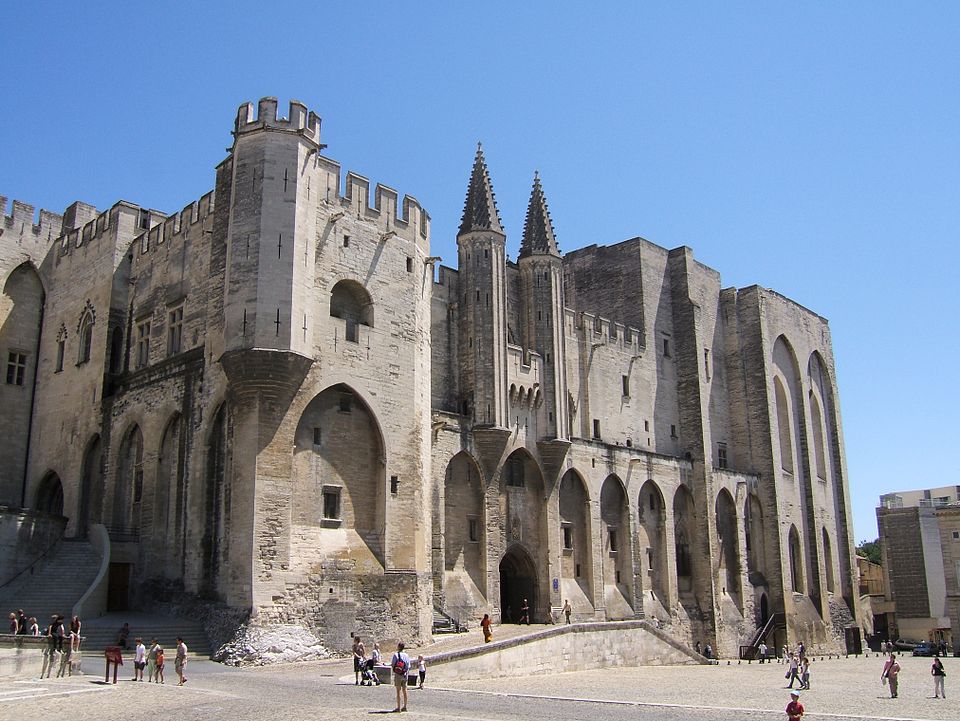
Rising over the Rhône River in the medieval city of Avignon, the Palais des Papes is one of the most imposing and well-preserved examples of Gothic ecclesiastical architecture in Europe. More than just a palace, it was once the epicenter of Catholic power during a critical 70-year period when the papacy broke with Rome and took up residence in southern France. This architectural complex—part castle, part monastery, part government headquarters—reflects not only the religious and political authority of the Church but also the intense pressures and conflicts of the 14th century.
From 1309 to 1377, the papacy was based in Avignon rather than Rome. This relocation, known as the Avignon Papacy, occurred during a time of political instability and war in Italy. Seven successive popes ruled from Avignon, all of them French, and their reigns required a base that could command spiritual obedience while offering physical security. The result was the Palais des Papes—a vast fortified residence that combined Gothic elegance with military strength.
The palace was constructed in two major phases, under Pope Benedict XII and Pope Clement VI, and is today divided into the Old Palace (Palais Vieux) and New Palace (Palais Neuf). Together, they form a sprawling complex of over 15,000 square meters, with thick stone walls, massive towers, ceremonial halls, chapels, cloisters, and hidden passages.
Now a UNESCO World Heritage Site, the Palais des Papes stands not only as a monument to medieval Catholicism but also as a case study in how architecture expresses power, belief, and strategy. From its crenellated battlements to its frescoed chapels, it speaks the language of an institution that, for a time, ruled Western Christendom from within the walls of a French fortress.
Historical Background: Why the Papacy Moved to Avignon
The story of the Palais des Papes begins not with architecture, but with a political crisis. In 1309, facing instability and violence in Rome, Pope Clement V—a Frenchman—moved the papal court to Avignon. This was meant to be a temporary measure, but it lasted nearly 70 years. The move was influenced by several factors: conflicts between the papacy and the French crown, the collapse of public order in Italy, and Avignon’s strategic position near both the Papal-controlled Comtat Venaissin and the French royal domain.
Avignon, at the time, was not part of France but belonged to the Holy Roman Empire and was closely aligned with the papacy. The city was already a hub of religious and intellectual activity, and its location near major trade routes made it suitable for the logistical demands of the papal court.
The need for a permanent and defensible residence grew quickly. The first pope to undertake serious construction was Benedict XII, who began building a heavily fortified residence in 1335. His successor, Clement VI, expanded it dramatically, transforming it into one of the most lavish and powerful palatial complexes in Christendom.
During its peak, the Avignon papal court was home to:
- The pope and his curia
- Hundreds of clerks, secretaries, and theologians
- Foreign ambassadors and legates
- A vast administrative staff handling church finances, appointments, and diplomacy
The architectural demands of such a complex institution were immense. The Palais des Papes had to serve as a residence, chancery, treasury, courtroom, archive, monastery, and fortress—and it had to do so with grandeur befitting the Vicar of Christ.
The Old Palace: Benedict XII’s Fortress
The first major construction phase of the Palais des Papes was led by Pope Benedict XII, who reigned from 1334 to 1342. A Cistercian monk by training, Benedict was a man of austerity and discipline. His architectural vision for the palace was rooted in the principles of Cistercian simplicity, but also in the practical need for security. He commissioned the Palais Vieux (“Old Palace”)—a severe, rectilinear complex of stone buildings arranged around a central cloister.
Benedict hired Pierre Poisson of Mirepoix, a French master mason and architect, to carry out the design. The Palais Vieux included:
- A monastic-style cloister, with barrel-vaulted galleries
- The Grand Tinel, a banquet hall measuring over 50 meters long
- The Consistory Hall, for ecclesiastical meetings and tribunals
- Residential apartments and papal private chambers
- A chapel, with pointed Gothic vaulting and Cistercian-style decor
- Defensive towers, including the Tour de Trouillas, the largest of them all
The exterior of the Old Palace resembles a military fortress. Its thick limestone walls are nearly windowless, and its towers are crenellated for defense. Arrow slits, guard towers, and drawbridge systems gave the palace an appearance of impenetrable strength, reflecting Benedict’s concern with stability and order in a time of ecclesiastical uncertainty.
Internally, however, the structure was arranged with deliberate monastic logic. The spatial hierarchy reflected Benedict’s belief in order, piety, and discipline. The cloister, a centerpiece of Cistercian architecture, provided quiet meditation space and spiritual rhythm amidst the machinery of governance.
Architecturally, the Palais Vieux is one of the clearest examples of Gothic monastic fortress design—combining military utility with sacred space and administrative complexity. It set the foundation, literally and figuratively, for the far grander vision that would follow under Clement VI.
The New Palace: Clement VI’s Gothic Splendor
The second and most opulent phase of the Papal Palace’s construction was undertaken by Pope Clement VI, who reigned from 1342 to 1352. In stark contrast to his predecessor Benedict XII’s monastic austerity, Clement VI embraced the grandeur, diplomacy, and ceremonial culture of the late medieval papacy. A patron of the arts and former courtier in the French royal household, Clement envisioned a palace that would rival the greatest courts of Europe in majesty and refinement.
To realize this vision, Clement employed Jean de Louvres, a French architect known for his work on royal residences. Together, they designed and built what is now referred to as the Palais Neuf (“New Palace”), a spectacular expansion on the eastern side of the existing fortress. Construction began in 1342 and was completed in less than a decade—a remarkable pace for a project of such scale.
The Palais Neuf features:
- The Grand Chapel (Chapelle Clémentine), a soaring vaulted space used for major liturgical celebrations, complete with stained glass and elaborate painted decoration
- The Grand Audience Hall, where ambassadors and dignitaries were received under towering Gothic vaults
- The Stag Room (Chambre du Cerf), decorated with one of the oldest surviving secular frescoes in France
- Luxurious papal apartments, complete with fireplaces, stained glass, wood paneling, and private chapels
- Additional towers and service wings for guards, staff, and storage
Clement’s palace is a triumph of Rayonnant Gothic architecture, characterized by high pointed arches, ribbed vaults, and rich decorative detail. Unlike the fortress-like Old Palace, the New Palace features more generous windows and a sophisticated interplay of light and space. The chapels and ceremonial halls were designed not only for function but for visual impact—intended to impress visiting monarchs, cardinals, and foreign delegations.
The frescoes commissioned by Clement are among the palace’s most treasured artistic features. The Stag Room, for example, depicts a series of pastoral hunting scenes that reflect themes of leisure, nobility, and natural order. Other rooms were painted with religious scenes and architectural trompe-l’œil, giving a sense of depth and dynamism.
Clement VI’s expansion transformed the Palais des Papes from a fortress into a royal and spiritual capital—a place where art, faith, and politics merged in Gothic stone. It was a statement that Avignon was not merely a papal refuge—it was the legitimate and dignified seat of Christendom.
Fortification and Military Architecture
Though the New Palace under Clement VI brought refinement and ceremonial grandeur, the entire complex remained a highly defensible structure, appropriate for a papacy that faced both internal dissent and external threats. The city of Avignon itself was fortified with new walls during the 14th century, and the palace became a citadel within a citadel—equipped to resist sieges and rebellions.
The military architecture of the Palais des Papes includes:
- Ten defensive towers, some over 50 meters tall, including the Tour de Trouillas (used as a prison), the Tour des Anges, and the Tour de la Garde-Robe (guard tower)
- Crenellated parapets and walkways for patrols
- Arrow slits and defensive galleries integrated into the outer walls
- A double gate system and drawbridge that controlled access from the city
- Thick limestone walls, some over 3 meters thick, offering exceptional protection
The placement of the towers and their visual mass communicate power and dominance. The structure is both physically and symbolically elevated above the rest of Avignon, clearly marking the palace as the ruling presence in the city. Even as a religious complex, the Palais des Papes was unambiguously a military installation, equipped to withstand both spiritual and political conflict.
This dual nature—sacred and fortified—is key to understanding the architecture of the palace. It is not merely a Gothic monument to faith, but also a stronghold of papal sovereignty in a turbulent age. Its presence reminded Avignon’s citizens and foreign dignitaries alike that the papacy had both the authority of heaven and the defenses of a prince.
Gothic Style and Artistic Features
The architectural style of the Palais des Papes is firmly rooted in French Gothic tradition, particularly the Rayonnant Gothic style that flourished in the 13th and 14th centuries. Characterized by elegance, verticality, and the use of light as a design element, this style reached one of its most distinctive expressions in the chapels, halls, and apartments of the Avignon papal complex.
Key Gothic features found throughout the palace include:
- Pointed arches, used in doorways, windows, and arcades
- Ribbed vaulting, especially in ceremonial halls like the Grand Chapel and Audience Hall
- Flying buttresses, though less prominent than in cathedrals, are present in supporting structures
- Cloisters with carved capitals and column arcades
- Decorative elements such as tracery, quatrefoils, and floral bosses
Art was integral to the palace. Papal rooms were painted with frescoes, many of which were executed by Matteo Giovannetti, an Italian painter brought from the court of Naples. His work includes vivid religious and secular scenes in the Saint-Martial Chapel, Saint John’s Chapel, and other papal oratories.
The Grand Chapel, which hosted major liturgies, resembled a cathedral in its height and acoustic design. Large Gothic windows once filled the space with colored light, and remnants of the original stained glass have been preserved in fragments.
Floor plans were carefully organized according to a hierarchical logic, with increasingly private rooms arranged away from public areas. The transitions between courtyards, galleries, and chapels followed a spiritual and administrative rhythm—meant to reflect the inner sanctum of the Church.
The artistry, engineering, and spatial flow of the Palais des Papes place it among the greatest non-cathedral Gothic buildings in Europe. It was a palace not of idle luxury, but of order, ritual, and divine purpose.
Life Inside the Palace: Ceremonial, Liturgical, and Administrative Roles
The Palais des Papes was more than a physical structure—it was a fully functioning papal court, bustling with religious ceremony, international diplomacy, legal proceedings, and daily governance. Its architecture was shaped by these roles, with each room and passage designed to support a highly structured and hierarchical society.
At the heart of papal life was the liturgical calendar. The palace contained several chapels, the most important being the Grand Chapel, where major feasts were celebrated with elaborate Masses. Lesser oratories and private chapels allowed for daily devotions, while processional corridors linked sacred spaces with public ones. The rhythm of life was dictated by prayer, and the architecture reflected this spiritual priority.
Beyond worship, the palace was a center of diplomacy and administration. The Grand Audience Hall hosted emissaries from kingdoms across Europe, including England, France, the Holy Roman Empire, and the Crusader states. Treaties were signed, legates were dispatched, and Church policy was debated and announced from these rooms. Papal bulls were written and sealed in adjacent scriptoria, and secretaries managed an astonishing volume of correspondence and legal decrees.
Key functions and spaces within the palace included:
- The Chancery: Where official documents were drafted and sealed
- The Treasury: Vaulted rooms that stored papal revenues, gold, and relics
- The Archives: Rooms with stone shelving for storing scrolls, charters, and court records
- Kitchen and service quarters: Designed to feed hundreds of residents, from cardinals to guards
The palace was home to as many as 500 people during its peak: popes, cardinals, clerks, cooks, theologians, guards, servants, and visitors. Its design had to accommodate both high ceremonial life and the practical demands of running the medieval Church’s central bureaucracy.
In many ways, the Palais des Papes functioned as a Vatican in miniature—an entire city-state enclosed in walls. It was a rare fusion of spiritual sanctum and administrative machine, every bit as influential in its time as the Vatican is today.
Decline and Transformation After the Avignon Papacy
The Avignon Papacy ended in 1377, when Pope Gregory XI returned the seat of the Church to Rome. But the story of the Palais des Papes did not end there. The years following the return to Rome saw the Church plunged into the Western Schism, during which rival popes claimed authority. One line of anti-popes remained in Avignon, occupying the palace until 1403.
After the schism, Avignon lost its political prominence, and the palace entered a long period of decline and adaptation. It was used occasionally by Church officials and remained part of the Papal States, but its grandeur faded. The once-glorious chapels and halls were used for storage or abandoned. Frescoes were whitewashed or damaged by humidity and neglect.
By the 17th century, the palace had been turned into a military barracks under French royal control. Walls were reinforced, towers were converted into prisons, and religious iconography was stripped or destroyed. This military use continued even after the French Revolution, during which the palace was further desecrated and looted.
In the 19th century, following the rise of historic preservation movements across Europe, interest in the palace’s Gothic heritage was revived. Local and national efforts began to study, preserve, and restore the complex. Key moments included:
- Listing as a historic monument in 1840
- Restoration campaigns initiated in the late 19th and early 20th centuries
- Archaeological excavations revealing foundations and original artworks
In 1995, the Palais des Papes, along with the historic center of Avignon, was designated a UNESCO World Heritage Site, ensuring its global recognition and protection.
Today, the palace serves as a museum, cultural venue, and historic site, welcoming hundreds of thousands of visitors each year. It hosts concerts, art exhibitions, and public events—especially during the Festival d’Avignon, one of Europe’s leading theater festivals.
Legacy and Global Significance
The Palais des Papes stands today as one of the most remarkable Gothic architectural achievements of the Middle Ages—and one of the few large-scale papal complexes built outside of Rome. It is a testament to a time when the Catholic Church wielded global power from a city not in Italy, but in southern France.
Architecturally, the palace is unrivaled in its combination of:
- Military design, reflecting the volatility of the 14th century
- Monastic discipline, rooted in Benedict XII’s Cistercian background
- Ceremonial splendor, emblematic of Clement VI’s Renaissance-like patronage
- Functional complexity, serving worship, governance, diplomacy, and daily life
Its influence can be seen in subsequent ecclesiastical and civic architecture across Europe. The idea that a religious complex could also be a fortress, a court, and a symbol of international legitimacy became a model for other institutions—especially during the rise of absolutist monarchies in the early modern period.
More importantly, the Palais des Papes reminds us that architecture is more than style—it is politics in stone. Every wall, chapel, and tower speaks of power, faith, fear, and ambition. Its survival through centuries of war, neglect, and political change is proof of its original vision and enduring value.
In a time when political and spiritual authority often collide, the palace continues to inspire reflection on the role of sacred space in public life—and the profound responsibility that comes with building for eternity.
Key Takeaways
- The Palais des Papes was built in Avignon during the 14th century to house the papacy after its relocation from Rome.
- The complex includes the Old Palace (Benedict XII) and New Palace (Clement VI), blending military and Gothic ecclesiastical architecture.
- It features ceremonial halls, chapels, towers, private apartments, and administrative offices used by the papal court.
- After the papacy returned to Rome, the palace was used as a military barracks and later restored as a historic monument.
- Today, it is a UNESCO World Heritage Site and one of the best-preserved examples of Gothic secular-religious architecture in Europe.
FAQs
- Why did the popes move to Avignon?
Political instability in Rome and conflicts with the French crown led Pope Clement V to relocate the papacy in 1309. - Is the palace still used for religious purposes?
No, it is now a museum and cultural site, though some chapels occasionally host events. - How large is the Palais des Papes?
It covers more than 15,000 square meters, making it one of the largest Gothic buildings in Europe. - Can you visit the palace today?
Yes, it is open to the public year-round, offering guided tours, exhibitions, and festival events. - What architectural style is it built in?
Primarily French Gothic, with Rayonnant influences and military fortification elements.