Padua is not often the first name invoked in the popular imagination of Italian art. It lacks the touristic magnetism of Florence or the romantic decadence of Venice. Yet for the historian of Western art, Padua occupies a position of unparalleled significance—a crucible where sacred narrative, classical inheritance, and humanist experimentation converged in forms that reshaped the trajectory of European visual culture. To understand Padua’s contribution is not to engage in regional boosterism or revisionist emphasis, but to trace the contours of a city whose artistic identity was forged through its ability to assimilate, transform, and project ideas of startling originality.
Unlike Rome, whose authority was tethered to imperial and papal continuity, or Florence, whose republican ideology became an aesthetic creed, Padua’s status was more ambiguous: a learned city under various overlords, from communal independence to Carraresi tyranny and eventually Venetian control. This political instability did not hinder its cultural fertility. If anything, it fostered a certain resilience and eccentricity, making Padua both a guardian of tradition and an incubator of novelty. Its university, among the oldest in Europe, became a beacon of medical, philosophical, and legal studies, cultivating a class of erudite patrons deeply engaged with classical literature and natural science. This milieu provided the intellectual bedrock for its artistic achievements, situating them within a framework of inquiry rather than mere devotion or civic pride.
Padua’s role as an early harbinger of the Renaissance rests foremost on the frescoes of Giotto di Bondone in the Scrovegni Chapel—a cycle painted around 1305 that has long been acknowledged as one of the defining inaugurations of modern Western painting. The frescoes possess a dramatic unity, psychological gravity, and spatial coherence absent from the schematic iconographies of earlier medieval work. But to isolate Giotto as a singular phenomenon would be to misapprehend Padua’s broader contribution. For in his wake came a succession of Paduan masters—Altichiero, Guariento, and later Mantegna—who developed a distinct pictorial grammar, uniting sacred narrative with classical structure, emotional realism with symbolic clarity. Sculpture too underwent a radical shift in Padua, as seen in Donatello’s decades-long engagement with the city, where his innovations in bronze and relief endowed sacred form with a new tactile immediacy.
While the city’s political fortunes waned under Venetian suzerainty, its cultural momentum persisted. The Renaissance in Padua did not dissipate into decorative refinement, as it did in many provincial centers. Instead, it matured into a pedagogical force. The Paduan emphasis on disegno, anatomical precision, and rigorous draftsmanship established enduring traditions of studio training that influenced later generations, from the Carracci to the academies of the eighteenth century. The city’s anatomical theaters, botanical gardens, and printing presses underscored an intersection of scientific and visual knowledge—an epistemic synthesis rarely matched elsewhere in Europe.
Nor should one overlook Padua’s architectural palimpsest. From the Roman ruins half-buried beneath the cobblestones, to the medieval basilicas, Renaissance palazzi, and Baroque sanctuaries, the city bears witness to a continuity of built form that encodes its layered identity. The Basilica of Saint Anthony alone—home to relics, votive art, and Donatello’s monumental altar—stands as a testament to the city’s role as a destination for pilgrims, artists, and thinkers alike. Yet Padua never mythologized itself. Unlike Florence, which meticulously curated its Medicean narrative, or Venice, which turned its lagoon into a theatre of self-glorification, Padua has always seemed reticent, almost austere, in its presentation. Its masterpieces speak with the clarity of ideas rather than the opulence of display.
In the twentieth century, recognition of Padua’s centrality began to coalesce, aided by scholars such as Roberto Longhi and James Beck, who saw in Paduan art not merely regional flair, but the articulation of foundational concerns in Western representation: how to depict space, body, and soul. The inclusion of Giotto’s frescoes in the UNESCO World Heritage list has only reaffirmed their cultural gravity. Yet Padua remains, in many respects, underexamined. It lacks the institutional promotion lavished upon Tuscany or the international branding of Roman antiquity. This makes a comprehensive return to Padua’s artistic history not only necessary but urgent.
To trace the arc of Paduan art is to engage with the deepest transitions of the Western eye—from the abstraction of medieval cosmology to the sensual realism of the Renaissance, from the expressive austerity of religious frescoes to the lucid geometry of classical revival. It is a history less celebrated but more vital, more daring, more foundational than convention allows. The chapters that follow seek to restore Padua to its rightful place: not as a peripheral node, but as a center of artistic formation whose impact radiates far beyond its medieval walls.
Foundations in Antiquity: Roman Padua and the Classical Legacy
Before Padua became a crucible for Renaissance innovation, it existed as a formidable Roman settlement—Patavium, a city of great antiquity and considerable prestige in the northeastern quadrant of the Italian peninsula. Though largely submerged in the popular imagination by its later medieval and Renaissance splendors, the Roman substratum of Padua provides essential context for its later artistic evolution. The values of order, proportion, civic virtue, and the integration of art into daily life were not foreign imports from later centuries, but deeply embedded in the city’s earliest urban identity.
Patavium’s foundational myth reaches back to the Trojan exile Antenor, a narrative that links the city to the epic grandeur of Virgilian Rome. While this claim is patently legendary, it reflects a deliberate self-fashioning common to many Roman municipalities—myths that granted cultural capital by affiliating provincial origins with the authority of classical antiquity. Archaeological findings, however, confirm that Padua predates Roman colonization, with a substantial Venetic presence that already had developed artistic and metallurgical traditions. These were absorbed and gradually overwritten by Rome’s expansion, particularly during the late Republic and early Empire.
By the first century BC, Patavium had become one of the wealthiest cities in northern Italy, celebrated for its textiles, especially fine wool, and its river trade, anchored by the navigable Brenta. Its prosperity is not a minor economic detail, but the structural precondition for urban art. As in all classical cities, art in Roman Padua was not confined to elite commissions or monumental statuary—it permeated the very fabric of civic life. Decorative mosaics, funerary sculpture, domestic wall paintings, and civic architecture all functioned as both aesthetic expressions and civic statements, uniting beauty with order and public virtue.
Fragments of these artistic forms survive, though often eclipsed by the Christian overlay of later centuries. Mosaics unearthed beneath the Church of Santa Maria Assunta and at various villa sites around the city exhibit the hallmarks of Roman decorative tradition: geometric precision, mythological themes, and illusionistic framing. While lacking the chromatic finesse of Neapolitan or African examples, they demonstrate a high degree of technical skill and compositional clarity. Funerary stelae and sarcophagi found in the region, such as those preserved in the Museo Archeologico di Padova, reflect a convergence of Roman iconography with local craftsmanship—torches, garlands, and portrait busts rendered with an economy that nevertheless retains expressive force.
One must consider also the significance of Roman urban planning in Padua’s enduring spatial logic. The city’s grid was rationally laid out along cardinal axes, with a cardo maximus and decumanus maximus that intersected at the forum, establishing a model of spatial harmony and civic hierarchy. This geometric rationalism would re-emerge centuries later in the work of Renaissance architects who, under the influence of Vitruvius and Alberti, saw in ancient planning not a relic but a template for modern order. Indeed, the very discipline of perspective—so famously developed in quattrocento painting—was prefigured by Roman spatial strategies, not only in architecture but in illusionistic frescoes such as those at Pompeii. Padua’s Renaissance artists, Mantegna chief among them, would internalize these precedents, not through direct inheritance, but through a cityscape haunted by classical ratios and fragments.
Despite Christianization and the decline of the Western Empire, classical culture remained embedded in the city’s elite memory. This continuity was bolstered by Padua’s role as a center of learning. The survival of ancient manuscripts, particularly legal and medical texts, often depended on monastic and cathedral schools that preserved classical models of knowledge and form. Artistic production in early medieval Padua was undoubtedly curtailed by political turbulence, including Gothic invasions and Lombard dominance. Yet the classical ethos remained latent, like a seed dormant in winter soil. It is not coincidental that Padua would later become one of the epicenters of humanist revival. Its classical memory was not a Florentine innovation, but a local inheritance.
The fragmentary remains of Roman Padua thus serve not merely as archaeological footnotes, but as deep structural resonances. They conditioned the city’s urban morphology, its educational priorities, and its aesthetic orientations. When Donatello arrived in Padua in the 1440s, he encountered a city whose soil still bore the bones and marble of its Roman past. The very language of classical form he employed in his sculpture—torso, toga, triumphal posture—found a sympathetic setting in Padua not because it was novel, but because it felt like a return. Likewise, when Giotto painted the Virgin Mary in the Scrovegni Chapel with a gravitational dignity and spatial presence unknown to Byzantine iconography, he was not only departing from the medieval; he was reviving a psychological realism last seen in Roman sarcophagi and imperial portraiture.
Padua’s Roman heritage, then, was not inert. It was the bedrock of its self-understanding, a substratum upon which later generations would build. In time, this classical memory would converge with Christian piety, scientific inquiry, and artistic ambition to form the unique synthesis that is Paduan art. But that synthesis begins here—in the roads, mosaics, and civic institutions of Patavium, whose silent stones still whisper of an antiquity that never fully passed away.
The Medieval City and the Benedictine Matrix
The decline of the Roman Empire did not erase Padua’s classical inheritance so much as obscure it beneath successive layers of disruption and reinvention. The early Middle Ages in Padua were marked by waves of instability—first the Gothic Wars, then the Lombard conquest, and finally the Frankish annexation under Charlemagne. These centuries were not artistically barren, as older historiography once suggested, but characterized by a different register of cultural expression: one rooted in monastic discipline, liturgical rhythm, and the transmission of sacred knowledge. At the heart of this transformation stood the Benedictine order, whose presence in Padua shaped the city’s spiritual topography and artistic character in ways that would resonate well into the Renaissance.
Padua’s Benedictine heritage was anchored most visibly in the Abbey of Santa Giustina, situated on the southern edge of the city. Founded in the early Christian centuries and reconstituted under the Benedictine Rule in the 10th century, Santa Giustina grew into a powerful spiritual and territorial presence. The abbey was not only a religious institution but also a cultural engine: a landowner, a patron, a scriptorium, and—crucially—an incubator of visual form. Within its cloisters and basilicas, the synthesis of word and image became a Benedictine aesthetic imperative, expressed in illuminated manuscripts, sculptural capitals, and ecclesiastical architecture.
Monastic art in this period was less concerned with innovation than with fidelity—fidelity to theological clarity, to ritual function, to the continuity of sacred tradition. The illuminated codices produced at Santa Giustina and other Paduan scriptoria exemplify this ethos. While fewer survive than from northern centers like Monte Cassino or Reichenau, those that do—such as the 11th-century Evangelium manuscripts now housed in the Biblioteca Capitolare—display a restrained yet luminous formal language. Gold leaf, stylized vine scrolls, and the geometrized figures of saints and evangelists reflect the Benedictine concern for symbolic legibility over naturalistic detail. This was an art of contemplation, not spectacle.
Yet even within this discipline, one detects an undercurrent of expressive energy. The best of these manuscripts do not merely repeat inherited motifs but recompose them with subtle variations, achieving a balance between fidelity and imaginative interpretation. Marginal decoration, historiated initials, and calibrated use of color begin to anticipate the greater freedom of Gothic illumination. These manuscripts served not only as liturgical tools but as visual sermons, encoding theological narratives within a highly controlled decorative system.
Architecturally, the medieval city was marked by ecclesiastical austerity rather than civic grandeur. Padua’s skyline in the 11th and 12th centuries would have been dominated by the spires and domes of churches, their forms dictated less by local whim than by the prevailing currents of Romanesque design sweeping across Europe. Santa Giustina was rebuilt on a monumental scale in the 10th century, eventually incorporating a basilical plan with cross vaults and semicircular apses. While the present building largely reflects Renaissance reconstruction, the medieval substratum remains detectable in its foundations and spatial logic. Other churches, such as San Clemente and the original structure beneath the later Basilica of Saint Anthony, display a similar grammar of solid masonry, rounded arches, and minimal fenestration—forms derived not from Roman ostentation but from a monastic theology of order and humility.
It is essential to emphasize the intellectual dimension of this Benedictine matrix. Padua’s monasteries were not isolated enclaves but deeply engaged in the theological and scientific currents of their time. The monastic libraries preserved not only patristic texts but fragments of classical learning, contributing to the long continuity that would culminate in the university’s foundation in 1222. This scholarly tradition produced not only commentaries and sermons but visual schemata: cosmological diagrams, calendar cycles, and anatomical illustrations that subtly influenced the formal strategies of Paduan art in later centuries. The medieval fusion of image and intellect—particularly as mediated through monastic culture—laid the groundwork for the rationalization of space and form that would become hallmarks of Renaissance painting.
In this context, the emergence of fresco as a dominant medium in the 13th century marks a significant shift. While the Benedictine aesthetic favored manuscript illumination and architectural sculpture, the mendicant orders—particularly the Franciscans and Dominicans—began to favor large-scale narrative cycles on plastered walls. This transition was not merely technical but ideological. It reflected a shift from monastic inwardness to urban preaching, from liturgical recitation to didactic storytelling aimed at a wider public. Yet even as these new orders rose, the Benedictine legacy endured, shaping the iconographic programs and compositional strategies that early fresco painters would inherit.
It is within this interplay of old and new, monastic and mendicant, that Padua’s unique visual culture began to take form. The city’s medieval churches served not only as houses of worship but as theatres of symbolic architecture, visualizing the celestial hierarchy and ecclesiastical order through stone and pigment. Capitals carved with vegetal motifs or biblical vignettes, tympana depicting saints and martyrs, fresco fragments tucked into chapels or cloisters—all of these testify to a medieval imagination that was rich, ordered, and suffused with metaphysical purpose.
Padua in the High Middle Ages was thus neither a backwater nor a mere conduit for external influence. It was a city whose religious institutions cultivated a coherent visual language grounded in Benedictine discipline and scholastic clarity. This language did not vanish with the advent of Giotto or Donatello. Rather, it persisted as a substructure—often invisible, but always operative—beneath the dramatic surfaces of Renaissance innovation. To understand the art of Padua is to understand this matrix: not as a static medieval backdrop, but as the living soil from which the city’s later genius would emerge.
Pre-Giotto Fresco Cycles and the Rise of Local Schools
Before Giotto’s transformative arrival in Padua at the turn of the 14th century, the city already possessed a nascent tradition of mural painting that, while provincial in technique and ambition compared to the major Tuscan centers, nonetheless reveals the stirrings of a distinct local school. These early fresco cycles—largely anonymous, fragmentary, and stylistically uneven—are often overlooked in standard accounts of Italian art history. Yet they form a crucial chapter in the city’s visual development, embodying a transitional aesthetic that straddles Byzantine convention, Romanesque decorum, and the emerging Gothic sensibility. Far from being mere preludes to Giotto, they constitute a vernacular idiom shaped by local devotional practice, patronage networks, and architectural constraints.
The fresco medium in Padua, as elsewhere in northern Italy, initially developed within ecclesiastical contexts, particularly in the apses, transepts, and crypts of Romanesque churches. These early cycles were not conceived as comprehensive visual programs in the later sense but as segmented iconographic panels—single scenes or clusters of saints and evangelists arranged within strict architectural frames. Their visual vocabulary drew heavily from Byzantine sources, particularly in the use of gold backgrounds, frontal poses, hieratic scale, and the dominance of line over volume. These elements were transmitted through imported icons, illuminated manuscripts, and itinerant artists whose movements along trade and pilgrimage routes helped disseminate Eastern stylistic models.
The Church of San Clemente in Padua preserves some of the earliest extant frescoes from this period, including fragmentary depictions of saints and narrative scenes from the life of Christ. Though degraded by time and overpainting, these frescoes exhibit certain regional idiosyncrasies—elongated proportions, sharply modeled features, and a tendency toward compressed spatial composition—that distinguish them from their Tuscan or Roman counterparts. Their affect is often static, but not without a certain dignity; their restraint reflects the theological austerity of the time rather than artistic incapacity.
Another significant site is the crypt of Santa Sofia, whose decorative program, though largely schematic, includes early fresco remnants that suggest an experimental approach to color and gesture. These cryptic frescoes functioned within a liturgical space saturated with relics and cultic meaning, underscoring the role of mural painting not as narrative spectacle but as devotional interface. In these environments, painting was less about mimetic realism than about mediating sacred presence. Saints did not inhabit perspectival space; they floated in timeless registers, their authority derived not from anatomical plausibility but from their alignment with doctrinal truth.
However, even within these constraints, Padua’s local painters began to push the limits of expression. By the mid-13th century, we observe a gradual softening of the iconographic rigidity inherited from Byzantine models. Figures begin to show tentative gestures of interaction; eyes meet, hands extend, and draperies fold in suggestively volumetric patterns. This stylistic inflection coincides with broader ecclesiastical changes—the rise of the mendicant orders, the intensification of lay devotion, and a renewed emphasis on the humanity of Christ and the Virgin. The narrative cycles that began to appear in friaries and smaller chapels reflect these shifts, privileging scenes of moral instruction, Christological drama, and Marian intercession.
The Church of San Francesco, constructed in the latter half of the 13th century under the auspices of the Franciscan order, offers a compelling example of this transitional moment. Though later heavily redecorated, early records and surviving fragments suggest the presence of didactic frescoes that emphasized penitential themes and the lives of Franciscan saints. These compositions likely combined schematic forms with narrative sequencing—a hybrid visual syntax that bridged static iconicity and dynamic storytelling. The influence of Franciscan theology, with its emphasis on Christ’s humanity and the imitation of his suffering, spurred a new kind of imagery: more emotive, more accessible, and increasingly concerned with terrestrial realities.
It is in this context that one must view the development of a distinctly Paduan school of fresco painting. While not yet institutionalized or codified, a local tradition began to coalesce around certain formal preferences: a tendency toward architectural framing, an interest in expressive gesture within limited spatial fields, and a marked attention to theological clarity. These features would find more sophisticated expression in the works of later Paduan painters such as Altichiero and Guariento, but their seeds were planted in these anonymous, often ephemeral cycles.
One must also consider the patronage structures that enabled this development. In contrast to Florence, where powerful guilds and banking families commissioned elaborate chapels, Padua’s pre-Giotto frescoes were typically funded by religious orders, communal institutions, or lesser aristocrats. These patrons were less interested in aesthetic innovation than in spiritual efficacy. Their commissions reflect a devotional economy in which image-making was subordinate to the rhythms of prayer, liturgy, and votive obligation. Yet precisely because of their functional modesty, these works often contain moments of surprising intimacy and experimentation.
It is important not to retroject Giotto’s revolution backward onto these earlier painters. Their goals were different, their tools more limited, and their theological horizons more constrained. Yet they prepared the ground for the transformation to come—not by rejecting the old models outright, but by inhabiting them with increasing flexibility and awareness. The progression from icon to narrative, from stasis to sequence, from symbol to character—these were already underway before Giotto ever set foot in Padua. What he would bring was not a beginning ex nihilo, but an intensification of energies already latent within the local visual field.
Thus, the pre-Giotto fresco cycles of Padua deserve more than passing acknowledgment. They represent the city’s first sustained efforts to develop a visual language suited to its spiritual, intellectual, and urban character. They are the murmurings before the great voice, the preludes whose echoes can still be heard beneath the triumphs of the Scrovegni Chapel.
Giotto and the Scrovegni Chapel: A Revolution in Narrative Art
In the year 1303, a wealthy Paduan banker named Enrico Scrovegni commissioned the construction of a private chapel on the site of a disused Roman arena. The chapel, consecrated to the Virgin of Charity and known formally as the Cappella dell’Arena, would house what has since become one of the most decisive achievements in the history of Western painting. Its fresco cycle, executed by Giotto di Bondone and completed around 1305, did more than adorn a sacred space—it transformed the very grammar of pictorial narrative, giving visual form to a new conception of human experience, spatial reality, and theological presence. What Giotto accomplished in Padua would reverberate through centuries, altering not only artistic practice but the epistemological framework of vision itself.
To understand the significance of the Scrovegni Chapel, one must first situate it within its religious and civic context. Enrico Scrovegni was the son of Reginaldo Scrovegni, a notorious usurer immortalized by Dante in the Inferno (Canto XVII), condemned to the seventh circle of Hell for his sin. While it is tempting to read Enrico’s patronage as an act of penance—a filial attempt to redeem the family name through sacred architecture and devotional generosity—there is more at play than moral rehabilitation. The chapel was built adjacent to the Scrovegni family palace and functioned as a private oratory, a statement of wealth, learning, and spiritual ambition. In commissioning Giotto, Enrico aligned himself with one of the most avant-garde artists of the age, signaling both civic aspiration and theological seriousness.
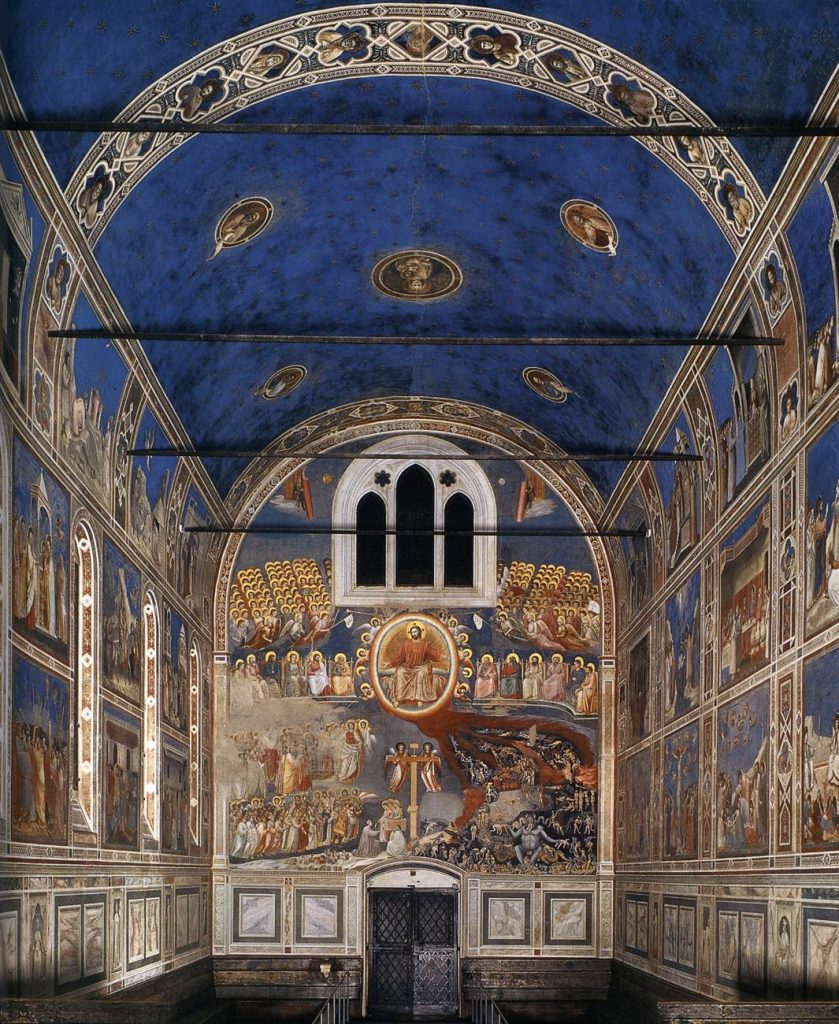
Giotto’s fresco cycle in the Scrovegni Chapel comprises 38 scenes arranged across three registers: the top register depicts the life of the Virgin; the middle, the life and Passion of Christ; and the lowest contains allegorical personifications of the Virtues and Vices. The cycle culminates in a grand Last Judgment on the counter-façade, with Christ enthroned in mandorla and the elect and damned arrayed across a sweeping eschatological landscape. Yet to describe the chapel in such schematic terms is to miss its radical force. Giotto’s achievement lies not in iconographic novelty—his subjects are traditional—but in the unprecedented coherence, emotional clarity, and spatial realism with which he renders them.
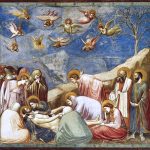
The frescoes’ narrative power derives from Giotto’s intuitive grasp of psychological drama. In the Lamentation over the Dead Christ, for instance, he orchestrates a poignant composition in which the Virgin cradles her son’s lifeless body while disciples and angels mourn in staggered gestures of despair. The figures are not symbols; they are people, grieving in individualized ways. One disciple flings his arms backward in despair, another buries his face in Christ’s feet, while angels twist and dive through the azure sky, their contorted bodies echoing the anguish below. The landscape itself participates in the grief, its rocky incline directing the viewer’s gaze toward the central axis of maternal sorrow.
Giotto’s realism is not photographic but metaphysical. He does not depict space with the mathematical rigor of later Renaissance perspective, but he understands how bodies occupy space—how they bend, lean, gesture, and respond to one another within architectonic settings. His use of architecture within the frescoes is masterful: buildings tilt inward to frame events; walls divide sacred from profane; thrones, staircases, and colonnades establish depth and hierarchy. In the Annunciation, the Virgin recoils not in abstraction but in a tangible domestic setting, her modesty embodied in the tilt of her head and the folding of her arms. The angel’s arrival is not a theological abstraction but a dramatic intrusion into real space.
This spatial coherence is matched by chromatic control. Giotto abandons the heavy gilding and ornamental excess of Byzantine precedent in favor of luminous blues, earthen reds, and olive greens. The famous ultramarine of the vault—representing the heavens—surrounds viewers with a sense of celestial order, while the restrained palette of the narrative scenes lends them an almost sculptural clarity. Color in the Scrovegni Chapel is never decorative; it serves emotional and symbolic functions, guiding the eye and intensifying affect.
The lower register, with its painted allegories of the Virtues and Vices, has often been marginalized in favor of the narrative cycles above. Yet these personifications constitute a vital ethical framework for the chapel’s moral vision. The Virtues—such as Charity, Prudence, and Fortitude—are depicted as serene, idealized figures, each embodying a Christian moral quality. Opposite them, the Vices—Despair, Injustice, Envy—are shown in grotesque distortion, their features exaggerated to reveal spiritual disorder. This contrast grounds the chapel’s salvific message not only in the events of salvation history but in the ongoing moral choices of the viewer. One does not merely observe Christ’s Passion; one is implicated in its ethical demands.
Giotto’s achievement in Padua was immediately recognized, and its influence was profound. Contemporary viewers would have experienced the frescoes not as isolated tableaux but as an immersive totality—a sacred encyclopedia rendered in color and form. The spatial unity, emotional nuance, and narrative continuity created a new standard for religious storytelling, one that profoundly shaped the trajectory of quattrocento art. His approach laid the groundwork for the later triumphs of Masaccio, Fra Angelico, and Piero della Francesca, each of whom would elaborate Giotto’s insights with increasing formal sophistication.
Yet it would be a mistake to view Giotto as a proto-Renaissance figure in the narrow sense. He was not breaking with the past so much as intensifying its potential. His art is deeply rooted in Christian theology, Franciscan spirituality, and Roman visual culture. The drama of his figures recalls Roman funerary reliefs; the moral earnestness of his cycle reflects the mendicant call to ethical reform; the unity of his space anticipates, but does not yet manifest, the rational perspective systems of the 15th century. What he offered was a new way of seeing—human, embodied, dramatic—at once grounded in tradition and radically forward-looking.
In the Scrovegni Chapel, Giotto brought the sacred narrative down from the heavens and placed it among us. He did not abandon the divine; he enfleshed it. The Virgin weeps, the disciples stagger, the traitor kisses with cold resolve. This was not a break with Christian art, but its intensification—a reimagining of the Incarnation not just as dogma but as image. In Padua, Giotto gave Western art a new soul, one that would animate its most enduring achievements for centuries to come.
The Scrovegni Legacy: Fourteenth-Century Fresco Traditions in Padua
The frescoes Giotto executed in the Scrovegni Chapel did not simply mark a climax of early Trecento art; they recalibrated the visual language of a generation. Yet their influence in Padua was not merely stylistic. They created an expectation—a model of theological clarity, pictorial unity, and emotive realism—that subsequent artists working in the city were compelled either to emulate, extend, or wrestle with. In the half-century following Giotto’s departure, Padua became a center of mural experimentation, where painters of considerable distinction elaborated upon his achievements while developing a distinctive local tradition. Chief among these were Altichiero da Zevio and Guariento di Arpo, figures who, though less widely known today, played a crucial role in sustaining and transforming the visual idioms that Giotto had introduced.
What distinguishes the Paduan fresco tradition in the fourteenth century is its commitment to narrative architecture. Giotto had already demonstrated how painted architecture could serve narrative ends—organizing space, defining action, and conveying theological hierarchy. Altichiero and his contemporaries deepened this integration, creating pictorial fields in which real and fictive architecture interlock. Their frescoes are neither stage sets nor purely decorative schema; they constitute symbolic architectures in themselves—temples of image and doctrine fused together.
Guariento di Arpo, active in the mid-14th century, provides the first major link between Giotto’s legacy and Paduan visual innovation. Trained within the Trecento idiom, Guariento developed a painterly style that synthesized the spiritual linearity of Byzantine iconography with the volumetric aspirations of Giotto’s realism. His frescoes in the Church of the Eremitani (particularly those in the now-destroyed choir of the Augustinian friars) and his monumental Paradise in the Palazzo Ducale in Venice reveal a preoccupation with celestial order rendered through radiant color and architectural clarity. In Guariento’s Coronation of the Virgin—fragments of which survive—he arranges hosts of angels and saints not as an ecstatic throng, but in precise, tiered registers. The composition conveys metaphysical hierarchy through pictorial symmetry, marrying late medieval spirituality with an incipient rationality.
But it is Altichiero da Zevio who emerges as the true heir to Giotto in Padua, both in ambition and in accomplishment. His masterwork—the fresco cycle in the Oratory of St. George (Oratorio di San Giorgio), adjacent to the Basilica of Saint Anthony—is one of the most accomplished pictorial ensembles of the 14th century. Commissioned by the Lupi family of Soragna and completed around 1379, the oratory functions as a private chapel and mausoleum, much like the Scrovegni Chapel. But where Giotto’s frescoes pivot around the narrative of salvation, Altichiero’s address the triumphs of individual saints—most notably George, Catherine, and Lucy—rendered in an architectural idiom that makes full use of perspective, light, and the human figure in motion.
In the Martyrdom of Saint George, Altichiero demonstrates a striking command of spatial orchestration. The scene unfolds across a plaza flanked by painted colonnades, with figures arrayed in dramatic sequence. Soldiers draw their swords, onlookers gesture in alarm or indifference, and the saint himself stands with imperturbable calm at the center of the composition. What is remarkable here is not only the narrative clarity, but the psychological density of the scene. Altichiero imbues his figures with individualized expression—grief, disbelief, fury, resolve—rendered through gesture and physiognomy with a subtlety that goes beyond Giotto’s pioneering realism. The architectural setting, meanwhile, is not merely backdrop but an active participant in the story, guiding the viewer’s gaze and anchoring the action in plausible, if stylized, urban space.
The Oratory of St. James (Oratorio di San Giacomo), also attached to the Basilica of Saint Anthony and executed by Altichiero and Jacopo Avanzi, constitutes a companion effort. Though damaged over time, this cycle elaborates a similar narrative strategy, organizing the life of the saint into sequential tableaux that unify sacred legend with courtly decorum. In these works, the Paduan fresco tradition achieves a new equilibrium: narrative unfolds with theatrical elegance, spatial coherence supports theological message, and painted architecture becomes a visual exegesis of holy story.
These cycles reflect more than technical mastery; they embody a specifically Paduan engagement with space, intellect, and spiritual action. This was a city shaped by its university, its legal culture, and its scholastic inheritance. It is therefore no accident that Paduan painters of the late Trecento exhibit a pronounced concern with logical clarity and compositional rigor. Their works read almost like visual syllogisms: premises established in architectural framing, conclusions drawn in the focal gestures of key figures. This dialectical quality distinguishes Paduan fresco from the more lyrical or ornamental tendencies of contemporary Sienese or Bolognese schools.
Moreover, the integration of tomb sculpture and painting in the oratories of St. George and St. James reveals a distinct funerary theology. These were spaces not only of private devotion but of dynastic commemoration. The frescoes did not merely illustrate hagiographic episodes; they participated in a broader visual program that linked the deceased patron with saintly intercession and celestial reward. The body entombed beneath became part of a sacred continuum rendered in pigment and stone, a continuity of matter and meaning that would later be perfected in Donatello’s high altar for the Basilica of Saint Anthony.
While Florence and Siena were developing their own pictorial traditions in these decades, Padua’s fresco cycles stand apart for their commitment to narrative lucidity and architectural depth. They lack the decorative flamboyance of Simone Martini or the chromatic sensuality of the Lorenzetti brothers, but they offer something else: an austere precision, a moral and spatial logic that anticipates the rational humanism of the early Renaissance. Indeed, one can trace a direct line from the Paduan fresco idiom of the late Trecento to the perspectival rigor and sculptural modeling of Andrea Mantegna in the next century.
Altichiero and Guariento may not have eclipsed Giotto, but they extended his revolution into new territories—territories defined by courtly patronage, theological sophistication, and the architectural imagination. They rendered the invisible visible, not by mysticism, but by staging the sacred within ordered space. In doing so, they established Padua as one of the foremost laboratories of fresco innovation in pre-Renaissance Italy.
Donatello in Padua: Sculpture and Sacred Space in the Fifteenth Century
The arrival of Donatello in Padua in the early 1440s marked not merely the transplantation of Florentine sculptural genius into northern Italy, but the birth of a new artistic synthesis. Over a span of roughly a decade, Donatello redefined the role of sculpture in Padua’s sacred and civic life, leaving behind works of such ambition and formal innovation that they permanently altered the city’s aesthetic horizon. His tenure in Padua—especially his projects for the Basilica of Saint Anthony—must be understood not as a provincial interlude in a Florentine career, but as one of the defining chapters of the Italian Renaissance: a confrontation between material, theology, and civic identity that reshaped the function and possibilities of sacred art.
By the time Donatello arrived in Padua, likely around 1443, he was already a mature artist. His early works in Florence—particularly the marble David, the St. George for Orsanmichele, and the pulpit reliefs for the Cathedral of Prato—had demonstrated his radical commitment to naturalism, classical form, and psychological expression. Yet it was in Padua that these commitments found a new field of application, one where the intellectual austerity of northern humanism met the emotional urgency of religious devotion.
At the center of Donatello’s Paduan production stands the high altar of the Basilica of Saint Anthony, a project that occupied him from roughly 1446 to 1450. The basilica, a vast and complex Romanesque-Gothic structure housing the relics of Padua’s patron saint, posed both a logistical and symbolic challenge. Donatello’s solution was to reconceive the altar as a total sculptural environment: a unified ensemble of freestanding statues, narrative reliefs, and architectural framing that fused the functions of liturgical center, theological narrative, and visual spectacle.
The altar includes seven larger-than-life bronze statues, representing saints central to Franciscan and local devotion—most notably Saint Anthony himself, the Madonna and Child, and a group of apostles. These figures are arranged not according to strict symmetry, but with a calculated asymmetry that enhances their expressive immediacy. Each figure possesses a distinct psychological gravity. Saint Anthony, in particular, is rendered not as an ethereal mystic but as a weighty, contemplative presence: his head slightly bowed, his robes cascading in heavy folds, his body caught in the gravitational pull of inner thought. Donatello does not idealize; he incarnates.
Equally revolutionary are the altar’s bronze reliefs, especially the Miracles of Saint Anthony—a series of narrative panels that depict the saint intervening in earthly affairs. These include the Miracle of the Speaking Infant, the Revival of a Murdered Man, and the Healing of a Young Man’s Foot. Each is rendered in Donatello’s pioneering rilievo schiacciato (flattened relief) technique, in which he conjures depth and atmosphere through the subtlest modulations of surface. Figures dissolve into shadow, architecture recedes in perspectival logic, and narrative unfolds in a cinematic continuum of gesture and space. The panels do not merely illustrate miraculous events; they re-stage them for the viewer with dramatic immediacy and optical precision.
In these reliefs, Donatello demonstrates an unprecedented command of pictorial sculpture. He constructs deep space with minimal means, suggesting entire cityscapes with a few incised lines and modulated textures. His figures are not emblematic types, but individuals caught in moments of tension, disbelief, and revelation. The emotional realism of these panels surpasses anything previously attempted in bronze, and it would prove decisive for the development of narrative sculpture in the decades that followed.
Perhaps the most iconic of Donatello’s Paduan works, however, stands not within the basilica but outside it: the equestrian statue of Gattamelata, completed around 1453 and installed on the piazza in front of the church. Commissioned by the family of the condottiero Erasmo da Narni, known as Gattamelata, the statue was the first large-scale bronze equestrian monument cast since antiquity. It revives the classical tradition of the Roman imperial equestrian statue—notably that of Marcus Aurelius on the Capitoline—but reinterprets it through a Christian and civic lens.
The Gattamelata presents the condottiero not as a theatrical hero, but as a figure of poised authority and moral fortitude. His face is stern and introspective; his posture firm but unexaggerated. The horse, muscular yet restrained, advances with a measured pace that evokes dignity rather than martial fury. Donatello achieves a balance between dynamic presence and stoic gravitas, projecting an ideal of virtù that reflects the civic aspirations of the Paduan elite. The statue functions both as a personal commemoration and a political symbol: it asserts the legitimacy of military leadership within the context of republican order and Christian virtue.
What unites Donatello’s Paduan oeuvre is a conception of sculpture as theological argument and civic speech. His works do not simply embellish sacred or public space; they redefine it. In the altar of Saint Anthony, he constructs a theology of presence—a sacramental realism that renders the divine tangible, tactile, and psychologically plausible. In the Gattamelata, he constructs a political icon—an image of command and virtue rooted not in divine right but in human excellence. In both, he manipulates scale, material, and spatial context to produce meaning that is both immediate and profound.
Donatello’s impact on Padua was immediate and enduring. He established new standards for artistic ambition and formal execution. His sculptural vocabulary—marked by expressive faces, intricate drapery, and perspectival relief—was absorbed by local artists and transmitted through generations. The young Andrea Mantegna, training in the workshop of Francesco Squarcione during Donatello’s residence in Padua, was undoubtedly shaped by this example. Indeed, one might argue that the fusion of sculptural clarity and pictorial illusion that defines Mantegna’s painting owes as much to Donatello as to classical statuary.
Donatello left Padua around 1454, returning to Florence to complete later commissions. But his time in the city remains a high watermark in the history of Italian sculpture. It was here, not in Florence, that he conceived his most integrated and ambitious sacred ensemble. It was here that he reimagined the equestrian monument for the Christian age. And it was here that he demonstrated the full expressive potential of bronze as a medium of narrative, psychology, and public memory. Padua did not merely host Donatello; it gave him the opportunity to invent new forms. And in doing so, it inscribed itself indelibly into the canon of Renaissance art.
The Renaissance University and Humanist Patronage
If Giotto and Donatello represent the artistic vanguard of Padua, the intellectual atmosphere that made their work possible owes much to another of the city’s enduring institutions: the University of Padua. Founded in 1222, the university was one of the oldest and most prestigious in Europe, second in Italy only to Bologna in age and legal renown. But by the early fifteenth century, it had evolved beyond its juridical foundations to become a cradle of humanist inquiry—a place where scholastic rigor intersected with classical revival, and where the visual arts found themselves increasingly drawn into the orbit of learned discourse. The Renaissance in Padua was not merely a matter of pigments and chisels; it was a culture of ideas, one in which art, science, and philosophy were bound by shared commitments to reason, proportion, and the eloquence of form.
The university’s curriculum, rooted initially in law, medicine, and theology, expanded during the Renaissance to include a robust program of humanist studies: Latin and Greek philology, rhetoric, moral philosophy, and natural science. Figures like Pietro d’Abano, a physician and philosopher of the late thirteenth and early fourteenth centuries, had already begun to integrate Aristotelian thought with medical and astronomical observation. But it was during the Quattrocento that Padua became a key node in the Republic of Letters, attracting scholars from across Europe—many of whom would become patrons, theorists, or even subjects of artistic representation.
This milieu had a profound effect on the arts. The very ethos of humanism, with its reverence for classical antiquity and its confidence in the capacities of human reason and sensory perception, provided a philosophical foundation for the aesthetic transformations taking place in Padua. Artists were no longer seen merely as craftsmen, but as ingeniosi—creative intellects whose work was comparable to that of poets, philosophers, and orators. This shift in status was not purely rhetorical. It redefined the expectations placed upon artists, demanding a new level of erudition, anatomical precision, and compositional sophistication that aligned with the intellectual disciplines cultivated within the university walls.
The best-known example of this confluence is the career of Andrea Mantegna, who, though not formally educated at the university, absorbed its intellectual atmosphere through his apprenticeship in the workshop of Francesco Squarcione. Squarcione, a painter and self-styled antiquarian, maintained a studio that functioned almost as a private academy of the arts, complete with casts of classical sculpture, architectural fragments, and drawings based on antique models. He cultivated connections with scholars and collectors, fostering a generation of artists who approached their work with the analytical eye of the philologist or the philosopher. Mantegna’s early work demonstrates a striking awareness of classical form and narrative construction—an awareness that cannot be disentangled from the humanist culture in which he was immersed.
The university also contributed to the development of anatomical study, which would become a central component of Renaissance art theory. The Paduan medical school was renowned for its emphasis on dissection and empirical observation, long before such practices gained wide acceptance. By the mid-fifteenth century, anatomy lessons were being held in the very spaces where artists could observe and sketch from cadavers. This anatomical precision would manifest itself vividly in Paduan art, not only in Mantegna’s foreshortened figures but in the increasing complexity of gesture, musculature, and spatial orientation seen in fresco and sculpture alike.
Humanist patrons played an equally vital role in shaping Padua’s visual culture. These were men of letters and learning, often members of the legal or medical professions, who saw in art a means of expressing their philosophical ideals and public virtue. They commissioned chapels, tombs, and altarpieces that fused classical motifs with Christian doctrine, creating a visual rhetoric that mirrored the oratorical elegance they so admired. One sees this in the tomb monuments of jurists and professors—elaborate sarcophagi adorned with Latin inscriptions, allegorical figures, and architectural frames reminiscent of Roman triumphal arches. These were not simply funerary markers; they were assertions of continuity with the classical world, claims to intellectual nobility rendered in stone.
Even more striking is the degree to which Padua’s civic and religious spaces began to reflect humanist concerns. The decoration of the Palazzo della Ragione, the city’s great medieval law court, was reimagined in the 15th century to include astrological, philosophical, and moral imagery drawn from both classical and Christian sources. Though much of this decoration is the work of earlier centuries and later restorations, it reveals a long-standing Paduan commitment to the integration of symbolic systems—juridical, cosmic, theological—that define the city’s intellectual architecture.
The university’s influence extended into the realm of print and publishing as well. By the late fifteenth century, Padua had become a center of early printing, with humanist texts, classical editions, and anatomical treatises circulating among its learned elite. Artists found themselves increasingly involved in these new media—not only providing illustrations, but designing frontispieces, initials, and emblematic devices that reflected the values of clarity, order, and classical restraint. The visual and the verbal, long separated under medieval scholasticism, were now joined in the Renaissance book as they had been in the illuminated manuscripts of the earlier Middle Ages.
Perhaps what most distinguishes the Paduan Renaissance, then, is its synthesis of intellect and image. This was not a city of merchants and bankers commissioning opulent displays, as in Florence, nor a theocratic capital like Rome where art served papal magnificence. Padua was a university city, where the painted figure and the sculpted body had to answer to the standards of logic, philosophy, and moral discourse. Its artists were tested not only by their hands but by their minds. And its patrons did not merely seek beauty, but meaning—allegory, narrative coherence, classical allusion.
This environment shaped a style of art that was lean, rigorous, and cerebral. It favored structure over flourish, clarity over ambiguity, design over spontaneity. And it gave birth to some of the most intellectually ambitious artists of the Renaissance. In Padua, the artist became a thinker, and the image a form of argument. It is this union—of stone and sentence, of pigment and principle—that defines the Paduan contribution to Renaissance art, and secures its place within the broader history of European visual culture.
Andrea Mantegna and the Camera degli Sposi: Paduan Classicism and Perspective
By the mid-fifteenth century, the intellectual and artistic forces nurtured in Padua began to radiate outward, shaping the Renaissance across northern Italy. No single figure embodies this transmission more completely than Andrea Mantegna. Born near Padua in 1431, trained within its unique matrix of humanism and pictorial discipline, and eventually called to the Gonzaga court in Mantua, Mantegna represents a hinge between the scholastic classicism of Padua and the courtly magnificence of the Renaissance courts. He emerged from the Paduan tradition not as a mere disciple, but as its most audacious executor—transforming its principles of perspective, form, and antiquarian erudition into a visual language of overwhelming force.
Mantegna’s early training under Francesco Squarcione provided the scaffolding for this transformation. Squarcione was less a master painter in the conventional sense than a collector, pedagogue, and curator of classical models. His workshop was filled with casts of Roman reliefs, architectural fragments, antique coins, and drawings copied from lost antiquities. He surrounded his pupils with the material lexicon of classical civilization, encouraging them to internalize not merely its forms but its ideals—rational order, moral gravity, and rhetorical power. Mantegna absorbed this lesson with almost excessive zeal. His early paintings reveal a near-obsessive concern with archaeological accuracy and sculptural form. Figures are chiseled, not painted; garments fall in linear folds that recall Roman statuary; architecture frames each scene with tectonic clarity.
This classical rigor found its most accomplished expression in Mantegna’s later work for the Gonzaga family in Mantua, particularly in the celebrated Camera degli Sposi (Room of the Bride and Groom), also known as the Camera Picta, painted between 1465 and 1474 in the Ducal Palace. While technically executed after Mantegna left Padua, the Camera is inconceivable without his Paduan formation. It is the culmination of a visual intelligence shaped by the city’s humanist atmosphere, anatomical precision, and perspectival innovation. Indeed, it stands as one of the defining monuments of Renaissance illusionism, a painted environment in which space, surface, and symbol are fused into a single, dizzying totality.
The Camera degli Sposi is not a chapel, tribunal, or throne room. It is a private audience chamber, designed to celebrate the authority and prestige of Ludovico III Gonzaga, the ruling Marquis of Mantua. But in Mantegna’s hands, this domestic space becomes a theater of power and dynastic image-making. The walls are adorned with scenes of courtly life, rendered in grisaille and subtle color, depicting members of the Gonzaga family receiving guests, conducting affairs of state, or simply gathered in informal conversation. These scenes, while ostensibly quotidian, are constructed with such formal gravity and perspectival discipline that they suggest the grandeur of Roman triumphs and the decorum of imperial portraiture.
Mantegna’s mastery of linear perspective is evident throughout. He constructs architectural frameworks with exacting control—pilasters, cornices, and arcades that recede into painted space with mathematical precision. Figures are arranged not as decorative clusters but as inhabitants of real, volumetric environments. Every spatial relationship is calculated; every gaze, gesture, and alignment serves to anchor the viewer within a coherent visual system. The walls do not merely depict space—they generate it, transforming the flat surface into a virtual architecture of power.
The illusionism reaches its zenith in the ceiling’s famed oculus—an open, painted oculus in the center of the barrel-vaulted ceiling, bordered by garlands and peopled with putti and women leaning over a balustrade. Through this painted aperture, we glimpse the sky and a ring of figures peering downward, as if into the very room we occupy. The illusion is both comical and disconcerting: cherubs dangle, a peacock struts on the ledge, a flowerpot teeters on the edge. This di sotto in su (from below upwards) perspective was unprecedented in its audacity. It shattered the ceiling as a boundary, transforming it into an opening—a visual metaphor for the court’s cosmic aspirations, its watchful omnipresence, and its self-image as the axis between heaven and earth.
Yet despite its sophistication, the Camera remains deeply rooted in the Paduan idiom. Its architectural logic, sculptural clarity, and classical vocabulary all derive from Mantegna’s formative years in Padua. The influence of Donatello is especially visible in the treatment of anatomy and drapery, while the narrative dignity of the Gonzaga scenes recalls the historical gravity of Altichiero’s frescoes. But where earlier Paduan artists emphasized sacred drama and saintly exemplarity, Mantegna transposes those virtues into the secular realm. The court replaces the chapel; the prince supplants the martyr. The result is a secular sacred space—one in which civic virtue, dynastic continuity, and classical erudition are enshrined in pigment.
It would be a mistake, however, to view the Camera degli Sposi as merely an exercise in flattery or theatricality. Mantegna’s courtly realism is undergirded by an ethical seriousness. He imbues his sitters with psychological depth, even when idealizing them. The faces of Ludovico, his wife Barbara of Brandenburg, and their children are rendered with a blend of stateliness and tenderness, as if caught between the demands of public image and the intimacy of familial affection. Mantegna does not merely depict power; he stages its moral burden.
Moreover, his classicism is never merely decorative. It is structural, intellectual, and ideological. The fictive architecture that surrounds the court scenes recalls Roman triumphal spaces, but it also suggests a Renaissance ideal of order—a world in which justice, learning, and authority are harmonized through proportion. The painted illusionism, dazzling as it is, serves this greater vision. It is not a trick, but a proposition: that image and reality, art and life, form and truth, can be reconciled through the disciplined eye and the learned hand.
In this sense, the Camera degli Sposi completes the trajectory begun in the Scrovegni Chapel. Where Giotto redefined sacred narrative through human emotion and pictorial unity, Mantegna redefined secular narrative through perspective and classicism. Both transform walls into spaces of vision and revelation. Both construct environments that envelop the viewer, not in ornament but in argument. And both are ultimately products of the same cultural soil: Padua, the city where form became thought, and thought became image.
Mantegna may have painted his masterpiece in Mantua, but his eye was formed in Padua. His marble-minded figures, his architectural rigor, his archaeological precision—all these bear the imprint of a city where the classical past was not a distant ideal but a living discipline. In Mantegna, the Paduan ideal reached its most exalted expression: a vision of art as monument, meditation, and intellectual achievement.
Paduan Drawing and the Studio Tradition
In the panorama of Italian Renaissance art, the importance of disegno—drawing not merely as preparatory sketching but as the disciplined foundation of artistic invention—achieved a particularly rigorous formulation in Padua. While Florence is often credited with institutionalizing disegno as the cornerstone of artistic training, Padua developed an equally influential, if less rhetorically triumphant, tradition in which the act of drawing assumed an almost scholastic discipline. Here, drawing was not a vehicle for spontaneous expression or decorative flourish, but an epistemological tool—a means by which the visible world could be analyzed, codified, and reconstructed according to principles of proportion, anatomy, and perspective. Padua, steeped in classical learning and medical science, approached the human body and the built environment with the same meticulous spirit it applied to law and logic.
At the center of this tradition stands Francesco Squarcione, a painter of modest talent but immense pedagogical significance. His workshop, active in the mid-fifteenth century, became a prototype for the formal studio system, anticipating the later academies in its emphasis on antique models, standardized instruction, and the cultivation of intellectual ambition. Squarcione’s studio was less a painter’s atelier in the Gothic sense and more a kind of visual seminary: a place where students were drilled in the study of ancient forms, anatomical accuracy, and linear perspective. His pupils included Andrea Mantegna, Marco Zoppo, and Carlo Crivelli, artists whose technical virtuosity and sculptural sensibility bear witness to the methodical rigor of their early formation.
The materials of instruction were significant. Squarcione assembled an impressive collection of antique sculptures, bas-reliefs, and architectural fragments, many of which were either genuine Roman pieces or plaster casts modeled on classical originals. Students were required to draw these objects repeatedly, not only to imitate their forms but to internalize their structural logic. This exercise was not a matter of visual copying; it was a philosophical training, aligning the eye and the hand with the underlying principles of proportion, rhythm, and anatomical truth. In this way, drawing became an act of knowing—an intellectual penetration of form that mirrored the scholastic ambitions of the university environment in which Squarcione’s workshop operated.
This connection to the anatomical sciences cannot be overstated. Padua’s university boasted the most advanced medical school in Europe, and its emphasis on dissection and empirical observation filtered into artistic practice with unusual immediacy. Artists were permitted to attend dissections, to sketch from cadavers, and to study musculature not merely as surface modeling but as a system of interdependent structures. This anatomical consciousness is vividly apparent in the work of Mantegna and his successors. Figures are not idealized types; they are bodies with weight, tension, and interior mechanics. The human form is rendered not only with physical accuracy but with an almost moral gravitas—as if the very structure of the body were a metaphor for order, discipline, and expressive constraint.
Padua’s studio culture also reinforced a particular graphic style, one defined by incised line, careful modeling, and sculptural clarity. Unlike the more painterly schools of Venice or Umbria, where color and atmosphere often superseded contour, the Paduan line is assertive, chiseled, and commanding. It functions almost architecturally, defining mass and space with linear force. This “engraver’s eye” finds its ultimate expression in Mantegna’s prints and drawings, where figures are constructed with a severity that verges on abstraction. In Mantegna’s Descent into Limbo, for example, every contour is measured, every gesture calibrated, as if the drawing were a sculptural relief translated into ink and paper. The figures do not melt into ambient light; they stand apart, autonomous, like fragments of antiquity preserved in the modern world.
The tradition of preparatory drawing in Padua was equally rigorous. Before any major fresco or altarpiece, artists would produce numerous studies—often full-scale cartoons—to establish compositional balance, anatomical accuracy, and spatial alignment. These drawings were not private exercises but collaborative instruments: tools through which assistants could replicate the master’s design, and through which large projects could be executed with systematic precision. The studio thus functioned as both a creative laboratory and a pedagogical hierarchy, with clear distinctions between master, assistant, and apprentice. Each level of the hierarchy corresponded to a degree of responsibility in the process of drawing, copying, transferring, and painting.
Padua’s commitment to disegno also extended into the realm of architecture. Architects trained in the Paduan tradition approached their work not as speculative builders but as visual theorists. Plans were meticulously drafted, elevations carefully calculated, and classical elements adapted according to the ratios established in Vitruvian theory. Though Padua never developed a distinct architectural “school” in the manner of Florence or Venice, it did produce architects and architectural draftsmen whose work reflected the same principles of geometric rationalism that governed its figurative arts. The city’s buildings—especially its chapels, cloisters, and academic spaces—often reveal a subdued elegance rooted in proportion rather than ornament, in measured articulation rather than theatrical display.
Perhaps the most enduring legacy of the Paduan studio tradition, however, lies in its influence beyond the city’s walls. Artists trained in Padua carried its graphic sensibility to Ferrara, Bologna, Mantua, and even into central Italy. The emphasis on drawing as the foundation of artistic practice anticipated the later codifications of Vasari and the Accademia del Disegno in Florence, but with a harder, more archaeological edge. Where the Florentine tradition often embraced idealization and expressive freedom, the Paduan tradition insisted on control, analysis, and formal rigor. It preferred the stone fragment to the lyrical gesture, the drawn contour to the atmospheric veil.
In an age increasingly enthralled by sensuality and affect, Padua stood for something sterner, more Platonic. It cultivated a vision of art as a form of reasoning, of the image as a construction of intellect. This was not a style easily domesticated by later trends. Its hardness, its deliberation, its ascetic precision all stood in quiet resistance to the softening exuberance of the High Renaissance. And yet, it left an indelible mark—a mark not always seen in color or volume, but in line: the measured line, the architectural line, the line that divides light from shadow, idea from image, surface from structure.
The tradition of drawing in Padua was not just a technical foundation—it was a philosophy of vision. To draw in Padua was to understand the world, to measure it, to embody it through intellect as much as through hand. And in that, perhaps more than anywhere else, the city left its deepest imprint on the history of art.
The Venetian Hegemony and the Decline of Independence
The annexation of Padua into the Republic of Venice in 1405 marked a profound shift in the city’s political identity and cultural trajectory. While the artistic vitality of Padua had flourished under communal governance, episcopal influence, and the patronage of ambitious families like the Carraresi, the city’s absorption into the Venetian mainland empire—Terraferma—subtly redirected the flow of patronage, altered civic priorities, and introduced new aesthetic pressures that would gradually erode its artistic autonomy. This period is not one of artistic collapse, but of reorientation, in which Paduan traditions contended with, adapted to, and were at times subsumed by the dominant currents of Venetian taste and administrative control.
Venetian rule in Padua was initially marked by strategic consolidation. Venice, wary of the destabilizing ambitions of powerful mainland lords such as the Carraresi, moved swiftly to neutralize potential centers of resistance. The great Carraresi palace was repurposed for administrative use; key fortifications were dismantled or restructured. Civic independence gave way to oligarchic oversight, as Venetian provveditori—governors appointed from the patrician elite—took charge of taxation, law, and urban planning. Though Padua retained its university and a measure of local governance, the city no longer set its own course. It became a satellite of a greater maritime empire, prized for its strategic location and intellectual capital, but no longer a crucible of political or artistic innovation in its own right.
This loss of autonomy was felt acutely in the realm of art. The vigorous patronage of the Carraresi court, which had underwritten much of Padua’s fourteenth-century brilliance—from Guariento’s frescoes to the humanist library of Francesco il Vecchio—came to an abrupt end. In its place emerged a more bureaucratic and conservative form of cultural sponsorship. The Venetian Republic was cautious in its deployment of civic art on the mainland, preferring symbols of stability and piety to the expressive experimentation that had characterized earlier Paduan works. Public commissions now had to pass through layers of official approval, and local artists increasingly found themselves competing with, or displaced by, Venetian masters sent inland to assert cultural cohesion.
Venetian influence did not mean the imposition of a uniform aesthetic. Rather, it brought a change in emphasis—from intellectual gravity to sensuous elegance, from narrative rigor to decorative harmony. Venetian painting, with its emphasis on colorito, atmospheric light, and painterly softness, stood in implicit contrast to the hard-edged classicism of the Paduan school. While artists such as Mantegna continued to uphold the disegno tradition, younger generations increasingly gravitated toward the chromatic richness and psychological subtlety of Venetian models. By the early sixteenth century, Padua had become a proving ground for artists trained in Venice or under its stylistic hegemony—Titian chief among them, who maintained close ties with Padua and executed works for both ecclesiastical and civic patrons.
The impact of Venetian taste is perhaps most evident in ecclesiastical art and architecture. Churches such as Santa Maria dei Servi and the renovated spaces within the Basilica of Saint Anthony began to exhibit architectural features and decorative programs consonant with Venetian styles: fluid altarpieces, lighter interior spaces, and a growing emphasis on Marian devotion as a unifying religious theme. In contrast to the austere theological iconography of earlier fresco cycles, these later works often emphasized grace, intercession, and spiritual consolation, rendered through soft modeling, luminous color, and emotive expressiveness. This was a gentler, more affective mode of visual piety—one better suited to the devotional needs of a post-communal, post-Carraresi populace integrated into a larger imperial structure.
Yet not all Paduan artists capitulated to Venetian aesthetics. Some continued to defend and adapt the city’s harder, more rational idiom. Domenico Campagnola, active in the mid-sixteenth century, represents an interesting case. A pupil and collaborator of Titian, Campagnola absorbed Venetian techniques but maintained a Paduan sensibility in his landscape drawings and mythological compositions—favoring clear contours, classical references, and a kind of rustic monumentality. Others, such as Girolamo dal Santo, worked within the basilica’s expanding decorative program, producing narrative cycles that combined Mantegnesque composition with softer, more Venetian handling of color and light. These hybrid styles speak not of artistic decline, but of a negotiation—an effort to maintain local identity within an increasingly homogenized cultural field.
The university, too, came under the sway of Venetian policies, though it retained much of its intellectual autonomy. Venice recognized the value of the university not only as a source of administrative expertise but as a symbol of imperial cultivation. Professors were recruited from across Europe, and the university’s anatomical and botanical facilities continued to advance empirical science. Yet even here, art began to reflect a more integrated, pan-Venetian identity. Anatomical illustrations, architectural designs, and ceremonial portraits increasingly adopted the conventions of Venetian elegance, flattening the distinctions that had once marked Paduan visual culture.
Perhaps the most symbolic representation of this cultural transition lies in the evolving perception of Padua itself. Where once the city had styled itself as a new Athens—a place of Stoic virtue, classical revival, and moral gravity—it now became, in Venetian propaganda, a bastion of imperial enlightenment: a jewel in the Terraferma, cultivated but subordinated, luminous but loyal. The shift is subtle but decisive. Padua was no longer the originator of artistic paradigms; it was now a custodian of Venice’s cultural extension. The city’s function changed from invention to repetition, from singularity to typology.
Yet it would be reductive to interpret the Venetian period purely in terms of decline. What Padua lost in autonomy, it gained in connectivity. The city’s artists, scholars, and craftsmen became part of a wider network of exchange, contributing to the grandeur of a republic whose cultural ambitions extended from the Adriatic to the Alps. And even within the structures of hegemony, Padua retained a degree of resistance—a stubborn commitment to clarity, discipline, and learned form that continued to distinguish its works from the sensuous excesses of Venetian opulence.
In the long arc of Padua’s art history, the Venetian domination represents not an erasure, but a recasting. The Paduan spirit did not vanish; it adjusted, adapted, recalibrated. Its clarity of form softened but did not dissolve. Its intellectualism bent but did not break. And in the quiet rigor of its drawings, the measured depth of its architecture, and the firm line of its figuration, the city continued to whisper its ancient language—even as the maritime wind from the lagoons rose steadily over its medieval towers.
Seventeenth-Century Continuities and Baroque Interventions
By the seventeenth century, Padua found itself situated in a paradoxical position: a city of intellectual preeminence and religious importance within the dominion of Venice, yet one increasingly bypassed by the great currents of Baroque magnificence that swept through Rome, Naples, and even Bologna. Padua, so central to the formal rigor of early Renaissance art, entered the Baroque era with a temperament at once reticent and self-conscious. It neither wholly resisted the drama and sensuality of the new style, nor fully embraced its excesses. Rather, it adopted Baroque aesthetics selectively, modulating their theatricality through the lens of its own traditions of restraint, structure, and intellectual gravity.
The city’s artistic production in this period is marked by continuity as much as innovation. While Rome was exploding with dynamic illusionistic ceilings and exuberant altarpieces, Padua’s Baroque unfolded on a quieter register—anchored in the enduring presence of its ecclesiastical institutions, the steady patronage of the University, and the residual classical sobriety that had defined its artistic identity for centuries. The result was a visual culture that engaged with Baroque forms but resisted their totalizing exuberance.
Architecturally, this tension is manifest in the ecclesiastical renovations and new constructions undertaken in the early 1600s. Many churches underwent significant interior transformations, with altars refashioned, chapels added, and decoration intensified. Yet few Paduan churches embraced the full-scale theatricality of Roman Baroque architecture. Take, for example, the Church of Santa Maria dei Servi, whose existing Gothic shell was adapted to new liturgical and aesthetic tastes without being fully supplanted. Decorative schemes introduced greater movement and color, yet retained an overall sense of balance and proportional clarity. Ornamentation increased, but it did not overwhelm. The architecture remained fundamentally rooted in the geometric principles of the late Renaissance.
More fully Baroque in expression is the Church of San Gaetano, constructed between 1655 and 1687. Commissioned by the Theatine order and designed in part by the Venetian architect Baldassare Longhena, San Gaetano represents perhaps the most unambiguously Baroque structure in Padua. Its concave façade, rhythmic pilasters, and dynamic interplay of shadow and light signal a decisive departure from earlier Paduan restraint. Yet even here, the church maintains a certain modesty in scale and ornament when compared to its Roman counterparts. The structure gestures toward theatricality, but remains within the confines of Paduan urban decorum—a monument to Baroque faith filtered through the local ethos of clarity and control.
In the realm of painting, similar dynamics prevail. Paduan painters of the seventeenth century worked under the long shadow of Venice, which remained the dominant artistic power in the region. Artists like Alessandro Varotari, known as Il Padovanino, sought to reconcile the chromatic brilliance of Titian and Veronese with the heightened emotion and spatial dynamism of the Baroque. Trained in Venice but deeply rooted in Paduan visual culture, Il Padovanino produced altarpieces and mythological canvases that oscillate between sumptuousness and structural order. His works often display an academic coolness—a studied elegance that echoes the clarity of earlier Paduan traditions, even as they absorb the richer palette and freer brushwork of Baroque painting.
The Basilica of Saint Anthony continued to serve as a major site for artistic patronage. Throughout the seventeenth century, its chapels and altars were adorned with new works, many of which exhibit a measured embrace of Baroque idioms. Painters such as Pietro Damini, a native of Castelfranco trained in Padua, contributed large-scale canvases that introduced greater emotional affect and compositional complexity, but without abandoning the theological clarity demanded by the Franciscan order. Damini’s Miracle of the Mule, for instance, dramatizes one of Saint Anthony’s most famous legends with intensified expression and gestural sweep, yet maintains a narrative sobriety and spatial coherence absent from more flamboyant Roman examples.
Sculpture, too, reflected this tempered Baroque sensibility. The tombs, pulpits, and reliquaries of the period exhibit a new fluency in movement and textural contrast, yet they rarely indulge in the full spiraling dynamism of a Bernini. The sculptors active in Padua—many of whom trained in Venice or Bologna—tempered their compositions with an awareness of architectural integration and liturgical function. Marble was animated, but not electrified; drapery moved, but did not dissolve into formlessness. The figures retained a psychological containment reminiscent of Donatello’s earlier bronze saints, suggesting a cultural memory that continued to inform even the most modern stylistic developments.
In the civic sphere, Baroque embellishments were more subdued. The University of Padua, while expanding its facilities and scientific collections, remained architecturally conservative. The anatomical theatre, constructed in 1595 and still in use during the seventeenth century, exemplifies this spirit of disciplined innovation. A marvel of functional design, the theatre is an elliptical, tiered amphitheater designed for cadaver dissection—part architectural spectacle, part moral diagram. It expresses a Baroque fascination with visibility and spectacle, but channels that energy into the service of empirical knowledge and pedagogical order. The theatre’s drama lies not in its ornamentation, but in its conceptual precision—a Baroque of the intellect rather than the passions.
The visual arts of seventeenth-century Padua thus offer a study in resistance and accommodation. Baroque styles entered the city, but they did so through existing channels of religious, civic, and academic authority. They were reshaped by the city’s enduring commitment to rational proportion, theological clarity, and classical restraint. Padua did not produce a Bernini, nor did it host the full-blown scenography of Roman altarpieces or Neapolitan martyrdoms. But it cultivated a Baroque language that was specific to its own traditions: quieter, more deliberate, but no less sincere in its religious and civic ambitions.
If there is a key to understanding Baroque Padua, it lies in the city’s insistence on coherence over ecstasy. The sacred remained central, but it was staged with decorum. The dramatic impulse was present, but disciplined. The city continued to look both backward—to its own intellectual and artistic heritage—and outward, toward the broader movements transforming European art. This dual orientation produced an art of moderation and nuance, a Baroque suited not to imperial fantasy or Counter-Reformation spectacle, but to a republic of scholars, saints, and citizens.
Eighteenth and Nineteenth Centuries: Arcadian Nostalgia and Academic Revival
By the eighteenth century, Padua had ceased to be a leading engine of artistic innovation. The explosive energies of the High Renaissance and the Baroque had largely passed it by, leaving behind a city rich in monuments, manuscripts, and memories. Yet the decline of originality did not entail cultural inertia. Instead, Padua entered a long period of academicism, antiquarianism, and aesthetic reflection. Its artists, scholars, and collectors turned increasingly toward the past—not merely to preserve it, but to idealize and emulate it. This period is marked by a dual sensibility: on one hand, a longing for the intellectual grandeur and formal clarity of the classical and Renaissance eras; on the other, a cautious adaptation to the emerging styles and ideologies of modernity. In this balance between nostalgia and adaptation, Padua cultivated an aesthetic ethos of learned revivalism that would shape both its artistic output and its place in the cultural imagination of Italy.
The eighteenth century began under the continued rule of the Venetian Republic, whose approach to mainland cities like Padua was increasingly conservative and administrative. Venetian patronage had long emphasized civic stability over artistic experimentation, and this posture intensified as the Republic aged. The result in Padua was an art world dominated by institutions: the University, the ecclesiastical hierarchy, and above all, the Accademia di Belle Arti, formally established in the mid-eighteenth century to regulate and promote the visual arts along neoclassical lines. The Academy served both pedagogical and ideological functions, providing formal instruction in drawing, anatomy, and composition while codifying a vision of art rooted in antiquity and the High Renaissance canon.
This academic culture fostered a refined but cautious style. Painters and sculptors were trained to emulate the proportions of classical statuary, the clarity of Raphael’s compositions, and the linear elegance of Paduan masters like Mantegna. The dominant aesthetic was not one of personal expression or sensory pleasure, but of measured harmony, anatomical precision, and moral decorum. History painting—long considered the noblest genre—remained the ideal, although religious and allegorical themes persisted, increasingly filtered through a lens of classical serenity and Arcadian idealism.
In this context, Paduan art became a form of intellectual and moral pedagogy. The goal was not to astonish, but to instruct; not to inflame the senses, but to elevate the mind. This was an art of measured emotion, architectural order, and disciplined line—an art that looked to antiquity not for its violence or sensuality, but for its supposed balance, virtue, and rational beauty. Neoclassical artists such as Giovanni Battista Mengardi and Giovanni Demin exemplify this tendency. Their works—often produced for churches, palaces, or academic ceremonies—reflect a commitment to compositional clarity, noble subject matter, and rhetorical control.
This neoclassical ideal was also manifested in architecture. Though Padua saw no projects on the scale of Rome’s grand piazzas or Milan’s later neogothic cathedral expansions, its civic and religious buildings underwent modifications that reflected the Enlightenment’s love of order and antiquity. Facades were cleaned, symmetry emphasized, and interiors refitted with classical motifs—coffered ceilings, Ionic pilasters, and restrained stucco reliefs. The result was a cityscape increasingly defined not by spontaneous urban growth or baroque exuberance, but by a conscious, cultivated sobriety.
This visual rhetoric was mirrored in the intellectual culture of Padua’s university, which continued to attract scholars and scientists even as its revolutionary edge dulled. Natural history, anatomy, and botany flourished, producing didactic illustrations and scientific treatises that themselves became minor works of art. The university’s anatomical theater, botanical gardens, and manuscript collections remained among the finest in Europe. And though the university was never a direct generator of visual art, its rationalist ethos permeated the city’s aesthetic sensibility, reinforcing the connection between visual clarity and intellectual virtue.
Padua’s cultural role during this period also became increasingly retrospective. It positioned itself not as a site of present innovation but as a guardian of past greatness. The city’s artists and intellectuals took pride in its medieval and Renaissance heritage, promoting public conservation, organizing historical exhibitions, and producing guidebooks and treatises celebrating its architectural and artistic monuments. The tombs of scholars, the frescoes of Giotto, the bronze works of Donatello—all became objects of study, replication, and commemoration. This historical consciousness was not mere antiquarianism. It functioned as a civic identity, a means by which the city maintained its dignity amid changing political and cultural tides.
The nineteenth century would only intensify this retrospection, especially after the fall of the Venetian Republic in 1797 and the subsequent waves of Napoleonic and Austrian control. Political instability, economic decline, and shifting ideological currents placed Padua in a marginal position within the emerging nation-state of Italy. Yet these very conditions fostered a renewed emphasis on academic rigor and cultural preservation. As Italy moved toward unification, Padua doubled down on its image as a city of learning and tradition, aligning itself with the neoclassical and early Romantic movements that valorized historical continuity and moral seriousness.
Romanticism, as it emerged in northern Italy, had a different flavor than its Parisian or Berlin counterparts. In Padua, Romanticism was less about emotional turbulence or metaphysical despair than about cultural memory, national identity, and historical reverence. The city’s artists began to depict scenes from its own past—Saint Anthony preaching, Giotto painting, Mantegna in his studio—creating a visual mythology of Paduan greatness. These works, often executed in an idealized academic style, served to cement the city’s self-image as a cradle of civilization, a repository of humanistic virtue amid the vulgarities of industrial modernity.
Restoration became both a practice and a metaphor. Churches, chapels, and university halls were cleaned, repainted, and refitted. Frescoes by Giotto, Altichiero, and Guariento were studied, cataloged, and partially restored—often with a degree of intervention that would later be questioned, but which at the time reflected a genuine reverence for historical patrimony. In these acts of restoration, the line between art history and artistic production blurred. The act of conserving the past became itself an aesthetic gesture, a performance of cultural continuity and civic piety.
In sum, the eighteenth and nineteenth centuries in Padua were characterized not by innovation, but by a complex cultivation of memory. The city withdrew from the artistic vanguard and assumed the role of custodian, pedagogue, and exemplar. It prized measure over passion, learning over originality, and historical fidelity over aesthetic revolution. This was not a failure of imagination, but a choice—a commitment to a vision of culture in which the past remained a living guide, the model and measure of all present endeavor. And in this choice, Padua secured not only the survival of its artistic legacy, but its continuing relevance as a site of serious reflection on the nature, function, and responsibility of art.
Twentieth Century to Present: Conservation, Restoration, and the Politics of Heritage
The art history of Padua, long defined by the energies of creation and the gravitas of tradition, entered the twentieth century through a different portal: that of preservation. The challenge was no longer to innovate or revive, but to conserve—to guard a cultural patrimony whose significance was now internationally recognized, but whose physical integrity had been compromised by time, war, and the changing ideologies of modernity. What had once been a living artistic tradition became, in this new context, a field of stewardship and debate. The city’s frescoes, sculptures, and buildings were no longer simply artworks; they were heritage—objects of collective memory, subjects of scholarly contestation, and symbols of national and global identity.
The first half of the twentieth century saw Padua drawn into the broader dramas of Italian statehood and global conflict. The city, though spared the worst devastations of World War I, was deeply affected by the ideological currents of fascism and the cultural policies that accompanied it. The Fascist regime promoted a cult of Romanità and a selective classicism that often aligned superficially with Padua’s artistic heritage. Restoration efforts were undertaken, sometimes with genuine care, sometimes with a nationalist agenda that favored clarity and grandeur over authenticity. The Basilica of Saint Anthony, the Scrovegni Chapel, and the Palazzo della Ragione were all subject to various forms of “rationalizing” intervention—meant to stabilize and purify the past for a public imagined as simultaneously devout, patriotic, and aesthetically educated.
World War II, by contrast, brought real physical danger. Allied bombings in 1944 damaged key areas of Padua, most notably the Church of the Eremitani, home to Mantegna’s early frescoes. The fresco cycle—among the most significant achievements of the Italian Quattrocento—was catastrophically fragmented, reduced in minutes to dust and splinters. The postwar response to this loss was emblematic of a new cultural moment: an internationalized discourse of art conservation, historical trauma, and the ethical limits of restoration. What should be done with such a ruin? Could it be reconstructed, and if so, how?
In the following decades, Padua became a case study in the complexities of restoration theory and practice. The fragments of Mantegna’s Eremitani frescoes were painstakingly catalogued, aligned, and stabilized. The process was slow, cautious, and deeply contested. Some scholars argued for reintegration; others for radical non-intervention. The eventual decision—to reassemble the fragments in situ, with minimal reconstructive painting—reflected a mid-century consensus that prioritized material authenticity over visual coherence. What emerged was less a “restored” artwork than a palimpsest of memory and loss—a monument not only to Renaissance mastery, but to the fragility of cultural transmission.
The Scrovegni Chapel faced a different, though no less urgent, set of challenges. By the 1970s, environmental damage from air pollution, humidity, and mass tourism had placed Giotto’s frescoes under threat. A series of conservation campaigns were launched, culminating in the construction of a high-tech protective entrance pavilion that regulates the chapel’s internal climate. Visitors now enter in controlled groups, passing through a climatization chamber before viewing the frescoes—an experience as much about ritual as revelation. The chapel has become a model for the integration of technology, conservation science, and curatorial discipline, but also a symbol of the contradictions that heritage management entails: the attempt to balance access and preservation, wonder and control.
In 2021, Padua’s fourteenth-century fresco cycles—including not only the Scrovegni Chapel, but also works by Giusto de’ Menabuoi, Altichiero, and Guariento—were inscribed on the UNESCO World Heritage list. This recognition, long overdue in scholarly eyes, marked a turning point in the city’s international cultural profile. Yet it also introduced new questions: How does UNESCO’s imprimatur affect local control? To what extent does global heritage discourse impose a homogenized narrative on works deeply embedded in a particular civic and religious history? The frescoes are now “world treasures,” but their meanings remain rooted in the specific contexts of Paduan devotion, patronage, and urban identity.
The politics of heritage in Padua must also be understood in relation to tourism. In the postwar decades, and especially in the 1990s and 2000s, Padua was increasingly drawn into the circuits of international cultural tourism. The Scrovegni Chapel became a pilgrimage site for art historians and tourists alike, its compact size and immersive interior making it uniquely suited to the logic of curated spectacle. But this very success risked reducing the work to an icon of visual consumption—experienced less as a theological narrative or civic monument, and more as a masterpiece to be ticked off the cultural itinerary.
To counteract this, city authorities and cultural institutions have sought to expand the narrative beyond Giotto, promoting the wider fresco heritage of Padua as a network of interrelated sites. Visitors are now encouraged to explore the Eremitani Church, the Baptistery of the Cathedral with Giusto de’ Menabuoi’s dome, and the Oratory of Saint George. This decentralized approach reflects both scholarly consensus and urban strategy: an attempt to distribute attention, generate a richer experience, and mitigate the pressures of concentrated foot traffic.
Meanwhile, Padua’s university has remained a key player in the conservation and study of the city’s artistic patrimony. Art historians, conservators, and scientists collaborate across disciplines, producing state-of-the-art imaging, pigment analysis, and condition reports that deepen our understanding of medieval and Renaissance techniques. Padua today is not merely a museum of its past; it is a laboratory for its future preservation. Projects are often carried out in collaboration with European institutions, with EU cultural heritage funding providing both opportunity and constraint. The technical precision of these efforts is impressive, but the underlying question remains: how much of the past can be saved, and at what cost to its aura, spontaneity, and mystery?
In the twenty-first century, Padua stands at a crossroads familiar to many historic cities. It is a place of extraordinary patrimony, carefully managed and internationally recognized, yet constantly in negotiation with its own legacy. The frescoes, sculptures, and buildings that once functioned as liturgical tools, civic statements, and pedagogical aids now serve multiple roles: aesthetic masterpieces, national treasures, touristic commodities, and objects of forensic inquiry. They carry with them the weight of centuries, not only in their pigments and plaster, but in the accretions of meaning and interpretation they have gathered.
What has survived is not only a body of work, but a way of seeing—an approach to image, space, and intellect forged in the crucible of Paduan thought. The clarity of line, the economy of gesture, the commitment to architectural order: these remain, even when cracked, faded, or reassembled from fragments. And the city itself, so long overshadowed by its more glamorous neighbors, continues to speak—quietly, rigorously, insistently—of a tradition where art was not spectacle, but structure; not ornament, but insight.
In this, Padua offers not merely a record of Western art’s past, but a model for its possible future: one in which seriousness, scholarship, and care remain the highest artistic values. It is a tradition not easily marketable, but urgently needed—a tradition that reminds us that beauty is not always immediate, that depth resists speed, and that the most enduring forms are often those shaped not by the market or the mob, but by the slow, deliberate attention of minds in dialogue with time.