To enter Auckland’s art history honestly, one must begin before Auckland—before the name, before the plan, before the city existed in any colonial imagination. Tāmaki Makaurau, “the isthmus desired by many,” was not an empty canvas. It was already etched, woven, carved, and sung. Māori artistic traditions here were not side-notes to a history yet to come, but the first fully realized visual culture of this land, structured around genealogy, cosmology, and territory.
Carving whakapapa into architecture and landscape
The volcanic cones of the isthmus—Maungawhau, Maungakiekie, Te Tātua a Riukiuta—were not just strategic sites but sacred ones, alive with memory and carved into living sculpture through terracing, earthworks, and pā fortifications. The pā themselves became stages for visual expression. On the ridgelines, carved palisades and wharenui (meeting houses) transformed architecture into a narrative form. Each structural element—ridge beams, posts, lintels—became an opportunity to tell a story, to fix memory into wood.
These carvings functioned as mnemonic devices. To step into a wharenui was to step into the ancestral body. The tāhuhu (ridgepole) represented the spine, the rafters the ribs. Whakairo (carvings) along the interior beams often depicted ancestors with exaggerated features, stylized patterns, and symbolic gestures. These were not portraits in a Western sense, but archetypes—figures from which lineages unfolded and collective memory radiated. They created a space where art, architecture, and ontology converged. And they carried with them rules. Only those with proper whakapapa and knowledge were entitled to interpret or even reproduce them.
In Tāmaki Makaurau, these forms varied subtly from those farther north or south. The particular spiral patterns, depth of relief, and composition of figures showed localized traditions. Carvers operated in schools, passing down technique and symbolism through generations. An individual carving, then, was never just decorative—it was a concentrated node of memory, a public assertion of presence.
Symbolic geometry, woven memory
Not all pre-European Māori art in Auckland was carved. Weaving—especially of cloaks, panels, and basketry—represented a parallel visual system, grounded in abstraction and process. Harakeke (flax), once stripped, softened, and dyed, was turned into kākahu (cloaks) that served not only to warm but to signal mana, status, and sometimes tapu. These garments were themselves archives. A single cloak might incorporate fibers from different regions, patterns indicating tribal affiliation, or rare feathers signifying chiefly lineage.
The act of weaving also carried metaphorical weight. The whāriki (floor mat), often placed inside wharenui, was not just functional—it symbolized the foundation of discussion, the base on which important matters were deliberated. The layout of threads mirrored the social logic of assembly. Even the process of weaving—tightening, crossing, binding—was infused with spiritual meaning. It linked the weaver to atua (deities), to the land, and to those who had come before.
In Tāmaki Makaurau, an area defined by movement—seasonal, strategic, or migratory—woven objects often traveled with people. They were mobile artworks, bearing the marks of place but unbound by it. A finely woven kete (basket) might carry food, but also tribal design motifs. These patterns functioned like signatures, saying: we were here, we still are.
There was also pigment. Kōkōwai (red ochre) was used in ceremonial contexts to anoint carvings, decorate interiors, and mark sacred spaces. Mixed with shark oil, it had a pungent, earthy presence. White and black pigments, often sourced from clay or charred wood, were used in kowhaiwhai patterns—sinuous, rhythmic designs painted on rafters. These patterns—waves, hooks, spirals—were not simply ornamental. They represented genealogies, migrations, and the flow of time itself. Reading them required cultural fluency.
The isthmus as a visual cosmology
The Māori world did not separate art from function, ritual from utility, or image from word. The visible was deeply entangled with the spoken, the sung, and the remembered. Tāmaki Makaurau’s geography supported this complexity. The narrowness of the land—bounded by two harbors—allowed for constant movement, but also constant watching. Visual art in this context operated as signal and story, as boundary marker and invitation. The location of a carved pātaka (raised storehouse) on a hilltop was not only practical but declarative. It asserted rights, identity, and economic power.
One preserved story, passed down through Ngāti Whātua, tells of a tohunga (expert) who ordered a carved gateway constructed so that the figures’ eyes aligned with three ancestral mountain peaks. The work was paused multiple times until the visual geometry matched the tribal history. When asked why the precision mattered, he said, “Because when I am gone, that line will still speak.”
Art in the pre-colonial Auckland region thus took place not only in objects, but in alignments—between body and land, story and structure. It was not about capturing a likeness but transmitting a presence. In that sense, the entire isthmus was legible to those who knew how to read it. Carvings were texts. Patterns were histories. Hills were names.
Today, the great carved houses of the region’s past have mostly been lost, destroyed, or displaced. Some lie buried beneath suburbs; others were dismantled under missionary orders. But the foundations remain—physical, cultural, spiritual. In stone terraces, in resurgent weaving practices, in the carving programs of contemporary wharenui, Auckland’s earliest visual language still breathes. It does not belong in a gallery corner or a historical footnote. It is the first chapter of the city’s art history, and without it, none of the others make sense.
Drawing a Colony: Maps, Missions, and First Contact Aesthetics
Art entered Auckland’s colonial period not through the gallery but through the notebook, the ledger, the missionary tract, and the surveyor’s map. From the 1769 arrival of James Cook on New Zealand’s coasts to the formal British annexation of the islands in 1840, European modes of visual representation arrived in Tāmaki Makaurau like waves—gradual at first, then overwhelming. The isthmus, once mapped by mountain, river, and tribal memory, was reframed by gridlines, title deeds, and sketches of land awaiting cultivation. This was not a dialogue between visual cultures. It was a rearrangement—deliberate, abrupt, and deeply consequential.
Missionary erasure and aesthetic suppression
The Church Missionary Society and other Protestant groups were the first sustained European presence in many Māori regions. Though their footprint in Auckland was initially more administrative than artistic, their influence on the visual environment was profound. They sought to introduce Christianity not only as a belief system, but as a visual order: a set of images, aesthetics, and spatial norms that aligned with British moral sensibilities.
Missionaries often described Māori carving and moko (tattoo) practices as signs of spiritual darkness. In the 1820s and 1830s, wharenui decorated with ancestral figures—wide-eyed, tongue-protruding, genitalia visible—were condemned as idolatrous or obscene. Carvings were defaced or destroyed. Christian converts were encouraged, even required, to abandon taonga (treasured objects) that bore traditional symbolism. A new architecture appeared: plain gabled churches, rough-hewn but symmetrical, modeled after English chapels and stripped of symbolic form. Where once a rafter beam might contain a whakapapa, now it held only its structural weight.
This purge extended to personal adornment. Christian Māori were discouraged from wearing feathered cloaks or facial tattooing, practices now interpreted as vanity or paganism. Some early converts chose to alter their appearance voluntarily, as expressions of piety. Others resisted. A few tohunga whakairo (master carvers) began adapting their motifs in secret, embedding traditional elements in new structures or hiding figures in roof beams. This was visual resistance—not loud or public, but persistent.
Mission schools also reshaped the visual training of young Māori. Drawing lessons emphasized line, proportion, and objectivity. Pupils were taught to depict the human figure in profile or three-quarter view, to shade using Western techniques. But they sometimes slipped in their own codes—spirals hidden in the curls of hair, tribal patterns in the hems of tunics. These acts weren’t always noticed, but they mattered. They kept an older language flickering under a new one.
Topographic vision and the grid
The Treaty of Waitangi, signed in 1840, marked a turning point. Though contested from the outset and signed under radically different understandings by Māori and the British, it provided the legal cover for land acquisition. Auckland was declared the colonial capital shortly after, and the real visual conquest began—not in painting, but in cartography.
Surveyors set to work immediately. The isthmus was divided into lots, parishes, roads, and reserves. The cartographic style was crisp, clinical, and exacting: straight lines, numerical notations, precise measurements of contour and elevation. The land was no longer visualized through whakapapa and use, but through division and sale. Māori place names were replaced, translated, or misspelled into permanence. Te Reuroa became “Mount Albert,” Te Tōangaroa was labeled “Mechanics Bay.” These acts weren’t simply bureaucratic—they were visual acts of colonization.
In this period, the visual culture of Auckland became saturated with plans. Architects drafted elevations for buildings that didn’t yet exist. Engineers drew proposals for drainage systems, bridges, wharves. Maps of future suburbs were published in England to attract investment. Even in its earliest colonial moments, Auckland was already a picture of itself—as it might become. It was a city first built in imagination, in pencil and ink.
Yet the land still spoke back. Surveyors sometimes recorded ancient pā sites with a note: “abandoned fortification.” Others were labeled as obstacles—“swamp,” “scrub,” “native dwellings.” Even here, the act of drawing encoded a worldview: one in which the past was to be cleared and the future was geometric.
The colonial sketchbook as witness and tool
Amid the maps and blueprints, another visual form emerged: the sketchbook. Soldiers, administrators, and settlers—many of whom had received amateur training in drawing—filled pages with landscapes, buildings, people, and scenes from daily life. These sketches, often dashed off quickly, tell more than they intended. They show what caught the colonial eye, and what did not.
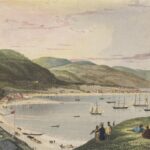
John Kinder, an Anglican clergyman and early Auckland resident, became one of the city’s first significant visual chroniclers. His watercolours depict a city in formation: muddy roads, scattered tents, the half-built spire of St. Paul’s Church. But Kinder’s works are not triumphalist. They convey a strange quiet, an awareness of impermanence. In several paintings, the volcanic cones loom in the background—not as tourist icons, but as brooding reminders of a prior sovereignty.
Other artists—Albin Martin, Charles Heaphy—tried to bring European romanticism to the frontier. They painted harbors with golden light, native bush with a softness borrowed from English pastoral scenes. Māori figures appear in these paintings too, but often as staffage: small, dignified, static. They are rarely central, rarely individualized. The exception was portraiture. Some artists, fascinated by Māori tattooing and costume, drew careful likenesses of rangatira (chiefs) in pen and wash. These images were often sold or reproduced in Europe, feeding an audience hungry for exotic nobility.
But the most telling images were the incomplete ones. In a surviving sketch from the 1840s, an unknown artist begins a drawing of a carved gateway at a pā. Only half is finished. The rest fades into blankness. The note reads: “Structure removed during clearing.” In that erasure, we glimpse not just a lost object, but a moment when two visual systems collided—one drawing, the other vanishing.
Three recurring visual tropes in early colonial representations of Auckland:
- The cleared ridge: once a fortified pā, now shown as an empty hill awaiting development.
- The noble Māori: carefully posed, often with weaponry, often unnamed, used to symbolize pre-modern dignity.
- The fertile future: panoramic views from elevated points, emphasizing open land, distant sea, and colonial potential.
Auckland’s early colonial aesthetics did not arise in a vacuum. They were part of a broader British imperial visual grammar, designed to show order, possibility, and entitlement. But these images were also haunted. They hover between documentary and fiction, between mapping and dreaming. The land was not as empty as they suggested, and not as compliant.
By the time the first art societies were founded in Auckland in the 1870s, the city had already been thoroughly pictured—by maps, plans, and colonial eyes. But beneath those images, another layer remained: the memory of a different way of seeing, briefly visible in the gaps between sketches, the pauses in the paint.
Oil and Order: Early Colonial Painting in Auckland
In the decades after the Treaty of Waitangi, Auckland developed not only as a colonial capital but as a visual project. Painters, often self-taught or trained in the conventions of British Romanticism, turned their attention to the land—its harbours, hills, homesteads—and to the structures of order slowly taking hold. In oils and watercolours, they imagined a future city while recording a fragile present. If maps and surveys established legal possession, painting made aesthetic claims. These images did not simply document the transformation of Tāmaki Makaurau—they helped author it.
Romanticizing the frontier
Many of Auckland’s earliest European painters were not professionals in the sense we use the word now. They were army officers, clergymen, civil servants, and settlers, often with some education in drawing or a background in surveying. Their landscapes reflect this dual role: part record, part reverie. The natural environment was not painted as wilderness but as potential.
Charles Heaphy, perhaps the best known of the early colonial artists, painted Auckland and its surrounding regions with a deliberate sense of grandeur. His compositions often included a Māori figure in the foreground—posed, dignified, and facing the viewer—while the mid-ground revealed a river or plain, and the background lifted into hazy mountain ranges. These works echoed the tropes of European landscape painting: the pastoral foreground, the sublime distance, the sense of harmony between human and nature. But in Heaphy’s hands, these tropes carried a political subtext. The Māori figure, noble and still, became a sign of a vanishing culture; the landscape, open and fertile, awaited settlement.
What was often missing from these images was disorder. The muddy chaos of actual Auckland—the makeshift tents, the hastily felled trees, the disease-ridden gullies—rarely made it into the frame. Instead, paintings offered aspirational visions: of streets soon to be paved, of hills soon to be tamed by survey and sale.
This aesthetic vision was not neutral. It aligned with the ideological aims of the colonial state. To paint a landscape as orderly was to imply it should be orderly, and that it was available for improvement.
The city as subject: muddy roads and imperial dreams
As Auckland expanded—its port bustling with British ships, its ridgelines dotted with homesteads and churches—the city itself began to appear in paintings. These works were rarely urban in the modern sense. They showed Auckland as an emergent town: its outlines visible, but not yet filled in.
John Kinder, the Anglican clergyman and educator, offered a more intimate and reflective vision than Heaphy. His watercolours from the 1850s and 60s depict the city with restraint and precision. Churches and houses appear small against wide skies; volcanic cones, often partially obscured, dominate the horizon. Kinder’s Auckland is not heroic. It is quiet, tentative, and often melancholic.
One of his most evocative paintings, St Paul’s Church from Official Bay (c. 1860), captures a view of the modest church spire rising above the trees, with the Waitematā Harbour stretching behind. There are no people in the scene. The city feels newly placed, provisional. The composition invites reflection not on triumph, but on settlement as an act of isolation and effort. His palette—subdued earth tones, pale skies—eschews the celebratory hues of imperial romanticism.
Not all artists shared Kinder’s reserve. Albin Martin, a trained painter from England who settled in Auckland, produced more decorative scenes, often infused with a sense of European nostalgia. His interiors, portraits, and garden views reflect a desire to establish a cultural life in step with Victorian taste. In his work, art becomes a form of social performance—proof that Auckland’s settlers were not just clearing bush but building civilization.
The visual grammar of colonial Auckland solidified in this period:
- Paintings of volcanoes and hills with distant ships or spires—linking the natural landscape to the signs of progress.
- Idealized port scenes, omitting the industrial grime of wharves and loading bays.
- Panoramic vistas viewed from elevated points—Governor’s Hill, Mount Eden, or Northcote—suggesting a city growing toward its destiny.
These images served both documentary and aspirational purposes. They were displayed in homes, reproduced in books, and sent to relatives in Britain to show what the colony was becoming. In them, Auckland was not a real place so much as a vision of orderly expansion.
The visual politics of possession
Beneath the placid surfaces of these paintings lay a deeper logic: the transformation of land into property. The shift from Māori to British sovereignty was not just a legal process—it was a visual one. Painters participated, knowingly or not, in the redefinition of what the land meant and who it belonged to.
Land that had once been embedded in whakapapa, in narrative and use, was now rendered as real estate. The artist’s task was often to affirm that transition. Even in works that included Māori subjects, the overall composition positioned them within a European frame—both literally and metaphorically. They became part of the scenery, not agents of its meaning.
A striking example appears in an 1850s oil by an unknown settler artist: a panoramic view of Auckland from the western slopes of Parnell. In the foreground, a group of Māori sit beside a cooking fire. Behind them, the town unfolds in symmetrical rows, the harbor bright with sails. The eye is drawn not to the people but to the pattern of development beyond them. The figures, once central to the land, have been relegated to its edge.
This framing was part of a broader process by which Auckland’s artistic and political consciousness evolved together. The colonial administration needed images that made the land legible—not as a contested space, but as an asset. Artists provided those images. They made the city look inevitable.
Yet even within this framework, ambiguities crept in. Kinder’s skies are often overcast. Martin’s streets, though neat, are sparsely populated. Heaphy’s mountains seem to hold something in reserve. These moments suggest unease—an unconscious awareness, perhaps, that the story being painted was not the only one unfolding.
What remains remarkable is how early painting in Auckland reveals the tensions between possession and observation. The artists wanted to see clearly, but clarity itself was political. To look at a land and call it beautiful, fertile, open—was also to imagine it as one’s own.
The Civic Gaze: Art Societies, Exhibitions, and the Search for Refinement
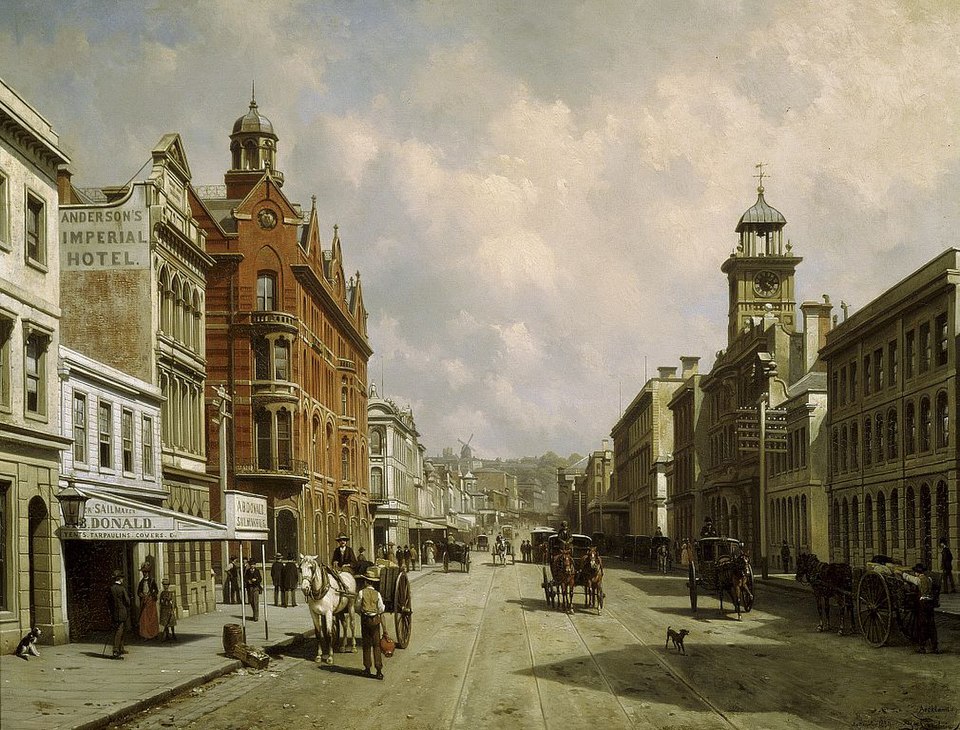
As the city of Auckland inched toward urban maturity in the late 19th century, its art culture followed a parallel arc—from improvised sketchbooks and amateur watercolours to organized exhibitions, formal societies, and a growing sense of civic aesthetic identity. Painting had begun in the colony as a private pursuit or a settler’s document of place. By the 1870s, it was a public affair. Art became a tool for refinement, prestige, and municipal self-presentation. The city no longer wanted to merely exist—it wanted to see itself reflected, elevated, and admired.
The Auckland Society of Arts and Victorian cultural ambition
Founded in 1870, the Auckland Society of Arts (ASA) was both a symptom and a cause of the city’s evolving cultural ambition. It emerged from the energies of a settler elite eager to model Auckland on the great metropolises of Britain. Art societies were not just venues for creativity; they were emblems of progress, proof that the frontier had been civilized, that cultural life had arrived.
The early exhibitions mounted by the ASA were modest but aspirational. Held in borrowed spaces—church halls, municipal buildings—they featured landscapes, portraits, botanical illustrations, and decorative arts. Many works came from enthusiastic amateurs, often women, who painted still lifes or local flora in styles learned from manuals or correspondence courses. A smaller number were the work of professionally trained artists, some of whom had recently arrived from England, bringing with them not only skills but a sense of hierarchy: oil over watercolour, figure over flora, Academy over instinct.
What these exhibitions lacked in polish, they made up for in civic energy. Crowds came not just to admire but to inspect, compare, and converse. Exhibitions were social events, where clothing, posture, and commentary mattered as much as the art. They reinforced class distinctions while offering a taste of cosmopolitanism. To be seen looking at art was, increasingly, to be seen as respectable.
Within this culture of viewing, landscape remained dominant. Paintings of the Waitematā Harbour, the volcanic cones, and the pastoral outskirts of the city proliferated. These images offered a comforting fusion: the drama of the New Zealand landscape softened by the stylistic gentility of European brushwork. Urban life, with its overcrowding, mud, and industrial messiness, remained less often painted—except in sanitized forms. Art at this stage wasn’t interrogating Auckland so much as flattering it.
Yet even these polite images were part of a deeper civic desire: to shape the city’s self-image. Just as Victorian architecture sought to lend gravitas to public buildings—columns, cornices, clock towers—so too did art societies attempt to bestow cultural weight on a city still uncertain of its status.
Imported taste and local hesitation
Auckland’s art institutions grew in the shadow of London. The taste-making apparatus of the Royal Academy, the South Kensington Museum, and the British press loomed large over settler sensibilities. Curators, patrons, and educators deferred to imported standards. Copies of European paintings were purchased for instructional purposes. Engravings of Old Masters were hung in schoolrooms. When the ASA judged its exhibitions, it used criteria modeled on the Salon or the Academy. Works that deviated—too rough, too raw, too experimental—were often dismissed.
This colonial mimicry extended to the kinds of art considered “serious.” History painting, portraiture, and classical subjects were lauded, even though local artists had limited access to the training or subjects required to execute them convincingly. The irony was stark: in a land with no classical ruins, no ancestral castles, and no Renaissance tradition, settlers were encouraged to paint like they were still in Kent or Surrey.
The result was a visible hesitancy in many Auckland paintings of the period. Landscapes often appear slightly generic, as if afraid to commit to the specific ruggedness of local terrain. Portraits aim for dignity but often fall into stiffness. There is a persistent sense of trying to measure up—not only to artistic standards, but to the idea of cultural worth itself.
Still, artists began to push back, subtly at first. By the 1880s, painters like Louis John Steele—trained in Europe and later a teacher in Auckland—began introducing stronger tonal contrasts, bolder brushwork, and more distinct local themes. Steele’s influence extended into pedagogy: he mentored younger artists and helped shift local painting away from imitative gentility toward something closer to visual confidence.
Meanwhile, the Society’s exhibitions increasingly included works by women. C.F. Goldie’s early rival, Frances Hodgkins, would later become internationally known, but even in these early years, women artists were reshaping the scene. They painted not just flowers and teacups, as critics condescendingly claimed, but also complex interiors, psychological portraits, and subtle studies of weather and light.
Three recurring tensions in Auckland’s late 19th-century art scene:
- A desire to impress England versus a slowly growing interest in New Zealand subject matter.
- The dominance of amateurism in exhibition spaces versus the emergence of professional ambition.
- A reliance on European instruction versus an inchoate local visual language.
These tensions didn’t resolve easily. But they made Auckland’s art scene more interesting than it appeared on the surface. Behind the polite watercolours and Academy-style oils was a city trying to see itself—awkwardly, ambitiously, and sometimes with surprising clarity.
Early exhibitions as social theatre
For all the talk of aesthetics, art in Auckland during this period functioned just as strongly as a kind of social theatre. The annual ASA exhibitions were not only cultural events but civic rituals. Opening nights were reported in the press, with attention paid to who attended, what they wore, and what they said. The room itself mattered. Lighting, spacing, and arrangement signaled hierarchy. Large gold frames dominated, while smaller works were crammed into corners or “skied” above eye level.
These displays had cumulative effects. They reinforced certain modes of painting as normative: soft landscapes, respectable portraits, floral still lifes. They also taught viewers how to look—where to pause, what to admire, how to discuss art in terms of value and taste.
Children were brought in as part of their education. Ladies’ sketching clubs formed. Collectors began to buy—not many, and not extravagantly, but enough to establish a tiny local market. The idea of art as a civic good began to take root. And with it came calls for a permanent institution.
By the 1880s, the dream of an Auckland public gallery had begun to circulate. It would take time—and significant controversy—for that dream to be realized. But the groundwork had been laid: in watercolours hung on temporary walls, in catalogues printed for fundraisers, in conversations between strangers standing before a borrowed canvas and wondering, together, whether Auckland might really become a city of culture.
Māori Responses: Adaptation, Resistance, and the Art of Survival
Throughout the 19th century, as Auckland’s colonial art institutions grew and settler artists attempted to visualize their new world, Māori were not passive observers. Their visual culture, long established and intricately developed before colonization, did not vanish under missionary pressure or legislative control. Instead, it entered a period of profound adaptation—one marked by both strategic silence and deliberate visibility. In and around Auckland, Māori artists and communities responded to the new aesthetic order with a complex mix of resilience, camouflage, invention, and refusal.
Cloaks, moko, and visual sovereignty
Even as formal Māori carving and architecture came under sustained colonial pressure—targeted for erasure, simplification, or museumfication—other visual forms remained highly visible in daily life, particularly those that could be worn. Garments, tattoos, and adornments became sites of resistance. A finely woven kākahu (cloak), especially one adorned with korowai tassels or rare bird feathers, could assert tribal prestige and political authority in a setting increasingly dominated by Western dress codes.
In Auckland, the wearing of such cloaks at hui (gatherings) or on diplomatic visits with colonial officials was not merely ceremonial—it was declarative. In a context where the settler state increasingly defined Māori through deficit (as relics, rebels, or wards), the visual presence of customary adornment reasserted mana. Chiefs from Ngāti Whātua and other iwi continued to wear full ceremonial regalia when meeting with Crown agents, framing themselves within their own visual logic rather than adopting the visual neutrality preferred by colonial authorities.
Moko, too, persisted against pressure. By the 1860s, facial tattooing—particularly among women—remained widespread across much of the North Island, including in communities surrounding Auckland. While some Māori men chose to forego moko in public to avoid discrimination or comply with missionary norms, others continued to wear it as an assertion of identity, even appearing in formal painted portraits.
These forms were not just decorative or traditional; they operated as political language. A cloak might communicate tribal affiliation, alliance, or intention. A chin tattoo could signal rank, lineage, or readiness for leadership. In a settler city increasingly governed by the written word and the printed image, Māori continued to communicate power visually—on their own bodies, with their own symbols.
Mission station adaptation and code-switching
One of the more subtle responses to colonial visual culture came through strategic adaptation—what might now be described as visual code-switching. Māori artists and artisans, particularly those exposed to mission schooling or employed by colonial households, learned to move between visual systems. They acquired European techniques of drawing and painting, learned to render figures in profile, to use perspective, and to work with new materials such as paper, ink, and manufactured pigments.
But they did not always abandon their own modes of seeing. In some cases, Māori creators used European media to depict traditional content. In others, they embedded ancestral patterns within Western forms. Mission-educated Māori boys might sketch still lifes that quietly echoed kowhaiwhai patterns in their arrangement of line and space. Māori girls trained in embroidery were known to insert subtle spiral motifs into cushion covers or samplers—small acts of aesthetic defiance dressed as obedience.
There were even instances of hybrid buildings. A chapel built under Māori direction might follow Christian architectural lines but contain carved supports with ancestral references. These were not errors or inconsistencies. They were deliberate juxtapositions, asserting cultural continuity beneath the imposed structure.
The most remarkable example of this aesthetic negotiation came in the form of Māori Christianity itself. Religious texts were translated into te reo Māori, but sermons and hymns were sometimes delivered within spaces still governed by Māori design and decoration. Some missionary records from Auckland’s peripheries note their discomfort with “native forms” present during worship—evidence, in fact, that Māori were reframing religion within their own cosmological traditions rather than absorbing it uncritically.
This selective adaptation allowed Māori to engage with colonial institutions without surrendering sovereignty. It also laid the groundwork for future artistic synthesis, when Māori artists would begin to openly manipulate European art forms on their own terms.
Three examples of adaptation visible in 19th-century Māori visual culture near Auckland:
- Use of British wool in korowai weaving, creating a texture and sheen not seen in pre-contact cloaks but still adhering to traditional patterns.
- Watercolour sketches by Māori students at mission schools depicting marae scenes or carved figures using European perspective.
- Carved church interiors where Christian motifs were surrounded by ancestral designs, transforming the religious space into a dual-language structure.
The unspoken presence in settler imagery
Perhaps the most telling form of Māori artistic presence during this period is the one that hovers at the edges of settler art—half-seen, barely acknowledged, but unmistakable. Many of Auckland’s early colonial landscapes contain traces of Māori life, often rendered with ambiguity. A small canoe on a harbour. A group of figures standing on a hill. A wharenui in the middle distance. These inclusions, never central, served to authenticate the exoticism of the image without disturbing its colonial narrative.
Yet for those who know what to look for, they tell another story. In several early paintings by John Kinder, for example, Māori dwellings are visible in the margins of the built environment—often half-obscured by trees or nestled into hillsides. In one work, a carved gateway stands quietly beside a dirt path; it is not labeled, but its presence anchors the scene in a different time and authority.
Even when omitted, Māori presence shaped the image. Settler painters made compositional choices that emphasized “emptiness”—wide, unpeopled landscapes awaiting cultivation. But such emptiness was fictional. These were inhabited lands, with names, histories, and layered significance. The act of painting them as blank was an aesthetic strategy with legal and cultural consequences.
For Māori, this created a kind of ghost position within settler art: neither fully absent nor fully seen. This ambiguity later became fertile ground for intervention. In the 20th century, Māori artists would return to these early works—sometimes literally, by reworking colonial images—to reinsert the bodies, symbols, and histories that had been elided.
But even in the 19th century, the art of survival was visual. In public, Māori aesthetics might retreat. But in private, on clothing, on skin, in carvings hidden beneath linings or inside doorposts, they endured. They spoke in quiet forms, invisible to the untrained eye, but unmistakable to those who had lived them.
Modernist Turns: National Identity and Auckland’s Rebellious Edge
By the early 20th century, New Zealand art found itself at a cultural crossroads, with Auckland in an uneasy but pivotal role. The growing dominance of European academic realism, reinforced by gallery institutions and colonial pedagogy, began to feel stifling to a younger generation of artists. While Wellington held the reins of political power and Dunedin retained its claim to colonial seriousness, Auckland became the site of rupture—artistically restless, geographically peripheral to European centers, and socially unorthodox. It was in this context that modernism took hold, not as a clean break from tradition, but as a provocation: against Britain, against realism, and, increasingly, against the very idea of art as colonial confirmation.
Colin McCahon and the anti-picturesque
The defining figure of New Zealand’s modernist turn remains Colin McCahon. Though born in Dunedin, it was Auckland that gave McCahon both the friction and the freedom he needed to become his most difficult, original self. When he moved to the city in the 1950s to work as a curator and educator at Auckland City Art Gallery, the local art scene was in flux: too provincial to be confidently international, too self-conscious to rest on tradition. Into this tense, uncertain atmosphere McCahon dropped paintings that rejected both the lushness of colonial landscape art and the sentimentality of nationalist mythmaking.
Instead of panoramic harbors or nostalgic bush scenes, McCahon painted stark hills, black texts, and cryptic, weathered skies. His works from this Auckland period—The Northland Panels (1958), A Question of Faith (1970)—replace the visual seductions of earlier landscape with a kind of moral geography. They are not about scenery but about doubt. The land is not offered to the viewer as possession, but as riddle.
One of McCahon’s most striking departures from tradition was his use of text in painting. Biblical fragments, questions, and cries of uncertainty appear in scrawled white across moody, earth-toned fields. This was a profound break with inherited aesthetics. Whereas colonial painters had shown land as bounty and promise, McCahon showed it as site of struggle—spiritual, psychological, ecological. His New Zealand was not a paradise, but a place of testing.
Auckland, with its humid volatility, its mix of cultures, its refusal to settle into artistic orthodoxy, gave McCahon room to innovate. It also gave him something to resist. The city’s built environment—neither beautiful nor entirely brutal—appears in his later urban works as a place of visual overload, religious alienation, and metaphysical exhaustion. He painted it not to celebrate, but to ask what it meant to live there and still believe in anything at all.
Abstraction, place, and theological doubt
McCahon was not alone in pushing Auckland toward modernism. By the 1960s, a younger group of artists—Don Binney, Ralph Hotere, Milan Mrkusich—were also testing the limits of form, space, and content. Each approached abstraction differently, but all shared a conviction that the landscape could no longer be simply pictured. It had to be interpreted, or in some cases, dismantled.
Binney, with his stylized native birds hovering over coastal ridgelines, created compositions that were both ecological and symbolic. His works, often associated with West Auckland, treat place not as background but as habitat—a living system under threat. The birds are not decorative; they are sentinels.
Hotere, though based primarily in Dunedin, exhibited regularly in Auckland and developed deep ties with its Māori and artistic communities. His minimalism—often black-on-black, often funereal—introduced Māori experience into a language of abstraction. Where earlier Māori representation had often been figural or folkloric in settler art, Hotere offered something radically different: an aesthetics of silence, rage, and dignity. In his 1984 Black Phoenix, constructed from charred timber salvaged after the Rainbow Warrior bombing, the political and the sacred meet in sculptural lament. His repeated showings at Auckland institutions forced the city to reckon with the fact that modernism was not a purely European inheritance.
Mrkusich, of Dalmatian descent and trained as a decorator, developed a geometric vocabulary in which color and proportion were treated with the seriousness of theological inquiry. His early architectural commissions in Auckland—murals, glass panels—blurred the line between art and built space. In doing so, he reminded a city obsessed with growth that visual form could still offer meaning beyond branding.
In these artists’ work, Auckland appears not just as subject but as pressure—urban sprawl, spiritual confusion, political ambiguity. Their paintings were responses not to an image of the city, but to the experience of living within its fractured reality.
Three key features of Auckland’s modernist edge:
- A deep suspicion of picturesque tradition, replacing beauty with moral or existential tension.
- An embrace of text, minimalism, or stark symbolism as tools of resistance and ambiguity.
- A growing willingness to mix spiritual language with political and personal doubt.
A city too new for nostalgia
What made Auckland fertile ground for modernism was precisely what made it culturally insecure. It was not old enough to have a stable tradition, not official enough to demand loyalty, not international enough to impose fashion. This looseness, which irked many curators and critics at the time, allowed artists to move between modes, to experiment without consensus, to challenge the imported norms of taste.
The Auckland City Art Gallery, under directors like Peter Tomory and later Rodney Wilson, began to reflect this new energy. Its exhibitions, though still uneven, moved beyond polite landscape shows to include conceptual work, political themes, and critical retrospectives of overlooked local artists. For the first time, the city began to take its own artistic past seriously—not as a settler legacy to preserve, but as a history to interrogate.
In the studios and artist-run spaces of Ponsonby and Grey Lynn, collectives formed and dissolved. Painters shared walls with poets and performance artists. The idea of an “Auckland School” remained elusive—there were too many contradictions, too many crosscurrents—but the city had clearly become a place where serious, original art could be made. Not despite its cultural ambivalence, but because of it.
By the end of the 1970s, Auckland was no longer a cultural backwater. It was a city with edges—some sharp, some uncertain—but undeniably its own. The modernist experiments of this era didn’t just challenge the past. They expanded what the future might look like.
The Island City: Pacific Migrations and Visual Culture
Auckland is often described as the largest Polynesian city in the world, and this is not a statistic—it’s a transformation. From the 1950s onward, waves of migration from Samoa, Tonga, Niue, the Cook Islands, and later Fiji, Tokelau, and Tuvalu reshaped the cultural life of the city. These movements were not simply demographic shifts. They were aesthetic ones. Alongside new foods, music, and language, Pacific communities brought visual systems steeped in symbolism, ritual, and intergenerational craftsmanship. In the galleries, these systems took time to be recognized. On the streets and in homes, they never waited for permission.
Postwar arrivals and the transformation of suburbia
The story of Pacific art in Auckland begins not in studios but in lounge rooms, church halls, garages, and front yards. The 1950s and 60s saw government-led labour recruitment schemes that brought thousands of Pacific Islanders to Auckland for work in factories, construction, and domestic service. These migrants often lived in densely packed inner suburbs like Grey Lynn, Ponsonby, and Newton—areas later mythologized for their gentrification, but in this earlier period alive with communal visual expression.
Inside modest homes, mats woven from pandanus, shells arranged in intricate patterns, and portraits of ancestors or Jesus shared space on the walls. Colour was everywhere—bright hibiscus fabrics, patterned curtains, painted plaster ornaments, plastic floral arrangements. These were not frivolous decorations. They formed an aesthetics of presence. In a country where Pacific people were often marginalised, this everyday art said: we are here, we are connected, we remember.
The churches served as key visual spaces. Samoan siapo (tapa cloth), Cook Islands tivaevae (quilting), and Tongan ngatu transformed sanctuaries into repositories of visual history. Women often played central roles in the creation of these works, working in collaborative, intergenerational groups. Designs carried genealogical, spiritual, and political meaning. They referenced not just island traditions but the lived realities of migration: the tension between home and host, the pressure to adapt, the need to hold on.
This domestic visual culture found little echo in Auckland’s official art spaces during these decades. The Auckland Art Gallery, still largely focused on European and New Zealand Pākehā artists, did not yet have the institutional imagination to engage seriously with Pacific visual traditions. And yet, these traditions were flourishing—unarchived, unframed, but unmistakably vital.
Three expressions of Pacific visual culture that reshaped Auckland’s suburbs:
- Painted concrete fences and exterior walls with hibiscus or geometric patterns, turning private homes into aesthetic declarations.
- Assemblages of shells, glass, and mirrors used in yard altars or shrines, reflecting both Christian faith and ancestral veneration.
- Hybrid photo walls inside homes, combining formal family portraits with cut-outs from magazines, creating diasporic constellations.
Tattoo revival and performance art
By the late 1980s and early 90s, a younger generation of Pacific artists—born in Auckland or having arrived as children—began to re-engage with traditional forms in new, often radical ways. Tattoo, once heavily stigmatised, re-emerged as both artistic practice and political declaration. Samoan tatau and Tongan tatatau traditions, carried on by master artists such as Sua Sulu’ape Paulo II, found renewed life in suburban garages and later in formal studios. These weren’t just revivals—they were reassertions of visual sovereignty on the most intimate canvas: the body.
At the same time, a more experimental art movement began to take shape. Artists like Michel Tuffery, John Pule, and Ani O’Neill worked across media—sculpture, painting, performance, textile—often mixing customary materials with Western art school techniques. Their works appeared in new contexts: dealer galleries, contemporary group shows, and biennales.
Pule, raised in Auckland but born in Niue, combined Catholic iconography, personal memory, and Niuean barkcloth design into a densely narrative painting style. His canvases were maps of dislocation—part autobiography, part cosmology. Tuffery’s Pisupo Lua Afe (1994), a life-sized bull sculpture made from recycled corned beef cans, directly confronted the commodification of Pacific bodies and diets under colonial capitalism. It was funny, furious, and unforgettable—and it signaled a new visual vocabulary for Pacific Auckland: one that didn’t ask to be included, but declared itself essential.
Performance also emerged as a critical tool. Groups like the Pacific Sisters blurred the line between fashion, ritual, dance, and sculpture. Their shows—part catwalk, part ceremony—deconstructed Western ideas of costume and craft, presenting identity as dynamic, layered, and resistant to definition. In Auckland’s increasingly diverse art scene, these performances offered not only spectacle but critique: of museums, of white liberal multiculturalism, of the expectation that Pacific art must be quiet, humble, or folkloric.
Tapa, tivaevae, and the aesthetics of diaspora
One of the central achievements of Pacific artists in Auckland was their insistence that customary forms—tapa, tivaevae, tattoo—be treated not as heritage relics but as living, evolving mediums. These works were not simply transplanted from the islands to the city. They were transformed by migration, shaped by memory, work, weather, and context.
Tivaevae, in particular, became a powerful symbol of female creativity and collective authorship. Traditionally made in small groups, these quilts were used in weddings, funerals, and gifting rituals. In Auckland, their production continued in both homes and churches, often with altered materials and adapted patterns. Some featured Auckland cityscapes, motorway signs, or corporate logos—images of life in the diaspora. The quilts functioned as counter-archives, recording what institutions ignored.
In the 2000s, artists such as Dagmar Dyck and Leilani Kake began explicitly engaging with these textile traditions in a contemporary art context. Dyck, of Tongan and German descent, incorporated ngatu patterns into print and mixed media, highlighting the layering of cultural identity in a city of migration. Kake’s video installations explored gender, family, and grief, often drawing from both customary forms and personal experience.
As Auckland’s Pacific communities moved outward—from central suburbs to South Auckland—so too did the visual culture. Otara, Māngere, and Ōtāhuhu became new aesthetic centers. Murals, church art, streetwear design, and social media graphics all became sites of innovation. A distinctly urban Pacific visual language emerged—one shaped by intergenerational negotiation, local politics, and a global awareness of Black and brown solidarity movements.
In 2012, the Auckland Art Gallery hosted Home AKL, a major exhibition of contemporary Pacific art. It was late, and overdue, but it marked a shift. The gallery was no longer just a house of European pictures. It was beginning, however haltingly, to reflect the city around it.
Urban Texture: Art and the Changing Face of Auckland
No city remains static in its self-image, but few transform as visibly—and as chaotically—as Auckland. From the late 20th century onward, the city’s skyline, social composition, and infrastructure morphed with astonishing speed. And as the physical shape of Auckland changed, so too did its visual language. Artists who once painted volcanic cones and coastal estuaries turned their attention to motorway offramps, concrete underpasses, suburban shopping malls, and the glowing, ambivalent cityscape of night. Art no longer simply depicted Auckland; it wrestled with it—its sprawl, its noise, its buried histories, and its divided dreams.
Concrete and shadow: the modern city in paint
By the 1980s, the Auckland landscape was no longer just natural. It had become infrastructural. The city’s rapid expansion, driven by car culture and suburban growth, carved new routes and erased old neighborhoods. Painters began to take this new environment seriously, not as a failure of beauty, but as a subject worthy of examination.
One of the most consistent chroniclers of Auckland’s evolving urban core was Jeffrey Harris. Though born in Christchurch, Harris spent time in Auckland and captured its psychological texture: buildings looming like half-formed memories, streets empty yet charged. Meanwhile, artists such as Graham Fletcher, influenced by both architectural history and cultural hybridity, began incorporating modernist interior design into canvases that questioned who these spaces were built for and what ideologies they housed.
Even more direct were the works of Ian Scott and Gavin Chilcott. Scott, especially in his later grid paintings and earlier suburban scenes, collapsed the divide between decoration and critique. His Lattice series echoed both Polynesian weaving and abstract minimalism, hinting at a kind of visual détente between cultural orders while exposing their artificial separation. Chilcott, by contrast, embraced the deliberately artificial: his installations and mixed media works poked at Auckland’s aspirational consumer culture—its malls, its faux gardens, its whitewashed comfort.
By the 1990s, even younger painters like Martin Ball were turning their attention to photographic realism, rendering Aucklanders not as types but as hyper-individuals, caught between glossy surfaces and unspoken tensions. The city became less a place to depict and more a state to inhabit—a texture, a mood, a built argument.
Three recurring themes in late-20th-century Auckland urban art:
- The motorway as metaphor: endlessly expanding, isolating, and central to Auckland’s self-perception.
- Empty architectural space: office towers, petrol stations, car parks—sites of ambiguity, repetition, and latent memory.
- The suburban threshold: fences, garages, hedges—spaces that hide as much as they contain.
These motifs weren’t nostalgic or celebratory. They documented a city increasingly defined by fragmentation. In place of skyline pride came visual doubt: What does it mean to belong in a place that changes so rapidly it forgets what it looked like last year?
Street art, signage, and the contested wall
As formal galleries contended with the pace of urban change, a new art form claimed the walls themselves. Street art in Auckland, which first emerged as tagging culture in the 1980s, grew into a full-fledged visual movement by the 2000s. What began in alleyways and overpasses became a complex, layered language of commentary, identity, and reclamation.
K-Road—Karangahape Road—became the city’s most charged visual corridor. Once a genteel shopping avenue, then a red-light district, then an arts precinct, K-Road’s walls transformed into a constantly shifting gallery of mural work, stencil art, and unsanctioned installation. Artists like Component, Askew One, and TrustMe built reputations on large-scale, intricate works that blended graffiti traditions with fine art technique. Their pieces commented on housing inequality, Pacific identity, corporate intrusion, and memory loss.
Murals spread throughout South Auckland as well, often under the auspices of community initiatives. In Ōtara and Māngere, wall art became a form of local storytelling: portraits of elders, evocations of ancestral islands, references to gang history, and celebrations of youth achievement. These works weren’t about beautification. They were about visibility—about ensuring that neighborhoods long ignored by the city’s cultural planners could see themselves represented, not just serviced.
At the same time, corporate muralism began to blur the line between street art and branding. Commissioned works appeared on new developments, often stripped of political content and framed as “urban vibrancy.” Some artists participated willingly, using these platforms to reach new audiences. Others resisted, tagging over such works or mocking their bland positivity.
In this contested space, street art became a battleground for how Auckland saw itself: raw or polished, angry or aspirational, remembered or erased. A spray-painted quote on a Grey Lynn wall said it best: “This wall remembers more than your council does.”
From Queen Street to K-Road: image and identity in motion
If Queen Street was once the visual heart of Auckland, by the turn of the 21st century, its authority had fragmented. The city no longer had a single image of itself. Instead, it flickered between multiple narratives: the glossy metropolis of property developers, the gritty undercity of street-level memory, the suburban sprawl of everyday life, and the virtual city of Instagram filters and real estate renderings.
Artists responded with strategies as fluid as the city itself. Photographer Edith Amituanai began documenting West Auckland homes and their interiors, capturing the subtle ways in which diasporic identity was staged in private space. Her images, often quiet and unassuming, told stories of longing, domestic pride, and cultural negotiation without spectacle.
Meanwhile, performance artists used the city as stage. Rosanna Raymond and the SaVAge K’lub enacted live interventions that reinserted Indigenous and Pacific bodies into central spaces—libraries, galleries, and city squares—with gestures that were at once humorous, confrontational, and sacred. Their work forced Auckland to look again at its architecture and ask: who was left out of its original design?
Auckland’s changing face was also reflected in its architecture. Glass-and-steel towers replaced older buildings, many of them demolished without ceremony. Artists mourned these losses, sometimes documenting them through photography, sometimes reclaiming fragments in assemblages. The city’s aesthetic memory was porous, but not gone.
By the 2010s, new collectives emerged, blending design, music, fashion, and visual art. FAFSWAG, a queer Pacific collective based in South Auckland, used digital art, performance, and social media to expand the possibilities of representation. Their work wasn’t just in galleries—it was online, in clubs, on bodies. It made the city feel wider, stranger, and more honest.
Auckland had become a city of layers: some visible, some painted over, some buried beneath car parks and condo glass. Art didn’t always keep pace, but when it did, it illuminated not only what the city looked like, but how it felt to live inside its daily transformations.
Elam and After: Art Education, Experiment, and Revolt
If Auckland had a crucible for artistic experimentation in the 20th century, it was the Elam School of Fine Arts. Situated within the University of Auckland, Elam produced not just graduates but provocateurs. For decades, it served as a paradoxical institution: rigidly academic in structure yet often anarchic in spirit. From the postwar years through the turn of the millennium, Elam shaped—and was shaped by—the wider artistic currents coursing through Auckland’s streets, galleries, and subcultures. What emerged was a culture of rupture: a refusal to accept art as polite production, and a hunger to expand what it could be.
The Elam School of Fine Arts and the making of a scene
Founded in 1890 and absorbed into the university in 1950, Elam was, for much of its early life, a conservative institution. Instruction revolved around technical proficiency, life drawing, and an imported British sensibility that prized skill and decorum over provocation. But even by mid-century, cracks were forming. The postwar influx of international teachers, combined with rising student radicalism and exposure to international modernism, turned Elam into a site of tension.
In the 1960s and 70s, that tension broke into open rebellion. Students no longer accepted the studio as sanctuary. They pushed for performance, installation, video. They wanted critique, not compliance. Among the most radical figures to pass through Elam was Jim Allen, a sculptor and educator who in the late 1960s introduced “post-object art” to the curriculum. This was not sculpture in any traditional sense. It was a form of artistic inquiry based in ephemeral action, gesture, and audience engagement.
Allen’s teaching, which included classes in time-based art, collaboration, and critique of institutional structures, fundamentally reshaped the expectations of what an art school could do. Elam students were no longer trained merely to master a medium. They were provoked to question the very premise of medium itself.
This atmosphere produced not a school of style, but a school of inquiry. Artists such as Bruce Barber, Andrew Drummond, and Philip Dadson emerged from this period not with a unified aesthetic but a shared distrust of constraint. Many left Auckland, some to Europe or North America, but they carried the city’s experimental DNA with them.
Performance, installation, and ephemeral acts
By the late 1970s, Auckland had become home to a flourishing—and often unrecorded—scene of performance and conceptual art. Much of it happened outside formal galleries: in warehouses, backyards, temporary squats, and city parks. These works were not designed for longevity or sale. They were gestures, provocations, sometimes jokes, sometimes rituals.
Philip Dadson, a former student and later a teacher at Elam, founded From Scratch, a sound-performance group that combined homemade instruments, sculpture, and choreography. Their works, often staged in raw urban spaces, blurred the boundary between music, sculpture, and endurance. They were also unmistakably of Auckland: their rhythms echoed the city’s industrial pulse, its tin roofs and port cranes.
Artists like Alexa Johnston and Richard Killeen turned toward installation and curatorial experimentation. Killeen’s “cut-outs”—arrangements of silhouetted shapes, symbols, and objects—undermined traditional notions of painting and composition. Instead of framing a scene, he exploded it across space, inviting viewers to assemble meaning for themselves. This open-form logic reflected a city with no clear center, a cultural geography in flux.
The 1980s also saw a sharp politicization of art. Māori and Pacific artists challenged Elam’s Eurocentric curriculum, demanding recognition of Indigenous and diasporic visual knowledge. These critiques were not simply cultural—they were institutional. Who taught, who was admitted, whose work was purchased or celebrated: all came under scrutiny.
Art historian and critic Rangihiroa Panoho would later argue that this period marked the beginning of “counter-institutional Māori modernism”—a movement not based in style but in refusal. Artists refused the passive role of ‘influence’ and claimed full authorship, not as token participants but as critical agents in the national conversation.
Feminist collectives and art as argument
Amid this ferment, feminist art collectives emerged as some of the most intellectually daring and socially incisive forces in Auckland. Groups like the Women’s Gallery (though based in Wellington, its reach extended nationally) and individual artists working in Auckland—including Claudia Pond Eyley, Carole Shepheard, and Juliet Batten—used both art and writing to question the assumptions embedded in masculine modernism.
For these artists, the personal was not just political—it was spatial, textual, and visual. They turned domestic materials into sculpture, diaries into manifestos, and sewing into critique. Batten’s installations incorporated ritual and ecology, challenging both patriarchal religion and capitalist land use. Shepheard explored printmaking as a feminist language, integrating bodily forms and cyclical motifs.
Their work was often shown in alternative spaces: cafés, cooperative galleries, and makeshift salons. They wrote essays, taught community classes, and published zines. The art world, still dominated by male curators and critics, struggled to respond. Feminist artists weren’t just asking to be included—they were questioning the foundations of inclusion itself.
This energy intersected with queer and LGBTQ+ expression, particularly in K-Road and inner-city spaces. Artists like Peter Wells and others working in film, photography, and performance turned the marginal into the magnetic. Identity was no longer to be suppressed or euphemized. It became a source of form and friction.
By the late 1990s, this history began to coalesce. Formerly marginal practices—performance, installation, relational art—gained institutional attention. Elam, once a bastion of technique, now produced artists who showed internationally, published theoretical work, and blurred art with activism.
Yet the question remained: could institutions keep up? Or were they still framing art in forms no longer adequate to the city it purported to reflect?
In Auckland, art education had become a proving ground—not for style, but for dissent. What Elam and its aftermath produced was not consensus, but a kind of visual argument: about power, identity, space, and the terms on which art enters the world.
Dealers, Collectors, and Downtown Cool
The story of art in Auckland is not only one of ideas and expression—it is also a story of rooms, reputations, and money. From the 1960s onward, as New Zealand’s cultural institutions matured and the idea of a professional art career became less utopian, a local art market began to form. Central to this market were the dealer galleries, those idiosyncratic rooms in which aesthetics met capital, and where the reputations of artists were often made or unmade. In Auckland, the emergence of a distinctive dealer gallery culture shaped not only what art was seen, but how it was talked about, priced, and remembered.
Barry Lett and the early dealer scene
The name Barry Lett stands at the beginning of Auckland’s serious gallery culture. In 1965, Lett, a painter and charismatic figure in the local scene, co-founded the Barry Lett Galleries with Rodney Kirk Smith and Frank Lowe. Located on Victoria Street, it quickly became a locus for contemporary art in the city—showing work that was often bold, sometimes divisive, and increasingly critical of conservative aesthetics. Lett himself was not a passive figurehead; he understood the importance of curatorial framing, of developing audiences, and of maintaining relationships with both artists and collectors.
What made Barry Lett Galleries distinct was its roster. It exhibited many of the country’s most adventurous artists: Colin McCahon, Don Binney, Pat Hanly, and Milan Mrkusich among them. The gallery did not shy away from work that challenged the viewer, nor from large-scale or unconventional formats. Lett’s strategy was to place contemporary New Zealand art not as provincial echo, but as fully self-contained—a world with its own urgency.
While the dealer model existed in Wellington (notably through Peter McLeavey), in Auckland it took on a more entrepreneurial, sometimes theatrical air. Galleries had to compete not only with each other but with the city’s cultural restlessness. Openings became events, critics took sides, and artists began to think tactically about their visibility. For some, this marked a loss of innocence: the transformation of art into product. For others, it offered liberation: a chance to make a living from their work and reach audiences beyond the cloistered world of art societies and state institutions.
Other important galleries followed in Lett’s wake. RKS Art, established in the late 1970s by Ross Sutton and Rodney Kirk Smith, carried forward a vision of contemporary art as intellectually and commercially viable. Sue Crockford Gallery, founded in the 1980s, became one of the most influential spaces in the country, representing artists like Jacqueline Fraser and Peter Robinson—figures whose work challenged both form and content with a postmodern sensibility.
By the 1990s, Auckland had a functioning, if still precarious, commercial art ecology. Artists, critics, and collectors moved between openings and studios, dealer showrooms and public galleries. The city’s art scene no longer depended solely on state funding or institutional validation. It had built its own infrastructure—fragile, elite, and undeniably influential.
The rise of private patronage
Parallel to the rise of dealer galleries was the emergence of a new class of private collectors—often businesspeople, lawyers, and doctors—who saw in contemporary New Zealand art not only cultural value but investment potential. This shift was critical. It meant that artists could, at least occasionally, earn a living from their work without relying on government grants or teaching posts.
These new collectors were not always fluent in the history of art, but they were alert to prestige. Owning a McCahon became a form of cultural capital, a way to signal seriousness and discernment. Corporate collections sprang up, particularly among banks and law firms, many of which filled boardrooms and corridors with bold local paintings—often abstract, often large, often masculine.
Some collectors went beyond private acquisition and became patrons in the older sense. Jenny Gibbs stands out as a major figure: her collection, her philanthropy, and her institutional advocacy helped shape the city’s cultural direction. She supported individual artists, championed the development of contemporary shows at Auckland Art Gallery, and made significant donations that expanded both public access and curatorial freedom.
Yet private patronage came with complications. It created a shadow canon—one driven by taste, wealth, and availability rather than scholarly assessment. Artists who were easier to live with (in terms of content or palette) sometimes fared better in the market than those whose work demanded confrontation. And gender imbalances remained persistent. Female artists were underrepresented both in sales and in high-profile exhibitions, a trend that would only begin to shift in earnest in the 2000s.
Still, the rise of private collecting gave Auckland’s art scene a financial and psychological jolt. Art was no longer simply admired. It was bought, sold, insured, and—crucially—argued over.
Galleries as cultural currency
By the turn of the millennium, the dealer gallery had evolved into a powerful arbiter of taste in Auckland. New galleries appeared in the central city, on K-Road, in Newmarket and Grey Lynn. Some were austere white cubes, others more bohemian. Together, they formed a network in which artists circulated, sometimes loyally, sometimes restlessly.
This system brought with it new expectations. Artists were expected to produce regular shows, to maintain visibility, and increasingly, to build coherent brands. Success was measured not just in critical response, but in media coverage and sales. A painting might be discussed as much for who bought it as for what it contained.
The scene also became more international. Auckland galleries began taking work to art fairs in Sydney, Hong Kong, and later, Basel. Local artists were suddenly visible in a global market, with prices rising and competition intensifying. The flip side of this growth was a creeping commercial homogeneity. Some critics lamented the dominance of “art fair art”—works that photographed well, traveled easily, and offended no one.
Against this, new spaces emerged to challenge the dealer orthodoxy. Artist-run initiatives, pop-up exhibitions, and collectives like Window, RM Gallery, and Fresh Gallery Ōtara offered alternatives to the commercial model. They prioritized experimentation, community engagement, and critical dialogue. These were not just fringe spaces—they were sites where the terms of artistic value were being actively contested.
Auckland’s downtown cool, then, was always double-edged. On one hand, it offered recognition, infrastructure, and a sense of connection to global circuits. On the other, it risked polishing away the unruly, unmarketable parts of the city’s visual imagination.
Still, within these contradictions, Auckland’s dealer and collector scene produced something real: a space in which contemporary art could live as more than hobby or service. It could be argued over in the press, invested in, challenged in public. It became, in fits and starts, part of the city’s cultural metabolism.
Toi o Tāmaki: The Gallery and the City
It sits at the edge of Albert Park, half-buried in volcanic foundations, half-reaching into the glass skyline: the Auckland Art Gallery Toi o Tāmaki. More than a museum, more than a civic monument, it is a site of accumulation and tension—a place where the city’s visual memory is held, displayed, negotiated, and sometimes refused. For over a century, the gallery has mirrored Auckland’s cultural ambitions and anxieties. It has canonised and omitted, expanded and withdrawn, striving to be both a repository and a stage. Its evolution tells not just the story of art in Auckland, but of Auckland as an idea.
Institutional architecture as visual statement
The Auckland Art Gallery opened in 1888 in a corner of the newly built Auckland Public Library. The building—gothic-arched and turreted—signaled its civic aspiration from the start: art was to be housed with learning, in the heart of the city, accessible and monumental. The collection at first was modest and deeply Anglophile: portraits of British officials, copies of European masters, and polite landscapes. It served more as a token of culture than as a dynamic institution.
Over the following decades, the gallery expanded cautiously. Its early acquisitions privileged European painting, with a smattering of New Zealand works that largely aligned with colonial aesthetics. Māori and Pacific art were mostly excluded, or included as ethnographic curiosities rather than as cultural equals. Still, through the 20th century, the gallery grew in stature. It hosted increasingly ambitious exhibitions, began building a modernist collection, and played a crucial role in bringing Colin McCahon to prominence—first as an artist, then as a curator.
But it was not until the 21st century that the gallery underwent its most dramatic transformation. The $121 million redevelopment completed in 2011, led by Australian architecture firm fjmt in collaboration with Auckland’s Archimedia, created a striking new structure. Its wooden canopies—evoking both the trees of the adjacent park and the ribs of a wharenui—sought to balance openness with rootedness, to fuse past and future. The building’s visual language was clear: this would be a contemporary museum that still acknowledged the land it stood on.
And yet, architecture is always aspiration as much as reality. For all its elegance and symbolic gestures, the revamped gallery remained hemmed in by institutional habit. Who would be shown, and how, remained as contested as ever.
Global loans, local tensions
In the decades following its expansion, Auckland Art Gallery adopted the dual mandate faced by most civic museums: to serve local audiences and to engage with international networks. It began hosting blockbuster exhibitions—Degas, Monet, Yayoi Kusama—bringing crowds and global attention. These shows, while often successful, also diverted attention from local art and from long-term collection development.
Some artists and critics argued that the gallery was becoming more responsive to international prestige than to the city’s own visual culture. They pointed to the scarcity of solo exhibitions for Māori and Pacific artists relative to their centrality in Auckland life. Others noted the absence of sustained curatorial focus on experimental or time-based practices, which had long flourished in the city’s fringe spaces.
Still, the gallery made key strides. It began to collect more actively in contemporary fields, expanding its holdings of Māori, Pacific, and feminist art. It hired curators with specific cultural expertise and supported landmark exhibitions like Home AKL (2012), the first major show dedicated to contemporary Pacific art made in Auckland. The exhibition brought together artists such as Ani O’Neill, Ioane Ioane, and Leilani Kake, and signaled a tentative shift in institutional voice—from curator as arbiter to gallery as listener.
Other key exhibitions followed, including retrospectives for senior Māori artists and explorations of colonial legacies. Yet even these were often framed within the language of inclusion—celebrated as correctives rather than as foundational. The gallery, like the city, still struggled to tell stories in which Indigenous and diasporic art did not simply arrive late, but shaped the beginning.
Three points of unresolved tension in Toi o Tāmaki’s institutional identity:
- A Eurocentric historical collection still disproportionately dominates wall space and conservation resources.
- The push for global relevance sometimes comes at the expense of sustained local engagement or curatorial risk.
- The role of contemporary Māori and Pacific art remains contested: is it a category, a contribution, or the new center?
These tensions are not failures so much as conditions of the gallery’s existence in a city still working out its cultural balance.
Curating Auckland’s contradictions
To curate in Auckland is to navigate multiplicity. No single narrative satisfies. The gallery’s exhibitions increasingly reflect this. Rather than organizing shows around movements or schools, curators have turned to themes: memory, land, migration, resistance, form. These thematic shows allow works from different generations, mediums, and cultural traditions to speak together—sometimes in harmony, more often in fruitful friction.
One of the most ambitious examples was A Place to Paint: Colin McCahon in Auckland (2019), which reframed the familiar master not as a solitary genius but as part of a complex city network. The exhibition placed McCahon’s work in dialogue with the places he lived, the artists he influenced, and the urban context that shaped his vision. It was not hagiography. It was history.
Other exhibitions—Unseen City, The Māori Portraits: Gottfried Lindauer’s New Zealand—took on questions of visibility and voice. The Lindauer show in particular raised difficult questions: how do we present 19th-century portraits of Māori, painted by a European artist, in a way that respects the mana of the sitters and the contemporary descendants who still live with their images?
To its credit, the gallery did not shy away from these questions. It engaged iwi directly, offered contextual material, and held public discussions. The portraits were not simply art—they were ancestors.
Today, Toi o Tāmaki remains a paradox: a place of refuge and resistance, celebration and omission. It holds one of the country’s most significant collections, and yet it is still chasing a truly Auckland mode of curation—one in which the city’s full visual complexity is not managed, but revealed.
The gallery’s future may depend less on architecture or acquisitions than on its willingness to keep listening—to artists, to critics, to communities, to the city itself, which always speaks more loudly than the walls that try to contain it.
Digital Light and Networked Eyes: Art in the 21st Century
At the turn of the 21st century, Auckland entered a new phase—not of expansion, but acceleration. The city’s population surged, its infrastructure strained, and its cultural sectors found themselves increasingly tethered to the flicker and glow of screens. In this new visual order, art was no longer bound by gallery walls or stable formats. It was streamed, filtered, coded, embedded. The digital did not merely alter how Auckland’s artists made work. It transformed the very conditions of attention, presence, and recognition.
Screens, signals, and augmented spaces
As the city’s physical sprawl grew, so too did its digital density. The arrival of broadband internet, social media, smartphones, and location-based technologies meant that the visual experience of Auckland became layered and elastic. Artists working in the 2000s and 2010s began to explore what this meant for both form and meaning.
Janine Randerson, for example, developed a practice rooted in environmental systems and data. Her digital video installations combined weather modeling, climate data, and algorithmic imagery to represent not just the environment, but our mediated experience of it. Her projects often responded to Auckland’s unique meteorological geography—its harbors, microclimates, and volcanic ridgelines—not through representation but through simulation. In her work, weather becomes language, and light becomes code.
Other artists approached the digital with social or political urgency. Shannon Novak used QR codes, augmented reality, and interactive platforms to create works about queer visibility, privacy, and community formation. His interventions—sometimes architectural, sometimes ephemeral—reframed the city as a network of concealed connections, hidden vulnerabilities, and activated spaces.
Mobile phone photography, Instagram aesthetics, and the language of the user interface crept into painting and print. Typography blurred with sculpture. The border between “art” and “design,” once fiercely policed in academic institutions, grew more porous in practice. Artists were now working as coders, DJs, curators, and content producers. Auckland’s younger generation came of age in a world where a painting might be seen more often on a screen than on a wall.
Three visual habits reshaped by digital culture in Auckland:
- The rise of ephemeral viewing: works created to be experienced online, at speed, rather than in slow contemplation.
- The use of maps and geolocation as artistic tools, reframing the city as a navigable interface.
- The aesthetics of glitch, lag, and distortion—visual signatures of a city mediated through unstable systems.
These weren’t simply stylistic trends. They reflected the deeper instability of Auckland’s cultural moment: a city at once highly connected and deeply fragmented.
Whakapapa in motion: digital Māori and the future of form
For Māori artists in Auckland, the digital offered not escape from tradition but a new terrain on which to extend it. Rather than viewing technology as a break from ancestral knowledge, many artists embraced it as a continuation—another form of carving, weaving, or performance.
Lisa Reihana’s In Pursuit of Venus [Infected] (2015) marked a turning point. A vast, panoramic video work inspired by 19th-century wallpaper and the European voyages of discovery, it digitally reimagined first contact scenes between Pacific peoples and Europeans. Reihana’s work was not nostalgic. It was revisionist, meticulous, and immersive. Using green screen technology and choreographed tableaux, she populated the colonial imagination with resistant, unruly, fully embodied Indigenous figures.
Presented at the Venice Biennale in 2017 and later shown in Auckland, the work demonstrated the power of digital media to challenge visual histories, not just repackage them. Reihana’s lens was not neutral—it was ancestral. And through it, the gallery became a site of confrontation, not comfort.
Other artists explored whakapapa through 3D modeling, gaming engines, and immersive installations. Johnson Witehira developed graphic and spatial designs that wove together Māori cosmology and digital form. Ngahuia Harrison used photography and video to explore iwi relationships to land, water, and sovereignty, often embedding metadata, GPS, and other digital tools into the structure of her work.
These artists rejected the binary of traditional vs. contemporary. They saw no contradiction in using VR to explore whakapapa, or coding as a form of mātauranga Māori. Instead, they asked: how can the digital help remember? How can it help return?
What emerges is not a genre, but a strategy: to use the very tools of disconnection—screens, algorithms, digital compression—to enact reconnection across time, geography, and cultural rupture.
The algorithm as curator
As art increasingly moved into digital circulation, curatorial power itself began to shift. In Auckland, as elsewhere, decisions once made by gallery directors or reviewers were now mediated by platforms, hashtags, and algorithmic visibility. What was seen, and by whom, no longer followed the slow rhythm of openings and exhibitions. It moved at the pace of the feed.
This had both liberating and distorting effects. Artists with limited institutional support could build large online followings. Pop-up shows were announced via Instagram stories. Collaborative works took place entirely on TikTok or Discord. But the flattening effect of the feed—where memes, protests, paintings, and ads coexist in identical frames—posed new challenges. How could artists maintain depth, contradiction, or scale in an environment optimized for scrolling?
Some responded by making work about this condition. The collective FAFSWAG, based in South Auckland, used digital platforms not as a compromise but as a core site of practice. Their projects blended vogue balls, documentary video, animation, and social media aesthetics to create a distinctly Pacific, queer, urban visual culture. Their work refused to choose between art and life, between the street and the screen.
Others turned away from the digital, or engaged it with skepticism. Painters like Star Gossage continued to work slowly, materially, with layered surfaces and ancestral subjects—reminding viewers of a visual tempo not governed by immediacy. Installations appeared that required no photography, no interface—just presence.
The gallery, too, adjusted. Auckland Art Gallery began commissioning digital works, hosting online exhibitions, and rethinking collection strategies. But the question of how to archive, preserve, and assess digital art remained unresolved. The material conditions of art—its fragility, its tactility, its resistance to capture—did not vanish. They simply entered new tension with the expectations of networked visibility.
Auckland’s artists, in response, did not converge on a single solution. Some embraced the stream; others dammed it. What mattered was not platform or style, but whether the work could still cut through the haze—still mark a difference between signal and noise.
In the digital century, art in Auckland no longer sought to reflect a stable city. It sought to track a moving one—to light its shifting contours in pixel, pulse, and code, and to remind its viewers that even in the blur, something real remained.
Art in Public: Murals, Protest, and Civic Image Wars
If galleries are where art is invited in, the streets are where it demands to be seen. Auckland’s public art history is not a series of installations but a series of arguments—about memory, land, visibility, and power. From bronze statues to brick-wall murals, from corporate commissions to spontaneous interventions, public art in the city has never merely adorned space. It has challenged it, claimed it, and, in many cases, contested the narratives laid into its foundations. Nowhere is Auckland’s divided identity more visibly rehearsed than in its public image wars.
Monument debates and visual memory
For much of its modern history, Auckland’s official public art consisted of statues, fountains, and war memorials—objects of bronze and stone, rooted in European civic tradition. These works were designed to solidify identity, not question it. Queen Victoria stands in Albert Park; Sir George Grey looms outside the Central Library; Governor Hobson watches from his pedestal in Waterloo Quadrant. Each figure gazes down not as symbol, but as statement: this is who founded the city, who governed it, who must be remembered.
But statues are not inert. They are claims. And from the 1980s onward, these claims began to be challenged—not with polite disagreement, but with paint, placards, and pressure.
The most significant flashpoint came in 2020, during the global wave of monument removals triggered by the killing of George Floyd and the subsequent re-examination of colonial legacy across the Commonwealth. In Auckland, attention turned toward the statue of Captain John Fane Charles Hamilton—located not in Auckland proper, but in the nearby city bearing his name. After sustained protest and a powerful campaign by local Māori groups, the statue was removed. Though technically outside Auckland’s municipal limits, the act sent shockwaves through the city’s cultural sector.
Activists soon began questioning why Auckland’s public art still overwhelmingly commemorated colonial administrators while ignoring the artists, ancestors, and events that had shaped its Indigenous and Pacific populations. Statues of Māori leaders are scarce. Memorials to the New Zealand Wars—many of which were fought in the Auckland region—are even rarer. Public art, it became clear, was not neutral space. It was historical choreography.
Three consistent absences in Auckland’s commemorative art:
- No major public sculpture of a Māori woman leader, despite their centrality in urban and tribal histories.
- Minimal visual acknowledgment of the 1970s–80s Māori and Pacific protest movements, which helped define the city’s identity.
- Near-total silence on the history of urban displacement caused by state housing clearances and motorway construction, especially in central Māori and Pacific neighborhoods.
This silence has begun to be addressed, but only partially. New commissions now frequently require cultural consultation. Yet consultation without authority rarely produces radical change. The conflict over who gets pictured in public remains unresolved.
Grassroots murals and the unofficial archive
While statues freeze memory, murals pulse with life. From the 1970s onward, Auckland’s wall-based art offered a counter-archive to the city’s official commemorations. It began with protest, spread through subculture, and matured into one of the city’s most powerful aesthetic languages.
In the early years, muralism was political first and visual second. Walls in Ponsonby, Newton, and Grey Lynn bore messages about land rights, anti-apartheid activism, and housing justice. These were not artworks in the traditional sense—they were declarations. But gradually, artists began to merge protest with composition. Paintings appeared that referenced ancestral stories, Pacific patterns, and urban struggle in equal measure.
The mural movement gained institutional recognition in the 1990s with works like the Karangahape Road underpass murals and the large-scale projects funded through council initiatives. These often involved community consultation and youth participation, linking public art to public ownership. They depicted not kings and queens, but kaumatua, musicians, athletes, children. Their subject was the city as lived.
Artists like Flox (Hayley King), Charles and Janine Williams, and TrustMe developed distinct mural practices that combined aerosol with brush, realism with pattern. Their work appeared on schools, silos, and highway embankments. And crucially, it changed what counted as civic beauty. A 10-story wall of birds and vines, once unthinkable in the city’s visual order, became a source of local pride—and tourist selfies.
But murals also fade. They peel, weather, and are sometimes painted over without notice. Unlike bronze, they do not ask to be permanent. They assert that memory is provisional, that visibility is a condition constantly renewed. In this way, they reflect Auckland more honestly than any statue: a city whose face is always being repainted, whose meanings are never quite settled.
Whose stories, whose walls?
The core question that public art in Auckland now faces is not aesthetic, but political: who decides? For decades, public art commissions were controlled by city councils, development agencies, and arts consultants. The rise of iwi partnership boards, community-based curatorial models, and activist pressure has begun to shift that calculus—but the change remains uneven.
In some cases, large-scale projects have embraced this complexity. The Lightpath (Te Ara I Whiti), a cycleway through central Auckland, features changing projections, Māori-language design elements, and visual references to pre-colonial trade routes. It is playful, interactive, and historically anchored—an attempt to layer new infrastructure with old knowledge.
But other projects falter. Tokenistic inclusion, aesthetic flattening, or design-by-committee dilute what might otherwise be acts of bold visual storytelling. The fear of offence leads to anodyne abstraction; the desire for consensus results in compromise. In the meantime, artists continue to work outside these frameworks—painting walls unofficially, projecting videos onto office towers, staging processions down Queen Street with placards and drums.
The best public art in Auckland doesn’t try to unify the city. It recognizes its divisions, inhabits them, and lets them show. A mural in Ōtāhuhu doesn’t have to explain itself to a viewer in Remuera. A sculpture in Avondale doesn’t need translation for a downtown audience. These works speak from where they stand.
To walk Auckland today is to encounter these fragments of visual insistence: a stylized manaia overlooking a rail station, a faded protest slogan still visible under layers of whitewash, a wall of portraits that have outlived the building they grace. Together, they form a map—not of what the city claims to be, but of who has walked it, challenged it, and marked it in passing.
Past as Prologue: Rewriting Auckland’s Art Narrative
Auckland’s art history, like its skyline, has been built unevenly—layer by layer, sometimes over ruins, often without consensus. From carved ridgelines and painted rafters to ephemeral performances and networked screens, the city’s visual record is less a coherent chronicle than a set of overlapping claims. For too long, that history was told narrowly: as the ascent of institutions, the triumph of painters, the polite evolution of taste. What now becomes clear is that Auckland’s truest art history is not linear. It is recursive, plural, and constantly under revision.
Canon revision and critical omissions
For much of the 20th century, Auckland’s art history followed a familiar Eurocentric model: the early sketchers and settler painters, the arrival of formalism, the ascent of McCahon, the emergence of a dealer scene, the eventual recognition of Māori and Pacific voices as valuable “additions.” This structure, while convenient for exhibition labels and textbooks, has increasingly shown its limits.
What it omits is substantial: the sustained presence of Māori visual epistemologies long before galleries existed; the role of Pacific communities in creating urban aesthetic life outside institutional oversight; the feminist and queer interventions that reshaped public language around the body and space; the dozens of artist-run spaces that operated for short but explosive periods before vanishing without archive.
More recently, scholars, artists, and curators have begun the hard work of revision. Projects like Te Taumata Toi-a-Iwi and exhibitions such as This Is Not A New Zealand Show have challenged national frameworks that marginalize Auckland’s specificity. Local researchers have begun cataloguing street art, ephemeral works, and grassroots collectives. Oral histories are being recorded. Institutional archives are being combed for lost or suppressed names.
But the process remains patchy. Many artist legacies are still held only in family collections or remembered through anecdote. Works by women, by working-class artists, by those who never entered the gallery system, are still disproportionately absent from the formal record. The city’s art history has been built through framing—but also through framing out.
The revision is not only corrective—it is generative. It asks new questions:
- What if Auckland’s art history began not with colonisation but with whakairo and moko?
- What if public housing murals mattered as much as dealer sales?
- What if the history of art here included not just what was shown, but what was silenced?
These are not academic provocations. They are curatorial imperatives.
Oral histories, fringe archives, and community voices
One of the most promising developments in recent years has been the growing emphasis on community-led documentation. Institutions have begun partnering with artists, iwi, and local historians to create records that are not retrospective but dialogic. These efforts reflect a shift from authority to reciprocity—from the voice that tells, to the network that listens.
Auckland’s fringe spaces—those artist-run galleries, warehouses, community halls—have played a disproportionate role in shaping visual culture but left little paper trail. Spaces like Teststrip, Snake Pit, and RM have incubated artists who would later become central to the national scene. Their shows, texts, and politics circulated via photocopies, posters, word of mouth.
Now, some of these histories are being reconstructed. Archives are being digitised. Artist interviews are being recorded. Social media, ironically, has helped track otherwise ephemeral work, turning Instagram timelines into informal catalogues.
Crucially, these efforts are not simply nostalgic. They help expand the definition of art history beyond the formal and finished. They treat failed projects, temporary installations, and rejected proposals as worthy of memory. They ask not just what was good, but what was possible.
Community curation is also reshaping institutions from within. Iwi partnerships at Auckland Art Gallery, public art initiatives in South Auckland, and school-led mural projects are shifting the weight of authorship. The city’s image is no longer authored solely by curators or architects. It is co-constructed—sometimes awkwardly, but with growing clarity.
This turn toward multiplicity does not erase aesthetic standards. It contextualizes them. It makes space for artworks that do not seek to universalize experience, but to inhabit it fully. In doing so, it restores texture to a history once flattened by official taste.
Art history as urban biography
In the end, Auckland’s art history is inseparable from its urban character: restless, layered, contradictory. It is a city of simultaneous erasure and invention. Motorways plough through neighborhoods, but carved pou reappear by the roadside. Skyscrapers rise over former pā sites, but murals remind passersby whose land they stand on. A protest poster in Avondale and a digital animation in Newmarket may seem worlds apart, but they speak to the same question: who is visible, and how?
Unlike cities with older institutions or more codified traditions, Auckland has had to invent its art history as it went. That has meant improvisation, rupture, and unevenness. But it has also allowed for sudden clarity—for moments when the city seems to see itself all at once, in a painting, a performance, or a wall of faces.
This history doesn’t end. It loops. Every new building erases and reframes; every new exhibition reinterprets and forgets. The best art in Auckland has always lived in this ambiguity—not as decoration, but as declaration.
To write the art history of Auckland, then, is not to settle it. It is to keep it unsettled—to keep asking what has been seen, what has been missed, and what still waits, under paint, in memory, or under asphalt, to come into view.