The Dutch Golden Age of painting was a visual feast born out of a period of economic strength, religious independence, and cultural pride. Centered in the 17th century, this artistic era blossomed in the Dutch Republic shortly after it broke from Spanish rule. The new Republic enjoyed a booming economy due to flourishing trade routes, advanced shipbuilding, and colonial expansion. The result was a growing middle class with the means to commission art—and the taste for pictures reflecting daily life, personal virtue, and national pride.
What truly set the Dutch Golden Age apart was its focus on secular subjects. Unlike Catholic nations where grand religious art dominated, Dutch painters embraced themes rooted in everyday experience: portraits, still lifes, landscapes, and domestic interiors. Protestantism, particularly Calvinism, discouraged religious iconography, leading artists to explore alternate forms of expression. The combination of civic pride and humble personal values produced a body of work that remains remarkably human, relatable, and honest.
What Sparked the Golden Age?
Much of the art from this time reflected the Dutch work ethic and spirit of independence. Following the 1581 Act of Abjuration, which declared independence from Spanish rule, the Dutch Republic entered a golden era, both economically and culturally. Urban centers like Amsterdam, Haarlem, and Delft became hubs of innovation, attracting painters, merchants, and scholars alike. Wealthy merchants and local guilds became major patrons, shifting artistic production away from the Church and aristocracy.
This shift gave artists an unusual level of creative freedom. Free from religious commissions, they could explore personal interests or cater to the desires of everyday citizens. The Dutch middle class valued realistic depictions of their lives—fine silverware, intimate home scenes, quiet landscapes, and expressive faces. This appetite for realism launched one of the most prolific and technically accomplished periods in European art history.
The Role of Art Guilds and Markets in the Golden Age
Behind every masterpiece of the Dutch Golden Age stood a robust system of guilds, civic patronage, and private enterprise. These structures gave artists the freedom to operate as independent professionals rather than mere servants to the Church or Crown. The Guild of Saint Luke, active in cities like Amsterdam, Haarlem, and Delft, functioned as both union and quality control, ensuring high artistic standards. Admission to the guild was required to sell works legally and to train apprentices, giving it considerable influence over the direction of local art scenes.
Artists were no longer dependent on royal commissions or Church frescoes, but instead competed in a vibrant open market. Works were often sold in open-air stalls, studios, or through middlemen such as dealers and collectors. Some painters catered to elite merchants who sought family portraits or patriotic allegories, while others focused on mass-producing popular genre scenes for the middle class. This blend of artistic independence and entrepreneurial opportunity helped to democratize art ownership in a way that was rare for the time.
Guild Membership and Civic Independence
Guild membership was a mark of prestige and professionalism. For example, Johannes Vermeer joined the Delft Guild of Saint Luke in 1653, which legitimized his studio practice and allowed him to mentor others. Similarly, Judith Leyster’s acceptance into the Haarlem guild in 1633 was a major step for a woman artist in a male-dominated field. Guilds also organized public commissions—town halls, guardhouses, and civic institutions often hired members for murals or commemorative works.
The Dutch Republic’s decentralized political structure gave cities more control over cultural life, encouraging civic pride and local styles. For instance, Haarlem specialized in portraiture and genre scenes, while Delft leaned into quiet interiors and still lifes. Cities often sponsored art competitions and celebrations, giving artists a platform to shine. This competitive, local-first spirit mirrors many traditional values—individual responsibility, self-governance, and excellence rooted in community.
In many ways, the Dutch art market anticipated today’s free-market model. Artists had to brand themselves, meet the demands of discerning clients, and adapt their style without compromising quality. Some, like Rembrandt, thrived early on but later struggled due to shifting tastes and personal misfortunes. Others, like Jan Steen, managed to produce popular, humorous works for years by reading public sentiment. This dynamic system, both fair and unforgiving, produced some of the most honest, human art in European history.
Even as artistic centers in Europe leaned toward royal academies and court art, the Dutch stuck with civic commissions and personal patronage. This commitment to craft over court politics fostered diversity in themes, techniques, and styles. It allowed artists from different social backgrounds—including women—to rise based on talent and determination. In an age when freedom was scarce across much of Europe, Dutch art thrived because it rewarded virtue, skill, and initiative.
Rembrandt van Rijn — The Master of Light and Shadow
Rembrandt Harmenszoon van Rijn, born on July 15, 1606, in Leiden, was the ninth child in a family of modest means. His father was a miller, and his mother came from a baker’s family, but they saw potential in young Rembrandt and enrolled him at the Latin School. He briefly attended the University of Leiden around 1620 but left to train as a painter under Jacob van Swanenburgh, and later Pieter Lastman in Amsterdam. By 1625, he returned to Leiden and began accepting students—a sign of his early artistic maturity.
In 1631, Rembrandt moved to Amsterdam, where his career flourished. He became known for his powerful use of light and shadow, known as chiaroscuro, which brought unprecedented emotional depth to his portraits and biblical scenes. In 1634, he married Saskia van Uylenburgh, cousin of a wealthy art dealer, which expanded his access to elite patrons. Over the next decade, Rembrandt created masterpieces such as The Anatomy Lesson of Dr. Nicolaes Tulp (1632) and The Night Watch (1642), both of which revolutionized group portraiture with dramatic lighting and dynamic composition.
Biography and Artistic Evolution
Tragically, Rembrandt’s personal life was filled with loss. Saskia died in 1642, shortly after the birth of their son Titus, who would be Rembrandt’s only surviving child. He formed later romantic relationships, most notably with Hendrickje Stoffels, who acted as his housekeeper, muse, and partner. Financial hardship followed, and in 1656, Rembrandt declared bankruptcy, losing his home and much of his art collection. Still, he continued to produce deeply introspective work, especially in self-portraits that show him aging, weathered, but unbowed.
By the time of his death on October 4, 1669, in Amsterdam, Rembrandt’s reputation had dimmed, eclipsed by changing tastes and financial ruin. Yet today, he is hailed as one of the greatest painters in Western history. His ability to capture human emotion in both grandeur and despair remains unmatched. From opulent group scenes to quiet self-reflection, Rembrandt defined the soul of the Dutch Golden Age.
Vermeer and the Poetics of Everyday Life
Johannes Vermeer was born in Delft in 1632 and lived his entire life in the city. He became a master in the Delft Guild of Saint Luke in 1653, the same year he converted to Catholicism and married Catharina Bolnes. They had 15 children, though only 11 survived infancy—a personal tragedy that likely affected his work and finances. Vermeer’s father was an art dealer, and Vermeer likely continued the trade while producing his own paintings.
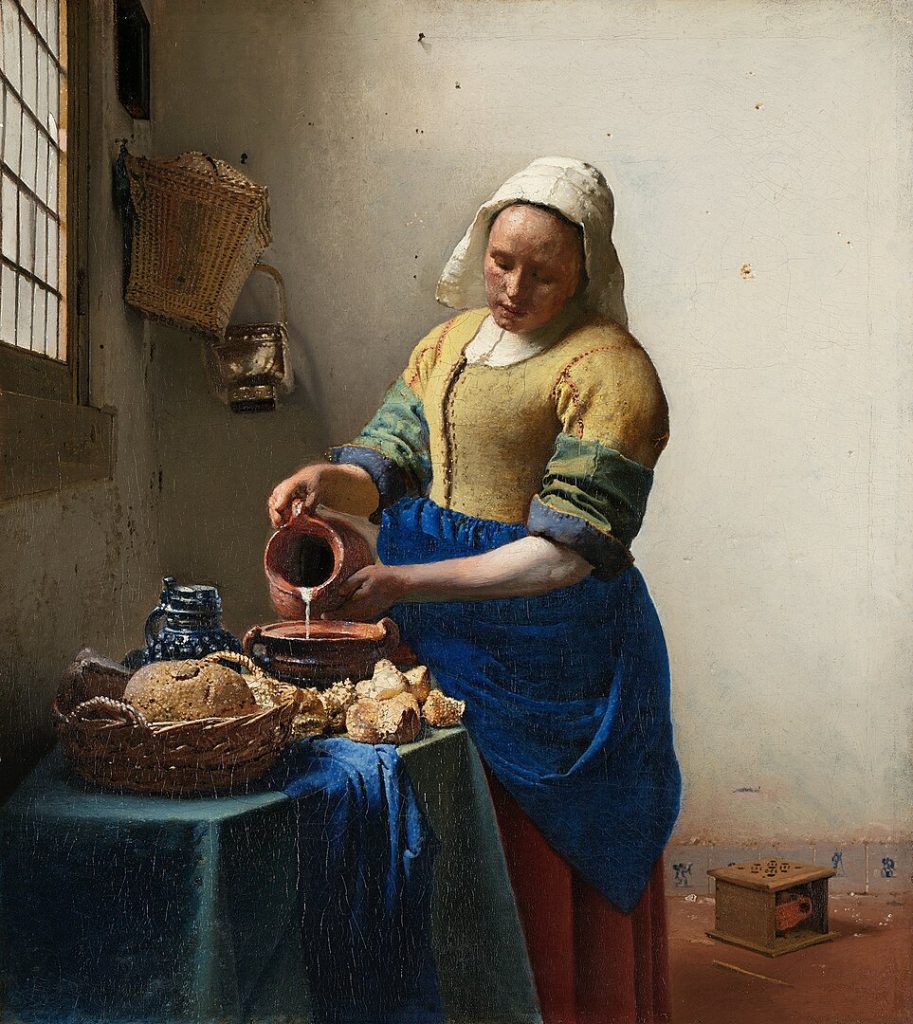
Vermeer’s career was modest during his lifetime, and only about 36 of his paintings survive today. His fame rests on a small but brilliant body of work that reveals astonishing control of light, color, and perspective. Masterpieces like Girl with a Pearl Earring (c. 1665) and The Milkmaid (c. 1657–58) reflect a tranquil, almost sacred vision of domestic life. His paintings typically feature women engaged in simple, everyday tasks—pouring milk, reading letters, or playing music—rendered with luminous detail.
The Mysterious Genius of Delft
Unlike Rembrandt, Vermeer had very few patrons, which limited his output. It is believed that art collector Pieter van Ruijven and his heirs supported Vermeer for much of his career. The artist used expensive materials like ultramarine pigment, suggesting he had financial support despite low public demand for his works. Scholars have debated whether Vermeer used a camera obscura, an early optical device, to achieve the photographic precision in his compositions.
Vermeer died suddenly in December 1675 at the age of 43, leaving his wife and children in debt. His work faded into obscurity for nearly two centuries until being rediscovered in the 19th century. Today, he is celebrated as one of the great geniuses of light and form, second only to Rembrandt in Dutch art history. Vermeer’s quiet, introspective scenes are now considered some of the most poetic and technically perfect in the Western tradition.
Frans Hals and the Rise of Portraiture
Frans Hals was born around 1582 or 1583 in Antwerp and moved with his family to Haarlem around 1585 to escape religious persecution. He studied under Karel van Mander and joined the Haarlem Guild of St. Luke in 1610. Hals specialized in portraiture, particularly group portraits and individual sitters who exude life and personality. His brushwork was energetic and expressive, often capturing a fleeting moment or a mischievous smile.
One of Hals’ most famous paintings, The Laughing Cavalier (1624), exemplifies his style—bold, colorful, and filled with vitality. His ability to depict character through casual poses and dynamic gestures made his portraits stand out in a period often dominated by stiff, formal likenesses. Hals’ work was especially popular with Haarlem’s civic institutions and militias, leading to several large group commissions. His Banquet of the Officers of the St. George Civic Guard series (1616–1627) showcases his flair for composition and individuality within a crowd.
Laughing Faces and Bold Brushwork
Hals had several apprentices and his influence spread beyond the Netherlands. He fathered ten children, five of whom became painters, continuing his artistic legacy. Though Hals never achieved the international fame of Rembrandt, his work was rediscovered in the 19th century and greatly admired by Impressionists like Édouard Manet and Vincent van Gogh. They valued his lively brushwork and loose handling of paint, which broke with the rigid traditions of academic art.
Despite a long and productive career, Hals struggled financially in his later years. He received public assistance from the city of Haarlem, and in 1664 was granted a pension of 200 florins. He died in Haarlem in 1666 at the age of 83 and was buried in the city’s St. Bavo Church. Today, Hals is remembered not just for his technical skill, but for the infectious life and joy that radiate from his canvases.
Still Life, Landscapes, and Genre Painting
While Rembrandt and Vermeer dominate public imagination, much of the Dutch Golden Age’s richness lies in its still lifes, landscapes, and genre scenes. These subjects emerged in response to Protestant values that favored modesty and shunned religious excess. Paintings of breakfast tables, flower arrangements, and village life gave moral lessons or celebrated everyday beauty. Unlike Southern Europe, where religious painting still held sway, the Dutch embraced secular life in all its details.
Artists like Pieter Claesz and Willem Claesz Heda pioneered the “ontbijtjes” or breakfast still life genre. Their work depicted half-eaten meals, fine silverware, and rich textures with astonishing realism. These paintings often carried moral meanings: a tipped glass, a half-peeled lemon, or a flickering candle could allude to the fleeting nature of life. Similarly, floral painters like Jan Davidsz. de Heem and Rachel Ruysch used blooms as symbols of both prosperity and impermanence.
Everyday Beauty on Canvas
Landscape painting also flourished, offering visions of national pride and divine order. Jacob van Ruisdael painted stormy skies and dramatic horizons, emphasizing the sublime beauty of the Dutch countryside. His scenes often included churches, windmills, and rivers—symbols of Dutch resilience and innovation. Meindert Hobbema, his pupil, continued this tradition with softer, more idyllic forest paths and canals.
Genre painters such as Jan Steen and Gerard ter Borch portrayed daily life with humor, empathy, and occasional moral critique. Steen’s chaotic households and drunken tavern scenes served as cautionary tales, while Ter Borch’s refined interiors reflected domestic virtue and restraint. These works gave viewers an opportunity to see themselves—flaws and all—on canvas. In the absence of kings and saints, the Dutch painted butchers, bakers, and milkmaids with dignity and honesty.
Women Painters in the Golden Age
The Dutch Golden Age was dominated by male artists, but several remarkable women made their mark despite societal barriers. Judith Leyster, born in Haarlem in 1609, became one of the first women admitted to the Guild of St. Luke in 1633. Her early work shows the influence of Frans Hals, with similar loose brushwork and cheerful subjects. Her Self-Portrait (c. 1633) is a declaration of artistic confidence, showing her mid-stroke, smiling over her shoulder.
Leyster’s genre scenes often depicted lively young musicians, children, and humorous domestic moments. She married fellow painter Jan Miense Molenaer in 1636, and her output declined afterward, likely due to the demands of motherhood. Still, she was a successful artist in her own right and even sued a client who wrongly attributed one of her paintings to Frans Hals. For centuries her work was misattributed to male artists, but she is now recognized as a vital voice of the Golden Age.
Breaking the Canvas Ceiling
Another important figure was Rachel Ruysch, born in 1664 into a family of scientists and botanists. She specialized in intricate floral still lifes and worked well into her eighties, a rare feat for any artist, male or female. Ruysch became court painter to Johann Wilhelm, Elector Palatine, and was celebrated across Europe for her technical precision. Her compositions often included exotic flowers, insects, and mosses, all painted with meticulous detail.
Women artists faced considerable obstacles—limited access to training, social skepticism, and restrictive domestic roles. Yet Leyster, Ruysch, and others like Maria van Oosterwijck carved out professional careers, often surpassing their male peers in technical skill and originality. Their works added depth to Dutch art, offering both a feminine and a deeply personal perspective. Today, they are celebrated not as anomalies, but as central contributors to the Golden Age.
Legacy and Global Influence of Dutch Golden Age Art
The Dutch Golden Age ended in the late 1600s as the economy slowed and France rose to prominence. Yet the legacy of its painters has proven enduring. Museums around the world, including the Rijksmuseum in Amsterdam and the Mauritshuis in The Hague, showcase its masterpieces. From Van Gogh to modern realism, the Dutch emphasis on detail, naturalism, and moral narrative continues to inspire artists today.
Many 19th-century painters rediscovered the Dutch masters as an antidote to academic stiffness. French Impressionists admired Hals’ loose brushwork, while American collectors prized Vermeer’s intimacy. Art historians in the 20th century elevated these works from regional curiosities to global masterpieces. The rediscovery of artists like Judith Leyster and Rachel Ruysch has also expanded the canon to include voices long neglected.
A Lasting Impression
The art market has followed suit, with Dutch Golden Age paintings commanding high prices at auctions and exhibitions. The Milkmaid by Vermeer and The Night Watch by Rembrandt attract millions of visitors annually. Their paintings offer more than technique—they provide insight into a world that prized faith, hard work, and personal responsibility. In a time when artistic values often feel unmoored, the Dutch Golden Age provides clarity, order, and beauty.
Even today, the influence of this era is felt in photography, cinema, and advertising. The use of light, composition, and realism pioneered by Dutch artists remains foundational. Their success came not from royal patronage but from the values of ordinary people—proof that beauty and truth thrive in freedom. The Dutch Golden Age reminds us that art belongs to the people, and greatness can grow from the humblest roots.
Key Takeaways
- The Dutch Golden Age was rooted in prosperity, Calvinist values, and civic pride.
- Rembrandt, Vermeer, and Frans Hals were pivotal figures in shaping the era’s visual legacy.
- Still lifes, landscapes, and genre scenes emphasized realism and moral lessons.
- Women artists like Judith Leyster and Rachel Ruysch overcame barriers to achieve success.
- The era’s influence continues in modern realism, museums, and global art markets.
FAQs
- What years define the Dutch Golden Age of painting?
The Dutch Golden Age spans roughly from 1600 to 1700, peaking in the mid-17th century. - Why is Rembrandt considered so important?
Rembrandt revolutionized portraiture with emotional depth and dramatic lighting. - How did religion influence Dutch painting?
Protestantism discouraged religious imagery, promoting secular and moral subjects. - Were there any successful women painters?
Yes, Judith Leyster and Rachel Ruysch are now celebrated for their significant contributions. - Where can I see Dutch Golden Age paintings today?
Major collections are housed in the Rijksmuseum, Mauritshuis, and the Louvre.