In the bright, salt-laden air of Spain’s eastern coast, Valencia rises like a palimpsest of civilizations, each layer stitched tightly to the next. For over two millennia, this city has been a living canvas — painted, scraped, and painted over again by empires, merchants, artists, and mystics. Few places in Europe offer such a vivid tapestry where Roman grids coexist with Islamic gardens, Gothic cathedrals peer over Art Nouveau market halls, and postmodern marvels sit at ease beside medieval alleyways. To understand Valencia’s art history is to understand the beating heart of a city that has forever been a meeting ground, a battleground, and a birthplace of dreams.
Founded in 138 BCE as a Roman colony — Valentia Edetanorum — the city’s very name spoke of valor and endurance. This spirit would be tested again and again as Visigoths, Moors, Christians, and modern Spaniards each left their imprint. Yet what stands out most in Valencia’s artistic history is not the succession of conquerors, but rather the city’s uncanny ability to synthesize cultures. While elsewhere the victors might have sought to erase the past, Valencia often absorbed it, reworking old forms into new expressions. Its art history, therefore, is not linear, but layered and cyclical, a spiraling conversation between past and present.
The city’s geographical position helped define its cultural richness. Hugging the Mediterranean and cradled by the Turia River (which once flooded so frequently it had to be redirected in the 20th century), Valencia became a crucial maritime hub in the Middle Ages. From its bustling ports flowed not only silk and spices but also ideas: Gothic sculpture from northern Europe, Islamic patterns from North Africa, Renaissance humanism from Italy, and later, Modernist dreams from Barcelona and beyond. This influx of goods and thought created a fertile ground for artistic innovation that would see Valencian painters, architects, and artisans reach heights of influence across Europe.
Valencia’s medieval splendor was largely fueled by its status as a center of silk production — a fact often overlooked when tracing the roots of its artistic golden age. Wealth from the silk trade enabled the construction of monumental buildings like the Lonja de la Seda (Silk Exchange), a masterpiece of late Gothic civil architecture now recognized as a UNESCO World Heritage Site. This affluence also patronized local artists, commissioning grand altarpieces, frescoes, and sculptures that adorned the city’s burgeoning number of churches and civic buildings.
Throughout the centuries, Valencia would also become a stage for conflict and renewal. The Reconquista — the Christian reconquest from Muslim rule — infused the city with a passionate, often turbulent artistic energy. Cathedrals were built atop mosques; Islamic motifs were reinterpreted in Christian iconography. In the Baroque period, ornate altarpieces gleamed under vaults once touched by Moorish artisans. Later, Romanticism would romanticize these ruins, and Modernisme would reinvent the city’s aesthetic vocabulary altogether.
In modern times, Valencia has embraced its role as a living museum as well as a laboratory of contemporary creativity. Institutions like the IVAM (Institut Valencià d’Art Modern) and the City of Arts and Sciences, designed by Santiago Calatrava, embody a city that reveres its past but is never shackled by it. Meanwhile, grassroots movements have blossomed, from street art collectives in the Carmen district to the reinvention of the traditional Fallas festival into an internationally acclaimed art phenomenon, blending satire, sculpture, and fire into a singular Valencian spectacle.
If one must seek a singular theme in Valencia’s artistic journey, it is resilience through reinvention. Here, art has never been a static mirror but rather a living, breathing force — shaped by conquest and commerce, by catastrophe and celebration. It is a city where Gothic spires whisper secrets to Art Deco balconies, where Islamic calligraphy dances in the shadows of Renaissance frescoes, where every brushstroke, brick, and broken relic tells a story not just of survival, but of continual becoming.
In the pages that follow, we will journey through this rich and complex history, exploring how each epoch left its mark, how Valencian artists both borrowed from and contributed to broader currents, and how the spirit of this sun-drenched, sea-kissed city continues to animate its art in ways both timeless and thrillingly new.
Iberian and Roman Foundations: Early Artistic Roots
Long before Valencia’s skyline bristled with Gothic steeples or Modernist curves, it was the realm of ancient Iberians — a people whose artistry left an indelible, if often overlooked, imprint on the region’s cultural DNA. These early settlers, living in scattered hilltop communities called oppida, developed a distinctive visual language: abstract yet symbolic, rugged yet refined. Their ceramics, bronzes, and stone sculptures hinted at a cosmology where gods, animals, and warriors were bound together in intricate tales. Even today, when one steps into the shadowy corners of Valencia’s archaeological museums, the spirit of these early artisans seems almost palpable.
The Iberians, who flourished from around the 6th century BCE, were remarkable for their synthesis of influences. Trading across the Mediterranean with Greeks, Phoenicians, and later Carthaginians, they adapted foreign styles without surrendering their native flair. The famed Lady of Elche, discovered just south of Valencia’s modern boundaries, stands as a testament to this cultural fusion — an elegant limestone bust whose serene expression and elaborate headdress weave Greek, Punic, and indigenous elements into a singular artistic vision. Although technically found outside Valencia proper, pieces like the Lady offer invaluable insight into the shared aesthetic atmosphere of the eastern Iberian coast.
By the 2nd century BCE, the Roman juggernaut had arrived, forever altering Valencia’s artistic landscape. In 138 BCE, Decimus Junius Brutus Callaicus founded Valentia Edetanorum on a strategic bend of the Turia River, establishing it as a vital outpost in the expanding Roman world. With Rome came an entirely new artistic and architectural vocabulary: forum complexes, aqueducts, villas adorned with mosaics, and sculptural forms that celebrated both imperial power and domestic life.
The Romanization of Valencia was not simply imposed by force; it seeped gradually into daily existence. Public spaces, essential to Roman civic life, became stages where art and architecture converged. The remains of Roman Valentia’s cardo and decumanus — its main north-south and east-west streets — reveal a meticulously planned city where artistry and order were intertwined. Decorative mosaics, such as those depicting mythological scenes or geometric patterns, once graced the floors of affluent homes, suggesting a populace increasingly attuned to Roman aesthetics.
Archaeological excavations in the Plaza de la Almoina, just behind Valencia’s Cathedral, have uncovered a rich palimpsest of these early centuries. There, one can see the remains of Roman baths, an early Christian basilica, and even Visigothic structures layered atop one another — a tangible embodiment of Valencia’s perpetual layering of history. Among the Roman ruins, fragments of frescoes still cling to stone walls, their once-vivid pigments faded but not extinguished by time. Through these fragile remnants, we glimpse a city already beginning to cultivate its unique dialogue between imported ideas and local expression.
Roman influence extended beyond architecture and urban planning into the visual arts. Sculpture, both monumental and domestic, flourished. Statues of emperors or local dignitaries stood in public squares, reinforcing Rome’s ideological grip, while more intimate portrait busts adorned private homes. Meanwhile, funerary art — an especially poignant form in a culture so obsessed with legacy and memory — reflected a blend of Roman technical mastery and regional variations. Sarcophagi carved with pastoral scenes, mythological motifs, or stoic portraits suggest a society negotiating its identity between Iberian ancestry and Roman allegiance.
Interestingly, Valencia’s early artistic evolution also foreshadowed a recurring theme in its history: adaptation rather than annihilation. Even as Roman forms became dominant, Iberian symbols persisted in subtle ways — in decorative motifs, in burial practices, in the choice of certain local materials. Rather than obliterate the past, Valencia’s earliest artists and patrons wove their old symbols into the new imperial tapestry.
Thus, by the late antiquity period, as the Roman Empire began to fracture and Visigothic rule loomed on the horizon, Valencia had already established a pattern that would define its art for centuries: embracing change while clinging, stubbornly and beautifully, to the threads of its past.
The Iberian and Roman eras laid not only the physical foundations of the city but also its enduring artistic soul — one that would continue to blend outside influences with fierce local pride, creating a cultural identity as rich and varied as the Valencian landscape itself.
Moorish Valencia: Islamic Influence and Aesthetic Innovations
When the banners of the Umayyad Caliphate unfurled across the Iberian Peninsula in the early 8th century, Valencia—then a modest Roman outpost struggling through the chaos of Visigothic decline—entered a new and dazzling era. Under Muslim rule, which would last for over five centuries, Valencia was reborn as Balansiya, a city of shimmering gardens, intricate irrigation networks, and an artistic culture that redefined its identity.
Islamic rule did not simply replace what came before; it transformed it. The Romans had ordered the land; the Muslims breathed new life into it. Balansiya blossomed into a major center of agriculture, trade, and learning, made possible by revolutionary advancements in water management. The creation of an elaborate system of canals—the acequias—allowed Valencia to turn its surrounding plains into a patchwork of verdant fields, a prosperity that fueled an artistic renaissance rooted in the aesthetics of the Islamic world.
One of the most defining characteristics of Islamic art in Valencia was its interplay of geometry, nature, and abstraction. Forbidden by religious doctrine from depicting human forms in religious contexts, Muslim artists in Valencia channeled their creativity into mesmerizing patterns: swirling arabesques, infinite tessellations, and calligraphic scripts that turned words into visual symphonies. The very fabric of the city changed. Palaces and mosques rose with courtyards at their hearts, cooled by fountains and shaded by fruit trees, embodying the Qur’anic ideal of paradise.
Though few complete structures from this period survive unaltered—thanks largely to the Christian Reconquest and subsequent architectural overhauls—traces of Islamic Balansiya remain. The Almoina archaeological complex reveals not just Roman and Visigothic layers but also fragments of Muslim baths and houses. In the Serranos Gate and the Quart Towers, though primarily Gothic today, scholars have detected underlying elements of Islamic fortification techniques—massive walls, horseshoe arches, and an emphasis on defensive pragmatism married to aesthetic flourish.
Perhaps the most enduring artistic legacy of Islamic Valencia is found not in stone but in ceramics. Valencian artisans mastered the technique of lusterware, a type of pottery distinguished by its metallic sheen and intricate designs. Originally perfected in Abbasid Iraq and then transmitted across North Africa, lusterware found a fertile home in Balansiya. The city’s workshops produced exquisite bowls, plates, and tiles decorated with complex patterns and brilliant iridescence, destined for markets across the Mediterranean.
The influence of Islamic lusterware would be so profound that even after the Reconquista, Christian Valencia became one of Europe’s leading centers for ceramic production, maintaining the techniques and styles first developed under Muslim rule. Thus, the gleaming ceramics seen in later Gothic and Renaissance periods—often thought of as purely European art—carry within them the unmistakable fingerprints of Islamic Valencia.
The sophistication of Islamic art in Valencia also extended to urban planning and landscape design. The very rhythm of the medieval city was dictated by a philosophy that prized the harmony of utility and beauty. Narrow, winding streets created pockets of cool shade; houses were built inward-facing, preserving privacy while allowing for lush, internal gardens. Water was not only a resource but a spiritual and aesthetic element, flowing through canals, courtyards, and fountains, reflecting the ever-present intertwining of daily life with artistic aspiration.
Literary arts flourished alongside the visual ones. Valencia became home to poets, philosophers, and scientists, many of whom infused their works with a sensibility that blurred the boundaries between scholarship and art. Manuscripts illuminated with delicate scripts and marginal decorations reveal a society where writing itself was an act of artistry.
The collapse of the Caliphate of Córdoba in the early 11th century and the subsequent rise of independent taifas (small kingdoms) brought both challenges and a flowering of regional expression. As the capital of one such taifa, Balansiya experienced a final burst of artistic efflorescence before the arrival of Christian forces under King James I of Aragon in 1238. The last Muslim rulers of Valencia adorned their courts with finely woven textiles, intricately carved wooden ceilings (artesonados), and delicate stucco work that bore the unmistakable hallmarks of a dying but dazzling civilization.
When the city finally fell to the Christian armies, many Muslim artisans remained, their skills too valuable to discard. They became the mudéjares, Muslim craftsmen working under Christian rule, and their influence would seed the extraordinary Mudéjar style—a hybrid architectural language fusing Islamic motifs with Gothic structures that would become a defining feature of Valencian art.
In this way, the Moorish legacy in Valencia did not end with conquest. It lived on—transmuted, hidden sometimes, but ever-present—in the colors of a tile, the curve of an arch, the whisper of water in a shaded courtyard. Valencia’s Islamic past is not merely a chapter in its history; it is one of its deepest roots, still nourishing the city’s artistic soul centuries after the banners changed and the prayers in the mosques were silenced.
The Christian Reconquest: Gothic Flourishing (13th–15th Centuries)
In 1238, after months of siege, the city of Balansiya surrendered to King James I of Aragon. With the signing of the capitulations, a profound transformation began. Valencia shifted from the soft, intricate rhythms of an Islamic court to the soaring, muscular ambition of a Christian kingdom eager to establish its new order — and nowhere was this more vividly expressed than through its art and architecture. The Reconquest did not simply redraw political boundaries; it reshaped Valencia’s very visual and spiritual identity, setting the stage for a Gothic flourishing that would define the city’s skyline and soul for centuries to come.
James I’s entry into the city marked both an end and a beginning. Muslim mosques were consecrated as Christian churches, Arabic inscriptions were plastered over with Latin script, and Islamic gardens were absorbed into cloistered monasteries. Yet, in typical Valencian fashion, this transition was not one of total erasure. Islamic artisans, known as mudéjares, were often employed by Christian patrons to build and decorate the new edifices, creating an artistic dialogue that enriched the emerging Gothic aesthetic with exotic intricacies.
The Gothic style that took root in Valencia was not merely a provincial echo of French or Catalan trends. It evolved its own distinct flavor — robust, imaginative, and often shot through with a lightness and grace uniquely suited to the Mediterranean climate. Valencian Gothic architecture, as it came to be known, balanced monumental grandeur with intricate detail, weaving together strength and delicacy in a way that still astonishes visitors today.
One of the earliest and most significant symbols of this new era was the Valencia Cathedral, begun in the mid-13th century atop the site of the city’s former mosque. Built over several centuries, the cathedral reflects a fascinating palimpsest of styles — Romanesque, Gothic, Renaissance, Baroque, and Neoclassical — yet its core is undeniably Gothic. The cathedral’s three great doorways, each in a different style, capture the layering of time: the Romanesque Almoina Gate, the Gothic Apostles’ Gate, and the Baroque main façade.
The interior of the cathedral is a lesson in the soaring aspirations of Valencian Gothic. Pointed arches, ribbed vaults, and slender columns draw the eye upward, toward the divine. Light spills in through rose windows, illuminating chapels that still bear the marks of their medieval painters and sculptors. Perhaps most famously, the cathedral claims to house the Holy Grail — a relic that, whether authentic or not, speaks to the intense spiritual fervor of the period.
Beyond the cathedral, the Lonja de la Seda (Silk Exchange) stands as the supreme achievement of Valencian Gothic civic architecture. Constructed between 1482 and 1533 during Valencia’s economic golden age, the Lonja is a masterwork of stone lacework, twisting columns, and symbolic ornamentation. Its great hall, the Sala de Contratación, with its helicoidal columns reaching toward star-like vaults, feels less like a marketplace and more like a sacred grove — a testament to the era’s belief that commerce, art, and faith could intertwine.
Religious devotion drove much of the Gothic artistic production. Churches such as Santa Catalina, San Juan del Hospital, and Santos Juanes rose across the city, each one an opportunity for artists and craftsmen to create soaring altarpieces, elaborate stained glass, and painted murals. The city’s newfound prosperity — fueled by agriculture, trade, and the burgeoning silk industry — provided the resources for increasingly ambitious artistic endeavors.
Painting, too, began to flower. Early Gothic panel painting in Valencia often followed Italo-Byzantine models, with flat backgrounds and iconic, hieratic figures. But by the late 14th and 15th centuries, Valencian painters like Pere Nicolau, Gonçal Peris Sarrià, and Marçal de Sax began to develop more naturalistic approaches, experimenting with perspective, landscape backgrounds, and emotional expressiveness. Their works adorned church altars and private chapels, spreading a new visual language that blended Northern Gothic detail with Mediterranean warmth.
Sculpture flourished in tandem with painting and architecture. Gothic tombs, often adorned with lifelike effigies, celebrated not just saints and royalty but wealthy merchants and civic leaders, underscoring the rising power of the urban bourgeoisie. Master carvers created pulpits, choir stalls, and intricate stone façades where vines, angels, grotesques, and saints intertwined in elaborate visual symphonies.
Despite the fervent Christianization of the city, echoes of the Islamic past lingered, subtly influencing decorative motifs, tilework, and even architectural forms. The result was not a pure Gothic style, but rather a uniquely Valencian Gothic — an art born of conquest and continuity, of faith and pragmatism, of light and stone.
By the end of the 15th century, Valencia had established itself not only as a political and economic powerhouse but also as an artistic beacon. Its painters, sculptors, and architects were in dialogue with the greatest currents of European art, and yet they retained a fierce sense of local identity, rooted in the city’s layered, multifaceted past.
The Gothic period in Valencia is often remembered as a time of sacred ambition — of vaults reaching for heaven, of canvases blooming with saints and miracles, of civic buildings carved with the pride of a people forging a new destiny. But it is also a reminder of the city’s perennial genius for adaptation and fusion, turning the aftermath of conquest into a springboard for artistic renaissance.
The Valencian Golden Age: Painting, Sculpture, and Architecture (15th Century)
By the mid-15th century, Valencia was not just thriving — it was radiant. The city had become one of the most prosperous and cosmopolitan hubs in the Crown of Aragon, its markets bustling with merchants from Italy, Flanders, and the Islamic world, its ports sending ships across the Mediterranean and beyond. This economic vitality fueled an explosion of artistic production, ushering in what is now known as the Valencian Golden Age — a period when painting, sculpture, and architecture reached extraordinary heights, leaving a legacy that still defines the city’s visual identity.
Central to this flourishing was a unique convergence of factors: wealth generated by the silk trade, the rise of a powerful merchant class, increased literacy and humanist learning, and the city’s strategic position as a cultural crossroads. The wealthy citizens of Valencia—no longer just the nobility but also successful artisans, bankers, and traders—became avid patrons of the arts, commissioning paintings, sculptures, and grand civic structures that broadcast their influence and piety in equal measure.
Painting: From Devotion to Humanism
Valencian painting in the 15th century evolved dramatically, shifting from the rigid, hierarchical compositions of earlier Gothic art toward more naturalistic, emotionally expressive styles. This was partly the result of direct exposure to Flemish and Italian Renaissance influences, as well as the internal maturation of local talent.
The leading figure of this era was Lluís Dalmau, who studied in Flanders and brought back to Valencia the secrets of oil painting and meticulous naturalism. His works, like the Virgin of the Councillors (painted in Barcelona but influential in Valencia), display an astonishing attention to texture, light, and individual characterization. Dalmau’s art helped catalyze a broader shift toward realism among Valencian painters.
But the true luminary of Valencian painting’s Golden Age was Joan de Joanes (born Vicente Juan Masip). Deeply religious and technically brilliant, Joanes infused his works with both the serene grandeur of Italian Renaissance art and the jewel-toned precision of Northern painting. His altarpieces, such as those for the Cathedral of Valencia and other major churches, radiate a spiritual intensity coupled with a profound human tenderness. Joanes is often referred to as “the Valencian Raphael” for his masterful integration of classical harmony and devotional depth.
Another key figure was Pere Nicolau, whose expressive, often elegantly elongated figures retained a strong Gothic sensibility even as the city edged toward Renaissance ideals. His Altarpiece of Saint Martha, brimming with narrative energy and vivid color, remains a standout example of this transitional moment in Valencian art.
Altarpieces were a major focus of artistic energy. Commissioned by churches, guilds, and wealthy families, these vast, multi-paneled works served both devotional and didactic purposes, illustrating saints’ lives, miracles, and key biblical events in richly detailed visual narratives.
Sculpture: Piety in Marble and Wood
Sculpture too found new vitality during the Golden Age. Stone carvers and wood sculptors, often working closely with architects, adorned churches and civic buildings with a profusion of decorative elements.
Among the leading sculptors was Pere Compte, whose architectural and sculptural genius gave birth not only to soaring buildings like the Lonja de la Seda but also to elaborate portals, cloisters, and tombs. His work on the doorway of the Apostles at Valencia Cathedral exemplifies the era’s sculptural grandeur, blending Gothic verticality with delicate naturalism.
Woodcarving reached exquisite levels in the creation of retablos (altarpieces), many of which were lavishly polychromed and gilded. Master carvers like Jordi de Déu and his workshop created intricate scenes populated by expressive, lifelike figures, blurring the line between sculpture and narrative theater.
Tombs of prominent citizens, crafted from alabaster or marble, became sites of artistic innovation. Effigies were rendered with startling realism, capturing the peaceful repose or eternal prayer of the deceased, often surrounded by angels, heraldic shields, and symbolic flora.
Architecture: A Civic Renaissance
Valencia’s architecture in the 15th century showcased both religious devotion and burgeoning civic pride. Beyond churches and cathedrals, the city invested heavily in secular buildings that demonstrated its wealth and sophistication.
The crowning achievement of this era was undoubtedly the Lonja de la Seda, a civic temple to commerce that rivals any religious edifice in splendor. Its twisting, palm-tree-like columns in the Contract Hall (Sala de Contratación), the delicately vaulted ceilings, and the richly ornamented façade make it a masterpiece of late Gothic architecture. The Lonja’s design spoke volumes about Valencia’s self-image: a city where trade was sacred, and beauty was good business.
Other notable architectural projects included the expansion of the Cathedral’s chapter house and the construction of new city walls and gates. Fortifications like the Serranos Towers and the Quart Towers, begun in the late 14th century but completed during this period, were both defensive structures and monumental statements of urban power.
Even residential architecture reflected the Golden Age’s artistic ambitions. Noble palaces, like the Palacio de los Borja, featured ornate façades, grand staircases, and elaborate wooden ceilings (artesonados) influenced by both Gothic and lingering Mudéjar traditions.
The Broader Cultural Milieu
This artistic flowering did not occur in a vacuum. The 15th century also saw Valencia emerge as a literary and intellectual center. Writers such as Ausiàs March revolutionized Catalan poetry with their psychological depth and emotional candor, while humanist thinkers fostered the spread of Renaissance ideals. Printing presses arrived early in Valencia — one of the first books printed in Spain, Obres o trobes en lahors de la Verge Maria, appeared here in 1474 — helping to spread both religious devotion and humanist inquiry.
The convergence of these forces — economic, intellectual, spiritual, and artistic — made 15th-century Valencia not just a provincial city, but a true center of Mediterranean culture.
The Valencian Golden Age represents a moment when the city, at the height of its powers, produced art that rivaled and sometimes surpassed that of older European centers. It was a time when stone, pigment, and marble were marshaled to create visions of transcendent beauty and earthly glory — a testament to the city’s boundless ambition and its irrepressible spirit of reinvention.
The Renaissance in Valencia: Adaptation and Innovation
As the 15th century faded and Europe stepped fully into the bright, daring spirit of the Renaissance, Valencia once again found itself at the crossroads of transformation. Yet, unlike Florence or Rome, where humanism was born amid a revolutionary break from medieval traditions, Valencia’s embrace of the Renaissance was subtler, more hybrid. Here, the new ideas were not a rupture but a continuation—a layer woven over centuries of accumulated culture.
The Renaissance in Valencia was characterized by adaptation and innovation, rather than wholesale imitation. While the city eagerly absorbed the classical ideals of proportion, balance, and human-centered art, it interpreted them through a distinctly Valencian lens—infusing southern light, Gothic residues, and Islamic echoes into the new visual vocabulary.
The Renaissance Spirit Arrives
By the late 15th and early 16th centuries, Valencia’s merchant fleets sailed not just with silk and spices but with ideas. Contact with Italy—especially Naples, then under Aragonese rule—exposed Valencian artists and patrons to the revolutionary ideas of the Italian Renaissance: linear perspective, anatomical accuracy, classical motifs, and a focus on human dignity.
However, the Renaissance spirit was already percolating locally. Valencian scholars, emboldened by the new printing presses and the growing universities, began reading classical texts with fresh eyes. Humanism—the belief in human potential and earthly beauty—found fertile ground in a city long accustomed to cultural fusion.
Architects, painters, and sculptors were eager to integrate these new concepts but did so without abandoning their Gothic heritage entirely. The result was a synthesis that produced some of the most intriguing and original Renaissance art in Spain.
Architectural Transformation
One of the clearest arenas for Renaissance influence was architecture. Early examples, like the Santa Cruz Palace and the Generalidad Palace, reveal the gradual incorporation of classical elements—symmetrical façades, pilasters, and rounded arches—into structures that still bore Gothic proportions and verticality.
The University of Valencia, founded in 1499, became a bastion of Renaissance ideals, both intellectually and aesthetically. Its early buildings, like the Claustro Gótico, blended late Gothic forms with the emerging clarity and order of Renaissance design. By the mid-16th century, pure Renaissance forms—domed courtyards, classical columns, and restrained ornamentation—had fully taken root, as seen in the elegant Patriarch College, built by Juan de Ribera.
Public buildings and private residences alike adopted Renaissance motifs. Courtyards became orderly and geometric; façades featured medallions of Roman emperors or mythological figures. Yet the love for ornate detailing, inherited from both Gothic exuberance and Mudéjar intricacy, meant that Valencian Renaissance buildings often felt more luxuriant than their Italian counterparts.
Painting: Classical Forms, Valencian Soul
In painting, the Renaissance influence was profound but always filtered through a local prism. Joan de Joanes, trained initially in the Gothic tradition, became the leading figure in translating Italianate ideals into Valencian art. His serene Madonnas, radiant in carefully modulated light, and his meticulous treatment of human emotion placed him among Spain’s greatest painters of the era.
Joanes was deeply influenced by Raphael and the Venetian school, but he never abandoned the bright color palette and emotional immediacy that characterized Valencian Gothic painting. His Last Supper, now housed in the Cathedral of Valencia, is a masterwork of Renaissance structure and psychology, yet it retains a heartfelt devotional intensity that is unmistakably Mediterranean.
Other painters, such as Fernando Yáñez de la Almedina and Fernando Llanos, who had direct contact with Italy (working alongside Leonardo da Vinci), brought back a heightened understanding of anatomy, perspective, and chiaroscuro. Their altarpieces and devotional panels show the technical refinement of the High Renaissance, blended with Valencian warmth and texture.
Sculpture: From Gothic Realism to Classical Grace
Valencian sculpture also absorbed Renaissance ideals, softening Gothic linearity into classical harmony. Artists like Damià Forment, though better known for his work in Zaragoza, had deep connections to Valencian workshops. His influence led to the production of altarpieces that combined Gothic intricacy with the rounded, balanced figures of Renaissance statuary.
Funerary sculpture, too, evolved. Tomb effigies became less rigid, portraying the deceased not as stylized saints but as individuals caught in serene, earthly repose—echoing the humanist emphasis on the dignity of the individual soul.
Literature, Music, and the Wider Renaissance Spirit
The Renaissance in Valencia was not confined to the visual arts. Literature blossomed, with writers like Joanot Martorell, whose Tirant lo Blanch is often hailed as one of the first modern novels. Combining chivalric romance with ironic realism, Martorell’s work foreshadowed Cervantes and embodied the Renaissance spirit of innovation and critical engagement.
Music, too, flourished. Composers like Juan Bautista Comes brought Renaissance polyphony to Valencian cathedrals, blending sacred themes with lush harmonic textures that mirrored the visual arts’ newfound emphasis on balance and beauty.
A Distinctive Renaissance Identity
What makes the Renaissance in Valencia so fascinating is its hybridity. It was not a simple importation of Italian forms, nor was it a stubborn clinging to Gothic tradition. Instead, it was a creative reinterpretation—a dialogue between old and new, between the universal and the local.
While Florence and Rome might boast grander revolutions, Valencia’s Renaissance was arguably more intimate, more personal. It was visible in the softened gaze of a painted saint, the graceful curve of a cloister’s arch, the careful arrangement of a merchant’s palace courtyard. It was a Renaissance not of cataclysms, but of conversations—between past and present, heaven and earth, city and sea.
In this way, Valencia once again proved its greatest strength: the ability to absorb, adapt, and create something uniquely its own—a luminous, enduring testament to the city’s layered soul.
Baroque Splendor: Religious Art and Monumental Architecture
By the dawn of the 17th century, Valencia was a city transformed once again. The steady rhythms of Renaissance balance gave way to the emotional crescendos and theatrical grandeur of the Baroque. This new artistic spirit was born from a period of profound contradictions: economic decline yet bursts of cultural investment, religious fervor tinged with doubt, and a cityscape striving toward heaven even as it grappled with earthly challenges. For Valencia, the Baroque era would be one of stunning visual richness, where art became an act of passion, persuasion, and performance.
Historical Context: Crisis and Renewal
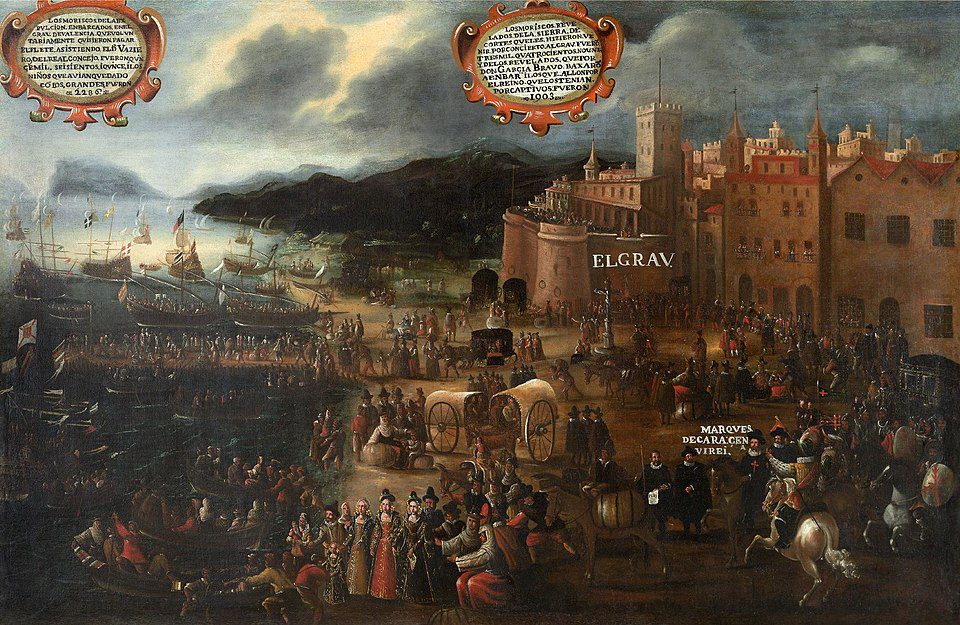
The 17th century was a time of upheaval across Spain. The decline of Habsburg power, repeated plagues, economic hardships, and the expulsion of the Moriscos (Muslims forcibly converted to Christianity) in 1609 had profound impacts on Valencia’s economy and demographics. Yet paradoxically, the Counter-Reformation—the Catholic Church’s vigorous response to Protestantism—sparked a golden age of religious art and architecture. Art was now explicitly a tool for spiritual persuasion, meant to inspire awe, devotion, and obedience among the faithful.
In Valencia, ecclesiastical patrons and civic leaders poured resources into churches, convents, and monasteries, commissioning grand paintings, ornate altarpieces, and architectural marvels designed to overwhelm the senses and reaffirm Catholic orthodoxy.
The Baroque Style Takes Hold
Valencian Baroque art embraced the broader tendencies of the style: dramatic contrasts of light and dark, heightened emotion, swirling movement, and lavish ornamentation. But true to the city’s nature, it developed its own regional flavor—blending the opulence of Italian and Castilian models with a sun-soaked Mediterranean warmth.
Architecture shifted from the harmonious clarity of the Renaissance to dynamic façades, often dripping with sculpture, twisted columns, and elaborate broken pediments. Interiors exploded into riotous splendor, with gilded altarpieces, frescoed ceilings, and polychrome marble intended to simulate the very gates of heaven.
One of the most spectacular examples of Valencian Baroque architecture is the Chapel of the Holy Grail in the Cathedral. Though the cathedral itself remained fundamentally Gothic, Baroque additions throughout the 17th and 18th centuries transformed its visual experience. The main façade—completed by Konrad Rudolf in the 18th century—is a classic explosion of Baroque drama, with its spiraling forms and theatrical grouping of saints and angels.
Similarly, the Iglesia de San Juan del Hospital, originally a sober Gothic structure, was refurbished with ornate Baroque chapels, merging the city’s medieval roots with its contemporary thirst for grandeur.
Painting: Masters of Emotion and Light
The Baroque period in Valencia produced several painters of outstanding merit, none more influential than Francisco Ribalta (1565–1628). Ribalta is often considered the founder of the Spanish Baroque school of painting, and his work in Valencia helped define the region’s artistic language for generations.
Drawing inspiration from Caravaggio’s use of chiaroscuro, Ribalta’s paintings—such as The Vision of St. Francis and Christ Embracing St. Bernard—vibrate with spiritual intensity. Figures emerge from deep shadow into pools of divine light, their faces contorted in ecstasy, sorrow, or revelation. His style matched the Counter-Reformation’s demand for visceral, emotionally accessible religious imagery, capable of reaching even the illiterate faithful.
Ribalta’s son, Juan Ribalta, continued his father’s legacy, while painters like Jerónimo Jacinto de Espinosa and later Esteban March brought further refinement and personal expression to the Valencian Baroque tradition.
Beyond the grand altarpieces and monumental canvases, portraiture also thrived. Valencian Baroque portraitists captured the new civic and ecclesiastical elite, portraying bishops, nobles, and merchants with a combination of unflinching realism and idealized dignity.
Sculpture: The Theatrical Carvings
Sculpture during the Baroque era in Valencia became a medium of dramatic storytelling. Altarpieces (retablos) grew more extravagant, festooned with twisting Solomonic columns, cherubs, saints, and swirling clouds.
Wooden sculpture, often polychromed with intense realism, achieved new heights. Figures of the Virgin Mary, Christ, and martyrs were carved with agonizing precision, their wounds bleeding bright red, their robes fluttering in theatrical waves. Such statues were designed not merely to decorate, but to participate in religious festivals, carried through the streets during processions, bringing sacred dramas directly into the lives of the people.
Sculptors like Ignacio Vergara brought a remarkable blend of classical training and Baroque exuberance to these works, often collaborating with painters to create immersive visual experiences in the city’s churches.
Urban Renewal and the Baroque City
The Baroque spirit also touched Valencia’s urban fabric. New convents, churches, and chapels sprang up across the city. The rise of civic squares and promenades echoed new ideas about public space—areas where architecture, sculpture, and ritual could merge into shared spectacles of faith and identity.
Notably, the Plaza de la Virgen, adjacent to the Cathedral, became a key ceremonial space, framed by buildings that bore the ornate flourishes of Baroque design. Religious processions, especially during Corpus Christi and Holy Week, turned the entire city into a stage where the drama of salvation was reenacted with full sensory immersion.
Lasting Legacy
Today, the Valencian Baroque remains woven into the city’s fabric, often hiding in plain sight behind the more imposing Gothic monuments. Its legacy is not merely ornamental; it shaped the way Valencians imagined their city and their faith.
Where earlier eras reached toward heaven with disciplined elegance, the Baroque sought to bring heaven crashing down into the streets, filling every corner with divine drama and visceral beauty. It was an art of passion, born from crisis yet suffused with hope—a magnificent, theatrical testament to the resilience and creativity of Valencia’s spirit.
Neoclassicism and the Enlightenment: New Ideas in the 18th Century
The 18th century arrived in Valencia like a cautious dawn after the dramatic storms of the Baroque. Across Europe, the intellectual revolution known as the Enlightenment began to unravel centuries-old certainties, ushering in an era where reason, order, and empirical observation were placed above mystery and passion. In the realm of art, this seismic shift manifested as Neoclassicism — a movement that sought clarity, proportion, and the revival of Greco-Roman ideals, counterbalancing the florid excesses of the previous century.
For Valencia, the transition was both aesthetic and philosophical. The city, though still deeply rooted in tradition, found itself swept along by the tides of reform emanating from Madrid and beyond. Neoclassicism in Valencia was more than a style — it was a signal of changing worldviews, of a society tentatively stepping into modernity.
The Intellectual Climate: Seeds of Enlightenment
In the early 18th century, the War of Spanish Succession (1701–1714) had a profound effect on Valencia. Supporting the losing Habsburg side, the city suffered political and economic repercussions under the new Bourbon monarchy. Yet paradoxically, Bourbon centralization also brought reforms: improved infrastructure, education, and a greater emphasis on civic life.
The University of Valencia, already a centuries-old institution, became a beacon of Enlightenment thinking, introducing new scientific curricula and fostering secular inquiry alongside traditional theology and law. Libraries expanded, scientific societies formed, and Valencian elites began to embrace the ideals of reason, progress, and public virtue.
This intellectual ferment naturally influenced the arts, fostering a taste for restraint, symmetry, and moral clarity.
Neoclassicism: The Art of Rational Beauty
In architecture, Neoclassicism swept aside the exuberance of the Baroque in favor of clean lines, balanced proportions, and classical motifs. The Gothic and Baroque landmarks of Valencia were not demolished, but new construction began to reflect the Enlightenment’s love of order and rationality.
One of the emblematic figures of this transformation was architect Vicente Gascó, whose works typified the sober, harmonious aesthetics of the period. Although Valencia lacked the grand-scale Neoclassical projects seen in Madrid or Cádiz, it cultivated a more restrained, urban Neoclassicism, visible in modest civic buildings, redesigned plazas, and private residences.
The Plaza Redonda, for instance, reimagined the urban experience as an orderly, geometric marketplace, subtly reflecting Enlightenment ideals of rational social organization. Likewise, the Puente de la Trinidad (Trinity Bridge) was reconstructed during this period with elegant, balanced arches after suffering flood damage — a quiet marriage of utility and classical beauty.
Churches, too, adapted. Interiors were “corrected” to match Neoclassical tastes: Baroque exuberance was toned down, stucco replaced gilding, and clean, whitewashed surfaces emphasized architectural form over emotional impact.
Painting and Sculpture: From Devotion to Reason
Painting in 18th-century Valencia underwent a similar evolution. Religious themes persisted, but they were increasingly treated with cool, academic precision rather than Baroque fervor. Artists like Cristóbal Valero, who studied in Rome and became a leader at the Valencia Academy of Fine Arts (Real Academia de Bellas Artes de San Carlos, founded in 1768), championed a style that emphasized anatomical correctness, idealized beauty, and classical narratives.
The founding of the San Carlos Academy was pivotal. It institutionalized art education, encouraging the study of antiquity, anatomy, and perspective, and promoting a professionalization of the arts that mirrored Enlightenment values. For the first time, Valencian artists were formally trained in drawing from life and copying classical models, rather than relying solely on workshop traditions.
Sculpture, too, became more restrained and idealized. Religious imagery remained dominant, but the figures were less emotionally charged, more serene and dignified, reflecting the Enlightenment’s distaste for overwrought displays of emotion.
In the public sphere, commemorative monuments — statues of kings, civic leaders, and mythological allegories — began to appear, celebrating rational governance, civic virtue, and the Enlightenment’s vision of a well-ordered society.
Tensions Beneath the Surface
Despite these changes, Valencia remained deeply traditional at its core. Enlightenment ideas of secularism and rationalism often sat uneasily alongside the city’s entrenched Catholic piety. Many Valencians admired the order and elegance of Neoclassical art without fully embracing the more radical aspects of Enlightenment thought.
This tension produced fascinating hybrids: religious art that celebrated saints not as ecstatic visionaries, but as paragons of moral reason; altarpieces that balanced devotion with didactic clarity; civic monuments that subtly praised both monarchy and emerging concepts of popular participation.
Legacy of the 18th Century
The Neoclassical period in Valencia never fully supplanted the older layers of the city’s identity. Instead, it gently overlaid them, like a transparent veil of order over a deeply textured past.
What it did achieve, however, was to lay the groundwork for Valencia’s slow but inexorable modernization. Through the establishment of formal academies, the expansion of public works, and the cautious embrace of rational aesthetics, Valencia prepared itself for the even more radical artistic upheavals of the 19th and 20th centuries.
In the delicate curves of a Neoclassical façade, the airy layout of a public square, or the serene gaze of an 18th-century Madonna, we glimpse the dreams of a society striving for clarity and enlightenment — a society whose ambitions, even when tempered by tradition, pointed steadily toward the future.
Romanticism and Costumbrismo: 19th Century Valencia
The 19th century arrived in Valencia trailing the smoke of revolution, the thunder of Napoleonic cannons, and the restless energy of a world increasingly obsessed with individual emotion, national identity, and everyday life. In art, this period saw the city turn away from the rational clarity of the Enlightenment toward the tumultuous passions of Romanticism, and eventually to the affectionate, earthy gaze of Costumbrismo — an artistic celebration of local customs and daily life.
Together, these movements produced an era of extraordinary visual and emotional richness, even as political and social upheavals continually reshaped the city’s landscape.
Romanticism: The Age of Passion
Romanticism, which swept across Europe in the early 19th century, found fertile ground in Valencia. The trauma of the Peninsular War (1808–1814) — when Napoleon’s forces occupied Spain and devastated much of its territory — had awakened deep currents of patriotism, nostalgia, and a yearning for the heroic past.
In Valencia, as elsewhere, Romantic artists rejected the formal constraints of Neoclassicism. They sought instead to depict grand, emotionally charged scenes: historical battles, religious ecstasies, tragic love stories, and sublime landscapes filled with brooding skies and dramatic contrasts.
Painters like Francisco Martínez Yago embraced the Romantic spirit, producing stirring historical scenes and portraits charged with psychological depth. His works captured not only the likeness of his subjects but also their inner turmoil — a key Romantic preoccupation.
The romanticization of medieval Valencia was another strong current. Artists and writers turned to the city’s Gothic cathedrals, ancient walls, and traditional festivals as symbols of an uncorrupted, heroic past. Gothic revivalism blossomed, not just in architecture but also in painting and literature, blending nostalgia with national pride.
Costumbrismo: Capturing Everyday Life
By mid-century, another artistic movement had taken root: Costumbrismo. Less grandiose than Romanticism, Costumbrismo focused on the ordinary — the market scenes, festivals, taverns, and domestic rituals of Valencian life.
Costumbrista painters sought to preserve a vanishing way of life in the face of industrialization and modernization. Their works were rich in local color, emphasizing regional costumes, traditional trades, and folk celebrations with affectionate detail.
Valencian Costumbrismo developed its own flavor, distinguished by its Mediterranean warmth and sunlight. Artists depicted bustling outdoor markets, fishermen at work along the Albufera lagoon, lively street festivals, and the quiet dignity of rural life.
A pivotal figure here was Antonio Cortina Farinós, whose genre scenes captured the vibrancy of daily Valencian life with a delicate blend of realism and sentiment. His paintings often featured cheerful children, robust vendors, and richly detailed street settings, evoking a world both immediate and timeless.
Costumbrismo in Valencia was not merely nostalgic; it was also subtly political. By celebrating local customs, artists asserted a distinct regional identity within a Spain increasingly centralized under Madrid’s authority. Paintings of traditional dress and local fiestas were acts of cultural preservation as much as artistic creation.
The Rise of Valencian Landscape Painting
Another significant development of the 19th century was the rise of landscape painting as an independent genre. Valencian artists began to move out of their studios and into the countryside, capturing the soft golden light, the shimmering expanses of the Albufera, and the rugged outlines of nearby mountains.
This was part of a broader Romantic fascination with nature — not as a backdrop for human drama, but as a subject worthy of reverence in itself. José Benlliure, a pivotal figure of this period, excelled at both historical painting and naturalistic scenes, bridging the gap between Romanticism and emerging Realism.
Valencia’s unique light, so different from the harsher contrasts of Castilian landscapes, imbued these works with a luminous, almost tactile warmth that would later profoundly influence artists like Joaquín Sorolla.
Sculpture and Public Monuments
Public sculpture also flourished during this era, spurred by a new civic consciousness. Statues of local heroes, scholars, and benefactors began to appear in Valencia’s squares and parks.
The Romantic spirit demanded monuments not just to kings and generals, but also to poets, patriots, and even symbolic figures representing Liberty, Justice, or the Homeland. These public works often blended Neoclassical form with Romantic sentiment, creating enduring icons of Valencian civic pride.
The Broader Social and Artistic Landscape
The 19th century in Valencia was marked by tension between tradition and change. While artists lovingly depicted rural life and ancient customs, the city itself was modernizing: railways were built, the Turia river was increasingly tamed, and new industrial centers emerged on the outskirts.
Cultural institutions blossomed. The Real Academia de Bellas Artes de San Carlos trained a new generation of artists, grounding them in academic technique while gradually opening to the innovations coming from Paris, Rome, and elsewhere.
At the same time, major exhibitions, such as the Exposiciones Nacionales de Bellas Artes, began to offer Valencian artists broader national exposure, setting the stage for the international fame that some would achieve in the coming decades.
A World on the Verge of Change
As the 19th century drew to a close, the seeds of modernism were already stirring in Valencian art. Young painters traveled to Paris and returned with new ideas about light, color, and social realism. Yet the deep affection for local traditions — so lovingly chronicled by the Costumbristas — would never vanish entirely.
Instead, it would evolve, blending with the daring visions of Modernisme and the avant-garde movements to come, ensuring that Valencia’s art would continue to be a vibrant dialogue between past and future, between rootedness and innovation.
The 19th century in Valencia, then, stands as a pivotal chapter — a time when the city’s artists, caught between nostalgia and progress, created works that remain among the most tender, vivid, and human in the entire Spanish tradition.
Modernisme (Valencian Art Nouveau): Blasco Ibáñez and Architectural Transformation
As the 19th century gave way to the 20th, Valencia, like much of Europe, found itself caught in a whirlwind of change. Industrialization accelerated, populations swelled, and new technologies and philosophies reshaped daily life. In the arts, a bold new aesthetic emerged to capture this spirit of modernity: Modernisme, or Valencian Art Nouveau — a movement that sought to marry craftsmanship with industrial innovation, beauty with progress.
Valencia’s embrace of Modernisme was passionate and unique. While often compared to the parallel Catalan movement led by figures like Gaudí in Barcelona, Valencian Modernisme developed its own identity — brighter, more floral, more Mediterranean in spirit. Here, Art Nouveau became not only an artistic style but a symbol of a city reinventing itself for the 20th century.
The Spirit of Modernisme: A New Age of Beauty
Modernisme was more than a style; it was an attitude. Inspired by the belief that art should permeate all aspects of life — from architecture and furniture to public spaces and typography — Modernisme sought to elevate everyday existence through beauty.
In Valencia, this impulse was given added urgency by the city’s rapid growth. Expanding industries, burgeoning middle classes, and urban reforms created a demand for new buildings, new neighborhoods, and a new visual identity. Artists and architects saw in Modernisme a perfect vehicle for expressing this hopeful, forward-looking energy.
The movement’s defining features included:
- Organic forms drawn from nature — flowers, vines, flowing water.
- Asymmetry and curvilinear lines, replacing rigid, academic styles.
- Rich ornamentation, often in ironwork, ceramics, and stained glass.
- Integration of the arts, where architecture, sculpture, and painting merged into a single, harmonious creation.
Architectural Transformation: Valencia’s Modernista Gems
Valencia’s cityscape was transformed during this period, with hundreds of new buildings erected between roughly 1890 and 1930, many of which still define the city’s character today.
Among the leading architects of Valencian Modernisme was Demetrio Ribes, whose masterwork, the North Railway Station (Estació del Nord), opened in 1917. The station is a triumph of Modernisme: its polychrome ceramic mosaics celebrate Valencia’s agricultural bounty with exuberant depictions of oranges, flowers, and sunny landscapes, while the structure’s iron and glass canopies herald the age of the machine.
Another towering figure was Francisco Mora Berenguer, who designed the Mercado de Colón (Columbus Market), completed in 1916. This airy, cathedral-like market hall embodies Modernisme’s fusion of form and function. With its sweeping arches, intricate ironwork, and colorful tilework, the Mercado de Colón exemplifies the idea that even a place of commerce could be a work of art.
Residential architecture also flourished. Entire neighborhoods, especially around the Ensanche and Ruzafa districts, were filled with Modernista apartment blocks boasting wrought-iron balconies, carved stone façades, and floral motifs. Buildings like the Casa Ortega and the Casa Ferrer showcase how Modernisme touched everyday urban life, imbuing even middle-class housing with an artistic vibrancy.
The Influence of Vicente Blasco Ibáñez
No discussion of Valencian Modernisme would be complete without mentioning Vicente Blasco Ibáñez — novelist, journalist, and politician — whose work helped articulate the era’s broader cultural ambitions.
Blasco Ibáñez embodied the Modernista spirit of progress, secularism, and social reform. His novels, such as La Barraca and Cañas y Barro, painted vivid portraits of rural Valencian life while also advocating for modernization and social justice. He championed public education, democratic ideals, and urban renewal — ideas that found physical expression in the Modernista architecture springing up across the city.
Although not an architect or painter himself, Blasco Ibáñez’s influence was profound. His writings celebrated Valencia’s traditions even as they demanded a new, more equitable society — a duality that resonates with Modernisme’s blending of natural forms and technological optimism.
Today, his legacy is preserved not only in literature but also in spaces like his former home, now the Casa Museo Blasco Ibáñez, located near the Malvarrosa Beach he so often described.
A Mediterranean Modernisme
Compared to its Catalan counterpart, Valencian Modernisme was often lighter, more playful, and more directly inspired by the region’s agricultural and maritime heritage. Floral motifs, agricultural symbols (especially orange blossoms and wheat), and references to the sea abounded in ceramic murals, balcony designs, and building façades.
Where Catalan Modernisme often veered into the mystical and symbolic, Valencian Modernisme remained grounded, joyful, and sensuous — an art born from sunshine, sea breezes, and the rich bounty of the Huerta.
Challenges and Legacy
Despite its dazzling creativity, Valencian Modernisme faced challenges. The economic crises of the 1920s and the political upheavals leading to the Spanish Civil War in 1936 slowed and eventually ended the movement’s momentum. Many Modernista projects were left unfinished, and during the Franco era, the style was often dismissed as decadent or overly regionalist.
Yet Modernisme’s imprint remained. In recent decades, Valencia has rediscovered and celebrated its Modernista heritage. Restoration projects have revived masterpieces like the Estació del Nord and Mercado de Colón, and new generations have embraced Modernisme as a vital, living part of their cultural identity.
Walking through Valencia today — along the Avenida Reino de Valencia, through the Ensanche, or beneath the soaring vaults of the Mercado Central — one can still feel the vibrancy of that era when art, life, and progress danced together under the Mediterranean sun.
Modernisme in Valencia was a declaration: that beauty belonged not just to palaces and cathedrals, but to markets, train stations, and apartment blocks — to the people, and to the future.
The Vanguard Movements: Impressionism, Surrealism, and Post-War Art
As the 20th century unfolded, Valencia once again found itself swept into the tides of change. The luminous, handcrafted optimism of Modernisme gave way to the radical experimentation of the avant-garde. Across Europe, old certainties collapsed — in politics, society, and art alike — and in their place arose a dizzying array of new visions. In Valencia, too, the world of art fractured and reformed, embracing Impressionism, Surrealism, and the various modernist movements that would define the city’s creative life during and after the devastating upheavals of war.
Throughout it all, Valencian artists wrestled with profound questions: how to represent a shattered reality, how to preserve cultural identity amid chaos, and how to reinvent artistic language for a new century.
Impressionism and the Revolution of Light
In the early decades of the 20th century, Impressionism arrived in Valencia not as a pale imitation of French models, but as a profound revelation — particularly suited to the city’s unique quality of light.
Joaquín Sorolla, Valencia’s greatest painter of this era and arguably Spain’s greatest Impressionist, transformed the very way Valencians saw their world. Sorolla’s paintings — like Paseo a orillas del mar (Walk on the Beach) and Cosiendo la vela (Sewing the Sail) — captured the shimmering brightness of the Mediterranean sun, the translucent waves of Malvarrosa Beach, the wind fluttering through white garments, and the rugged dignity of fishermen and farmers.
Sorolla’s technique, characterized by rapid brushstrokes, vibrant color palettes, and a masterful understanding of natural light, brought international acclaim not only to himself but also to Valencia. His success in Paris, New York, and Madrid heralded a broader acceptance of Valencian art on the world stage.
Following Sorolla, numerous local painters — such as Ignacio Pinazo Camarlench and José Benlliure y Gil — developed a distinctive Valencian Impressionism, fusing French techniques with local subjects. Pinazo’s intimate portraits and atmospheric landscapes, often executed with loose, expressive brushwork, reflected both personal emotion and regional pride.
This period marked a shift from the narrative-heavy art of earlier centuries to an art of sensation, of fleeting moments captured like butterflies pinned to canvas.
Surrealism: Dreams and Disillusionment
The 1920s and 30s brought darker, more introspective currents. As Europe hurtled toward crisis, the Surrealists explored the unconscious, dreams, and the irrational — and in Valencia, the movement found fertile ground, especially among younger, more radical artists.
While Salvador Dalí and Luis Buñuel (both Catalan) were the most famous Spanish Surrealists, Valencia nurtured its own contributors to this international avant-garde.
Artists like Josep Renau embraced Surrealism’s ability to critique reality. Renau’s early works combined dream imagery with political engagement, a fusion that would later find full expression in his role as a poster designer and propagandist during the Spanish Civil War.
Surrealist tendencies also infiltrated literature and theater in Valencia. Writers and poets experimented with fractured narratives and dreamlike imagery, seeking new ways to express a world slipping into chaos.
Yet, as civil war loomed, the playful aspects of Surrealism gave way to urgent, politicized art.
The Spanish Civil War and Artistic Trauma
The outbreak of the Spanish Civil War (1936–1939) devastated Valencia, both physically and spiritually. As the provisional capital of the Republic for part of the conflict, Valencia became a center of political and artistic mobilization.
Art was weaponized. Posters, murals, and pamphlets flooded the city, blending avant-garde styles with urgent, revolutionary messages. Artists like Renau produced iconic propaganda, using photomontage and stark symbolism to rally support for the Republic.
The war destroyed much of Valencia’s cultural infrastructure. Churches were burned, artworks looted, institutions shattered. Many artists fled into exile or were silenced by the ensuing Franco dictatorship.
This catastrophic rupture severed Valencia’s direct participation in many international artistic currents, isolating the city culturally for decades.
Post-War Art: Silence and Resistance
Under Franco’s rule (1939–1975), Spanish art entered a dark, repressive period. Official culture promoted conservative, academic styles aligned with Catholic nationalism, stifling innovation.
Yet in Valencia, beneath the surface, a quieter resistance brewed. Artists like Manuel Hernández Mompó and Genaro Lahuerta began to explore abstraction and personal expression, subtly defying the regime’s imposed aesthetic.
The Grupo Parpalló, founded in 1956, marked a turning point. Comprising artists like Eusebio Sempere, Juana Francés, and Andreu Alfaro, the group embraced geometric abstraction, kinetic art, and conceptual experimentation. Drawing inspiration from international movements like Constructivism and Op Art, they reconnected Valencia to the broader avant-garde.
Sempere, in particular, became a pioneering figure in kinetic and optical art. His delicate, rhythmic compositions — often executed in precise lines and subtle color shifts — evoked movement, perception, and the passage of time. His work offered a meditative counterpoint to both the bombast of Fascist art and the despair of postwar Europe.
Through quiet innovation rather than overt rebellion, these artists helped revive Valencia’s creative spirit, preparing the ground for the explosion of artistic energy that would follow the death of Franco.
A Resilient Creativity
The vanguard movements of the 20th century — Impressionism’s sensuality, Surrealism’s subconscious dreams, and the post-war pursuit of abstraction — profoundly reshaped Valencian art.
Each movement forced artists to grapple with new realities: the fleetingness of light and life, the horrors and absurdities of war, the possibility (and necessity) of reinvention.
And each time, Valencia responded not with resignation but with creativity — often under crushing circumstances, often in exile or in silence — ensuring that its artistic voice, though sometimes muted, was never extinguished.
By the late 20th century, that voice would roar back to full volume, as Valencia reemerged as a dynamic center of contemporary art, proud of its traditions yet unafraid to dream anew.
Contemporary Valencia: Street Art, Museums, and Global Influence
Today’s Valencia is a city where art no longer hides behind cathedral walls or noble palaces — it bursts into the streets, floods luminous museum halls, and claims abandoned factories as playgrounds for imagination. After centuries of layered transformations, Valencia has emerged as a vibrant, global center for contemporary art, where tradition and innovation meet in dazzling, sometimes confrontational, dialogue.
The Valencia of the 21st century is not content merely to preserve its artistic past; it reinvents art as a living, evolving force, deeply entwined with urban life, global conversations, and local identity.
Museums: Guardians and Innovators
A key driver of Valencia’s contemporary artistic vitality is its world-class network of museums and cultural institutions.
The IVAM (Institut Valencià d’Art Modern), founded in 1989, was a landmark in the city’s modern cultural renaissance. Dedicated to 20th- and 21st-century art, IVAM has showcased everything from Spanish avant-garde to international modernism and conceptual installations. Its permanent collection includes works by Jorge Oteiza, Julio González, and international movements like Constructivism and Pop Art.
Crucially, IVAM set a tone: Valencia would not merely exhibit contemporary art — it would generate it, fostering critical engagement and global dialogue.
Alongside IVAM, the Centre del Carme Cultura Contemporània (CCCC) has become another critical hub. Located in a former convent, the CCCC mixes historic architecture with experimental exhibitions: immersive installations, video art, urban culture, and interdisciplinary performances pulse through its cloisters and refectories, attracting a diverse, youthful audience.
The Bombas Gens Centre d’Art, housed in a restored Art Deco factory, represents another striking example of how Valencia reclaims its industrial past for contemporary creativity. Bombas Gens hosts exhibitions by leading international artists and is home to one of Spain’s most significant private collections of contemporary art.
The city’s Museo de Bellas Artes, while rooted in the classical canon, has also evolved to include modern Valencian masters and connects historical art to living practice.
Street Art: The City as Canvas
Beyond museums, the streets of Valencia themselves have become a massive open-air gallery.
In neighborhoods like El Carmen, graffiti, murals, and installations transform crumbling medieval walls into pulsating works of art. Far from simple vandalism, much of Valencia’s street art is deeply sophisticated, often commenting on politics, social issues, gender, identity, and ecology.
Artists like Escif, often called the “Spanish Banksy,” have made an indelible mark. His minimalist, ironic murals tackle subjects from consumerism to immigration with sharp wit and subtle melancholy. Other prominent figures, like Julieta XLF, bring colorful, dreamlike characters to the streets, while the collectives behind festivals like Poliniza ensure that new generations of muralists keep pushing boundaries.
Street art in Valencia is not an underground rebellion — it is increasingly embraced as part of the city’s official cultural strategy, woven into tourism, urban regeneration, and civic pride.
Festivals and Public Art
Valencia’s love of spectacle and public celebration has also evolved to embrace contemporary artistic forms.
The Fallas Festival, historically rooted in the burning of satirical sculptures, has become a massive artistic production involving hundreds of workshops, artists, and designers. Each year, monumental ninots (puppets or figures) fill the city squares — fantastical, baroque, satirical — before being sacrificed to fire. Increasingly, these creations incorporate modern themes: environmental crises, political corruption, global inequality.
Other festivals, like the Festival Intramurs, celebrate interdisciplinary urban art, inviting installations, performances, and experimental pieces into the city’s public spaces.
Even traditional celebrations now often feature multimedia projections, digital mapping, and conceptual reinterpretations — blending centuries-old practices with cutting-edge technologies.
Global Connections and Local Identity
Valencia’s contemporary art scene is deeply globalized, yet proudly local. Many Valencian artists exhibit internationally, and major exhibitions regularly bring works by figures like Ai Weiwei, Jenny Holzer, and Yayoi Kusama to the city.
At the same time, institutions and artists fiercely promote regional identity: celebrating the Valencian language (valencià), the Mediterranean environment, and historic crafts like ceramics and textiles, now reimagined in contemporary forms.
Architectural landmarks like the City of Arts and Sciences — Santiago Calatrava’s futuristic complex of museums, aquariums, and performance halls — physically embody this ambition. With its gleaming white curves and reflecting pools, the complex thrusts Valencia’s silhouette into the 21st century, symbolizing a city that honors its roots even as it launches into the future.
Challenges and New Horizons
Despite its vibrancy, Valencia’s contemporary art scene faces challenges. Funding cuts, political instability, and the ever-present pressures of tourism and gentrification complicate the cultural ecosystem. The COVID-19 pandemic, too, forced dramatic rethinking of how art is produced and shared.
Yet Valencia’s resilience, so deeply embedded in its artistic DNA, continues to shine. Hybrid spaces, artist collectives, and virtual exhibitions have flourished, ensuring that art remains not only visible but vital.
In many ways, contemporary Valencia mirrors its own history: a palimpsest city, where Gothic cathedrals, Baroque churches, Modernista markets, and graffiti-splashed alleyways coexist — each layer enriching the next.
Here, art is not a luxury or an afterthought. It is a daily presence, a dialogue, a shared dream. It moves between museums and markets, between tradition and radical experimentation, reflecting a city forever in motion, forever reinventing itself.
Valencia’s art history, from ancient Iberian sculptures to kinetic installations, from Islamic lusterware to burning Fallas, is not a closed book. It is a living story, and today, that story is more vibrant, diverse, and thrilling than ever.