In the far northern reaches of Denmark lies a coastal village that once shimmered not only with natural light, but also with artistic ambition. Skagen, situated where the Kattegat and Skagerrak seas meet, became an unlikely sanctuary for artists in the late 19th century. What began as an isolated fishing settlement slowly turned into a beacon for painters seeking to capture the raw, unpolished beauty of everyday life. The Skagen School, as it came to be known, emerged not as a formal academy but as a loosely connected group of artists united by place, light, and an unshakeable reverence for the natural world.
The broader artistic climate of the time set the stage for Skagen’s rise. During the 1870s and 1880s, Europe was experiencing a shift away from academic historicism and toward Realism and Naturalism. Artists were growing tired of mythological and aristocratic subjects; they wanted to paint what they saw with their own eyes. Just as French Impressionists ventured outdoors with their easels, Danish and Scandinavian painters were looking for authentic locales that reflected traditional values and hard-working people. Skagen, still untouched by industrial modernity, offered a compelling stage.
One of the village’s greatest appeals was its light—a luminous, northern glow that seemed to dance across sand dunes, breakwaters, and whitewashed cottages. This light, especially in summer, created long golden evenings and soft shadows that inspired artists to take their work outside. Skagen’s expansive beaches and open skies gave painters endless opportunities to experiment with plein air techniques. At a time when art was moving toward truthfulness and observation, Skagen provided the perfect muse.
Artists began arriving in earnest around 1875. Most came from Copenhagen, though a few arrived from as far as Norway and Sweden. The first wave included Michael Ancher and Karl Madsen, with others like P.S. Krøyer, Anna Ancher, and Viggo Johansen following in the 1880s. These painters were drawn not only to the scenery, but also to the camaraderie of like-minded peers. They gathered at Brøndums Hotel, forming a social and artistic circle that would leave a lasting mark on Danish art history.
P.S. Krøyer: The Spirit of Skagen
Peder Severin Krøyer, born on July 23, 1851, in Stavanger, Norway, is perhaps the most emblematic figure of the Skagen School. Orphaned as a child, he was raised by his aunt and uncle in Copenhagen, where his artistic talents emerged early. At the age of 14, he was admitted to the Royal Danish Academy of Fine Arts, graduating in 1870 with top honors. His early education immersed him in academic traditions, but his restless spirit soon led him abroad in search of fresh inspiration.
Krøyer’s artistic pilgrimage took him to Paris in the early 1870s, where he came under the influence of the French Impressionists. He studied under Léon Bonnat and was exposed to the light, movement, and immediacy of Impressionist painting. During his time in France, Krøyer met with figures like Claude Monet and Alfred Sisley, whose works inspired him to experiment with color and brushstroke. By the time he returned to Denmark in the 1880s, he had developed a unique style blending Impressionist luminosity with Nordic Naturalism.
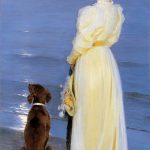
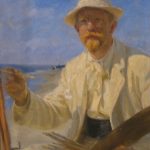
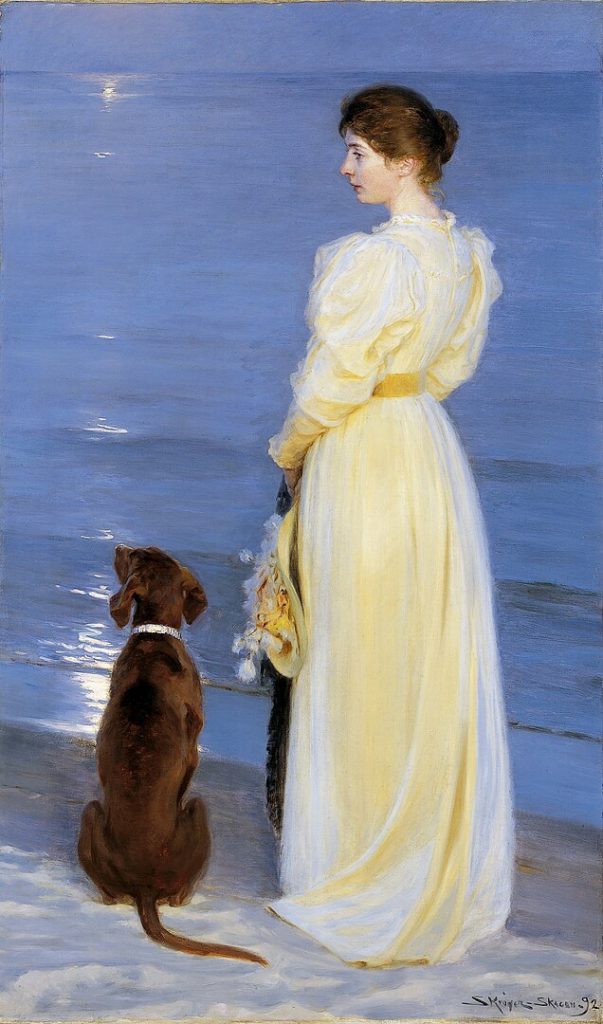
Krøyer settled in Skagen in 1882, quickly becoming both a leading artist and an informal leader of the Skagen circle. His social nature made him the heart of the artists’ gatherings at Brøndums Hotel. There, he organized summer feasts and portrait sessions, turning the dining room into a living gallery. Works like Summer Evening on Skagen’s Southern Beach (1893) and Artists’ Luncheon at Skagen (1883) reflect not only his masterful command of light but also the joy and fellowship of the community he helped foster.
Krøyer’s personal life, however, was marked by both brilliance and sorrow. He married fellow artist Marie Triepcke in 1889, but their relationship was strained by his mental health struggles and her eventual affair with Swedish composer Hugo Alfvén. Diagnosed with bipolar disorder, Krøyer suffered repeated breakdowns in the late 1890s and early 1900s. Despite his decline, he continued to paint until his death on November 21, 1909, leaving behind a body of work that remains central to Denmark’s cultural heritage.
Anna and Michael Ancher: Heart and Heritage
Anna Kirstine Brøndum was born in Skagen on August 18, 1859, into a family that owned the Brøndums Hotel—an establishment that would later become the heart of the Skagen artistic colony. As a native of the town, Anna was uniquely attuned to the rhythms and nuances of daily life in Skagen. Though women were often barred from formal art education, Anna studied at Vilhelm Kyhn’s art school in Copenhagen in the late 1870s. Her paintings often featured quiet interiors, domestic tasks, and the fleeting effects of sunlight pouring through windows.
Michael Ancher was born on June 9, 1849, on the island of Bornholm. He entered the Royal Danish Academy of Fine Arts in 1871, where he met several artists who would later accompany him to Skagen. Michael first visited Skagen in 1874, and the rugged beauty of the fishermen and their heroic labor captivated him. He returned frequently, eventually marrying Anna Brøndum in 1880, forming one of the most artistically significant partnerships in Danish art.
As a couple, Anna and Michael exemplified the complementary forces of the Skagen School. Michael’s work focused on the heroic and stoic labor of fishermen, such as in his acclaimed piece The Lifeboat is Carried Through the Dunes (1883). His palette was darker, more dramatic, and grounded in realism. Anna, on the other hand, introduced a subtler touch, painting women in domestic settings and using bold colors and innovative light patterns that hinted at modernism’s arrival.
Together, they helped shape the ethos and direction of the Skagen School. Their home became a gathering place for fellow artists, and their influence encouraged both emotional depth and technical experimentation. Anna continued to work and evolve even after Michael’s death on September 19, 1927. She remained an active painter and cultural figure in Skagen until her own death on April 15, 1935. Their legacy is one of devotion—both to each other and to the honest portrayal of Danish life.
Light, Labor, and Leisure: What the Skagen Artists Painted
The Skagen artists were unified by a shared love of light—not just any light, but the clear, high-latitude glow that seemed to bathe the Danish coast in silver and gold. They sought to capture this ethereal quality through plein air painting, which meant setting up easels directly in the dunes, gardens, and beaches of Skagen. The act of painting outdoors allowed them to observe firsthand how light changed with the wind, the tide, and the time of day. The resulting works pulse with vibrancy and immediacy, making viewers feel as if they’re standing in the sand alongside the artists.
Among the most recurring subjects in Skagen School paintings were the village’s fishermen. These were not romanticized heroes but real men performing dangerous, back-breaking labor in unforgiving seas. Artists like Michael Ancher and P.S. Krøyer portrayed these men with dignity and respect, showing them hauling nets, launching boats, or simply resting after a day’s work. Their faces—weathered by salt and wind—were rendered with the same care and attention as any aristocratic portrait.
Equally significant were the domestic scenes often painted by Anna Ancher and Viggo Johansen. They focused on the quiet beauty of everyday life: a woman feeding a child, a girl reading near a window, or a shaft of light illuminating a plain white wall. These images, though gentle, held emotional weight. They told stories of patience, tradition, and the central role of women in keeping home and community intact.
Social life was another beloved theme. The Skagen artists painted themselves and each other at meals, in gardens, or enjoying the coastline. Paintings like Hip, Hip, Hurrah! by Krøyer captured the camaraderie and warmth of their gatherings. These scenes offered a counterbalance to the more somber depictions of labor, presenting a full spectrum of life—joy, hardship, solitude, and celebration—all grounded in the natural beauty of Skagen.
The Wider Circle: Johansen, Tuxen, and Other Voices
While Krøyer and the Anchers formed the core of the Skagen School, several other artists added depth and diversity to the movement. Among them was Viggo Johansen, born January 3, 1851, in Copenhagen. Johansen studied at the Royal Danish Academy of Fine Arts and began visiting Skagen in the early 1880s. His works stood out for their moody lighting and subtle portrayal of interiors, often using muted tones and layered textures to evoke quiet contemplation.
Laurits Tuxen, born December 9, 1853, in Copenhagen, brought a different flavor to the group. He also studied at the Royal Academy and later trained in Paris. Tuxen was more academically inclined than many of his Skagen peers and was best known for his grand royal commissions, including portraits of Queen Victoria and Tsar Nicholas II. Despite this, he spent his summers in Skagen and became instrumental in preserving its artistic heritage.
Another important figure was Oscar Björck, a Swedish painter born January 15, 1860, in Stockholm. Björck visited Skagen for the first time in 1882 and quickly integrated into the community. His work blended Swedish romanticism with the clear-eyed realism of the Skagen style. Like the others, he painted both the people and the landscapes of Skagen, often focusing on beach scenes that highlighted the interaction between land and sea.
The interaction between these artists fostered collaboration and a unique creative synergy. They learned from one another’s techniques, shared critiques, and sometimes even painted the same subjects from different perspectives. While each had their own style, they were united by a respect for craftsmanship, a love of Denmark’s coastal beauty, and a desire to portray the nobility of ordinary life. This brotherhood of paint and passion defined the Skagen School’s enduring influence.
Skagens Museum and the Preservation of a Legacy
By the early 20th century, it became clear that the Skagen School had produced more than just individual masterpieces—it had created a cultural phenomenon worth preserving. In 1908, under the guidance of Laurits Tuxen and others, the Skagens Museum was founded to safeguard the legacy of the artists who had painted there. The museum was built adjacent to Brøndums Hotel, where so many of the group’s memories and canvases had been made. Its mission was to house the collective spirit of a movement that had made an indelible mark on Danish art.
One of the museum’s most unique features is the dining room of Brøndums Hotel, where the artists painted portraits of one another directly onto the walls. These portraits serve as both artwork and documentation—a visual roster of the Skagen circle, alive with personality and camaraderie. Visitors to the museum today can still see these portraits, which evoke the laughter and spirited debates that once filled the room. It is a rare and intimate view into the personal lives behind the paintings.
Over the decades, Skagens Museum has expanded its collection to include more than 1,800 works by Skagen artists, including paintings, sketches, and letters. Restoration efforts have preserved the color and texture of original works, ensuring their continued impact for new generations. The museum also sponsors exhibitions, educational programs, and partnerships with other Nordic cultural institutions. It serves not just as a gallery, but as a living tribute to an artistic legacy rooted in faith, tradition, and the power of place.
Skagens Museum is more than a repository—it is a continuation of the artists’ vision. Just as they sought to reflect the beauty and dignity of ordinary life, the museum presents their work in a setting that honors their values. By maintaining the very locations and rooms where the artists lived and worked, the museum helps bridge the past and the present. It reminds us that art can thrive even in the quietest corners of the world, as long as there is light to illuminate it.
The Skagen School Today: Influence and Inspiration
Though the last of the original Skagen painters passed away nearly a century ago, their influence endures across Denmark and beyond. Contemporary Danish artists frequently cite the Skagen School as a foundational influence, especially in their use of light and everyday subject matter. Painters like Søren Martinsen and Anita Houvenaeghel have drawn from Anna Ancher’s techniques, while others emulate Krøyer’s plein air vibrancy. The emphasis on portraying honest labor, family life, and the divine in the ordinary continues to resonate today.
In Skagen itself, the artistic spirit remains very much alive. The village has become a hub for cultural tourism, attracting visitors from all over the world who want to walk the beaches and see the vistas that inspired the great works. Art workshops, painting retreats, and summer festivals are held regularly, often based at or around the Skagens Museum. These events ensure that the traditions of the Skagen School are not only remembered but also practiced and passed on.
The legacy of the Skagen artists is also preserved through modern media and education. Danish schools often teach about the movement in history and art classes, and several documentaries have explored their lives and contributions. The artworks themselves appear in calendars, textbooks, and public campaigns, reflecting their place in national consciousness. While their techniques were rooted in a specific time and place, their values—truth, tradition, craftsmanship—are timeless.
In a world that often prizes novelty over substance, the Skagen School offers a powerful reminder of the beauty found in fidelity to place and principle. Their art was not revolutionary in the political sense, but it was deeply transformative in its moral clarity and visual sincerity. The Skagen artists chose to turn away from decadence and embrace a humble village and its people. And in doing so, they created a legacy that still shines today with the soft, golden light of a Skagen summer.
Key Takeaways
- The Skagen School emerged in the late 19th century in northern Denmark, influenced by Naturalism and Impressionism.
- P.S. Krøyer was the movement’s leading figure, known for capturing Skagen’s light and community.
- Anna and Michael Ancher brought distinct but complementary perspectives, enriching the group’s output.
- Themes included fishermen’s labor, domestic life, and the natural landscape of Skagen.
- Skagens Museum continues to preserve and celebrate the movement’s legacy today.
Frequently Asked Questions
- What is the Skagen School?
A late 19th-century art movement centered in Skagen, Denmark, focused on natural light and Realist themes. - Who were the main Skagen painters?
P.S. Krøyer, Anna Ancher, Michael Ancher, Viggo Johansen, and Laurits Tuxen were key figures. - Why is Skagen significant in art history?
It was a gathering place for artists who painted rural life with honesty and light-filled technique. - Where can I see Skagen School artworks today?
Skagens Museum in Denmark holds the largest collection, including dining room portraits and plein air masterpieces. - What subjects did the Skagen School artists paint?
Fishermen, domestic interiors, beaches, social gatherings, and the distinctive Nordic light.