There are cities whose histories read like a single story: a beginning, a rise, and a transformation into the modern world. Then there are cities like Palermo — places where history doesn’t unfold in a straight line but layers itself thickly, like paint on a centuries-old canvas. The capital of Sicily is one of the rare places on Earth where East and West, North and South, ancient and modern, collide and embrace. This collision has made Palermo not merely a political or economic center through the ages, but a living laboratory of art.
To understand Palermo’s art history is to trace the movement of entire civilizations: the Phoenicians, who sailed across the Mediterranean to establish trading posts; the Greeks, whose culture and drama left their marks; the Romans, who added grandeur; the Byzantines, who painted walls with glittering mosaics; the Arabs, who transformed the landscape with gardens and geometric artistry; the Normans, who layered those Islamic forms with Christian imagery; the Spanish, who flooded the city with Baroque splendor; and finally, the modern Italians, who have grappled with decay, renewal, and the burdens of history.
Every epoch brought its own artistic language, and rather than erasing the old to make way for the new, Palermo preserved, absorbed, and reimagined. Nowhere else in Europe, perhaps nowhere else in the world, can one stand in a single cathedral and see such a precise layering of styles — Islamic arches beneath Byzantine mosaics framed by Norman stonework, all crowned centuries later by Baroque frescoes.
The setting for this great artistic experiment is Palermo’s geography itself. Hugging a wide bay and backed by steep, rugged mountains, the city is both naturally protected and easily accessible — a paradox that made it a jewel fiercely contested over centuries. Its Mediterranean light bathes its stones in a soft, golden hue that seems almost designed for artists to capture.
For centuries, however, Palermo’s riches were overlooked or dismissed by mainland European observers. Grand Tour travelers in the 18th and 19th centuries often regarded Sicily as a rough, decadent backwater — too wild, too tainted by decay to belong fully to the classical tradition they revered. It took time, scholarship, and a deeper appreciation of complexity to realize that Palermo’s messy, layered, hybrid nature was its true brilliance. As the Sicilian writer Leonardo Sciascia once noted, “Sicily is the key to everything.”
Indeed, Palermo challenges the very idea of purity in art history. Instead of viewing art as a linear progression from classical Greece to Renaissance Florence to Enlightenment Paris, Palermo forces us to see history as a palimpsest — a manuscript written, erased, and rewritten, each new hand respecting or at least responding to what came before.
Modern scholars increasingly recognize Palermo as one of the cradles of world heritage, particularly since the inclusion of the city’s Arab-Norman monuments on UNESCO’s World Heritage List in 2015. Sites like the Palatine Chapel, Monreale Cathedral, and the Zisa Palace are not anomalies, but the beating heart of a city whose artistic identity is built on coexistence and transformation.
Palermo’s art is not only monumental but deeply intertwined with daily life. The intricate marble floors of churches, the puppet theaters telling tales of Charlemagne and Saracens, the hand-painted carts of the countryside, the elaborately decorated street markets — all are expressions of a culture where art is not reserved for galleries but spills into the streets and squares.
Today, Palermo is experiencing a new artistic renaissance. The Manifesta 12 biennial in 2018 placed the city squarely on the international contemporary art map, and ongoing projects aim to restore its crumbling palaces, forgotten churches, and abandoned theaters. Yet the city’s soul remains rooted in its centuries-long tradition of layering, borrowing, and blending.
In the chapters to come, we will peel back the layers of Palermo’s rich art history: from the ancient Phoenicians and Punic settlements, through the dazzling Arab-Norman era, to the gold-encrusted Baroque churches, and into the 21st century’s experiments in memory and reinvention. Each period will offer not just a style or an aesthetic, but a glimpse into a world where art was — and remains — inseparable from life itself.
The Ancient Foundations: Phoenician and Punic Palermo
Long before the glittering mosaics and towering domes, long before the marble statues and Baroque facades, Palermo was already a city — a prized possession of the Mediterranean world. To truly grasp the origins of its artistic identity, we must travel back nearly three thousand years, to an era when the sea itself was the great highway of commerce and conquest, and when a seafaring people called the Phoenicians founded what they would call Ziz — “the Flower.”
Sometime around the 8th century BCE, these skilled traders and navigators — whose homeland stretched along what is today the coast of Lebanon — established a network of colonies across the Mediterranean. They were not empire-builders in the Roman or Greek mold; instead, the Phoenicians built their power through commerce, bringing goods, ideas, and artistic styles from port to port. They sought out places with natural harbors and fertile hinterlands, and in the broad bay of Palermo, sheltered by the mountains and fed by freshwater rivers, they found an ideal anchorage.
The early settlement at Palermo was modest compared to the grandeur that would come later, but it was sophisticated in its own right. Archaeological excavations in the area known today as the Kalsa and around Piazza Marina have uncovered fragments of walls, ceramics, and burial sites that testify to a lively, organized community. The artistic expressions of this time were practical yet infused with symbolic meaning: finely worked jewelry in gold and silver; amphorae decorated with stylized motifs; and funerary objects that hint at a complex spiritual life.
Phoenician art was marked by a fluid synthesis of influences. These were people who absorbed and reinterpreted the styles of Egypt, Mesopotamia, and Greece, creating objects that are difficult to pin to one tradition alone. A Phoenician amulet found in Palermo, for example, might feature Egyptian motifs — such as the Eye of Horus or the sacred scarab — rendered with a Levantine sensibility. Their architecture, though largely lost to time in Palermo, likely featured the massive stone blocks and rectangular plans typical of their other Mediterranean colonies.
By the 5th century BCE, Palermo — now increasingly under Carthaginian influence — began to reflect the power struggles that dominated the region. Carthage, the great Phoenician city-state in North Africa, assumed control over Sicily’s western half, and Palermo became a critical node in a network of military and economic power. With Carthage came a new layer of artistic input: Punic culture, a blend of Phoenician, North African, and local Sicilian elements, further enriched the city’s early identity.
Punic Palermo was more fortified, more militarized, but it was not devoid of beauty. Recent discoveries have unearthed remnants of Punic-era necropolises where the art of death spoke volumes about the living. Stone sarcophagi adorned with carved reliefs, finely painted pottery, and intricate funerary masks reveal a society that placed great importance on memorializing the dead with dignity and artistry.
One of the most fascinating aspects of Punic Palermo is how little it has survived above ground — and yet how much it permeates the city’s subconscious landscape. Unlike Greek cities such as Syracuse or Agrigento, where massive temples still rise against the sky, Palermo’s ancient past is buried beneath layers of subsequent civilizations. It lives on not in monumental ruins but in the city’s very shape: the orientation of streets, the siting of the port, even the choice of sacred places that later rulers would appropriate.
The Punic period also sowed the seeds of Palermo’s first multicultural interactions. The Carthaginians were pragmatic rulers, often incorporating elements of local customs rather than imposing a rigid cultural model. This early tolerance and adaptability would become a recurring theme in Palermo’s history, setting the stage for the even more spectacular cultural syntheses of the Arab-Norman period centuries later.
By the end of the 3rd century BCE, however, the tides of power shifted once again. The Punic Wars — the colossal struggles between Rome and Carthage — would lead to Carthage’s downfall and Sicily’s absorption into the Roman Republic. Palermo, known as Panormus under the Romans (meaning “all-port,” a nod to its splendid harbor), would enter a new phase of its artistic and cultural development.
Yet even as Roman mosaics and baths would soon come to dominate the landscape, the Phoenician and Punic foundations remained. The very name of the city — Palermo — is a linguistic echo, passed down from Punic Panormos and shaped by centuries of speech and conquest. And in the art of the city — in its embrace of multiple styles, its willingness to absorb and adapt — one can still trace the spirit of its first artists: the merchants, craftsmen, and sailors who came from the east to plant a flowering outpost on a fertile shore.
Thus, Palermo’s artistic story does not begin with statues or grand temples, but with the humbler, more intimate arts of a cosmopolitan port: the curve of an amphora, the gleam of a pendant, the silent guardians of a painted tomb. In these early traces, the DNA of Palermo’s artistic destiny was already set: hybrid, resilient, and eternally open to the world.
Roman and Byzantine Palermo: Mosaics, Villas, and Early Christianity
When the dust of the Punic Wars finally settled in the 3rd century BCE, a new power held sway over Sicily: Rome. Palermo — now known as Panormus — transitioned into a Roman city, its great natural harbor making it a prized possession in Rome’s strategic and commercial network. The Romanization of Palermo brought with it profound changes, not just in governance, but in the city’s artistic and cultural life. Yet, in typical Palermitan fashion, the old was never entirely discarded. Instead, Roman Palermo layered its new marble and mosaics atop Phoenician and Punic foundations, beginning yet another chapter in its palimpsest history.
In the Roman world, Panormus was not among the most prestigious cities — it could not rival the size or grandeur of cities like Syracuse or Carthage — but it held its own importance. It was a provisioning port, a garrison town, and a stopping point on the vital maritime routes between Africa, Italy, and Spain. With trade came wealth, and with wealth came art.
Archaeological finds, though modest compared to mainland Italy, suggest a thriving Roman community. Villas with intricate floor mosaics began to appear, both within the city and in the surrounding countryside. These mosaics, painstakingly composed from tiny tesserae, often depicted scenes from mythology, daily life, or nature — a dolphin leaping from stylized waves, a hunter poised with spear in hand, the swirling vines of Bacchic festivities. They connected Panormus not just to Rome politically, but to the grand visual language of the empire.
One of the most significant glimpses into this period comes from nearby: the Villa Romana del Casale in Piazza Armerina, about 150 kilometers inland. While not in Palermo itself, this sprawling late Roman villa offers a vivid picture of the artistic milieu that would have influenced wealthy patrons throughout Sicily. Its sumptuous mosaics — the famous “Bikini Girls,” hunting scenes, mythological tableaus — suggest that the art of mosaic reached dizzying heights on the island, with Palermo’s own elites likely commissioning similar, if less grand, works.
As the Roman Empire evolved and Christianity began its slow, seismic shift from persecuted sect to state religion, Panormus, too, adapted. Christianity reached Sicily relatively early — certainly by the 3rd century CE — and the art of Palermo began to reflect this profound spiritual transformation. Pagan deities gave way to Christian symbols: the fish, the anchor, the Chi-Rho. Baptismal fonts, catacombs, and modest house-churches began to emerge, though most have not survived Palermo’s later building booms.
The Christian art of this period was humble compared to the grand basilicas that would later rise in Constantinople or Ravenna, but it was nonetheless powerful. It spoke of faith quietly flowering under the heavy canopy of imperial Rome, a new narrative expressed through simple frescoes, engraved tombstones, and clandestine gatherings. In Palermo, early Christian burials have been found in subterranean cemeteries such as the Catacombs of Porta d’Ossuna — labyrinthine spaces where painted symbols of hope and salvation adorned the walls.
The fall of the Western Roman Empire in the 5th century and the subsequent turbulence of the Vandal invasions did not erase the Roman imprint from Palermo. Instead, as Sicily fell under Byzantine control in the 6th century, the city entered yet another phase of cultural transformation. The Byzantines, heirs to Rome’s eastern legacy, infused Palermo with new artistic traditions — and with them, a love for the art form that would come to define the city: mosaics.
Byzantine mosaics differed from their Roman predecessors in key ways. Where Roman mosaics often celebrated earthly pleasures and were grounded in naturalistic representation, Byzantine mosaics aimed for transcendence. Figures became more stylized; gold backgrounds evoked the shimmering heavens; solemn saints and regal emperors gazed out from the walls of churches with an intensity meant to inspire awe rather than mere admiration.
Though little survives in Palermo from this early Byzantine period, later constructions such as the Palatine Chapel would retain clear echoes of Byzantine aesthetic principles. The seeds of what would become Palermo’s most famous artistic achievements — glittering religious mosaics that seem to dissolve the boundary between earth and heaven — were planted during this time.
It is important to remember, too, that Byzantine Palermo was not isolated. It remained a vibrant Mediterranean port, exchanging goods, people, and ideas with North Africa, the Levant, and Constantinople itself. This cosmopolitan character allowed Byzantine art in Palermo to mingle with older Roman traditions and newer local influences, creating an artistic language that was distinct even from the imperial capitals.
But as ever in Sicily, the tides of power shifted yet again. By the 9th century, Byzantine rule in Palermo had weakened. Into the vacuum stepped a new force: the Arabs, who would transform not only the political landscape but the very fabric of Sicilian life — and with it, its art.
The Roman and Byzantine eras thus represent Palermo’s first major reimagining of itself: from Punic trading post to Roman port to Byzantine outpost. Each transition layered new artistic expressions upon the old, setting the stage for the breathtaking cultural fusion that was to come. When we marvel at the glittering mosaics of Norman Palermo or the intricate marble floors of its Baroque churches, we are witnessing the culmination of traditions that began with the first Roman mosaicist setting tiny stones into wet mortar, and with the first Christian convert carving a humble cross into the catacomb wall.
Palermo’s genius lies not just in its masterpieces, but in its memory — its capacity to carry forward the artistic DNA of every people who called it home. In Roman mosaics and Byzantine frescoes, we hear the first verses of a long, complex, and beautiful song that Palermo is still singing today.
Arab-Norman Synthesis: A Unique Artistic Fusion (9th–12th centuries)
If Palermo’s Roman and Byzantine periods were a slow gathering of currents, then the arrival of the Arabs in the 9th century was a tidal wave of change. In 831 CE, after a prolonged siege, Muslim forces captured the city from the Byzantines, and Palermo — Balarm, as they called it — was transformed into one of the most glittering cities of the Islamic world. Under Arab rule, and later under the Norman kings who conquered Sicily in the 11th century, Palermo became a place unlike any other: a crucible where Islamic, Byzantine, and Latin traditions melted and reforged into something astonishingly new.
The Arab rulers of Palermo infused the city with the sophistication of Islamic art and architecture. They built palaces and mosques, planted lush gardens watered by ingenious irrigation systems, and cultivated a court culture steeped in poetry, science, and philosophy. Although much of the original Islamic city has been lost to time, echoes of its splendor survive — in the city’s labyrinthine street patterns, in its love of enclosed gardens and fountains, and, most spectacularly, in the Arab-Norman monuments that would later incorporate Islamic artistry at their core.
When the Normans — descendants of Viking raiders who had settled in northern France — arrived in Sicily in the 11th century, they encountered not a barren island of peasants but a thriving, multicultural society. Rather than obliterate what they found, the Norman rulers, particularly Roger II (r. 1130–1154), embraced and elevated it. They recruited Arab architects, artisans, and scribes to their courts. They employed Greek mosaicists and Latin clerics. They created a kingdom where Muslim, Christian, and Jewish communities could coexist — at least for a time — in relative harmony.
This spirit of syncretism is nowhere more visible than in the art and architecture of Arab-Norman Palermo, a style so distinctive that UNESCO has recognized it as a World Heritage treasure.
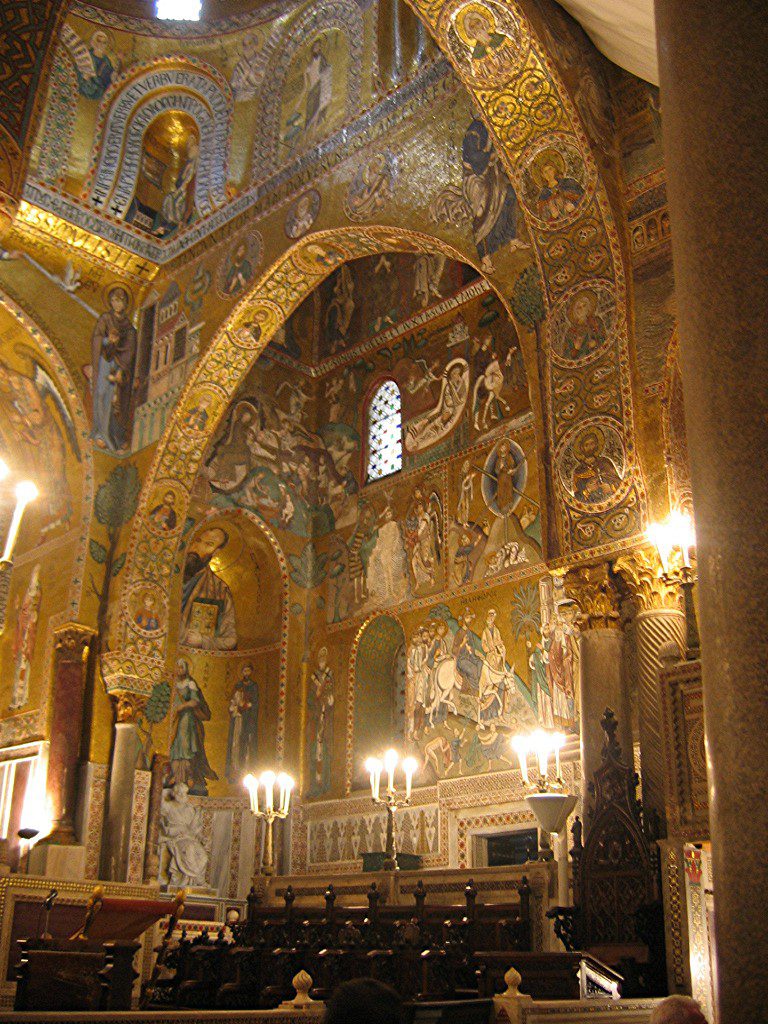
One of the crowning achievements of this era is the Palatine Chapel (Cappella Palatina), located within the Norman royal palace. Commissioned by Roger II around 1132, the chapel is a dazzling encapsulation of Palermo’s cultural alchemy. Its wooden muqarnas ceiling — an intricate, honeycomb-like Islamic design — seems to drip from the heavens, painted with vibrant images of animals, geometric patterns, and Arabic inscriptions. Below this, glittering Byzantine mosaics tell Christian stories in shimmering golds and blues. Latin, Greek, and Arabic languages intertwine in the chapel’s inscriptions, an unmistakable symbol of the king’s multicultural vision.
It is almost impossible to overstate the artistic audacity of this place. In no other European court would one find Muslim artisans decorating a Christian chapel in Byzantine styles under a Latin-speaking king. Yet in Palermo, this synthesis was not an oddity but the very essence of its art.
Other monuments from this period further showcase this hybrid brilliance. The Zisa Palace, begun under King William I, is a pleasure palace whose design draws directly from Islamic prototypes, complete with cooling water channels and lavish stucco work. The Cuba, another 12th-century palace, rises in near-abstract perfection: a rectangular block softened by blind arches and domes, set within what was once a vast, Persian-inspired garden.
The great churches of the countryside, too, reveal this fusion. The Cathedral of Monreale, just outside Palermo, boasts more than 6,500 square meters of mosaics — one of the largest collections in the world — depicting Biblical stories with a grandeur and luminosity that could rival Hagia Sophia itself. Here, Greek mosaicists worked alongside local Sicilian artisans, melding Byzantine iconography with western narrative techniques.
It was not just in architecture that this synthesis flourished. Palermo’s decorative arts during this period blossomed with an exuberance rarely seen elsewhere. Ivory carving, an art form perfected in the Islamic world, produced masterpieces like the celebrated cassettes — intricately carved boxes depicting scenes of courtly life, both secular and sacred. Textiles, another Arab specialty, reached new heights: silk weavers created fabrics so prized that Sicilian silks were exported across Europe and the Islamic world alike.
What is perhaps most remarkable is that this artistic fusion was not born merely of necessity or pragmatism but of genuine admiration. The Normans saw in Arab culture not an alien threat but a repository of wisdom, skill, and refinement. Roger II famously wore robes embroidered with Arabic inscriptions. His court geographer, al-Idrisi, composed his great Tabula Rogeriana — a detailed world map — in Arabic. In Palermo, during these brief golden centuries, the idea of cultural superiority gave way to something more rare and beautiful: cultural synergy.
Of course, this harmony was not eternal. By the late 12th century, pressures from the Papacy and the mainland Latin world began to erode the unique tolerance of Norman Sicily. Muslim communities were gradually marginalized, expelled, or forcibly converted. The brilliant Arab-Norman civilization faded, its monuments left as magnificent but melancholy witnesses to a lost world.
Yet the legacy endures. When modern visitors walk through the Palatine Chapel, gaze up at the mosaics of Monreale, or wander the silent gardens of the Zisa, they encounter not just art objects, but an idea: that difference can be not a threat, but a source of beauty; that cultures, when allowed to mingle freely, can create works of transcendent grace.
The Arab-Norman period stands as the high watermark of Palermo’s artistic history — a time when east and west, Islam and Christianity, heaven and earth, met and mingled beneath the golden light of Sicily. In the chapters that follow, we will see how this artistic legacy endured even as new waves of power — Gothic, Spanish, and Baroque — reshaped Palermo once again. But always, beneath every layer, the memory of Arab-Norman Palermo shimmers: a brilliant, impossible dream made stone.
The Palatine Chapel and Cefalù Cathedral: Jewels of Norman Art
There are buildings that dazzle because of their size, their wealth, their fame. And then there are those rare places — few and far between — that seem to hold the very soul of a civilization within their walls. In Palermo, the Palatine Chapel and the Cefalù Cathedral are such places. They are not merely relics of the past but enduring miracles: where the light of Byzantium, the intricacy of Islam, and the ambition of Latin Christendom converge in radiant, tangible form.
The Palatine Chapel (Cappella Palatina) is, at first glance, almost modest. Nestled within the massive, sprawling complex of Palermo’s Royal Palace (Palazzo dei Normanni), it is easy to miss from the outside. But crossing its threshold is like entering another world — or several worlds at once.
Commissioned by King Roger II in 1132, the Palatine Chapel was intended not just as a royal place of worship but as a statement of power and vision. Roger, a Norman adventurer who had transformed himself into the crowned ruler of a multicultural kingdom, wanted his private chapel to embody the full spectrum of cultures under his dominion. He succeeded beyond all imagination.
The ceiling is the first astonishment. Unlike anything seen elsewhere in Western Europe, it is a wooden muqarnas ceiling — a cascade of carved and painted stalactite-like forms, a masterpiece of Islamic craftsmanship. Painted on its surfaces are images of courtly life: hunters with falcons, dancers, drinkers, exotic animals — scenes rendered in vivid color and exquisite detail. It is as if the courtly pleasures of the Islamic world have been suspended above the heads of Christian worshipers.
Below this floating paradise, the walls are a riot of Byzantine mosaics. Gold is everywhere — a sea of luminous tesserae that catch and scatter the light. Christ Pantocrator, the all-powerful ruler of the universe, stares down from the apse with solemn majesty. Around him unfold scenes from Genesis: Adam and Eve, Noah and the Flood, Abraham and Isaac. The storytelling is intense and immediate, rendered in a language inherited from Constantinople but infused with local spirit.
And then there is the Latin architecture: the basilica layout, the Romanesque arches, the marble columns — all speaking to the Western traditions that underpinned Norman legitimacy.
Three artistic languages, three religious traditions, three civilizations — all perfectly balanced within a single sacred space. And yet, astonishingly, the Palatine Chapel does not feel like a clash or a compromise. It feels inevitable, as if this synthesis were always meant to be.
Contemporary observers were left awestruck. Ibn Jubayr, the Andalusian Muslim traveler who visited Palermo in 1185, described the chapel’s brilliance with near reverence, noting the “beauty of its construction and the quality of its workmanship,” and the “marvelous paintings” that filled its spaces. In his account, even a devout Muslim could find wonder and admiration for this Christian king’s architectural masterpiece — a testament to the universality of its appeal.
Roughly an hour’s drive along the coast from Palermo lies another jewel of Norman art: the Cathedral of Cefalù. Founded by Roger II in 1131 — just a year before he began the Palatine Chapel — the cathedral rises dramatically against the backdrop of La Rocca, a towering rocky crag that looms over the town. According to legend, Roger commissioned the cathedral after surviving a perilous sea voyage and vowing to build a church in gratitude.
If the Palatine Chapel is intimate and layered, Cefalù Cathedral is monumental and open, a bold declaration in stone. Its twin towers flank a massive, austere facade that speaks of Norman military might and religious authority. Yet inside, the same spirit of cultural blending reigns supreme.
Cefalù’s interior, though more sober than the Palatine Chapel, bursts into splendor at the eastern end, where the apse is entirely covered in Byzantine mosaics of breathtaking quality. Dominating the space is the figure of Christ Pantocrator — the same motif seen in Palermo, but here even larger, even more commanding. Christ’s right hand is raised in blessing; his left holds the Gospel open to a passage from the Gospel of John, written in Greek and Latin, symbolizing the dual heritage of the kingdom.
The mosaic work in Cefalù is among the finest anywhere in Europe. The tesserae — tiny pieces of colored glass and gold leaf — are set at slightly different angles, causing the light to dance across the surfaces. This technique, inherited from Constantinople, gives the impression that the walls themselves are alive, shimmering with divine energy.
Flanking the Pantocrator are images of the Virgin Mary, angels, and apostles, arranged in a strict theological hierarchy. Every detail is intentional, part of a complex iconographic program designed to assert the divine right of Roger II’s rule. In creating Cefalù Cathedral, Roger was not simply building a place of worship; he was crafting a cosmic vision of his kingship, sanctified by God and rooted in the universal Christian empire.
Taken together, the Palatine Chapel and Cefalù Cathedral encapsulate the genius of Norman Sicily. They reveal a vision of kingship that was not parochial or insular but ecumenical and global — a kingdom that looked simultaneously to Rome, Byzantium, and the Islamic world for its sources of legitimacy and inspiration.
They also testify to the extraordinary skill of the artisans — Arab, Greek, Latin — who worked side by side, each bringing their traditions and innovations to the whole. Their work reminds us that the art of Palermo was never about pure origins or singular identities; it was about encounter, exchange, and the creation of something richer than the sum of its parts.
Today, both the Palatine Chapel and Cefalù Cathedral stand remarkably well preserved. Their survival is itself a miracle, given the centuries of conquest, neglect, and modernization that swept through Sicily. They are not frozen relics but living monuments — still places of worship, still objects of pilgrimage, still sources of wonder.
For those who enter these spaces, the experience is visceral: the glint of gold mosaics, the coolness of marble, the intricate dance of Islamic woodwork above. It is not simply a journey back in time, but a glimpse into an alternate vision of what civilization could be: diverse, tolerant, beautiful beyond imagining.
As we move forward in Palermo’s story, through Gothic, Renaissance, and Baroque transformations, the memory of the Palatine Chapel and Cefalù Cathedral will linger — as the beating heart of a city that dared to dream across borders, and succeeded.
Gothic and Early Renaissance Palermo
The Arab-Norman period had gifted Palermo a unique identity, but no era, however golden, is immune to change. By the late 12th and early 13th centuries, Sicily — and Palermo with it — was drawn deeper into the orbit of mainland Europe. Dynasties shifted: the Hauteville kings gave way to the Hohenstaufen emperors, then the Angevins, and eventually the Spanish Crown. With each transition came new influences, and in the changing aesthetic winds, Gothic and early Renaissance styles found fertile, if sometimes reluctant, ground in Palermo’s ancient streets.
Unlike northern Europe, where the Gothic style — with its pointed arches, soaring vaults, and intricate tracery — revolutionized the landscape with towering cathedrals, Palermo absorbed Gothic influences more selectively, blending them with its deep-seated traditions. Here, Gothic did not sweep away the past; it seeped into it, leaving subtle but significant marks.
One of the first and most striking examples of Gothic architecture in Palermo is the transformation of the Palermo Cathedral (Cattedrale di Santa Maria Assunta). Originally founded in 1185 during the Norman period, the cathedral was modified extensively over the centuries. In the 14th and 15th centuries, Gothic elements were layered onto the structure: pointed arches, mullioned windows, and elaborate portal decorations. The building became a living document of Palermo’s layered history — part Arab-Norman fortress, part Gothic aspiration.
The cathedral’s south portico, built in the 15th century under the Spanish Aragonese rulers, is a particularly beautiful example of Gothic intervention. Its pointed arches and intricate stonework demonstrate the new sensibilities that were drifting down from mainland Europe. Yet even in these features, a distinct Sicilian flavor persists: the arches are wider, the ornamentation heavier, the structure grounded rather than aspiring to impossible heights.
Elsewhere in Palermo, Gothic styles found expression in smaller churches and civic buildings. The Chiesa di San Francesco d’Assisi, located in the Kalsa district, underwent Gothic renovations in the 13th and 14th centuries. Its ribbed vaults, delicate tracery, and austere stone surfaces contrast sharply with the glitter of the Palatine Chapel, revealing the city’s evolving artistic moods.
At the same time, the Gothic influence extended into the realm of funerary art. In Palermo’s cathedrals and monasteries, elaborate Gothic tombs began to appear, carved in white marble, adorned with cusped arches, niches, and effigies of knights and nobles in solemn repose. These monuments speak to the growing importance of individual legacy and memory in a way that earlier, more collective artistic traditions did not emphasize.
As the 15th century advanced, another current began to stir in Palermo: the early Renaissance. But here too, the city moved to its own rhythm.
Florence, Rome, and Venice were already basking in the revolutionary new ideas of humanism, proportion, and classical revival. In Sicily, these ideas arrived more slowly, carried by itinerant artists, architects, and administrators from the mainland. Palermo’s Renaissance was less about radical rupture and more about careful adaptation.
One of the pivotal figures in introducing Renaissance ideals to Palermo was Francesco Laurana, a Dalmatian sculptor and architect who worked across Italy and southern France. His marble busts, particularly of aristocratic women, introduced a new kind of portraiture to Palermo — one that combined classical serenity with a delicate psychological realism. His Bust of Eleanor of Aragon (c. 1468) captures a strikingly human sense of individuality, a hallmark of Renaissance art.
Architecture, too, began to reflect Renaissance tastes. Buildings became more symmetrical; columns and pilasters re-emerged in classical forms; decorative motifs such as garlands, putti, and mythological scenes adorned facades and interiors. Yet Gothic and Arab-Norman elements never vanished entirely. Instead, Palermo’s Renaissance architecture often displays a hybrid character: a classical column here, a pointed Gothic arch there, and always the lingering memory of Islamic geometry in the city’s urban fabric.
One of the most notable Renaissance structures in Palermo is the Palazzo Abatellis, constructed in the late 15th century for Francesco Abatellis, a wealthy nobleman and naval commander. Designed in a Gothic-Catalan style with Renaissance influences, the palace features a sober elegance, with its airy courtyards, pointed arches, and restrained decoration. Today, it houses the Galleria Regionale della Sicilia, where masterpieces from Palermo’s medieval and Renaissance periods are carefully preserved — including Antonello da Messina’s haunting Annunciata, a painting that distills the spirit of early Sicilian Renaissance art.
It’s important to note that even as Gothic and Renaissance styles gained a foothold, Palermo remained distinct from the mainland Italian cities. It was never purely Gothic like Chartres or Siena, nor purely Renaissance like Florence. The reasons for this are complex: geography, political instability, and the city’s deep-rooted multiculturalism all played a role.
Moreover, the dominant Spanish influence during the late 15th and early 16th centuries — as the Kingdom of Sicily became a satellite of the Spanish Crown — meant that Palermo’s artistic evolution increasingly followed Iberian rather than purely Italian models. Spanish Gothic and Renaissance styles, themselves infused with Moorish and Mudéjar elements, resonated deeply with Palermo’s own hybrid identity.
Thus, in Palermo’s Gothic and early Renaissance art, we see not a simple adoption of foreign styles but a creative dialogue. The city took what it needed, adapted it to its context, and produced works that are subtly different from anything found elsewhere in Europe.
As we stand in the quiet nave of San Francesco, or trace the delicate lines of Laurana’s busts, we glimpse a Palermo in transition — a city still rooted in its luminous Arab-Norman past, yet beginning to orient itself toward the modern world. It was a slow, uneven, but deeply creative process, setting the stage for the even more flamboyant transformations that would come with the Baroque age.
And so, once again, Palermo proved that its greatest strength lay not in rigid adherence to a single tradition, but in its endless ability to adapt, absorb, and reinvent.
The Spanish Viceroyalty: Baroque Splendor in Palermo
By the end of the 16th century, Palermo had once again changed masters. Sicily was now firmly under the control of the Spanish Crown, governed by powerful viceroys who ruled in the name of distant monarchs. While political autonomy diminished, a new kind of energy entered Palermo’s cultural bloodstream: the exuberant, theatrical spirit of the Baroque.
For a city accustomed to layering one tradition atop another, Baroque was a natural fit. Where Arab-Norman Palermo had balanced restraint and opulence, and Gothic-Renaissance Palermo had flirted with classical symmetry, Spanish Palermo surrendered to excess. Art and architecture under the Spanish viceroys exploded into flourishes of marble, gilding, twisting columns, and lavish altarpieces. This was not mere decoration for its own sake — it was the visual language of power, faith, and spectacle, crafted to awe and overwhelm.
The Baroque period in Palermo unfolded during a time of both grandeur and hardship. The 17th century brought prosperity to some, but also epidemics, food shortages, and social unrest. In response, art became a tool of both escapism and propaganda. The Church, facing the challenges of Protestant Reformation sweeping northern Europe, embraced the Baroque as a weapon of the Counter-Reformation, designing churches and public spaces to emotionally capture the faithful and reaffirm Catholic dominance.
Few places exemplify this ambition more spectacularly than the Quattro Canti — officially known as Piazza Vigliena. Constructed between 1608 and 1620 at the intersection of Palermo’s two main streets, Via Maqueda and Via Vittorio Emanuele, the Quattro Canti is the very heart of Baroque Palermo. The square is a brilliant urban stage set: four concave facades, each adorned with fountains, Corinthian columns, statues of the Spanish kings, and allegorical representations of Palermo’s patron saints and the four seasons. Standing in the center, one feels encircled by history itself, as if the city has choreographed its own grand ballet.
Churches, of course, were the primary canvases for Baroque artistry. Palermo’s ecclesiastical landscape was transformed by the rise of orders like the Jesuits, who brought with them a zeal for sensory immersion. The Church of the Gesù (Casa Professa), built between the late 16th and early 17th centuries, is one of the most astonishing examples. Its interior is an explosion of colored marble inlays, sculpted cherubs, twisting Solomonic columns, and frescoed ceilings that blur the line between architecture and illusionistic painting. Every surface teems with energy, a visual manifestation of divine ecstasy.
This period also gave rise to a flourishing of sculptural decoration, much of it in richly veined Sicilian marble. Local artisans developed a technique called marmi mischi (mixed marbles), creating intricate, multicolored inlaid designs that covered altars, pulpits, and entire walls. Palermo’s churches became veritable jewel boxes, with swirling marbles in reds, greens, yellows, and blues, arranged in dizzying arabesques.
The Spanish viceroys themselves were great patrons of the arts, commissioning grand palaces and public works designed to glorify their reigns. The Palazzo dei Normanni, already an ancient seat of power, was renovated and expanded to fit the tastes of the Spanish court. New grand staircases, frescoed halls, and ceremonial rooms testified to the blending of medieval roots with Baroque ambition.
One of the most emblematic civic works from this period is the Fontana Pretoria, though it predates the high Baroque and was imported from Florence. Originally sculpted in the 1550s by Francesco Camilliani for a Tuscan villa, the fountain was sold to Palermo in the 1570s. Reassembled in the city center, it became a symbol of Baroque urban splendor. Its nude allegorical figures caused scandal among the pious citizens, who nicknamed it Fontana della Vergogna (“Fountain of Shame”), but it perfectly captured the city’s taste for theatricality and sensual beauty.
The Baroque spirit also shaped Palermo’s private life. Noble families such as the Gravinas, the Moncadas, and the Alliata di Villafrancas competed in a dizzying arms race of architectural and decorative magnificence. Their palaces — many of which survive today, often in various states of glorious decay — featured grand courtyards, monumental staircases, frescoed salons, and secret gardens. These residences were not merely homes but statements of power, culture, and lineage.
Painters, too, found new opportunities. Artists like Pietro Novelli (1603–1647), known as il Monrealese, became stars of the Palermitan scene. Novelli combined the dramatic chiaroscuro of Caravaggio with a refined Sicilian sensibility, producing works of intense emotional immediacy. His altarpieces, portraits, and civic commissions helped define the visual culture of Baroque Palermo, infusing it with both grandeur and a surprising intimacy.
Yet even in the midst of this visual splendor, Palermo’s Baroque art often retained echoes of its older traditions. In church facades and palace designs, one can sometimes glimpse the heavy, fortress-like solidity of Arab-Norman architecture, refracted through the prism of Spanish theatricality. Even at its most ostentatious, Palermo’s Baroque never fully erased the city’s historical memory — it simply dressed it in new costumes.
Today, to walk through Palermo’s Baroque heart is to experience a city in perpetual performance. The swirling marble of Casa Professa, the proud statues of the Quattro Canti, the sensual curves of the Fontana Pretoria — all speak of a time when art was a kind of public theater, where faith, politics, and personal ambition played out on an open stage.
But Baroque Palermo was not only about display. It was about resilience — a city asserting its splendor in the face of adversity, a people expressing their vitality through art, even as they weathered plagues, earthquakes, and political oppression. In its exuberance, its sensuality, and its undeniable power, the Baroque remains one of Palermo’s most enduring and recognizable faces.
As we move into the next chapter, we will see how the exuberance of the Baroque gradually gave way to the more measured elegance of Neoclassicism — and how Palermo continued, as always, to reinvent itself in the shifting tides of history.
Sicilian Baroque: Identity, Ornamentation, and Earthquake Recovery
If the Baroque in Palermo under Spanish rule was theatrical and grand, the Sicilian Baroque that emerged in the late 17th and early 18th centuries was something even more distinctive — something profoundly local, born not merely from aesthetic choice but from catastrophe.
The catalyst was devastation. In 1693, a massive earthquake ripped through southeastern Sicily, leveling cities such as Catania, Noto, Modica, and Ragusa. Palermo, though not at the epicenter, felt the tremors both physically and culturally. The rebuilding that followed across the island sparked an artistic flowering that was at once exuberant, fantastical, and unmistakably Sicilian.
In the wake of destruction, the island’s architects, sculptors, and patrons seized the opportunity not just to reconstruct what had been lost but to reinvent it. This was not a cautious restoration of the past. It was an audacious leap forward, an assertion of survival, identity, and spiritual vitality through a radically ornamental style that came to be known as Sicilian Baroque.
While many of the most dramatic examples of Sicilian Baroque are found in the Val di Noto, Palermo developed its own version, no less flamboyant. Here, the style manifested in wild facades that seemed to ripple with movement, in balconies with ironwork so elaborate it resembled lace, and in decorative programs bursting with grotesques, putti, masks, and fantastic beasts.
One of the most vivid examples in Palermo is the Church of Santa Caterina d’Alessandria, located in the historic center near Piazza Bellini. Though begun in the Renaissance period, it was completed in high Sicilian Baroque style. Its interior is a breathtaking riot of marmi mischi (inlaid polychrome marble), stucco angels, gilded woodwork, and frescoed ceilings. No surface is left untouched; every inch cries out in celebration of divine glory.
Similarly, the Church of San Giuseppe dei Teatini, near the Quattro Canti, showcases the lavishness that characterized Palermo’s contribution to the Sicilian Baroque. Built by the Theatine Order, its massive dome, soaring columns, and interior frescoes are crowned by intricate marble work that exemplifies the period’s taste for overwhelming decoration.
Palermo’s palaces, too, were transformed. Nobility who had survived the turbulent 17th century — and those newly enriched through Spanish favor — adorned their urban residences with fantastical balconies supported by carved corbels. These corbels often featured grotesque faces, winged monsters, writhing cherubs, and theatrical masks — a departure from the classical restraint of earlier periods and a direct channeling of Sicily’s love of visual storytelling.
The Palazzo Valguarnera-Gangi, famous for its later ballroom scenes in Visconti’s film The Leopard, is one of the finest examples. Though the palace as a whole straddles multiple styles, its Baroque interiors, with their gilded mirrors, rich frescoes, and elaborate stucco, embody the spirit of post-earthquake Sicilian Baroque: rich, dramatic, a vivid assertion of aristocratic and cultural vitality.
Yet Sicilian Baroque was not merely about ornament for its own sake. It served deeper, often contradictory, purposes. In churches, the profusion of decoration was meant to overwhelm the senses, leading the worshiper toward a direct emotional experience of the divine — an extension of the Counter-Reformation ethos that still lingered. In civic architecture, Baroque style became a tool of political authority, symbolizing resilience, order, and the glory of the Spanish Empire.
But in Palermo — and Sicily more broadly — there was also something subversively playful about the Baroque. The grotesque masks grinning from balconies, the writhing putti crowding altarpieces, the theatrical gestures of saints and angels all suggest a culture deeply aware of life’s absurdities as well as its sanctities. In a land regularly rocked by earthquakes, eruptions, and foreign domination, Baroque art became a way to stare mortality in the face and laugh — or at least to dance defiantly in the shadow of fate.
This quality is particularly visible in the Oratory of the Rosary of San Domenico (Oratorio del Rosario di San Domenico), home to works by great Sicilian artists like Giacomo Serpotta. Serpotta, the undisputed master of stucco sculpture, turned these oratories into luminous, almost dreamlike spaces. His figures — angels, virtues, allegories — float across the walls with an ethereal lightness, their pale whiteness offset by the rich colors of surrounding marbles and paintings. Serpotta’s genius lay in his ability to fuse the exuberance of Baroque with a tender, almost Rococo delicacy, creating scenes that seem both earthly and otherworldly.
Serpotta’s work at the Oratory of the Rosary of Santa Cita is even more extraordinary. There, his Teatrini — miniature stucco “theaters” — depict the Mysteries of the Rosary with astonishing narrative detail, blending religious solemnity with a vibrant theatricality that is uniquely Sicilian.
It is impossible to understand the spirit of Palermo without appreciating the Sicilian Baroque. Here, architecture and ornamentation become acts of cultural affirmation, declarations of joy in survival, beauty drawn defiantly from the rubble of disaster.
The city’s streets, even today, carry the imprint of this period. Wandering the alleys behind the Quattro Canti, or stepping into a hidden oratory, one feels the pulse of a city that embraced exuberance not out of naive optimism, but out of a deep, hard-won wisdom about the fragility of life and the necessity of beauty.
Sicilian Baroque, at its best, is a dance with history itself — an art form that, rather than mourning the end of a golden age, created a new one amid the ruins. Palermo’s artists and patrons turned catastrophe into creativity, building a cityscape that remains one of the world’s most vibrant monuments to resilience, imagination, and survival.
As we move into the 18th and 19th centuries, we will see how this Baroque exuberance gradually gave way to the more measured forms of Neoclassicism — and how Palermo once again reinvented its artistic identity for a changing world.
19th Century Palermo: Neoclassicism, Risorgimento, and Bourgeois Patronage
By the dawn of the 19th century, Palermo stood at another crossroads. The Baroque age, with its ecstatic ornamentation and swirling marble, had begun to fade into memory. In its place, a new, more measured aesthetic emerged — one shaped by the ideals of Neoclassicism, the political upheavals of the Risorgimento, and the rise of a newly self-conscious bourgeois class eager to make its mark on the city’s fabric.
The 19th century was a time of profound change for Palermo, and for Sicily as a whole. Politically, it was the century of Italian unification, or Risorgimento, a tumultuous process that swept away old regimes and birthed the modern Italian state. Artistically, it was a time when the city’s elites — no longer feudal barons, but increasingly wealthy merchants, professionals, and bureaucrats — sought to align themselves with the progressive, rational ideals of the new era. Their art, architecture, and patronage reflected these ambitions.
The most immediate artistic shift was toward Neoclassicism, a style that looked back to the clean lines and balanced proportions of ancient Greece and Rome for inspiration. In a world that had tired of the emotional excesses of the Baroque and Rococo, Neoclassicism offered order, clarity, and moral seriousness.
In Palermo, the leading monument of this movement is the Teatro Massimo. Designed by architect Giovanni Battista Filippo Basile and completed by his son Ernesto Basile after his death, the Teatro Massimo is the largest opera house in Italy and one of the largest in Europe. Its construction, begun in 1875 and completed in 1897, was an act of both civic pride and political statement: Palermo was no provincial backwater, but a city capable of matching — and even surpassing — the great capitals of Europe.
The Teatro Massimo is a temple of Neoclassical grandeur. Its soaring facade, framed by Corinthian columns and approached by a majestic staircase, consciously evokes the architecture of ancient temples. Inside, every detail — from the sweeping horseshoe-shaped auditorium to the gilded ornamentation and painted ceilings — exudes a sense of rational order elevated by sumptuous beauty. Even the statues that flank the entrance — representations of Lyric Poetry and Tragedy — affirm the values of a society that saw itself as heir to the cultural glory of antiquity.
Other public works from this period, such as the Teatro Politeama Garibaldi (completed in 1874), also reflect this Neoclassical impulse. Though more eclectic in style — mixing classical, Renaissance, and exotic influences — the Politeama’s colonnaded portico and triumphal arch entrance assert the same civic pride and commitment to the public arts.
Palermo’s churches, too, were touched by the Neoclassical spirit. Older medieval and Baroque interiors were sometimes renovated to reflect simpler, more “rational” tastes. Altarpieces grew less crowded; sculptures became more restrained; architectural lines were clarified. The city, which had once reveled in baroque excess, now sought dignity, sobriety, and a touch of ancient grandeur.
Parallel to these aesthetic changes was the profound social transformation brought about by the Risorgimento — the movement that sought to unite Italy under a single national government. Palermo played a significant role in this struggle. In 1860, Giuseppe Garibaldi’s famed Thousand — a volunteer force known as the I Mille — landed in Sicily and swept through the island, culminating in Palermo’s liberation from Bourbon rule.
The spirit of the Risorgimento found expression in Palermo’s public art. Statues of national heroes such as Garibaldi and King Victor Emmanuel II were erected in prominent squares. Street names changed to honor the martyrs and battles of unification. Civic architecture adopted symbols of unity, liberty, and progress.
One notable example is the Piazza Castelnuovo, where the imposing Monumento a Ruggero Settimo — a marble statue of one of Sicily’s greatest 19th-century political leaders — proudly presides. Ruggero Settimo, a naval officer and politician, symbolized Sicilian aspirations for constitutional government and integration into the modern Italian nation-state.
In these public spaces, art became not merely a matter of taste, but a tool for shaping civic identity. Where once art had glorified saints and kings, now it exalted liberty, reason, and national pride.
Another major shift in 19th-century Palermo was the rise of bourgeois patronage. For centuries, the Church and the aristocracy had been the dominant forces behind the city’s artistic commissions. Now, a new class of merchants, bankers, and professionals — enriched by trade, industry, and administrative careers — stepped forward as patrons of the arts.
This new bourgeoisie built elegant palazzi in the emerging neighborhoods beyond the old medieval core, particularly along the newly laid-out Via Libertà. These residences, often designed in an eclectic blend of Neoclassical and early Art Nouveau styles, were statements of wealth, taste, and modernity. Inside, private salons boasted commissioned paintings, marble statues, and grand pianos — symbols of cultivated refinement.
Art collecting, too, became a passion. Palermo’s burgeoning bourgeoisie frequented exhibitions, purchased works from contemporary Sicilian painters, and founded cultural associations. The Circolo Artistico and other clubs fostered the exchange of ideas among artists, intellectuals, and businessmen, further weaving art into the fabric of urban life.
Painters like Francesco Lojacono, often called the “painter of the Sicilian landscape,” captured the island’s light, sea, and countryside with a romantic yet restrained palette, winning patrons among Palermo’s elites. Lojacono’s luminous seascapes and pastoral scenes, suffused with atmosphere and subtle emotion, reflected a quieter, more introspective side of 19th-century Sicilian identity.
Yet even as Palermo embraced modernity, it never entirely abandoned its past. Walking through the city in the late 19th century, one might encounter a Neoclassical theater next to a crumbling Baroque church; a new bourgeois mansion beside a Norman cloister. Palermo remained, as ever, a city of layers — where every new style added another stratum rather than erasing what came before.
The 19th century thus stands as a pivotal chapter in Palermo’s artistic evolution: a time when the city sought to redefine itself within a modern, unified Italy while honoring — and at times reinventing — the splendors of its rich, tangled heritage.
As we move into the 20th century, we will see how Palermo grappled with even more radical changes — how modernism, Liberty Style, and political upheavals would once again reshape the city’s art, architecture, and identity.
Modernist Currents: Futurism, Liberty Style, and the Twentieth Century
As Palermo crossed the threshold into the 20th century, it faced a familiar paradox: the desire to modernize, to be part of the new currents sweeping Europe, while never quite shedding the heavy, beautiful layers of its past. Yet the city embraced this challenge with characteristic creativity, participating — sometimes reluctantly, sometimes exuberantly — in the artistic revolutions of the modern age.
At the dawn of the new century, one of the most significant aesthetic movements to touch Palermo was Liberty Style, Italy’s version of Art Nouveau. Named after the London department store Liberty & Co., which popularized its flowing, floral designs, Liberty Style offered an escape from the strict historicism of the 19th century. It was a celebration of organic forms, natural motifs, and artisanal craftsmanship — and in Palermo, it found fertile ground.
The city’s Via Libertà, which had already emerged as a fashionable boulevard for the upper classes, became a showcase for Liberty architecture. Elegant villas and palazzi sprouted along the wide, tree-lined avenue, their facades adorned with curving balconies, floral ironwork, and intricate stucco decorations. Architects like Ernesto Basile — the son of the architect of the Teatro Massimo — became leading figures of this movement, skillfully blending modern European trends with Sicilian sensibilities.
Basile’s Villino Florio, built between 1899 and 1902 for the wealthy Florio family, is a jewel of Liberty architecture in Palermo. The house, with its dynamic forms, eclectic ornamentation, and luxurious materials, captures the optimism and cosmopolitan spirit of turn-of-the-century Sicily. Basile would later design other significant works, including the expansion of the Palazzo Montecitorio in Rome, but his early Liberty designs in Palermo remain some of his most lyrical creations.
Inside these Liberty villas, decoration extended to every detail — from stained glass windows featuring Sicilian flora and fauna, to custom-designed furniture, lighting, and textiles. Palermo’s artists and artisans flourished in this new decorative world, blending imported Art Nouveau influences with local traditions, motifs, and materials.
Yet the 20th century was not only a time of beauty and optimism. It was also a century of dislocation, violence, and profound political upheaval. As Europe hurtled toward World War I, a new artistic movement — Futurism — exploded onto the Italian cultural scene.
Founded in 1909 by Filippo Tommaso Marinetti, Futurism celebrated speed, technology, youth, and violent disruption of the past. Its manifestos called for the destruction of museums and libraries, seeing them as chains binding Italy to a dead tradition. Futurist painters like Umberto Boccioni and Giacomo Balla depicted movement and mechanized energy in fragmented, dynamic forms.
Palermo, ever complex, had a complicated relationship with Futurism. While the movement’s heart beat strongest in Milan, Turin, and Rome, Sicilian artists were not immune to its provocations. Painters such as Gino Morici and Pippo Rizzo engaged with Futurist ideas, experimenting with new forms of visual dynamism, abstraction, and social commentary. Yet in Palermo, the movement often softened its more violent rhetoric, blending innovation with a deep, almost subconscious attachment to memory and tradition.
Futurism’s influence also seeped into urban design. Modernist principles began to inform new public buildings and infrastructure, although Palermo’s deep-rooted aesthetic conservatism meant that fully radical transformations were rare. Nevertheless, glimpses of modernist architecture began to appear, hinting at the city’s ongoing dialogue with modernity.
The interwar period brought further shifts. Under Mussolini’s Fascist regime, architecture in Palermo — as elsewhere in Italy — was often pressed into the service of ideology. Rationalism, a stripped-down, geometric style that emphasized clarity, functionality, and the heroic spirit of the new Fascist man, became the official aesthetic of the regime.
In Palermo, Rationalist architecture left a clear mark. Public buildings like schools, post offices, and government offices were constructed with an emphasis on clean lines, symmetry, and monumentality. The Palazzo delle Poste (Main Post Office), designed by Angiolo Mazzoni and completed in 1934, stands as a prominent example: an austere yet imposing structure that embodies the regime’s vision of modernity as order and discipline.
Yet even in these official works, a tension is palpable. Rationalist forms coexisted uneasily with Palermo’s older urban texture — the Baroque churches, the Liberty villas, the crumbling Arab-Norman palaces. Modernity in Palermo was never a full erasure; it was another layer, imperfectly and often awkwardly laid atop the old.
World War II devastated Palermo. Allied bombing campaigns in 1943 reduced large parts of the historic center to rubble. Priceless works of art were lost; entire neighborhoods were scarred beyond recognition. The postwar period brought massive challenges: rebuilding, population displacement, economic stagnation, and the shadow of Mafia infiltration into public and private life.
Yet even amid this devastation, Palermo’s artistic spirit refused to die. In the second half of the 20th century, a new generation of artists began to grapple with the city’s trauma and contradictions. Painters, sculptors, writers, and filmmakers used Palermo’s shattered beauty as both subject and medium, weaving stories of loss, endurance, and resilience.
In architecture, the later 20th century saw both hopeful and disastrous projects. Modernist apartment blocks sprang up to house the displaced, often without regard for aesthetic or historical context. Yet simultaneously, preservation movements gained strength, pushing to save and restore what remained of Palermo’s extraordinary built heritage.
Thus, Palermo’s encounter with modernism was complex, bittersweet, and deeply Sicilian. The city embraced Liberty’s floral optimism, dabbled in Futurism’s radical dynamism, submitted to Rationalism’s severe order — but through it all, it remained profoundly itself.
Today, the legacy of Palermo’s 20th-century modernist currents is everywhere visible. It lives in the fading Liberty villas of Via Libertà, in the Rationalist government buildings, in the scattered works of Futurist-inspired artists. But it also lives in the city’s resilient spirit — a spirit that finds beauty in contradiction, that embraces both ruin and renewal as inevitable parts of the human story.
As we move into the next chapter, we will explore how Palermo emerged from the postwar period, grappling with decay and corruption, and slowly forging a path toward contemporary artistic revival.
Postwar Palermo: Decay, Recovery, and the Rise of Contemporary Art
When the bombs fell on Palermo in 1943, they did more than pulverize buildings — they shattered the city’s delicate balance between past and present. Entire quarters of the old center, already fragile from centuries of neglect, were reduced to rubble. The end of World War II left Palermo not simply wounded, but deeply destabilized, socially and culturally. Yet even in decay, the city’s story did not end. From the ruins would eventually arise a new, raw, and powerful era of contemporary art and recovery — but the journey would be long, complex, and anything but linear.
In the immediate postwar decades, Palermo struggled to rebuild. The priority was survival, not beauty. Rapid, unregulated urban expansion scarred the outskirts of the city: makeshift buildings, concrete apartment blocks, and hastily constructed suburbs mushroomed with little attention to aesthetic or historical context. This phenomenon, known locally as the “Sack of Palermo” (Il Sacco di Palermo), unfolded during the 1950s and 1960s, as political corruption and Mafia influence turned urban planning into an instrument of exploitation.
Historic palazzi crumbled or were abandoned; ancient churches stood open to the elements. Meanwhile, modern structures of dubious quality and indifferent design consumed the city’s rural landscape. Palermo, once a radiant jewel of layered beauty, seemed on the verge of losing its soul entirely.
Yet within this environment of decay, a new kind of artistic consciousness began to emerge — one shaped by Palermo’s contradictions: its splendor and squalor, its violence and resilience, its memory and its amnesia.
By the 1970s and 1980s, Palermo became a focal point for contemporary artists, writers, and filmmakers who sought to grapple with the city’s complex reality. Art was no longer merely about beauty; it became a tool for social commentary, protest, and memory.
One of the most powerful movements of this period was the rise of politically engaged art responding to the Mafia’s stranglehold over Sicilian society. The assassinations of judges, journalists, and civic leaders — including the shocking murders of anti-Mafia magistrates Giovanni Falcone and Paolo Borsellino in 1992 — sent shockwaves not just through Italy, but through Palermo’s cultural world.
Artists responded with works that mourned, commemorated, and accused. Murals sprang up on city walls, transforming blank spaces into sites of resistance and remembrance. Photography, too, became a vital medium. Sicilian photographers such as Letizia Battaglia and Franco Zecchin documented Mafia violence with stark, heartbreaking clarity, turning the camera into an uncompromising witness.
Battaglia, in particular, became an international symbol of Palermo’s artistic courage. Her haunting black-and-white images — of grieving mothers, blood-stained sidewalks, defiant street protests — captured the human cost of corruption and violence. Yet her work also revealed Palermo’s raw beauty, its stubborn dignity, its moments of grace amid despair.
Parallel to these darker currents, a quieter but equally profound movement toward preservation and restoration was gathering momentum. Citizens, artists, historians, and activists began to push back against the tide of neglect. Restoration projects were launched — slowly, painfully, but determinedly — to save what remained of Palermo’s irreplaceable heritage.
The Centro Storico, the old historic center once riddled with ruins, became the focus of massive recovery efforts. Crumbling churches were stabilized and reopened; palazzi were cleaned and reinhabited; squares that had been desolate for decades once again filled with life.
One landmark project was the restoration of Santa Caterina d’Alessandria, whose breathtaking Baroque interior, hidden under layers of grime and neglect, was painstakingly revealed once again. Other jewels, like the Oratorio di San Lorenzo, famed for once housing a stolen Caravaggio painting, were revived as cultural sites, hosting exhibitions, concerts, and community events.
Crucially, contemporary artists were often at the forefront of this recovery, blending old and new in innovative ways. Installations, performances, and public art projects transformed forgotten spaces into vibrant laboratories of creativity.
A major turning point came in 2018, when Palermo was chosen to host Manifesta 12, the European biennial of contemporary art. For the first time, the city’s decaying palazzi, abandoned gardens, and forgotten churches became the main stages for cutting-edge installations, performances, and exhibitions by artists from around the globe.
Manifesta 12 was not about papering over Palermo’s scars; it was about confronting them directly. The exhibitions explored themes of migration, ecology, memory, and resilience — all issues deeply rooted in the city’s DNA. Artists worked in dialogue with the fabric of Palermo itself, sometimes leaving interventions that blended seamlessly with the aging architecture, sometimes offering stark contrasts.
The biennial not only brought global attention to Palermo’s contemporary art scene; it also galvanized local initiatives. Galleries, artist collectives, and independent spaces flourished in the wake of Manifesta, embedding contemporary creativity into the city’s ongoing rebirth.
Today, Palermo stands as one of the most fascinating cities in Europe for contemporary art precisely because of its layered, unresolved nature. Unlike cities that have sanitized their histories, Palermo embraces its contradictions. It is a place where a centuries-old Arab-Norman church can sit beside a Liberty villa, where a Futurist-inspired mural covers the walls of a bombed-out palazzo, where a photography exhibit about Mafia victims can open next to a glittering Baroque oratory.
Artists continue to draw from the city’s inexhaustible well of stories — of conquest and coexistence, of tragedy and triumph. Palermo’s art today is not merely about heritage; it is about dialogue across time, between the living and the dead, between memory and imagination.
In the face of economic hardship, environmental challenges, and ongoing struggles for social justice, Palermo’s contemporary art scene remains defiantly alive. Every restored palazzo, every vibrant mural, every grassroots exhibition is an act of reclamation — a declaration that art, even amid ruins, even after centuries of tumult, can still bloom.
As we move into the final section of our journey, we will explore how Palermo today is embracing its role as a global cultural capital — a city that continues to rewrite its extraordinary story through the language of art.
Palermo Today: A Living Museum and a New Artistic Renaissance
Standing in the heart of Palermo today, it is impossible not to feel the weight of centuries pressing down — and yet, equally, it is impossible not to sense something new stirring. This city, so often broken and reborn, has entered a fresh phase of its long artistic life: a renaissance that draws not from nostalgia or superficial tourism, but from Palermo’s deepest traditions of resilience, hybridization, and creativity.
In many ways, Palermo has embraced its identity as a living museum. Walking through its labyrinthine streets is like stepping through a constantly shifting gallery of human history. One passes from Phoenician street grids to Arab gardens, from Norman palaces to Spanish Baroque facades, from Liberty villas to Rationalist government buildings, to contemporary art installations tucked into forgotten courtyards.
But this is no static museum. Palermo refuses to be embalmed in amber. Instead, the city pulses with life — a messy, chaotic, exhilarating life that continually reinterprets its past to meet the demands of the present.
A key symbol of this new artistic vitality is the restoration and repurposing of the city’s historic buildings. Churches that once stood abandoned are now vibrant cultural centers; palazzi that moldered for decades have reopened as galleries, museums, and performance spaces.
One remarkable example is the Palazzo Butera, once a decaying aristocratic residence on the waterfront, now transformed into a major cultural hub. Purchased and restored by art patrons Francesca and Massimo Valsecchi, the Palazzo Butera houses an eclectic, world-class collection of contemporary and historical art, displayed in rooms where frescoed ceilings and peeling stucco coexist with avant-garde installations. Here, the past is not polished away but allowed to converse openly with the present.
Another major player in Palermo’s cultural renaissance is the ZAC — Zisa Zona Arti Contemporanee, housed in a former industrial space near the Norman Zisa Palace. ZAC hosts exhibitions, performances, and residencies for contemporary artists, anchoring a growing creative community that sees Palermo not as a provincial outpost, but as a vital center for experimentation and dialogue.
Beyond the institutional scene, Palermo’s public spaces have also become stages for contemporary expression. Murals, light installations, and ephemeral art projects transform the streets themselves into galleries. Community-driven initiatives, often operating on shoestring budgets but immense passion, bring art to neighborhoods far beyond the tourist circuit.
One standout project is Ballarò Buskers, a festival that turns the working-class Ballarò market — famous for its noisy, colorful chaos — into an open-air theater for street performers, musicians, and visual artists. Here, art meets life directly, without barriers or pretensions, rekindling the ancient Mediterranean tradition of the street as a space of both commerce and cultural exchange.
Similarly, the Museo Riso, housed in the 18th-century Palazzo Belmonte Riso, offers a dynamic platform for contemporary Sicilian artists alongside international figures. It is one of the few places where visitors can trace the evolution of Sicily’s modern artistic language, from postwar struggles to today’s global conversations.
Palermo’s international reputation as a cultural city has grown steadily since hosting Manifesta 12 in 2018. The success of the biennial demonstrated that Palermo could not only attract world-class art but integrate it meaningfully into its urban fabric. Rather than parachuting in disconnected exhibitions, Manifesta worked with local communities, architects, historians, and activists to ensure that the art reflected Palermo’s ongoing struggles and aspirations.
Themes such as migration, environmental crisis, and postcolonial identity resonated deeply in a city that has, for millennia, been a crossroads of peoples and empires. Manifesta’s legacy continues, not only in the physical artworks left behind but in the networks, collaborations, and new institutions it helped catalyze.
Palermo is no longer seen as simply a backdrop for historical art but as a producer of contemporary culture — a city capable of generating new artistic energy, new critical thought, and new ways of imagining urban life.
Yet Palermo’s renaissance is not without challenges. Economic inequality remains stark. Many restoration projects still await funding. Mafia influence, though greatly weakened, has not vanished. And the temptation to commodify the city’s authentic grit for tourism is ever-present.
The key to Palermo’s future — and its artistic integrity — lies in maintaining its tension between past and present, between ruin and revival, between memory and imagination. Its greatest strength is not perfection but imperfection: the unfinished, the layered, the open-ended.
In this sense, Palermo’s true art form may be the city itself. Every cracked stucco wall, every vibrant market cry, every carefully restored fresco and every spontaneous mural is part of a single, living artwork — one that stretches back three thousand years and continues to evolve with every passing day.
As the Sicilian writer Gesualdo Bufalino once said, “In Palermo, even the stones are tired. But even the tired stones dream.” Today, those dreams are vivid, stubborn, and dazzling.
Palermo, the ancient flower of the Mediterranean, blooms again — not as a museum piece, but as a living, breathing testament to the enduring, transforming power of art.
Palermo’s Enduring Artistic Legacy
Palermo is not a city that offers itself easily. To understand it — to truly see it — one must be willing to embrace contradiction, to walk through both its splendor and its decay, to listen to the many languages it speaks through its stones, paintings, and forgotten gardens.
Across millennia, Palermo has absorbed the dreams and ambitions of countless civilizations: Phoenician traders, Roman governors, Arab emirs, Norman kings, Spanish viceroys, Bourbon aristocrats, modern revolutionaries. Each left an imprint — sometimes a building, sometimes a fresco, sometimes only a shadow in the city’s winding streets.
Yet what makes Palermo extraordinary is not merely the accumulation of these layers, but the way the city refuses to reduce them to a single, simple narrative. Palermo’s art history is not linear. It is palimpsestic — a manuscript written and rewritten over centuries, where the erased lines are never truly lost, and every new chapter carries traces of what came before.
This deep, almost geological layering of culture has produced one of the richest artistic tapestries in the world. From the delicate ivory carvings of the Arab-Norman court, to the luminous mosaics of Monreale, to the soaring extravagance of Baroque churches, to the restrained elegance of Neoclassical theaters, to the explosive vitality of contemporary murals — Palermo’s art forms a continuum of resilience and reinvention.
More than once, the city seemed on the verge of oblivion. Bombed, neglected, corrupted, abandoned — and yet always, somehow, Palermo returns. Always there are those who pick up the fragments, who plant new seeds in the ruins, who dare to imagine beauty where others see only decay.
In the 21st century, Palermo stands not only as a guardian of an extraordinary past but as an active participant in shaping the future of global culture. Its contemporary artists, curators, and citizens engage with the same questions that have haunted the city for centuries: How do we live with the past without being trapped by it? How do we build something new without erasing what came before?
There are few places better suited to answering these questions than Palermo — because here, survival itself has always been an act of art.
The city’s enduring legacy is not just in its masterpieces but in its attitude: a stubborn openness to transformation, a refusal to settle for purity, an insistence on the possibility of beauty even amid the scars of history.
For the traveler willing to look beyond the obvious, Palermo offers endless rewards. It is a place where a faded fresco can move you as deeply as the grandest cathedral, where a street performance can feel as profound as a museum exhibition, where a crumbling palace doorway can open onto centuries of untold stories.
Palermo’s art is not only something to be admired — it is something to be inhabited. To walk its streets, to breathe its charged air, is to become part of its ongoing story.
And so, the city continues: dreaming, remembering, creating — a testament to the power of art to survive, to transform, and, ultimately, to transcend.