To understand Lisbon’s art history is to walk through layers of conquest, rebirth, tragedy, and imagination. It is a city where art clings to ancient stones and glows from colorful tiles; where the facades of buildings tell stories, and narrow alleyways echo with centuries of cultural dialogue. Lisbon’s art isn’t just something that hangs in museums or is tucked away in chapels—it’s everywhere, embedded in the lived experience of the city itself.
Unlike cities whose art scenes are easily summarized by a single movement or period, Lisbon resists simplification. Its artistic legacy reflects its identity as a city on the edge—geographically, politically, and culturally. As the westernmost capital of mainland Europe and the gateway to the Atlantic, Lisbon has always been a liminal space: a meeting point between continents, religions, empires, and ideologies. That tension—between inside and outside, old and new, tradition and experimentation—is what gives Lisbon’s art its distinctively layered character.
The story begins in ancient Olisipo, a Romanized city layered atop earlier Iberian settlements. Here we already see the seeds of an artistic tradition that blends the local with the foreign. Later, under Moorish rule, Lisbon absorbed the aesthetics of Islamic art, embracing a visual language of abstraction, geometry, and tilework that would become part of its signature. The city’s reconquest by Christian forces in the 12th century set in motion another wave of stylistic transformation, eventually flowering into the Manueline style—a flamboyant architectural idiom unique to Portugal, fusing Gothic structure with maritime symbols and Renaissance flair.
By the 15th and 16th centuries, Lisbon was not just a European city—it was the head of an empire. The Age of Exploration funneled immense wealth, spices, gold, and cultural influences into its streets. Art in this period was both opulent and didactic, used to celebrate imperial power and reinforce Catholic identity. Yet Lisbon’s grandeur came at a cost. The city’s prosperity made it a target for invaders, a pawn in European power games, and ultimately a victim of nature: the great earthquake of 1755 leveled much of the city and reshaped not just its physical layout, but its philosophical and aesthetic outlook.
The centuries that followed saw Lisbon adapt, absorb, and often rebel against artistic trends from the rest of Europe. Romanticism in the 19th century gave way to early modernist experimentation in the early 20th. Lisbon-based artists like Amadeo de Souza-Cardoso and Almada Negreiros drew inspiration from Futurism, Cubism, and other avant-garde movements, often fusing these with distinctly Portuguese themes. But political repression under the Estado Novo dictatorship curtailed artistic freedom, forcing artists to develop subtle, coded languages of resistance—often rooted in the absurd, the symbolic, or the deeply personal.
It was only after the 1974 Carnation Revolution that Lisbon’s art scene began to bloom freely again. This newfound openness didn’t just revive existing traditions—it helped birth entirely new ones. From mural movements that reclaimed the streets to international art festivals that put Lisbon on the global contemporary art map, the post-revolutionary decades transformed the city into a hub of experimentation and hybrid aesthetics. Today, Lisbon’s art world is both deeply local and unmistakably international. Its galleries, studios, and public art projects attract creatives from across the world, drawn by its affordability, light, and enduring sense of mystery.
Yet for all its changes, there’s a continuity in Lisbon’s artistic spirit—a refusal to separate art from life, and a persistent belief that the city itself is the greatest canvas. The tiled walls of Alfama, the ornate stonework of Jerónimos Monastery, the surrealist poetry of Pessoa, the minimalist interventions of contemporary artists—all speak to an enduring dialogue between past and present, form and emotion, structure and soul.
In the chapters that follow, we’ll traverse the centuries to examine how this city came to embody such a unique artistic voice. From Roman mosaics to postmodern installations, Lisbon’s art tells the story not just of a city, but of a world in constant motion. This is the story of Lisbon as seen through the eyes of its artists—its dreamers, rebels, and visionaries.
Pre-Roman and Roman Artistic Footprints
Before Lisbon became the luminous city of tiles and maritime empires, it was a rugged settlement perched at the mouth of the Tagus River, a strategically valuable natural harbor that would shape its destiny long before it bore the name we know today. This early city—known to the Phoenicians, Greeks, and eventually the Romans as Olisipo—offers a glimpse into the foundations of Lisbon’s artistic identity: practical, cosmopolitan, and deeply embedded in its geography.
The Forgotten Foundations: Pre-Roman Artistic Presence
Evidence of human habitation in the Lisbon area dates back to prehistoric times. While visual culture from these early periods is sparse, archaeological discoveries across the Tagus valley and nearby regions have unearthed cave paintings, funerary stelae, and rudimentary pottery that suggest a symbolic or ritualistic dimension to early Iberian societies. These works, often abstract or geometric in design, reflect a concern with marking territory, honoring the dead, and invoking spiritual forces—motifs that would reappear in different forms throughout Lisbon’s later artistic traditions.
While these early settlers did not leave behind great monuments, they laid down a spatial logic that persisted: building on hills, orienting settlements toward the river, and blending sacred and utilitarian architecture. When the Phoenicians established a trading post around the 8th century BCE, they brought with them a culture of seafaring, measurement, and exchange—qualities that would deeply influence Lisbon’s future not just economically, but artistically.
Olisipo and the Roman Imprint
The arrival of the Romans in the 2nd century BCE marked a decisive turn in Lisbon’s artistic and architectural evolution. As Olisipo was incorporated into the Roman Empire, it became more than a strategic port—it was transformed into a city of stone, symmetry, and spectacle. Romanization wasn’t just a political process; it was aesthetic. The empire exported a visual language rooted in proportion, order, and the celebration of imperial power. Olisipo was no exception.
Mosaics and Domestic Art
Among the most enduring artistic legacies of Roman Lisbon are the mosaics. These were not just decorative floor coverings but visual narratives, often depicting mythological scenes, local fauna, or geometric patterns. They adorned the villas of the wealthy, providing a glimpse into private life and values. One notable site is the Casa dos Bicos—now famously home to the José Saramago Foundation—which was built much later in the 16th century but sits atop Roman foundations. Excavations beneath the building have revealed intricate mosaics and fish-salting tanks, demonstrating the integration of beauty and industry.
Other mosaics found throughout Lisbon, especially in the Alfama and Baixa areas, reflect a local adaptation of Roman styles—often simpler than those found in Rome or Pompeii, but no less expressive. They showcase Lisbon’s position on the empire’s periphery: influenced by the artistic core, but filtered through regional tastes and material limitations.
Sculpture and Funerary Art
Though Lisbon did not produce monumental sculpture on the scale of larger Roman cities, smaller sculptural works have been found in necropoleis and public spaces. These include votive altars, funerary busts, and reliefs that offer a mix of Roman iconography and localized motifs. Inscriptions in Latin serve both as linguistic markers and as visual artifacts in themselves—beautifully carved, often adorned with laurels, and steeped in a stoic approach to death and memory.
Temples and Theatres
While much of Roman Lisbon’s architecture has been lost to time, urban excavations have unearthed remnants of temples, baths, and what is believed to be a theatre. The theatre, located near the current Rua de São Mamede, once seated thousands and followed the classic semi-circular Roman design. Its very existence attests to the centrality of public performance and shared civic life in Olisipo. The theatre wasn’t just for entertainment; it was a ritualized space, where architecture, performance, and sculpture came together to embody imperial values.
Engineering as Art
Roman engineering in Lisbon also straddled the line between utility and artistry. Aqueducts, roadways, and walls were not merely infrastructure—they were symbolic assertions of control over nature, rendered in stone. The layered masonry, the use of arches, and the spatial logic of Roman urbanism laid the groundwork for Lisbon’s later architectural language. Even the later Manueline style, with its flair for grand entrances and symbolic motifs, owes something to the Roman fusion of function and spectacle.
Artistic Syncretism and Local Identity
Olisipo was not a blank slate upon which Roman aesthetics were imposed. Rather, it was a hybrid space, where Roman art interacted with indigenous Iberian traditions, North African influences, and the cosmopolitan swirl of traders and settlers. This cultural syncretism is visible in the archaeological record—not through grand singular masterpieces, but in the small artifacts: decorated ceramics, coins with hybrid iconography, and household items that reflect a blending of motifs.
One striking example is the use of maritime symbols—ships, fish, waves—on mosaics and reliefs. These weren’t just artistic choices; they reflected Olisipo’s identity as a seaport and the lived reality of a population bound to the sea. This maritime consciousness would echo centuries later in the Age of Exploration, forming a visual throughline from antiquity to empire.
Legacy and Echoes
Today, much of what we know about Roman art in Lisbon lies underground. The city has been built and rebuilt so many times that Roman ruins often appear as ghostly layers beneath contemporary streets. Yet the spirit of Roman art persists: in the spatial organization of Lisbon’s hills, in the mosaic traditions that continue through azulejos, and in the enduring idea that art should both reflect and elevate the civic identity.
Lisbon’s Roman past may not be as visually dominant as that of Rome or Mérida, but it is foundational—both literally and metaphorically. It provided the language of permanence, of visual storytelling, and of artistic dialogue between cultures. It was the first chapter in a long tradition of Lisbon as a city that doesn’t just absorb art but transforms it, localizes it, and gives it a distinctive Atlantic voice.
Moorish Aesthetics and Islamic Influence
When the Moors took Lisbon in 714 CE, they brought more than new rulers—they brought a complete reimagining of urban life, religious practice, and visual culture. For nearly 450 years, Lisbon—then known as al-Ushbuna—was part of the Islamic world, embedded within the sprawling Umayyad and later Almoravid and Almohad caliphates. While often overshadowed in Western histories, this period left an indelible mark on the city’s artistic DNA. It was during this era that Lisbon learned to think in patterns, to blend beauty with utility, and to see walls, water, and writing as vessels of artistic expression.
Islamic Conquest and Cultural Realignment
The early 8th century was a time of swift expansion for the Islamic world. Following their conquest of the Iberian Peninsula, Muslim forces quickly established control over key cities, including Lisbon. Though a frontier city far from the major Islamic cultural centers of Damascus, Baghdad, or Córdoba, Lisbon absorbed the aesthetics and ideologies of its new rulers. The transition was not one of abrupt imposition but of gradual synthesis. Christian, Visigothic, and Roman traditions persisted but were recontextualized within an Islamic framework.
In Islamic thought, particularly under Sunni rule, figural representation was often avoided in religious contexts, leading to a surge in non-figurative art: geometry, calligraphy, vegetal patterns, and the careful use of light and water. These principles became foundational to Lisbon’s Islamic-era architecture and decorative arts.
The Kasbah and Urban Structure
One of the most significant contributions of the Moors was the transformation of Lisbon’s urban fabric. They introduced the kasbah, or fortified citadel, atop the city’s highest hill—now crowned by the Castelo de São Jorge. Around this nucleus grew a medina-like warren of narrow, winding streets, designed to maximize shade and airflow in the Iberian heat. The Alfama district, one of the oldest in Lisbon, retains much of this Islamic-era layout.
This urbanism was more than functional; it was deeply aesthetic. Streets twisted not only to protect from the sun but to create a sense of discovery, privacy, and spatial rhythm. Doors opened onto courtyards, not streets; fountains offered both hydration and sonic tranquility; walls served as canvases for patterned brickwork and carved inscriptions.
Architecture and the Art of Absence
Islamic architecture in Lisbon, as elsewhere in Al-Andalus, excelled at the art of restraint. Mosques, hammams (public baths), and madrasas (religious schools) used simple materials—brick, plaster, wood—but turned them into intricate masterpieces through repetition, proportion, and detail.
Though few Islamic buildings survived the Christian reconquest intact, fragments and foundations persist. The Igreja de São Martinho and Igreja de São João da Praça, both built after the Reconquista, incorporate reused Islamic materials (spolia)—columns, arches, and decorative motifs that hint at a submerged aesthetic legacy.
Most evocative are the horseshoe arches—a signature of Islamic Iberian architecture—whose elegant curves later influenced Romanesque and Gothic architects in Portugal. Similarly, the use of muqarnas (stalactite-like carvings), though rarer in Lisbon than in southern cities like Seville or Granada, finds echoes in later Portuguese decorative programs.
Azulejos: The Legacy of Glazed Beauty
Perhaps the most lasting Moorish artistic legacy in Lisbon is the tradition of ceramic tilework. While the iconic blue-and-white azulejos are typically associated with later periods, the origin of this medium lies squarely in the Islamic era.
The term “azulejo” derives from the Arabic al-zillīj, meaning “polished stone,” and refers to the glazed, geometrically patterned tiles that adorned walls, fountains, and even floors. In Islamic aesthetics, such tiling served multiple purposes: it was hygienic, cooling, durable, and spiritually evocative. The endless repetition of patterns reflected divine infinity, while the avoidance of figural imagery emphasized humility before the Creator.
Early examples in Lisbon featured interlacing stars, polygonal grids, and vegetal motifs—designs that encouraged contemplation and elevated domestic and public architecture alike. These Moorish tiling techniques would later be rediscovered and expanded upon in the Renaissance and Baroque periods, creating one of Lisbon’s most recognizable visual signatures.
Calligraphy and the Art of the Word
Another important Islamic art form was calligraphy. While few monumental inscriptions have survived in Lisbon, fragments of Arabic script have been found in architectural elements, coins, and tombstones. For the Moors, writing was not just communication—it was art. Quranic verses, poetry, and proverbs were carved or painted with careful elegance, often in kufic or naskh scripts.
The emphasis on calligraphy also reflected a broader cultural priority: the intellectual elevation of language. This valuing of the word—particularly poetry—would later find echoes in Lisbon’s literary history, from the troubadours of the medieval court to Fernando Pessoa’s fragmented modernism.
Gardens and Water: Sensory Aesthetics
Islamic Lisbon also embraced the aesthetics of water and greenery. The Andalusian garden was a microcosm of paradise: enclosed, ordered, and centered around a water source. While Lisbon’s gardens have largely been reshaped by later eras, the underlying principle of the hortus conclusus (enclosed garden) remained.
The use of fountains—both ornamental and functional—reflected Islamic principles of cleanliness, but also carried sensory weight. The sound of trickling water, the coolness it brought to interior courtyards, and the reflections it cast all became elements of a multisensory aesthetic that shaped how space was felt as much as seen.
End of an Era, Persistence of a Style
Lisbon was retaken by Christian forces in 1147 during the Second Crusade, a pivotal moment that ended Muslim political control but not necessarily its cultural influence. Rather than wipe the slate clean, many Christian rulers incorporated Moorish styles into their own architecture—partly out of admiration, partly due to practicality, and partly as a political gesture of dominance through appropriation.
This cultural interplay would evolve into Mudéjar art—a hybrid style that flourished in post-Reconquest Iberia. In Lisbon, while the Mudéjar is less pronounced than in cities like Toledo or Seville, its echoes are still visible: in latticework, in domed interiors, in the rhythmic patterns of stone and tile.
Even centuries later, the Manueline architects of the 16th century would borrow from Islamic vocabulary—ornamented arches, arabesques, lattice screens—folding them into a uniquely Portuguese idiom that blurred the boundaries between conqueror and conquered.
This chapter of Lisbon’s art history reminds us that cultural transmission is rarely linear. It flows in eddies, layering upon itself, creating aesthetic palimpsests. The Moorish period didn’t vanish after 1147; it was absorbed, reinterpreted, and reasserted in Lisbon’s ongoing visual story. Through its tiles, its spatial logic, its silence, and its sense of pattern, the Islamic past still whispers from the walls of the city.
The Christian Reconquista and Gothic Flourish
When Christian forces captured Lisbon from the Moors in 1147, it was not just a political or military event—it marked a profound cultural and artistic reorientation. The city, once defined by the aesthetic principles of Islamic art, began to refashion itself through a Gothic lens, aligning more closely with the Latin Christian kingdoms of Europe. Yet this transition was not instantaneous, nor did it completely erase the visual traditions of the Islamic era. Instead, the period following the Reconquista saw an artistic hybridity gradually give way to a more assertive Gothic style—one that would define Lisbon’s sacred and civic architecture for centuries.
The Siege of Lisbon and the Symbolism of Victory
The capture of Lisbon in 1147 was part of a broader campaign by Afonso I (Afonso Henriques), the first king of Portugal, to secure independence and expand Christian dominion. It was also famously aided by a fleet of Crusaders en route to the Holy Land, adding a distinctly international flavor to the conquest. The fall of Lisbon was thus framed not just as a military win, but as a spiritual and civilizational triumph—and art quickly became a tool for expressing this new order.
Churches were erected on or near the foundations of former mosques. Lisbon’s topography—once shaped by the curved streets and inward-looking courtyards of the Moorish medina—began to be reshaped by Christian ideas of public space, processional routes, and monumental structures. Architecture and art served both a devotional purpose and a propagandistic one, asserting the legitimacy of Christian rule through visual grandeur.
Lisbon Cathedral: Gothic Roots Amid Moorish Stones
The most iconic building of this transitional period is undoubtedly the Sé de Lisboa, or Lisbon Cathedral. Built almost immediately after the Reconquest, the cathedral is a study in stylistic layering. Its heavy Romanesque walls and fortress-like façade reflect a time of tension and instability, when Christian control was not yet absolute and military preparedness was paramount. Yet over the centuries, Gothic elements were grafted onto the structure: pointed arches, ribbed vaults, and stained glass windows that softened its martial tone and infused it with vertical aspiration.
The Sé thus embodies the broader narrative of Lisbon’s Gothic transformation—not a sudden break from the past, but a gradual infusion of new styles into an existing cultural fabric. Within the cathedral’s cloisters, ongoing archaeological excavations have even revealed remnants of a former mosque and earlier Roman structures, visually compressing centuries of religious and artistic shifts into a single, layered site.
Monasteries and the Spread of Ecclesiastical Gothic
While the cathedral asserted Christian dominance at the city’s heart, it was the monastic orders—Cistercians, Dominicans, Franciscans—that disseminated Gothic art and architecture across Lisbon and its surroundings. These orders built churches and cloisters that emphasized verticality, light, and harmony—core tenets of the Gothic style as it had evolved in France and spread through Europe.
The Convento do Carmo, founded in 1389 by Nuno Álvares Pereira (a hero of Portuguese independence), is one of the most evocative examples. Though partially ruined by the 1755 earthquake, its skeletal arches still soar skyward, creating a hauntingly beautiful silhouette against the Lisbon sky. The Carmo was a masterpiece of late Gothic design—its pointed arches, tracery, and ribbed vaults exemplified the marriage of spiritual aspiration and structural innovation.
Lisbon’s Gothic buildings often reflect a local adaptation of the style—simpler than the soaring cathedrals of northern Europe, but more sculpturally expressive and open to Moorish influences in detail and pattern. This regional variant of Gothic, known in Portugal as Gótico Nacional, developed a robust visual language, balancing ornate embellishment with the severe lines of monastic architecture.
Sculpture, Tombs, and the Art of Death
Gothic Lisbon also saw a flourishing of sculptural art, particularly in funerary contexts. Tombs from this period often featured life-sized effigies of the deceased lying in repose, sometimes surrounded by angels or allegorical figures. These were not merely commemorative; they were instructional, reminding viewers of the inevitability of death and the promise of salvation.
One of the most fascinating examples is the Tomb of King Afonso IV and Queen Beatrice, located in the old cathedral. The sculpture shows the royal couple not just as rulers, but as humble believers, hands clasped in prayer. Their faces are rendered with gentle realism—a departure from the stiff iconography of earlier medieval art—and their garments ripple with carved detail. Such works reflect the evolving Gothic concern with human individuality, emotion, and the interplay between the earthly and the divine.
Reliefs and portals from this era also began to tell biblical stories with increasing narrative clarity. Scenes from the Last Judgment, the Passion of Christ, or the lives of saints were carved into tympanums and doorways, serving as “stone sermons” for the largely illiterate populace.
Gothic in the Civic Realm
Although primarily associated with religious architecture, the Gothic style also left its mark on civic buildings in Lisbon. City gates, towers, and halls began to adopt pointed arches, crenellated parapets, and ornamental stonework. These were symbols of a new Christian urban order, one rooted in divine right and royal authority.
Records from the 13th and 14th centuries show increasing investment in public infrastructure: bridges, aqueducts, and hospitals that reflected not just functional needs but a sense of shared Christian identity. These structures often included chapels or sculptural programs, blurring the line between sacred and civic space—a hallmark of the medieval worldview.
The Gothic-Mudéjar Synthesis
Though Gothic was the dominant style of the period, it coexisted and even merged with the lingering aesthetics of the Islamic past. This is evident in what scholars call Mudéjar Gothic, where pointed arches and rose windows coexist with arabesques, intricate tilework, and wooden ceilings featuring Islamic geometric patterns. These were not accidental inclusions but a recognition—sometimes pragmatic, sometimes aesthetic—of the artisanal traditions that still thrived under Christian rule.
This synthesis reveals a cultural complexity often glossed over in simplified narratives of conquest. Even as the Christian church asserted dominance, it relied on the craftsmanship of Muslim artisans and absorbed their techniques. The result was a Lisbon that, even in its most fervently Christian expression, bore the unmistakable fingerprints of its Islamic past.
The Gothic flourish in Lisbon did not just build churches—it built a visual identity for a newly Christian city poised for greatness. These early centuries after the Reconquista were a crucible, where religious fervor, imported aesthetics, and local craftsmanship combined to create a uniquely Portuguese Gothic language. It was a time of spiritual ambition and visual reinvention, setting the stage for the next great leap in Lisbon’s art history: the radiant, oceanic splendor of the Manueline age.
Manueline Style: Portugal’s Unique Gothic-Renaissance Fusion
There is no architectural style in the world quite like the Manueline. Lavish, symbolic, exuberantly detailed—this uniquely Portuguese synthesis of Gothic structure, Renaissance flourish, and maritime iconography emerged at the turn of the 16th century and reached its full expression in Lisbon. More than a mere artistic movement, the Manueline style was a declaration: Portugal had arrived on the world stage as a global empire, and its capital would proclaim that fact in stone.
Named after King Manuel I, who reigned from 1495 to 1521 during the height of the Age of Discoveries, the Manueline aesthetic is both celebratory and spiritual, deeply national yet unmistakably international in its influences. Nowhere is Lisbon’s identity more visible—or more fantastically realized—than in the swirling, coiling, carved detail of its Manueline monuments.
Historical Context: A City on the Rise
At the dawn of the 16th century, Lisbon was no longer a provincial Christian stronghold or a sleepy port—it was the emporium of a maritime empire stretching from Brazil to India to Africa. Vasco da Gama’s sea route to India (1498) and Pedro Álvares Cabral’s discovery of Brazil (1500) had ushered in a golden age of wealth, expansion, and cultural exchange. The spice trade flooded Lisbon with unimaginable riches, and Manuel I, dubbed “the Fortunate,” sought to immortalize this new Portuguese might through architecture.
It was in this climate that the Manueline style was born—a kind of national Gothic, infused with the spirit of the Renaissance and the symbolism of the sea.
Architectural Hallmarks of the Manueline
Manueline architecture is best described as Gothic pushed to its decorative extremes. While it retains the structural features of Late Gothic—pointed arches, ribbed vaults, flying buttresses—it overlays them with an almost baroque level of ornamentation. What makes it uniquely Portuguese is its subject matter: ropes, coral, seaweed, ship wheels, navigational instruments, spheres, exotic flora, and the armillary sphere (a celestial device and symbol of Manuel’s reign).
This iconography is not random—it’s an artistic codex of Portugal’s imperial ideology. The sea is rendered sacred. The tools of navigation become relics. Even naturalistic motifs like vines and animals are presented with a sense of wonder, as if reflecting the awe of new worlds discovered.
Jerónimos Monastery: The Manueline Masterpiece
The clearest—and most breathtaking—expression of this style is the Mosteiro dos Jerónimos in the Belém district of Lisbon. Commissioned by King Manuel I in 1501 and funded largely by the spice trade, the monastery was both a house of prayer and a political monument. It was designed to commemorate Vasco da Gama’s voyage and to serve as a dynastic mausoleum, symbolizing the union of faith, royalty, and empire.
Walking through its cloisters is like stepping into a carved dream. Every column is different—twisted like rope, wrapped in leaves, sprouting fantastical creatures. The ceilings are star-vaulted, appearing to levitate. The south portal, designed by João de Castilho, is a vertical tapestry of saints, royal figures, and maritime motifs. It’s both a gate to the spiritual world and a proclamation of Portugal’s temporal glory.
The church’s interior contains the tombs of Vasco da Gama and the poet Luís de Camões—two icons of Portuguese identity, enshrined in Manueline marble.
Other Lisbon Examples: Belem Tower and Beyond
Just a stone’s throw from Jerónimos lies another Manueline jewel: the Torre de Belém (Belem Tower), constructed between 1514 and 1520 as a ceremonial gateway to Lisbon and a defensive bastion. Its riverside location and ornate turrets give it a fairy-tale appearance, but it was built with serious symbolic intent. Carved onto its limestone surfaces are ropes, crosses of the Order of Christ, Islamic-influenced battlements, and fantastical creatures peering from alcoves—a sculptural celebration of Portugal’s dominion over the seas.
Other notable Manueline sites in Lisbon include:
- The Chapter House of the Convento da Madre de Deus, now part of the National Tile Museum, with its rich stonework and heraldic imagery.
- The Church of Nossa Senhora da Conceição Velha, rebuilt after the 1755 earthquake, incorporating salvaged Manueline portals and windows.
- The Cloisters of the Carmo Convent, showing early experiments with Manueline flair prior to the 1755 ruin.
Symbolism and Spiritual Syncretism
One of the most intriguing aspects of Manueline art is how it synthesizes spiritual and worldly iconography. The religious motifs—saints, apostles, biblical scenes—are frequently entangled with worldly symbols of navigation and empire. In doing so, the style suggests a theological justification for Portugal’s expansionist ambitions. It’s a sacred imperialism rendered in stone.
The use of the armillary sphere, for instance, was not only a navigational tool but a cosmological model—linking Portuguese exploration to divine order. The cross of the Order of Christ, ubiquitous in Manueline designs, recalled the Templar roots of Portuguese conquest and symbolized divine favor in overseas ventures.
This blending of faith and exploration also mirrors the Portuguese encounter with other cultures. While the Manueline style is rooted in Catholic orthodoxy, it is visually porous—open to Islamic forms, African textures, and Asian botanical motifs. It’s as much a celebration of Portugal’s contact with the world as it is a reflection of its power over it.
Manueline as a Transitional Style
Though distinct, the Manueline style sits at a crossroads in European art history. It belongs to the tail end of the Gothic era but borrows heavily from the early Renaissance: symmetry, classical references, and a greater focus on naturalistic detail. It also foreshadows the coming of the Baroque with its density and dramatic flair.
What makes it uniquely Portuguese is its refusal to abandon Gothic structure even as it adopts Renaissance ornamentation. It is not a copy of Italian or Flemish trends, but a native response to Portugal’s unique moment in history—a blend of old forms and new ambitions.
The End of the Style and the Onset of Change
The Manueline period was relatively short-lived. After the death of King Manuel I and the dynastic crises of the late 16th century, Portuguese art began to align more closely with broader European Mannerist and Baroque trends. The 1580 Iberian Union under Spanish rule also diluted distinctly Portuguese expressions in favor of more Habsburg styles.
Still, the Manueline aesthetic remained a potent symbol of national identity, often revived in later periods of crisis or rebirth—most notably in the 19th-century Romantic nationalist movements and again in the 20th century under the Estado Novo regime, which used Manueline imagery in colonial and propagandistic architecture.
The Manueline style is Lisbon’s artistic signature—a moment when the city’s buildings became chronicles of adventure, monuments to faith, and dreams in limestone. As we leave this golden age behind, the art of Lisbon will begin to change—reshaped first by natural disaster, and later by modernist rebellion. But Manueline remains the city’s great artistic myth: an era when art, empire, and the divine were indistinguishable.
The Age of Exploration: Art as Imperial Propaganda
By the early 16th century, Lisbon stood at the center of a world-spanning empire. The city was the launch point for explorers, the landing place of exotic goods, and the seat of royal power. Its harbor teemed with ships returning from Africa, Asia, and the Americas, and its streets echoed with the languages and footsteps of travelers, merchants, priests, and emissaries. Art in this age was not merely decorative or devotional—it was political. It was a medium of storytelling and statecraft, woven deeply into the fabric of imperial ambition.
This period, often referred to as the Portuguese Discoveries, gave rise to a flood of artistic activity that both celebrated and justified Portugal’s expansion. Lisbon became a showroom for the wealth and reach of empire, and art became a central tool in crafting an image of divine favor, cultural superiority, and global destiny.
Empire in Marble and Paint
Artistic commissions during this period were often designed to awe: towering altarpieces, gilded retables, intricate ivory carvings, and murals that transformed the interiors of churches and palaces into visual narratives of conquest and salvation. Royal and ecclesiastical patrons alike poured resources into these works, with Lisbon as the primary beneficiary of this cultural golden age.
One of the clearest examples of imperial art functioning as propaganda is found in the Church of São Roque, one of the earliest Jesuit churches in the world, built in the mid-16th century. Though plain on the outside, its interior explodes with gold, marble, and religious imagery. Among its chapels is the Chapel of St. John the Baptist, constructed in Rome with some of the most expensive materials available, then shipped piece by piece to Lisbon—a feat meant to demonstrate Portugal’s wealth, piety, and logistical prowess.
Here, art served multiple symbolic purposes: affirming the divine right of kings, promoting Catholic orthodoxy, and showcasing Portugal as a civilizing force in the non-European world.
The Role of Religious Orders
Key to Lisbon’s artistic flowering during the Age of Exploration were the monastic and missionary orders, particularly the Jesuits, Franciscans, and Dominicans. These groups were not only spiritual actors—they were also administrators, educators, and cultural agents. Their churches and convents became artistic laboratories, decorated with imported materials and local craftsmanship.
These religious institutions used art strategically: to inspire devotion, reinforce catechism, and present the Church’s role in exploration as divinely sanctioned. Paintings of saints alongside exotic flora, sculpted angels with Asiatic features, and altarpieces flanked by African attendants were not uncommon. These images were less about ethnographic accuracy and more about political messaging—Portugal, under divine guidance, had brought Christianity to the ends of the earth.
Ivory, Lacquer, and Hybrid Art Forms
One of the most fascinating aspects of Lisbon’s imperial art is its material diversity. The flow of goods from overseas territories introduced new textures and colors into the Portuguese artistic vocabulary. Artists and patrons in Lisbon had access to:
- Ivory from West and Central Africa, carved into religious figurines, crucifixes, and diptychs.
- Asian lacquerware, incorporated into church furnishings and private chapels.
- Spices and exotic woods, which not only inspired decorative motifs but also influenced olfactory experiences in sacred spaces.
- Feather art and textiles from Brazil, some of which were fashioned into liturgical garments or ecclesiastical banners.
These imported materials were often fashioned into traditional Christian forms but retained traces of their geographic and cultural origin. The result was a series of hybrid artworks—part Catholic, part colonial artifact. While Lisbon-based artists typically did the final carving or assembly, many pieces originated in Goa, Macau, Luanda, or Salvador da Bahia, created by indigenous or Afro-Portuguese artisans trained in European styles.
This cross-cultural production made Lisbon a node in a global network of artistic exchange, where Gothic silhouettes met Indian inlays, and European angels stood atop African elephants.
Cartography and Visual Control
Another key art form during this period was cartography. Maps were not only practical tools of navigation—they were visual declarations of imperial possession. Lisbon’s royal court became a center of scientific and cartographic innovation, particularly under Prince Henry the Navigator and later under Manuel I and João III.
One of the most famous examples is the Cantino Planisphere (1502), which, though housed today in Italy, was made for the Portuguese crown and likely consulted in Lisbon. It shows a world recently expanded by Portuguese ships: Africa’s contours, the coasts of Brazil, the Indian Ocean rim. Illustrated with flags, ships, and exotic animals, these maps were less concerned with geographical accuracy than with spectacle. They projected Portugal as a master of the known world.
Art, in this context, was a claim of knowledge—and knowledge was power.
Art in the Royal Court
Lisbon’s royal palaces were showcases of empire. The Paço da Ribeira, the waterfront palace built under King Manuel I, was a center of political and aesthetic power (though tragically destroyed in the 1755 earthquake). It housed royal collections of exotic animals, navigational instruments, and art from across the empire. Flemish tapestries depicted battle scenes; Indian silks adorned windows; and imported hardwoods paneled the ceilings. Visitors from other European courts were dazzled by this display of wealth and cultural reach.
Court painters such as Gregório Lopes and Cristóvão de Figueiredo produced large narrative panels that fused Gothic traditions with new Renaissance ideals of perspective and realism. Their works often included figures in African dress, Moorish costumes, or Asian robes—evidence of Lisbon’s self-image as a cosmopolitan, imperial capital.
Propaganda or Pride?
It is easy from a modern perspective to critique the imperial art of this era as a tool of colonial domination—and it certainly was. But to contemporaries, this was also a period of genuine artistic excitement. The world had become larger, stranger, and more knowable. Artists responded with wonder, curiosity, and at times, reverence for the cultures they encountered.
That said, these works often served to reinforce Portugal’s central myth: that it was chosen by God to civilize the world. Whether in a golden retable or a mural of missionaries baptizing “heathens,” the message was clear. Art was not neutral—it was an instrument of ideology.
Legacy and Continuity
The visual language forged during this period—the maritime motifs, the global materials, the theological undertones—did not vanish with the decline of Portugal’s first empire. In fact, these images were repurposed in later centuries during new waves of expansion and nationalist fervor. The Manueline style was revived. Paintings of explorers adorned government buildings. The idea of Lisbon as the heart of a global spiritual mission persisted well into the 20th century.
And yet, embedded within these imperial images are the traces of cultural exchange that resist simplification. The African carver, the Goan painter, the Chinese lacquer artisan—all had a hand in shaping Lisbon’s visual identity. Their work, too, is part of the story.
The Azulejo Tradition: Tiles as Storytellers
If there is one visual element that defines Lisbon—its hills, its homes, its soul—it is the azulejo. These glazed ceramic tiles are more than decoration; they are narrative devices, historical records, and cultural signifiers. From their origins in Islamic art to their proliferation during the Baroque period and their continued reinvention by modern artists, azulejos are Lisbon’s most enduring artistic medium. They coat the city in pattern and poetry, turning walls into manuscripts and staircases into galleries.
To walk through Lisbon is to read its history written in ceramic: battles and saints, ships and saints, myth and daily life, all rendered in a thousand shades of blue.
Origins: Islamic Geometry and Gloss
The story of azulejos in Lisbon begins not with Portugal, but with the Moors. The word itself comes from the Arabic al-zillīj, meaning “polished stone.” Moorish artisans brought the technique of tin-glazed tile-making to the Iberian Peninsula in the 13th century, introducing it as a way to create intricate geometric patterns that aligned with Islamic prohibitions against figural representation in religious art.
These early tiles were laid out in repeating patterns—stars, polygons, arabesques—often in earthy tones of green, brown, and cobalt blue. They were used to line walls, fountains, and floors, not only for their beauty but for their cooling properties and ease of cleaning. In Lisbon, fragments of such Islamic-era tiles have been found in the Alfama district, remnants of a time when visual abstraction was an act of devotion.
Even after the Christian reconquest of Lisbon, this decorative tradition persisted. Christian rulers, admiring the skill of Muslim artisans, continued to employ them, and over time, the abstract gave way to the representational. By the 16th century, the azulejo had evolved from pattern into picture.
The Narrative Turn: Tiles Tell Stories
In the early 1500s, Lisbon’s azulejos began to transform. Influenced by the Renaissance’s emphasis on humanism and narrative, tiles moved from simple patterns to elaborate figural scenes. This shift was partly inspired by Italian maiolica and Flemish tapestry design, and it coincided with the explosion of religious and imperial art during the reign of King Manuel I.
These tiles became massive panels (painéis) that covered entire church walls, convent cloisters, and palace salons. The panels told stories—biblical tales, saintly legends, and even historical events—rendered with remarkable detail and drama. Each panel functioned almost like a graphic novel: a sequence of episodes, framed by decorative borders and anchored by visual motifs that made them readable even to the illiterate.
A fine early example is found in the Convento da Madre de Deus, now home to the Museu Nacional do Azulejo (National Tile Museum). The convent’s chapels are covered in 16th- and 17th-century tile panels showing the lives of saints, complete with expressive faces, complex spatial arrangements, and costume details that reflect contemporary Portuguese fashion. These tiles were meant to educate and awe, to guide meditation and to glorify both God and Portugal’s imperial project.
Blue and White: The Baroque Zenith
By the late 17th century, a new aesthetic emerged: the blue-and-white azulejo. Inspired by Chinese porcelain and Dutch Delftware, Portuguese artists adopted this two-tone palette and used it to maximal effect. These azulejos, painted in cobalt blue on white backgrounds, achieved an almost theatrical grandeur in Lisbon’s churches, palaces, and public spaces.
The use of blue was not just a nod to Eastern imports—it had deep symbolic resonance. Blue was the color of the Virgin Mary, of the sea, of the heavens. It connected Lisbon to both divine realms and imperial reach.
One of the most extraordinary examples from this period is the Cloister of São Vicente de Fora, where entire walls are covered in panels depicting scenes from the Fables of La Fontaine. Though secular, these panels were installed in a religious space, indicating the broadening of subject matter as azulejos became not just devotional but educational and entertaining.
Similarly, the Palácio Fronteira, a noble residence in Lisbon, contains gardens and galleries adorned with azulejos showing mythological battles, hunting scenes, and allegorical figures. The tiles are both landscape and language, layering storytelling onto architecture in a way that is uniquely Portuguese.
Techniques and Workshops
Azulejos were not painted freehand like frescoes. They required a careful process involving:
- Molding and drying the clay into flat, square tiles.
- Glazing with a white tin-oxide coat that served as a canvas.
- Painting with cobalt or other metal oxides, often in stages and layers.
- Firing in kilns that fixed the color and glaze into the tile.
Lisbon was home to numerous tile workshops (olarias), some of which were family-run studios that passed techniques down through generations. Artists such as Gabriel del Barco and António de Oliveira Bernardes became known for their masterful handling of narrative composition and fine brushwork. They brought the painter’s sensibility to the ceramic medium, elevating tile art to the status of canvas painting.
Urban Azulejo: Public Beauty and Storytelling
What sets Lisbon apart from other tile-loving cities is how azulejos migrated from elite and religious spaces to the everyday streetscape. By the 18th and 19th centuries, tiles were used on the façades of homes, apartment buildings, and shops. They weren’t just decorative—they were pragmatic: resistant to rain, easy to clean, and excellent at regulating temperature.
These urban tiles often included repeating patterns, sometimes in bright colors, sometimes in sober blues and greys. Others featured the names of streets, house numbers, or devotional images. Some buildings included tile portraits of saints or patron figures watching over the neighborhood. In many cases, the tiles outlived the buildings themselves, surviving fires, earthquakes, and renovations.
Perhaps the most poignant form of urban azulejo are the pombaline grids that emerged after the 1755 earthquake, which devastated Lisbon. In the rebuilt city, azulejos were standardized and mass-produced for use in fire-resistant building façades. This marked a new phase of industrialized beauty—an early form of public art policy where utility and elegance were not mutually exclusive.
Modernism and the Azulejo Revival
In the 20th century, as Portugal grappled with political change and artistic modernization, the azulejo underwent another transformation. No longer confined to tradition, it became a medium for experimentation. Artists like Jorge Barradas, Maria Keil, and Querubim Lapa began using tiles to create abstract compositions, murals with political overtones, and even surrealistic scenes.
One of the most important modern uses of azulejo in Lisbon is the Metro system, particularly the stations designed during the 1950s and 60s. Maria Keil was instrumental in integrating tile art into the everyday commute, turning subterranean transit into a gallery of abstract forms, narrative murals, and poetic inscriptions. This was a moment of democratized art—tiles made not just to decorate, but to provoke, uplift, and engage.
Azulejos Today: Art, Protest, and Preservation
In recent decades, azulejos have returned as both art object and cultural symbol. Lisbon-based artists and activists have used them to comment on gentrification, identity, and memory. Azulejos now appear in street art, contemporary sculpture, and even digital art. At the same time, theft and illegal export of antique tiles has sparked a growing preservation movement, with groups working to catalog, protect, and restore Lisbon’s vast tile heritage.
The National Tile Museum stands as both a treasury and a teaching tool, reminding visitors that these humble squares of clay are not just decoration—they are history, language, and identity.
The azulejo is Lisbon’s visual language—at once deeply traditional and constantly evolving. It speaks in pattern and picture, in color and glaze. It tells stories of saints and sailors, queens and quarrymen. And it turns the city itself into an ever-unfolding artwork, one tile at a time.
The Earthquake of 1755 and the Pombaline Rebuild
At 9:40 AM on the morning of November 1st, 1755, Lisbon was shaken to its core—literally and metaphorically. A massive earthquake, estimated today at a magnitude between 8.5 and 9.0, tore through the city. Buildings collapsed, fires broke out, and a tsunami swept up the Tagus River, engulfing entire neighborhoods. In just a few hours, Lisbon—then one of Europe’s most powerful and artistically rich capitals—was reduced to rubble. The catastrophe took tens of thousands of lives and destroyed countless architectural treasures, artworks, manuscripts, and homes.
Yet from this devastation arose one of Europe’s first large-scale urban planning projects. Spearheaded by the powerful minister Sebastião José de Carvalho e Melo, later the Marquês de Pombal, the rebuilding of Lisbon was not just a matter of necessity—it was a radical artistic and ideological act. The result was the Pombaline style, a new architectural language that merged Enlightenment ideals with modern engineering, and which continues to shape Lisbon’s identity today.
The Artistic and Cultural Toll of the Earthquake
The destruction was nearly total in some quarters. The Paço da Ribeira—the royal palace on the riverfront—was obliterated, along with its priceless collections of paintings, tapestries, navigational charts, and imperial archives. Churches crumbled, their altarpieces and tile panels smashed beneath vaults. The Hospital Real de Todos os Santos, one of the largest in Europe at the time, was reduced to ruins. The Convento do Carmo, a Gothic masterpiece, was left roofless—its stone arches still stand today as a haunting monument to the disaster.
Artists were among the dead. Workshops were destroyed. Manuscripts, plans, and tools of centuries of craft were lost overnight. The city’s built memory was erased, forcing Lisbon to reinvent itself—culturally, aesthetically, structurally.
In the days that followed, many feared the destruction was divine punishment. Sermons across Europe cited the quake as evidence of God’s wrath; Voltaire wrote his famously skeptical Poème sur le désastre de Lisbonne, questioning divine justice. But in Lisbon, the response was more practical—and profoundly modern.
Enter the Marquês de Pombal: A Rational Vision
Sebastião José de Carvalho e Melo, chief minister to King José I, immediately took control of the response. His famous directive, “Bury the dead and feed the living,” signaled a shift from religious fatalism to Enlightenment rationalism. He suspended religious interpretation and instead turned to science, engineering, and planning.
Pombal convened architects, military engineers, and surveyors to redesign Lisbon’s downtown core—the Baixa—from scratch. The result was one of the earliest examples of earthquake-resistant, modernist urban planning in Europe.
The Pombaline Style: Rational Beauty
The new city rose not in Gothic splendor or Manueline flourish, but in a restrained, neoclassical idiom. Buildings were symmetrical, modular, and uniform—features designed for safety, efficiency, and speed of construction. The Pombaline grid replaced the chaotic medieval street plan with rational blocks and wide boulevards, creating a city that reflected Enlightenment ideals of order, reason, and balance.
Architects such as Carlos Mardel and Eugénio dos Santos introduced innovative construction techniques, including the “gaiola” system—a wooden lattice framework built into stone walls to absorb seismic shocks. These buildings were not only earthquake-resistant; they were among the earliest examples of anti-seismic architecture in the Western world.
Art within the Pombaline style was less decorative and more civic. Ornamentation was minimal, often focused on cornices, wrought-iron balconies, and repeating tile patterns. Religious iconography was subdued. Instead, buildings were marked by their civic function—markets, post offices, customs houses—each contributing to a new, modern urban identity.
Praça do Comércio: Monumental Rebirth
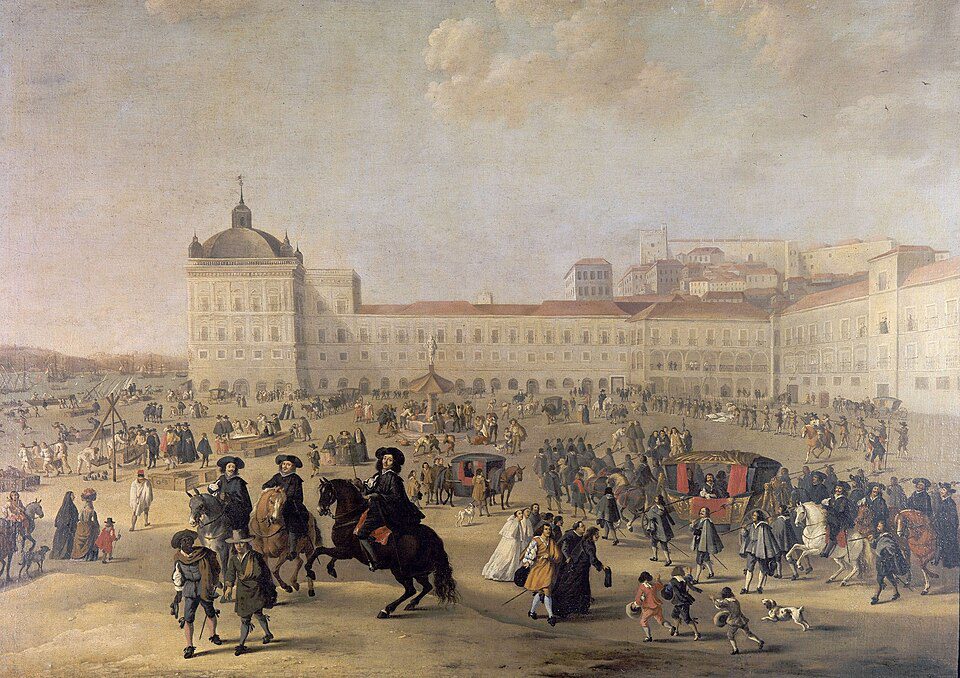
At the heart of this new Lisbon stood the Praça do Comércio, or Commerce Square, built on the site of the destroyed royal palace. Framed by arcaded government buildings and opening onto the Tagus River, the square was a statement of economic and political resilience. Its symmetry and scale announced that Lisbon had not only survived but had been reborn.
At the center of the square rose an equestrian statue of King José I, designed by Machado de Castro, one of Portugal’s greatest sculptors. The statue, cast in bronze and erected in 1775, shows the king astride his horse, trampling serpents—a symbolic triumph over chaos, disaster, and perhaps the invisible threats of political instability.
This statue is significant not only for its iconography but also for its technical innovation—it was one of the first monumental bronzes in Portugal and was cast using a single pour, a risky and complex procedure that showcased local skill and ambition.
Artistic Restraint and Enlightenment Values
The art that emerged from the Pombaline rebuild reflected a new philosophical stance. Gone was the overwrought theatricality of the Baroque. In its place came clarity, symmetry, and restraint—hallmarks of Enlightenment aesthetics. While some saw this as a cultural loss, others embraced it as a necessary evolution: art in service of stability, reason, and civic dignity.
Paintings from this era often depicted Lisbon in recovery: engravings, panoramas, and architectural elevations documented the new streetscapes, many of them sold as souvenirs to foreign visitors. These were works not of fantasy, but of record—testaments to rationalism and the power of state-driven reform.
Churches, when rebuilt, adopted simpler façades and less ostentatious interiors. Even tilework became more geometrically focused and subdued, aligning with the cleaner lines of neoclassical design.
Public Art and the Rise of the Bourgeois City
Another important shift during this period was the emergence of public art and architecture designed for a broader segment of society. The Pombaline vision was not exclusively royal or ecclesiastical—it emphasized commerce, health, education, and civic pride.
- The new Lisbon waterfront, with its symmetrical arcades, was designed for trade and bureaucracy, not palace life.
- Hospitals and schools were rebuilt with clean lines and humanist murals, reflecting new priorities in urban planning.
- Theaters and cafés began to appear in the rebuilt city, marking a shift toward bourgeois leisure culture.
In this sense, the art of post-earthquake Lisbon was about function and future—not merely commemoration, but creation.
Legacy: The Aesthetic of Survival
Today, the Pombaline downtown is recognized as one of the earliest examples of disaster-responsive urbanism—a city literally reborn through the fusion of art, architecture, science, and ideology. It’s no accident that Lisbon’s cityscape feels so ordered compared to many other European capitals: it was designed that way, not over centuries of organic growth, but in a moment of national emergency.
Artists and architects responded to destruction not with nostalgia, but with invention. They took tragedy and turned it into a blueprint for modernity.
From catastrophe came clarity. From ashes, architecture. The Pombaline rebuild marked a turning point not only in Lisbon’s skyline but in its artistic values: from ornament to order, from devotion to design. But even as Lisbon embraced Enlightenment ideals, the seeds of Romanticism were quietly taking root—an aesthetic that would soon reclaim emotion, memory, and nationhood as central artistic themes.
19th Century Romanticism and National Identity
As the 19th century unfolded, Lisbon entered a new phase of artistic identity. The rational, orderly lines of the Pombaline city gave way to a growing cultural appetite for emotion, history, and individuality. In a period shaped by political upheaval, liberal revolutions, and the decline of empire, Lisbon’s artists, writers, and architects turned inward—toward the imagination, the past, and the idea of the Portuguese nation itself. This was the era of Romanticism, and in Lisbon, it was more than an artistic movement. It was a search for meaning in a changing world.
The Cultural Context: Decline and Dreaming
Portugal’s political and economic status in the 19th century was fraught. The Napoleonic invasions, the flight of the royal court to Brazil (1807), the loss of Brazil as a colony (1822), and a string of internal conflicts—including the Liberal Wars—left Lisbon in a state of flux. The Enlightenment ideals that had shaped the Pombaline rebuild began to feel cold and impersonal. The city, once a capital of empire, was now searching for a renewed cultural purpose.
Into this uncertainty stepped the Romantics: artists and intellectuals who embraced feeling over form, memory over reason, the local over the universal. Their Lisbon was not the measured grid of the Baixa, but the dreamy ruins of the Carmo Convent, the winding streets of Alfama, and the melancholic fado songs echoing through tavern windows.
Architecture: Neo-Gothic, Neo-Manueline, and the Historic Turn
In architecture, Romanticism expressed itself through revivalism. Rather than inventing new forms, 19th-century architects looked to the past—specifically to Portugal’s golden age under Manuel I—for inspiration. This nostalgia birthed the Neo-Manueline style, a romantic revival of the earlier maritime Gothic aesthetic, now deployed in civic buildings and nationalist monuments.
One of the most iconic examples is the Palácio da Pena in nearby Sintra (begun in 1839), commissioned by King Ferdinand II, a German prince with a flair for fantasy. Though not in Lisbon proper, Pena’s fairytale turrets, vibrant colors, and collage of styles set a precedent for Romantic-era Lisbon. It is part cathedral, part castle, part dreamscape—a physical embodiment of Romantic eclecticism.
In Lisbon, this impulse toward historic pastiche found form in:
- The Rossio Railway Station (1886–91), with its ornate horseshoe arches and Manueline ornamentation.
- The Campo Pequeno bullring (1892), which adopted a Neo-Moorish aesthetic with its onion domes and red brick façade.
- Restoration efforts at the Jerónimos Monastery, where Romantic architects reimagined medieval structures with even greater flourish than their original form.
This was an era in which ruins were preserved not merely for utility but for their emotional and symbolic weight.
Painting: Historical Drama and National Identity
Lisbon’s Romantic painters often looked to history and folklore for their subject matter, aligning art with the burgeoning sense of national identity. Domingos Sequeira, one of the period’s leading artists, exemplified this trend with dramatic, emotionally charged scenes that merged academic technique with theatrical storytelling.
His monumental painting A Adoração dos Magos (1828), though religious in subject, is Romantic in scale and mood—rich in chiaroscuro, pathos, and allegorical detail. Other artists focused on specifically Portuguese themes: the Age of Discoveries, royal myths, and folk traditions were common. These paintings were designed to do more than decorate—they were didactic and nationalist, reinforcing a shared cultural narrative.
The rise of genre painting—scenes of everyday life—also reflected the Romantic interest in local color and emotional immediacy. Painters like Miguel Ângelo Lupi and José Malhoa captured Lisbon’s domestic interiors, rural outskirts, and humble street life with sympathetic detail, helping to anchor national identity not just in history, but in lived experience.
Literature and the Romantic Image of Lisbon
While visual artists built Romantic Lisbon in stone and pigment, writers gave it voice. Lisbon in the 19th century was home to some of Portugal’s greatest literary figures, most notably Almeida Garrett and Alexandre Herculano, who used literature to rediscover and mythologize Portuguese history.
Garrett’s Viagens na Minha Terra (1846) blends travelogue, fiction, and political critique into a Romantic meditation on Lisbon and the Portuguese soul. Herculano, both a novelist and historian, helped define the nation’s medieval past as a source of cultural pride. His historical romances were widely read and adapted, shaping public perception of Lisbon’s legacy as a city of saints, kings, and crusaders.
This literary Romanticism dovetailed with the rise of journalism and illustration, turning Lisbon’s cityscape into a visual text. Periodicals like O Panorama and Arquivo Pittoresco published woodcuts and etchings of Lisbon landmarks, feeding a public fascination with both the picturesque and the national.
The Public Sphere and Artistic Institutions
The 19th century also saw the professionalization of the arts in Lisbon. New institutions were founded to promote, exhibit, and teach art in line with national values. Chief among them was the Academia de Belas-Artes (Academy of Fine Arts), established in 1836, which became a training ground for painters, sculptors, and architects steeped in Romantic ideals.
Art was no longer the exclusive domain of the Church or the court—it became a civic duty, a tool for education and patriotism. Public art was installed in plazas and gardens; statues of poets and monarchs began to dot Lisbon’s landscape, casting the city as a living pantheon.
Sculptors like Simões de Almeida and Teixeira Lopes created busts and monuments with deep emotional resonance, often depicting national figures in classical poses. Their work helped reframe Lisbon not only as a modern capital, but as a cradle of cultural memory.
Fado and the Poetics of Melancholy
No discussion of Romantic Lisbon would be complete without mentioning fado, the city’s mournful, expressive musical form. Though its origins lie earlier, fado came into its own in the 19th century, emerging from the taverns and sailors’ quarters of Alfama and Mouraria.
Characterized by themes of longing (saudade), unfulfilled love, and fatalism, fado is Lisbon’s auditory Romanticism—music that turns personal sorrow into collective identity. The guitar becomes the Romantic brush; the singer, the painter of moods. In fado, Lisbon’s streets are theaters of emotion, and its past is ever-present.
Fado’s intimate venues—like Casa de Linhares or Clube de Fado—became spaces of artistic performance, where the visual and the auditory merged. The walls were often lined with azulejos or portraits, creating an immersive Romantic environment of nostalgia and national pride.
In the 19th century, Lisbon fell in love with its past. Romanticism gave the city not just new monuments, but a mythology—a vision of itself as both wounded and noble, faded and eternal. As political certainties crumbled and modernity loomed, Lisbon’s artists turned to history, emotion, and imagination, forging a new sense of cultural identity from the ruins of empire and the echoes of saints.
Modernism in Lisbon: Amadeo, Almada, and the Avant-Garde
By the early 20th century, Lisbon had become a city of contradictions: nostalgic yet restless, traditional yet teetering on the brink of transformation. Political instability—the collapse of the monarchy in 1910 and the emergence of the First Republic—was mirrored in cultural upheaval. Artists, poets, and intellectuals in Lisbon were increasingly disillusioned with academic norms and nationalist romanticism. They turned instead to modernism, a broad and sometimes chaotic movement that celebrated experimentation, fragmentation, and the new.
Yet Lisbon’s modernism was never a mere imitation of Parisian or Italian avant-gardes. It was intensely local, inflected by Portugal’s cultural isolation, its literary tradition, and its unique sense of melancholy. Lisbon’s modernist artists were rebels, yes—but they were also mystics, patriots, and visionaries, transforming the city into a site of artistic reinvention.
The Birth of Portuguese Modernism: Orpheu and the Literary Vanguard
The crucible of Portuguese modernism was not a painting but a magazine. In 1915, a group of young writers and thinkers—including Fernando Pessoa, Mário de Sá-Carneiro, and Almada Negreiros—published Orpheu, a short-lived but explosive literary journal that introduced surrealism, futurism, and symbolist introspection to a conservative Lisbon audience.
Orpheu was radical not only in its content but in its philosophy. It rejected realism and romanticism in favor of abstraction, multiplicity, and psychological depth. Pessoa, with his famously fragmented identity and multiple literary heteronyms, became the embodiment of modernist Lisbon—a city with many faces, speaking in many voices.
Though primarily literary, Orpheu had visual implications. It influenced the aesthetics of layout, typography, and design, and set the stage for a visual art movement that would soon explode into painting, performance, and public life.
Amadeo de Souza-Cardoso: Portugal’s Cosmopolitan Modernist
One of the key figures in Portuguese modernism—though based largely outside Lisbon—was Amadeo de Souza-Cardoso. Born in 1887, Amadeo studied in Paris and absorbed the influence of Cubism, Futurism, and Orphism, becoming a friend of artists like Modigliani and Brancusi.
His return to Portugal during World War I was a cultural shock—for him and for the local art world. Amadeo’s paintings, filled with explosive color, dynamic forms, and abstract symbols, baffled Lisbon’s conservative critics. Works like Entrada and Cozinha da Casa de Manhufe were declarations of artistic autonomy: painterly experiments unconcerned with narrative or nationalist tropes.
Though he died tragically young in 1918, Amadeo’s impact would echo in the Lisbon art scene for decades. He helped legitimate abstraction and non-mimetic art, inspiring younger generations to challenge the idea that Portuguese painting had to be historical, religious, or folkloric.
Almada Negreiros: The Modernist Polymath of Lisbon
If Amadeo was the painter of Portuguese modernism, José de Almada Negreiros (1893–1970) was its soul. A painter, poet, playwright, designer, and provocateur, Almada was deeply rooted in Lisbon’s cultural life. His art was theatrical, satirical, and often wildly experimental—ranging from cubist-inspired portraits to abstract murals, magazine illustrations, and even ballet choreography.
His 1917 Manifesto Anti-Dantas, a scathing polemic against academic culture and cultural mediocrity, became a kind of artistic declaration of independence. Almada called for a Lisbon unafraid of modernity—a Lisbon of electric trams, jazz, and synthetic color.
His early works, such as Auto-Retrato (Self-Portrait) and K4: O Quadrado Azul, played with geometric abstraction and literary nonsense, blending visual art with typography and conceptual games. Later, Almada’s involvement with public art would transform the cityscape itself.
In the 1940s and 50s, he designed some of Lisbon’s most iconic azulejo murals, including those at the Gare Marítima de Alcântara and Rocha do Conde de Óbidos. These works combine futurist dynamism with maritime symbolism, casting Portuguese history in a modernist idiom—curved lines, heroic scale, streamlined forms. They are among the finest examples of State Modernism, fusing personal vision with public ideology.
The Role of Abstraction and Experimentation
Beyond Almada and Amadeo, Lisbon in the mid-20th century saw the rise of new abstractionists and expressionists. Influenced by international movements, artists like António Dacosta, Maria Helena Vieira da Silva, and Álvaro Lapa pushed the boundaries of what Portuguese painting could be.
Vieira da Silva, in particular, became one of Portugal’s most acclaimed modernist painters. Though she lived much of her life in Paris, her work—full of grid-like spaces, shifting perspectives, and architectural disorientation—was deeply Lisbonian in spirit. Her paintings are mazes of memory, evoking city maps, tiled walls, and warped dimensions.
Her style was introspective, cerebral, and non-figurative, echoing Lisbon’s own fragmented identity during the 20th century—a city caught between modern promise and nostalgic introspection.
Modernism and the Estado Novo
The relationship between Lisbon’s modernist artists and the Estado Novo dictatorship (1933–1974) was complex. On the one hand, the regime promoted certain forms of modern art—especially monumental public works that aligned with nationalist narratives. Almada’s later murals, for example, were state commissions.
On the other hand, many modernist artists found themselves marginalized, censored, or pushed into abstraction as a form of resistance. Figurative painting that did not conform to state ideals of national virtue or religious conservatism was often suppressed. Abstract art, precisely because of its ambiguity, became a refuge for critical voices.
Lisbon’s galleries, especially the Galeria de Arte Moderna, became contested spaces—arenas where artists negotiated the boundaries of acceptable expression under authoritarianism.
Architecture and Urban Modernity
Modernism in Lisbon wasn’t confined to painting. It reshaped the city itself. Architects like Porfírio Pardal Monteiro introduced Art Deco and rationalist modernism to Lisbon’s skyline, with buildings like:
- The Instituto Superior Técnico (1937), a campus of neoclassical modernity.
- The Estação de Entrecampos and various cinemas, which embraced streamlined, geometric design.
- The Igreja de Nossa Senhora de Fátima (1938), a modern Catholic space that blended liturgical simplicity with architectural innovation.
This was modernism as civic identity—Lisbon reshaping itself for the age of speed, technology, and mass communication.
Café Modernism: Intellectual Life and Bohemia
Lisbon’s modernist movement was also social. The city’s cafés—especially the iconic A Brasileira in Chiado—served as salons for writers, painters, and philosophers. Here, over strong coffee and cheap cigarettes, the future of Portuguese art and identity was debated.
Fernando Pessoa, though primarily a writer, looms over this world. His bronze statue still sits outside A Brasileira, legs crossed, welcoming passersby. His heteronymous poetry is modernist not just in form but in philosophy—fragmented, dislocated, metaphysical. His Lisbon is a metaphysical city, where streets fold in on themselves and identities fracture across the page.
Modernism in Lisbon was not a clean break from the past, but a complex conversation—a remix of tradition, abstraction, and rebellion. It turned the city into a laboratory of forms, a landscape of murals, manifestos, and broken perspectives. In the face of dictatorship and decay, Lisbon’s modernists imagined new futures—some utopian, some anxious, all visionary.
Dictatorship and Resistance: Art Under Estado Novo
For over four decades, from 1933 to 1974, Portugal was governed by a repressive authoritarian regime known as the Estado Novo (New State). Led by António de Oliveira Salazar, this corporatist dictatorship imposed strict censorship, nationalist propaganda, and Catholic conservatism on all aspects of Portuguese life—including the arts. In Lisbon, the cultural capital of the nation, artists were faced with a stark choice: conform, retreat into ambiguity, or resist.
This era produced a deeply paradoxical artistic climate. On the surface, Lisbon’s art scene seemed to flourish, filled with public commissions, art schools, exhibitions, and state-funded projects. But beneath this façade, a quieter revolution was taking place. Artists responded to repression not only with protest, but with subversion, metaphor, abstraction, and irony. In this constrained space, Lisbon’s artists turned limitation into innovation—and made art a weapon of survival.
The State’s Aesthetic: Tradition, Order, and Control
The Estado Novo viewed art primarily as a tool of ideological consolidation. It promoted a vision of Portugal as timeless, rural, devout, and obedient. This meant that modernism, with its embrace of change, ambiguity, and psychological complexity, was treated with deep suspicion.
Instead, the regime favored:
- Naturalist painting that celebrated the countryside, Catholic rituals, and traditional family roles.
- Monumental sculpture that idealized political leaders, explorers, and saints.
- Public murals and architecture that echoed classical forms, reinforcing messages of hierarchy and permanence.
Artists who conformed to these aesthetics were rewarded with state support and prominent commissions. The architect Cottinelli Telmo and sculptor Francisco Franco de Sousa became key figures in this state-sanctioned art. Their work, visible in Lisbon’s public buildings and exhibitions, embodied the Estado Novo’s desire for harmony, control, and historical continuity.
Exposição do Mundo Português (1940): A Propaganda Spectacle
One of the most significant cultural events of the regime was the Exposição do Mundo Português (Portuguese World Exhibition) held in Lisbon in 1940. Designed to commemorate the 800th anniversary of the nation’s founding and the 300th anniversary of the Restoration of Independence from Spain, the exhibition was a massive display of imperial nostalgia and cultural propaganda.
Architects, artists, and designers created pavilions that idealized Portugal’s history and colonial empire. Lisbon’s Belém district was transformed into a theatrical stage of golden domes, heroic sculptures, and meticulously curated dioramas.
While visually impressive, the exhibition also erased complexity, celebrating empire without acknowledging its violence, and presenting Portugal as a culturally unified, morally superior nation. Art here was not inquiry—it was spectacle and affirmation.
Censorship and Artistic Surveillance
Under the Estado Novo, all forms of media—including literature, theater, cinema, and the visual arts—were subject to strict censorship by the Secretariado Nacional de Informação (SNI). Artists had to submit works for approval, and galleries were monitored.
Themes considered dangerous included:
- Political critique or satire.
- References to social injustice, poverty, or colonial brutality.
- Any content associated with socialism, communism, or moral “decadence.”
This led many artists to develop a coded language—using symbolism, surrealism, or abstraction to express ideas without directly confronting the regime. In this context, what was not said often became more powerful than what was.
Resistance Through Abstraction and Allegory
One of the most potent strategies for artistic resistance in Lisbon was abstraction. Devoid of literal subjects, abstract art gave artists room to explore mood, structure, and metaphor without triggering censorship.
Figures like Vieira da Silva, Júlio Pomar, Marcelino Vespeira, and Álvaro Lapa used abstraction not as escapism, but as resistance. Their fragmented forms, distorted perspectives, and psychological ambiguity became mirrors of a society fragmented by fear and repression.
- Júlio Pomar, who began as a neorealist painter focused on workers and social themes, later shifted to more ambiguous, symbolic work after censorship pressure. His series on Don Quixote is a subtle commentary on idealism versus reality, echoing the frustrations of a politically stifled generation.
- Vieira da Silva, based in Paris but deeply connected to Lisbon, created canvases that feel like psychological cityscapes—labyrinths of longing, displacement, and memory.
Underground Movements and Artistic Subcultures
Despite the regime’s grip, Lisbon was never artistically dead. Beneath the official institutions, clandestine networks of artists, writers, and intellectuals kept the spirit of experimentation and dissent alive. Cafés, private studios, and underground exhibitions served as incubators for alternative thinking.
One example is the Grupo Surrealista de Lisboa, founded in the 1940s by artists and poets including Mário Cesariny, António Maria Lisboa, and Cruzeiro Seixas. Though marginalized by mainstream critics and censored by the regime, the group championed surrealism as both aesthetic rebellion and psychological liberation. Their work—dreamlike, erotic, absurd—was deeply influenced by André Breton, but imbued with Lisbon’s unique atmosphere of shadows, alleys, and existential ambiguity.
Surrealism offered these artists a way to escape the suffocating nationalism of Estado Novo—not through direct political attack, but through estranhamento (estrangement), dream logic, and irrationality. Lisbon became, in their hands, a city of subconscious symbols and forbidden desires.
The Role of the Church: Complicity and Dissent
The Estado Novo’s alliance with the Catholic Church also shaped Lisbon’s art scene. Many church commissions during this time reinforced conservative values, but some religious institutions offered surprising sanctuaries for more adventurous artists.
Certain churches and monasteries became homes to modernist altarpieces and tile panels, allowing artists like Lino António to push stylistic boundaries within sacred spaces. These hybrid projects allowed for subtle expressions of individuality, spirituality, and even critique, under the protective cloak of religion.
Design, Illustration, and the Margins of Expression
In areas considered less “dangerous”—such as illustration, children’s books, and commercial design—Lisbon’s artists found more freedom. Graphic designers like Fred Kradolfer and illustrators like Stuart Carvalhais created works that combined modernist aesthetics with social satire, slipping critiques past the censors under the guise of whimsy.
Magazine design, poster art, and advertising became unexpected arenas for innovation. The clean lines of modernist typography and abstract patterns appeared in everything from railway posters to wine labels—often more formally adventurous than official fine art exhibitions.
Cracks in the Wall: The 1960s and Early 70s
By the 1960s, Lisbon’s cultural scene was shifting. A younger generation of artists, increasingly exposed to international trends and disillusioned with the regime’s stagnation, began to push harder. Pop art, conceptual art, and performance art entered Lisbon’s galleries, often testing the limits of censorship.
Artist collectives like Grupo 5+1 and exhibitions like Alternativa Zero (1977, shortly after the regime’s fall) reflected the pent-up energy of years of quiet resistance. Though Alternativa Zero technically falls just after Estado Novo’s collapse, it embodies the culmination of artistic frustrations and innovations that had been building in silence.
Under Estado Novo, Lisbon’s artists worked in a city of silence and metaphor—a place where every brushstroke was a gamble, and every mural a mask. Art did not die; it adapted. It turned inward, grew subtle, and found expression in the spaces between the regime’s rigid lines.
This long, quiet resistance helped Lisbon’s art survive authoritarianism with its integrity—and imagination—intact.
This era produced a deeply paradoxical artistic climate. On one hand, Lisbon became a carefully curated stage for official art—murals, statues, and state-sponsored exhibitions that glorified Portuguese tradition, Catholic values, and the myth of a unified, heroic nation. On the other hand, it was also a city of quiet rebellion, where subversive voices found expression in metaphor, abstraction, and coded language. Lisbon’s artists did not all raise fists in defiance—but many wielded brushes and pens with radical subtlety.
The Estado Novo Aesthetic: Tradition, Order, and Empire
Salazar’s regime was deeply suspicious of avant-garde movements and modernist expression. Art was to be clear, moral, and in service of the nation. The regime favored naturalistic, narrative, and didactic styles, often depicting historical triumphs, rural labor, religious devotion, or imperial conquest. Lisbon’s walls, government buildings, and public spaces were filled with this art—designed to reinforce ideological control.
The Exposição do Mundo Português (Portuguese World Exhibition) of 1940, held in Belém, was a prime example. The massive fair celebrated eight centuries of Portuguese nationhood and five centuries of overseas exploration, using architecture, sculpture, and murals to build a narrative of national greatness. The exhibition’s monumentalism was intended to rival the fascist spectacles of Mussolini or Franco, though with a uniquely Portuguese veneer: paternalistic, religious, and nostalgic.
Artists who aligned with this vision—whether sincerely or pragmatically—received commissions and institutional support. One of the most prominent was Almada Negreiros, whose later works, such as the azulejo panels at the maritime stations and the stained-glass windows in the Church of Nossa Senhora de Fátima, display a sleek, stylized nationalism that walks a fine line between propaganda and personal vision.
Other “official” artists included Jorge Barradas, who worked on state-sponsored murals, and Leopoldo de Almeida, the sculptor behind grand monuments like the Padrão dos Descobrimentos (Monument to the Discoveries), inaugurated in 1960. This riverside monolith, shaped like a caravel’s prow, features Henry the Navigator and a parade of imperial figures, carved in a neoclassical, heroic style. While visually stunning, it remains a deeply loaded symbol—celebrating exploration while ignoring the violence of empire.
Censorship and the Artistic Gray Zone
All artistic production under Estado Novo was subject to strict censorship. Novels, poems, plays, songs, and visual artworks were reviewed by bureaucrats who could ban, alter, or silence them. Artists never knew where the line was—what was safe yesterday might be subversive tomorrow. This created a culture of caution, but also of innovation. Many artists developed strategies of coded critique: symbolism, ambiguity, irony, or abstraction.
Painters like António Dacosta and Fernando Lanhas explored abstract surrealism, creating dreamlike compositions with unsettling undertones. These works offered psychological and metaphysical escape from ideological rigidity. They couldn’t be banned for any specific image, yet their ambiguity made them resistant to simplistic interpretation—and potentially threatening.
Other artists went deeper underground. Manuel Ribeiro de Pavia, known for his stark, black-and-white ink drawings, created grotesque, anguished figures that reflected the moral suffocation of the regime. Though never explicitly political, his work captured the spiritual malaise of Salazarist Portugal.
In the 1960s, a younger generation emerged, increasingly influenced by international conceptualism, neo-Dada, and pop art. Artists like Eurico Gonçalves, João Vieira, and Álvaro Lapa used language, found objects, and minimalist forms to undermine traditional meanings and expose the emptiness of state rhetoric.
Literature, Theater, and Cross-Disciplinary Resistance
Lisbon’s literary scene also became a key site of resistance. Writers such as José Gomes Ferreira, Sophia de Mello Breyner Andresen, and Natália Correia critiqued the regime’s moral hypocrisy and cultural stagnation through poetry and allegorical fiction. Plays and theatrical productions—especially at the Teatro Nacional D. Maria II—sometimes slipped subversive messages past the censors through historical allegory or absurdist comedy.
The visual and literary arts increasingly intersected. Lisbon’s modernists collaborated with poets, composers, and filmmakers, creating a hybrid resistance culture that lived in cafés, small galleries, and underground salons. Despite repression, this cross-pollination kept artistic life vibrant and intellectually charged.
The Colonial Wars and the Rise of Political Art
By the 1960s, Portugal was embroiled in brutal colonial wars in Angola, Mozambique, and Guinea-Bissau. These conflicts were expensive, unpopular, and increasingly indefensible. In Lisbon, artists began to reflect this unease in more direct terms.
Carlos Botelho, an older artist once known for charming Lisbon cityscapes, began to paint increasingly grim and distorted visions of urban life. His once-cheerful rooftops grew dark and claustrophobic—mirrors of the political mood.
Meanwhile, younger artists like Júlio Pomar evolved from figurative styles into openly political art. Pomar’s paintings of workers, protestors, and soldiers—sometimes in abstracted, jagged forms—captured the anxieties and struggles of a nation at war with itself. Though Pomar was often harassed by authorities, his status in the art world gave him a degree of protection, and his studio became a meeting place for dissenting artists and intellectuals.
Lisbon’s student protests in 1962 and growing cultural opposition culminated in an increasingly confrontational mood, even as censorship intensified. Galleries and exhibitions were shut down. Artists were imprisoned or exiled. Yet the cultural underground thrived, quietly building momentum for what was to come.
Prelude to Revolution: Cracks in the Façade
By the early 1970s, the Estado Novo was visibly crumbling. The death of Salazar (in 1970) and the continuation of the regime under Marcelo Caetano did little to stem the tide of dissent. Lisbon’s art world became bolder. Exhibitions pushed boundaries. Music—especially fado de intervenção, or protest song—gained popularity. Street art and visual satire began to emerge in discreet forms.
Lisbon’s artists played a crucial role in keeping the spirit of resistance alive. They worked in silence, in metaphor, in gesture. They held memory in paint, and hope in abstraction. And when the regime finally fell, it was artists who helped narrate the story of rebirth.
The Estado Novo wanted art to be an obedient mirror—reflecting order, faith, and the myth of a unified nation. But in the shadows of official style, Lisbon’s artists forged something else: a language of resistance, a refuge of ambiguity, and ultimately, a cultural legacy that would explode into full expression after the revolution.
Post-Revolution and Contemporary Renaissance
On April 25th, 1974, Lisbon woke to the strains of a song—“Grândola, Vila Morena”—broadcast over the radio, signaling the start of a revolution. Tanks rolled through the cobbled streets. Soldiers placed carnations in their rifle barrels. Within hours, the Estado Novo dictatorship had collapsed without a single shot fired. In a city silenced by censorship for over forty years, the dam broke.
This was not just a political revolution—it was a cultural awakening. In Lisbon, art surged into the streets, into the galleries, into the very bones of public life. Artists who had long worked in coded language were suddenly free to speak. Others, silenced by fear or exile, returned to the city to find a blank canvas waiting. Lisbon’s post-revolutionary art scene became a laboratory of radical possibility, fusing political urgency with avant-garde experimentation.
Carnation Imagery and Revolutionary Symbolism
In the immediate aftermath of the Carnation Revolution, visual art played a central role in shaping the new democratic narrative. Posters, murals, and street graphics appeared overnight, transforming Lisbon’s walls into a living newspaper of protest and celebration.
- The red carnation, placed in gun barrels by demonstrators, became the instant symbol of the revolution and appeared everywhere in visual culture—from hastily painted banners to fine art canvases.
- Artist collectives and design groups like Ala 1 and Gráfica 71 produced hundreds of screen-printed images in support of workers’ movements, agrarian reform, and national liberation.
- Lisbon’s urban surfaces became palimpsests—layered with slogans, portraits of political prisoners, Marxist iconography, and hopeful visions of a just society.
This era of street art wasn’t fringe—it was the aesthetic of the people, with artists, unionists, and students often working side by side to plaster messages across the city.
Institutional Explosion and New Galleries
Freed from state oversight, Lisbon’s cultural institutions were reborn. New galleries opened. Museums expanded. Theatres launched bold programs. The Gulbenkian Foundation, already an important supporter of the arts during the dictatorship (albeit within strict boundaries), shifted into high gear—sponsoring exhibitions of modern and contemporary work, often by previously censored artists.
The Museu do Chiado and Galeria Quadrum became central venues for post-revolutionary experimentation, showcasing conceptual installations, performance art, video work, and radical painting. Exhibitions like Alternativa Zero (1977), organized by artist Ernesto de Sousa, became touchstones for an entire generation of avant-garde Portuguese artists.
Alternativa Zero brought together dozens of artists—including Ana Hatherly, José Barrias, António Palolo, and Julião Sarmento—who challenged the very idea of what art could be. The exhibition included body art, text-based interventions, conceptual environments, and critiques of consumerism and commodification. Lisbon, once a bastion of conservative aesthetics, was now a node of global experimentalism.
Public Art and the Democratization of Space
One of the most important legacies of the post-revolution period was the redefinition of public space. Lisbon’s urban fabric, long shaped by state monuments and religious art, was reclaimed by artists working outside the gallery system.
- The Festival de Arte Pública (Public Art Festival) brought sculpture and mural painting into public squares and housing estates.
- Azulejo artists like Querubim Lapa and Júlio Pomar began creating large-scale works in metro stations, hospitals, and schools—transforming transit and infrastructure into opportunities for cultural reflection.
- Artists such as Graça Morais and Paula Rego, who had been marginalized under the Estado Novo, rose to prominence with deeply personal, politically charged works that fused figuration, narrative, and feminist critique.
The Return of the Exiles
The post-1974 period also saw the return of exiled or self-exiled artists, many of whom had spent decades working abroad to escape censorship or persecution. Their return marked not only a homecoming but also a cultural fusion: international ideas brought into Lisbon’s unique historical and social context.
Paula Rego, who had made her name in the UK, began exhibiting regularly in Lisbon, eventually establishing a museum in her name in nearby Cascais. Her psychologically complex, often unsettling paintings—full of women in ambiguous power dynamics—offered a new kind of storytelling that resonated in a post-authoritarian society confronting its buried traumas.
Vieira da Silva, too, was welcomed back as a national icon, and her paintings—labyrinthine, spatially unstable—found new resonance in a country rebuilding its identity.
Contemporary Art Infrastructure Emerges
In the 1980s and 1990s, Lisbon’s contemporary art world began to consolidate. Private collectors, curators, and new funding models allowed for the establishment of major institutions like:
- Centro de Arte Moderna Gulbenkian – with a collection focused on 20th-century Portuguese art, from abstraction to conceptualism.
- Museu Coleção Berardo, opened in 2007 in the Belém Cultural Center, showcasing modern and contemporary art from across the globe alongside major Portuguese figures.
- MAAT (Museum of Art, Architecture and Technology), inaugurated in 2016, which redefined the Lisbon waterfront and brought cutting-edge installation and digital art into the city’s orbit.
Lisbon began attracting international artists, curators, and gallerists, drawn by its light, affordability, and complex cultural layers. The art market expanded. Artist residencies blossomed. The Lisbon Triennale, launched in 2007, gave the city global visibility as a hub of contemporary artistic dialogue.
Urban Interventions and the Rise of Street Art
No post-revolution cultural movement in Lisbon has had as much popular impact as the street art renaissance of the 2000s and 2010s. Following decades of political muralism and spontaneous graffiti, Lisbon’s walls became home to a new wave of artists—combining international street aesthetics with local history, humor, and critique.
Artists like:
- Vhils (Alexandre Farto) – known for carving portraits into plaster walls using chisels and explosives, creating hauntingly eroded human faces across Lisbon.
- Tamara Alves – blending poetic text and female figures in evocative street compositions.
- Add Fuel (Diogo Machado) – merging traditional azulejo patterns with pop culture references and visual glitches.
The city embraced this energy. Public art programs and legal mural zones were established, and festivals like MURO – Festival de Arte Urbana invited artists from around the world to collaborate in Lisbon’s neighborhoods.
The walls of Lisbon became conversation spaces—canvases for memory, protest, celebration, and re-imagination. And this public art didn’t erase Lisbon’s past—it layered itself over it, like a palimpsest of hope.
In the decades since 1974, Lisbon has transformed from a quiet capital under dictatorship into one of Europe’s most vibrant artistic cities. The revolution didn’t just topple a regime—it freed a voice, a visual language of complexity, contradiction, and creativity. Today, Lisbon’s art scene is both deeply rooted in its turbulent past and restlessly oriented toward the future. It is, still, a city of reinvention.
The Lisbon Art Scene Today: Galleries, Biennials, and Global Attention
Lisbon has emerged in the 21st century not just as a city with a rich art history, but as a thriving global art capital—a place where tradition and experimentation collide, where the patina of centuries meets the raw energy of now. With an influx of international artists, the growth of cutting-edge institutions, and a flourishing scene of galleries, residencies, festivals, and public art, Lisbon today is not merely participating in the global art conversation—it’s helping shape it.
What sets Lisbon apart isn’t just the quantity or quality of its artistic output—it’s the unique tension between memory and momentum, a city perpetually balancing nostalgia and reinvention.
A Magnet for Artists: Why Lisbon, Why Now?
Over the last two decades, Lisbon has become a magnet for artists, curators, and collectors from across the world. Why?
- Affordability (relative to other European capitals) allowed for studio spaces, artist-run initiatives, and experimental ventures to flourish.
- Light—that famous golden, Atlantic glow—has long attracted visual artists and filmmakers alike.
- Cultural hybridity, born from centuries of imperial and migratory flow, offers fertile terrain for artists working with identity, postcolonial critique, and memory.
- A relaxed rhythm, juxtaposed with increasingly global connectivity, makes Lisbon an ideal creative hub.
But this boom isn’t just organic—it’s been actively cultivated through state and private investment, institution-building, and a growing international recognition of Portugal’s artistic lineage and contemporary talent.
Institutions: Anchoring the Contemporary Scene
Lisbon today boasts a constellation of public and private institutions that frame, fund, and exhibit contemporary art:
- Museu Coleção Berardo (Belém): Though embroiled in recent political disputes over its future, this collection houses major works by Warhol, Bacon, Duchamp, and Serra alongside key Portuguese artists. Its role in placing Lisbon on the modern art map is indisputable.
- MAAT (Museum of Art, Architecture and Technology): Opened in 2016, MAAT is a showpiece of Lisbon’s contemporary identity. Designed by Amanda Levete’s AL_A studio, the building’s sinuous form hugs the Tagus River, symbolizing Lisbon’s connection to water, energy, and innovation. MAAT’s programming fuses visual art, digital culture, and ecological critique.
- Galerias Municipais: A network of municipal-run galleries (e.g. Galeria da Boavista, Torreão Nascente) that host ambitious exhibitions of local and international artists, often with experimental or research-based practices.
- Calouste Gulbenkian Foundation: Still one of Lisbon’s most respected art institutions, the Foundation’s Centro de Arte Moderna recently underwent renovations to expand its focus on contemporary Portuguese art, particularly underrepresented voices.
Biennials and Art Fairs: Lisbon on the Global Stage
- Lisbon Architecture Triennale and Lisbon Art Week have positioned the city within global design and gallery circuits.
- The ARCOlisboa art fair, a satellite of Madrid’s ARCOmadrid, attracts international collectors and galleries, while still spotlighting Portuguese and Lusophone artists.
- BoCA – Biennial of Contemporary Arts offers a platform for interdisciplinary work—crossing performance, installation, and socially engaged practice.
These events draw a new class of cosmopolitan art tourists and investors, even as they create opportunities for emerging local artists to network and gain visibility.
The Gallery Scene: From Chiado to Marvila
Lisbon’s gallery ecosystem is impressively diverse:
- Chiado remains the traditional center, home to established galleries like Galeria Vera Cortês, Cristina Guerra Contemporary Art, and Carlos Carvalho Arte Contemporânea.
- The once-industrial neighborhood of Marvila has become a creative enclave, with larger-scale spaces like Foco Gallery and Galeria Francisco Fino offering room for installation, sculpture, and large-format painting.
- Artist-run and independent spaces—such as Pavilhão 31 (inside a psychiatric hospital), Appleton, and Zaratan—offer alternative platforms for riskier, non-commercial work.
These galleries reflect Lisbon’s layered identity: some are cosmopolitan and market-savvy; others are rough-edged, activist, or deeply rooted in the city’s socio-political currents.
Lisbon’s Street Art Renaissance: Global and Local Voices
Few cities in Europe can claim a street art scene as vibrant—or as integrated into the urban landscape—as Lisbon’s. Since the 2000s, legal mural programs, artist commissions, and festivals like MURO have turned Lisbon’s facades into canvases.
Key figures:
- Vhils (Alexandre Farto) – Internationally renowned for his subtractive technique—carving into walls to create monumental portraits—Vhils has become Lisbon’s unofficial street art ambassador.
- Tamara Alves – Known for dreamlike, sensual female figures and poetic phrases.
- Add Fuel (Diogo Machado) – Who remixes traditional azulejo motifs into contemporary, digitally twisted patterns.
This movement isn’t just visual—it’s political. Street art in Lisbon often addresses gentrification, housing justice, climate change, and anti-racist solidarity. It’s ephemeral, community-based, and constantly evolving.
Lisbon and the Postcolonial Imagination
As Lisbon grapples with its imperial past, many contemporary artists are exploring Portugal’s colonial legacies and their reverberations in modern life. This includes work from:
- Grada Kilomba, who fuses performance, video, and theory to examine memory, race, and decolonization.
- Marta Rosas, whose installations deal with Afro-Portuguese identity and the politics of cultural memory.
- Kiluanji Kia Henda, an Angolan artist based partly in Lisbon, whose conceptual photography and sculpture reflect on architecture, history, and power.
These voices are helping reshape Lisbon’s art narrative—not as a Eurocentric capital looking out to the world, but as a pluralistic city, confronting its entangled histories and global futures.
Residencies, Studios, and Artist Networks
Behind the scenes, Lisbon’s art world thrives on networks of artist residencies, co-working spaces, and interdisciplinary labs. Programs like:
- Hangar – Artistic Research Center (in Graça): an Afro-diasporic-focused residency and platform that fosters south-south dialogue.
- Carpe Diem Arte e Pesquisa (now closed but historically influential): helped pioneer Lisbon’s alternative art spaces in the 2010s.
- Largo Residências, PADA Studios, and others support local and international artists with studio space, exchange programs, and public events.
These hubs are crucial for cross-cultural dialogue and for Lisbon’s continued evolution as a place not just of aesthetic production, but of community and critique.
Lisbon today is a city alive with contrasts: past and future, elite and underground, local and global. Its art scene doesn’t fit easily into categories. It’s slippery, multilingual, often improvised—and profoundly shaped by its long and layered history. From the curves of Manueline cloisters to the sprayed lines of contemporary murals, the city remains one giant open-air gallery.
Conclusion: Memory, Modernity, and the Layers of Lisbon
Lisbon is a city that resists flattening. It does not wear its identity all at once, but layer by layer—like the tiles on its façades, like the brushstrokes in its art. To study the art history of Lisbon is to trace the very soul of the city: not through a single dominant style or school, but through a palimpsest of influences, interruptions, and renewals.
It is a city where Roman mosaics lie beneath cathedrals, where Islamic abstraction still shapes how light falls on a wall. A city where the Gothic vaults gave way to maritime grandeur, and where golden imperial iconography once proclaimed Portugal’s dominion over half the known world. But it is also a city that has suffered—natural disasters, authoritarian rule, cultural erasure—and rebuilt itself each time, not just in bricks and stone, but in image and imagination.
From the fevered precision of Manueline ornament to the quiet resistance of Estado Novo-era abstraction, Lisbon’s art has always been deeply entangled with history. Art in Lisbon has never been passive or purely aesthetic—it has always meant something. It has celebrated, mourned, questioned, provoked. It has functioned as a mirror and a mask, a monument and a whisper.
In the late 20th and early 21st centuries, Lisbon has undergone a radical reawakening. Its revolutionary murals, feminist canvases, postcolonial performances, and street art interventions are not just aesthetic projects—they are attempts to rewrite the city, to expand its visual language, and to democratize its memory.
Lisbon’s art is deeply spatial. It responds to hills and horizons, to ruins and river light. It is political without being didactic, melancholic without losing its playfulness. Artists here draw on a deep archive of textures and tensions—between East and West, church and street, elite and popular, silence and song.
And perhaps most importantly, Lisbon never forgets. Even its most futuristic artworks—its media installations and urban interventions—carry shadows of the past. A Manueline twist reappears in a mural. A colonial echo lingers in a found object. An azulejo grid becomes the background for digital code. Lisbon’s art doesn’t erase history—it folds it forward.
This is what makes Lisbon so compelling in the global art landscape. It is not a city chasing trends, but one continually reinterpreting itself. Its past is not a burden, but a toolkit. Its geography—a port city perched between Europe, Africa, and the Atlantic—is not just a metaphor but a reality: Lisbon is a cultural confluence. It always has been.
And so as you walk the city—through Alfama’s tiled alleys, through Baixa’s Pombaline grids, past the daring lines of MAAT, or under the shadow of a Vhils mural—you’re not just witnessing art. You’re walking through an ongoing conversation, centuries deep and still unfolding.
Lisbon’s art history is not finished. It never will be.