In the year 1889, one of the most iconic portraits of the Victorian era was unveiled: Ellen Terry as Lady Macbeth, painted by the renowned American-born artist John Singer Sargent. This dramatic painting did more than capture the likeness of England’s most famous actress—it immortalized a moment in cultural history when the stage and the canvas met in a powerful fusion of performance and portraiture. The painting remains one of Sargent’s most celebrated works, and it speaks volumes about both the sitter and the artist.
Ellen Terry was not just a celebrated actress; she was a cultural symbol of late 19th-century British theater. Her interpretation of Lady Macbeth captivated audiences in London and beyond, and her presence on the stage was as commanding as it was graceful. Sargent, whose career was flourishing at the time, recognized the potential to preserve that moment in paint—her expression, her costume, her movement. What emerged was not a traditional portrait, but a piece of theater captured on canvas.
John Singer Sargent, best known for his society portraits and bold technique, had a knack for depicting powerful women with poise and strength. In Terry, he found a sitter who brought not only physical beauty but the weight of character and performance. The result was a work of art that continues to bridge the gap between painting and performance more than a century later.
This collaboration between painter and actress gave the world a visual representation of Shakespearean ambition and tragedy that remains unmatched. It was a single painting, but the impact was lasting—both for the legacy of Ellen Terry and for Sargent’s reputation as one of the greatest portraitists of his time.
Who Was Ellen Terry? England’s Leading Lady
Ellen Terry was born on February 27, 1847, in Coventry, England, into a family already steeped in theatrical tradition. Her parents were actors, and Ellen made her stage debut at the age of eight. By the 1860s, she had become a popular figure in the London theater scene, known for her expressive style, radiant appearance, and command of Shakespearean roles. She embodied a uniquely English sense of grace and intensity, which made her a favorite of audiences and critics alike.
Terry’s career reached new heights in 1878 when she joined the Lyceum Theatre under the management of Henry Irving, who became both her professional partner and lifelong friend. Together, they formed one of the most famous acting duos in British theater history. Their performances of Shakespeare’s greatest works—Hamlet, The Merchant of Venice, and Macbeth, among others—drew packed houses and critical acclaim. Terry’s Lady Macbeth, in particular, was widely praised for its intelligence and emotional range.
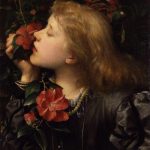
Beyond the stage, Ellen Terry had connections to many of the leading cultural figures of the day. She briefly married the painter George Frederic Watts in 1864, when she was just 16 years old, though the marriage was short-lived. This connection placed her in the orbit of the Pre-Raphaelite Brotherhood and introduced her to artistic circles that would influence her aesthetic throughout life. She was admired not just for her acting but also for her beauty, intelligence, and the sense of mystery she carried.
Terry was more than just an actress; she was a symbol of English theater’s golden age. Her portraits by various artists—including Watts, Julia Margaret Cameron, and later Sargent—solidified her visual identity as much as her stage roles. Through her presence and performances, she became a muse not just to painters, but to a generation seeking to capture the spirit of Victorian drama.
John Singer Sargent’s Artistic Eye
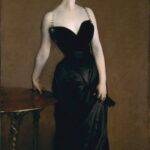
John Singer Sargent was born on January 12, 1856, in Florence, Italy, to American parents. His early education included rigorous training at the École des Beaux-Arts in Paris, where he studied under Carolus-Duran, who encouraged a fluid, painterly style. By the 1880s, Sargent had established himself as one of the premier portrait painters in Europe and America. His 1884 painting Portrait of Madame X caused a scandal in Paris but cemented his reputation as a bold and gifted artist.
Sargent had a talent for painting individuals with depth and presence. His subjects often included aristocrats, industrialists, and performers—people who carried themselves with confidence and distinction. He was known for capturing not only likenesses but personalities, often emphasizing light, fabric, and facial expression to convey mood and character. His brushwork was loose yet precise, bringing vitality to even the most composed portraits.
By the time he painted Ellen Terry in 1889, Sargent was at the height of his powers. He had painted members of the British royal family and the American elite, but he also had an eye for dramatic subjects who offered more than just social status. In Terry, he saw someone whose stage presence could be transformed into visual drama—a muse who brought theatrical energy to the stillness of portraiture.
Sargent’s interest in depicting theatrical subjects was not new. He had previously painted performers such as the Spanish dancer La Carmencita and would later paint the singer Ethel Smyth. His artistic eye was drawn to movement, costuming, and charisma—all traits embodied by Terry in her role as Lady Macbeth. The portrait that resulted from their collaboration was less about formality and more about the performance of power and ambition.
The Making of Ellen Terry as Lady Macbeth
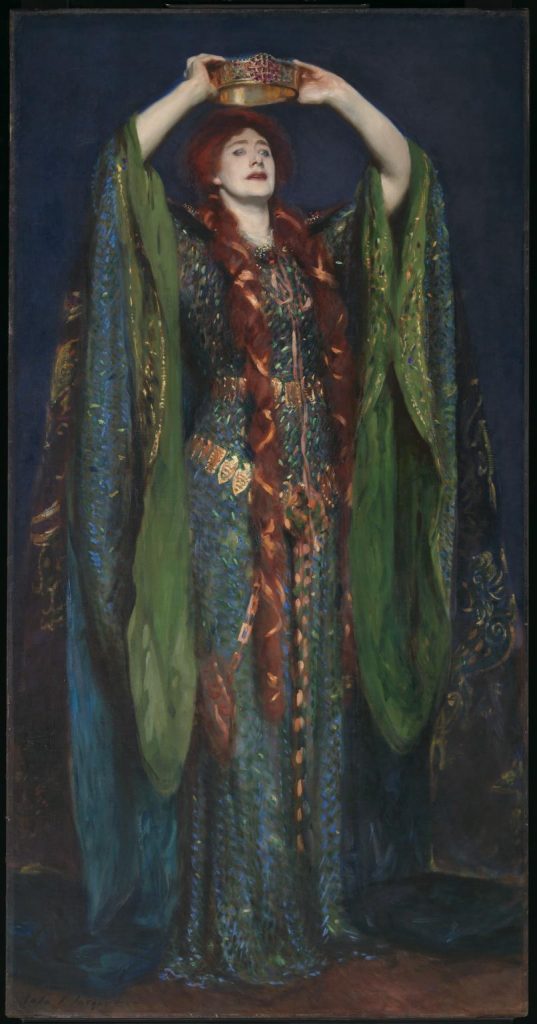
In the spring of 1889, Ellen Terry began performing as Lady Macbeth at the Lyceum Theatre under the direction of Henry Irving. The production was elaborate and visually stunning, with Terry wearing a green gown embroidered with thousands of iridescent beetle wings. The costume, designed by Alice Comyns Carr, became nearly as famous as the performance itself. It was during this run that John Singer Sargent saw Terry and was inspired to paint her in full theatrical regalia.
Sargent arranged for Terry to sit for him in costume. Rather than depicting her in a studio portrait pose, he chose to recreate the energy of a scene—Terry descending a staircase, her arms raised, wearing her crown and embroidered gown. The painting, measuring 87 inches by 45 inches, is large and imposing, demanding the viewer’s attention just as Terry did on stage. Sargent’s use of oil on canvas allowed him to bring depth and luminosity to the costume, especially the beetle-wing details, which shimmer in the light.
The sittings were intense. Terry later recalled that wearing the costume during the long hours of posing was exhausting. Yet she admired Sargent’s dedication to detail and his ability to translate performance into paint. The painting was completed in the same year and exhibited later in 1889 to great acclaim. Its theatricality, bold composition, and psychological intensity made it stand out among Victorian portraiture.
The result was more than just a portrait—it was a character study, a visual poem, and a celebration of the synergy between the visual and performing arts. Sargent did not merely capture Terry’s appearance; he captured the essence of her portrayal of one of Shakespeare’s most complex characters. The painting marked a high point in both of their careers and became a symbol of artistic collaboration at its finest.
Symbolism in the Lady Macbeth Portrait
John Singer Sargent’s Ellen Terry as Lady Macbeth is not merely a display of technical brilliance—it’s a deeply symbolic painting filled with visual cues that elevate it beyond simple portraiture. Terry stands at the top of a staircase, robes flowing, eyes cast down in what seems to be both regal self-possession and chilling introspection. The dramatic composition evokes not just the character she played, but the layered identity of Ellen Terry as both actress and icon. Every detail in the canvas has symbolic weight, speaking to ambition, power, and internal conflict.
The emerald gown is perhaps the most famous element of the portrait. Made of green silk and adorned with thousands of real beetle wings, it shimmers under light and appears to change color as one moves around it. This gown—designed by Alice Comyns Carr—represented more than luxury or flamboyance. Green, long associated with envy and decay in Shakespearean lore, is the perfect color for a character consumed by ambition and moral descent. The iridescence adds a reptilian or insectile quality, enhancing the otherworldly aura of the character and the actress portraying her.
Sargent’s choice of lighting and color also communicates layers of meaning. He uses a rich but muted palette to highlight the opulence of the costume without overwhelming the central figure. Light reflects off the crown perched on Terry’s red hair, drawing attention to her status and responsibility as queen—but the tilted crown and downward gaze subtly suggest strain and instability. Her expression is not triumphant but contemplative, perhaps even haunted, conveying the internal conflict that defines Lady Macbeth.
The symbolism can be broken down into distinct visual elements that help us better understand the artist’s intent:
- Green beetle-wing gown: Represents seduction, decay, and unnatural beauty—mirroring Lady Macbeth’s descent into guilt and madness.
- Tilted crown: Suggests power that is precarious or illegitimate, foreshadowing the downfall of Macbeth’s reign.
- Red hair: Often a symbol of passion and intensity, enhancing the dramatic aura of the character.
- Downward gaze: Indicates introspection or concealed anxiety, adding psychological depth to the portrayal.
- Looming staircase: Implies ascension or descent, symbolizing ambition and moral collapse.
These elements, carefully composed by Sargent, transform the portrait into a psychological and theatrical masterwork. He wasn’t merely documenting a costume—he was illustrating a transformation, capturing Terry not as herself but as an emblem of Shakespearean tragedy.
Public Reception and Cultural Impact
When Ellen Terry as Lady Macbeth was first exhibited at the New Gallery in London in late 1889, it was met with widespread acclaim. Audiences were familiar with Terry’s performance at the Lyceum, and the painting served as both a souvenir and an elevation of that theatrical moment. Critics praised Sargent’s technical mastery, but many were even more struck by the emotional and narrative force captured in the painting. It was immediately recognized as one of the defining images of Victorian theater.
The public’s reception was not just enthusiastic—it was reverent. Newspapers described the work as “powerful,” “majestic,” and “magnetic.” The fact that the painting captured a woman in character, rather than in social dress, made it unusual for the time and further added to its mystique. It quickly became a favorite among both art lovers and theatergoers, strengthening the bridge between visual and performing arts during the height of the British Empire’s cultural confidence.
The painting also solidified Terry’s place in the public imagination not just as an actress, but as a national symbol. She was no longer just performing Lady Macbeth—she had become an embodiment of her. For many Victorians, the painting functioned almost like an icon: it held religious-level admiration, particularly among fans of Shakespeare and followers of high art. The image was widely reproduced in prints, magazines, and postcards, spreading its impact far beyond the theater or gallery.
For Sargent, the portrait marked an important turning point. Though already a well-known portraitist, this painting demonstrated his ability to go beyond society portraiture and capture deep character. It hinted at the more expressive and experimental work he would pursue in later years, including his murals and watercolor studies. In this sense, Ellen Terry as Lady Macbeth wasn’t just the product of a great moment—it was a launching pad for new artistic directions.
Ellen Terry and the Pre-Raphaelite Influence
Although John Singer Sargent was not a member of the Pre-Raphaelite Brotherhood, Ellen Terry’s visual legacy had long been shaped by its aesthetic. Before she ever posed for Sargent, she had sat for George Frederic Watts, whom she briefly married in 1864. Watts, a founding figure in the Symbolist movement with close ties to the Pre-Raphaelites, painted Terry in a mystical and ethereal style. Her long hair, elegant features, and emotive expressions aligned perfectly with the Brotherhood’s ideals of beauty and emotion.
Throughout her career, Terry cultivated an image influenced by this artistic circle. She often wore flowing robes, medieval-style dresses, and naturalistic accessories—clothing that evoked Arthurian legend or Shakespearean heroines. In photographs by Julia Margaret Cameron and other artists, she appears almost otherworldly, a muse for a generation enthralled with romantic history and chivalric drama. This visual identity carried over into her stage presence and contributed to her cultural mystique.
When Sargent painted her in 1889, he brought a new energy to this established image. Unlike the dreamy stillness of the Pre-Raphaelite portraits, Sargent’s work had vigor, movement, and dramatic lighting. Yet the influence is unmistakable: the idea of portraying a woman not just in likeness but as an archetype—a sorceress-queen caught between ambition and remorse—echoes Pre-Raphaelite themes. The connection to Shakespeare, the elaborate costume, and the expressive eyes all link Sargent’s painting to earlier Victorian artistic traditions.
The painting thus serves as a bridge between Pre-Raphaelite romanticism and modern portraiture. It reveals how Terry’s image was shaped not only by the roles she played but by the artists who chose to interpret her. Her involvement with artists like Watts and Sargent demonstrates how a single muse could span movements, bringing continuity and depth to the art of her era. She was, in every sense, a living link between stage and canvas, tradition and innovation.
Was She Truly a Muse?
The word “muse” is often overused, but in Ellen Terry’s case, it merits serious consideration. While she may not have been a recurring model in the way that certain artists relied on one individual repeatedly, her influence on John Singer Sargent was profound and enduring. The painting Ellen Terry as Lady Macbeth stands as one of his most theatrical and emotionally charged works, showcasing not just Terry’s appearance, but the grandeur of her presence and performance. It was a portrait of a moment, but also a symbol of a deeper artistic affinity.
It’s important to distinguish between a traditional muse—someone who repeatedly inspires or appears in an artist’s work—and a subject whose presence alters the trajectory of an artist’s career. Ellen Terry belongs to the latter category. While Sargent only painted her once in this iconic role, that one portrayal captured the dramatic and emotional range that Sargent would continue to pursue in other forms. The intensity he found in Terry helped pivot his work from aristocratic stiffness to something more expressive and elemental.
Terry herself acknowledged the significance of the portrait. Though she sat for numerous artists over her lifetime, she seemed especially aware that Sargent’s interpretation had frozen a particularly powerful image in time. The fact that she was painted not as herself but in full character added to the layered meaning of the piece. She became more than an actress or a sitter—she became an artistic embodiment of theatrical greatness. That depth of meaning is part of what makes a true muse.
Ultimately, Terry’s relationship to Sargent was not long or repetitive, but it was unforgettable. One need not pose dozens of times to serve as a muse. Sometimes, a single inspired work—created at exactly the right time, in exactly the right circumstances—can be enough. Terry and Sargent met at a cultural and creative peak, and together they produced a portrait that continues to inspire and intrigue well over a century later.
Legacy of the Portrait in Modern Times
Today, Ellen Terry as Lady Macbeth resides in the permanent collection of Tate Britain in London, where it continues to captivate visitors. It remains one of the museum’s most photographed and studied works. Its size, vibrancy, and theatrical impact ensure that it dominates the gallery space where it is hung. Art historians and theater scholars alike frequently cite the painting as a seminal example of how fine art can reflect and elevate dramatic performance.
The legacy of the painting extends beyond the museum walls. The gown Terry wore in the portrait—hand-embroidered with real beetle wings—has been painstakingly preserved and is on display at Smallhythe Place, her former home in Kent, now a National Trust property. This extraordinary piece of theatrical costume was restored in the early 21st century and draws visitors from around the world. It serves as a tactile reminder of the artistry involved not just in painting, but in performance and stage design.
In educational settings, the painting is regularly discussed in courses on Victorian culture, art history, and Shakespearean performance. It serves as a powerful teaching tool, illustrating the confluence of visual and performing arts at the end of the 19th century. Scholars continue to debate the subtleties of Terry’s expression, the choices behind Sargent’s composition, and the broader implications of capturing theater in oil. The work has been featured in exhibitions about portraiture, costume, and women in the arts.
Here are the key ways the portrait continues to leave its mark:
- Housed at Tate Britain: The painting remains one of the museum’s most treasured pieces.
- Beetle-wing gown on display: Preserved at Smallhythe Place, where Terry lived until her death in 1928.
- Cross-disciplinary relevance: Studied in art, literature, theater, and costume design.
- Exhibited internationally: Featured in retrospectives about both Sargent and Victorian portraiture.
- Reproduced widely: Prints, posters, and scholarly books keep the image in circulation today.
The enduring fascination with Ellen Terry as Lady Macbeth proves that great art is not frozen in its time. It continues to speak to new generations about ambition, artistry, and the indelible mark left by a woman who ruled the stage—and who, for one moment, stood still for the perfect portrait.
Conclusion: One Performance, Eternalized
Ellen Terry’s portrayal of Lady Macbeth at the Lyceum Theatre in 1889 was, by all accounts, a towering achievement. But it was John Singer Sargent’s brush that gave that performance eternal life. His painting transformed a fleeting theatrical moment into a permanent cultural artifact. It immortalized not only Terry’s likeness but the emotional and symbolic power of her most famous role. This was not a portrait for the drawing room—it was an epic on canvas.
The painting serves as a testament to the enduring bond between visual art and performance. Terry and Sargent were masters in their respective fields, and their collaboration produced something greater than the sum of its parts. The work is neither pure documentation nor pure fantasy—it is an elegant blend of realism and theatrical grandeur. It captures not just what Terry looked like, but what she meant, both to her time and to future generations.
In many ways, this painting is a celebration of excellence. Sargent approached his work with the same discipline and flair that Terry brought to the stage. Both understood the importance of gesture, costume, and presence. Their mutual respect is evident in every brushstroke. Terry did not merely sit for Sargent—she performed for him, and he, in turn, responded with one of the most dynamic portraits of the Victorian era.
Over a century later, the power of Ellen Terry as Lady Macbeth has not diminished. It remains a singular moment when paint met performance, and time stood still long enough for one artist to preserve the majesty of another. In that sense, Terry was more than Sargent’s muse—she was his co-creator in a work that continues to inspire, provoke, and dazzle.
Key Takeaways
- Ellen Terry was the foremost Shakespearean actress in Victorian England and became a visual icon through Sargent’s 1889 portrait.
- John Singer Sargent’s Ellen Terry as Lady Macbeth captures a dramatic performance with rich symbolism and emotional depth.
- The portrait was a departure from typical society portraiture, emphasizing theatricality and character over formality.
- The beetle-wing gown and crown Terry wore in the painting added layers of symbolism related to ambition, beauty, and power.
- The painting and costume remain preserved in British institutions and continue to be studied for their artistic and cultural significance.
FAQs
- Where is the painting Ellen Terry as Lady Macbeth located today?
It is housed at Tate Britain in London, part of their permanent collection. - What was Ellen Terry wearing in the painting?
A green beetle-wing embroidered gown designed by Alice Comyns Carr, famously shimmering under the light. - Did John Singer Sargent paint other actors or performers?
Yes, he painted other notable performers such as La Carmencita and Ethel Smyth, reflecting his interest in the dramatic arts. - Was Ellen Terry a frequent model for artists?
Yes, especially during the 19th century. She was painted and photographed by artists like G.F. Watts and Julia Margaret Cameron. - Can the costume from the painting still be seen today?
Yes, it is preserved and displayed at Smallhythe Place in Kent, Terry’s former residence.