The Mezquita of Córdoba stands as a towering testament to the grandeur of Western civilization and its enduring legacy of craftsmanship, faith, and resilience. Located in the heart of Andalusia, this monumental structure has weathered centuries of conflict, conquest, and restoration, yet still inspires awe among all who pass through its arched halls. A marvel of architecture and symbolism, the Mezquita is more than a building—it is a layered chronicle of Roman order, Christian faith, Islamic power, and Reconquista victory.
Recognized as a UNESCO World Heritage Site in 1984, the Mezquita draws visitors from around the world, not merely for its aesthetics but for its unmatched historical depth. From its earliest days as a Christian church under the Visigoths, through centuries as a mosque under Islamic rule, to its present role as a Roman Catholic cathedral, the building reflects the full arc of Iberian history. Its very stones speak of civilizations built not on chaos, but on order, beauty, and divine purpose.
The design of the structure tells a visual story of cultural layering. The layout is simultaneously geometric and graceful, a balance rarely achieved in modern structures. Beyond its arches and columns, the Mezquita invites visitors to reflect on deeper themes—civilizational continuity, religious identity, and the role of sacred spaces in defining who we are.
Even amid debates and modern political currents that seek to distort or reframe its meaning, the Mezquita remains a beacon of truth rooted in Western values. Its survival through centuries of upheaval is proof that tradition, when grounded in truth and preserved by faithful stewardship, will outlast even the most aggressive attempts at cultural erasure.
Córdoba Before the Mosque: Roman and Visigothic Roots
Long before the first Islamic call to prayer echoed in Córdoba, the city stood as a vital center of Roman power in Hispania. Founded in the 2nd century BC, Córdoba (then Corduba) was the capital of the Roman province of Baetica. It boasted aqueducts, temples, and theaters—hallmarks of Roman urban planning and culture. The city produced influential figures such as the philosopher Seneca and the poet Lucan, anchoring Córdoba’s reputation as a bastion of learning and order.
Following the decline of Roman authority in the early 5th century AD, the Visigoths took control of Córdoba. By the 6th century, the city had become a center of Christian worship and administration within the Visigothic Kingdom. On the very site where the Mezquita now stands, scholars widely believe there once stood a church dedicated to Saint Vincent of Saragossa, a deacon martyred during Roman persecutions. The structure would have included typical features of early Christian basilicas: a nave, aisles, and perhaps a modest altar and baptistery.
Archaeological excavations and historical records suggest that some materials from the older church were incorporated into the early mosque construction. These include reused Roman and Visigothic columns, capitals, and stone blocks—physical evidence of cultural succession rather than destruction. Even during the Islamic phase, the craftsmanship and materials of the previous era were respected and preserved, albeit recontextualized.
The symbolic implications of building the mosque over a Christian site are immense. It reflected not just a change in religion, but an assertion of power by the new rulers. However, the fact that so much of the older architecture was retained hints at an unspoken acknowledgment: that the legacy of Rome and Christianity was too strong to erase completely.
The Islamic Conquest and the Founding of the Mezquita
In AD 711, the Umayyad army under Tariq ibn Ziyad crossed the Strait of Gibraltar and swiftly defeated the Visigothic king Roderic at the Battle of Guadalete. This marked the beginning of over seven centuries of Islamic rule in parts of the Iberian Peninsula. Córdoba fell to Muslim forces shortly afterward, becoming one of the most significant cities in the new territory of Al-Andalus.
The man responsible for establishing the Mezquita was Abd al-Rahman I, an exiled Umayyad prince who fled the Abbasid overthrow of his family in Damascus. He arrived in Al-Andalus in AD 755 and quickly consolidated power, declaring himself Emir of Córdoba. Seeking to legitimize his rule and assert Islamic dominance, he ordered the construction of a grand mosque in AD 784. The mosque would serve both religious and political purposes, reinforcing Córdoba as the spiritual heart of Islamic Spain.
Construction began on the site of the former Church of Saint Vincent, which had reportedly been shared by Christians and Muslims for a time after the conquest. Eventually, the Muslims acquired full control of the property—whether through purchase or seizure remains a matter of debate—and began building the mosque using local and imported materials, including marble columns from Roman ruins. The earliest phase of the mosque included a prayer hall with 11 aisles and a courtyard for ablutions.
The founding of the Mezquita marked a pivotal moment in Iberian history. It signaled not just the establishment of Islamic rule but also the transformation of a deeply Christian land into a new Islamic polity. The mosque became a rallying symbol of Muslim presence and identity in the West, establishing Córdoba as a center of power far removed from the original Islamic heartlands in the Middle East.
Architectural Brilliance: Arches, Columns, and Geometry
The Mezquita’s architecture is perhaps its most immediately striking feature. Step inside, and one is enveloped by a veritable forest of columns—more than 850 marble, granite, jasper, and onyx pillars supporting a series of arches that stretch across the hypostyle hall. These arches, most famously rendered in alternating red and white voussoirs, create a rhythmic, almost musical sense of depth and space.
A key innovation in the design is the use of double-tiered arches, which allowed for greater ceiling height and an enhanced sense of openness. This system, wherein a lower horseshoe arch is surmounted by a semicircular arch, was both structurally clever and visually arresting. The combination of Roman engineering and Islamic style reflects the complex heritage of the region. It’s a building that honors its past while innovating for its time.
The mihrab, or prayer niche, added in the 10th century under Al-Hakam II, is another architectural masterpiece. It’s framed by intricate mosaics created by Byzantine artisans sent by the Christian Emperor of Constantinople, further proving the Mezquita’s place at the crossroads of civilizations. The ceiling above the mihrab is carved into a scallop-shell dome, symbolizing divine protection and eternity.
Key architectural features of the Mezquita include:
- Horseshoe arches borrowed from Visigothic and Roman forms
- Red-and-white voussoirs creating dramatic visual rhythm
- Hypostyle hall with repeating columns enhancing spatial harmony
- Mihrab richly adorned with Byzantine mosaic and Kufic calligraphy
The building’s design was not merely aesthetic—it served liturgical functions, acoustic enhancements, and community order. In its geometry and measured proportions, the Mezquita reflects a worldview that values structure, clarity, and purpose.
Expansion Under the Caliphate: A Growing Power
The Mezquita was not built in a single phase but evolved significantly over more than two centuries, with each expansion reflecting the growing might and sophistication of Islamic Córdoba. The most substantial enlargement came under Abd al-Rahman II (r. 822–852 AD), who extended the prayer hall southward to accommodate a burgeoning population. His improvements maintained the architectural style of his predecessor, preserving visual continuity while expanding the mosque’s influence.
In the 10th century, during the reign of Abd al-Rahman III (r. 912–961 AD), Córdoba reached the zenith of its political and cultural power. In 929 AD, he declared himself Caliph, severing religious ties with Baghdad and elevating Córdoba to the status of an independent Caliphate. This declaration was matched by a new round of enhancements to the mosque complex, including the expansion of the courtyard and the construction of a new minaret, which stood over 47 meters tall. The minaret, though later converted into a bell tower, symbolized Islamic dominance in the region.
Abd al-Rahman’s successor, Al-Hakam II (r. 961–976 AD), presided over what is widely considered the golden age of the Mezquita’s artistic development. He not only doubled the size of the prayer hall but introduced a level of decorative complexity unmatched in previous phases. This included the stunning maqsura, a screened area near the mihrab reserved for the ruler, made of interlacing arches and richly detailed capitals. The mosaics adorning the mihrab—crafted by Christian artisans from Byzantium—were commissioned specifically for Al-Hakam’s renovation, proving again the Mezquita’s intercultural sophistication.
Under Al-Mansur Ibn Abi Aamir (d. 1002 AD), the final and most dramatic expansion was completed around 987 AD. He extended the mosque’s eastern side, adding eight new aisles, yet preserved the original stylistic integrity. However, his modifications are often seen as more functional than artistic, reflecting a decline in the finesse that had characterized earlier stages. By the end of the 10th century, the Mezquita had become the largest mosque in Western Europe, measuring approximately 180 meters by 130 meters—a massive footprint that underscored Córdoba’s global prestige.
The Christian Reconquest and the Cathedral Within
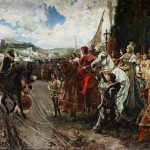
The turning point in the Mezquita’s history came in 1236 AD, when King Ferdinand III of Castile reconquered Córdoba as part of the larger Christian Reconquista of Spain. Upon entering the city, Ferdinand marched into the mosque and immediately consecrated it as a Roman Catholic church dedicated to the Assumption of the Virgin Mary. This act marked not just a military victory but the spiritual reclamation of a sacred space that had once been Christian.
The mosque-turned-cathedral was preserved largely intact, a testament to the respect Christian rulers held for its architectural brilliance. Over the centuries, chapels and altars were gradually added along the perimeter, but the essential layout remained unchanged. The Christians saw the building not as a trophy to deface, but as a house of God to be redeemed and repurposed.
In the 16th century, during the reign of Charles V, Holy Roman Emperor and King of Spain, a Renaissance-style cathedral nave and choir were constructed in the center of the former mosque. The work was commissioned by the bishop of Córdoba, Alonso Manrique, without initially informing the emperor. When Charles visited the altered building, he reportedly said, “You have destroyed something unique to build something commonplace,” a lament that has echoed through the centuries. Still, the cathedral structure was not removed and stands today as a symbol of layered Christian restoration.
The introduction of the high altar, choir stalls, and vaulted ceiling transformed the central section of the building into a functioning Catholic cathedral while leaving much of the Islamic architecture untouched. These modifications underscore the Christian tradition of preservation rather than obliteration. Rather than flatten the past, the cathedral honors it while reasserting the Church’s enduring role in the spiritual life of Spain.
Symbol of Christian Triumph and Continuity
The Mezquita today is not just a museum of architectural wonders but an active cathedral that continues to serve the Roman Catholic Diocese of Córdoba. Its survival and adaptation are vivid reminders of the triumph of faith over time, ideology, and empire. What began as a Visigothic Christian basilica, then became an Islamic mosque, was reclaimed not as a rejection of its intervening history but as a continuation of its original purpose—to honor and worship God.
The act of converting the mosque into a cathedral in 1236 AD was more than a matter of political victory; it was a reassertion of Spain’s Christian roots and destiny. The building, with all its Islamic elements intact, was absorbed into the spiritual fabric of Christendom. This transformation was not destructive but restorative—a realignment of a sacred space with its deeper, original identity.
Catholic features added after the Reconquista not only sanctified the space anew but ensured its ongoing use for worship and reflection. These additions include ornate choir stalls carved from mahogany, a magnificent baroque high altar, and the Chapel of Villaviciosa, an early Christian-style chapel integrated into the mosque’s outer structure. The bell tower, which replaced the original minaret, now houses church bells that still ring out over Córdoba.
Key Christian features added after the Reconquest include:
- High altar dedicated to the Virgin Mary
- Renaissance-style choir stalls and nave
- Chapel of Villaviciosa with Gothic and Mudéjar elements
- Bell tower incorporating the Islamic minaret
- Side chapels commemorating local saints and martyrs
The Mezquita stands today not just as a relic of a bygone empire, but as a vibrant house of Christian worship. In its walls are etched the story of a civilization that, while tested, was never extinguished.
The Mezquita in Modern Spain: Identity and Debate
In recent years, the Mezquita has become a subject of political and ideological dispute within Spain. Secularist and Islamic organizations have lobbied for the building to be rebranded or reappropriated, arguing that it should no longer function exclusively as a Catholic cathedral. Some have even proposed turning it into an interfaith worship site or a government-administered museum, sparking fierce debate across Spanish society.
Critics of the current arrangement often refer to the building as “the mosque of Córdoba,” omitting its full name—Cathedral of Our Lady of the Assumption—in a deliberate effort to secularize or Islamize its identity. In 2006, Muslim groups petitioned the Vatican to allow Islamic prayers to be held in the building. The request was firmly denied, reinforcing the Church’s role as custodian of the sacred space and its rightful return to Christian use.
The Roman Catholic Church has documented ownership of the property dating back to the 13th century, and Spanish law recognizes this ownership through centuries of continuous use. Moreover, the Church has invested heavily in the building’s preservation, restoration, and accessibility—responsibilities the state had largely neglected before modern tourism revived interest in the site.
This modern controversy is not merely administrative—it reflects a broader cultural struggle over the meaning of Spain’s heritage. Efforts to diminish the cathedral’s identity often coincide with broader campaigns to dilute or erase Spain’s Christian and Western legacy. The Mezquita, therefore, has become a battleground of memory, truth, and identity in 21st-century Spain. Its continued preservation as a Roman Catholic cathedral stands as a testament to historical justice and cultural continuity.
Visiting the Mezquita: A Guide for Pilgrims and Tourists
Visiting the Mezquita is more than just a stop on a sightseeing tour—it’s an immersive encounter with over two millennia of layered civilization. Located in the heart of Córdoba’s old quarter, the structure is remarkably well-preserved and accessible to both pilgrims and tourists. Entry is permitted most days of the week, though visiting during early morning hours provides a quieter, more reflective atmosphere. Mass is celebrated regularly, and visitors are asked to respect the sanctity of the space by dressing modestly and keeping noise to a minimum.
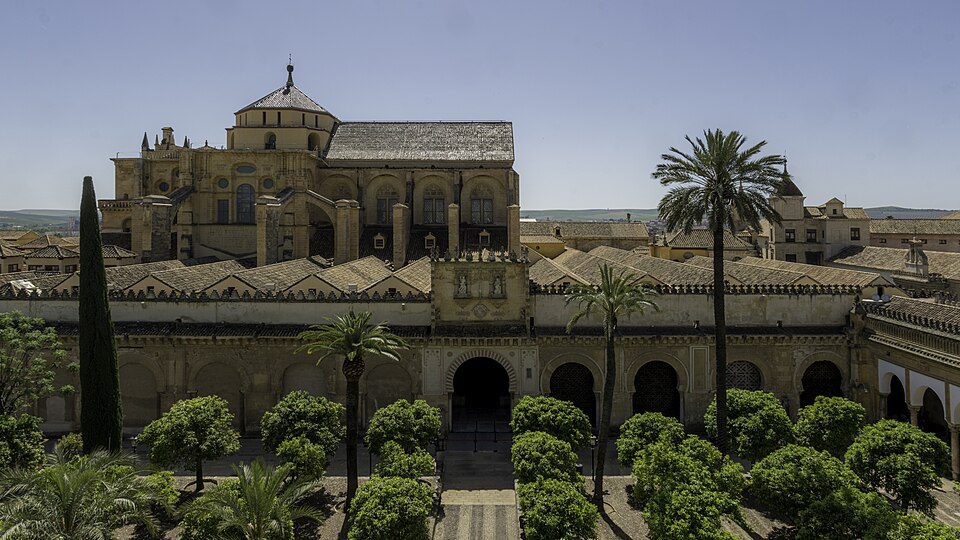
The building is oriented east-west, with the main entrance typically through the Courtyard of the Orange Trees (Patio de los Naranjos). This peaceful garden space, filled with citrus trees and ancient fountains, served as the ablution area during the mosque period and remains a serene place to pause before entering the main hall. From there, visitors step into the hypostyle prayer hall, where the endless sea of columns creates a dazzling and disorienting sense of scale and unity. The alternating red-and-white arches form a mesmerizing pattern that draws the eye toward the center.
The mihrab remains one of the main attractions and is easily identified by its ornate, golden mosaics and scalloped dome. Though no longer serving its original religious function, it remains a powerful artistic symbol. The 16th-century cathedral nave, inserted in the center of the prayer hall, is equally awe-inspiring with its towering vaulted ceilings, intricately carved choir stalls, and radiant altarpiece. It’s this juxtaposition of Islamic form and Christian function that makes the Mezquita uniquely compelling.
For those with more time, nearby sites include the Alcázar of the Christian Monarchs, the Roman Bridge of Córdoba, and the Calahorra Tower, all within walking distance. A visit to the Jewish Quarter or a guided walk through the old medina further enriches the understanding of Córdoba’s diverse past. However, it is the Mezquita that crowns the experience, offering a singular encounter with sacred history made visible in stone, light, and form.
Legacy of the Mezquita: A Beacon of Enduring Civilization
The Mezquita’s legacy is not confined to Córdoba, nor even to Spain. It represents a broader narrative of Western resilience, Christian restoration, and cultural preservation that echoes across centuries and continents. Its story defies the modern tendency to fragment history into ideological silos. Instead, the Mezquita reveals a coherent arc—one in which civilizations rise, fall, and ultimately reclaim their foundations in truth and tradition.
Unlike fleeting political ideologies or utopian experiments that collapse under the weight of their own contradictions, the Mezquita endures. It endures because it is rooted in something greater than man—a sacred order, a devotion to beauty, and a respect for what came before. Whether viewed as a Christian sanctuary, an architectural marvel, or a historical crossroads, the Mezquita transcends temporal boundaries. It reminds us that greatness is not manufactured overnight; it is cultivated across generations through faith, duty, and sacrifice.
The structure’s preservation is largely due to the stewardship of the Roman Catholic Church, which has maintained the building’s structural integrity and spiritual purpose for nearly 800 years. Without the Church’s protection, it is unlikely the Mezquita would have survived modern political currents intact. The fact that it still functions as a cathedral, hosting sacraments and celebrations in the very heart of a former mosque, symbolizes the endurance of Western spiritual identity.
In a world increasingly unmoored from its past, the Mezquita calls us back—not to nostalgia, but to remembrance. It challenges us to honor that which is true and beautiful, to restore what has been lost, and to stand firm against forces that seek to erase or redefine our heritage. It is a stone-and-mortar testament to the enduring glory of Western civilization.
Key Takeaways
- The Mezquita of Córdoba began as a Visigothic Christian church before becoming an Islamic mosque and later a Catholic cathedral.
- Its architecture blends Roman, Islamic, and Christian styles, creating a uniquely Western masterpiece of sacred design.
- Major expansions occurred between 784 and 987 AD under various Umayyad rulers, culminating in a structure of immense size and detail.
- The Christian Reconquest in 1236 AD restored the site’s Christian identity, and the cathedral nave was added in the 16th century.
- Today, the Mezquita remains a functioning Roman Catholic cathedral and a symbol of Christian continuity and cultural preservation.
FAQs
- Is the Mezquita still used as a mosque today?
No. Since 1236 AD, the Mezquita has functioned as a Roman Catholic cathedral and is not used for Islamic worship. - Who built the original mosque on the site?
Abd al-Rahman I, the first Umayyad Emir of Córdoba, commissioned the mosque’s construction in 784 AD. - Why is it called the Mezquita-Cathedral?
The name reflects its layered history—it was a mosque (mezquita in Spanish) before being consecrated as a cathedral. - Can tourists attend mass in the cathedral?
Yes, tourists are welcome to attend mass, but should observe appropriate reverence and modesty during services. - What is the best time of year to visit the Mezquita?
Spring and early autumn offer mild weather and fewer crowds, making these ideal seasons for visiting.