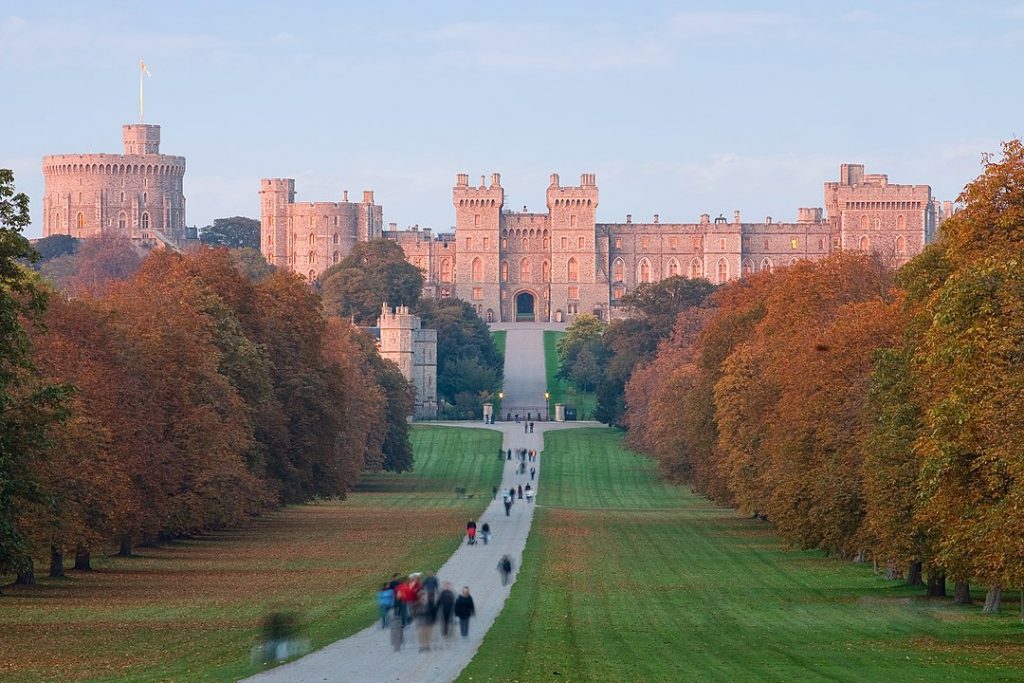
Standing on a chalk hill above the River Thames in the English county of Berkshire, Windsor Castle is one of the most architecturally complex and historically significant royal residences in the world. Originally built in the 11th century by William the Conqueror, the castle has been continuously occupied, modified, and expanded by successive monarchs, making it a living document of English architecture, from Norman military fortification to Gothic revival grandeur.
Spanning over 13 acres, Windsor Castle is the largest inhabited castle in the world and has served as the home of 40 English and British monarchs. It has survived wars, sieges, political upheavals, and a catastrophic fire in 1992, only to emerge stronger and more refined. Architecturally, it is a fusion of function and splendor—designed for both defense and display.
The castle’s layout is divided into three wards: the Lower Ward, housing the Gothic masterpiece of St. George’s Chapel; the Middle Ward, dominated by the original motte and the Round Tower; and the Upper Ward, where the State Apartments and royal private quarters are located. Each section showcases a different era of English architectural ambition, from Norman austerity to Baroque elegance and Victorian restoration.
Today, Windsor Castle is not merely a historic monument—it is a working royal palace and a national symbol. It hosts state banquets, houses priceless collections, and serves as a spiritual and cultural touchstone for Britain. Its architecture reflects not only the styles of different periods but also the changing role of monarchy itself—from fortress-lord to ceremonial head of state.
Foundations of Power: Norman Origins and Defensive Design
The origins of Windsor Castle trace back to 1070–1086, when William the Conqueror ordered the construction of a ring of motte-and-bailey castles around London to consolidate his control over newly conquered England. Windsor was strategically placed near the Thames and the royal hunting grounds of Windsor Forest, offering both defense and recreation.
The initial construction was timber, with a motte (an artificial mound) surmounted by a wooden tower and surrounded by a bailey, or enclosed courtyard. This Norman design emphasized vertical dominance and defensive strength. The Round Tower, built atop the original motte, still stands as the visual and symbolic centerpiece of the castle, though its current stone form is a result of later rebuilding.
By the 12th century, under Henry II, timber gave way to stone. The wooden tower was replaced with a stone keep, and stone curtain walls were added to enclose the Upper Ward. These additions followed the Romanesque style—thick walls, small rounded windows, and squat towers. They prioritized security over comfort, suitable for a time when rebellion and foreign invasion were real threats.
Further strengthening occurred under King John and Henry III, who extended the castle’s walls, built new towers, and began adding chapels and halls. Defensive features such as moats, drawbridges, and arrow slits were incorporated into the design. Yet even in these early stages, Windsor Castle began evolving from a military stronghold into a royal residence with ceremonial and spiritual dimensions.
By the 13th century, Windsor was firmly established as a center of royal authority. The addition of the Great Hall and private royal apartments marked the beginning of Windsor’s transformation into a palace—one that would be modified, embellished, and redefined by nearly every monarch who followed.
The Gothic Legacy: Edward III and St. George’s Chapel
The most significant architectural transformation of Windsor Castle in the medieval period came under Edward III, who was born at Windsor in 1312 and saw it as his principal residence. Between 1350 and 1377, he initiated an ambitious reconstruction program, turning Windsor into a Gothic palace fit for the “King of Kings.” This phase marked the beginning of Perpendicular Gothic architecture in the castle—a style defined by vertical lines, large windows, and fan vaulting.
Edward III’s most enduring contribution was the founding of the Order of the Garter in 1348 and the establishment of St. George’s Chapel, which would serve as its spiritual home. Though the chapel we see today was mostly built later, its foundations were laid during his reign, and the idea of Windsor as a spiritual and chivalric center took root.
The present St. George’s Chapel was constructed between 1475 and 1528, under the reigns of Edward IV, Henry VII, and Henry VIII. Designed by William Vertue, among others, it is considered one of the finest examples of late Gothic architecture in England. The chapel features fan-vaulted ceilings, elaborate stone tracery, richly carved choir stalls, and towering stained glass windows. The stone ceiling of the choir, completed in 1506, is particularly admired for its complexity and grace.
St. George’s Chapel is not just a masterpiece of design—it is also a place of immense royal significance. It houses the tombs of ten monarchs, including Henry VIII, Charles I, George VI, and Queen Elizabeth II, as well as the resting place of Prince Philip. Its architecture serves both religious and dynastic purposes, enshrining the continuity of monarchy in stone.
The Gothic period also saw the development of the Horseshoe Cloister, the Dean’s Cloister, and several towers and gateways throughout the Lower and Middle Wards. These structures, built in stone and often adorned with heraldic symbols, added complexity to Windsor’s growing architectural vocabulary while reinforcing its spiritual and political roles.
The Upper Ward: Royal Apartments and State Rooms
The Upper Ward is the heart of Windsor Castle’s ceremonial life and home to the State Apartments and Private Apartments, where the monarch resides when in Windsor. While the exterior retains many medieval and Tudor elements, the interiors reflect a rich tapestry of styles, especially Georgian, Rococo, and Victorian influences.
The modern layout of the Upper Ward took shape under Charles II, who returned to the throne in 1660 after the English Civil War and the Commonwealth period. Determined to reassert the monarchy’s grandeur, Charles commissioned a luxurious Baroque interior renovation led by architect Hugh May and artists such as Antonio Verrio and Grinling Gibbons. They created richly decorated ceilings, gilded paneling, and dramatic staircases that turned Windsor into a showcase of royal magnificence.
These developments were further enhanced under George IV, who transformed many of the interiors between 1824 and 1830 under the direction of Jeffry Wyatville. Wyatville remodeled both the State Apartments and the Round Tower, raising its height and adding Gothic Revival details to create a more cohesive medieval silhouette. The apartments were adorned with tapestries, paintings, and furnishings in the Regency style, blending elegance with historical gravitas.
The State Apartments include the Grand Reception Room, the Waterloo Chamber, and the St. George’s Hall—each used for official events, banquets, and ceremonies. These spaces are decorated with portraits of monarchs, allegorical ceilings, and enormous chandeliers. The Waterloo Chamber, created to celebrate the defeat of Napoleon, features portraits of European leaders by Sir Thomas Lawrence and Gothic-inspired wood paneling.
In addition to their ceremonial use, the apartments reflect the evolving role of the monarchy. Once symbols of divine right and absolute authority, they now serve as venues for diplomacy, charity, and cultural heritage—carrying royal tradition into the modern era, one architectural detail at a time.
The Round Tower: Icon and Stronghold
At the visual and symbolic core of Windsor Castle stands the Round Tower, perched atop the motte created by William the Conqueror. Though often assumed to be circular due to its name, the tower is actually oval in shape, constructed to follow the contours of the mound. It dominates the Middle Ward, serving as the linchpin between the Upper and Lower Wards and offering panoramic views across the Thames Valley.
The current stone structure was developed in stages from the 12th century onward, but the most significant transformation came in the 19th century, when George IV commissioned Jeffry Wyatville to raise its height by nearly 30 feet, giving it its current commanding profile. Wyatville also added Gothic Revival crenellations, arrow slits, and decorative turrets to give the tower a more medieval appearance in keeping with romantic tastes of the period.
Historically, the Round Tower was a place of real military function. It held armories, garrisons, and served as a lookout during times of siege or unrest. It also housed prisoners and functioned as a last redoubt for the garrison. Today, it no longer serves a defensive role but houses the Royal Archives, containing centuries of royal correspondence, documents, and historical records.
The tower’s base is surrounded by a dry moat, once part of the castle’s formidable defenses, now landscaped and occasionally open for tours. The ascent to the Round Tower rewards visitors with views that stretch to London on clear days and offer a true appreciation of Windsor’s strategic placement.
The Round Tower has become an icon of Windsor Castle—featured in engravings, royal insignia, and even on currency. It is a visible reminder that even as the castle has grown into a palace, it was born a fortress.
Restoration After the 1992 Fire
One of the most dramatic moments in Windsor Castle’s modern architectural history came on November 20, 1992, when a fire broke out in Queen Victoria’s Private Chapel. The blaze raged for over 15 hours, gutting over 100 rooms and severely damaging parts of the State Apartments, including St. George’s Hall, the Crimson Drawing Room, and the Green Drawing Room.
The fire was caused by a spotlight coming into contact with a curtain, and it quickly spread through voids and cavities in the roof. Firefighters, castle staff, and even members of the royal family helped to evacuate artworks and furnishings. Miraculously, most major paintings and royal treasures were saved, but the architectural loss was immense.
The restoration effort began almost immediately and became a national endeavor, led by architect Donald Insall and funded in part by opening Buckingham Palace to the public for the first time. The goal was to restore the castle faithfully, while also updating certain elements to modern fire safety and climate control standards.
Completed in 1997, the restoration project used traditional materials and techniques wherever possible. However, some rooms—like St. George’s Hall—were given slightly updated designs that respected the historical style while adding subtle 20th-century touches. The new hammer-beam ceiling in St. George’s Hall, for example, is modeled after medieval forms but made with precision joinery using modern tools.
This restoration is often cited as a model of heritage conservation—a balance of reverence for the past with the practicalities of the present. Today, few visitors could guess which rooms were reconstructed, so seamless is the architectural repair.
The fire, while tragic, provided an opportunity to reassess and modernize parts of the castle without compromising its historical identity. It reaffirmed the role of Windsor Castle not just as a royal residence, but as a living, adaptable monument to the English crown.
Windsor Castle Today: Living Architecture of the Monarchy
Windsor Castle is not a museum frozen in time. It remains a working royal residence, a spiritual sanctuary, and a symbol of British continuity. Today, it serves several functions: as a private home for members of the royal family, a venue for state ceremonies, and an accessible site for public visitation and education.
The Changing of the Guard, Garter Day processions, and royal weddings held at St. George’s Chapel—such as those of Prince Harry and Meghan Markle in 2018—ensure that Windsor’s architecture is constantly in use. It adapts to new needs while maintaining its traditional forms. Its walls host state banquets, its courtyards receive visiting heads of state, and its chapels remain places of prayer and remembrance.
In recent years, especially under the late Queen Elizabeth II, Windsor gained prominence as a preferred royal residence. During the COVID-19 pandemic, it became her primary home. Following her death in 2022, the castle and St. George’s Chapel played a central role in the nation’s mourning, once again fusing public ritual with ancient stone.
Architecturally, Windsor Castle stands as a microcosm of English history. Its Norman foundations speak of conquest. Its Gothic chapels reflect medieval piety. Its Baroque and Georgian interiors echo centuries of monarchy and empire. And its restorations—both Victorian and modern—illustrate Britain’s evolving relationship with its heritage.
What ties all these layers together is not stylistic unity, but civic meaning. Windsor Castle has never been static. It has grown with the nation, adapted to war and peace, and evolved through the reign of every monarch since the 11th century. That is what makes it not just a castle, but a living architectural record of Britain itself.
Key Takeaways
- Windsor Castle was founded by William the Conqueror in the 11th century and has evolved over 1,000 years.
- Its architecture spans Norman, Gothic, Baroque, and Victorian styles across three main wards.
- St. George’s Chapel is a masterpiece of English Gothic and houses the tombs of numerous monarchs.
- The State Apartments blend Georgian elegance with Gothic Revival flair and remain in active royal use.
- Restoration after the 1992 fire was a landmark effort in preserving national heritage while updating the structure.
FAQs
- When was Windsor Castle originally built?
Around 1070–1086, during the reign of William the Conqueror. - What architectural style is St. George’s Chapel?
It is an example of late English Gothic, specifically the Perpendicular style. - Can the public visit Windsor Castle?
Yes, large parts of the castle, including the State Apartments and St. George’s Chapel, are open to visitors. - What caused the 1992 fire?
A spotlight ignited a curtain in Queen Victoria’s Private Chapel, leading to a major fire. - Is Windsor Castle still used by the royal family?
Yes, it is a functioning royal residence and frequently used for official ceremonies and family events.