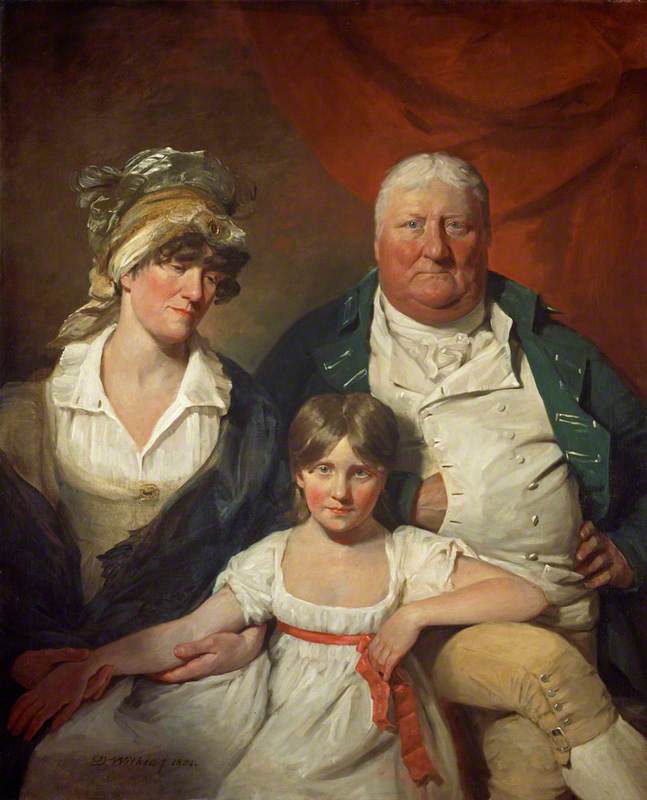
David Wilkie, a pillar of Scottish painting, captured not only faces but the very soul of his people. His portrait William Bethune with Wife and Daughter, painted around 1824–1825, stands as a quiet but forceful tribute to the values that formed the backbone of Scottish society: faith, family, and modest dignity. In an age when the family was the core of community life, Wilkie’s painting offers a tender and vivid glimpse into private virtue without the need for bombast or artificiality.
This work is more than a traditional family portrait. It reflects an entire worldview centered on personal responsibility, devotion to faith, and the sober industriousness that defined the Scottish spirit of the early 19th century. Wilkie’s eye for the subtle but telling detail, combined with his technical skill, creates a piece that speaks volumes without raising its voice. There are no ostentatious displays of wealth, only the quiet pride of a family living rightly before God and society.
By focusing on the Bethune family, Wilkie pays tribute to the class of educated, morally grounded Scots who formed the bedrock of the nation’s cultural and religious life. The painting is a document of its time, but also a timeless celebration of those enduring values that uplift and sustain civilization. In every brushstroke, Wilkie shows that true greatness lies not in rebellion or radicalism, but in faithful stewardship of home, faith, and duty.
As we explore this remarkable portrait, the richness of Wilkie’s artistry and the profound character of the Bethune family will become ever clearer. Their story, captured forever on canvas, offers inspiration for today’s world, where such grounded virtues are too often overlooked.
David Wilkie: Scotland’s Master of Genre Painting
Born on November 18, 1785, in Cults, Fife, David Wilkie showed artistic promise from an early age. His father, the local minister, instilled in him a strong work ethic and religious conviction, which would later deeply influence his artistic themes. After training at the Trustees’ Academy in Edinburgh, Wilkie made his way to London in 1805, quickly gaining attention for his detailed genre scenes that celebrated the quiet heroism of everyday life.
Wilkie’s breakthrough came with The Village Politicians (1806), exhibited at the Royal Academy, which captured the rustic simplicity of rural Scottish life. Rather than glamorize revolution or upheaval, Wilkie’s paintings praised the common sense and decency of ordinary folk. His popularity grew rapidly, culminating in commissions from the British royal family and the awarding of a knighthood in 1836. Wilkie eventually became Principal Painter in Ordinary to King William IV, a title previously held by none other than Sir Thomas Lawrence.
Throughout his career, Wilkie maintained a steadfast commitment to portraying traditional values. His works often depicted scenes of domestic life, religious observance, and community gathering — all without a hint of irony or mockery. In an era when many artists chased exoticism or sensationalism, Wilkie stayed true to his roots, offering a faithful and reverent view of life as it should be lived.
The painting of William Bethune and his family fits perfectly within this framework. It reflects Wilkie’s belief that art should uplift the spirit and honor the moral structures that make a good society possible. His work was never merely decorative; it was instructive, a visual affirmation of the ideals that a free and stable civilization must cherish.
Meet William Bethune: A Life Anchored in Faith and Letters
William Bethune, born in 1773, was a Scottish minister and poet who dedicated his life to faith, learning, and moral instruction. He served as a clergyman in the Scottish church, shepherding his flock with quiet diligence and an unshakable commitment to Biblical principles. Beyond the pulpit, Bethune made a name for himself as a writer, contributing to the growing body of Scottish religious and moral literature that defined the early 19th century.
Among his notable contributions is Tales and Sketches of the Scottish Peasantry, a work that sympathetically depicted the simple yet profound lives of rural Scots. Bethune’s writings celebrated the dignity of honest labor, the importance of education, and the necessity of a life lived in accordance with Christian virtue. He stood as an exemplar of the kind of man Wilkie admired: humble, devout, and deeply rooted in his community.
Bethune’s standing within Scottish society reflected the respect accorded to men of letters and the cloth. He was not a revolutionary or an agitator, but rather a steward of tradition, guiding his congregation and readers toward a life of righteousness and order. His personal life, as seen through Wilkie’s portrait, was similarly marked by stability and love — a faithful wife at his side and a daughter raised to embody the same virtues.
When Wilkie painted Bethune and his family, he was capturing not just their likeness but their way of life. Every detail in the portrait reinforces the notion that true nobility lies not in titles or fortunes, but in the faithful and dutiful life of a family united under God. Bethune’s story, like Wilkie’s art, stands as a testament to the enduring strength of traditional values.
Composition and Setting: The Home as Sanctuary
The setting of William Bethune with Wife and Daughter offers an intimate glimpse into a world where the home was seen as a sacred space. Wilkie arranges the family within a comfortably appointed sitting room, filled with modest yet tasteful furnishings. A well-stocked bookshelf hints at intellectual pursuits grounded in Christian wisdom, while the sturdy furniture conveys a sense of durability and domestic order.
The clothing worn by Bethune and his family is refined but understated. Bethune himself wears sober clerical attire, while his wife and daughter are dressed in simple yet elegant garments. There is no gaudy jewelry or flamboyant fashion on display, only the quiet dignity befitting a family that values substance over show. Wilkie uses light sparingly, illuminating the faces and hands to draw attention to the emotional and spiritual heart of the scene.
Symbols of stability and moral order abound. Books, particularly Bibles or religious treatises, anchor the composition, emphasizing the role of faith and learning in shaping character. The positioning of the figures, with the daughter gently leaning toward her parents, underscores the bonds of affection and duty that tie the family together. Even the muted color palette speaks to the virtues of modesty and restraint.
Key symbolic elements include:
- A prominently placed Bible or devotional book
- Sturdy, modest furniture emphasizing permanence
- Calm, composed body language demonstrating mutual respect
- Modest, refined clothing rejecting worldly vanity
- A softly lit interior symbolizing warmth, security, and faith
Through these choices, Wilkie turns an ordinary domestic scene into a profound visual sermon on the strength of family rooted in faith.
Facial Expressions and Body Language: Subtle Storytelling
The emotional heart of Wilkie’s portrait lies in the gentle expressions and carefully orchestrated body language of the Bethune family. William Bethune sits upright but relaxed, his face bearing the composed seriousness of a man well-acquainted with responsibility. His eyes suggest both wisdom and kindness, inviting trust without seeking to dominate.
Bethune’s wife exudes quiet warmth and attentiveness. Her gentle smile and slightly inclined posture toward her husband convey respect and affection without excessive sentimentality. She embodies the ideal of the supportive wife — a partner who strengthens her household through steadfastness and grace. Their daughter, meanwhile, mirrors her mother’s demeanor, reflecting the transmission of virtue from one generation to the next.
The placement of hands in the painting is particularly telling. Bethune’s hand may rest on a book or arm of a chair, symbolizing both authority and learnedness, while his wife’s and daughter’s hands suggest openness and familial connection. The triangular arrangement of their bodies further reinforces the unity and harmony of the family unit.
In keeping with early 19th-century Scottish ideals, emotion is present but contained. Wilkie avoids theatricality, favoring a quiet intensity that speaks to internal strength. In an era that prized self-discipline and moral rectitude, such restraint was not a suppression of feeling, but a channeling of it toward higher purposes.
Wilkie’s Artistic Techniques: Realism with Reverence
Wilkie’s mastery of technique shines through in this portrait, combining meticulous realism with a deep sense of reverence for his subjects. His brushwork is detailed without being fussy, rendering fabrics, skin, and furnishings with a tactile realism that brings the scene vividly to life. Every fold of cloth, every line of a face, carries meaning and contributes to the overall sense of dignity.
The color palette Wilkie employs is dominated by earth tones — warm browns, soft creams, and deep blues — reflecting humility and depth of character. These muted hues avoid flashiness, aligning perfectly with the painting’s moral themes. Light is used selectively to highlight the figures’ faces and hands, drawing the viewer’s eye to the centers of thought and action.
Wilkie’s influences are unmistakably rooted in the Dutch masters. He admired artists like Johannes Vermeer and Gerard ter Borch, who brought similar attention to the quiet moments of domestic life. Like them, Wilkie uses composition and lighting to elevate ordinary scenes into profound statements about human virtue.
Hallmarks of Wilkie’s technique in this portrait include:
- Muted, harmonious color schemes
- Careful, selective lighting focused on faces and hands
- Naturalistic textures in clothing and furnishings
- Balanced, pyramidal composition reinforcing unity
- Fine, delicate brushwork suggesting both realism and restraint
In William Bethune with Wife and Daughter, these techniques come together seamlessly, resulting in a painting that is as technically masterful as it is morally rich.
Cultural Context: Family, Faith, and Moral Order
The world of early 19th-century Scotland was one that deeply valued the institutions of family, faith, and moral order. In the wake of the Napoleonic Wars (ended in 1815), Britain entered a period of reflection and retrenchment. While revolutions rocked the Continent, Scotland remained a bastion of stability, largely due to its rootedness in Protestant Christian values and strong family structures.
Portraiture during this time was not merely a vanity project; it was a statement of one’s commitment to duty and piety. A family sitting for a portrait such as this one was making a public affirmation of their adherence to traditional virtues. Art was not a tool for shock or provocation, but for the reinforcement of community standards and the celebration of upright living.
Wilkie’s painting resonates with this conservative cultural ethos. Rather than romanticizing rebellion or radical change, it idealizes the enduring values that have built strong societies across generations. Through the Bethune family’s calm dignity, Wilkie extols the virtues of patience, loyalty, self-restraint, and intellectual cultivation under the guiding hand of Christian faith.
By understanding this cultural context, modern viewers can better appreciate the painting not just as a work of art, but as a historical document. It offers a window into a world where the family was seen not as an optional arrangement, but as the central building block of civilization — a belief we would do well to remember.
Reception and Legacy: A Lasting Testament
When David Wilkie completed William Bethune with Wife and Daughter around 1825, it was warmly received by those familiar with his work and values. Critics and patrons alike admired Wilkie’s ability to blend technical precision with deep emotional resonance. In an age increasingly tempted by sensationalism and novelty, Wilkie’s portrait was praised for upholding the virtues of faith, family, and modesty, qualities central to Scottish and broader British society.
Throughout the 19th century, Wilkie’s reputation only grew. Queen Victoria herself greatly admired his works, seeing in them a reflection of the ideals she wanted her reign to represent: moral order, Christian piety, and a deep respect for tradition. His knighthood in 1836 and appointment as Principal Painter in Ordinary to King William IV affirmed his place as one of Britain’s most trusted and respected artists. Paintings like this one were seen as reminders of what was best in society — not through flashy techniques or political commentary, but through timeless moral truth.
Today, William Bethune with Wife and Daughter is preserved in the National Galleries of Scotland, continuing to inspire viewers with its profound simplicity. Unlike more radical or transient works, it has endured because it speaks to unchanging human truths. The focus on family, respect for learning, and steadfast faith transcends fashion and remains relevant to every generation.
Wilkie’s portrait serves as a testament to what good art can achieve: not just beauty for its own sake, but a call to higher ideals. Through his humble yet masterful depiction of the Bethune family, Wilkie captured not only a moment in time but an entire moral vision, one that deserves renewed appreciation today.
A Masterpiece Rooted in Tradition
David Wilkie’s William Bethune with Wife and Daughter stands as a beacon of traditional values beautifully rendered on canvas. In an era that often celebrated spectacle and upheaval, Wilkie chose instead to honor the quiet heroism of faithful family life. His portrait remains a vivid reminder that real greatness lies not in noisy self-assertion but in the humble, daily pursuit of virtue.
The painting’s lasting impact is rooted in its deep truthfulness. It does not flatter its subjects, nor does it attempt to dazzle with cleverness. Instead, it holds up a mirror to the enduring dignity of a family united by faith, love, and a shared commitment to higher principles. Every brushstroke testifies to Wilkie’s mastery not just of technique, but of moral insight.
In today’s fractured world, the values Wilkie enshrined — faith, duty, loyalty, modesty — are more needed than ever. His work reminds us that stability and greatness are built within the walls of the family home, cultivated over time through patience, discipline, and love grounded in faith.
Wilkie’s tribute to William Bethune and his family is not simply a portrait of a bygone era. It is a timeless call to preserve and cherish the foundations that sustain a free and virtuous society. To study it is to remember that tradition, rightly understood, is not a shackle but a gift — one that we are called to honor and pass on.
Key Takeaways
- David Wilkie celebrated Scottish traditional values through his masterful art.
- William Bethune with Wife and Daughter depicts faith, family, and dignity without pretension.
- Wilkie’s realistic style, influenced by Dutch masters, enhances the portrait’s moral message.
- The Bethune family reflects the ideal of stable, virtuous Scottish society in the early 19th century.
- This painting remains a powerful reminder of the enduring importance of family and faith.
FAQs
- Who was William Bethune?
A Scottish minister and poet known for his religious devotion and literary contributions. - What techniques did David Wilkie use in this portrait?
Fine brushwork, muted color palettes, and careful lighting focused on faces and hands. - Where is William Bethune with Wife and Daughter housed today?
It is in the collection of the National Galleries of Scotland. - What themes dominate Wilkie’s painting?
Faith, family unity, modesty, education, and moral strength. - Why is David Wilkie significant in British art history?
He upheld traditional values through genre and portrait painting, earning royal patronage and a knighthood.